This is an Open Access article distributed under the terms of Copyright: © 2020 Korean Journal of Agrcultural Science
FOOD & CHEMISTRY
Development of diagnostic method for human Astrovirus with rapid, specific and high sensitivity using loop-mediated isothermal amplification method
Jin-Young Lee, Jae Young Rho
*Department of Microbiology, College of Natural Sciences, Dankook University, Cheonan 31116, Korea
*
Corresponding author: [email protected]
Abstract
Human Astrovirus (HuAstV), known as a waterborne virus, is a group IV positive-sense single- stranded RNA that belongs to Astroviridae. The first outbreak of HuAstV was reported in England in 1975. HuAstV can exist not only among clinical patients but also in various water environments, such as water for agriculture and vegetables. For diagnosis of HuAstV from water samples, a polymerase chain reaction (PCR) system has been developed. However, the PCR-based diagnostic method has problems in field application, such as reaction time, sensitivity and specificity. For this reason, in this study we developed the loop-mediated isothermal amplification assay (LAMP) system, aimed specifically at HuAstV. Three prepared LAMP primer sets were tested by specificity, non-specificity and sensitivity; one LAMP primer set was selected with optimum reaction temperature. The developed LAMP primer set reaction conditions were confirmed at 62℃, and detection sensitivity was 1 fg/µL. In addition, restriction enzyme HaeIII (GG/CC) was introduced to confirm that the LAMP reaction was positive. As a result, selected LAMP primer set was 100 - 1000 times more specific, rapid, and sensitive than conventional-nested PCR methods. For verification of the developed LAMP assay, twenty samples of cDNA from groundwater samples were tested. We expect that the developed LAMP assay will be used to diagnose HuAstV from various samples.
Keywords: human Astrovirus (HuAstV), loop-mediated isothermal amplification (LAMP), water sample
Introduction
Human Astrovirus (HuAstV) 는 group IV (+) ssRNA, Astroviridae로 분류되는 인체 병원 성 장바이러스로 감염 시 구토, 복통, 설사, 발열 등의 증상이 나타난다(Thongprachum et
al., 2015; Cortez et al., 2017). HuAstV 는 1975년 영국에서 장염증상을 가지고 있는 환자의 OPEN ACCESS
Accepted: February 25, 2020 Revised: February 21, 2020 Received: January 08, 2020 Citation: Lee JY, Rho JY . 2020.
Development of diagnostic method for human Astrovirus with rapid, specific and high sensitivity using loop-mediated isothermal amplification method.
Korean Journal of Agricultural Science 47:173-182. https://doi.org/10.7744/
kjoas.20200009
Jiang et al., 2013), 주로 2살 이하의 영유아에게 감염되는 것으로 알려져 있어 감염 시 위험 가능성이 높을 수 있다(Brown et al., 2008). 국내에서는 HuAstV의 감염은 2003년에 최초 보고되었으며, 2013년부터 2017년까지 전체 장염 환자 중 HuAstV가 1.0 - 1.9%로 보고되는 등 국내에서도 HuAstV가 보고되고 있다(Hwang and Lee, 2014; Ham et al., 2014; Kim et al., 2019). 한편, 장바이러스의 감염경로는 구강-분변 경로로 환자로부터 수계환 경 등에서도 감염이 가능하다. HuAstV도 수인성바이러스로, 방류수 등을 통해 지하수 등 자연 수계에 존재 가 능성이 높다(Fong and Lipp, 2005). 농업용수는 주로 지하수를 사용하며, 지하수에서 노로바이러스 등 수인성 바이러스의 오염 문제가 국내외 사회적으로 문제가 됨에 따라 음용 및 비 음용 지하수에서도 관련 항목에 대 한 모니터링 필요성이 제기되었다(Kang et al., 2016). 지하수에서 HuAstV를 모니터링 하는 방법은 주로 특정 핵산 단편을 증폭하는 polymerase chain reaction (PCR)이 주로 사용되고 있으나(Tang et al., 2005; Finkbeiner et al., 2009), 지하수에서 병원성 바이러스 핵산을 검출하기 위해서는 증폭한 산물로 다시 한 번 증폭하는 nested PCR 수준의 검출민감도가 필요하며, 핵산 추출 이 후 바이러스 검사에 약 10시간 수준의 반응이 필요하다는 단점이 있다(Lee et al., 2019). 반면 등온증폭법(LAMP, loop-mediated isothermal amplification)은 nested PCR과 동등한 검출 민감도를 가지고 약 1 - 3시간 반응으로 신속한 모니터링이 가능하다는 장점을 가지고 있어 지하 수에서 Aichivirus A 등 수인성바이러스 모니터링 방법으로 개발되고 있다(Lee et al., 2019). 또한 Suleman et
al. (2016) 에 의하면 LAMP 기법은 모니터링 기술로는 뛰어나지만 위양성(false positive) 등이 나타날 수도 있 어 양성을 확정하기 위한 판정에 단점을 가지고 있다. 이것을 보완하기 위해 제한 효소를 활용하여 양성 시료 에 대한 검증 시스템 장착으로 기술의 단점을 보완할 수 있다(Lee et al., 2019). 따라서 이번 연구에서는 LAMP 기법을 활용하여 농업용수 등 지하수에서 신속한 HuAstV 모니터링을 할 수 있는 방법 및 제한 효소를 활용하 여 양성시료(positive samples)를 검증할 수 있는 방법을 개발하였다.
Materials and Methods
Primer설계 및 재료수집
HuAstV 특이적 LAMP primer 설계를 위하여, HuAst를 포함한 수인성 바이러스 13종의 염기서열을 National Center for Biotechnology Information (NCBI) 에서 수집하였다. 수집한 염기서열은 primerExplorer (http://
primerexplorer.jp/e/index.html)를 사용하여 HuAstV 특이적인 LAMP primer를 설계하였다(Table 1). Primer 설계
후, 종 특이적 반응을 확인하기 위해 HuAstV의 ORF1b/ORF2 유전자 염기서열 (JN_887820; 4,047 - 5,789 nt)
을 대상으로 Macrogen (Seoul, Korea)에 의뢰하여 유전자 합성을 수행하였다. 합성한 유전자는 1 ng/µL로 조
절하여 사용하였다. 설계한 primer의 비특이적 반응을 확인하기 위해, 참고바이러스 12종 (enteric Adenovirus
41, Aichivirus A, Echovirus 5, Enterovirus 68, Enterovirus 71, Hepatitis A virus, Hepatitis E virus, Norovirus GII,
Parechovirus A, Poliovirus, Rotavirus A, Sapovirus) 의 핵산 또는 플라스미드를 수집하였다. 또한 HuAstV 진단
시스템의 검증을 위하여, 바이러스가 미량 또는 극미량 감염이 예상되는 지하수 환경 시료의 총 핵산(RNA)을
수집하였다(NIER, 2017). 수집한 핵산은 cDNA로 합성하였다.
LAMP primer 선발
HuAstV 특이적인 LAMP primer 선발을 위하여, 기존에 보고된 조성과 방법으로 LAMP 반응을 수행하였 다(Lee et al., 2019). 합성한 HuAstV plasmid를 주형으로 LAMP 반응을 형성하는 조합을 1차로 선발하였고, 1 차 선발된 primer 조합들을 대상 바이러스 및 참고바이러스 10종들과 반응하여 대상 바이러스 외에 비 특 이 반응을 보이는 primer 조합을 제외하는 2차 선발을 진행하였다. 2차 선발된 primer 조합들을 대상으로 검 출한계(detection limit) 실험을 수행하여 반응 강도가 가장 높은 primer 조합을 최종 선발하였다. Bacillus stearothermophilus (Bst.) polymerase의 경우, 80℃이상의 온도에서는 불활성이 나타나므로, Bst. polymerase를 첨가하지 않은 반응액을 95℃에서 10분간 반응시켜 해리 후 따로 첨가하였다. 다음 LAMP 반응을 1시간동안 진행시켰다. LAMP 반응이 끝난 후 증폭 산물은 1.2% agarose gel을 이용한 전기영동 (150 V, 25분)간 진행시킨 뒤, UV illuminator (Seoulin Bioscience Inc., Seoul, Korea)를 통해 관찰하였다.
양성반응의 검증 시스템
LAMP 반응을 검증하기 위하여 LAMP outer primer (F3, B3)을 이용한 PCR 산물의 제한효소 처리를 수행하 였다(Table 1). PCR 조성은 20 µL를 기준으로, Hotstart RT-PCR premix (Bioneer, Daejeon, Korea)를 사용하였으 며, cDNA template (HuAstV plasmid) 1 µL, F3, B3 primer 1 µL (10 pmole), 멸균증류수 17 µL로 반응하였다. 온 도 조건은 94℃ 5분 초기 변성 후 35반복으로 94℃ 30초, 58℃ 30초, 72℃ 45초 증폭 후 최종적으로 72℃에서 3 분간 반응하였다. PCR 산물은 전기영동을 통해 확인하였고, 제한효소 HaeIII (GG/CC) (10 units)를 37℃에 서 2시간 동안 PCR 산물과 반응하였다. 1.2% agarose gel을 이용한 전기영동 (150 V, 25 분)간 진행시킨 뒤, UV
illuminator 를 통해 제한효소 절편을 을 확인하였다.
지하수 시료 실증실험
개발한 검사법을 시료에서 검증하기 위해 수도꼭지가 있는 지하수 시료 20점을 무작위로 채취하였다. 시료 채취, 탈리 및 농축, 핵산 추출은 국립환경과학원에 기재된 노로바이러스 시료 채취방법을 기준으로 하였으 며, 나노세람 필터가 연결된 하우징에 500 L의 지하수를 흘려 실험실로 이동하였다. 소고기 추출(beef extract) 완충액을 사용하여 탈리 및 원심분리 방법으로 농축하였으며 최종 0.22 µM 필터에 여과하였다. 바이러스 핵산 추출 및 cDNA 합성은 viral RNA mini kits (QIAGEN, Hilden, Germany) 및 ReverTraAce-α-
®(TOYOBO, Oasaka, Japan)을 사용하여 제공된 프로토콜에 따라 수행하였다.
검출민감도 비교실험
선발된 LAMP primer와 비교실험을 위해, 설계된 outer primer에서 conventional PCR과 nested PCR이 가능한
조합을 설계하였다(Table 2). 설계된 3개의 조합들을 대상으로 검출민감도 한계 실험을 수행하여 반응 강도를
선발된 LAMP primer의 검출민감도 한계와 비교하였다. PCR 반응은 조성은 20 µL를 기준으로, Hotstart RT-
PCR premix 를 사용하였으며, cDNA template (HuAstV plasmid) 1 µL, F3, B3 primer 1 µL (10 pmole), 멸균증류
Results and Discussion
HuAstV 특이적 primer 선발
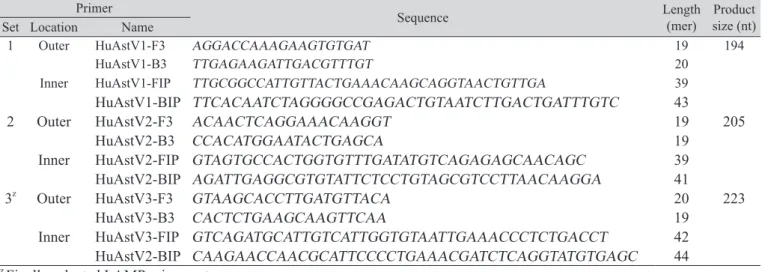
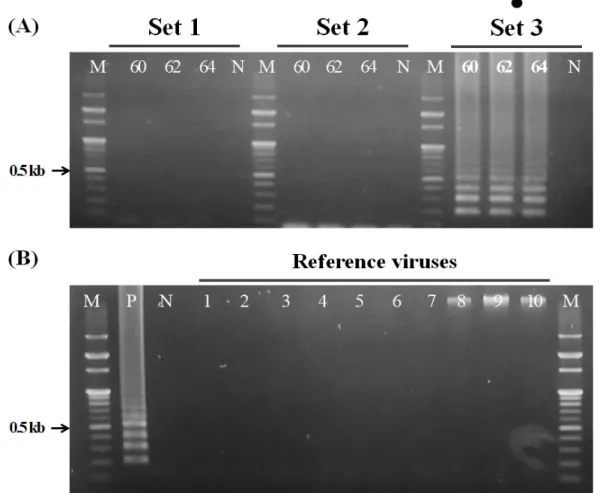
HuAstV 특이적 primer 12개(F3, B3, FIP, BIP primer 각각 3개씩)가 설계되었으며, 194 - 223 nt 증폭이 가능 한 3개 조합을 구성하였다(Table 1). 이 3개의 조합을 이용하여 HuAstV 특이적 LAMP 반응을 수행한 결과 조 합1과 조합2에서는 LAMP 반응이 확인되지 않고, 조합 3에서만 LAMP 양성 반응이 확인되었으며, 최적 반응 온도는 62℃로 확인되었다(Fig. 1A). HuAstV에 특이적 밴드를 형성한 1개의 LAMP primer 조합을 대상으로
HuAstV와 참고 수인성 바이러스 10종의 비특이적 분석을 수행한 결과, 양성대조구로 사용한 HuAstV plasmid 를 제외하고 음성대조군을 포함하여 참고바이러스 10종 모두 반응이 나오지 않아 조합3이 HuAstV 특이적 인 LAMP 반응이 가능한 것이 확인되었다(Fig. 1B). 특이적 및 비특이적 결과를 종합하여 LAMP 조합 3를
HuAstV 의 특이적 진단에 적합한 LAMP primer 조합으로 선발되었다.
Table 1. Lists of developed human Astrovirus (HuAstV) loop-mediated isothermal amplification (LAMP) primer sets.
Primer
Sequence Length
(mer) Product size (nt) Set Location Name
1 Outer HuAstV1-F3 AGGACCAAAGAAGTGTGAT 19 194
HuAstV1-B3 TTGAGAAGATTGACGTTTGT 20
Inner HuAstV1-FIP TTGCGGCCATTGTTACTGAAACAAGCAGGTAACTGTTGA 39
HuAstV1-BIP TTCACAATCTAGGGGCCGAGACTGTAATCTTGACTGATTTGTC 43
2 Outer HuAstV2-F3 ACAACTCAGGAAACAAGGT 19 205
HuAstV2-B3 CCACATGGAATACTGAGCA 19
Inner HuAstV2-FIP GTAGTGCCACTGGTGTTTGATATGTCAGAGAGCAACAGC 39 HuAstV2-BIP AGATTGAGGCGTGTATTCTCCTGTAGCGTCCTTAACAAGGA 41
3
zOuter HuAstV3-F3 GTAAGCACCTTGATGTTACA 20 223
HuAstV3-B3 CACTCTGAAGCAAGTTCAA 19
Inner HuAstV3-FIP GTCAGATGCATTGTCATTGGTGTAATTGAAACCCTCTGACCT 42 HuAstV2-BIP CAAGAACCAACGCATTCCCCTGAAACGATCTCAGGTATGTGAGC 44
z
Finally selected LAMP primer set.
Table 2. Lists of conventional and nested polymerase chain reaction (PCR) primer set of human Astrovirus (HuAstV).
PCR primer set Nested PCR primer set
Primer Sequence
(5' - 3') Length
(nt) Sensitivity
Z(Conc.) Primer Sequence
(5' - 3') Length
(nt) Sensitivity (Conc.)
Set Name Name
A HuAstV1-F3 AGGACCAAAGAAGTGTGAT 775 1 pg/µL HuAstV3-F3 GTAAGCACCTTGATGTTACA 223 100 fg/µL
HuAstV3-B3 CACTCTGAAGCAAGTTCAA HuAstV3-B3 CACTCTGAAGCAAGTTCAA
B HuAstV2-F3 ACAACTCAGGAAACAAGGT 558 1 pg/µL HuAstV3-F3 GTAAGCACCTTGATGTTACA 223 100 fg/µL
HuAstV3-B3 CACTCTGAAGCAAGTTCAA HuAstV3-B3 CACTCTGAAGCAAGTTCAA
C HuAstV3-F3 GTAAGCACCTTGATGTTACA 223 1 pg/µL None
HuAstV3-B3 CACTCTGAAGCAAGTTCAA
Z
Selected loop-mediated isothermal amplification (LAMP) primer set 3 sensitivity was 1 fg/µL.
Fig. 1. Loop-mediated isothermal amplification (LAMP) reaction results of human Astrovirus (HuAstV). (A) Specific test of HuAstV. M, 100 bp DNA Ladder marker (Enzynomics); 60, 62, 64, LAMP reaction temperature;
Set 1 - 3, LAMP primer set; N, negative control; dot (●), finally selected LAMP primer set. (B) non-Specific test of HuAstV. M, 100 bp DNA ladder marker (enzynomics); P, HuAstV plasmid (1fg/uL); N, negative control;
1, Aichivirus-A; 2, Rotavirus-A; 3, enteric Adenovirus 41; 4, Hepatitis A virus; 5, Sapovirus; 6, Enterovirus; 7, Hepatitis E virus; 8, Parechovirus-A; 9, Norovirus-GII; 10, Poliovirus.
양성반응의 검증시스템
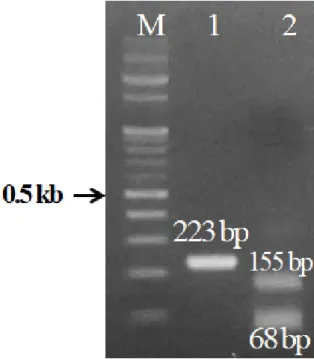
LAMP의 단점으로 나타나는 위양성을 구분하고, LAMP 양성 반응을 검증하기 위하여, 특이적, 비특이 적, 검출민감도 반응 후 최종적으로 선발된 선발된 LAMP primer 조합 3의 F3, B3 (10 pmole) primer를 이용하 여 outer primer PCR 반응을 진행한 결과, 223 nt의 PCR 증폭이 확인되었으며, 제한효소 HaeIII (GG/CC) (10
units) 를 사용하여 37℃, 2시간 반응 후 양성반응을 전기 영동으로 확인한 결과 155 + 68 nt의 제한효소 절편이 확인되었다(Fig. 2).
지하수 시료 실증시험
지하수에서 추출한 핵산(cDNA)로 20개 중 5개에서 HuAstV 양성 반응이 나타났다(Fig. 3). 양성 반응 검정을
Fig. 3. Sample tests of human Astrovirus (HuAstV) loop-mediated isothermal amplification (LAMP). M, 100 bp DNA Ladder marker (enzynomics); P, positive control (HuAstV plamsid); N, negative control; Lane 1 - 20, groundwater samples; Dot (●), LAMP positive reaction samples.
검출민감도 비교실험
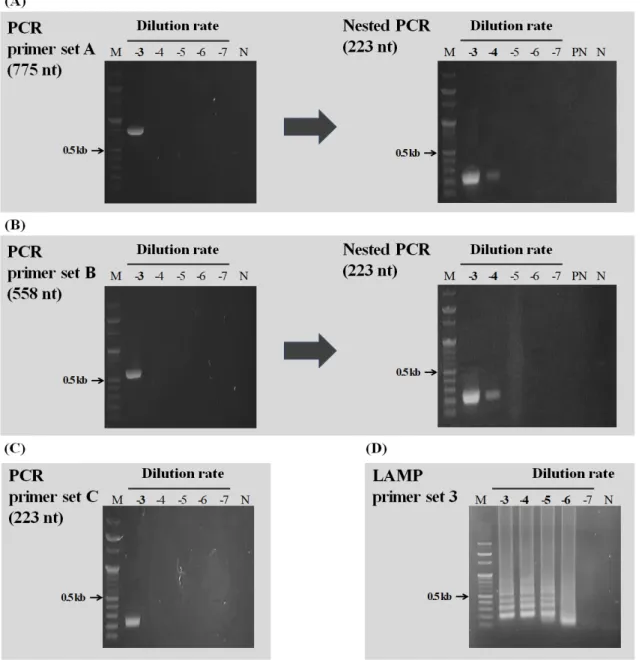
선발된 LAMP primer 조합과 outer primer PCR조합의 검출민감도 한계를 비교한 결과, outer primer PCR 조 합A와 B의 경우, nested PCR이 희석배율 10
-4(100 fg/µL)으로 확인되었으며(Fig. 4A and 4B), 조합 C의 경우 희 석배율 10
-3(1 pg/µL) 로 확인되었다(Fig. 4C). 반면 선발된 LAMP primer조합 3의 검출민감도 분석 결과 조합
3은 HuAstV의 plasmid 희석배율 10
-6(1 fg/µL)로 검출감도가 분석(Fig. 4D)되어, PCR 반응보다 LAMP반응이 약 100 - 1000배 높게 나타나는 것을 확인하였다(Table 2).
Fig. 2. Restriction results of human Astrovirus (HuAstV) loop-mediated isothermal amplification (LAMP) for
verifying positive reaction. M, 100 bp DNA Ladder marker (Enzynomics); 1, polymerase chain reaction (PCR)
results of HuAstV LAMP outer primer; 2, restriction enzyme results of HuAstV LAMP outer primer PCR.
Fig. 4. human Astrovirus (HuAstV) ensitivity test compare with outer primer conventional-nested polymerase chain reaction (PCR) and loop-mediated isothermal amplification (LAMP). (A) conventional and nested PCR results of HuAstV PCR set A. (B) conventional and nested PCR results of HuAstV PCR set B. (C) conventional and nested PCR results of HuAstV PCR set C. (D) LAMP results of HuAstV set 3. M, 100 bp DNA ladder marker (enzynomics); Lane -3 to -7, dilution rates of HuAstV plasmid (1ng/uL); N, negative; PN, PCR-negative.
PCR 기술과 비교 및 활용성