大韓獸醫學會誌 (2014) 第 54 卷 第 2 號 Korean J Vet Res(2014) 54(2) : 113~115 http://dx.doi.org/10.14405/kjvr.2014.54.2.113
113
<Short Communication>
Loop-mediated isothermal amplification assay for the detection of Salmonella spp. in pig feces
Yong Kwan Kim, Ha-Young Kim, Albert Byungyun Jeon, Myoung-Heon Lee, You-Chan Bae, Jae-Won Byun*
Animal Disease Diagnostic Division, Animal and Plant Quarantine Agency, Anyang 430-757, Korea (Received: August 7, 2013; Revised: January 22, 2014; Accepted: February 28, 2014)
Abstract : Salmonella are causative agents of gastroenteritis and systemic disease in animals. The invA gene was selected as a target sequence of loop-mediated isothermal amplification (LAMP) assay for diagnosis of Salmonella infection.
The detection limits for broth dilution, spiked feces and enrichment were 104, 105 and 102 CFUs/mL, respectively.
The LAMP assay developed in the present study may be a reliable method for detection of Salmonella spp. in pig feces.
Keywords : detection limit, invA, loop-mediated isothermal amplification assay, Salmonella
Salmonella (S.) are gram-negative bacilli belong to the family of Enterobacteriaceae and comprise a number of closely related serotypes, many of which are responsible for various illness and death in animals [5, 8]. Although most of the Salmonella cause gastrointestinal disorder, some Serovar such as Cholerasuis, Abortusequi, Gallinarum produce sys- temic diseases [3]. It is important that the identification of causative agent is simple and rapid. A variety of methods such as isolation and PCR have been applied for salmonello- sis in animal and human beings. Although isolation of agents is golden method for diagnosis of the disease, it is laborious and time consuming. Thus, molecular diagnostics such as PCR have been applied to detect Salmonella spp. in feces and pork [1]. However, there are shortcomings such as carry- over contaminations and non-specific reactions. Recently, loop-mediated isothermal amplification (LAMP) has been developed and used as an alternative for molecular diagnosis [13]. LAMP is a nucleic acid amplification technique that relies on an auto-cycling strand displacement DNA synthesis under isothermal condition [10, 11, 12, 13]. Although there are some reports for inspections such as eggs and pork [14, 19], there are few reports for developing LAMP for diagnos- tic purpose. Therefore, LAMP assay was developed for ampli- fying invA gene to detect the Salmonella spp. and evaluated for the detection limit and specificity.
Nineteen strains containing 6 Salmonella spp. (Cholerasuis, Derby, Enteritidis, Montevideo, Schwarzenground, Typhimu- rium) and 13 non-Salmonella spp. (Acinetobacter haemolyticus ATCC17906, Acinetobacter johnsonii ATCC17909, Acineto- bacter junii ATCC17098, Alcaligenes xylosoxydans ATCC15173,
Burkholderia cepacia ATCC25416, Comamonas testosteroni ATCC11996, Enterobacter cloacae ATCC13047, Escheri- chia coli ATCC25922, Kocuria rosea ATCC186, Micrococ- cus luteus ATCC4698, Ochrobactrum anthropi ATCC49188, Serratia marcescens ATCC13880, Stenotrophomonas malto- philia ATCC13637) were used. All strains of Salmonella were from field isolates and serogrouped by O and H anti- body (Becton, Dickson and Company, USA) except S. Chol- eraesuis (ATCC 10708). The primer sequence is shown in Table 1. Salmonella invasion protein gene (invA) was tar- geted for the LAMP assay. Each primer was designed using PrimerExplorer V3 software (Eiken Chemical, Japan). The primers consisted of forward outer (F3), backward outer (B3), forward inner (FIP), backward inner (BIP), loop for- ward (LF), and loop backward (LB). The reaction was car- ried out in a 25 µL volume containing 15 µL of Isothermal Master Mix (OptiGene, UK), 50 µM of the primers FIP and BIP, 25 µM of the primers LF and LB, 5 µM of the primers F3 and B3 and 2 µL of DNA template. The amplified signal was detected by Genie (OptiGene) under the 63
oC for 30 min. To compare the efficacy of LAMP, conventional PCR was carried out following the previously described method [1]. The PCR reaction was carried out in 20 µL volume con- taining 10 µL of Takara EmeraldAmp PCR Master Mix (Takara Bio, Japan), 0.5 µM of each primers and 2 µL of DNA template. Amplification was performed as follows: 5 min at 95
oC, followed by 35 cycles of 1 min at 94
oC, 30 sec at 54
oC, and 30 sec at 72
oC; and a final elongation step of 10 min at 72
oC. Bacteria were suspended in 1 mL of distilled water and heated at 100
oC for 10 min. After centrifugation at
*Corresponding author
Tel: +82-31-467-1751, Fax: +82-31-467-1868 E-mail: [email protected]
114 Yong Kwan Kim, Ha-Young Kim, Albert Byungyun Jeon, Myoung-Heon Lee, You-Chan Bae, Jae-Won Byun
13,500 × g for 2 min, supernatant (2 µL) were used for the template of LAMP assay. The detection limit was deter- mined by 10-fold dilution using S. Typhimurium as refer- ence strain. Briefly, the bacteria were aerobically cultured in tryptic soy broth (Becton, Dickson and Company) at 37
oC for 18 h. The broth was 10-fold diluted with saline and boiled for 15 min. After cooling in ice, the broth was centrifuged and supernatant being used for DNA templates. The cell numbers were calculated by standard plate counting method.
The specificity was evaluated by performing the LAMP assay using DNA from 12 non-Salmonella strains. To see if the LAMP can be working in feces, One milliliter of the broth (2 × 10
9colony forming units [CFU]/mL) was centri- fuged at 13,200 × g for 5 min and serially diluted from 10
1to 10
8. The 1 mL of diluents were mixed with 9 mL of feces mixture (feces : saline = 1 : 1). The each diluent was extracted by stool DNA extraction kit (Qiagen, Germany) according to manufacturer’s instructions. To enrich the mixture, 1 mL of spiked feces was inoculated into 9 mL of tryptic soy broth and incubated for 18 h. The supernatant was extracted by boiling and subjected to LAMP assay.
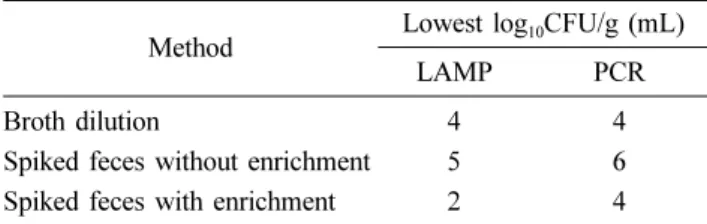
To evaluate the specificity, LAMP was applied to the 13 non-Salmonella strains. No amplification was observed in the 13 non-Salmonella strains. The detection limit of broth dilu- tion was 10
4CFU/mL in LAMP and conventional PCR, respectively (Table 2). In spiked feces without enrichment, the detection limit was 10
5CFU/g of feces. However, 10
5CFU/g of feces was observed in the conventional PCR. Fol- lowing enrichment, the LAMP detected 10
2CFU/g of feces but that of PCR was 10
4CFU/g of feces.
The present study describes the development of Salmo- nella-specific LAMP assay targeting the InvA gene. The InvA gene has been used as a target in many reports [2, 14, 19], whereas phoP gene was used for detection of Salmonella in milk and minced pork [7]. However, the phoP gene is present in most Enterobacteriaceae and non-specific amplification might occur when testing samples. By contrast, the invA is only known as common gene encoded in Salmonella spp.
and more specific than the phoP gene [6]. LAMP assay have been applied to eggs [2, 14] and pork [19] to detect the Sal-
monella spp. The detection limit of Salmonella targeting rfbJ and fim Y was 10
3CFU/mL in previous reports [15, 18]
which was lower than that of our LAMP assay. However, the reaction time was 60 min in a previous report [15], whereas the reaction time in this study was 30 min. As a result, the detection limit was 10
4CFU/mL. In addition, LAMP assay in present study possessed 100% exclusivity among 13 non-Sal- monella strains tested. These results clearly indicate that InvA specific LAMP was sensitive and specific assay for the detection of Salmonella spp. There are several DNA extrac- tion methods which could influence the results of molecular assay. It is important that DNA extraction should be fast and simple in order to reduce the contamination [17]. Gram-neg- ative bacteria can easily be extracted by boiling method, which was applied to S. Enteritidis and S. Typhimurium [9, 16]. Conventional PCR was widely used for detecting Salmo- nella spp. from different specimens such as stools and tis- sues. Until now, conventional PCR has been used for detection of Salmonella. However, there are shortcomings such as carry-over contaminations and skilled staffs. Besides, PCR inhibitors in samples reduce the sensitivity of PCR in case of detecting the target gene [4, 20]. The advantage of LAMP is to use simple equipments, such as heating block or water bath and the results of LAMP can be observed by tur- bidity of reagents. Also, LAMP reaction is carried out in a closed tube which prevents contamination and can be moni- tored in a real-time manner [16]. The LAMP assay devel- oped in the present study is simple and reliable assay to detect the salmonellosis in pig samples.
Table 1. Oligonucleotide sequences
Primer Sequence (5’ to 3’) Positiona
invA
FIP CCAGTACGCTTCGCCGTTCAGATGAGTATTGATGCCGAT 538-558 (3’-F)
596-613 (5’-R)
BIP AGGGAAAGCCAGCTTTACGGGGCAATAGCGTCACCTTT 616-635 (5’-F)
664-681 (3’-R)
F3 CCCGATTTTCTCTGGATGG 506-524
B3 ACCGCCAATAAAGTTCACA 699-717
LF GCATCCGCATCAATAATACCG
LB TTGACGGTGCGATGAAGT
aGenome position relative to the invA gene of Salmonella Typhimurium (Accession No. M90846). FIP: forward inner, BIP: backward inner, F3: forward outer, B3: backward outer, LF: loop forward, LB: loop backward.
Table 2. The detection limit of LAMP in broth dilution, spiked feces and enrichment
Method Lowest log10CFU/g (mL)
LAMP PCR
Broth dilution 4 4
Spiked feces without enrichment 5 6
Spiked feces with enrichment 2 4
LAMP: loop-mediated isothermal amplification, PCR: polymerase chain reaction.
LAMP assay for the detection of Salmonella spp. in pig feces 115
Acknowledgments
This work was supported by the Program (B-1543069- 2013-13-01) of National Veterinary Research and Develop- ment Foundation in the Ministry of Agriculture, Food and Rural Affairs, Korea.
References
1. Arnold T, Scholz HC, Marg H, Rösler U, Hensel A.
Impact of invA-PCR and culture detection methods on occurrence and survival of Salmonella in the flesh, internal organs and lymphoid tissues of experimentally infected pigs. J Vet Med B Infect Dis Vet Public Health 2004, 51, 459-463.
2. Hara-Kudo Y, Yoshino M, Kojima T, Ikedo M. Loop- mediated isothermal amplification for the rapid detection of Salmonella. FEMS Microbiol Lett 2005, 253, 155-161.
3. Hoelzer K, Moreno Switt AI, Wiedmann M. Animal contact as a source of human non-typhoidal salmonellosis.
Vet Res 2011, 42, 34.
4. Horisaka T, Fujita K, Iwata T, Nakadai A, Okatani AT, Horikita T, Taniguchi T, Honda E, Yokomizo Y, Hayashidani H. Sensitive and specific detection of Yersinia pseudotuberculosis by loop-mediated isothermal amplification.
J Clin Microbiol 2004, 42, 5349-5352.
5. Kim S, Frye JG, Hu J, Fedorka-Cray PJ, Gautom R, Boyle DS. Multiplex PCR-based method for identification of common clinical serotypes of Salmonella enterica subsp.
enterica. J Clin Microbiol 2006, 44, 3608-3615.
6. Li J, Ochman H, Groisman EA, Boyd EF, Solomon F, Nelson K, Selander RK. Relationship between evolutionary rate and cellular location among the Inv/Spa invasion proteins of Salmonella enterica. Proc Natl Acad Sci U S A 1995, 92, 7252-7256.
7. Li X, Zhang S, Zhang H, Zhang L, Tao H, Yu J, Zheng W, Liu C, Lü D, Xiang R, Liu Y. A loop- mediated isothermal amplification method targets the phoP gene for the detection of Salmonella in food samples. Int J Food Microbiol 2009, 133, 252-258.
8. Lim BK, Thong KL. Application of PCR-based serogrouping of selected Salmonella serotypes in Malaysia. J Infect Dev Ctries 2009, 3, 420-428.
9. Moganedi KLM, Goyvaerts EMA, Venter SN, Sibara MM. Optimisation of the PCR-invA primers for the detection
of Salmonella in drinking and surface waters following a pre-cultivation step. Water SA, 2007, 33, 195-202.
10. Mori Y, Nagamine K, Tomita N, Notomi T. Detection of loop-mediated isothermal amplification reaction by turbidity derived from magnesium pyrophosphate formation. Biochem Biophys Res Commun 2001, 289, 150-154.
11. Nagamine K, Kuzuhara Y, Notomi T. Isolation of single- stranded DNA from loop-mediated isothermal amplification products. Biochem Biophys Res Commun 2002, 290, 1195- 1198.
12. Nagamine K, Watanabe K, Ohtsuka K, Hase T, Notomi T. Loop-mediated isothermal amplification reaction using a nondenatured template. Clin Chem 2001, 47, 1742-1743.
13. Notomi T, Okayama H, Masubuchi H, Yonekawa T, Watanabe K, Amino N, Hase T. Loop-mediated isothermal amplification of DNA. Nucleic Acids Res 2000, 28, e63.
14. Ohtsuka K, Yanagawa K, Takatori K, Hara-Kudo Y.
Detection of Salmonella enterica in naturally contaminated liquid eggs by loop-mediated isothermal amplification, and characterization of Salmonella isolates. Appl Environ Microbiol 2005, 71, 6730-6735.
15. Okamura M, Ohba Y, Kikuchi S, Takehara K, Ikedo M, Kojima T, Nakamura M. Rapid, sensitive, and specific detection of the O4 group of Salmonella enterica by loop- mediated isothermal amplification. Avian Dis 2009, 53, 216-221.
16. Pui CF, Wong WC, Chai LC, Lee HY, Noorlis A, Zainazor TCT, Tang JYH, Ghazali FM, Cheah YK, Nakaguchi Y, Nishibuchi M, Radu S. Multiplex PCR for the concurrent detection and differentiation of Salmonella spp., Salmonella Typhi and Salmonella Typhimurium. Trop Med Health 2011, 39, 9-15.
17. Sepp R, Szabó I, Uda H, Sakamoto H. Rapid techniques for DNA extraction from routinely processed archival tissue for use in PCR. J Clin Pathol 1994, 47, 318-323.
18. Tang T, Cheng A, Wang M, Li X, He Q, Jia R, Zhu D, Chen X. Development and clinical verification of a loop- mediated isothermal amplification method for detection of Salmonella species in suspect infected ducks. Poult Sci 2012, 91, 979-986.
19. Techathuvanan C, Draughon FA, D’Souza DH. Loop- mediated isothermal amplification (LAMP) for the rapid and sensitive detection of Salmonella Typhimurium from pork. J Food Sci 2010, 75, M165-172.
20. Wilson IG. Inhibition and facilitation of nucleic acid amplification. Appl Environ Microbiol 1997, 63, 3741-3751.