Korean Journal of Microbiology (2017) Vol. 53, No. 4, pp. 351-353 pISSN 0440-2413
DOI https://doi.org/10.7845/kjm.2017.7077 eISSN 2383-9902
Copyright ⓒ 2017, The Microbiological Society of Korea
Note (Genome Announcement)
Complete genome sequence of Chryseobacterium sp. T16E-39, a plant growth-promoting and biocontrol bacterium, isolated from tomato ( Solanum lycopersicum L.) root
Shin Ae Lee, Sang Yoon Kim, Mee Kyung Sang, Jaekyeong Song, and Hang-Yeon Weon*
Agricultural Microbiology Division, National Institute of Agricultural Sciences, Rural Development Administration, Wanju 55365, Republic of Korea
토마토 뿌리에서 분리한 식물생육촉진과 생물방제 세균 Chryseobacterium sp. T16E-39 균주의 유전체 서열
이신애 ・ 김상윤 ・ 상미경 ・ 송재경 ・ 원항연*
국립농업과학원 농업미생물과
(Received October 16, 2017; Accepted December 4, 2017)
*For correspondence. E-mail: [email protected];
Tel.: +82-63-238-3042; Fax: +82-63-238-3845
Chryseobacterium sp. strain T16E-39, isolated from roots of a tomato plant, promotes plant growth and suppresses phyto- phthora blight and bacterial wilt diseases. The complete genome of strain T16E-39 consists of a circular chromosome with 4,872,888 base pairs with a G + C content of 35.22%. The genome includes 4,289 coding sequences, 15 rRNAs, and 71 tRNAs. We detected genes involved in phosphate solubilization, phytohormone regulation, antioxidant activity, chitin degradation, and the type IX secretion system (T9SS) that may be related to growth promotion and disease suppression in plants.
Keywords: Chryseobacterium, biocontrol, genome sequence, plant growth-promoting bacteria
The genus Chryseobacterium, a member of the family Flavobacteriaceae, is commonly known for nonmotile, non- spore-forming, oxidase-positive, and Gram-negative bacteria (Vandamme et al., 1994). Chryseobacterium species are widely distributed in various environments such as soil, fresh water,
plant rhizosphere, fish, meat, and milk (Kook et al., 2014). Some Chryseobacterium strains isolated from the plant rhizosphere and endosphere have been shown to have plant growth pro- motion and biocontrol activity (Sang et al., 2008; Dardanelli et al., 2009).
Strain T16E-39 was isolated from the root endosphere of tomato plants grown in a greenhouse in Buyeo, Republic of Korea (36.2934270 N 126.9317180 E). It was assigned to the genus Chryseobacterium based on the 16S rRNA gene sequence; the most closely related species was Chryseobacterium xinjiangense with 97.7% sequence similarity. We observed that strain T16E-39 promoted tomato plant growth and suppressed phytophthora blight and bacterial wilt diseases (unpublished data). In an in vitro assay, the strain displayed indole-3-acetic acid (IAA) production and 1-aminocyclopropane-1-carboxylate (ACC) deaminase activity (unpublished data), which are both related to plant growth and development (Spaepen and Vanderleyden, 2011). To identify genes related to tomato growth and health, we conducted whole genome sequencing.
The Chryseobacterium sp. T16E-39 genome was sequenced
352
∙Lee et al.
미생물학회지 제53권 제4호
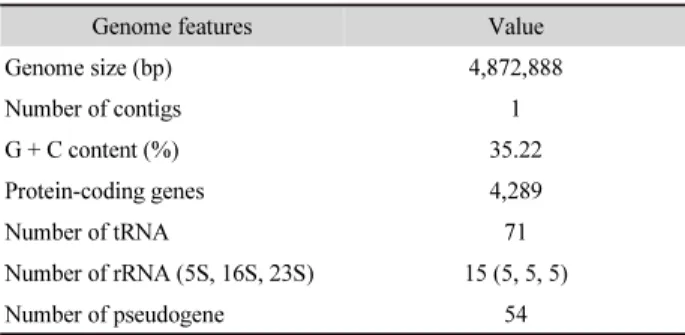
Table 1. Genome features of Chryseobacterium sp. T16E-39
Genome features Value
Genome size (bp) 4,872,888
Number of contigs 1
G + C content (%) 35.22
Protein-coding genes 4,289
Number of tRNA 71
Number of rRNA (5S, 16S, 23S) 15 (5, 5, 5)
Number of pseudogene 54
using the Pacific Biosciences (PacBio) RSII single-molecule real-time (SMRT) sequencing platform with a 20 kb SMRTbell
TMtemplate at ChunLab Inc. All generated reads were assembled de novo using SMRT Analysis version 2.3.0. Gene prediction and functional annotation were carried out using the NCBI Prokaryotic Genomes Automatic Annotation Pipeline (Angiuoli et al., 2008) and the RAST server (Aziz et al., 2008).
The complete genome of the Chryseobacterium sp. strain T16E-39 consists of a 4,872,888 bp circular chromosome with 35.22% G + C content(Table 1). A total of 4,289 coding sequences, 15 rRNAs, 71 tRNAs, 3 ncRNAs, and 54 pseudo- genes were detected. The genome contained genes involved in phosphate solubilization (phytase and quinoprotein glucose dehydrogenase) and phytohormone regulation (ACC deaminase), which are related to plant growth promotion (Spaepen and Vanderleyden, 2011; Sharma et al., 2013). The genes encoding several antioxidant enzymes, such as peroxidase, catalase, and superoxide dismutase, were detected in the genome; these are known to play roles in abiotic or biotic stress responses (Gross et al., 2013). The gene encoding the chitinase, which is hydrolytic enzyme responsible for degrading fungal cell walls composed of chitin, was also present and may be related to biocontrol activity (Zhang et al., 2001). Furthermore, strain T16E-39 possesses genes (gldK, gldL, gldM, and gldN) involved in the type IX secretion system (T9SS), which is associated with gliding motility (Abby et al., 2016). The secretion complex has been reported to be responsible for root colonization and plant defense (Kolton et al., 2014). The whole genome sequence provides genetic information for improving understanding of beneficial bacteria in plants and facilitates its future applications.
Nucleotide sequence accession numbers
The complete genome sequence of Chryseobacterium sp.
T16E-39 has been deposited at NCBI under the GenBank accession no. CP022282. The strain has been deposited in the Korean Agricultural Culture Collection (KACC) under the accession number KACC 81042BP.
적 요
토마토 뿌리에서 분리한 Chryseobacterium sp. T16E-39 균 주는 식물생육촉진과 역병, 시들음병에 대한 억제효과가 있었 다. 이 균주의 유전체 염기서열은 4,873,888 염기쌍이었으며 G + C 함량은 35.22%이었다. 이 유전체는 4,289개 단백질 유 전자, 15개 rRNA 유전자, 71개 tRNA 유전자를 포함하였다.
T16E-39 균주의 유전체에서 인산가용화, 식물호르몬 조절,
항산화 활성, 키틴 분해, 제9형 분비시스템에 관여하는 유전자 를 확인하였으며, 이들 유전자는 식물의 생육을 촉진하고 병 발생을 억제하는 기작과 관련되어 있을 것으로 판단된다.
Acknowledgements
This study was made possible by the support of “Coopera- tive Research Program for Agricultural Science & Technology Development (Project No. PJ01093903)”, Rural Development Administration, Republic of Korea.
References