Korean Journal of Microbiology (2019) Vol. 55, No. 4, pp. 408-410 pISSN 0440-2413
DOI https://doi.org/10.7845/kjm.2019.9113 eISSN 2383-9902
Copyright ⓒ 2019, The Microbiological Society of Korea
Complete genome sequence of Bacillus mesonae H20-5, an efficient strain enhancing abiotic stress tolerance in plants
Shailesh S Sawant
1, Sang Yoon Kim
2, Mee Kyung Sang
1, Hang-Yeon Weon
1, Songwha Kim
1, and Jaekyeong Song
1*
1
Agricultural Microbiology Division, National Institute of Agricultural Sciences (NAS), Rural Development Administration (RDA), Wanju 55365, Republic of Korea
2
Department of Bio-Enviornment Sciences, Suncheon National University, Suncheon 57922, Republic of Korea
식물의 비생물적 스트레스 내성을 강화하는 Bacillus mesonae H20-5 균주의 전체 게놈 서열
새래시 사완트
1・ 김상윤
2・ 상미경
1・ 원항연
1・ 김송화
1・ 송재경
1*
1
국립농업과학원 농업미생물과,
2국립순천대학교 생물환경과학과
(Received September 25, 2019; Revised October 8, 2019; Accepted October 10, 2019)
*For correspondence. E-mail: [email protected];
Tel.: +82-63-238-3041; Fax: +82-63-238-3834
Bacillus mesonae H20-5, a bacterial strain isolated from soil cultivated with lettuce, enhances the tolerance to abiotic stress in a host plant. In this study, the complete genomic sequence of the B. mesonae strain H20-5 has been reported. The sequence revealed that B. mesonae possessed a single 5,839,313 bp circular chromosome with an average DNA GC-content of 40.4%. The chromosome encoded 5,373 protein-coding genes, 41 rRNA genes and 109 tRNA genes. From the genome, the main genes related to plant growth and stress tolerance which affect processes such as auxin biosynthesis, biofilm formation, and proline and spermidine synthesis were identified.
Keywords: Bacillus mesonae, H20-5, genome, abiotic stress, plant tolerance
Due to an increasing demand for a safe and sustainable means of agricultural production, beneficial microorganisms or bio-fertilizers can potentially be used to improve the growth and yield of crops. Bacillus strains, isolated from plant rhi- zospheres, have been extensively studied and used to alleviate
abiotic stresses (Kim et al., 2017a; Sansinenea, 2019). The microorganisms can improve plant growth and combat abiotic stress through the production of phytohormones, volatile organic compounds, and solutes, which improve resistance. Previously, Yoo et al. (2019a, 2019b) reported that the B. mesonae strain H20-5 could be used as a potential biofertilizer to improve the quality of fruit and increase the yield in different crops facing salt stress. They observed that plants treated with the strain H20-5 accumulated significantly higher levels of proline and abscisic acid (ABA), and also had increased levels of antioxidant enzyme activities compared to untreated plants. However, to better understand the molecular mechanisms of induced abiotic stress tolerance in plants by B. mesonae we carried out complete genome sequencing of the strain H20-5.
B. mesonae H20-5 was isolated from a field where soil was
cultivated with lettuce in the National Institute of Agricultural
Sciences (NAS), Korea. Genomic DNA was extracted from
cultured cells grown to stationary phase in tryptic soy broth
(TSB) medium using a QIAamp DNA mini kit (Qiagen)
according to the manufacturer’s protocols. The whole genome
of the strain H20-5 was sequenced with a 20-kb SMRTbell
TMComplete genome sequence of B. mesonae H20-5∙
409
Korean Journal of Microbiology, Vol. 55, No. 4
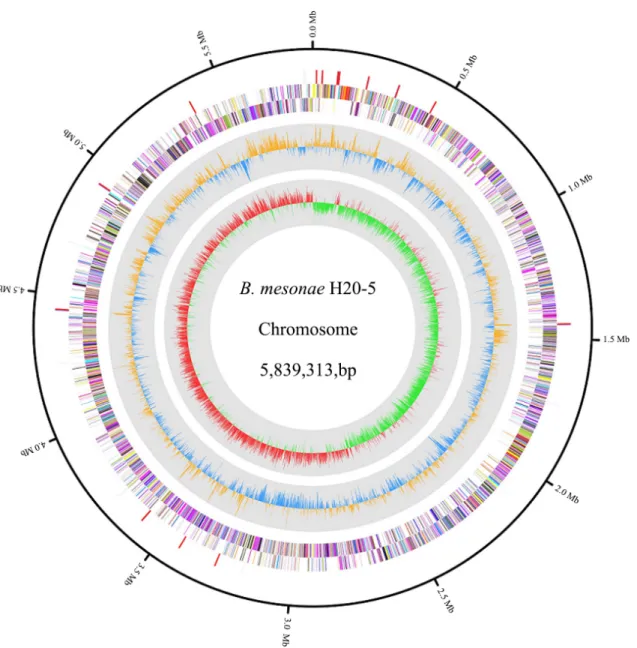
Fig. 1. Circular genome maps of the Bacillus mesonae H20-5 complete genome. The circular map consists of five circles. From the outermost circle to the inner, each circle contains information about (1) rRNA/ tRNA, (2) Reverse CDS, (3) Forward CDS, (4) GC Ratio, and (5) GC Skew.Table 1. Genome features of Bacillus mesonae H20-5
Genomic features Chromosome
Genome size (bp) 5,839,313
Number of contigs 1
G + C content (%) 40.4
Protein-coding genes (CDSs) 5,373
rRNA genes 41
tRNA genes 109
ncRNA genes 5
Pseudogenes 102
Plasmids 0
Accession number (GenBank) CP022572
template library using Pacific Biosciences (PacBio) RSII Single Molecule Real Time (SMRT) sequencing at ChunLab. The genome was assembled and annotated using previously detailed analytical procedures (van Heel et al., 2013; Weber et al., 2015;
Kim et al., 2017a, 2017b). The complete genome sequence of
the strain H20-5 was found to be composed of 5,839,313 bp
with an average DNA GC-content of 40.4%, no plasmids were
detected (Fig. 1). The chromosome contained 5,373 protein-
coding genes (CDSs), 41 rRNA genes, and 109 tRNA genes
(Table 1). The analysis of the genomic sequence revealed that
strain H20-5 possessed a large number of genes associated with
410
∙ Sawant et al.미생물학회지 제55권 제4호
growth promotion in plants, which induce systemic resistance and promote abiotic stress tolerance. The genome possessed Indole-3-acetaldehyde dehydrogenase (dhaS), hydrolase (yhcX), and acetyltransferase (ysnE), involved in auxin biosynthesis and known to promote growth in plants. The presences of genes associated with the synthesis of volatile organic compounds (alsR, alsS) also stimulate plant growth. The strain H20-5 also possesses 7 genes and 1 operon, essential for biofilm formation, and 1 gene (sacB) involved in root adhesion and colonization.
The genome of this strain also contains genes involved in proline and spermidine biosynthesis (proB, proC, speA, speB, speD, and speE) which produce organic osmolytes increasing plant stress tolerance. Overall, the genome sequence and analyses indicated that strain H20-5 possesses several genes which are vital in improving abiotic stress resistance in plants and can potentially be applied as a biostimulant or biofertilizer.
Nucleotide sequence accession number
The genome sequence of B. mesonae H20-5 chromosome described in this study was deposited into the National Center for Biotechnology Information under the accession number CP022572. The strain is deposited into Korean Agricultural culture collection (accession number KACC 81041BP).
적 요
식물의 비생물적 스트레스에 대한 내성을 강화시키는 Bacillus mesonae H20-5 균주는 상추재배 토양에서 분리되었다. 본 연 구에서 H20-5 균주의 전체 염기서열을 분석한 결과, H20-5 균 주는 5,839,313 bp를 가진 단일 환형 염색체로서 G + C 함량은 40.4%로 구성되었다. 이 유전체는 5,373개의 단백질 암호화 유전자를 가졌으며, 41개의 rRNA 유전자와 109 개의 tRNA 유전자를 포함하였다. 유전체로부터 생육 증진과 스트레스 내 성에 관련된 옥신 생합성, 생물막 형성, 휘발성 물질 생산, 프롤 린과 스퍼미딘의 합성 유전자를 확인하였다.
Acknowledgements
This study was carried out with the support of “Research Program for Agricultural Science & Technology Development (Project No PJ011850)” from the National Institute of Agri- cultural Sciences, Rural Development Administration, Republic of Korea.
References
Kim SY, Lee SY, Weon HY, Sang MK, and Song J. 2017a. Complete genome sequence of Bacillus velezensis M75, a biocontrol agent against fungal plant pathogens, isolated from cotton waste. J.
Biotechnol. 241, 112–115.
Kim SY, Song H, Sang MK, Weon HY, and Song J. 2017b. The complete genome sequence of Bacillus velezensis strain GH1-13 reveals agriculturally beneficial properties and a unique plasmid.
J. Biotechnol. 259, 221–227.
Sansinenea E. 2019. Bacillus spp.: As plant growth-promoting bacteria, pp. 225–237. In Singh H, Keswani C, Reddy M, Sansinenea E, and García-Estrada C. (eds.), Secondary Metabolites of Plant Growth Promoting Rhizomicroorganisms. First Online, Springer, Singapore.
van Heel AJ, de Jong A, Montalbán-López M, Kok J, Kuipers OP.
2013. BAGEL3: automated identification of genes encoding bacteriocins and (non-) bactericidal posttranslationally modified peptides. Nucleic Acids Res. 41, W448–453.
Weber T, Blin K, Duddela S, Krug D, Kim HU, Bruccoleri R, Lee SY, Fischbach MA, Müller R, Wohlleben W, et al. 2015. antiSMASH 3.0-a comprehensive resource for the genome mining of bio- synthetic gene clusters. Nucleic Acids Res. 43, W237–W243.
Yoo SJ, Kim JW, Kim ST, Weon HY, Song J, and Sang MK. 2019a.
Effect of Bacillus mesonae H20-5 on fruit yields and quality in protected cultivation. Res. Plant Dis. 25, 84–88.
Yoo SJ, Weon HY, Song J, and Sang MK. 2019b. Induced tolerance to salinity stress by halotolerant bacteria Bacillus aryabhattai H19-1 and B. mesonae H20-5 in tomato plants. J. Microbiol. Biotechnol.
29, 1124–1136.