
Modern Housing Complexes in South Korea. An Educational Analysis to Evaluate the Typological Evolution and Urban Adaptations
6
0
0
전체 글
(2) J. Pract. Eng. Educ. 9(1), 85-90, 2017. the traditional principles of the original city. Urban design prior to this time was based on a conventional oriental geomantic idea called Pungsu - Feng Shui in Chinese – a set of theoretical principles based on the study of the wind and water. While the main urban fabric was based on a gridiron layout, there existed a maze of secondary arteries. Gelézeau described the space between the axis as follows: “Roads providing access to the houses branch chaotically, forming a convoluted maze of frequent dead-ends, all highlighting the essentially pedestrian nature of this network” [2]. The city of Seoul was then remodelled according to new modern urban standards that were first tested in Tokyo and later adapted to other cities such as Osaka, Kyoto, Taipei, and Pyongyang [3]. Large new boulevards were introduced and existing roads were widened according to the City Ward Improvement Plans of 1912 and 1919 [4]. Further urban development occurred during the 1920s, but it is in the 1930s that the first modern planning acts appear: the 1934 Joseon City Planning Act and the 1936 Gyungsung City Plan, which also resulted in a large expansion of the boundaries of Seoul [5]. In terms of architectural developments, new colonial Western Style buildings were introduced in the cities – mainly public buildings and transportation facilities – intended to be used as tools to consolidate colonial rule. The buildings adopted neo-classical eclectic styles mainly deriving their influence from Britain, due to the wellestablished relationship between Japan and the UK.. South Korea was ruled by a military dictatorship from 1961-87, and during the leadership of President Park ChungHee (1961-79) the modernisation process was especially key to the political agenda. This period was characterised by massive economic growth coupled with severe repression. President Park had a clear intention to use the urban transformation as a tool for social reform, introducing large scale population control in Seoul. Thus, the construction of vast mass housing projects (called ap'at'û tanji) was seen as “a very powerful tool for guiding and managing the social groups that have been at the core of South Korea’s economic development” [8]. To accommodate an increasing number of new urban dwellers, Seoul adopted an urban growth management strategy based on ring-radial roadway circulation, multiple centres, and green belts. The proposed urban model was inspired by the Western New-Town Planning and Garden City ideas. The resulting 1966 Comprehensive Development Plan was put into place to facilitate the expansion of the city, proposing four ring roads at varying distances from the city centre and thirteen radial arterials [9]. The junctions of these roads were to become subcentres. This plan was followed by the 1972 National Development Plan, which introduced a new greenbelt system, easily leapfrogged by unplanned development. The plan also pushed new development toward the south side of the Han River and, by the mid 1980s, the expanse of urbanisation on both the north and south banks of the river was equal [10]. A further decentralisation process occurred in 1989, with the construction of five new large towns – Ilsan, Jungdong, Sanbon, Pyeongchon and Bundang – with a planned variety of population density. Recent ambitious new town projects include Sejong Metropolitan Autonomous City and Songdo Smart City.. II. FAST URBAN TRANSFORMATION After the Korean War (1950-53) Seoul experienced one of the largest single country-to-city migrations ever recorded. Korea’s economic “miracle of the Hangang river” exploded and starting from the early 1960s, this area experienced exponential demographic growth [6]. Urban development in Seoul was impossible to control and thus the urban organisation introduced by the Japanese was kept. New large-scale public works projects were planned, and spontaneous development was expropriated and destroyed [7].. http://dx.doi.org/10.14702/JPEE.2017.085. 85-90 10 Dario(영문지).indd 86. III. CHARACTERS OF MASS HOUSING COMPLEXES In this context, modern apartment blocks became the prevailing housing typology and consequently the dominant image of the South Korean landscape, spreading through. 86. 2017-06-15 오후 5:34:30.
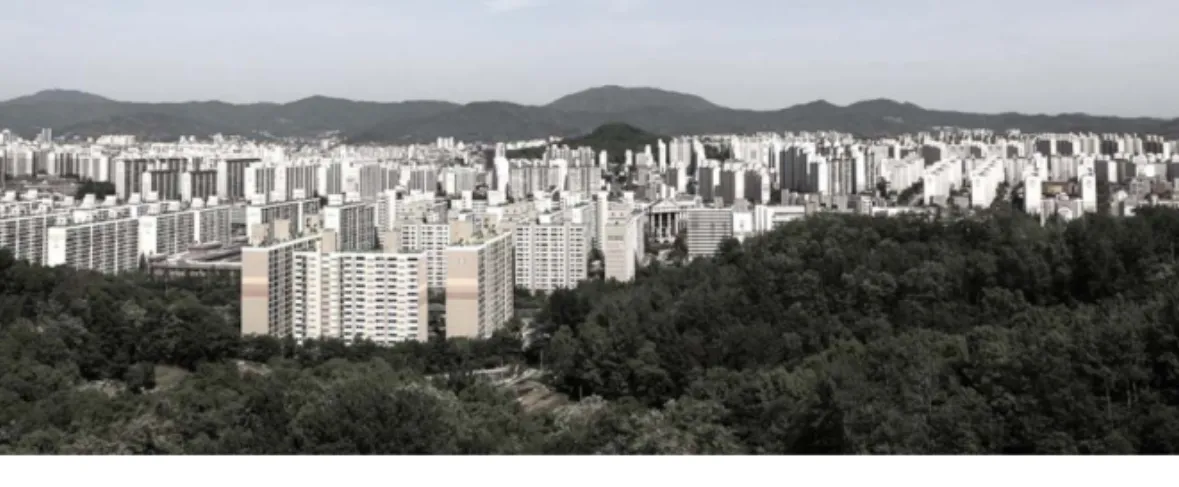
(3) Modern Housing Complexes in South Korea.... Fig. 1. View of apartment complexes in Cheonan (Source: the author).. both the city and countryside (Fig. 1). As Florian Urban pointed out, “serial construction methods became the prevalent technology of mass housing around the world, and simultaneously a stylistic principle of modern city design” [11]. In the 1970s, the prefab high-rises comprised less than 4 percent of the housing stock in South Korea, while that number rose to 50 percent in 2000. Accordingly, in the same period the percentage of individual houses decreased from 90 percent to approximately 25 percent [12]. Korea’s first apartment building, the Mikuni Apartment in Hoehyun-dong, was constructed in 1930 by a Japanese company to provide accommodation for its employees. It was followed by a second apartment built in 1935 in Naejadong. In the same year, records show the construction of the Yurim apartment, the first to be built for rental purposes [13]. None of these buildings survive today. We have to wait until 1958 to see the first apartment buildings built after Korea’s liberation from Japan. The two examples worth mentioning are: The Jongam apartments, comprised of three buildings, four to five stories high, the first to be equipped with flush toilets; and the Mapo Apartments – ten six-floor apartment buildings – constructed between 1962 and 1964 by the Korean National Housing Corporation (KNHC), equipped with individual hot-water heating systems. Although the formal policies that applied to the apartment buildings were defined later on, the Mapo apartments established a set of planning principles for the. Fig. 2. View of a communal area in a tanji, Cheonan (Source: the author).. Fig. 3. View of Boram Apartments, Sanggye-dong, Seoul (Source: the author).. 87. 85-90 10 Dario(영문지).indd 87. http://JPEE.org. 2017-06-15 오후 5:34:30.
(4) J. Pract. Eng. Educ. 9(1), 85-90, 2017. IV. HYBRID MODERNIST THEORIES FOR KOREAN SERIAL APARTMENTS. layout of the tanji: collective housing, at least 300 units, autonomy, and shared facilities [14]. The tanji realised exponential growth when the government launched the Housing Construction Promotion Act in 1972. Amended and strengthened in the early 1980s, the law promoted the construction of high-density residential areas within the city boundaries and other newly designated areas [15]. The tanji were then defined as a grouping of large urban blocks, containing monofunctional residential slabs, interspersed with small commercial buildings and service facilities (Fig. 2). The construction model employed the Fordist production system, where residential slabs are built in a reinforced concrete structure and prefab elements. The main building types are slab buildings having a single-loaded corridor system with open corridors (gallery access), and multiple vertical access. These slabs usually have the ridgeline of the building oriented east-west to maximise sun exposure, leaving the north façade merely as a functional element, aesthetically forgotten (Fig. 3). These features allowed the maximum land use and the minimum construction cost, but at the same time created a completely new environment that disintegrated the traditional landscape and social relationships. Nevertheless, the apartments became a symbol of higher social status and a highly desired product that is still very popular nowadays. In terms of interior design, the typical apartment floorplan is a combination of different influences. As analysed earlier, the traditional floorplan developed from the transformation of the urban hanok into the spec house, where the madang became an interior space and started to function as a living room. The Western influences travelled through Japan, adopting new building technologies and new spatial configurations. The typical LDK floorplan system (Living, Dining, Kitchen) was already developing in Japan staring from the 1940s and then employed in Korea, becoming the standard layout in modern Korean apartments. Nevertheless, these influences were combined with the traditional floorplan, creating a hybrid arrangement together with these foreign systems, which blended the continuity and consistency of the traditional plan into the contemporary design.. http://dx.doi.org/10.14702/JPEE.2017.085. 85-90 10 Dario(영문지).indd 88. To trace the architectural references of the Korean modern apartment building we should analyse the theories of the modern movement and the experiments developed by the architects that rallied around the CIAM. After the previous two CIAM congresses on «The Minimum Dwelling» (Frankfurt/Main, 1929) and «Rational Land Development» (Brussels, 1930), «The Functional City» (1933) represented an ambitious project to apply modern methods of architectural analysis and planning to the city as a whole [16]. In particular, Le Corbusier’s Athens Charter publication of 1943 foreshadowed Korean urban planning by codifying the paradigm of strict urban functional division. Modern Korean development was inspired by the most visionary unbuilt projects that have influenced many urban planners around the world. Specifically, the ones developed by the great modern masters at the beginning of the twentieth century. Ludwig Hilberseimer with the projects of High Rise City in 1924 and Berlin's Gendarmenmarkt Square in 1927, envisioned a repetition of identical residential buildings, disposed in a logical geometrical layout, completely disconnected from the existing context. In a similar fashion, Walter Gropius’s housing diagrams from 1929 show a clear scientific approach to the problem of large housing complexes. Ultimately, Le Corbusier’s three main urban proposals – Contemporary City for Three Million People, 1922; Plan Voisin, 1925; The Radiant City, 1933 – were the main source of inspiration for the Korean architectural vision, in particular, his adherence to height, light, and geometrical order, were seen as a salvation from inefficient and unhealthy urban sprawl. Another very important theory that influenced the definition of modern apartment complex planning in Korea is Clarence Perry’s Neighbourhood Unit. The American urbanist developed the Neighbourhood Unit theory in 1929, which essentially defined a residential block delimited by transportation arteries. The block is designed to be selfsufficient, containing all the facilities needed to support the residences therein, such as shops and services. The Neighbourhood Unit would be designed to accommodate. 88. 2017-06-15 오후 5:34:31.
(5) Modern Housing Complexes in South Korea.... FINAL REMARKS. a population that ranges from 3,000 to 9,000 residents which corresponds to a primary school capacity of 1,000 to 1,600 students. It should be noted, however, that the residential buildings were intended to be low-rise individual houses. This urban scheme is clearly influenced by the Garden City, but the interesting fact is that the Garden City movement predicated urban dispersal as a reaction against the congested urban centre, whereas the Korean tanji were intended to be located in the very heart of the city and in the new expansion areas. Eventually the urban layout adopted by Korean urban planners was a hybrid interpretation of Clarence Perry’s Neighbourhood Unit, combined with the modernist’s proposition of collective high-rise residential towers and slabs. In reality, the tanji were not completely self-sufficient and the contemporary city is characterised by a collage of high-rise and low-rise buildings, with strict functional division. When comparing the 1950s and 1960s European applications with the Korean tanji, we note a distinctive political approach. While the European projects were developed as ‘social housing’ for the poor and located at the periphery of the city, the Korean high-rise apartments were built within the existing city, and oriented toward the growing middle class and upper-middle class. Similarly, while European social housing was intended to be rented, Korean housing was based on a policy of home ownership [17]. Other, more direct influences, should be credited to Japan and to the USA. Japan developed its post-war modernisation process earlier than Korea, also being the only Asian country to have developed an architectural avantgarde – the Metabolism – which has had an international impact. In contrast, South Korea had advanced a very unique corporation system, defined by the country’s large construction conglomerates (chaebol). These large companies played – and still play – a key role in the urban and regional transformation, where large housing projects are the instrument used to dominate the real estate market, leaving only the small and middle-scale projects to more independent and progressive architectural firms.. South Korea has experienced one of the fastest urban transformations in human history. Retracing the evolution of different housing types that emerged through the modernisation process allows us to comprehend the resulting urban morphology and the altered social relationships in the contemporary city. After the initial adaptation of the traditional urban house and the early modern developments, the apartment building became the prevailing housing typology in South Korea. Its success has been determined by three main factors. First, the tanji were located in the city and not at the periphery as in the European cases. Second, the apartment buildings were constructed with high-quality standards and oriented toward the rising middle-class and not the society’s lower strata. Third, the remaining lowrise residential areas suffered from a lack of urban and architectural quality, becoming unattractive to the majority of the population, while in Europe the vernacular city was seen as a privileged place. In Korea, apartments buildings became the image of modern life and a highly desired product. Still nowadays the apartments blocks are considered the best and most convenient preference for Koreans, and this trend is far from over. Thus, a global architectural typology has been locally conditioned in both its spatial adaptation and in its political application, determining the success of a housing type that has been disparaged elsewhere.. REFERENCES [1] I. Jung, Architecture and Urbanism in Modern Korea, Honolulu: University of Hawaii Press, p. 4, 2014. [2] Valérie Gelézeau. Streets and open Spaces in Seoul (1995-2010). A Cultural and Geographical View of Local Neighborhood. KNCU-Korean Studies Series. Seoul, Seoul, Seoul, Hollym, 2014, 978-1-56591-413-1. Available: <halshs-01174275> [3] I. Jung, Architecture and Urbanism in Modern Korea, Honolulu: University of Hawaii Press, p. 9, 2014. [4] Ibid., 11. 89. 85-90 10 Dario(영문지).indd 89. http://JPEE.org. 2017-06-15 오후 5:34:32.
(6) J. Pract. Eng. Educ. 9(1), 85-90, 2017. [12] P. Hall, Cities of Tomorrow, 2nd ed. Oxford: Blackwell,. [5] Seoul Metropolitan Government, “Spatial Development of Seoul. History & Prospect,” Accessed April 20, 2016.. p. 356, 1998.. Available: http://english.seoul.go.kr/wp-content/up-. [13] C. K. Lee, “Apartment City, Seoul” in Replacing: Docu-. loads/2014/02/03_Spatial_Structure_of_Seoul.pdf. mentary of Changing Metropolis SEOUL, ed Moon Sung. [6] Y. W. Kim, “Industrialization and Urbanization in Korea,”. Kwom, Venice: 12th International Architecture Exhibition. Korea Journal, pp. 35-62, Autumn, 1999.. la Biennale di Venezia, Korean Pavilion, pp. 70-75, 2010.. [7] V. Gelézeau, “Streets and Open Spaces in Seoul,” 168.. [14] Gelézeau, “Korean Modernism, Modern Korean. [8] V. Gelézeau, “Korean Modernism, Modern Korean. Cityscapes”, 171.. Cityscapes, and Mass Housing Development: Charting the. [15] Ibid., 176. Rise of Ap'at'ŭ Tanji since the 1969s,” in Korea Yearbook. [16] E. van Es et al. (eds), Atlas of the Functional City CIAM. 2007. Politics, Economy, and Society, eds. Rüdiger Frank. 4 and Comparative Urban Analysis, Bussum: Thoth Pub-. et al., Leiden & Boston: Brill, p. 186, 2007.. lishers, 2014.. [9] P. G. Rowe, East Asia Modern. Shaping the Contemporary. [17] R. Pernice, “From ‘Hanok’ to ‘A-Pa-Tu’. Korean Urban-. City, London: Reaktion Books Ltd, p. 81, 2005.. ism in the XXth Century”, paper presented at the EAAC. [10] Ibid., 82. 2012 International Conference on East Asian Architectural. [11] F. Urban, Tower and Slab. Histories of Global Mass Hous-. Culture, Hong Kong, p. 9, 2012.. ing, London & New York: Routledge, p. 16, 2012.. Dario Pedrabissi Dario Pedrabissi is a practicing architect, researcher and educator. He is an Assistant Professor at Korea Tech, specializing in Design and Practice, teaching design studios at the intersection of architecture, spatial design and contemporary urbanism. His research is based on both historical-theoretical studies and contemporary design analysis, which focuse on technical and cultural phenomenon within the permanent renewal of ‘modernity’. The objectives of this research are the study of the interactions between people and space, both in the private and in the public realm, as this topic relates to the issue of social relationships and sustainability. He received his Bachelor of Architecture from Florence University in Italy and his Master of Science in Architecture and Urbanism from the University of Technology, Delft, The Netherlands. He worked for several local practices in Italy – both in design and construction – and was involved in public and private projects on different scales. Since 2013 Pedrabissi has been the principal at Pedrabissi Studio, an emerging design and research practice based in Italy and South Korea. The studio’s interest lies in diverse fields ranging from architecture and interior design to urban research and the creation of public artworks.. http://dx.doi.org/10.14702/JPEE.2017.085. 85-90 10 Dario(영문지).indd 90. 90. 2017-06-15 오후 5:34:32.
(7)
수치
관련 문서
The Japanese government and urban planners of the Chinese democratic government adopted a modern urban planning theory (composition of residential areas and green belts,
German Federal Government) 9 ; two South Korean public actors (an executive from the Korea Foundation and a manager from the Ministry of Foreign Affairs of the
• 이명의 치료에 대한 매커니즘과 디지털 음향 기술에 대한 상업적으로의 급속한 발전으로 인해 치료 옵션은 증가했 지만, 선택 가이드 라인은 거의 없음.. •
To review the distinctive features and potential problems of Korean government plans this report analyzes the case of Power Development Plan and Housing Development Plan. In
웹 표준을 지원하는 플랫폼에서 큰 수정없이 실행 가능함 패키징을 통해 다양한 기기를 위한 앱을 작성할 수 있음 네이티브 앱과
Improving the Functioning of the Housing Market in the United Kingdom, OECD Economics Department
“Social housing and private markets: from public economics to local housing markets”, in Social Housing in Europe Ⅱ, Edited by Scanlon, Kathleen and Whitehead, Christine.
The index is calculated with the latest 5-year auction data of 400 selected Classic, Modern, and Contemporary Chinese painting artists from major auction houses..
