Journal of the Korean Chemical Society 2010, Vol. 54, No. 6
Printed in the Republic of Korea DOI 10.5012/jkcs.2010.54.6.723
-723-
요약. 마이크로 반응을 이용하여 NaHSO4/SiO2 을 촉매로 하는 solvent-free 합성을 통하여 β-enaminone 과 2-methylquinolin- 4(1H)-one 및 그 유도체를 합성하는 효율적인 방법을 개발하였다. 반응 시간이 짧고, 수율이 좋았으며, 마이크로웨이브를 사 용하지 않는 반응보다는 높은 선택성, 간단성, 무용매 반응 및 친환경적인 반응이다.
주제어: NaHSO4/SiO2 Catalyst, β-Enaminones, Quinoline-4-Ones, 축합반응
ABSTRACT. An efficient and simplified protocol for NaHSO4/SiO2 catalyzed solvent-free synthesis of β-enaminone and 2-methyl- quinolin-4(1H)-one derivatives under microwave irradiation is described. A series of functionalized derivatives have been syn- thesized in shorter reaction times with moderate to good yields. The use of milder catalyst in non-conventional method offers signi- ficant advantages over conventional methods, such as higher selectivities, simplicity, solvent-free reaction and non-environmental polluting conditions.
Keywords: NaHSO4/SiO2 Catalyst, β-enaminones, Quinoline-4-Ones, Condensation
NaHSO
4/SiO
2: Solvent-Free 반응 조건에서 β-Enaminone들과 2-Methylquinolin-4(1H)-One들의 합성을 위한 효율적인 촉매
Suryakant B. Sapkal, Kiran F. Shelke, Bapurao B. Shingate, and Murlidhar S. Shingare*
Department of Chemistry, Dr. Babasaheb Ambedkar Marathwada University, Aurangabad-431004, M.S. India (접수 2010. 4. 5; 수정 2010. 8. 20; 게재확정 2010. 8. 23)
NaHSO
4/SiO
2: An Efficient Catalyst for the Synthesis of β-Enaminones and 2-Methylquinolin-4(1H)-Ones under Solvent-Free Condition
Suryakant B. Sapkal, Kiran F. Shelke, Bapurao B. Shingate, and Murlidhar S. Shingare*
Department of Chemistry, Dr. Babasaheb Ambedkar Marathwada University, Aurangabad-431004, M.S. India
*E-mail: [email protected]
(Received April 5, 2010; Revised August 20, 2010; Accepted August 23, 2010)
INTRODUCTION
Nitrogen containing organic compounds are of special interest because they constitute an important class of natural and non-natural products, many of which exhibit useful bio- logical activities. Among those compounds, β-enaminones have been employed as synthetic building block of a wide veriety of heterocycles,1 key intermediate in synthesis of different heterocycles and naturally occouring alkaloids2 and in pharmaceuticles.3 Despite the importance of β-enaminones as valuable biologically active compounds, their synthesis has received great attention of chemists and hence several routes have been recently reported in literature using Lewis acids,4 P2O5/SiO2,5 Cu-nanoparticles,6 and heteropoly acid.7 In addition, β-enaminone have also been synthesized by using non-traditional methods.8
Another nitrogen containing heterocyclic compound is quinoline moiety. Quinolines possess diverse biological as well as physiological activities such as, anti-malerial, anti-
tuberculosis, antagonists and anti-cancer activity.9 Realizing the importance of quinoline molecule, several methods have been reported in literature such as, by the condensation of o-amino aldehyde/ketones,10 Skraup,11 Knorr,12 Conard-Lim- pach,13 Dober-Vonmiller,14 Combs,15 Friedlander16 etc. More- over, H2SO4,17 AcOH/CaSO4 in Ph2O at 250 oC17 and P- TsOH in EtOH/xylene at 250 oC19 has been recently repor- ted.
Unfortunately many of these methods for the synthesis of β-enaminones and quinolines suffers from relevant limita- tions such as, drastic condition, low product yield, tedious work-up procedure, low selectivity, and required chromato- graphic isolation technique. Therefore, search of new simple, clean and one-pot method for the synthesis of desired orga- nic compounds is of prime interest. In search of better alter- natives, we have paid attention to find convenient and effici- ent method based on green approach for the synthesis of β- enaminones and quinoline-4-one derivatives.
Solvent-free reactions have attracted much attention in
724 Suryakant B. Sapkal, Kiran F. Shelke, Bapurao B. Shingate, and Murlidhar S. Shingare
Journal of the Korean Chemical Society Table 1. Screening of different catalyst for the synthesis of β-enami- nones
O
O
+ R
H2N
Catalyst MW
O
NH R
Entry Catalyst Time (min) Yield (%)a
1 MgSO4 15 30
2 ZnCl2 20 25
3 Na2SO4 15 40
4 TiO2 20 > 20
5 NaHSO4 10 65
6 SiO2 10 60
7 NaHSO4/SiO2 4 90
aIsolated yield organic synthesis in recent years,20 not only because solvent-
free reactions offers practical advantages over reactions in organic solvents from economical, environmental and safety standpoints, but also because solvent-free reactions usually need shorter reaction time, low costs, simplicity in process, handling and no need to use harmful organic solvents. These factors are beneficial to industry as well as to environment.
Thus solvent-free reactions are one of the most important synthesis techniques in green chemistry. Various solvent-free reactions were found to occurs using microwave irradia- tion.21 Microwave irradiation takes a particular place being an emerging technique that provides an alternative to con- ventional heating by introducing energy into chemical reac- tion. Hence microwave technique has been successfully app- lied because of some advantages such as, very fast heating, better homogeneity in reaction temperature, shorter reaction time, improved conversion and clean product formation.
Therefore, we would like to report the solvent-free synthesis of β-enaminones and 4-quinolones under microwave irradia- tion.
EXPERIMENTAL
All starting materials and reagents were commercially available and used without further purification. All the melt- ing points were taken in an open capillary and are uncorrect- ed. The progress of the reactions was monitored by thin layer chromatography (TLC). IR spectra were recorded on Perkin-Elmer FT-IR spectrophotometer in KBr disc. 1H NMR spectra were recorded on mercury plus Varian spectro- meter at 400 MHz in DMSO-d6 as a solvent and chemical shift values are recorded in units δ (ppm) relative to tetra- methylsilane (Me4Si) as an internal standard.
GENERAL PROCEDURE Synthesis of β-enaminones
A mixture of aromatic amines (1 mmol), dimedone (1 mmol) and NaHSO4/SiO2 (0.5 g) were taken in a beaker.
The reaction mixture homogenized with the help of glass rod and irradiated in microwave oven (180 W) by the inter- val of 10 second. The progress of reaction was monitored on TLC. After completion of the reaction, mixture was cool- ed to room temperature and poured on crushed ice. Thus, solid obtained was filtered, dried and purified by crystalliza- tion in ethanol.
Synthesis of 2-methylquinolin-4(1H)-ones
A mixture of anilines (1 mmol), ethyl acetoacetate (1 mmol) and NaHSO4/SiO2 (0.5 g) were taken in beaker. The
reaction mixture was homogenized with the help of glass rod and irradiated under microwave oven (360 W) by inter- val of 10 second. After completion of the reaction as indicat- ed on TLC. The reaction mixture was cooled at room tem- perature and poured on crushed ice. Thus, solid obtained was filtered, dried and purified by crystallization in etha- nol.
RESULTS AND DISCUSSION
In continuation of our research work on microwave assist- ed organic reactions for the synthesis of various bioactive compounds,20a,22 herein an effective strategies catalyzed by NaHSO4/SiO2 under microwave irradiation have been dis- cussed.
Initially we examined the efficiency of different cataly- sts for the condensation reactions of aniline with dimedone as representative reactants under microwave irradiation at 180 W (Table 1).
Our initial investigation focused on the use of acidic ca- talyst such as Lewis acids, acidic salts for the synthesis of β-enaminones by the condensation of the reactants. In search of an efficient catalyst and the best experimental condition, the preferred reactions in the presence of catalyst at 180 W have been considered. After successful screening of different catalysts shown in Table 1, it has been found that acidic salt NaHSO4 in combination with SiO2 as a solid support act as a best promoter for this reaction and gives 90% product yield within 4 min (Table 1, entry 7). This amazing result is may be due to NaHSO4 act as Brønsted acid which protonate carbonyl oxygen of dimedone to enhance the electrophilicity of that carbonyl carbon preferably on the active solid support of SiO2 to afford respective product yield. Such type of stepping-up performance about other catalysts was not ob-
NaHSO4/SiO2: Solvent-Free 반응 조건에서 β-Enaminone들과 2-Methylquinolin-4(1H)-One들의 합을 위한 효율적인 촉매 725
2010, Vol. 54, No. 6
Table 2. Synthesis of β-enaminone derivatives catalyzed by NaHSO4/ SiO2
Productsa R Time (min) Yield (%) mp oC
1 H 4 90 183 - 185
2 4-F 4 89 190 - 192
3 4-OMe 6 90 106 - 108
4 4-Br 5 88 164 - 166
5 4-Me 4 91 144 - 146
6 4-OEt 7 88 110 - 112
7 2,3-diCl 8 87 200 - 202
8 2-Me 5 89 133 - 135
9 3-Me 6 90 139 - 141
10 4-Cl 5 90 149 - 151
aIsolated product yield and all products were characterized from their spectroscopic (IR,1H NMR and MS) data and compared with authentic samples.
Table 4. Synthesis of 4-quinolone derivatives catalyzed by NaHSO4/ SiO2
Productsa R Time (min) Yield (%) mp oC
1 H 5 92 132 - 134
2 4-F 4 93 141 - 143
3 4-OMe 5 90 129 - 131
4 4-Me 5 90 222 - 224
5 4-OEt 6 88 152 - 154
6 2,3-diCl 6 87 147 - 149
7 4-Br 5 92 126 - 128
8 2-Me 5 90 199 - 201
9 3-Me 6 90 195 - 197
10 3-OMe 6 90 112 - 114
11 3-Cl 6 89 208 - 210
12 2-Cl 5 87 214 - 216
13 4-Cl 5 90 202 - 204
aIsolated product yield and all products were characterized from their spectroscopic (IR,1H NMR and MS) data and compared with authentic samples.
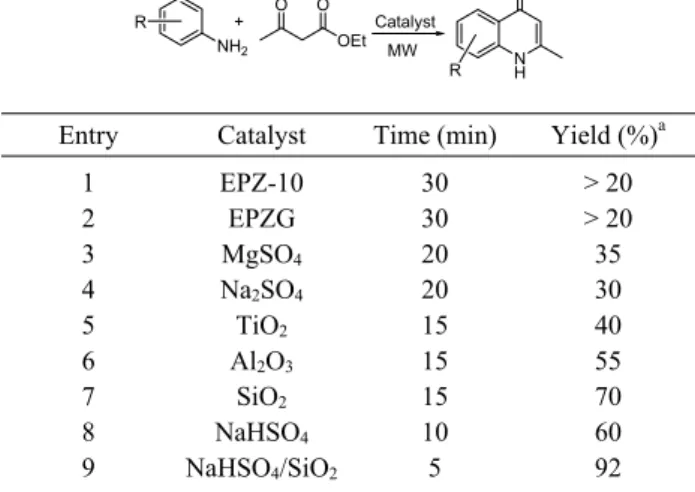
Table 3. Screening of suitable catalyst for the synthesis of 4-quinolo- nes
OEt
O O
+ NH2
R Catalyst
MW N
R H O
Entry Catalyst Time (min) Yield (%)a
1 EPZ-10 30 > 20
2 EPZG 30 > 20
3 MgSO4 20 35
4 Na2SO4 20 30
5 TiO2 15 40
6 Al2O3 15 55
7 SiO2 15 70
8 NaHSO4 10 60
9 NaHSO4/SiO2 5 92
aIsolated yield
served (Table 1, entries 1-4).
Meanwhile, MgSO4,Na2SO4, TiO2, and ZnCl2 have also been screened and required longer reaction time under mi- crowave irradiation and conversion of reactant into corre- sponding products is less (> 20 - 40%). Even though use of NaHSO4 or SiO2 does not results into higher yield as it has given in combination of NaHSO4/SiO2 (Table 1, entry 5, 6).
Herein we would like to report the combination of catalysts NaHSO4/SiO2 as a best catalyst for the synthesis of β-enami- none derivatives under microwave irradiation.
Our next attempt was to perform synthesis of 4-quinolone derivatives by the cyclocondensation of aromatic anilines with ethyl acetoacetate under solvent-free condition. The catalytic influence of various inorganic solid supports on the condensation of aniline with ethyl acetoacetate under
microwave irradiation at 360 W has studied and the results are as shown in Table 3.
In order to select an appropriate catalyst for the synthesis of 4-quinolones under solvent-free condition, initially we have screened the acidic clays such as, EPZ-10 and EPZG for the preferred reaction, it was observed that no significant product was formed even after 30 min (Table 3, entries 1,2).
Moreover, starting materials were subjected with MgSO4, Na2SO4 as compared to acidic clays; these gives more yield (Table 3, entries 3,4). In addition, we examined the TiO2, Al2O3, and SiO2 among these SiO2 gives appreciable yield within 15 min (Table 3, entry 7). Fortunately, we think over acidic salt like NaHSO4 and applied for the same reaction under microwave irradiation after 10 min 65% reactants were converted into corresponding product. Finally, we decided to use combination of catalyst NaHSO4/SiO2 amazingly, we obtained 92% product yield (Table 3, entry 9). As discussed in earlier results NaHSO4/SiO2 plays same mechanistic role to promote the rate of reaction furnishing better yield within shorter reaction time. When aromatic anilines and ethyl ace- toacetate react with each other in the presence of NaHSO4/ SiO2 under microwave irradiation, the cyclization of quino- line ring takes place through emine- enamine tautomeriza- tion eliminating water molecules we got appreciable yields of desired products within shorter reaction time as shown in Table 4.
Spectral Data for representative compounds
4-Br-enaminone: IR (KBr, cm-1): 3264, 1592, 704; 1H NMR (400, MHz, DMSO-d6, δ ppm) 1.02 (6H, s), 2.14 (2H, s),
726 Suryakant B. Sapkal, Kiran F. Shelke, Bapurao B. Shingate, and Murlidhar S. Shingare
Journal of the Korean Chemical Society
2.36 (2H, s), 5.13 (1H, s), 6.66 (1H, s broad peak), 6.96 (2H, d, J = 8.6 Hz), 7.39 (2H, d, J = 8.6 Hz); 13C NMR (DMSO-d6, TMS) δ = 26.8,28.5, 31.8, 44.1, 50.4, 100.2, 121.6, 129.8, 132.7, 140.3, 143.2, 198.7; ES-MS: m/z (m+): 393.
2,6-dimethyl-1H-quinolin-4-one: IR (KBr, cm-1): 3255;
1628; 1H NMR (400, MHz, DMSO-d6, δ ppm): 2.05 (3H, s);
2.27 (3H, s); 5.99 (1H, s); 7.09 (1H, d, J = 7.5 Hz); 7.38 (1H, t,); 9.10 (1H, s); 13C NMR (DMSO-d6, TMS) δ = 20.87, 29.70, 98.51, 114.73, 120.26, 122.58, 126.43, 129.45, 134.20, 163.72, 205.03; ES-MS: m/z (m+): 173.
CONCLUSION
In conclusion, we have described simple, efficient and one-pot synthesis of some β-enaminones and quinoline-4- one derivatives under microwave irradiation in the presence of NaHSO4/SiO2 as a catalyst. The synthetic utility of the methodologies demonstrated in this work, whilst contribut- ing the part of green and clean chemistry to sustain the human health and environment unaffected. The remarkable advantages offered by the methods presented are use of safer and ecofriendly catalysts, mild reaction conditions, simpli- city of the reaction procedure and high yielding strategies.
Acknowledgments. The authors are thankful to the Head, Department of Chemistry, Dr. Babasaheb Ambedkar Marath- wada University, Aurangabad-431 004, MS, India for provid- ing the laboratory facility, We gratefully acknowledge the financial assistance received for this work from University Grants Commission, New Delhi.
REFERENCES
1. Alan, C.; Spivey, A. C.; Sirikaran, R.; Diaper, C. M.; David, J.;
Turner, D. Org. Biomol. Chem. 2003, 1638.
2. (a) White, J. D.; Lhle, D. C. Org. Lett. 2006, 8, 1081; (b) Li, G.;
Watson, K.; Buckheit, R. W.; Zhang, Y. Org. Lett. 2007, 9, 2043;
(c) Kappe, C. Angew. Chem. Int. Ed. 2004, 43, 6250.
3. (a) Abass, M.; Mostafa, B. B.; Bioorg. Med. Chem. 2005, 13, 6133; (b) Edafiogho, I. O.; Ananthalakshmi, K. V.; Kombian, S. B. Bioorg. Med. Chem. 2006, 14, 5266; (c) Edafiogho, I. O.;
Phillips, O. A.; Udo, E. E.; Samuel, S.; Rethish, B. Eur. J. Med.
Chem. 2009, 44, 967.
4. (a) Dalpozzo, R. R.; Nino, A. D.; Nardi, M.; Procopio, B. A.
Synthesis 2006, 7, 1127; (b) Epifano, F.; Genovese, S.; Curini, M. Tetrahedron Lett. 2007, 48, 2717.
5. Mohammadizadeh, M. R.; Hasaninejad, A.; Bahramzadeh, M.;
Khanjarlou, Z. S. Synth. Commun. 2009, 39, 1152.
6. Kidwai, M.; Bhardwaj, S.; Mishra, N.; Bansal, V.; Kumar, A.;
Mozumdar, S. Catal. Commun. 2009, 10, 1514.
7. Rafiee, E.; Joshaghani, M.; Eavani, S.; Roshidzadeh, S. Green Chem. 2008, 10, 982.
8. (a) Lee, A. S. Y.; Cheng, R. Y.; Tetrahedron Lett. 1997, 38, 443;
(b) Brandt, C. A.; D’Silva, A. C. M. P.; Pancote, C. G.; Brito, C. L.; daSilveria, M. A. B. Synthesis 2004, 10, 1557.
9. (a) Ridley, R. G. Nature 2002, 415, 686; (b) Solomon, V. R.;
Haq, W.; Srivastava, K.; Puri, S. K.; Katti, S. B. J. Med. Chem.
2007, 50, 394; (c) Jasinski, P.; Welsh, B.; Galveg, J.; Land, D.;
Zwolak, P.; Ghandi, L.; Terai, K.; Dudek, A. Z. Invest. New Drugs 2008, 26, 223; (d) Jayashree, B. S.; Jagarlamudi, L. R.;
Nayak, Y.; Daroji, V. Pharm. Logy. 2009, 1, 322; (e) Pattan, S. R.; Dighe, N. S.; Hariprasad, C. K.; Pattan, J. S.; Daithan- kar, A. V.; Gaware, V. M.; Hole, M. B. J. Pharm. Sci. & Res.
2009, 1, 55.
10. Kiss, A.; Potor, A.; Hell, Z.; Catal. Lett. 2008, 125, 250.
11. Skraup, Z. H. Chem. Ber. 1880, 13, 2086.
12. Hauser, C. R.; Reynolds, G. A. J. Am. Chem. Soc. 1948, 70, 2402.
13. Conard, M.; Limpach, L. Chem. Ber. 1887, 20, 944.
14. Dobner, O.; Miller, W. Chem. Ber. 1883, 16, 246.
15. Combes, A. Bull. Soc. Chem. 1888, 49, 89.
16. Friedlander, P. Chem. Ber. 1882, 15, 2572.
17. Farah, A. A.; Pietro, W. J. Acta Cryst. 2001, E-57, 677.
18. Morris, A. L. C.; Jackson, Y. A. Heterocycles 2010, 81, (DOI:
10.3987/COM-09-11868).
19. Pain, C.; Celanire, S.; Guillaumet, G.; Joseph, B. Tetrahedron 2003, 59, 9627.
20. (a) Madje, B. R.; Shindalkar, S. S.; Ware, M. N.; Shingare, M.
S. Arkivoc 2005, xiv, 82; (b) Pesyan, N. N.; Khalafy, J.; Male- kpoor, Z. J. Chin. Chem. Soc. 2009, 56, 1018; (c) Wang, G. W.;
Gao, J. Org. Lett. 2009, 11, 2385; (d) Mogilaiah, K.; Vidya, K.;
Swamy, T. K. Ind. J. Chem. 2009, 48B, 599.
21. (a) Arvapalli, V. S.; Chen, G.; Kosarev, S.; Tan, E. M.; Xie, D.;
Yet, L. Tetrahedron Lett. 2010, 51, 284; (b) Shore, G.; Yoo, W.
J.; Li, C. J.; Organ, M. G. Chem. Eur. J. 2010, 16, 126; (c) Gaina, L.; Porumb, D.; Dumitrescu, S. I.; Cristea, C.; Dumitrescu, S.
L. Can. J. Chem. 2010, 88, 42; (d) Chen, X.; Xu, P.; Xia, Z.
Chem. Bull. Huax. Tong. 2009, 72, 674; (e) Tyagi, B.; Shaikh, B.; Bajaj, H. C. Catal. Commun. 2009, 11, 114.
22. (a) Sapkal, S. B.; Shelke, K. F.; Shingate, B. B.; Shingare, M.
S. Tetrahedron Lett. 2009, 50, 1754; (b) Shelke, K. F.; Sapkal, S. B.; Shitole, N. V.; Shingate, B. B.; Shingare, M. S. Organic Commun. 2009, 2, 72; (c) Shelke, K. F.; Sapkal, S. B.; Shitole, N. V.; Shingate, B. B.; Shingare, M. S. Bull. Korean. Chem. Soc.
2009, 30, 2883; (d) Sadaphal, S. A.; Merkhele, V. M.; Sonar, S. S.; Shingare, M. S. J. Korean Chem. Soc. 2008, 52, 454; (e) Kategaonkar, A. H.; Sasdaphal, S. A.; Shelke, K. F.; Shingate, B. B.; Shingare, M. S. Ukranica Bioorg. Acta 2009, 1, 3.