Printed in the Republic of Korea DOI 10.5012/jkcs.2011.55.3.400
홍화잇꽃의 여드름피부 개선효과 및 세안용 생약식물소재 응용
박영호†·이창섭‡,*
†한국국제대학교 제약공학과
‡계명대학교 화학과
(접수 2011. 4. 4; 수정 2011. 4. 8; 게재확정 2011. 5. 9)
Efficacy of Safflower on the Acne Skin and Its Application for Facial Cleansing Biomedical Material
Young-Ho Park† and Chang-Seop Lee‡,*
†Department of Pharmaceutical Engineering, International University of Korea, Jinju 660-759, Republic of Korea
‡Department of Chemistry Keimyung University, Daegu 704-701, Republic of Korea
*E-mail: [email protected]
(Received April 4, 2011; Revised April 8, 2011; Accepted May 9, 2011)
요 약. 홍화는 예로부터 ‘사람의 건강에 도움이 된다’고 해서 ‘잇꽃’으로 불려져 왔으며 동의보감에서는 꽃잎이 홍색을 나타내기 때문에 홍화(紅花)로 소개되어 있다. 예로부터 홍화는 꽃잎을 압착후 정제된 색소를 이용하여 옷감에 천연색소 를 입히는 염료와 연지의 재료로 사용되기도 하였다. 현대에 와서는 홍화의 주성분인 폴리페놀 화합물(Polyphenol cocktail) 성분이 건강식품업계에서 항노화 및 항산화물질로 알려지면서 관심의 대상이 되고 있다. 금번연구에서는 홍화의 주성분 인 폴리페놀 화합물이 청소년기 혹은 장년기에서도 고민거리가 되고 있는 여드름균의 생성을 억제시킬 수 있는 항균,항 염효능이 있음을 DDT(Disk Diffusion Test) assay, MTT assay, NF-kB Luciferase activity inhibition assay의 in vitro법으로 확인하고 더불어 인체안면에 대한 임상시험에 사용할 세안화장품 제형의 화장비누 시제품을 제조하여 여드름피부의 개선 효과가 있음을 시험하고자 한다. 또한 이번 연구는 여드름용 화장비누 개발에 진일보하여 약용화장품 산업의 발전에 기 여할 것임을 확신한다.
주제어: 홍화, 폴리페놀, 여드름균, 화장비누
ABSTRACT. Safflower is called as the ‘beneficial flower’ because ‘it helps human health’, and it was introduced as red flower in Tonguibogam due to the red color of floral leaf. From old times, it has been used for the material of cloth and rouge. Recently, polyphenol compound, the main ingredient of safflower, known as anti-aging and anti-oxidizing material in the healthy food industry becomes the emerging hot topic. This study aims to confirm by DDT (Disk Diffusion Test) assay, MTT assay, and NF-kB Luciferase activity inhibition assay in vitro that polyphenol compound, which is the main ingredient of safflower, has the anti-microbial efficacy to inhibit the growth of acne germs that make troubles for the teen- agers or middle aged. Also it aims to evaluate its clinical efficacy on the acne skin, utilizing the facial cleansing cosmetic form of soap sample. This study can contribute to take a major step forward to the development of cosmetic soap for acne in the cosmeceutical industry.
Keyworlds: Safflower, Polyphenol, Acne germs, Cosmetic soap
INTRODUCTION
From old times, safflower has been called as the ‘ben- eficial flower’ because ‘it helps human health’, and it was introduced as red flower in Tonguibogam due to the red color of floral leaf. It is a yearly herbaceous plant origi- nated from Egypt and breeds with seed after anthesis. Its fruit and seed can be grown in 3-4 months after seeding.
Safflower is classified as a herb and it is known variously as beneficial flower (Asteraceae, Composicae), red flower
(tubular flower, Safflower), and safflower seed (seed), together with its scientific name, Carthamus tinctorius L.
Linolic acid, the active ingredient of the seed, has the effi- cacy to purify the cholesterol in the blood vessel and to improve the symptom of arteriosclerosis. It is known that the symptom of arteriosclerosis, one of the adult diseases, can be relieved by a mouthful of dried flower or seed with one cup of warm water. The flower has been used as the red dye for the traditional clothing such as Hanbok, lip rouge, and natural coloring for food from old times. Saf-
flower is classified as a herbal medicine since it has the efficacy on the treatment of fractured bone or women’s menstrual pain.
EXPERIMENTAL
More than 1200 herbs are growing near Mt. Jiri, where is one of the best mountains in Korea, and their usages and efficacies are varied. Especially, safflower has positioned as one of the major earning sources, cultivated directly in the local farms, and yet it is applicable to the cosmetic materials since it has the therapeutic efficacy and wide cultivation area, also it is possible to get the fixed harvest annually. The previous studies on safflower have been already reported variously including the effective segre- gation and chemical structure analysis of carthamin which is a red pigment of safflower; physicochemical properties of safflower; and confirmation of large amount of polyphe- nol compound in the seed, shoot and floral leaf extract;
and utilization of safflower as the physiological material for anti-microbial effect.
Focusing on the fact that safflower has the antimicro- bial activity, we would like to evaluate the efficacy of polyphenol compound in the safflower extract on the acne germs and safety to the skin keratinocytes by DDT assay, MTT assay and NF-kB Luciferase activity inhibition assay in vitro, and also to conduct the clinical trial with the com- posite mixture of safflower extract and aroma oil in order to evaluate the clinical efficacy on the acne skin.1-3
Although the active ingredient of safflower is easily extracted by alcohols, their disadvantage would be a little lower extract productivity than by the organic solvent if it is used for the material of facial cleansing cosmetics.
Therefore, we extracted it by boiled water method that has various advantages such as stability, extract facility, produc- tion cost, and so on. First, safflower material was heated, concentrated, and filtered by liquid-liquid extraction and open column chromatography, followed by decompres- sion of the remaining solution at 60oC and lyophilizing for the test.
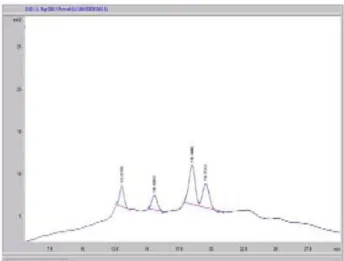
Also, HPLC (Agilent 1100, USA) was used for the qualitative analysis of polyphenol compound in the test material, IUK (safflower extract). This was compared with the standard polyphenol cocktail (Sigma) measured by the absorbance at 280 nm utilizing column (C18, zorbox, 4.6×150 mm, 5 micrometer) under the isocratic con- dition with 10% ethanol solvent. In HPLC agilent 1100 series, experimental conditions were 1 ml/min flow rate, 20 ul sample injection volume, and 25oC column
room temperature. The results of analysis were shown in Fig. 1.
DDT (Disk Diffusion Test) test
DDT test was performed in vitro after the dissolution of lyophilized powder into the solvent. The main equip- ments and test materials for DDT test of safflower extract were as follows; Shaking incubator (SI 600R, Jeiotech, Korea), CO2 Incubator (IB-600M, Jeiotech, Korea), Clean bench, and Autoclave (S120V, Tomy, Korea) as the main equipments, and Propionibacteriumacnes (ATCC6919), etc as the main materials. The test material was labeled as IUK (safflower extract). The test is to determine the exist- ence of antimicrobial materials and their concentrations in the solution with the following methods; smearing the antimicrobial solution with certain concentration on each disc, putting on the solid agar media smeared by test germ, culturing them, and measuring the size of transparent zone (growth inhibition halo) that has no germs near the disc.
The transparent zone means that the antimicrobial mate- rial inhibits the growth of germs by diffusion into the media. The test procedures are pre-culture of test germ in the liquid media for 1-2 days, followed by adding pre-cul- ture solution to 7 ml of 0.8% soft agar media so as to be 105,6cells/ml of germ concentration, and inoculation of agar media with germ on the test media. Then, dampen 50µl erythromycin sample, which is the positive control, on each paper disc and drop this on the media. Culture this for 1-5 days at 30-37oC until the germs grow sufficiently.
The anti-microbial efficacy is assessed by measuring the diameter of transparent zone formed in the media by mil- limeter.1-3
Fig. 1. HPLC analysis result of test material IUK.
MTT assay (Cell viability test)
After the lyophilized powder was dissolved in the sol- vent, cell viability test was performed in vitro to be cat- egorized by concentration. The main equipments and test materials for the cell viability test of safflower extract were as follows; ELISA Reader system (Powerwave X, Bio-tek inc, Japan), Clean bench (SH-120S., Hansol SM, KR), Inverted-microscope (TS-100F, Nikon, JPN), etc as the main equipments, and human normal fibroblast (from neonatal foreskin, Dermatology Dept. Ajou University), HaCaT (KCLB 3002, Korea Cell Line Bank), FBS (Gibco, CA), RPMI1640 (WelGENE, Korea), Penicillin/Strepto- mycin (WelGENE, Korea), PBS (Gibco, CA), MTT (3- (4,5-Dimethylthiazol-2-yl)-2,5-diphenyltetrazolium bro- mide (Sigma, MI), Dimetyl sulfoxide (Duchefa biochem- icls, Nederland), etc as the main materials. The experimental theory is to understand cell viability utilizing HaCaT cell culture in order to test the cytotoxicity of the test material after processing with it and culturing the cell. MTT assay is used to measure the viable cells.
MTT is dark-yellow colored cytoplasm arrayed by res- piratory chain enzyme in the mitochondria of the living cell and it forms dark-blue colored formazan. The generated amount of formazan is used for the measurement of the number of viable cells since this reaction does not occur in the dead cells. HaCaT (keratinocyte) cell was cultured under 5% CO2 at 37oC, with the additions of 10% fetal bovine serum (FBS) and 1% penicillin-streptomycin in the DMEM media. The test samples were diluted by dis- tilled water and stored in the refrigerator after the filtra- tion by 0.2 um syringe filter and separate inoculation.
MTT reagent was dissolved in PBS (pH7.4) to be 1 mg/
ml concentration and stored in the refrigerator after the fil- tration by 0.2 um syringe filter and separate inoculation.
Cell viability was measured after inoculation of HaCaT cell into 24-well plate with the concentration of 2×10⁴cells/
well and culture for one day. After confirmation of the cell attachment, the test materials were cultured again for addi- tional 48 hours after processing of test materials by con- centration in each well. MTT solution (1 mg/ml in PBS) with 1/10 of total media volume was mixed after processing period of the test material. They were reacted at 37oC in CO2 reactor for 3 hours. All culture solution was removed and 100µl DMSO was put into each well to dissolve for- mazan which had been formed in the cell, and then we measured the absorbance at 540 nm by ELISA reader.4-7
NF-kB Luciferase activity inhibition assay
After the lyophilized powder was dissolved in the sol-
vent, NF-kB Luciferase activity inhibition assay was per- formed in vitro to be categorized by concentration. The main equipment and test materials for the assay of saf- flower extract were as follows; Luminometer/Photometer Reader system (Aureon PhL, Aureon Biosystems, Japan) for the test equipment, and NF-kB Luciferase reporter vector, TNF-alpha (recombinant, human) NIH3T3 fibro- blast, DMEM media, 12 well, pipette, Blue tip, Yellow tip, etc. for the test materials. They were labeled as IUK (saf- flower extract). The sample of NIH3T3 fibroblast cell (5×10⁵ cells/ml) was put into 12-well plate at the room temperature and incubated for 18 hours. NF-kB Luciferase reporter vector was transfected by Superfect (Qiagen) reagent. It was activated by dose dependent dilution treat- ment with TNF-alpha (30 ng/ml). Cell lysates were har- vested after the same conditions of incubation. Then they were centrifuged. The supernatants were assayed for Luciferase activity by the absorbance at 450 nm using Luminometer/Photometer Reader system.
Clinical trial with the composite
The solid type samples were prepared by the mixture of cosmetic soap with Carthamustinctorius (safflower) flower extract as a main ingredient and various aroma essential oils (evening primrose oil, calendula oil, Ger- man chamomile oil, lavender oil, and tea tree oil). The clinical trial was conducted to evaluate the efficacy of the composite mixture as the above on the acne facial skin by the following methods. First, 17 male and female adults in between 20 and 40s who had complained the trouble due to the acne or have the lesion of acne were selected among the volunteers and they applied the cos- metic soap to their faces and washed it twice a day, once in the morning and once in the evening, for 2 months.
The pictures of the skin status before and after the appli- cation were compared after using the cosmetic soap for 2 months. DSLR camera (NS10, Samsung, Korea) was used in the clinical trial. The same light was used in the designated dark room and the picture angle was preset with stanchion to keep the same conditions before and after the trial. Also, the subjects were evaluated by ask- ing the question on the level of improvement in the acne skin at the time of trial completion.
RESULTS AND DISCUSSION
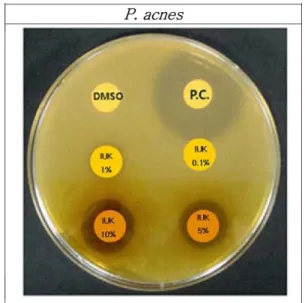
Table 1 showed the antimicrobial activity by DDT assay in vitro when they were treated with 0.1%, 1%, 5%, and 10% IUK against P. acnes, respectively. The results by
each strain were shown in Fig. 2. When 0.1-10% con- centration IUK, which is the test material, was treated, the significant antimicrobial activity was shown from 1%
concentration against P. acnesfrom. It still showed the remarkable antimicrobial activity, when it was compared with positive control, erythromycin.1-3
From cytotoxicity test, no concentration was detected to change the number of cells significantly in HaCaT cells treated with test material IUK, compared to the negative control group. In conclusion, HaCaT cell did not show any meaningful cytotoxicity upon the observation of cell viability after the treatment with 1-100 ppm test material IUK. Fig. 3 shows the results of cell viability by MTT assay. The control group was the negative one that noth- ing was processed to the test cell, and the data were dem- onstrated by Mean ± SD in the graph.4-7
The test material IUK (safflower extract) showed the meaningful effect in the test of NF-kB Luciferase inhi- bition assay. From the test result with IUK in a way of concentration dependent within the range of 0.1 to 10%
in the activity inhibition assay, 3600 log value of activity inhibition was observed at maximum at 10% concen- tration.
From the result of IUK anti-inflammation effect by NF-kB Luciferase inhibition assay, the used IUK dem- onstrated general decreasing trend of Luciferase inhibi- tion effect significantly within the range of IUK0.1-10%
as shown in Fig. 4. After all, this is considered that saf- flower extract, which has meaningful anti-inflammation activity, may have the efficacy on the acne of human facial skin.
In addition, while 3 out of 17 subjects (18%) did not show the significant improvement in the results of clinical trial after 2 months, the other 14 (82%) showed the remark- able improvement over 70%, upon the history taking results from the subjects with acne skin, as seen in Table 2.
No subject complained the adverse event such as skin rash during the trial period. As seen in the result of clinical pic- tures in 2 months when they completed the trial as Fig. 5, the acne of the subjects’ foreheads was improved remark- ably.
Table 1. Antimicrobial effect test by DDT (Disk Diffusion Test) assay P. acnes
P.C.a 0.002% 30
IUKb
10% 23
5% 17
1% 12
0.1% NE
aP.C: Positive control (P. acnes: 0.002% Erythromycin)
bIUK: IUK symbols for carthamus tinctorius flower extract
Fig. 2. Pictures of antimicrobial effect distribution by DDT (Disk Diffusion Test) assay.
Fig. 3. Cell viability in HaCaT cells cultured.
Fig. 4. NF-kB Luciferase inhibition assay test.
CONCLUSION
Upon the results of DDT assay in vitro, test material IUK against P. acnes, the acne strain, showed the mean- ingful antimicrobial efficacy compared to the control of erythromycin. This is because the main ingredient of IUK, polyphenol compound has the good antimicrobial activ- ity against acne germs as well as anti-oxidizing and anti- aging effects as published. In addition, test material IUK has an excellent cell viability compared to negative con- trol in MTT assay, which is considered that it will be tol- erable to the skin keratin cell in the toxicology test. This is considered that especially polyphenol compound may have the suppression effect to the acne skin where the trouble and the inflammation are generated easily since it has the remarkable anti-oxidizing and anti-microbial effects.
From the test result with IUK in a way of concentration dependent within the range of 0.1 to 10% in the activity inhibition assay, 3600 log value of activity inhibition at maximum was observed at 10% concentration by Lumi- nometer/Photometer Reader system. After all, this is con-
sidered that safflower extract, which has the excellent anti-inflammatory activity, may have the efficacy on the acne of human facial skin.
The results of clinical trial revealed that the continuous application over 2 months with cosmetic soap with com- posite mixture resulted in remarkable improvement, espe- cially on the acne in the forehead. This may be due to the improvement of circulation by well penetration of active ingredients of safflower extract to the skin as well as relieving stress from mental stabilization and resolving tension by glossy skin. Further studies will contribute the improvement of technology development for anti-acne cosmetics.
REFERENCES
1. Clark, A.; El-Feraly, F.; Li, W. J. Pharm. Sci. 1981, 951.
2. Mitscher, L. et al., J. Nat. Prod. 1980, 43(2), 259.
3. Park, J.; Lee, J.; Jung, E.; Park, Y.; Kim, K.; Park, B.;
Jung, K.; Park, E.; Kim, J.; Park, D. Eur. J. Pharmacol.
2004, 496(1-3), 189.
4. Van de Loosdrecht, A. A.; Nennie, E.; Ossenkoppele, G.
J.; Beelen, R. H.; Langenhuijsen, M. M. J. Immunol.
Methods. 1991, 141(1), 15.
5. De Marchis, F.; Ribatti, D.; Giampietri, C.; Lentini, A.;
Faraone, D.; Scoccianti, M.; Capogrossi, M. C. Facchiano A. Blood Mar. 15; 2002, 99(6), 2045.
6. Yu-ichi Tsukada, Keiji Miyazawa, and Naomi Kitamura.
J. Biol. Chem. 2001, 276, 40968.
7. Loosdrecht, A. A.; Nennie, E.; Ossenkoppele, G. J.; Bee- len, R. H.; Langenhuijsen, J. Immunol. Methods. Jul. 26;
1991, 141(1), 15.
Table 2. Improvement rate of acne skin
No Sex Age Period of Acne Trouble (Year) Period of Vivo Test (Month) Skin Irritation Improve-ment Rate(%)
1 M 20 6 2 NONE 80
2 M 20 5 2 " 90
3 M 20 5 2 " 70
4 M 20 4 2 " 80
5 M 20 4 2 " 50
6 M 20 6 2 " 90
7 M 20 1 2 " 60
8 M 20 1 2 " 50
9 M 20 1 2 " 60
10 F 20 10 2 " 80
11 M 23 1 2 " 90
12 F 20 1 2 " 90
13 M 49 1 2 " 90
14 F 49 1 2 " 80
15 F 48 1 2 " 90
16 M 20 4 2 " 70
17 M 20 3 2 " 80
Fig. 5. Clinical picture results of acne skin (in 2 months).