Root resorption is the loss of dental hard tissue as a re- sult of clastic activities.1The dental hard tissue of perma- nent teeth does not normally undergo resorption. The clas- sification of root resorption plays an important role for the clinician in the processes of diagnosis and treatment planning. Tooth resorption may be described according to location as internal or external resorption. External root resorption can be further classified into surface resorp- tion, external inflammatory resorption, external replace- ment resorption, external cervical resorption, and transient apical breakdown.2Some local factors cause external re- sorption, such as impacted teeth, orthodontic treatment, tumors and cysts, luxated or reimplanted teeth, periradic- ular inflammatory lesions, periodontal disease, and tooth bleaching. Systematic disorders including hypoparathy- roidism, hyperparathyroidism, calcinosis, Turner’s syn-
drome, Gaucher’s disease, and Paget’s disease have also been reported as the causative factors of external root re- sorption.3
Internal root resorption can be classified into internal inflammatory resorption and internal replacement resorp- tion.4Although the etiology and pathogenesis of internal resorption is not fully understood, it is generally caused by chronic infection or trauma,5and radiographically, in- ternal resorption appears as a well-demarcated, round-to- oval radiolucent widening or ballooning out of the pulpal root canal that is continuous with the walls of the canal itself on the radiograph.2,6
There are also some rare cases of tooth resorption of an unknown cause that do not fit into any of the above cat- egories; they are usually named “idiopathic root resorp- tion.”7
Two types of idiopathic root resorption have been ob- served: apical and cervical. Cervical root resorption begins at the cervical area of a tooth and progresses towards the pulp, whereas apical root resorption affects the apical por- tion of the tooth root and causes gradual shortening.8The
Multiple idiopathic external and internal resorption: Case report with cone-beam computed tomography findings
Berkan Celikten1,*, Ceren Feriha Uzuntas1, Hakan Kurt2
1Department of Endodontics, Faculty of Dentistry, Ankara University, Ankara, Turkey
2Department of Dento-Maxillo-Facial Radiology, Faculty of Dentistry, Ankara University, Ankara, Turkey
ABSTRACT
Root resorption is loss of dental hard tissue as a result of clastic activities. The dental hard tissue of permanent teeth does not normally undergo resorption, except in cases of inflammation or trauma. However, there are rare cases of tooth resorption of an unknown cause, known as “idiopathic root resorption.” This report would discuss a rare case of multiple idiopathic resorption in the permanent maxillary and mandibular teeth of an otherwise healthy 36-year- old male patient. In addition to a clinical examination, the patient was imaged using conventional radiography and cone-beam computed tomography (CBCT). The examinations revealed multiple external and internal resorption of the teeth in all four quadrants of the jaws with an unknown cause. Multiple root resorption is a rare clinical phenomenon that should be examined using different radiographic modalities. Cross-sectional CBCT is useful in the diagnosis and examination of such lesions. (Imaging Sci Dent 2014; 44: 315-20)
KEY WORDS: Cone-Beam Computed Tomography; Endodontics; Tooth Resorption
Received April 6, 2014; Revised June 5, 2014; Accepted July 9, 2014
*Correspondence to: Dr. Berkan Celikten
Department of Endodontics, Faculty of Dentistry, Ankara University, Besevler, Ankara 06560, Turkey
Tel) 90-312-296-56-23, Fax) 90-312-212-39-54, E-mail) [email protected]
Copyright ⓒ 2014 by Korean Academy of Oral and Maxillofacial Radiology
This is an Open Access article distributed under the terms of the Creative Commons Attribution Non-Commercial License (http://creativecommons.org/licenses/by-nc/3.0) which permits unrestricted non-commercial use, distribution, and reproduction in any medium, provided the original work is properly cited.
Imaging Science in Dentistry∙pISSN 2233-7822 eISSN 2233-7830
most common clinical feature of idiopathic root resorp- tion is that patients are generally asymptomatic with an occasional complaint of tooth mobility. Indeed, resorptive defects are generally found coincidentally on routine radio- graphic examinations.9The locations of resorbed teeth in documented cases have been variable. Such defects have been reported to affect the posterior or anterior quadrants or all teeth.10
Radiographic diagnosis is essential to ensure correct treatment of the affected tooth. Conventional radiographs are frequently used to detect and follow root resorption.1,4,7-
9However, apical shortening, lateral or cervical root gaps, enlargement of root canals, and external and internal root radiolucencies are typically not detectable on radiographs at an early stage (when they are small) or because of the limitations of this twodimensional method.11,12
Cone-beam computed tomography (CBCT) is a relative- ly new three-dimensional (3D) imaging modality requir- ing a significantly lower radiation dose than conventional computed tomography (CT). Endodontic applications of CBCT include the diagnosis of periapical lesions due to pulpal inflammation, the identification and localization of internal or external resorption, the detection of vertical root fractures, the visualization of accessory canals, and assessment of the causes of non-healing endodontically treated teeth. The detection and management of internal and external root resorption can be a challenging task and one for which CBCT is well suited.13
The treatment choice should be pulpectomy in the case of an internal resorption detected radiographically. If the resorption has not led to a large defect in the tooth struc- ture, the resorption can be stopped by an endodontic treat- ment.14
In general, when the cause of external resorption is
known, it can be treated by removing the etiologic fac- tor(s).3The prognosis is excellent if the condition is man- aged early before any significant loss of tooth structure occurs; however, if the resorption is dismissed, the prog- nosis is poor. Internal and external resorption represents different pathologic processes that require different treat- ment protocols; therefore, accurate diagnosis is necessary for excellent prognosis.15
In this report, we discuss a rare case of multiple idio- pathic external and internal resorption in the permanent maxillary and mandibular teeth of an otherwise healthy 36-year-old male patient evaluated using periapical/pano- ramic radiography and CBCT.
Case Report
A 36-year-old male was referred to our outpatient clinic for discomfort in the left mandibular second molar under a crown bridge restoration; he experienced slight discom- fort while chewing. There was no history of trauma, hos- pitalization, or medical, endocrine, or systemic disease.
Hematological investigations, including a complete blood count and measurement of the calcium, phosphorus, and alkaline phosphatase levels, revealed values within the normal range.
A clinical examination showed no tenderness upon pal- pation of the labial tissues over the periapical region of any tooth. There was no tenderness to percussion; how- ever, the patient felt discomfort while chewing with the left mandibular second molar. There was no evidence of adenopathy, paresthesia, or motor nerve deficiency in the head and neck area. A clinical examination revealed mod- erate oral hygiene and healthy gingival tissues. The mobil- ity of the teeth was within the normal range. An intraoral
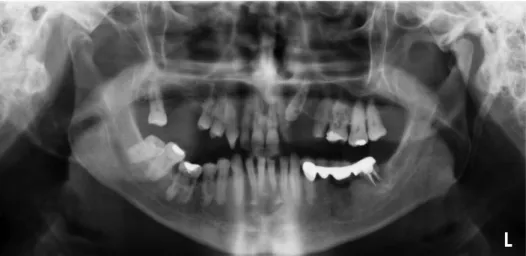
Fig. 1. Panoramic image shows multiple instances of idiopathic in- ternal and external root resorption.
L
examination also revealed that the patient was caries-free and had four amalgam restorations and a fixed bridge to replace lost mandibular premolars and molars.
All teeth except the bridge teeth were pulp-tested using a refrigerant spray and electrical pulp test, and all responded within normal limits. Periodontal probing was consistent- ly 3 mm or less, and no bleeding on probing was detected.
Initially, a panoramic radiograph was taken. The radio- graph showed evidence of resorption in several teeth, in-
cluding the right maxillary central incisor, first and second premolars, left maxillary central and lateral incisors, sec- ond premolar, and first molar, and the unerupted left max- illary canine (Fig. 1). A decision was made to perform CBCT with 3D reconstruction to obtain a more precise lo- cation and definition of the pathological features of the re- sorption sites. CBCT was performed in all three dimen- sions - axial, sagittal, and cross-sectional - with a slice thick- ness of 1 mm by using a Promax CBCT scanner (Planme-
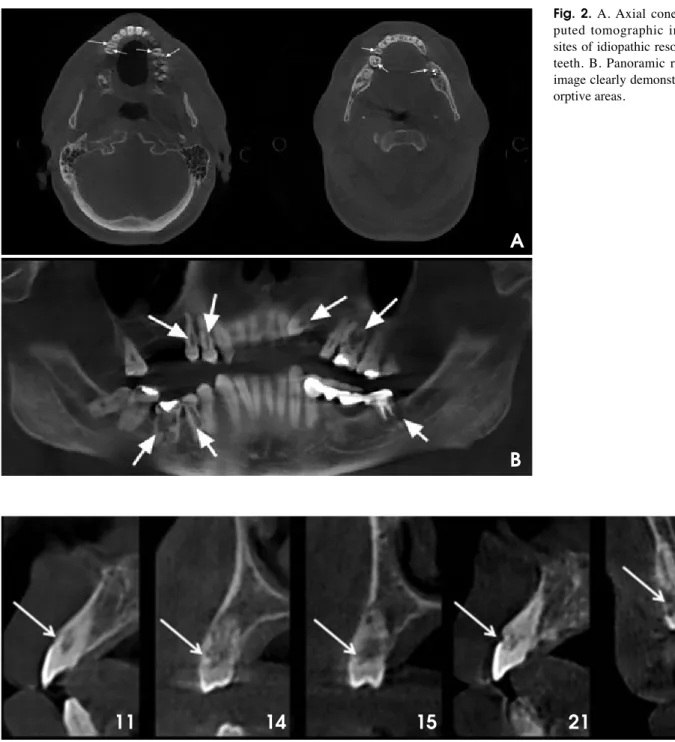
Fig. 2. A. Axial cone-beam com- puted tomographic images show sites of idiopathic resorption of the teeth. B. Panoramic reconstructed image clearly demonstrates the res- orptive areas.
A
B
Fig. 3.Cross-sectional cone-beam computed tomographic images show external resorption in molar teeth (arrows).
11 14 15 21 23
ca, Helsinki, Finland) together with 3D rendered images.
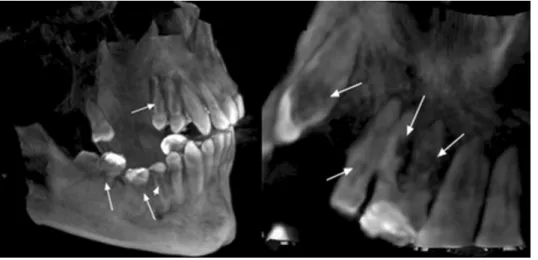
The axial (Fig. 2A) and panoramic reconstructed images (Fig. 2B) of the left maxillary first molar clearly showed multiple resorptive areas. The cross-sectional images showed internal resorption of the teeth, including the right maxillary central incisor, first and second premolars, left central and lateral incisors, canine, and right mandibular second premolar (Fig. 3). Further, external resorption was found in the teeth, including the left maxillary second pre- molar, first molar, mandibular second molar, and right mandibular first molar (Fig. 4). The 3D rendered images were not sufficiently clear to detect the nature or extent of the external or internal resorption of the teeth (Fig. 5).
Based on the diagnosis of multiple internal resorption from the panoramic and CBCT images, we decided to perform dental examinations of the patient’s family members to assess multiple resorption because of the possibility of a hereditary influence. However, no clinical or radiographic examination could be performed because it was not possi- ble to contact any of the family members. CBCT demon- strated that the lesions were generally larger than was evi-
dent from the periapical or panoramic films. No treatment was performed because the patient refused treatment.
Discussion
Root resorption of a tooth is a pathological process of in- ternal or external origin. Internal resorption occurs when the natural protection of the predentin and odontoblasts in the root canal is damaged or removed due to the transfor- mation of embryonic connective tissue cells into giant mul- tinucleate odontoclasts. The internal aspect of the root ca- nal is resorbed by activated multinucleate giant cells adja- cent to the granulation tissue in the inflamed pulp. Teeth in which the resorptive process reaches the cervical area of the crown may have a pinkish color, and are known as
“pink teeth,” resulting from granulation tissue ingrow- th.1,16
In contrast, external root resorption in multiple perma- nent teeth is a rare phenomenon. It occurs when the bal- ance between osteoblastic and osteoclastic activities, which maintain the physiological state of the tooth root and bone,
Fig. 4.Cross-sectional cone-beam computed tomographic images show internal resorption in molar teeth (arrows).
25 26 37 40
Fig. 5. Three-dimensional cone- beam computed tomographic vol- ume rendering images clearly show external and internal resorption (arrows).
is disturbed, resulting in the removal of the precementum and cementoblasts from the root surface.10
Resorption of the cementum, dentin, and/or enamel due to an unknown mechanism not depending on the condi- tions mentioned above, is called “idiopathic resorption.”
Idiopathic resorption in multiple roots is far rarer than re- sorption seen in one or two teeth, and it occurs in a differ- ent pattern from that seen in physiological resorption. Pos- sible causes include microbiologically induced osteoclas- tic or chronic inflammatory activity, familial (genetic) disorders, occlusal trauma, orthodontic tooth movement, systemic disorders, and drug use.8,10It is thought that the process involves the destruction of dentin followed by the creation of a bony matrix within the resorptive cavity.17 This case had no obvious etiological factor, so there might be a genetic component.
Multiple external resorption of permanent teeth is an un- commonly reported phenomenon. Further, certain idiopa- thic cervical root resorption cases have been reported.10,18,19 Soni and La Velle10and Brooks18reported that maxillary teeth were more commonly involved in such cases than mandibular teeth. Lynch and Ahlberg19 also observed the resorption of the upper first premolars.
Tooth resorption is a problem for dental practitioners, and early detection is important. Conventional radiogra- phic images are frequently used to detect root resorption.
However, apical shortening, lateral or cervical root gaps, enlargement of the root canal, and external root radiolu- cencies are typically not detectable on radiographs in the early stages when they are small or because of the limi- tations of this two-dimensional method. An alternative diagnostic tool for the early detection of root resorption is CBCT. It was used to detect root resorption in the present case report. Early detection can lead to timely interven- tion and better treatment outcomes. Root resorption ex- tension is identified by analyzing all lesion dimensions;
axial, transverse, and cross-sectional slices can be obtain- ed using CBCT. Root resorption measurements, as part of a longitudinal follow-up, can determine whether the lesion is in a stage of arrest, repair, or progression. The most im- portant advantage of this imaging modality is acquiring comparable images with much lower radiation doses than multiple-detector CT. In recent studies, it has been con- cluded that the scans produced by CBCT are more accu- rate than periapical radiographs and are an effective and safe way to detect both horizontal and vertical root frac- tures. It has also been concluded that CBCT should be considered when conventional radiographic techniques fail to provide information for the diagnosis.20-22
Although in the present case the initial diagnosis demon- strates that CBCT was superior in diagnostic efficacy to panoramic imaging with respect to the localization of the extension of the fibrous dysplasia because of the many affected bones through the skull, CBCT should not neces- sarily replace panoramic images for following-up the max- illary sinus region after surgery because it involves greater radiation exposure (4-20 times greater). From the stand- point of radiation risk, CBCT appears to involve 3-7 times the dose of a panoramic examination, depending on the area examined, the degree of collimation, and the acqui- sition software. Thus, the decision to select an imaging modality for diagnostic purposes should be based on the expected diagnostic yield and in accordance with the “as low as reasonably achievable” principle.20,21
In conclusion, our report presented a case of multiple root resorption, which was a rare clinical process that should be examined using different radiographic modal- ities. Cross-sectional and axial CBCT images would be useful in the diagnosis and assessment of such lesions.
References
1. Patel S, Ford TP. Is the resorption external or internal? Dent Update 2007; 34: 218-29.
2. Gunraj MN. Dental root resorption. Oral Surg Oral Med Oral Pathol Oral Radiol Endod 1999; 88: 647-53.
3. Sŏgur E, Sŏgur HD, Baksi Akdeniz BG, Sen BH. Idiopathic root resorption of the entire permanent dentition: systematic review and report of a case. Dent Traumatol 2008; 24: 490-5.
4. Heithersay GS. Management of tooth resorption. Aust Dent J 2007; 52: S105-21.
5. Gunraj MN. Dental root resorption. Oral Surg Oral Med Oral Pathol Oral Radiol Endod 1999; 88: 647-53.
6. Patel S, Dawood A. The use of cone beam computed tomo- graphy in the management of external cervical resorption le- sions. Int Endod J 2007; 40: 730-7.
7. Liang H, Burkes EJ, Frederiksen NL. Multiple idiopathic cer- vical root resorption: systematic review and report of four cases. Dentomaxillofac Radiol 2003; 32: 150-5.
8. Kim PH, Heffez LB. Multiple idiopathic resorption in the pri- mary dentition: review of the literature and case report. Oral Surg Oral Med Oral Pathol Oral Radiol Endod 1999; 88: 501-5.
9. Rivera EM, Walton RE. Extensive idiopathic apical root re- sorption. A case report. Oral Surg Oral Med Oral Pathol 1994;
78: 673-7.
10. Soni NN, La Velle WE. Idiopathic root resorption. Report of a case. Oral Surg Oral Med Oral Pathol 1970; 29: 387-9.
11. Ne RF, Witherspoon DE, Gutmann JL. Tooth resorption. Quin- tessence Int 1999; 30: 9-25.
12. Bernardes RA, de Moraes IG, Húngaro Duarte MA, Azevedo BC, de Azevedo JR, Bramante CM. Use of cone-beam volu- metric tomography in the diagnosis of root fractures. Oral Surg Oral Med Oral Pathol Oral Radiol Endod 2009; 108: 270-7.
13. Tyndall DA, Kohltfarber H. Application of cone beam volu- metric tomography in endodontics. Aust Dent J 2012; 57 Suppl 1: 72-81.
14. Tronstad L. Root resorption - etiology, terminology and clini- cal manifestations. Endod Dent Traumatol 1988; 4: 241-52.
15. Lyroudia KM, Dourou VI, Pantelidou OC, Labrianidis T, Pitas IK. Internal root resorption studied by radiography, stereo- microscope, scanning electron microscope and computerized 3D reconstructive method. Dent Traumatol 2002; 18: 148-52.
16. Keinan D, Heling I, Stabholtz A, Moshonov J. Rapidly pro- gressive internal root resorption: a case report. Dent Trauma- tol 2008; 24: 546-9.
17. Neely AL, Gordon SC. A familial pattern of multiple idiopathic cervical root resorption in a father and son: a 22-year follow- up. J Periodontol 2007; 78: 367-71.
18. Brooks JK. Multiple idiopathic apical external root resorption.
Gen Dent 1986; 34: 385-6.
19. Lynch EJ, Ahlberg KF. Bilateral idiopathic root resorption of upper first premolars. Int Endod J 1984; 17: 218-20.
20. Patel S, Dawood A, Ford TP, Whaites E. The potential appli- cations of cone beam computed tomography in the manage- ment of endodontic problems. Int Endod J 2007; 40: 818-30.
21. Hassan B, Metska ME, Ozok AR, van der Stelt P, Wesselink PR. Detection of vertical root fractures in endodontically treat- ed teeth by a cone beam computed tomography scan. J Endod 2009; 35: 719-22.
22. Orhan K, Aksoy U, Kalender A. Cone-beam computed tomo- graphic evaluation of spontaneously healed root fracture. J Endod 2010; 36: 1584-7.