ISSN 2234-3806 • eISSN 2234-3814
Ann Lab Med 2014;34:230-234
http://dx.doi.org/10.3343/alm.2014.34.3.230
Analysis of Reverse Transcriptase Gene Mutations in the Hepatitis B Virus at a University Hospital in Korea
A-Jin Lee, M.D.1, Chang Hyeong Lee, M.D.2, and Chang-Ho Jeon, M.D.1
Departments of Laboratory Medicine1 and Internal Medicine2, College of Medicine, Catholic University of Daegu, Daegu, Korea Background: Most mutations in the reverse transcriptase (RT) gene of the hepatitis B virus
(HBV) are related to resistance to antiviral agents. Cross-sectional studies on the mutations of this gene are rare. Thus, we analyzed the mutation patterns of RT genes and their bio- chemical parameters.
Methods: From 2009 to 2012, 301 blood specimens from patients with chronic hepatitis B at Daegu Catholic University Medical Center were retrospectively analyzed for the RT gene sequence of HBV, ALT, hepatitis B e antigen (HBeAg), and HBV DNA. The mutation patterns of the RT gene were compared with the biochemical parameters.
Results: Of the 301 patients, 100 (33.2%) had no RT gene mutations. The remaining showed the following mutation patterns: rtM204I/V (50.2%), rtL180M (39.2%), and rtA181T/V (19.6%). Combined mutations were found in 146 cases (48.5%). Of these, the combination of amino acid changes at rt180+rt204 (49.3%) was most frequently detected, followed by rt181+rt236 (11.0%) and rt173+rt180+rt204 (9.6%). In the mutated group, HBV DNA and HBeAg positive rates were significantly higher (P <0.05 for both). Pheno- typic analysis showed that lamivudine resistance was most frequently detected (34.6%), followed by adefovir resistance (15.6%). Multidrug resistance was detected in 48 cases (15.9%). The adefovir-resistant group had a higher proportion of cases with HBV loads greater than 2,000 IU/mL.
Conclusions: We found correlations between the mutation status of the RT domain and biochemical parameters such as HBV DNA and HBeAg positive rate. The presence of RT gene mutations could therefore be utilized to predict clinical status.
Key Words: Alanine aminotransferase, Hepatitis B e antigen, Hepatitis B virus, Mutation, Reverse transcriptase
Received: July 3, 2013
Revision received: October 7, 2013 Accepted: February 13, 2014 Corresponding author: Chang-Ho Jeon Department of Laboratory Medicine, College of Medicine, Catholic University of Daegu, 33 Duryugongwon-ro 17-gil, Nam-gu, Daegu 705-718, Korea Tel: +82-53-650-4144 Fax: +82-53-653-8672 E-mail: [email protected]
© The Korean Society for Laboratory Medicine This is an Open Access article distributed under the terms of the Creative Commons Attribution Non-Commercial License (http://creativecom- mons.org/licenses/by-nc/3.0) which permits unrestricted non-commercial use, distribution, and reproduction in any medium, provided the original work is properly cited.
INTRODUCTION
The average prevalence of hepatitis B surface antigen (HBsAg) in Korea was 3.2% in 2009 [1], making it an intermediate en- demic area. In high endemic countries, the hepatitis B virus (HBV) carrier rate is over 8%, while in low endemic countries, the rate is less than 2% [2].
Mutations in the reverse transcriptase (RT) gene of HBV are closely correlated with resistance to antiviral drugs [3-5]. The in- cidence, clinical outcome, and biological significance of these
mutants have been studied extensively. However, there have been only a few recent reports about HBV RT mutants in un- treated patients. Huang et al. [6] reported a 26.9% tyrosine, methionine, aspartate, aspartate (YMDD) mutation rate from 104 cases who had not received lamivudine or any other antivi- ral drugs within the last one year. Zhao et al. [7] reported the rate of natural YMDD mutations in Western China as 15.56%
from 270 antiviral non-treated (treatment naïve) chronic hepati- tis B patients. Moreover, Tan et al. [8] found natural YMDD mu- tations in 23.3% of 1,042 patients recruited from six centers in
China. They posited that the natural existence of YMDD mutant strains was associated with a larger HBV load in chronic hepati- tis B patients. However, their report did not rule out the possibil- ity of mutant virus infection from other sources, such as trans- mission from a carrier having a mutant HBV to treatment naïve chronic hepatitis B patients. Generally, YMDD mutant viruses disappear in a few months after lamivudine withdrawal [9].
However, during lamivudine therapy, patients’ continued social activity could be a possible source of HBV infection. Chronic hepatitis B patients infected with HBV mutants usually have the hepatitis B e antigen (HBeAg), and live among others without isolation in Korea.
Thus, it is necessary to know the prevalence of mutant HBV in the hospital-based survey. Most of the studies about RT gene mutations were longitudinal studies carried out after treatment with antiviral medications [10-12]. We investigated the cross- sectional mutation rates and patterns of the HBV at a university hospital, then compared them with biochemical parameters.
METHODS
1. Sample collection and sequencing of the reverse transcriptase gene
From 2009 to 2012, 301 specimens obtained from chronic hepatitis B patients who had been diagnosed and received anti- viral agents at the Daegu Catholic University Medical Center (DCUMC) were sent to Seoul Clinical Laboratory (SCL) (Seoul, Korea) for sequencing of the RT gene of HBV. Chronic hepatitis B was diagnosed as per the guidelines of the Korean Associa- tion of the Study of the Liver [13]. In the SCL, the RT gene from rt169 to rt250 was directly sequenced by using the ABI 3130 genetic analyzer (Applied Biosystems, Foster City, CA, USA).
2. Biochemical parameters
The biochemical parameters of ALT, HBeAg, and HBV DNA concentration were analyzed in the laboratory department of DCUMC. The levels of ALT and HBeAg were measured using Roche modular analytics (Roche Diagnostics, Mannheim, Ger- many), and the concentration of HBV DNA was measured using the COBAS AmpliPrep/COBAS TaqMan system (Roche Diag- nostics). For the point of mutation analysis, three-months-later ALT values, HBeAg, and DNA results were used for the data analysis. ALT values ≤40 IU/L were considered normal. HBV DNA concentrations were measured quantitatively, and we used the percentage of higher DNA concentration ( >2,000 IU/mL) for comparison of the selected groups. The mutation patterns
were analyzed and compared with the results of the biochemi- cal parameters.
3. Statistics
Chi square test using IBM SPSS 19.0 (SPSS Inc., Chicago, IL, USA) was used to compare the positive rates between the se- lected groups.
RESULTS
1. Mutation patterns of the hepatitis B virus reverse transcriptase gene
The amino acid changes of the RT gene from 301 specimens are described in Table 1. The rtM204I/V mutation (50.2%) was most frequently detected, followed by rtL180M (39.2%) and rtA181V/T (19.6%) mutations. No mutation was observed in 33.2% of the specimens. The presence of combined mutations was found in 146 cases (48.5%), and the frequency of com- Table 1. Mutation patterns of hepatitis B virus reverse transcriptase (RT) gene
Mutation Associated drug Number Percentage
No mutation None 100 33.2
rtI169T Entecavir 1 0.3
rtV173L Lamivudine 20 6.6
rtL180M Lamivudine 118 39.2
rtA181V Adefovir 21 7.0
rtA181T Adefovir 38 12.6
rtT184G Entecavir 0 0.0
rtT184S Entecavir 2 0.7
rtT184A Entecavir 4 1.3
rtT184I Entecavir 10 3.3
rtT184L Entecavir 7 2.3
rtT184F Entecavir 1 0.3
rtS202I Entecavir 0 0.0
rtS202G Entecavir 17 5.6
rtM204I Lamivudine 79 26.3
rtM204V Lamivudine 72 23.9
rtM204S Lamivudine 0 0.0
rtV207I Lamivudine 0 0.0
rtB236T Adefovir 25 8.3
rtP237H Adefovir 4 1.3
rtB238T Adefovir 2 0.7
rtB238D Adefovir 4 1.3
rtM250V Entecavir 1 0.3
bined mutations is shown in Table 2. Of the 146 cases, amino acid changes at rt180+rt204 (49.3%) was most frequently de- tected, followed by rt181+rt236 (11.0%) and rt173+rt180+
rt204 (9.6%).
It is difficult to ascertain the clinical significance by mutation analysis only using genotype. Thus, we classified the mutation patterns according to the expected phenotypes associated with drug resistance (Table 3). Lamivudine resistance was most fre- quently detected (34.6%), followed by adefovir resistance (15.6%). Multidrug resistance was detected in 48 cases (15.9%).
The type and duration of drug usage are shown in Table 3.
2. Comparison of biochemical parameters according to mutation status of the hepatitis virus B reverse transcriptase gene
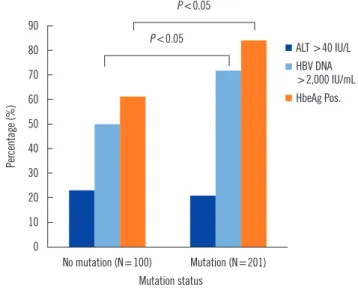
To determine the clinical significance of HBV RT gene mutations, we compared the ALT, HBV DNA concentration, and HBeAg positive rates between mutation-positive and -negative groups. In the mutation-positive group, HBV DNA and HBeAg positive rates were significantly higher (P <0.05, Fig. 1).
Table 3. Summary of hepatitis B virus reverse transcriptase (RT) gene mutation patterns according to expected phenotypes
Expected phenotype
(resistance) Number
(%) Mutated
gene Drug histories (duration, month*) No resistance 100 (33.2) No mutation LAM (N=30, 45.6±30.6),
ETV (N=36, 18.5±10.1), ADV (N=22, 34.5±13.8), TEL (N=7, 21.4±12.0), Unknown (N=5) LAM 104 (34.6) rt173,180,204 LAM (N=79, 52.1±29.4),
ETV (N=19, 28.7±16.4), ADV (N=36, 22.3±12.1), TEL (N=2, 10.0±1.4) LAM/ETV† 28 (9.2) rt169, 173,180,
184, 202, 204
LAM (N=26, 27.7±14.4), ETV (N=26, 33.0±9.5), ADV (N=6, 22.2±14.7) ADV 47 (15.6) rt181, 236, 237,
238
LAM (N=38, 31.2±19.9), ADV (N=47, 47.0±17.3) LAM/ADV† 18 (6.0) rt180, 181, 204,
237, 238
LAM (N=12, 42.6±19.2), ETV (N=2, 17.5±13.4) ADV (N=7, 36.3±19.7) LAM/ADV/ETV† 2 (0.7) rt173, 180, 181,
184, 202, 204
LAM (N=1, 27), ETV (N=2, 36.5±21.9), ADV (N=1, 42) Insignificant 2 (0.7) rt180 alone LAM (N=2, 20.5±17.7),
ADV (N=1, 52)
Total 301 (100.0)
*Values of duration are presented as mean±SD unless the number of case is one; †Multidrug resistant 15.9% (N=48).
Abbreviations: LAM, lamivudine; ETV, entecavir; ADV, adefovir.
Table 2. Combined mutation patterns of the hepatitis B virus re- verse transcriptase (RT) gene
Mutations Number Percentage
rt180, 204 72 49.3
rt181, 236 16 11.0
rt1173, 180, 204 14 9.6
rt180, 204, 184 9 6.2
rt180, 204, 181 8 5.5
rt180, 204, 184, 202 4 2.7
rt204, 237 3 2.1
rt204, 181 3 2.1
rt181, 236, 238 3 2.1
rt173, 204 2 1.4
rt180, 204, 238 2 1.4
rt204, 184 2 1.4
rt173, 180, 204, 184, 202 2 1.4
rt173, 180, 204, 250 1 0.7
rt173, 204, 184 1 0.7
rt180, 204, 236 1 0.7
rt180, 204, 169, 184 1 0.7
rt180, 204, 237 1 0.7
rt180, 181 1 0.7
Total 146 100.0
Fig. 1. Comparison of biochemical parameters according to the mutation status of the hepatitis B virus reverse transcriptase gene.
Abbreviations: HBV, hepatitis B virus; HBeAg Pos, hepatitis B e antigen positive.
Percentage (%)
90 80 70 60 50 40 30 20 10 0
No mutation (N=100) Mutation (N=201) Mutation status
P <0.05
P <0.05
ALT >40 IU/L HBV DNA
>2,000 IU/mL HbeAg Pos.
3. Comparison of the clinical parameters of groups with rt204 mutations in the hepatitis virus B reverse transcriptase gene
When the rtM204V and rtM204I mutation groups were com- pared, all 72 cases of rtM204V mutation had a simultaneous rtL180M mutation, while in 79 cases of rtM204I mutation, 43 cases (54.4%) had a simultaneous rtL180M mutation, 33 cases (41.8%) had the rtM204I mutation alone, and the remaining 3 cases (3.8%) showed a simultaneous rtV173L mutation. There was no statistical difference of HBeAg positive rates among rtM204V, rtL180M, and rtM204I mutant groups. There were no differences in ALT or HBV DNA levels among the different groups.
4. Comparison of clinical parameters according to the drug resistance patterns of hepatitis virus B reverse
transcriptase gene mutation
In the drug phenotype analysis of mutation, the adefovir-resis- tant group showed significantly higher HBV DNA concentration than the lamivudine-resistant group (P <0.05, Fig. 2). The ade- fovir-resistant group showed higher HBeAg positive rates than the lamivudine-resistant group but the difference was not signif- icant (P =0.087).
DISCUSSION
Most HBV RT gene mutation analyses are individualized longi-
tudinal studies carried out after the administration of antiviral agents. Important information on drug resistance mechanisms, such as time of appearance of resistance, and medication guidelines for resistant strains have been published and utilized for treatment. However, cross-sectional studies on mutation analysis in admitted patients are very rare. The results of cross- sectional studies might not be as easy to interpret as antimicro- bial resistant patterns in bacterial stains. Moreover, genotype to phenotype prediction was difficult owing to the multiple causes of antiviral drug resistance [13]. The therapeutic guidelines for chronic hepatitis B was established in 2004 and subsequently revised in 2007 and in 2011 in Korea [14]. The frequency of RT gene mutations was precipitated by antiviral treatment in Korea.
In our study, as expected, the rtM204I/V and rtL180M muta- tions related to lamivudine resistance were the most frequent, followed by the rtA181V/T mutation associated with adefovir re- sistance. No mutation was noted in 33.2% of the cases. It was reported that the infection rates of mutant virus in antiviral treat- ment naïve patients could be influenced by the mutant virus prevalence in the society [7, 8]. Where there is no available data for HBV mutation rates, the mutation rates in the chronic HBV patients visiting hospital might be utilized to postulate the infec- tion rates of mutant virus in antiviral treatment naïve patients.
In the analysis of mutation patterns according to the expected phenotype, multidrug resistance was detected in 15.9% cases.
Notably, two cases showing resistance to lamivudine, adefovir, and entecavir were HBeAg positive and had high HBV DNA concentration.
Comparing the mutant and wild type HBV RT groups, the mutant group had significantly higher HBV DNA and HBeAg positive rates. HBV DNA represents the amount of virus present in the blood, and can be used to monitor treatment [15, 16].
HBeAg has been also used to monitor the effectiveness of treat- ment [15, 17]. Taken together, both markers suggest that the virus is actively replicating and that the infection can be passed to others. Our results suggested that the mutated group had a higher likelihood of infecting healthy people.
The cases with the rtM204I mutation had higher HBeAg posi- tive rates than the cases with rtM204V/rtL180M; however, this difference was statistically insignificant. The rtM204V/rtL180M mutations are associated with much lower resistance to lamivu- dine than rtM204I alone [18]. In our study, rtM204V was always accompanied by rtL180M. The rtM204I mutation occurs alone followed by rtL180M mutation to increase viral replication [18].
Ono et al. [19] reported that rtM204I mutation alone had lower replication competency than rtL180M/rtM204V, but clinically Fig. 2. Comparison of clinical parameters according to the drug re-
sistance pattern of the hepatitis B virus reverse transcriptase gene mutation.
Abbreviations: HBV, hepatitis B virus; HBeAg Pos, hepatitis B e antigen positive; LAM, lamivudine; ETV, entecavir; ADV, adefovir.
Percentage (%)
90 80 70 60 50 40 30 20 10 0
(N=103)LAM LAM/ETV
(N=25) ADV
(N=47) LAM/ADV (N=18) Drug Resistance pattern
P <0.05
ALT >40 IU/L HBV DNA
>2,000 IU/mL HbeAg Pos.
there was no difference in ALT, HBV DNA levels, and HBeAg positivity [18], similar to our data.
Although genotype to phenotype correlation was difficult, the adefovir-resistant group showed significantly higher HBeAg-pos- itive rates than the lamivudine-resistant group. Since adefovir is usually used to treat lamivudine-resistant cases [5, 14], these results were concordant with the clinical course of chronic hep- atitis B patients. Our data showed that HBV replication was more difficult to suppress in the adefovir-resistant group than in the lamivudine-resistant group. We also showed increased HBV DNA concentrations in the adefovir-resistant group.
In conclusion, our results showed some correlation between RT gene mutation status and biochemical parameters. The mu- tated group showed significantly higher HBV DNA and HBeAg positive rates than the wild type group. The adefovir-resistant group showed significantly higher HBeAg positive rates than the lamivudine-resistant group. The results of RT gene mutations could be utilized to predict clinical status.
REFERENCES
1. Korea Centers for Disease Control and Prevention. The Fourth Korea National Health and Nutrition Examination Survey (KNHANES IV) 2009-Health Examination. Korea Centers for Disease Control and Pre- vention, 2010.
2. Franco E,Bagnato B, Marino MG, Meleleo C, Serino L, Zaratti L. Hepati- tis B: Epidemiology and prevention in developing countries. World J Hepatol 2012;4:74-80.
3. Hussain M and Lok AS. Mutations in the hepatitis B virus polymerase gene associated with antiviral treatment for hepatitis B. J Viral Hepat 1999;6:183-94.
4. Shaw T, Bartholomeusz A, Locarnini S. HBV drug resistance: mecha- nisms, detection and interpretation. J Hepatol 2006;44:593-606.
5. Yim HJ. Hepatitis B virus genetic diversity and mutant. Korean J Hepatol 2008;14:446-64.
6. Huang ZM, Huang QW, Qin YQ, He YZ, Qin HJ, Zhou YN, et al. YMDD mutations in patients with chronic hepatitis B untreated with antiviral medicines. World J Gastroenterol 2005;11:867-70.
7. Zhao J, Guo Y, Yan Z, Liang P, Zhang J, Liu Y. The natural YMDD muta- tions of hepatitis B virus in Western China. Scand J Infect Dis 2012;44:
44-7.
8. Tan YW, Ge GH, Zhao W, Gan JH, Zhao Y, Niu ZL, et al. YMDD motif mutations in chronic hepatitis B antiviral treatment naïve patients: a multi-center study. Braz J Infect Dis 2012;16:250-5.
9. Orlando R, Tosone G, Portella G, Veropalumbo E, D’Onofrio M, Piazza M.
Prolonged persistence of lamivudine-resistant mutant and emergence of new lamivudine-resistant mutants two years after lamivudine with- drawal in HBsAg-positive chronic hepatitis patient: a case report. Infec- tion 2008;36:472-4.
10. Wang F, Wang H, Shen H, Meng C, Weng X, Zhang W. Evolution of hepatitis B virus polymerase mutations in a patient with HBeAg-positive chronic hepatitis B virus treated with sequential monotherapy and add- on nucleoside/nucleotide analogues. Clin Ther 2009;31:360-6.
11. Bartholomeusz A and Locarnini S. Hepatitis B virus mutations associat- ed with antiviral therapy. J Med Virol 2006;78(S1):S52-5.
12. Moon JH, Cho M, Yoon KT, Bae JH, Heo J, Kim GH, et al. The efficacy of adefovir dipivoxil monotherapy and the incidence of genotypic resis- tance to adefovir dipivoxil in patients with lamivudine-resistant chronic hepatitis B infection. Korean J Hepatol 2008;14:503-12.
13. Locarnini S and Warner N. Major causes of antiviral drug resistance and implications for treatment of hepatitis B virus monoinfection and coinfection with HIV. Antivir Ther 2007;12(S3):H15-23.
14. Korean Association for the Study of the Liver. KASL Clinical Practice Guidelines: Management of chronic hepatitis B. Clin Mol Hepatol 2012;
18:109-62.
15. Yuen MF, Ng IO, Fan ST, Yuan HJ, Wong DK, Yuen JC, et al. Signifi- cance of HBV DNA levels in liver histology of HBeAg and Anti-HBe pos- itive patients with chronic hepatitis B. Am J Gastroenterol 2004;99:
2032-7.
16. Mommeja-Marin H, Mondou E, Blum MR, Rousseau F. Serum HBV DNA as a marker of efficacy during therapy for chronic HBV infection:
analysis and review of the literature. Hepatology 2003;37:1309-19.
17. Alagiozian-Angelova V, Alagiozian D, Antonov K, Krustev Z. Clinical sig- nificance of serum HBeAg and HBV-DNA-specific values of virus repli- cation in chronic hepatitis-B virus infection. Folia Med (Plovdiv) 1998;
40:34-41.
18. Enomoto M, Tamori A, Kohmoto MT, Morikawa H, Habu D, Sakaguchi H, et al. Mutational patterns of hepatitis B virus genome and clinical out- comes after emergence of drug-resistant variants during lamivudine therapy: analyses of the polymerase gene and full-length sequences. J Med Virol 2007;79:1664-70.
19. Ono SK, Kato N, Shiratori Y, Kato J, Goto T, Schinazi RF, et al. The poly- merase L528M mutation cooperates with nucleotide binding-site muta- tions, increasing hepatitis B virus replication and drug resistance. J Clin Invest 2001;107:449–55.