Outcomes for Patients with Hepatitis C Virus after Liver Transplantation in Korea
Jong Man Kim, M.D.
Department of Surgery, Samsung Medical Center, Sungkyunkwan University School of Medicine, Seoul, Korea
Hepatitis C virus (HCV)-related liver disease is the most common indication for liver transplantation (LT) in Western countries, whereas HCV LT is rare in Korea. We conducted a survey of HCV RNA-positive patients who underwent LT and investigated the prognostic factors for patient survival and the effects of immunosuppression. To accomplish this, we retrospectively reviewed the multicenter records of 192 HCV RNA-positive patients who underwent LT. The 1-, 3-, and 5-year overall survival rates were 78.8%, 75.3%, and 73.1%, respectively. Excluding cases of hospital mortality (n=23), 169 patients were evaluated. Most patients were genotype 1 (n=111, 65.7%) or genotype 2 (n=42, 24.9%). The proportion of living donors for LT (n=135, 79.9%) was higher than that of deceased donors (DDLT; n=34, 20.1%). The median donor and recipient ages were 32 and 56 years, respectively.
Twenty-eight patients (16.6%) died during the observation period, while 75 underwent universal prophylaxis and 15 received preemptive therapy. HCV recurrence was detected in 97 patients. Recipients who were older than 60, received DDLT, used cyclo- sporine, or suffered acute rejection had lower rates of survival. Acute rejection was closely associated with a lack of induction therapy, cyclosporine use, and universal prophylaxis after transplantation. The careful avoidance of acute rejection in the post-transplant period through adequate use of tacrolimus is a preferable strategy that increases patient survival following liver transplantation.
Key Words: Hepacivirus, Hepatitis C, Immunosuppression, Tacrolimus, Graft rejection, Survival, Antiviral agents
중심 단어: C형 간염 바이러스, 면역억제, 타크로리무스, 간이식 급성 거부 반응, 생존, 항바이러스 치료Received August 25, 2016 Accepted August 25, 2016
Corresponding author: Jong Man Kim
Department of Surgery, Samsung Medical Center, Sungkyunkwan University School of Medicine, 81 Irwon-ro, Gangnam-gu, Seoul 06351, Korea
Tel: 82-2-3410-1719, Fax: 82-2-3410-0040 E-mail: [email protected]
INTRODUCTION
An estimated 185 million individuals are chronically in- fected with hepatitis C virus (HCV) worldwide(1). Of all HCV-infected individuals, 20% to 30% develop liver cir- rhosis and 1% to 4% of all patients with liver cirrhosis de- velop hepatocellular carcinomas(2). HCV infection is the most common indication for liver transplantation (LT) in Western countries. In Korea, 1% to 2% of the population
is infected with HCV, and 15% to 20% of these infected individuals have chronic liver diseases related to HCV in- fection(3,4). As the prevalence has increased, HCV-related cirrhosis and HCV- related HCC will gradually become more common indications for LT in Korea(5).
Genetic variation in
interleukin-28B
(IL28B
) predicts hepatitis C treatment-induced viral clearance. Single nucleo- tide polymorphisms inIL28B
have varied distributions among ethnic groups. East Asian populations such as those in Korea, Japan, and China have the highest frequencies of single nucleotide polymorphisms in alleles associated with HCV clearance(6).Although LT offers the optimal treatment for HCV-re- lated end-stage liver disease and HCC, graft reinfection with HCV is not acute, but rather immediate and universal in all patients who are hepatitis C virus ribonucleic acid (HCV
Fig. 1. Patient survival rates. The 1-, 3-, and 5-year patient survival rates are 78.8%, 75.3%, and 73.1%, respectively.
RNA)-positive at transplantation(7). HCV RNA levels in- crease when immunosuppression is the highest during the first few months after transplantation. The progression of fibrosis in LT patients is accelerated compared to that in non-transplanted patients because the virus is more ag- gressive after LT than it is in immunocompetent subjects(1).
The relationship between HCV recurrence and im- munosuppression severity or type remains unclear due to a lack of good evidence.
Recurrent HCV infection after LT is associated with re- duced graft and patient survival(8). Progression to cirrhosis at 5 years occurs in 10% to 50% of LT patients(9), and the probability of liver graft failure is 42% within 12 months once cirrhosis is established(10). Immunosuppression for HCV patients requires a fine balance between suppressing immunity and maintaining an optimal host viral re- sponse(11). The effect of immunosuppression on recurrent HCV is difficult to assess.
Because there have been no reports of post-transplant HCV recurrence in HCV RNA-negative recipients, antiviral therapies based on PEGylated interferon-alpha (PEG-IFN) and ribavirin (RBV) have been used to treat HCV in de- compensated patients on the transplant waiting list until they are HCV RNA-negative(12). However, this therapy is limited due to poor tolerance, poor efficacy, and serious ad- verse events seen in those waiting for LT(8).
The cumulative number of HCV-related cirrhosis and HCV-related HCC cases in Korea is very small; therefore, we collected data of LT recipients with HCV from three major centers. We conducted a survey of HCV RNA-pos- itive patients who underwent LT and investigated the prog- nostic factors for patient survival and the effects of immunosuppression.
MATERIALS AND METHODS
1. Patients
This was a multicenter study involving three LT centers in Korea: Samsung Medical Center (SMC), Asan Medical Center (AMC), and Seoul National University Hospital (SNUH). We retrospectively evaluated patients undergoing their first LT between 1994 and 2012. Data from all consec- utive HCV RNA-positive cases were reviewed during this
period. Each institution utilized a survey with study ques- tionnaire items. Immunosuppression protocols, the treatment of rejection, and the treatment of recurrent HCV infection were not standardized across centers. The laboratory Model for End-stage Liver Disease (MELD) score was calculated at the time of transplantation.
Among the 255 cases with HCV-related cirrhosis who un- derwent LT during the study period, 63 cases were excluded due to re-transplantation (n=13) and HCV-RNA negativity (n=50). Among the remaining 192 included patients, we identified the causes for graft failure and mortality. We in- vestigated the risk factors associated with patient survival, but did not include hospital mortality (n=23).
RESULTS
1. Patient survival and outcomes
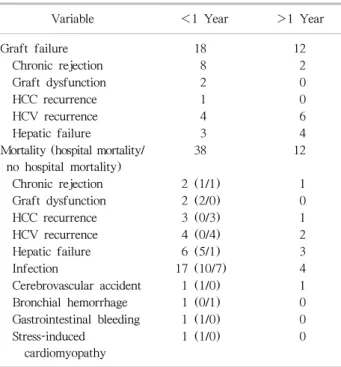
The 1-, 3-, and 5-year cumulative patient survival rates were 78.8%, 75.3%, and 73.1%, respectively (Fig. 1). The causes of graft failure and mortality are summarized in Table 1. Thirty patients (15.6%) developed graft failure during the observation period and 13 patients underwent re-transplantation. Fifty patients (26.0%) died during the observation period. Most cases of mortality (38/50, 76%) occurred less than 1 year after transplantation. The patient survival curve showed an abrupt decrease, but then stable survival after 2 years after transplantation and onward.
Recurrent HCV infection and hepatic failure (n=17) and
Table 1. The causes of graft failure and mortality
Variable <1 Year >1 Year
Graft failure 18 12
Chronic rejection 8 2
Graft dysfunction 2 0
HCC recurrence 1 0
HCV recurrence 4 6
Hepatic failure 3 4
Mortality (hospital mortality/
no hospital mortality)
38 12
Chronic rejection 2 (1/1) 1
Graft dysfunction 2 (2/0) 0
HCC recurrence 3 (0/3) 1
HCV recurrence 4 (0/4) 2
Hepatic failure 6 (5/1) 3
Infection 17 (10/7) 4
Cerebrovascular accident 1 (1/0) 1
Bronchial hemorrhage 1 (0/1) 0
Gastrointestinal bleeding 1 (1/0) 0 Stress-induced
cardiomyopathy
1 (1/0) 0
Abbreviations: HCC, hepatocellular carcinoma; HCV, hepatitis C virus.
Table 2. Baseline characteristics
Characteristic Value
Gender
Male 118 (69.8)
Female 51 (30.2)
Recipient age <60 years 117 (69.2)
HCV genotype
Unknown 9 (5.3)
Type 1 111 (65.7)
Type 2 42 (24.9)
Type 3 4 (2.4)
Type 6 3 (1.8)
Coexistence of hepatitis B virus 21 (12.4) Coexistence of hepatocellular carcinoma 77 (45.6) HCV-RNA level at transplantation (IU/mL) 133,568
(12∼26,000,000)
MELD score 16 (6∼50)
Type of liver transplantation
Deceased donor 34 (79.9)
Living donor 135 (20.1)
Donor age ≥30 years old 100 (59.2)
Donor gender
Male 123 (72.8)
Female 46 (27.2)
Graft type
Whole liver 33 (19.5)
Right Lobe 125 (74.0)
Left lobe 10 (5.9)
Split 1 (0.6)
Induction agent
None 64 (37.9)
Basiliximab 105 (62.1)
Calcineurin inhibitor
None 3 (1.8)
Cyclosporin 88 (52.1)
Tacrolimus 78 (46.2)
MMF 105 (62.1)
Data are presented as number (%) or median (range).
Abbreviations: HCV, hepatitis C virus; MELD, model for end-stage liver disease; MMF, mycophenolate mofetil.
chronic rejection (n=10) were the causes of graft failure.
Chronic rejection was the main cause of graft failure in pa- tients less than 1 year after transplantation. Infection (n=21) and recurrent HCV infection with hepatic failure (n=15) were the leading causes of recipient death. Infection was the main cause of hospital mortality in patients 1 year after transplantation.
2. Baseline characteristics
Among the 192 patients that were identified, we inves- tigated the 169 patients, who represented all patients except those who died in the hospital (n=23). The characteristics of the 169 HCV RNA-positive LT recipients compared in this study are summarized in Table 2. There were 118 men and 51 women, with a median age of 56 years (range: 34∼
71 years). The median follow-up period was 38 months (range: 1∼157 months), with a wide spectrum of follow-up duration due to death or shorter observation period from LT. The median MELD score and median HCV RNA levels were 16 (range: 6∼50) and 133,568 IU/mL (range: 12∼
26,000,000 IU/mL), respectively. One hundred eleven pa- tients (65.7%) had HCV genotype 1 and 42 patients (24.9%)
had HCV genotype 2. The number of patients with coexist- ing HBV infection, HIV infection, and HCC was 21 (12.4%), 1 (0.6%), and 77 (45.6%), respectively. There were 135 living donor liver transplantations (LDLTs) (79.9%) and 34 deceased donor liver transplantations (DDLTs) (20.1%). The median age of the donors was 32 years (range: 16∼70 years), and the graft type in the living donors was the right liver in 125 patients (74.0%). The me- dian cold ischemic time and median warm ischemic time
Table 3. Risk factors for patient survival
Univariate Odds ratio 95% Confidence interval P -value
Recipient gender (female) 0.880 0.387∼2.001 0.761
Recipient age ≥60 years 2.410 1.133∼5.128 0.018
Genotype
Type 1 1.392 0.185∼10.486 0.748
Type 2 2.100 0.265∼16.614 0.482
Pre-transplant antiviral treatment 2.048 0.897∼4.680 0.089
HCV RNA level 1.000 1.000∼1.000 0.023
Coexistence of hepatitis B virus 0.500 0.119∼2.110 0.346
Coexistenceof Hepatocellular carcinoma 0.828 0.390∼1.755 0.622
MELD score 0.990 0.941∼1.042 0.703
Deceased donor liver transplantation 2.475 1.119∼5.495 0.020
Donor age ≥30 years 3.214 1.216∼8.493 0.019
Donor gender (female) 0.889 0.376∼2.103 0.789
Cold ischemic time 1.000 0.997∼1.002 0.858
Warm ischemic time 1.005 0.994∼1.016 0.404
Induction agent (Basiliximab) 0.643 0.302∼1.369 0.252
Use of cyclosporin 2.475 1.089∼5.618 0.025
MMF 0.879 0.411∼1.881 0.740
Universal prophylaxis 1.421 0.668∼3.024 0.362
Preemptive treatment 0.663 0.154∼2.862 0.582
HCV recurrence 1.113 0.529∼2.344 0.778
Biopsy-proven acute rejection 4.013 1.909∼8.436 <0.001
Multivariate
Recipient age ≥60 2.277 1.014∼5.113 0.046
Deceased donor liver transplantation 2.398 1.041∼5.525 0.040
Use of cyclosporin 5.870 1.276∼11.909 0.029
Biopsy-proven acute rejection 4.338 1.884∼9.990 0.001
Abbreviations: HCV, hepatitis C virus; MELD, model for end-stage liver disease; MMF, mycophenolate mofetil.
were 81 and 39 minutes, respectively.
3. Prognostic factors for patient survival
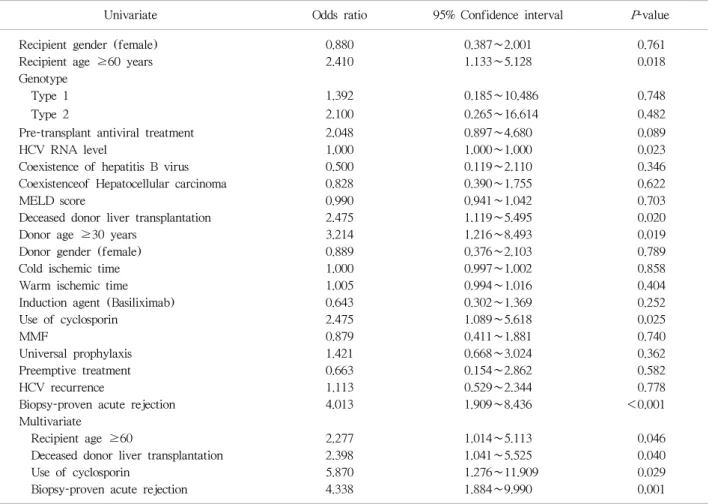
Recipient and donor factors were analyzed for their asso- ciation with overall mortality. The results of the univariate and multivariate analyses are shown in Table 3. The uni- variate analysis revealed that recipient age ≥60 years (
P
=0.018), HCV RNA levels at pretransplant (P
=0.023), DDLT (P
=0.020), donor age ≥30 years (P
=0.019), the use of cyclosporine (P
=0.025), and biopsy-proven acute re- jection (P
<0.001) were significant predictors of poor out- come in HCV RNA-positive recipients. The duration of ste- roid use did not affect patient survival. The ROC curve (receiver operating characteristic curve) did not reveal a significant cut-off value for HCV-RNA levels in terms of patient survival. The multivariate analysis showed that re-cipient age ≥60 years (
P
=0.046), DDLT (P
=0.040), the use of cyclosporine (P
=0.029), and biopsy-proven acute re- jection (P
=0.001) were independent prognostic factors for mortality. The Kaplan–Meier survival curves stratified by these factors are presented in Fig. 2.4. Antiviral treatments in pre- and post-transplant A summary of the antiviral treatments is shown in Table 4. Of the 169 recipients, 129 did not receive antiviral treat- ment in the pre-transplant period and 30 underwent anti- viral treatment. After LT, 75 patients received universal prophylaxis and 15 patients underwent preemptive treat- ment due to HCV reactivation. Most patients did not under- go a protocol biopsy, and HCV-RNA levels were monitored at every visit. HCV recurrence was detected in 97 patients (57.4%). Among the 97 patients with HCV recurrence, 48
Fig. 2. Patient survival according to recipient age, donor type, calcineurin inhibitor, and biopsy-proven acute rejection. Abbreviations: LDLT, living donor liver transplantation; DDLT, deceased donor liver transplantation; BPAR, biopsy-proven acute rejection.
patients were treated with antiviral therapy. The survival rates were higher in patients with sustained viral response (SVR) than in patients without SVR, but there was no stat- istically significant difference in patient survival between the two groups (
P
=0.062) (Fig. 3).5. Biopsy-proven acute rejection
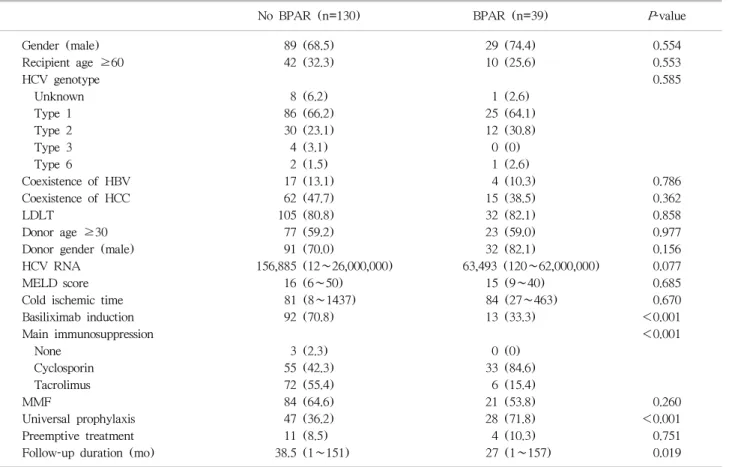
Biopsy-proven acute rejection occurred in 39 patients (23.1%). Most patients with acute rejection were treated with an increased immunosuppression dosage (n=9) or a calcineurin inhibitor change (n=23). Four patients were treated with steroid pulse therapy. Patients with biop- sy-proven acute rejection were associated with a lower pro- portion receiving basiliximab, a higher proportion receiving cyclosporine, and a more universal prophylaxis than patients without biopsy-proven acute rejection (Table 5).
DISCUSSION
Literature from the United Network for Organ Sharing (UNOS) database reported a 5-year patient survival rate of 76%, and a study from the European Liver Transplant Registry (ELTR) reported a 5-year patient survival rate of 65%(13,14). Recently, nationwide survey in Japan of LDLT reported a 5-year patient survival rate of 72%(15). Our study here is the largest case series of LT for HCV RNA- positive recipients in Korea. A total of 192 recipients from three large institutions were reviewed and found to have a 5-year patient survival rate of 73.1%. Based on these stud- ies, the outcomes of the present study may be superior to that of the ELTR and similar to that of the UNOS and Japanese survey. Comparisons of the survival rates of HCV recipients between studies should be interpreted with cau-
Fig. 3. Patient survival according to SVR. Patient survival in patients with SVR was higher than in patients without SVR, but there was no statistically significant difference in patient survival between the two groups. Abbreviations: SVR, sustained viral response.
Table 4. Antiviral treatment in pre- and post-transplant
Variable Value
Pre-transplant antiviral treatment 30 (17.8) Regimen of pre-transplant antiviral treatments
IFN 6
IFN and RBV 15
RBV 8
Unknown 2
Universal prophylaxis 75 (44.4)
Preemptive treatment 15 (8.9)
Post-transplant antiviral treatment
No treatment 81 (47.9)
IFN 4 (2.4)
IFN and RBV 74 (43.8)
RBV 9 (5.3)
Unknown 1 (0.6)
First protocol biopsy
None 138 (81.7)
<3 months 11 (6.5)
3∼6 months 8 (4.7)
6∼12 months 5 (3.0)
≥1 year 7 (4.1)
Interval of HCV RNA examination
None 2 (1.2)
Every visits 103 (60.9)
<3 months 32 (18.9)
3∼6 months 14 (8.3)
6∼12 months 8 (4.7)
≥1 year 10 (5.9)
HCV recurrence 97 (57.4)
HCV recurrence based on pathology 37
HCV recurrence based on HCV RNA 52
HCV recurrence based on LFT 41
SVR
Non-response 24
SVR achieved 64
Not assessed 9
Data are presented as number (%).
Abbreviations: IFN, interferon; RBV, ribavirin; HCV RNA, hepatitis C virus ribonucleic acid LFT, liver function test; SVR, sustained viral response.
tion because our study excluded patients with operative mortality, hospital mortality, and re-transplantation. The proportion of
IL28B
in Korea is higher than in European countries(6). The observation period of the databases used in Western countries was longer than the database used in Korea, which might reflect a bias from advances in surgical techniques and perioperative management in LT.Post-transplant viral load is an important marker of dis- ease severity, while pre-transplant viral load predicts more
severe HCV recurrence after transplantation(16). Negative HCV viral load at the time of transplantation does not pre- clude HCV recurrence in the liver graft. A peak post-trans- plant HCV viral load >107 IU/mL was an independent pre- dictor of graft loss and mortality(17). Our present study re- vealed that a high viral load was associated with mortality, but a cut-off value for the HCV RNA level was not drawn.
Universal prophylaxis should be initiated soon after LT be- cause the viral load is at its lowest level and fibrosis in the graft is absent(18). However, antiviral therapy may be less effective in the early post-transplant period secondary to strong immunosuppression, and tolerance is low because of the high risk of poor hematological tolerance, acute re- jection, and sepsis(19,20). In the present study, the in- cidence of biopsy-proven acute rejection in patients with universal prophylaxis was higher than in patients without universal prophylaxis.
Post-transplant patients with HCV recurrence have sig- nificantly diminished survival compared to post-transplant patients with no recurrence. The progression of recurrent HCV is variable and the key risk factors remain unclear.
Many factors have been reported to play a role prior to LT (genotype 1, viral load, and female gender) or after LT (time of cold or warm ischemia, blood transfusions, steatosis in the liver graft, age of the donor, the use of anti-lympho- cytes, and co-infection with HIV)(8,21). The early de- tection of HCV recurrence is crucial because HCV-infected
Table 5. Comparison of patients with and without biopsy-proven acute rejection
No BPAR (n=130) BPAR (n=39) P -value
Gender (male) 89 (68.5) 29 (74.4) 0.554
Recipient age ≥60 42 (32.3) 10 (25.6) 0.553
HCV genotype 0.585
Unknown 8 (6.2) 1 (2.6)
Type 1 86 (66.2) 25 (64.1)
Type 2 30 (23.1) 12 (30.8)
Type 3 4 (3.1) 0 (0)
Type 6 2 (1.5) 1 (2.6)
Coexistence of HBV 17 (13.1) 4 (10.3) 0.786
Coexistence of HCC 62 (47.7) 15 (38.5) 0.362
LDLT 105 (80.8) 32 (82.1) 0.858
Donor age ≥30 77 (59.2) 23 (59.0) 0.977
Donor gender (male) 91 (70.0) 32 (82.1) 0.156
HCV RNA 156,885 (12∼26,000,000) 63,493 (120∼62,000,000) 0.077
MELD score 16 (6∼50) 15 (9∼40) 0.685
Cold ischemic time 81 (8∼1437) 84 (27∼463) 0.670
Basiliximab induction 92 (70.8) 13 (33.3) <0.001
Main immunosuppression <0.001
None 3 (2.3) 0 (0)
Cyclosporin 55 (42.3) 33 (84.6)
Tacrolimus 72 (55.4) 6 (15.4)
MMF 84 (64.6) 21 (53.8) 0.260
Universal prophylaxis 47 (36.2) 28 (71.8) <0.001
Preemptive treatment 11 (8.5) 4 (10.3) 0.751
Follow-up duration (mo) 38.5 (1∼151) 27 (1∼157) 0.019
Data are presented as number (%) or median (range).
Abbreviations: BPAR, biopsy-proven acute rejection; HCV, hepatitis C virus; HBV, hepatitis B virus; HCC, hepatocellular carcinoma; LDLT, living donor liver transplantation; MELD, model for end-stage liver disease; MMF, mycophenolate mofetil.
patients appear to respond better to early antiviral ther- apy(21). The current clinical standard for early detection is for protocol liver biopsies to be performed every 1 to 2 years after LT, as HCV-infected recipients are at increased risk of HCV-mediated graft cirrhosis(22). Antiviral treat- ment is delayed until there is histological evidence of re- current hepatitis in many transplantation centers. However, none of the centers in the present study performed these protocol biopsies.
The successful treatment of recurrent HCV, which is demonstrated by sustained HCV clearance or an SVR, is as- sociated with reduced liver-related mortality and improved overall survival. The combination of PEG-IFN and RBV is the current standard of care(8,23). Our study also re- vealed this effect in the SVR group in recurrent HCV pa- tients, but this did not reach statistical significance.
However, the PHOENIX trial of PEG-IFN and RBV given
preemptively after the transplant for HCV found no clear benefits when considered in the context of side effects(20).
In a very small study, donor or recipient
IL28B
genotypes were shown to predict SVR with PEG-IFN and RBV ther- apy, andIL28B
status was related to SVR after LT(24).However, this effect of the
IL28B
genotype was not identi- fied in the present study, and our study did not reveal an association betweenIL28B
and patient survival.Prognostic factors, including recipient age >60 years, DDLT, the use of cyclosporin, and biopsy-proven acute re- jection, were closely associated with patient mortality. HCV- related post-transplant cirrhosis has increased with the in- creasing use of stronger immunosuppression(8,10). However, data on the relative risk of different immunosuppressive agents are highly controversial. Cyclosporin has weak anti- viral activity against HCV replication
in vitro
(25). Some studies have suggested that SVR rates are higher in patientsreceiving cyclosporin compared with those receiving MMF or tacrolimus(26,27), and that the risk of HCV recurrence in the cyclosporine group has been shown to be lower than in the tacrolimus group(28). The effect of calcineurin in- hibitors on HCV progression is highly controversial, with conflicting data exist regarding the relative risk of tacroli- mus compared with cyclosporine. Most prospective studies suggest that there is no difference between cyclosporin- based regimens and tacrolimus-based regimens for liver his- tology, acute rejection, graft survival, or mortality(29,30).
A recent analysis of the Scientific Registry of Transplant Recipients demonstrated that tacrolimus is associated with reduced mortality and graft cirrhosis in HCV patients(31).
These studies comparing cyclosporine and tacrolimus sup- ported the notion that tacrolimus might provide protection against graft cirrhosis in HCV recurrence. However, there is insufficient evidence to recommend the use of one calci- neurin inhibitor over another because appropriately pow- ered randomized controlled trials comparing antiviral thera- pies for recurrent HCV are lacking.
Acute rejection in conjunction with cyclosporine treat- ment is one of the most critical factors that influence pa- tient survival. There are adverse effects of both early and repeated episodes of acute cellular rejection and its treat- ment on the progression of HCV graft fibrosis(32). Our study suggests that careful avoidance of acute rejection in the post-transplant period through adequate use of tacroli- mus is a preferable strategy, because cyclosporin is asso- ciated with a greater incidence of acute rejection.
The findings of this retrospective, multicenter study are limited by several factors inherent to the study type, includ- ing variability in documentation, differences in the selection criteria and data collection, and missing data. To minimize variability, we sent a standardized collection form contain- ing 56 questions to the transplant centers. The answers were either multiple-choice or involved providing a name or a specific value. However, the quality of the pre-transplant interviews from which the baseline data were derived, and the quality of the post-transplant follow-up data across the three centers may have varied. Furthermore, subjects had varying follow-up durations. We did not have data on the onset of biopsy-proven acute rejection or the date of graft failure. To address these limitations, a well-designed pro-
spective study is needed.
CONCLUSION
This retrospective analysis of the largest three liver trans- plantation centers for HCV RNA-positive recipients in Korea revealed 1-, 3-, and 5-year survival rates of 78.8%, 75.3%, and 73.1%, respectively. The prognostic factors for patient survival except hospital mortality revealed that re- cipient age >60 years old, DDLT, the use of cyclosporin, and biopsy-proven acute rejection are closely associated with patient mortality. Based on the present results, calci- neurin inhibitor selection for HCV RNA-positive recipients should be carefully reviewed to prevent biopsy-proven acute rejection and to improve patient survival.
ACKNOWLEDGEMENTS
I would like thank to Professor, Kwang-Woong Lee (Department of Surgery, Seoul National University Hospital, Seoul National University College of Medicine) and Professor, Gi-Won Song (Division of Hepatobiliary Surgery and Liver Transplantation, Department of Surgery, Asan Medical Center, University of Ulsan College of Medicine) for present study.