• 검색 결과가 없습니다.

Current status and strategies for hepatitis B control in Korea

N/A
N/A
Protected

Academic year: 2021

Share "Current status and strategies for hepatitis B control in Korea"

Copied!
7
0
0

로드 중.... (전체 텍스트 보기)

전체 글

(1)

https://doi.org/10.3350/cmh.2017.0104 Clinical and Molecular Hepatology 2017;23:205-211

Review

Corresponding author : Yoon Jun Kim

Department of Internal Medicine and Liver Research Institute, Seoul National University Hospital, 101 Daehak-ro, Jongno-gu, Seoul 03080, Korea.

Tel: +82-2-2072-3081, Fax: +82-2-743-6701 E-mail: [email protected]

http://orcid.org/0000-0001-9141-7773 Abbreviations:

HBV, hepatitis B virus; HBsAg, hepatitis B surface antigen; HBIG, hepatitis B immunoglobulin

Received : Apr. 3, 2017 / Accepted : Apr. 5, 2017

INTRODUCTION

Hepatitis B virus (HBV) infection is an important public health problem worldwide and a major cause of chronic hepatitis, cir- rhosis, and hepatocellular carcinoma.

1

Although the prevalence of chronic HBV infection is decreasing in Korea as a result of the HBV vaccination program, it is still a major cause of liver-related morbidity and mortality. This review describes an overview of changing epidemiology of HBV infection in Korea, current strate-

gies for control of hepatitis B, and policy proposals to eradicate hepatitis B.

CURRENT STATUS OF HEPATITIS B IN KOREA Prevalence of hepatitis B virus infection in Korea

Before the introduction of the hepatitis B virus (HBV) vaccine,

Current status and strategies for hepatitis B control in Korea

Eun Ju Cho

1

, Sung Eun Kim

2

, Ki Tae Suk

3

, Jihyun An

4

, Soung Won Jeong

5

, Woo Jin Chung

6

, and Yoon Jun Kim

1

1

Department of Internal Medicine and Liver Research Institute, Seoul National University College of Medicine;

2

Department of Internal Medicine, Hallym University Sacred Heart Hospital, Hallym University College of Medicine, Anyang;

3

Department of Internal Medicine, Hallym University College of Medicine, Chuncheon;

4

Asan Medical Center, University of Ulsan College of Medicine, Seoul;

5

Department of Internal Medicine, Soonchunhyang University Hospital, Seoul; 6Department of Internal Medicine, Keimyung University School of Medicine, Daegu, Korea.

Hepatitis B virus (HBV) infection is the most common cause of chronic liver diseases in Korea. After the introduction of

the universal HBV vaccination program, the prevalence of hepatitis B surface antigen was markedly reduced, and Korea is

now classified as an area of intermediate endemicity for HBV. However, there are still hurdles for elimination of hepatitis B,

such as immunoprophylaxis failure against vertical transmission, occurrence of acute hepatitis B among peoples who did

not have vaccination at younger age, and rapid increase of immigrant populations from HBV endemic areas. To achieve

the World Health Organization goal of viral hepatitis elimination by 2030 in Korea, we suggest comprehensive policies

for more effective control of hepatitis B as following: i) insurance coverage for antiviral prophylaxis in mothers with high

viremia, ii) screening for hepatitis B seromarkers and catch-up HBV vaccinations of susceptible persons with hepatitis

B, iii) establishment of an independent 'viral hepatitis sector' in Centers for Disease Control & Prevention to organize and

execute comprehensive strategy for management of viral hepatitis, iv) encourage of management of HBV infection in

immigrant populations, v) national campaign to promote awareness of hepatitis B. (Clin Mol Hepatol 2017;23:205-211)

Keywords: Viral hepatitis; Hepatitis B; Korea

(2)

the prevalence of HBV carriage ranged from 8–10% in the 1980s and early 1990s.

2

After the launch of the universal vaccination program, the overall prevalence of hepatitis B surface antigen (HBsAg) has decreased from 4.6% in 1998 to 2.9% in 2008, and has been maintained at 2.9% since 2013 without significant changes. The rates of HBsAg carriage were consistently higher in males than in females, but the difference gradually decreased from 1.1% in 1998, to 0.5% in 2014. The rates peaked in 1998 among individuals between the ages of 35-39 years, whilst in 2013, individuals between the ages of 50-54 years recorded the highest rates. Specifically, the rates of HBsAg carriage in subjects

>10 years old decreased from 4.6% in 1998 (5.1% in males and 4.0% in females), to 2.9% in 2013 (3.1% in males and 2.5% in females). In 2014, the rates were lowest in subjects aged 10-29 years, with <1% for subjects between 10-19 years old and around 1% for subjects between 20-29 years old. The highest rates were observed in males aged 30-59 years (4-5%), and females aged 60- 69 years (4%) (Fig. 1). In the assessment of pediatric and adolescent population, subjects between the ages of 10-19 years showed sero- positive rates of 2.2±0.4% in 1998, 1.9±0.5% in 2001, 1.9±0.7% in 2007, 0.2±0.1% in 2009, 0.1±0.1% in 2011, and 0.4±0.4% in 2013, showing significant reduction over time ( P <0.001).

According to the 2009 census performed in 290,212 individuals of age and gender-standardized population, significant regional variation appeared. Seropositive rates were higher in Jeju island, Kwangju, Jeonnam, Busan, and Kyungnam (Fig. 2).

Incidence of acute hepatitis B

Since 2006, acute hepatitis B has been categorized as a group 2 nationally notifiable infectious diseases, and the monitoring sys- tem has been changed from a sentinel monitoring system to a mandatory surveillance system since 2010. In the 1980s, about 60% of patients with acute viral hepatitis were infected with

0.0 1.1

5.5

4.4 4.5

2.4

0.9

0.3 1.7

3.2 3.7

2.5 4.0

2.4

0 2 4 6 8 10

10- 19 20-

29 30- 39 40-

49 50- 59 60-

69 70+ 10-

19 20- 29 30-

39 40- 49 50-

59 60- 69 70+

남자 여자

(%)

Male Female

Figure 1. Prevalence of HB- sAg by age and sex group.

Adopted from Korean Na- tional Health and Nutritional Examination Survey in 2014.

Gyeonggi (3.7%) Seoul (3.5%) Incheon (3.6%) Chungnam (2.9%) Chungbuk (3.8%) Daejeon (4.5%) Jeonbuk (3.9%) Gwangju (5.0%) Jeonnam (5.6%) Jeju (5.9%)

Gangwon (3.7%) Gyeongbuk (3.9%) Daegu (4.2%) Ulsan (4.6%)

Gyeongnam (4.5%)

Busan (4.7%)

Figure 2. A nationwide seroprevalence of HBsAg in 2009, Korea. Pre-

sented in 18th annual meeting of the Korean Association for the study

of the Liver.

(3)

HBV.

3

This has decreased to approximately 5% of recent acute vi- ral hepatitis cases in Korean adults,

4

and the occurrence of acute hepatitis B has consistently decreased (Table 1). Most of the acute hepatitis B patients in the early 1980s were aged 10-29 years.

Recently, acute hepatitis B occurs in subjects aged 30-40 years, who were born before the introduction of the HBV vaccination program (Fig. 3).

5

Because transverse transmission of HBV may still occur in unvaccinated and uninfected adults, an adult without a complete set of previous vaccinations should be given ‘catch-up’

HBV vaccinations to prevent acute HBV infection.

Prevalence of HBV infection in a specific population

According to a report from Hanawon, the Unification Ministry’s

half-way house, 669 of 6,087 (10.9%) North Korean defectors were diagnosed with hepatitis B during routine health checkup.

Considering that the seroprevalence of HBsAg in the South Kore- an at a similar period was around 4%, the management of hepa- titis B in North Korea may be poor. Meanwhile, according to re- sults of the free health checkup offered to foreign workers during the “Liver Day” event hosted by the Korean Association for the Study of the Liver and Korean Liver Foundation, the seropreva- lence of HBV and HCV significantly differed between countries;

specifically, Chinese and Mongolian workers had higher preva- lence of hepatitis B (Table 2). Because illegal residents / foreign workers, unlike those who are legally admitted, undergo no medi- cal screening, the rapidly increasing population of illegal aliens has also set off a resurgence of contagious diseases such as hepa- titis B. Therefore, it is necessary to ensure that everyone has ac- cess to basic medical care, not only to ensure adherence to basic human rights, but also for public health.

CURRENT STRATEGIES FOR CONTROL OF HEPATITIS B

Prevention of perinatal infection

Hepatitis B is most commonly spread from mother-to-child transmission in highly endemic areas. During the 1980s, about 11% of neonates in Korea were infected with HBV via vertical Table 2. Prevalence of hepatitis B in foreign workers

Nation

According to the

literature 2010 2011 2012 2013

HBV HCV HBV HCV HBV HCV HBV HCV HBV HCV

Chinese 7.18% 0.43% 7.8% 11.2% 13.3% 6.7%

Mongolia 11.8% 15% 10.6% 9.1% 9.1% 4.5% 10.3% 8.9%

Adopted from White paper on liver disease in Korea, 2013.

HBV, hepatitis B virus; HCV, hepatitis C virus.

Table 1. Annual incidence of HBV infection

Annual incidence 2004 2005 2006 2007 2008 2009 2010 2011 2012 2013 2014 2015

Acute hepatitis B 537 650 1,211 1,588 1,612 1,746 1,486 462 303 117 173 155

H BsAg-positive pregnant

women 9,192 7,339 6,985 6,980 5,584 3,813 3,581 936 2,428 3,211 3,912 3,468

Vertical transmission 2 9 18 6 6 7 18 30 26 59 30 43

Source: Korea Centers for Disease Control and Prevention (2015).

HBV, hepatitis B virus.

50 40 30 20 10 0

Percentage of patients (%)

Age (years) 46%

14%

0%

23%

10%

7%

10-19 20-29 30-39 40-19 50-59 60-

Figure 3. Age distribution of acute hepatitis B. Adopted from the Kore-

an Journal of Hepatology; 2011.

5

(4)

transmission. Particularly, the vast majority (i.e. 65-93%) of un- vaccinated infants born to hepatitis B e antigen-positive mothers became infected.

2

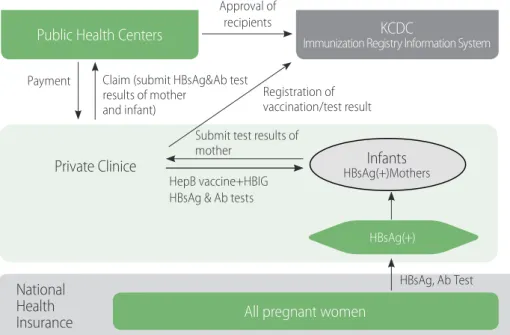
Therefore, the Ministry of Health and Welfare and Korea Centers for Disease Control and Prevention have been organizing HBV vertical transmission prevention program since July 2002, which provides complete financial support for HBV vac- cination and tests for newborns from HBsAg-positive mothers. All pregnant women check for HBsAg prior to delivery, and infants born to carrier mothers receive hepatitis B immunoglobulin (HBIG) at birth; HBV vaccination at birth and at 1 and 6 months of age;

and test for HBsAg and antibody to HBsAg at 9-15 months of age (Fig. 4). The mothers submit the health checks to clinics, and the clinics submit the serologic test results of mothers and infants to public health centers. The results were forwarded to the Immuni- zation Registry Information System, where the details were used to manage the program and measure compliance.

Through these endeavor, 180,690 out of 188,224 newborns (~96%) born to carrier mothers participated in the prevention

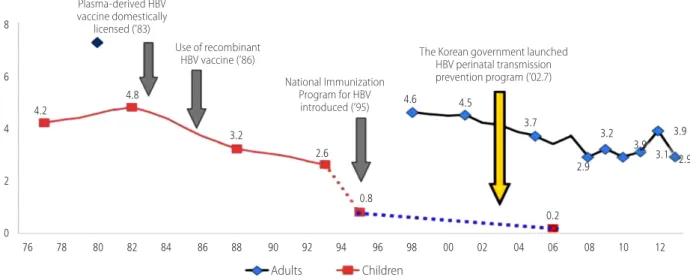
program between July 2002 and December 2014. Of them, 84,000 (~85.7%) newborns had completed the 3-dose vaccina- tion regimen and acquired immunity (Table 3). The completion rate has increased from 92.9% in 2008, to 99.4% in 2013, and the rate of possible HBV infection decreased about 93%. The se- roprevalance of HBsAg has remarkably reduced to ~3.1% in indi- viduals >10 years old, and to 0.2% in 4-6 years old infants (Fig.

5), which implies that perinatal transmission, the most important route of HBV infection in Korea, may continue to decrease.

POLICY PROPOSALS TO ERADICATE HEPATITIS B IN KOREA

Antiviral therapy in pregnant women with high viremia

Although the combination of passive and active immunization Table 3. Results of hepatitis B serologic test (from July 2002 to December 2014)

Test results Number of persons Rates (%)

Immunoprophylaxis success (97.1%) HBsAg (-) /anti-HBs Ab(+) 84,201 85.7

HBsAg (-) /anti-HBs Ab(-) 11,214 11.4

Immunoprophylaxis failure (2.9%) HBsAg (+) /anti-HBs Ab(-) 2,674 2.7

HBsAg (+) /anti-HBs Ab(+) 141 0.1

98,293 100.0

Source: Korea Centers for Disease Control and Prevention (2016).

Figure 4. Korean program for im- plementing perinatal transmission prevention. Source: Korea Centers for Disease Control and Prevention (2016).

Public Health Centers

All pregnant women

Immunization Registry Information System KCDC

Infants

HBsAg(+)Mothers

HBsAg(+)

Private Clinice

Submit test results of mother

Registration of vaccination/test result Approval of

recipients

HepB vaccine+HBIG HBsAg & Ab tests

National Health Insurance

HBsAg, Ab Test Claim (submit HBsAg&Ab test

results of mother

and infant)

Payment

(5)

reduces the vertical transmission rate from 90% to 10%, immu- noprophylaxis fails in 10 to 30% of infants born to mothers with serum HBV DNA levels >10

6

IU/mL.

6,7

Recent large-scale study showed that tenofovir treatment during the third trimester could reduce the maternal viral load and prevent vertical transmission of HBV.

8

Thus, mothers with high levels of HBV DNA should be in- formed that utilizing a prophylactic antiviral therapy could add to the effectiveness of HBIG and vaccination. However, current health insurance systems do not cover antiviral therapy in this sit- uation. To solve the problem, antiviral therapy for mothers with high viremia in third trimester should be covered by the insurance.

Catch-up vaccination

Conventionally, catch-up vaccination for unprotected population has not been involved in the national policy to control hepatitis B.

However, acute HBV infection sporadically occurs among adoles- cents and adults who did not have vaccination at younger age.

Therefore, it is necessary to assess the prevalence of HBsAg, and age groups with HBsAg-positive rate >1%. For example, in the U.S., HBV infection rates were high for infants of mothers who had migrated from high level or intermediate level endemic areas (such as Alaska or islands in Pacific Ocean). For them, additional guideline were established and catch-up vaccinations for 11-12 years old adolescents, and high-risk adults were provided. In Alaska, universal infant vaccination coupled with population-wide screening and vaccination for susceptible persons has eliminated HCC and acute symptomatic HBV infection.

9

With an increasing

number of North Korean defectors, catch-up vaccination for sus- ceptible persons could be an effective method to prevent addi- tional HBV transmission.

In addition, mass screening for hepatitis B seromarkers is war- ranted. Even in the cases of successful prevention of perinatal in- fection, there is still a risk of HBV infection during the transition to adulthood. According to the ‘Outbreak report of nationally notifi- able infectious diseases by the Ministry of Health and Welfare, acute HBV infection still occurs among adolescents and adults due to sexual contact, parenteral drug use, receipt of blood products, dialysis, and occupational exposures. Thus, appropriate education about high-risk behaviors and immunization of susceptible persons with hepatitis B may be needed to prevent new HBV infections.

Integrated control of hepatitis B by the establishment of national center for viral hepatitis

Currently, five independent parts at Centers for Disease Control

& Prevention are involved in managing viral hepatitis, and there is no control center; therefore, an integrated and effective manage- ment of viral hepatitis is not feasible. National health plans should provide the overall strategic direction for the health sector. It is im- portant that specific planning for priority areas, such as vaccination program, management of HBV-related disease, epidemiologic in- vestigation, and research of viral hepatitis, is aligned with national health plans. However, there is often a disconnection between planning for center-specific programs and national strategies which are often performed by different constituencies. This leads to frag-

Plasma-derived HBV vaccine domestically

licensed (’83)

Adults Children

Use of recombinant HBV vaccine (’86)

National Immunization Program for HBV

introduced (’95)

The Korean government launched HBV perinatal transmission prevention program (’02.7)

Figure 5. Trends in the prevalence of HBV infection according to implementation of national HBV vaccination program. Source: Korea Centers for Dis- ease Control and Prevention (2016). HBV, hepatitis B virus.

8

6

4

2

0

76 78 80 82 84 86 88 90 92 94 96 98 00 02 04 06 08 10 12 4.2

4.8

3.2

2.6

0.8

0.2 2.9 3.7 3.2

4.6 4.5

3.9

3.1 2.9

3.9

(6)

mentation and increased costs in the implementation of programs.

Therefore, it is important to integrate disease-specific plan in na- tional health plans, and integrate disease-specific services within the currently available health services. To achieve the goal of viral hepatitis elimination by 2030 in Korea, establishment of an inde- pendent ‘viral hepatitis sector’ in Centers for Disease Control &

Prevention is needed to organize and execute comprehensive strategy for the management of the viral hepatitis.

Management of HBV infection in immigrant populations

Rapid increase in international migration is a worldwide trend.

Mobile populations present unique health care concerns for soci- ety. In many developed countries, immigrants from high endemic areas may be partly related to an increasing burden of chronic HBV infection.

For a long time, Koreans had little experience with other ethnic groups. Recently, the sudden influx of foreign workers and in- creasing number of international marriage imposes challenges for both Koreans and migrants, heightening the risk for HBV infec- tion. According to monthly statistics published by the Ministry of Justice and Korea Immigration Service in 2015, the number of for- eigners as of January 2015 was 1,774,603. More than half of them came from HBV endemic areas such as Chinese (918,951, 51.8%), Vietnam (129,423, 7.3%), Philippines (51,836, 2.9%), and Indonesia (42,520, 2.4%). Furthermore, according to health check supported by the Ministry of Health and Welfare in 2008, about 40 to 60% of immigrants wives were susceptible to HBV infec- tion.

10

However, available resources for HBV prevention and care are targeted to Koreans, and migrants have little access to health services. According to the ‘Survey on labor rights of migrant work- ers’ by the Joint Committee with Migration in Korea, 80.9% of the workers were working over 10 hours a day, and 31.9% were work- ing 12 hours a day. Among them, only 27% had regular health check as most of the workers could not spare time during the day time. In most cases, the workers visited the free clinics for migrant workers on Sunday, or waited until the symptoms worsened. In ad- dition to structural problems, cultural and linguistic barriers also limit accessibility, and the illegal status of workers may cause them to actively avoid government health services. Therefore, the assess- ment of health conditions for future immigrants is an important is- sue waiting for the government’s attention. Children of foreigners must also be included in intervention activities for preventing peri- natal infection. Even unregistered foreigners should be able to ob-

tain financial aid for health care. Active promotion of these pro- grams will reduce the spread of hepatitis B in Korea.

National campaigns to promote awareness of hepatitis B

Typically, the public perception of hepatitis B is comparably higher than that of other viral hepatitis. However, the level of awareness is still low in Korean population. Campaigns to raise awareness about viral hepatitis among policy-makers and the public and strengthening prevention measures are the most expe- dient ways to educate people on the high burden of HBV-related diseases, the need for prevention of transmission, and importance of maintaining healthy life-style. National efforts to raise aware- ness and understanding of viral hepatitis should be performed consistently.

SUMMARY

HBV infection is still a serious public health problem in Ko- rea. To achieve the goal of eliminating hepatitis B by 2030 in South Korea, comprehensive national action plans for preven- tion, screening, diagnosis and treatment of hepatitis B should be developed through consultation between governments, health providers and society. In addition, greater investment will be needed in public health research to maximize the cost- effectiveness of national action plans.

Conflicts of Interest

The authors have no conflicts to disclose.

Funding support

This research was supposed by a fund (4851-308-260-01) by Research of Korea Centers for Disease Control and Prevention.

REFERENCES

1. Nelson NP, Easterbrook PJ, McMahon BJ. Epidemiology of Hepatitis B Virus Infection and Impact of Vaccination on Disease. Clin Liver Dis 2016;20:607-628.

2. Park NH, Chung YH, Lee HS. Impacts of vaccination on hepatitis B viral infections in Korea over a 25-year period. Intervirology 2010;53:20-28.

3. Lee HS, Byun JH, Kim CY. Etiology and outcome of acute viral hepa-

(7)

titis in Korean adults. J Korean Med Sci 1990;5:149-154.

4. Jang JH, Jung YM, Kim JS, Lee SH, Kim JW, Hwang SG, et al. Co- existence of IgM antihepatitis A virus and IgM antihepatitis E virus in acute viral hepatitis: a prospective, multicentre study in Korea. J Viral Hepat 2011;18:e408-e414.

5. Choi HJ, Ko SY, Choe WH, Seo YS, Kim JH, Byun KS, et al. Clinical features of acute viral hepatitis B in Korea: a multi-center study. Ko- rean J Hepatol 2011;17:307-312.

6. Zhang H, Pan CQ, Pang Q, Tian R, Yan M, Liu X. Telbivudine or lami- vudine use in late pregnancy safely reduces perinatal transmission of hepatitis B virus in real-life practice. Hepatology 2014 Jan 27. [Epub ahead of print]

7. Xu WM, Cui YT, Wang L, Yang H, Liang ZQ, Li XM, et al. Lamivudine

in late pregnancy to prevent perinatal transmission of hepatitis B virus infection: a multicentre, randomized, double-blind, placebo- controlled study. J Viral Hepat 2009;16:94-103.

8. Pan CQ, Duan Z, Dai E, Zhang S, Han G, Wang Y, et al. Tenofovir to Prevent Hepatitis B Transmission in Mothers with High Viral Load. N Engl J Med 2016;374:2324-2334.

9. McMahon BJ, Bulkow LR, Singleton RJ, Williams J, Snowball M, Homan C, et al. Elimination of hepatocellular carcinoma and acute hepatitis B in children 25 years after a hepatitis B newborn and catch-up immunization program. Hepatology 2011;54:801-807.

10. Kim HK, Yoo SH, Cho S, Kwon EJ, Kim SY, Park JY. Health status and associated health risks among female marriage immigrants in Korea.

Korean J Health Educ Promot 2010;27:79-89.

수치

Figure 2. A nationwide seroprevalence of HBsAg in 2009, Korea. Pre- Pre-sented in 18th annual meeting of the Korean Association for the study  of the Liver.
Figure 3. Age distribution of acute hepatitis B. Adopted from the Kore- Kore-an Journal of Hepatology; 2011
Figure 4. Korean program for im- im-plementing perinatal transmission  prevention. Source: Korea Centers  for Disease Control and Prevention  (2016).
Figure 5. Trends in the prevalence of HBV infection according to implementation of national HBV vaccination program

참조

관련 문서

MP Yousef Al-Fadalah, Supervisor of Parliament Business Environment Committee declared that the Public Institution for Housing Care intends to dedicate nearly 150

&#34;Naming the State of Kuwait to be Speaker of the Asian Group reflects the trust and confidence of member states in the important and active role played by Kuwait

Due to the heavy downpours during the coming few hours, and anticipations of Meteorological Department that weather fluctuation shall continue, it has been decided

Kuwait Direct Investment Promotion Authority (KDIPA) said the 2019 Doing Business Report of the World Bank Group, came in recognition of the reforms made between June 2, 2017, and

Current Tokyo is rich in green compared to other metro cities. In some parts, the greenery has been contributed by the many inherited gardens from the Edo era to today which

In a statement to Kuwait News Agency (KUNA) on the sidelines of a meeting of the Arab Parliament's Foreign Affairs Political and National Security

The meeting was attended by Assistant Foreign Minister for GCC Affairs, Ambassador, Nasser Al-Muzayyen, and Deputy Assistant Foreign Minister for the Office of the

“ Sheikh Nasser has a written message from HH the Amir, Sheikh Sabah Al-Ahmad Al-Jaber Al-Sabah to the Chinese President, Chi Gen Beng related to enhancing mutual