• 검색 결과가 없습니다.

The Effects of a Coordinative Locomotor Training Program on the Functional Movement Screen Scores of Badminton Players

N/A
N/A
Protected

Academic year: 2021

Share "The Effects of a Coordinative Locomotor Training Program on the Functional Movement Screen Scores of Badminton Players"

Copied!
10
0
0

로드 중.... (전체 텍스트 보기)

전체 글

(1)

| Abstract |

4)

Purpose: The purpose of this study was to determine the effects of a coordinative locomotor training program on the functional movement screen (FMS) scores of badminton players.

Methods: The participants consisted of 31 badminton players who were randomly assigned to either an experimental group (n=15) or a control group (n=16), and engaged in exercise five times per week for six weeks. The experimental group engaged in coordinative locomotor training and the control group engaged in general exercise. An FMS kit (USA) was used to measure the following: FMS score, deep squat, hurdle step, in-line lunge, shoulder mobility, active straight leg raise, trunk stability push up, and rotary stability.

Results: The FMS score, deep squat, hurdle step, in-line lunge, active straight leg raise, and trunk stability push up showed significant improvement in the experimental group (p<0.05).

Conclusion: The coordinative locomotor training program was able to produce confirmation that functional movement screen scores change in the case of effective exercise interventions in badminton players.

Key Words: Coordinative Locomotor Training, Functional Movement Screen, Badminton Players

†Coressponding Author : Seok-Hwan Kim ([email protected])

Original Article Open Access

CLT 프로그램이 배드민턴 선수의 Functional Movement Screen 점수에 미치는 효과

김태윤⋅김석환

원광보건대학교 물리치료과, 광주스포츠과학센터

The Effects of a Coordinative Locomotor Training Program on the Functional Movement Screen Scores of Badminton Players

Tae-Yoon Kim⋅Seok-Hwan Kim

Dept. of Physical Therapy, Wonkwang Health Science University Center for Sport Science in Gwangju, Gwangju Sports Council Received: February 26, 2016 / Revised: April 20, 2016 / Accepted: April 20, 2016

ⓒ 2016 Journal of Korea Proprioceptive Neuromuscular Facilitation Association

This is an Open Access article distributed under the terms of the Creative Commons Attribution Non-Commercial License

(http://creativecommons.org/licenses/by-nc/3.0) which permits unrestricted non-commercial use, distribution, and reproduction

in any medium, provided the original work is properly cited.

(2)

Ⅰ. 서 론

배드민턴은 신체적 접촉이 없는 라켓스포츠의 한 종류로서 다양한 위치에서 점프, 런지, 민첩한 방향전 환 및 빠른 팔의 움직임이 요구되는 스포츠이다 (Shariff et al, 2009). 또한 다양한 기술들을 활용하여 코트위에서 신속하고 정확하게 네트 위로 셔틀 콕 (shuttle cock)을 넘겨 승패를 결정하는 경기방식으로 상황에 맞는 전술과 심폐지구력, 근지구력과 같은 체 력적인 요인이 중요하다 (benjamin et al, 2009). 한국스 포츠개발원(2015)은 근지구력, 심폐지구력, 민첩성이 배드민턴의 경기력 향상과 관련이 높다고 하였고, 스 매싱(smashing)과 하이클리어(high clear)등과 같은 어 깨의 회전력 및 점프(jump), 스텝(step) 및 런지(lunge) 등의 하지의 근력을 이용한 순간적인 동작의 반복으 로 이루어졌기 때문에 강한 근력과 근지구력이 매우 중요시 되는 종목이라고 하였다. 이와 같이 배드민턴 종목은 셔틀 콕의 속도와 방향의 갑작스러운 변화로 재빠른 발동작과 강력한 라켓의 처리 능력이 요구되 며 신체의 뒤틀림 및 회전, 도약 등의 신체 조작이 매우 심하여 상하지에 가해지는 부하가 크기 때문에 다른 종목에 비하여 운동손상이 심각한 문제점으로 대두되고 있다(Kuntze et al, 2010).

배드민턴 상해와 관련된 국내 연구는 일반 동호인 들을 대상으로 한 연구가 많았으며(Kim et al, 2011), 엘리트 선수들을 대상으로 한 연구(Kim et al, 2013;

Kim et al, 2015; Lee et al, 2013)도 활발하게 진행되었 다. 또한 Lee(2012)의 연구에서는 배드민턴 국가대표 후보 선수들의 상해경험이 남자 91.3%, 여자 96.2%로 보고하였으며 거의 대부분의 선수들이 크고 작은 부 상의 경험이 있다고 하였다. 해외연구에서는 덴마크 에서 배드민턴으로 인한 운동손상 환자 4303명을 대 상으로 조사한 결과 58.5%가 하지에서 발생했다고 하 였으며(Kroner et al, 1990), 슬로베니아 국가대표 선수 들의 상해빈도를 조사한 결과 견관절, 척추, 발목, 손 목, 발의 순서로 나타났으며(Kondric et al, 2011), 말레 이시아 청소년 배드민턴 선수를 대상으로 한 연구에

서는 과사용으로 인한 상해부위가 하지에서 많이 발 생한다고 보고하였다(Goh et al, 2013).

Coordinative Locomotor Training (CLT)은 독일의 물 리치료사인 Dietz(2009)에 의해 소개된 운동프로그램 으로, 인체의 보행 주기 중 나타나는 운동패턴과 동작 들을 Proprioceptive Neuromuscular Facilitation (PNF)의 다양한 운동패턴과 통합하여 달리는 사람(sprinter)과 스케이트 타는 사람(skater)의 두 형태로 결합하여 인 간의 움직임을 활동 수행적 동작과 관련하여 중재하 였다. 즉, CLT의 주요 컨셉인 스프린터와 스케이터 동작에는 고유수용성신경근촉진법의 몸통(trunk)패 턴, 상지(upper extremity)패턴, 하지(lower extremity)패 턴, 머리와 목(head & neck)패턴이 포함되는 다면적 복합운동프로그램이다 . 또한 CLT는 운동조절(motor control)의 4단계와 운동학습(motor learning)의 3단계 를 적용할 수 있으며 , 열린 운동사슬(open kinematic chain)과 닫힌 운동사슬(closed kinematic chain)의 중재 가 가능하다. CLT에 관련된 연구들을 살펴보면, Kim(2008)은 통합패턴이 양궁선수들에게 자세조절과 균형능력을 향상시켜 슈팅기록에 미치는 영향을 규명 하였고, Choi(2009)은 체간 회전운동이 부정렬 증후군 의 자세변화와 보행에 미치는 영향에서 통합패턴을 적용한 그룹이 체간 기울기 , 체간 회전에서 가장 유의 한 증가를 보였다고 하였다.

Functional Movement Screen (FMS)는 미국의 물리치

료사인 Cook 등에 의하여 개발된 7가지 기능적 움직임

패턴을 평가하는 도구로서 고유수용기, 가동성 및 안

정성의 동작에 기초를 두고 좌우 불균형과 동작의 제

한 등의 기능적 동작 결함을 평가하는 검사방법이다

(Cook et al, 2006a; 2006b). 이 검사는 총 21점 만점(7가

지 항목 당 3점)으로, 14점 이하는 일상생활 중 손상

가능성이 높은 신체적 상태로 정의한다. 테스트별 최

소점수는 0점부터 최고점수 3점까지 받을 수 있으며

양측 테스트 시에는 최소점수를 부여하고 , clearing시

통증이 발생하면 최소점수 0점을 부여한다(Onate et

al, 2012). 즉, FMS는 기본적인 기능적 움직임 패턴의

질적인 검사방법으로 개인별 움직임의 제한점과 비대

(3)

칭을 포괄적으로 평가할 수 있으며, 부상예방과 예측 을 할 수 있는 효과적인 평가도구이다(Kiesel et al, 2007). 만일 FMS 평가 중, 동작이 적절하게 수행되지 않는다면 이는 보상적인 움직임 패턴의 존재로 인한 부상발생의 가능성이 높아짐을 의미한다(Burton, 2006). 이 검사방법은 운동선수들의 기능적 움직임을 평가하는 효율적인 도구로서 신뢰도가 입증되었고 (Wainner et al, 2007), 검사자 내 신뢰도(intra-rater reliability)와 검사자 간 신뢰도(inter-rater reliability) 모 두 비디오와 검사자의 신뢰도가 높다(K=0.74∼1.0, (Minick et al.,2010). 또한 국⋅내외에서 FMS에 대한 다양한 연구들이 진행되고 있으며(An & Lee, 2010;

Chorba et al, 2010; Kiesel et al, 2007; Song et al, 2015), 뛰어난 현장 적용성으로 인해 물리치료사 및 운동과 학자들에게 유용한 움직임 패턴의 평가도구로서 사용 되어 지고 있다.

따라서 본 연구에서는 CLT 프로그램이 배드민턴 선수의 FMS 점수에 미치는 영향을 분석하여 CLT 프로 그램의 효과를 검증하고 , 현장에서 쉽게 적용할 수 있 는 운동프로그램에 대한 기초자료를 제공하고자 한다 .

Ⅱ. 연구 방법

1. 연구 대상자

본 연구는 G광역시 중⋅고등학교 배드민턴 선수 중에서 제비뽑기를 통해 무작위로 선발된 실험군 (n=15)과 대조군(n=16) 총 31명을 대상으로 실험군은 CLT 운동프로그램을 적용하였으며, 대조군은 평상시 와 같은 훈련을 시행하였다. 대상자 선정 기준은 연구

목적을 이해하고, 자발적인 참여의사를 밝힌 선수로 선발하였으며 연구대상자의 일반적인 특성은 Table 1과 같다.

2. 연구 절차 및 방법

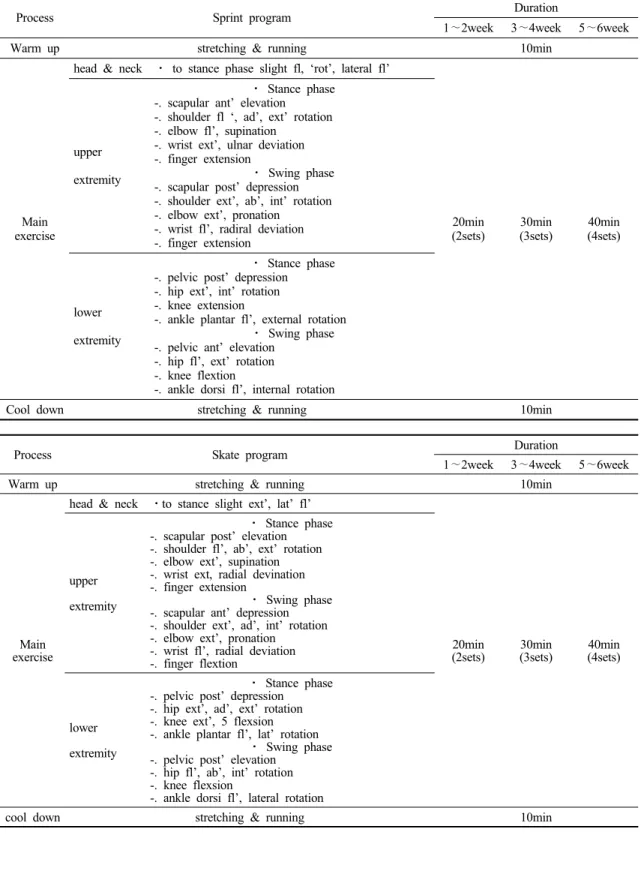
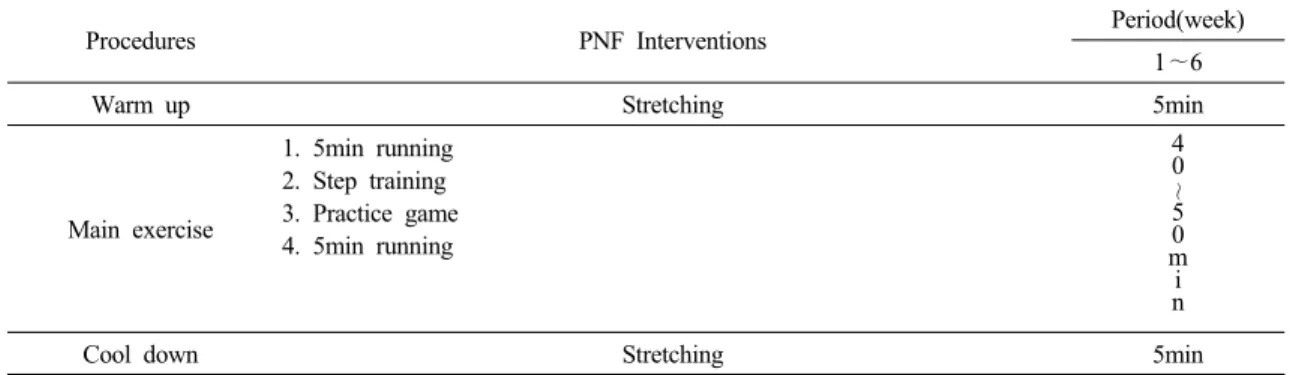
실험군에는 미국스포츠의학회(American College of Sports Medicine, 2007)의 운동처방지침에 의거하여 CLT 프로그램을 총 6주 동안 주 5회 적용하였으며, 구체적인 실험절차는 Table 2와 같다. 미국스포츠의학 회의 운동처방지침은 최소 주 2-3회의 운동 빈도를 권장하며 , 건강증진이 목적일 때는 주 5회 이상의 운동 빈도를 권장한다. 본 연구에서는 실험군에 준비운동, 본 운동 , 정리운동으로 구분하여 진행하였으며, 반복 횟수 (1-2주; 2sets, 3주-4주; 3sets, 5주-6주; 4sets)를 점증 적으로 증가시키는 점증부하훈련 (Progressive Resistnace Exercise, PRE)을 사용하였고, 실험군의 구체적인 운동 방법은 Table 3, 대조군의 일반훈련프로그램은 Table 4와 같다.

FMS의 측정은 FMS(FMS test kit, FMS

TM

, USA)를

Table 1. General characteristics of subjects (n=31)

Experimental group

(n=15)

Control group (n=16) Age (year) 16.53±3.27 16.22±3.38 Height (㎝) 158.97±8.82 157.42±7.39 Weight (㎏) 58.86±6.84 57.87±7.24

Mean±SD

subjects(n=31)


experimental group(n=15) control group(n=16)


CLT program (40∼60min/30day/6week)

General training (40∼60min/30day/6week)


pre-test(0week) post-test(6week)  

FMS 7 motion test FMS 7 motion test 1. Deep squat

2. Hurdle step 3. Inline lunge 4. Shoulder mobility 5. Active straight leg raise 6. Trunk satability push up 7. Ratary stability

1. Deep squat 2. Hurdle step 3. Inline lunge 4. Shoulder mobility 5. Active straight leg raise 6. Trunk satability push up 7. Ratary stability Table 2. Experimental process

(4)

Process Skate program Duration

1∼2week 3∼4week 5∼6week

Warm up stretching & running 10min

exerciseMain

head & neck ⋅to stance slight ext’, lat’ fl’

20min

(2sets) 30min

(3sets) 40min (4sets) upper

extremity

⋅ Stance phase -. scapular post’ elevation -. shoulder fl’, ab’, ext’ rotation -. elbow ext’, supination -. wrist ext, radial devination -. finger extension

⋅ Swing phase -. scapular ant’ depression -. shoulder ext’, ad’, int’ rotation -. elbow ext’, pronation

-. wrist fl’, radial deviation -. finger flextion

lower extremity

⋅ Stance phase -. pelvic post’ depression -. hip ext’, ad’, ext’ rotation -. knee ext’, 5 flexsion -. ankle plantar fl’, lat’ rotation

⋅ Swing phase -. pelvic post’ elevation -. hip fl’, ab’, int’ rotation -. knee flexsion

-. ankle dorsi fl’, lateral rotation

cool down stretching & running 10min

Process Sprint program Duration

1∼2week 3∼4week 5∼6week

Warm up stretching & running 10min

Main exercise

head & neck ⋅ to stance phase slight fl, ‘rot’, lateral fl’

20min

(2sets) 30min

(3sets) 40min (4sets) upper

extremity

⋅ Stance phase -. scapular ant’ elevation -. shoulder fl ‘, ad’, ext’ rotation -. elbow fl’, supination

-. wrist ext’, ulnar deviation -. finger extension

⋅ Swing phase -. scapular post’ depression -. shoulder ext’, ab’, int’ rotation -. elbow ext’, pronation

-. wrist fl’, radiral deviation -. finger extension

lower extremity

⋅ Stance phase -. pelvic post’ depression -. hip ext’, int’ rotation -. knee extension

-. ankle plantar fl’, external rotation

⋅ Swing phase -. pelvic ant’ elevation

-. hip fl’, ext’ rotation -. knee flextion

-. ankle dorsi fl’, internal rotation

Cool down stretching & running 10min

Table 3. CLT program(sprint & skate program)

(5)

이용하여 실험 전 , FMS에 대한 스포츠과학교실을 개 최하여 이해도를 높였으며, 측정결과의 신뢰도를 위

하여 임상 15년차 이상의 박사학위를 가진 물리치료 사 1명과 운동과학자 2명이 모든 항목을 촬영하였다.

Fig. 1. FMS scoring sheet.

Procedures PNF Interventions Period(week)

1∼6

Warm up Stretching 5min

Main exercise

1. 5min running 2. Step training 3. Practice game 4. 5min running

40

50 mi n

Cool down Stretching 5min

Table 4. General exercise

(6)

3. 평가 도구

본 연구에서는 FMS(FMS test kit, FMS

TM

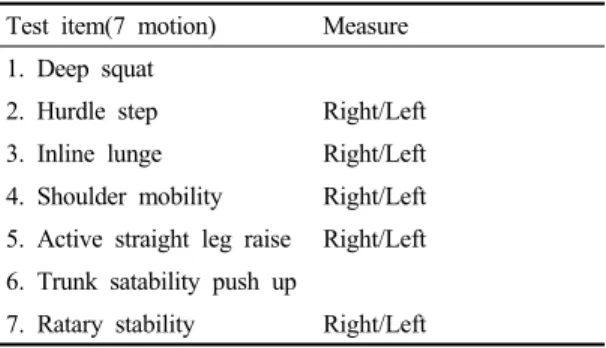
, USA)를 이용하여 7가지의 기능적 동작에 대한 항목을 측정하 였으며, FMS 측정표(Fig 1)와 기능적 동작 검사항목 및 평가 기준은 Table 5, Table 6과 같다.

Test item(7 motion) Measure 1. Deep squat

2. Hurdle step Right/Left 3. Inline lunge Right/Left 4. Shoulder mobility Right/Left 5. Active straight leg raise Right/Left 6. Trunk satability push up

7. Ratary stability Right/Left Table 5. FMS test item

Valuation basis Score 1. Perfect movement 3 point 2. Normal movement 2 point 3. Don’t movement 1 point

4. Pain 0 point

Table 6. FMS Valuation basis

4. 자료 처리

수집된 자료는 SPSS Ver 21.0을 이용하여 연구대상 자의 일반적 특성은 기술통계를 사용하였으며 , 각 집 단의 차이 비교를 위하여 대응표본 t-검정을 하였다.

자료의 통계적 유의수준은 p<0.05로 설정하였다.

Ⅲ. 연구 결과

기능적 움직임 점수와 7가지 동작에 대한 연구결과 는 Table 7과 같다.

variables week

Group Pre Post t p

FMS score E.G(n=15) 12.62±2.71 17.67±1.12 -2.64 0.01

C.G(n=16) 14.49±1.22 12.03±3.03 -1.71 0.06

Deep Squat E.G(n=15) 1.29±0.49 2.79±0.51 -2.77 0.01

C.G(n=16) 1.90±0.73 2.11±0.41 -1.41 0.15

Hurdle Step E.G(n=15) 1.83±0.5 2.73±0.43 -2.81 0.01

C.G(n=16) 1.89±0.34 1.91±0.43 0.00 1.00

In Line E.G(n=15) 1.79±0.47 2.71±0.37 -2.81 0.01

C.G(n=16) 1.83±0.45 1.94±0.33 0.00 1.00

Shoulder Mobility E.G(n=15) 1.81±1.40 2.61±0.47 -1.83 0.07

C.G(n=16) 2.38±0.49 1.57±1.52 -1.58 0.11

Active Straight Leg Raise E.G(n=15) 2..29±0.47 2.83±1.02 -2.64 0.01

C.G(n=16) 2.21±0.87 1.62±1.02 -1.63 0.10

Trunk Stability Push Up E.G(n=15) 1..71±1.26 2.71±0.37 -2.27 0.03

C.G(n=16) 2.26±0.51 1.48±1.00 -1.48 0.14

Rotary Stability E.G(n=15) 1..70±0.37 2.07±0.31 -1.63 0.10

C.G(n=16) 2.03±0.53 1.82±0.42 -1.02 0.31

Mean±SD, Test by Paired t-test, *p<0.05

Table 7. Comparison of measured score of FMS & 7 motion test

(7)

1. CLT그룹과 일반훈련 그룹의 기능적 움직임 평가 점수 변화

기능적 움직임 평가 점수에서 실험군은 12.62±2.71 에서 17.67±1.12로 유의한 차이가 있었고(p<0.05), 대 조군은 14.49±1.22에서 12.03±3.03으로 유의한 차이가 없었다(p>0.05).

2. Deep Squat 변화

Deep Squat의 변화는 실험군에서 1.29±0.49에서 2.79±0.51로 유의한 차이가 있었고(p<0.05), 대조군은 1.90±0.73에서 2.11±0.41으로 유의한 차이가 없었다 (p>0.05).

3. Hurdle Step 점수의 변화

Hurdle Step의 변화는 실험군에서 1.83±0.5에서 2.73±0.43으로 유의한 차이가 있었고(p<0.05), 대조군 은 1.89±0.34에서 1.91±0.43으로 유의한 차이가 없었다 (p>0.05).

4. In Line 점수의 변화

In Line 점수의 변화는 실험군에서 1.79±0.47에서 2.71±0.37로 유의한 차이가 있었고(p<0.05), 대조군은 1.83±0.45에서 1.94±0.33으로 유의한 차이가 없었다 (p>0.05).

5. Shoulder Mobility 점수의 변화

Shoulder Mobility 점수의 변화는 실험군에서 1.81±1.40에서 2.61±0.47로 유의한 차이가 없었고 (p<0.05), 대조군도 2.38±0.49에서 1.51±1.52로 두 그룹 모두 유의한 차이가 없었다(p>0.05).

6. Active Straight Leg Raise 점수의 변화 Active Straight Leg Raise 점수의 변화는 실험군에서 2.29±0.47에서 2.83±1.02로 유의한 변화를 보였고 (p<0.05), 대조군은 2.21±0.87에서 1.62±1.02로 유의한 차이가 없었다(p>0.05).

7. Trunk Stability Push Up 점수의 변화

Trunk Stability Push Up 점수의 변화는 실험군에서 1.71±1.26에서 2.71±0.37로 유의한 변화를 보였고 (p<0.05), 대조군은 2.26±0.51에서 1.48±1.00으로 유의 한 차이가 없었다(p>0.05).

8. Rotary Stability 점수의 변화

Rotary Stability 점수의 변화는 실험군에서 1.70±

0.37에서 2.07±0.31로 유의한 변화를 보이지 않았으며 (p>0.05), 대조군도 2.03±0.53에서 1.82±0.42로 두 그룹 모두 유의한 차이가 없었다(p>0.05).

Ⅳ. 고 찰

본 연구는 CLT 프로그램이 배드민턴 선수의 FMS 점수에 미치는 영향에 대하여 연구하여 CLT 프로그램 의 효과를 검증하고, 현장에서 쉽게 적용할 수 있는 부상 예방 운동프로그램에 대한 기초자료를 제공하고 자 하였다 .

배드민턴은 네트 위로 넘어오는 셔틀 콕을 신속하

고 정확하게 타격하기 위해 순간적으로 방향을 전환

할 수 있는 민첩성과 경기 당 평균 30분정도 소요되는

시간 동안 끊임없이 움직이기 위한 심폐지구력 및 근

지구력과 무산소성 파워가 요구된다(Korea Institute of

Sports Science, 2009). 또한 셔틀 콕의 방향과 속도 및

위치에 따라 다양한 기술(드롭, 헤어핀, 하이클리어,

리시브 , 드라이브, 서브 등)들의 구사를 위한 발동작의

빠른 몸놀림과 함께 방향변화에 따른 자세변화가 필

요하며, 몸통의 비틀림과 펴짐 그리고 구부림의 갑작

스런 동작이 반복되어 높은 운동상해를 가져올 수 있

는 비접촉 스포츠이다(Kim et al, 2013). 배드민턴과

같은 편향적인 신체 스포츠 종목의 경우에는 비대칭

적인 체형으로 인한 척추의 불균형으로 과 지속적인

훈련으로 인한 요통의 발병이 진행된다(Lee et al,

2012). Kim 등(2013)의 연구에 따르면 남자 국가대표

배드민턴 선수들의 경우 무릎 , 허리, 어깨, 발목 순으로

(8)

부상경험이 많고 여자선수들은 발목 , 허리, 어깨, 무릎 순으로 나타났다고 하였다. 이렇듯 배드민턴 선수에 게 부상예방을 위한 운동프로그램은 엘리트 선수 및 최근 급격하게 확산되고 있는 생활체육 배드민턴 동 호인에게도 많은 도움이 될 수 있다.

본 연구에서 CLT 프로그램은 FMS의 7가지 테스트 중, Shoulder Mobility 항목과 Rotary Stability를 제외한 5가지 항목에서 유의한 변화를 나타냈다. 이는 CLT 프로그램의 구성인 스프린터와 스케이터 동작이 고유 수용성신경근촉진법의 몸통(trunk)패턴, 상지(upper extremity)패턴, 하지(lower extremity)패턴, 머리와 목 (head & neck)패턴을 포함하고 있는 다면적 복합운동 프로그램 이기 때문이며, 또한 운동조절(motor control) 의 4단계와 운동학습(motor learning)의 3단계를 모두 적용할 수 있고, 열린 운동사슬(open kinematic chain)과 닫힌 운동사슬(closed kinematic chain)의 협응동작으로 구성되어 있기 때문이다 (Kim & Kim, 2013). 이에 대한 선행연구들을 살펴보면, Kim(2008)의 연구에서 실험 군에 스프린트 , 스케이트 패턴을 단계별로 훈련한 결 과 양궁선수들의 흔들림의 총 궤적 길이가 감소하였 으며 정적균형 능력과 슈팅시 균형능력을 향상시켰다 고 하였다. 다른 연구에서는 상하지 협응 운동 패턴에 따른 족부압력분포와 근 활성도 비교연구 결과 , 대칭 성 상하지 협응 운동패턴이 단일 상지 협응 운동패턴 보다 유의한 증가를 보였다고 제시하였다(Na, 2010).

또한 탄력밴드를 결합한 고유수용성신경근촉진법 통 합패턴 훈련과 웨이트 훈련이 소프트볼 선수의 등속 성 근력 및 균형에 긍정적인 영향을 주었다(Kim et al, 2011)는 연구 및 PNF 통합패턴 트레이닝이 하키선 수의 근 활성도와 균형 및 기능적 능력에 미치는 연구 에서 집단간 근활성도 , 정적 및 동적 균형능력, 기능적 능력에 유의한 차이를 보였다(Park, 2012)는 연구도 있었다. 이와 같이 고유수용기의 자극은 근육과 관절 에 있는 운동계의 반응이 나타나도록 도와주며 , 인간 의 움직임을 패턴화시켜 다양한 분야에서 사용되어 지고 있다(Feber et al, 2002).

FMS는 난이도가 있는 7가지 검사항목으로 구성되

어 있으며 기본적인 인간의 움직임 패턴으로 세분화 되어 있다. 검사 항목들은 근골격계 통증이 유발되는 스쿼트와 구부리는 동작 같은 기능적인 움직임을 평 가할 수 있으며, 3개의 확진검사를 통한 체간 안정성, 어깨의 가동성 , 회전 안정성에 관련된 검사가 포함되 어 있다(Cook et al, 2006a; 2006b). 물리치료사 및 스포 츠과학자들은 FMS 검사를 통하여 신체의 기능적인 장애를 발견할 수 있으며 , 기능제한과 관련 없는 부위 에서의 실제 기능수행에 대한 문제점도 발견할 수 있 다 . 또한 운동선수들의 기능적 움직임을 평가하는 효 율적인 도구로서 신뢰도가 입증되었고(Wainner et al, 2007), 검사자 내 신뢰도(intra-rater reliability)와 검사자 간 신뢰도(inter-rater reliability) 모두 비디오와 검사자 의 신뢰도가 높다(K=0.74∼1.0), (Minick et al, 2010)고 하였다 . 따라서 본 연구에서는 CLT 프로그램의 효과 를 알아보기 위해 신뢰도가 검증되고 현장에서 적용 이 용이한 FMS 검사를 통하여 배드민턴 선수들의 기 능변화를 연구하였다는데 그 가치가 있다고 생각된 다. 추후 연구에서는 보다 많은 스포츠종목에 대한 CLT의 적용효과와 FMS 검사 결과에 따른 교정운동 및 CLT 프로그램의 비교연구를 통한 후속 연구들이 진행되어져야 한다고 사료된다.

Ⅴ. 결 론

본 연구는 CLT 프로그램이 배드민턴 선수의

Functional Movement Screen 점수에 미치는 효과에 대

하여 알아보았다. 연구결과 실험군의 FMS 7가지 동작

중 5가지 동작에서 유의한 변화가 있었으며, 대조군은

유의한 변화가 없었다 . 따라서 CLT 프로그램은 FMS

점수에 유의한 영향을 주어서 부상예방을 위한 효율

적인 운동프로그램으로 활용될 수 있음을 확인 할 수

있었다.

(9)

References

American College of Sports Medicine: ACSM guidelines for exercise testing and prescription, 7th ed. USA.

Lippincott williams & wilkins. 2007.

An SH, Lee JH. Reliability and validity of the korean version of the FMS. The Journal of Korean Society of Physical Therapy. 2010;22(5):83-93.

Benjamin MW, Brendal JO, Carl DP, et al. Supplementing regular training with short-duration sprint-agility training leads to a substantial increase in repeated sprint-agility performance ith national level badminton players. The Journal of Strength and Conditioning Research. 2009;23(5):1477-1481.

Chorba RS, Chorba DJ, Bouillon LE, et al. Use of a functional movement screening tool to determine injury risk in female collegiate athletes. North American Journal of Sports Physical therapy. 2010;5(2):47.

Cook EG, Burtonl, Hogenboom B. The use of a functional movements as an assessment of function Part 1. North American Journal of Sports Physical therapy.

2006;1(2):62-72.

Cook EG, Burtonl, Hogenboom B. The use of a functional movements as an assessment of function Part 2. North American Journal of Sports Physical therapy.

2006;1(3):132-139.

Dietz B. Let’s sprint, let’s skate: Innovationen Tm PNF-Konzept.

Germany. Springer. 2009.

Feber R, Ostering LR, Gravells DC. Effect of pnf stretch techniques on knee flexor muscle EMG activity in older adults. Journal of Electromyography and Kinesiology. 2002;12:391-397.

Goh SL, Mokhtar AH, Mohamad AM. Badminton injuries in youth competitive players. The Journal of Sports Medicine and Physical Fitness. 2013;53(1):65-70.

Kiesel K, Plisky P, Voight M. Can serious injury in professional football be predicted by a preseason functional

movement screen. North American Journal of Sports Physical Therapy. 2007;2(3):147-158.

Kim DM, Sung BJ, Yoon JH, et al. Study on sports injuries in korea national badminton players. Journal of Korea Society for Wellness 2013;8(2):143-153.

Kim JP. The effect of balance exercise on postural control and shooting record in archers. The Korean Journal of Sport Biomechanics. 2008;18(2):65-74.

Kim JW, Kim DY, Yang CH. Study on sports injuries in badminton clubs sport for all of the sport participation Journal of Sport and Leisure Studies. 2011;

44(2):761-778.

Kim JY, Park JH, Choi WJ. The effects of proprioceptive neuromuscular facilitation integrative pattern with elastic band training and weight training on isokinetic strength and balance in softball players. International Journal of Coaching Science. 2011;13(1):243-249.

Kim SH, Kim DH. The effects of PNF exercise on body functions and fall efficacy of elderly women. The Korean Journal of Physical Education, 2013;52(2):495-512.

Kim TW, Choi KJ, Moon YJ, et al. Analysis of sports injury induced behavior in summer sports. Korean Journal of Sport Science. 2015;26(4):690-701.

Korea Institute of Sport Science: Badminton Guideline. South Korea. 2009.

Kondric M, Branka R MK, Gordana FM, et al. Injuries in racket sports among slovenian players. Collegium antropogicum. 2011;35(2):413-417.

Korea Institute of Sport Science: Guidelines for Exercise Training. South Korea. 2015.

Kroner K, Schmidt SA, Nielsen AB, et al. Badminton injuries.

British Journal of Sports Medicine. 1990;24(3):

169-172.

Kuntze G, Mansfield N, Sellers W. A biomechanical analysis of common lunge tasks in badminton. Journal of Sports Sciences, 2013;28(2):183-191.

Lee DS. The study on warm up and sports injuries in Korea

(10)

elite junior national badminton players. Korean Journal of Sport Science. 2012;21(4):993-1006.

Lee DS. Kwon DB, Sung BJ, et al. Comparison of basal fitness, anaerobic performance, and isokinetic muscle strength on badminton players. The Korean Journal of Measurement and Evaluation in Physical Education and Sport Science. 2013;15(3):67-76.

Lee JR, Kim YJ, Um HS, et al, The effects of chiropractic and exercise on spinal posture, function and serum IL-6, TNF-α level in badminton player with chronic low back pain. The Korean Journal of Sport.

2012;10(2):247-257.

Minick KI, Kiesel KB, Burton L, et al. Interrater Reliability of the FMS. Journal of Strength and Conditioning Research. 2010;24(2):479-486.

Na SH. The difference of foot pressure distributions and muscle activity during the coordinated movement patterns.

Korea University. Dissertation of Master’s Degree.

2010.

Onate JA. Real-time intersession and interrater reliability of

the FMS. Journal of Strength and Conditioning Research. 2012;26(2):408.

Park JH. The Effects of PNF combined patterns training on muscle activity, balance and functional ability of hockey players. Chosun University. Dissertation of Doctorate Degree. 2012.

Shariff AH, George J, Ramlan AA. Muscular injuries among Malaysian badminton players. Singapole Medical Journal. 2009;50(11):1095-1097.

Song HS, Kim GJ, Park JC, et al. Effect of 16-week functional movement improvement training program for injury prevention on Functional Movement Screen (FMSTM) test score in high-school baseball players.

Korean Journal of Sport Science. 2015;26(2):

391-402.

Wainner RS, Whitman JM, Cleland JA, et al. Regional interdependence: A musculoskeletal examination model whose time has come. Journal of Orthopaedic

& Sports Physical Therapy. 2007;37(11):658-660.

수치

Table 1. General characteristics of subjects (n=31) Experimental group  (n=15) Control group (n=16) Age (year) 16.53±3.27 16.22±3.38 Height (㎝) 158.97±8.82 157.42±7.39 Weight (㎏) 58.86±6.84 57.87±7.24 Mean±SD subjects(n=31)        
Table 3. CLT program(sprint &amp; skate program)
Fig. 1. FMS scoring sheet.
Table 7. Comparison of measured score of FMS &amp; 7 motion test

참조

관련 문서

The purpose of this thesis is to examine the effects of the Marriage Encounter program(ME program) on marital problem solving behavior.. The overall goal of

The purpose of this study was to investigate the effects of a disability awareness program on improving the attitudes of regular elementary school

The purpose of this study is to analyze the effects of word- recording on learning vocabulary, reading and listening of English. control groups to answer

The purpose of this study is to examine the effects of flow experience through the dance sports media, a dance sports image, and identification on

This study investigated the effects of university Taekwondo coaches' types of leadership on players' anxiety about intense competition. The study subjects were

This study characterizes the effects of vocational education as the probability of attaining qualification certificates, employability, and income level, which

The purpose and necessity of this study was to investigate the effect of the 8-week GX complex exercise program on the stress index, blood lipid and APG

The purpose of this study was to examine the parents' perceptions on the current status, effects and satisfaction of personal assistant service for students