플랜트 시설물 시공단계의 4M기법을 활용한 전문가 인식조사에 의한 안전관리요인 분석
김규진1·최병선2·전재열*
1단국대학교 건축공학과·2부천대학교 건축과
Safety Management Factor Analysis of Expert Perceptions Based on 4M Method for Plant Construction Phase
Kim, Kyujin
1, Choi, Byungsun
2, Chun, Jaeyoul
*1Department of Architectural Engineering, Dankook University
2Department of Architecture, Bucheon University
Abstract : The purpose of this study is to classify main risk factors on a construction phase of a plant project and analyze importance by the risk factors. Plant Industry is continuing boom and the increase in overseas plant orders in 2014 has showed a performance increase of 61% of the total orders, as the plant industry are risk factors for the construction phase, safety management target recognition and variety of accident prevention and safety factors by importance, etc.
a situation that requires the development and introduction of management. So, it is performed that collected disaster conditions data on a construction phase of a plant project, is questioned by plant construction professional and is classified by 4M. Then, it is performed that is questioned by plant construction and safety professional in order to apply AHP method, and is presented from analyzing the risk factors, which are results of the survey, by importance and priority. This study will recognize from identifying the main risk factors in advance and will be utilized as a basic data is to prevent the risk factors.
Keywords : Plant, Construction phase, Expert, Risk factors, 4M method, AHP method, Important
* Corresponding author: Chun, Jaeyoul, Department of Architectural Engineering, Dankook University, Yong-in, Gyeonggi-do, Korea
E-mail: [email protected]
Received July 30, 2015: revised November 30, 2015 accepted December 14, 2015
1. 서론
1.1 연구의 배경 및 목적 1.1.1 연구의 배경
고부가가치의 지식 집약적 산업으로 대표되는 플랜트 산업 은 지속적인 호황을 누리고 있으며 그 시장은 지속적으로 증 가하고 있다. 이에 한국 지식 경제부에 따르면 2011년도 한 국의 해외 플랜트 수주실적이 전년에 비해 0.8%를 상회하는 650억 달러에 이르렀다고 하였다. 2012년은 세계 경기의 침 체, 프로젝트의 대형화에 따른 자금조달의 난관이 계속되지 만 중동과 신흥국의 에너지 설비 확충계획 및 부흥 사업이 추
가되어 해외 플랜트 시장은 지속적으로 확대될 것으로 전망 하고 있다. 또한 우리나라 건설회사의 해외 건설 사업에 대한 수주액은 2007년 약 398억 달러에서 2013년 652억 달러로 꾸준히 증가하고 있으며, 그 중 플랜트 건설 산업은 2013년 전체 수주액의 60.7%를 차지하고 있다(해외건설협회 2013).
2015년 1월에는 해외건설의 수주액이 60억 달러를 기록하며 2014년 1월 수주액(37억 달러) 대비 61% 증가한 실적을 보였 다(해외건설협회 2015). 이처럼 해외 플랜트 시장의 성장은 계속 진행될 것으로 예상된다.
그러나 이와 같은 해외 플랜트 산업의 발전과 국내 건설 회
사의 경쟁성 확보 노력에도 불구하고, 경제성장 위주의 급격
한 산업화 추세에 부응하기 위해 플랜트 산업은 시공분야에
집중되어 있어 플랜트 시설물 공용 중 시설물 안전성을 위한
관리 및 안전관리 분야에서의 기술개발 및 연구는 미흡한 실
정이다. 또한, 플랜트 산업 시공단계의 위험 요인, 즉 안전에
문제를 일으킬 수 있는 핵심 관리 대상에 대한 인식 및 각 요
인별 중요도의 부재는 작은 사고를 중대 사고로 이어질 수 있
게 한다. 이러한 시공단계의 위험요인은 해당 프로젝트에까 지 이르러 차질을 줄 수 있는 프로젝트 전반에 위험(Risk)으 로 나타날 수 있기 때문에 플랜트 산업 시공 중에 잠재되어 있는 위험요소들을 정확히 인식하고, 이를 통해 다양한 사고 에 능동적으로 예방 및 대응할 수 있는 안전관리 방안의 개발 및 도입이 필요한 실정이다.
1.1.2 연구의 목적
플랜트 건설공사는 대규모 장치산업으로써 대형화되고 있 고, 설비산업 위주로 시공방법이 매우 복잡하며 고소(高所) 작업, 중량물 및 중장비 작업 등이 주를 이루기에 산업재해 발생확률이 일반건설공사에 비해 더 높다. 또한 대규모 근로 자가 투입되며, 발주처의 공기 단축 압박 등으로 인한 돌관공 사, 야간작업 등으로 인해 사전 안전 활동이 제대로 이행하기 어려운 상황이 많이 발생하므로 산업재해 예방을 위한 노력 이 더욱 절실하다. 특히, Table 1 분석표에서 안전의 시급함 이 비교되었고 시대별 플랜트 건설공사 산업재해는 매 해년 작업장과 고용자수 감소인 반면 재난률 증가는 플랜트 건설 공사 현장의 경우에는 일반 건설공사에 비해 산업재해에 대 한 취약성이 매우 크다는 것을 알 수 있다.
Table 1. Industrial accidents in the plant construction work
part 2008 2009 2010 2011 2012
Work places(total) 302,015 236,747 221,617 283,861 217,136 Number of
employees(total) 3,259,512 3,206,526 3,200,645 3,087,131 2,786,587 Number of
disasters(total) 20,835 20,998 22,504 22,782 23,849
disaster rate(%) 0.64 0.65 0.70 0.74 0.84
이에 따라 본 연구에서는 플랜트 시공단계의 위험요인을 분류 및 각 요인별 중요도를 분석하여 제시하고자 한다.
1.2 연구의 범위 및 방법 1.2.1 연구의 범위
플랜트 건설공사에서 효과적인 안전관리 활동을 위해서는 건설공사에서 발생할 수 있는 공정별 재해 요인들에 대한 분 석 및 각 요인들의 중요도에 따른 안전관리 방안을 제시하는 것이 중요하다. 그러나 플랜트 건설공사 현장에서 위험요인 에 따른 위험성 평가가 서면에 의한 형식적인 평가에 그쳐 체 계적이고 과학적인 관리가 이루어지고 있지 않다. 따라서 본 연구의 범위는 플랜트 공사 작업 공종별 재해현황을 실제 사 고조사를 바탕으로 한 설문조사 결과와 플랜트 건설공사 공 종별 위험도 분석결과를 토대로 시공단계의 주요 위험요인을 사고에 대한 인식조사와 시공단계의 주요 위험요인을 분석하 는데 연구의 범위를 제한하고자 한다.
1.2.2 연구의 방법
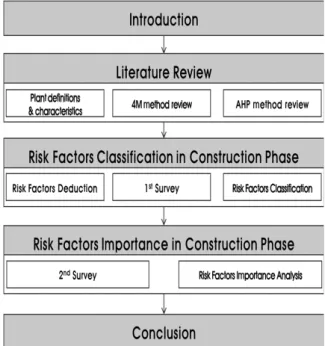
본 연구는 다음의 <Fig. 1>과 같은 절차 및 방법에 따라 진 행된다.
첫째, 본 연구의 서론 부분으로써 선행연구 고찰 및 플랜트 산업 시공단계의 위험요인을 분석코자 실제사고에 대한 안 전관리 조사를 바탕으로 연구의 배경 및 목적을 서술한다. 또 한, 본 연구의 목적을 효과적으로 달성하기 위해 플랜트 현장 실제사고를 전문가 인식 설문조사 결과를 비교 분석하여 연 구의 범위와 방법을 설정한다.
둘째, 플랜트 산업의 개념과 특징에 대해 조사 및 분석하였 으며, 4M(Man(인적), Machine(기계적), Media(물질·환경 적), Management(관리적))기법 및 AHP(Analytic Hierarchy Process) 기법에 대해 대처방안을 조사하여 고찰한다.
Fig. 1. Flow chart
셋째, 플랜트공사 작업공종별 재해현황 전문가 인식조사 분석을 토대로 플랜트 산업의 위험요인을 조사하여 시공단계 의 위험요인을 도출한다. 또한, 도출된 시공단계의 위험요인 은 실제사고를 포함한 전문가 인식조사 분석을 통해 4M 기 법의 4가지 관리 요인에 따라 분류한다.
넷째, 상기 분류된 플랜트 건설공사 시공단계 위험요인 은 AHP 기법을 적용하여 위험요인별 중요도를 분석하기 위 해 4M 요인별 각각의 위험요인을 5점 척도로 쌍대 비교하여 전문가 인식조사를 실시한다. 전문가 인식조사 결과에 따라 AHP 기법을 적용하여 플랜트 건설공사 실제사고 현장을 포 함한 시공단계의 위험요인별 순위를 정하여 전문가인식조사 별 중요도 및 대처방안을 분석한다.
다섯째, 연구의 결론부분으로써 연구 결과를 요약하고 본
연구의 결과를 바탕으로 연구 수행에 따른 결론과 향후 연구 방향에 대하여 위험요인에 따른 안전관리 체계 및 대처방안 을 제시한다.
2. 이론적 고찰
2.1 플랜트의 정의 및 특성 2.1.1 플랜트의 정의
플랜트란 대개 복합공정을 통해서 계획된 산출물을 생산하 는 통합설비를 의미하며 설비, 조달, 시공이 반드시 포함됨은 물론 전반적인 사업관리의 요구가 확대되고 있다. 이에 따른 산업 분야로는 ‘자연에 존재하고 있는 자원(물, 햇빛, 바람, 석유, 석탄, 천연가스 등)’을 에너지화하기 위한 각종 설비 및 관련된 공사로써 전력, 석유, 가스, 담수 등을 생산할 수 있는 설비를 공급하거나 공장을 지어주는 산업이라 할 수 있다.
2.1.2 플랜트의 특성
플랜트는 제품을 제조하기 위한 기계, 장비 등의 하드웨어 와 하드웨어 설치에 필요한 설계 및 엔지니어링 등의 소프트 웨어 그리고 시공 및 유지관리가 포함된 종합산업이다. 이러 한 종합 산업적 성향으로 인해 산업 연관효과가 매우 크며, 무역의존도가 매우 높은 우리나라의 입장에서 플랜트 산업은 수입국의 새로운 산업육성이나 수입대체 및 수출 진흥에 기 여하기 때문에 통상마찰이나 수입규제가 적은 반면 외화율이 매우 높다. 이러한 맥락에서 플랜트산업은 이미 주력 수출 분 야로 부상하였으며 앞으로도 수출에 대한 기여도가 빠르게 증가할 것으로 전망된다. 또한, 플랜트 산업은 ‘고도의 기술 력’과 ‘첨단 기계장비’를 이용해 최단시간 내에 공사를 성공적 으로 완료하는 것이 핵심역량이라 할 수 있다.
2.2 4M 기법 고찰
4M 기법의 목적은 사업장에서 예상되는 산업재해 발생 위험요인을 분석하여 사고발생 가능성을 최소화하는 것이 다. 이는 분석하고자 하는 해당 공정 및 작업 내에 잠재하고 있는 위험요인을 Machine(기계적), Media(물질 및 환경적) Man(인적), Management(관리적)의 4가지 요인을 통해 파 악하여 위험제거 대책을 제시하는 방법이다(한국 산업안전보 건공단 2010). Machine(기계적)은 불안전한 상태를 유발시 키는 물적 위험을 평가하며, Media(물질 및 환경적)는 소음, 분진, 유해물질 등 작업환경을 평가하며, Man(인적)은 작업 자 등의 불안전한 행동을 유발시키는 인적위험을 평가하며, Management(관리)는 사고를 유발시키는 관리적인 결함사 항을 평가한다.
연구과정 이러한 4M 기법은 전문가 집단 인식조사에 따라 산업재해 발생 위험요인을 분석하는 위험성 평가방법으로 제
시되었다. 이를 플랜트 건설공사 시공단계에 변형 및 적용하 여 작업공종별 재해요인을 4M 기법의 4가지 관리 요인에 따 른 전문가 인식조사에 따라 체계적으로 분류하여 재분류된 위험요인을 도출하고자 한다.
2.3 AHP 기법 고찰
계층화 분석기법인 AHP 기법은 복잡한 의사결정이 요구 되는 환경에서 합리적인 의사결정을 위해 개발한다. 기준 의 사결정 기법이며 다양한 평가요소들에 대한 중요도를 평가한 다. 또한, 각 요소들의 속성과 측정척도가 다양한 요소에 효 과적으로 적용하여 의사결정권자가 선택 가능한 여러 대안들 을 체계적으로 순위화 하여 가중치를 비율척도로 도출하는 방법을 제시하고자 한다.
AHP 기법은 의사결정시 계층적 구조의 설정, 상대적 중요 도의 설정, 논리적 일관성 유지의 세 가지 원칙에 의해 의사 결정이 이루어진다는 연구결과에 근거하여 개발되었다. 임의 의 현상을 동질성을 지닌 부분으로 분할하고, 더 작은 부분으 로 분할하여 많은 정보를 요소의 구조에 포함시켜 완벽한 전 체시스템을 구성한다.
또한 AHP 기법은 단순성, 명확성, 범용성의 특징으로 인 해 영향요인의 중요도가 체계적인 계량절차에 따라 결정이 가능하다. 기존의 통계적 기법 등에 비해서 접근 및 활용이 용이하며 전문가의 주관적·객관적인 정보를 종합적으로 사 용이 가능하다 할 것이다. 따라서 본 연구에서 4M 기법을 적 용하여 분류된 플랜트 시공단계의 위험요인을 통해 각각의 위험요인별 중요도를 분석하여 제시하고자 한다.
3. 시공단계 위험요인 도출 및 분류 3.1 시공단계 위험요인 도출
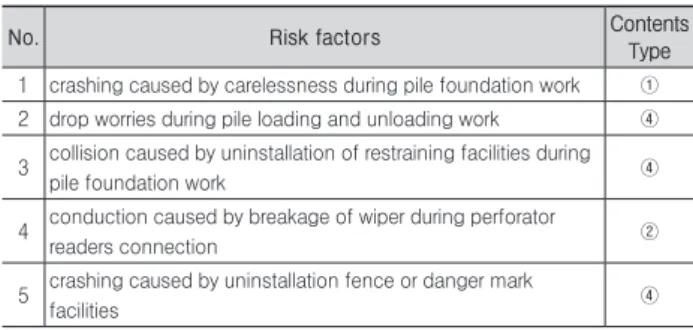
한국 산업안전 보건공단에서 플랜트공사 작업공종별 재 해현황 분석과 전문가 인식조사를 토대로 플랜트 산업의 위 험요인 84개 항목을 도출하였다(한국 산업안전 보건공단 자 료집 2014). 플랜트 시공단계의 위험요인을 정리하면 다음
<Table 2>와 같다.
Table 2. Risk factors in construction phase
①Machine Section ②Media Section ③Man Section ④Management Section
No. Risk factors Contents
Type
1 crashing caused by carelessness during pile foundation work ① 2 drop worries during pile loading and unloading work ④ 3 collision caused by uninstallation of restraining facilities duringpile foundation work ④
4 conduction caused by breakage of wiper during perforator
readers connection ②
5 crashing caused by uninstallation fence or danger mark
facilities ④
6 collapse·destruction caused by incompletion of ground
penetrating during excavation work ④
7 crashing caused by uninstallation fence facilities during
sheathing timbering work ④
8 wrap·trap caused by unsecuring of passage during sheathing
timbering work ④
9 crashing caused by excessive design loading during sheathing
timbering work ④
10 smashing caused by not placed of lifting equipment flagman
during sheathing timbering work ④
11 crashing caused by uninstallation of anti-crash mark of the
opening space during back filing work ④
12 crashing caused by uninstallation of work plate during form
assembly work ④
13 wrap·trap during form assembly work ①
14 crashing caused by breakage of crane wiper during lifting form ② 15 electric shock caused by saw during form work ② 16 cutting·mutilation caused by carelessness during using a
electric saw ①
17 collapse·destruction caused by excessive load of form work
materials ④
18 crashing from removable scaffold during rebar assembly ① 19 electric shock during rebar cutting and bending with rebar
processing machine ②
20 rebar falling caused by disruption of rebar loading stand ④ 21 collision of workers during rebar bending operation ① 22 cutting·mutilation caused by carelessness during
reinforcement work ①
23 collapse·destruction caused by poor rebar welding ① 24 crashing caused by uninstallation of danger mark at the end of
the opening near the ready mixed concrete casting place ④ 25 crashing caused by breakage of the boom of pump car during
concrete casting work ②
26 conduction of casting equipment ④
27 suffocation from oxygen bonds and harmful gases in concrete
curing access ④
28 traffic accident in the site during concrete work ④ 29 an outbreak of fire during concrete curing ④ 30 skin disease caused by contact with concrete after not wear
personal protective equipment ①
31 crashing on the go caused by not wear safety bar ① 32 narrowness with steel materials
when the steel materials are imported and alighted ④
33 conduction during steel work ①
34 material falling caused by dismantling of hanging rope before
connection of the joint ①
35 collision to steel materials when steel materials are alighted by
using movable crane ④
36 cutting·mutilation during steel work ①
37 collapse·destruction of temporary assembled steel materials ④ 38 crashed into the opening during waterproofing work ① 39 suffocation during epoxy painting work in confined spaced of
the basement ③
40 an outbreak of fire caused by using inflammable equipments
near combustible materials ④
41 workers get burn from inflammable equipments ① 42 crashing caused by poor installation of external scaffold during
stone pitching work ④
43 crashing caused by breakage of hanging scaffold and fixed
rope ④
44 crashing caused by not wear vertical life rope with the safety
belt when using hanging scaffold ①
45 suffocation from harmful gases during painting work ③ 46 an outbreak of fire during painting work near welding work ④ 47 crashing into the opening during lifting materials ④ 48 eye injuries caused by not wear goggles when using hand
grinder ①
49 material falling caused by excessive lifting of material at the
outside of the building ④
50 mutilation caused by uninstallation of cover for high-speed
cutter ②
51 an outbreak of fire caused by sparks flying from steel cutting
work ④
52 electric shock caused by automatic electric shock prevention
device is not attached to AC arc welder ④
53 narrowness with electric equipment during transformers
electrical equipment work ①
54 an outbreak of fire caused by electric spark from charging unit during electrical distribution panel installation ④ 55 narrowness with charging equipment during electrical
equipment dismantling work ①
56 explosion caused by electric spark during voltameter installation
work ④
57 crashing caused by carelessness during lighting installation
work ①
58 explosion during electrical installation work ④ 59 electric shock from charging unit during electricity incoming
unit installation work ①
60 crashing caused by duct is lost balance during duct work ① 61 crashing caused by defective rope during cold and hot water
dispensers lifting by using chain block ④
62 explosion caused by residual gases during tank welding work ④ 63 gas explosion within pipe during pipe welding work ④ 64 narrowness disasters caused by operation Immaturity of
excavators during manholes and pipe laying work ① 65 collapse of slopes caused by overloading of earth and sand
weight during manholes and pipe laying work ④ 66 buckets falling caused by dropped buckets connection of
excavator ②
67 narrowness with a jack during work near the hydraulic jack ① 68 pumice falling of slopes during retaining wall work ③ 69 collapse of soil during retaining wall work ③
70 lose footing into receiving hopper ①
71 conduction caused by not possess temporary lighting when
passing a dark place ①
72 suffocation caused by uninstallation of ventilation at
occurrence place of dusts and harmful gases ④ 73 crashing into the opening caused by arbitrary dismantling of
safety equipment and not following safety instruction ① 74 construction schedule delays caused by changed procurement
schedule ④
75 construction schedule delays caused by changed design
document ④
76 construction schedule delays caused by error of materials
takeoff ④
77 cultural differences and language problems ④
78 error of equipment Management Plan ④
79 shortages of local construction equipment ④
80 shortages of local technical labor ④
81 error of local laws review ④
82 shortages of local labor ④
83 shortages of local construction materials ④
84 shortages of local temporary facility ④
상기 <Table 2>와 같이 도출된 플랜트 시공단계의 주요 위 험요인은 포괄적 전문가 인식조사 분석에 따라 주요 요인분 류는 약 84가지로써, 플랜트 시공단계의 위험(Risk)은 매우 다양하며 이는 일정한 안전 관리 기준에 의해 분류되어 각각 의 관리 방안에 따라 관리하는 것이 효율적이라는 것을 예상 해 볼 수 있다. 따라서 상기 플랜트 시공단계의 위험요인을 4M(기계적, 물질적 및 환경적, 인적, 관리적)의 4가지 관리 요인을 기준으로 분류하기 위해 전문가 인식조사를 실시하여 분석하고자 한다.
3.2 시공단계 위험요인 분류 3.2.1 전문가 인식조사 개요
본 절에서는 플랜트 시공단계 위험요인을 제조 산업에서 활용되어 온 4M의 4가지 관리 요인을 기준으로 분류하기 위 한 목적으로 국내 플랜트 시공분야 관련 전문가를 대상으로 실제 사고현장을 포함하여 관련된 플랜트 전문가 인식조사를 근거하여 설문조사를 수행하였으며, 설문개요를 정리하면 다 음과 같다.
Table 3. Surveys Outline
Part Details
Purpose risk classification in construction phase Object domestic plant construction workers Period 2014.09.01. ~ 2014.12.31 Method 1. surveys by visiting
2. 4M classification Contents 1. 4M classification
2. improvement
Result
distribution : 80 collection : 75 available surveys : 53
상기 <Table 3>과 같이 국내 플랜트 시공분야 관련 전문가 를 대상으로 하여 플랜트 시공단계 위험요인 84개 요인분류 에 대한 조사를 실시하였다. 조사 분석결과 총 80부를 배포 하였으며 84개 항목을 완료한 전문가 설문지 관련 전문가 인 식조사를 위해 본 논문에서는(플랜트 전문가들에게 회수된 설문조사지) 유효설문 53부만을 1차 적용하였다.
3.2.2 시공단계 위험요인 분류
상기 3.2.1절에서 설정된 방법에 따라 플랜트 시공단계 위 험요인 분류에 대한 기계적 관리요인 26가지, 물질 및 환경적 관리요인에 해당하는 위험요인 7가지, 인적관리 요인에 해당 하는 위험요인 4가지, 관리적 관리요인에 해당하는 위험요인 47가지로 분류하여 전문가 인식조사 분석내용 총 84가지로 조사 분석을 수행하였다.
3.2.3 시공단계 위험요인 분류 결과
상기 3.2.2절의 조사 분석결과에 따라 플랜트 시공단계 위
험요인 분류에 대한 결과를 정리하면 다음의 <Fig. 2>와 같다.
Fig. 2. Risk Classification in Construction Phase
상기 <Fig. 2>와 같이 전문가 인식조사 분석을 통해 플랜 트 시공단계의 위험요인은 4M의 4가지 관리 요인으로 각 각 분류되었다. 분류 결과를 통해 4M의 4가지 관리 요인 중 Management(관리적) 관리요인에 해당하는 위험요인이 47 개 항목으로 가장 많으며, Man(인적) 관리요인에 해당하는 위험요인이 4개 항목으로 가장 적음을 알 수 있다. 이는 전문 가 인식조사 분석에 따라 플랜트 시공단계의 위험요인을 사 전에 파악하여 예방 및 관리할 시 Management(관리적) 분야 의 안전관리가 가장 중요함을 알 수 있다.
4. 시공단계 위험요인 중요도 도출 및 분석 4.1 시공단계 위험요인 중요도 도출
4.1.1 전문가 인식조사 개요
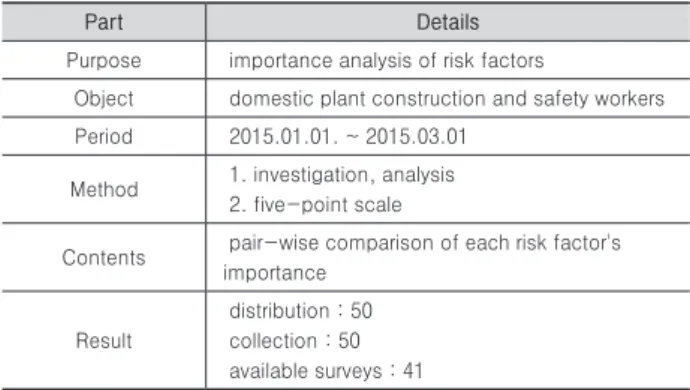
본 절에서는 상기 3.2.2절에 따라 분류된 플랜트 시공단계 위험요인에 AHP 기법을 적용하여 4M 요인별 각 위험요인의 중요도를 분석하기 위한 목적으로 국내 플랜트 시공 및 안전 분야 관련 전문가를 대상으로 조사 분석을 수행하였으며, 조 사개요를 정리하면 다음과 같다.
Table 4. Surveys Outline
Part Details
Purpose importance analysis of risk factors
Object domestic plant construction and safety workers Period 2015.01.01. ~ 2015.03.01
Method 1. investigation, analysis 2. five-point scale
Contents pair-wise comparison of each risk factor's importance
Result
distribution : 50 collection : 50 available surveys : 41
상기 <Table 4>와 같이 국내 플랜트 시공 및 안전 분야 관
련 전문가를 대상으로 주요 위험요인을 선정하여 플랜트 시
공단계 위험요인별 중요도 분석에 대한 2차 조사를 실시하였
다. 조사결과 총 50부를 배포하였으며 본 논문에서는 유효조 사 41부만을 적용하였다.
4.2 플랜트건설 시공단계에서의 중요도 4.2.1 시공단계 위험요인 중요도 고찰
상기 4.1.1절에서 설정된 방법에 따라 플랜트 시공단계 위 험요인 중요도 분석에 대한 2차 조사 분석을 수행하였다.
분석에 따라 중요도를 파악하여 최적 대안을 선정하는 기 법으로 선택된 여러 대안들을 체계적으로 순위화하여 비율척 도로 도출하여 AHP 기법을 적용한 결과를 정리하면 다음과 같다.
Table 5. Importance and ranking of Machine section
No. Risk factor
Importancescore Ranking 1 crashing caused by not wear vertical life rope with the
safety belt when using hanging scaffold 4.31 1 2 crashed into the opening during waterproofing work 4.21 2
3
crashing into the opening caused by arbitrary dismantling of safety equipment and not following safety instruction
4.09 3
4 crashing on the go caused by not wear safety bar 4.04 4 5 crashing from removable scaffold during rebar
assembly 3.97 5
6 electric shock from charging unit during electricity
incoming unit installation work 3.95 6
7 narrowness disasters caused by operation Immaturity
of excavators during manholes and pipe laying work 3.90 7 8 material falling caused by dismantling of hanging
rope 3.87 8
9 cutting·mutilation caused by carelessness during
using a electric saw 3.70 9
10 crashing caused by carelessness during lighting
installation work 3.68 10
11 crashing caused by carelessness during pile
foundation work 3.66 11
12 lose footing into receiving hopper 3.65 12 13 collapse·destruction caused by poor rebar welding 3.56 13 14 eye injuries caused by not wear goggles when using
hand grinder 3.56 13
15 narrowness with charging equipment during electrical
equipment dismantling work 3.56 13
16 crashing caused by duct is lost balance during duct
work 3.56 13
17 conduction during steel work 3.53 14
18 workers get burn from inflammable equipments 3.51 15 19 narrowness with a jack during work near the hydraulic
jack 3.41 16
20 narrowness with electric equipment during
transformers electrical equipment work 3.39 17 21 conduction caused by not possess temporary lighting 3.39 17 22 collision of workers during rebar bending operation 3.36 18 23 cutting·mutilation during steel work 3.36 18 24 wrap·trap during form assembly work 3.24 19 25 cutting·mutilation caused by carelessness during
reinforcement work 3.19 20
26 skin disease caused by contact with concrete after
not wear personal protective equipment 2.90 21
상기 <Table 5>의 위험요인은 3.2.2.절에서 분류된 기계적 관리요인에 해당하는 위험요인을 순차적으로 나열한 것이며 상기 26가지 위험요인 항목 간 쌍대비교를 통해 위험요인별 중요도 및 순위가 분석되었다. 기계적 관리 요인에 해당하는 위험요인 중 “근로자의 달비계 사용 시 수직구명줄에 안전대 미착용으로 인한 작업 중 추락”이 4.31로 가장 중요도가 높은 것으로 분석되었으며, “개인 보호구 미착용 후 레미콘 접촉에 의한 피부질환”이 2.90으로 가장 중요도가 낮은 것으로 분석 되었다.
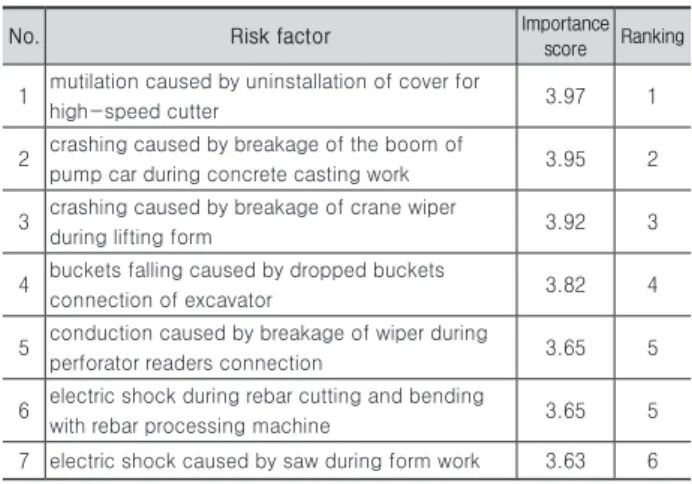
Table 6. Importance and ranking of Media section
No. Risk factor
Importancescore Ranking 1 mutilation caused by uninstallation of cover for
high-speed cutter 3.97 1
2 crashing caused by breakage of the boom of
pump car during concrete casting work 3.95 2 3 crashing caused by breakage of crane wiper
during lifting form 3.92 3
4 buckets falling caused by dropped buckets
connection of excavator 3.82 4
5 conduction caused by breakage of wiper during
perforator readers connection 3.65 5
6 electric shock during rebar cutting and bending
with rebar processing machine 3.65 5
7 electric shock caused by saw during form work 3.63 6
상기 <Table 6>의 위험요인은 3.2.2절에서 분류된 물질 및 환경적 관리 요인에 해당하는 위험요인을 순차적으로 나열 한 것이며, 상기 7가지 위험요인 항목 간 쌍대비교를 통해 위 험요인별 중요도 및 순위가 분석되었다. 물질 및 환경적 관리 요인에 해당하는 위험요인 중 “철물 절단용 고속 절단기 회전 부에 덮개가 미설치되어 신체 절상”이 3.97로 가장 중요도가 높은 것으로 분석되었으며, “거푸집 작업 시 목재가공용 둥근 톱 사용 중 감전”이 3.63으로 가장 중요도가 낮은 것으로 분 석되었다.
Table 7. Importance and ranking of Man section
No. Risk factor
Importancescore Ranking 1 suffocation during epoxy painting work in confined
spaced of the basement 4.46 1
2 suffocation from harmful gases during painting
work 4.36 2
3 collapse of soil during retaining wall work 3.87 3 4 pumice falling of slopes during retaining wall work 3.70 4
상기 <Table 7>의 위험요인은 3.2.2절에서 분류된 인적 관
리 요인에 해당하는 위험요인을 순차적으로 나열한 것이며,
상기 4가지 위험요인 항목 쌍대비교를 통해 위험요인별 중요
도 및 순위가 분석되었다. 인적 관리 요인에 해당하는 위험요
인 중 “지하 밀폐공간에서 에폭시 도장 작업 중 질식”이 4.46 으로 가장 중요도가 높은 것으로 분석되었으며, “옹벽 작업 중 주변 법면의 부석 낙하”가 3.70으로 가장 중요도가 낮은 것으로 분석되었다.
Table 8. Importance and ranking of Management section
No. Risk factor
Importancescore Ranking 1 crashing caused by breakage of hanging scaffold
and fixed rope 4.36 1
2 explosion caused by residual gases during tank
welding work 4.31 2
3 crashing caused by uninstallation of work plate during
form assembly work 4.26 3
4 crashing caused by poor installation of external
scaffold during stone pitching work 4.26 3 5 crashing caused by uninstallation of anti-crash mark
of the opening space 4.17 5
6
collapse of slopes caused by overloading of earth and sand weight during manholes and pipe laying work
4.17 5
7 suffocation caused by uninstallation of ventilation 4.17 5 8 an outbreak of fire during painting work near welding
work 4.14 6
9 gas explosion within pipe during pipe welding work 4.09 7 10 crashing caused by uninstallation fence facilities
during sheathing timbering work 4.07 8
11 an outbreak of fire caused by using inflammable
equipments near combustible materials 4.04 9
12
an outbreak of fire caused by electric spark from charging unit during electrical distribution panel installation
4 10
13 crashing caused by excessive design loading during
sheathing timbering work 3.97 11
14 conduction of casting equipment 3.95 12
15 explosion caused by electric spark during voltameter
installation work 3.92 13
16 crashing caused by uninstallation fence or danger
mark facilities 3.87 14
17 suffocation from oxygen bonds and harmful gases in
concrete curing access 4.19 14
18 crashing into the opening during lifting materials 3.87 14 19 an outbreak of fire caused by sparks flying from steel
cutting work 3.87 14
20 crashing caused by uninstallation of danger mark 3.85 15 21 crashing caused by defective rope during cold and
hot water dispensers lifting by using chain block 3.85 15 22 collapse·destruction of temporary assembled steel
materials 3.82 16
23 explosion during electrical installation work 3.8 17 24 material falling caused by excessive lifting of material 3.75 18 25 rebar falling caused by disruption of rebar loading
stand 3.63 19
26
an outbreak of fire caused by electric spark from charging unit during electrical distribution panel installation
3.63 19
27 collapse·destruction caused by incompletion of
ground penetrating during excavation work 3.6 20
28 narrowness with steel materials 3.6 20
29 collapse·destruction caused by excessive load of
form work materials 3.58 21
30 drop worries during pile loading and unloading work 3.56 22 31 collision to steel materials when steel materials are
alighted by using movable crane 3.56 22
32 an outbreak of fire during concrete curing 3.51 23 33 smashing caused by not placed of lifting equipment
flagman during sheathing timbering work 3.46 24 34 wrap·trap caused by unsecuring of passage during
sheathing timbering work 3.34 25
35 traffic accident in the site during concrete work 3.31 26 36 error of equipment Management Plan 3.26 27 37 shortages of local technical labor 3.26 27
38 error of local laws review 3.26 27
39 construction schedule delays caused by changed
design document 3.24 28
40 construction schedule delays caused by error of
materials takeoff 3.24 28
41 cultural differences and language problems 3.21 29 42 shortages of local construction equipment 3.21 29
43 shortages of local labor 3.19 30
44 construction schedule delays caused by changed
procurement schedule 3.17 31
45 shortages of local temporary facility 3.17 31 46 shortages of local construction materials 3.14 32 47 collision caused by uninstallation of restraining
facilities during pile foundation work 3.07 33
상기 <Table 8>의 위험요인은 3.2.2절에서 분류된 관리적 관리 요인에 해당하는 위험요인을 순차적으로 나열한 것이 며, 상기 47가지 위험요인 항목 간 쌍대 비교를 통해 위험요 인별 중요도 및 순위가 분석되었다. 관리적 관리 요인에 해당 하는 위험요인 중 “달비계 작업대와 고정 로프 연결부 파단으 로 근로자 추락”이 4.36으로 가장 중요도가 높은 것으로 분석 되었으며, “접근금지 시설 미설치로 기초 파일 작업 중 충돌 위험”이 3.07로 가장 중요도가 낮은 것으로 분석되었다.
4.2.2 시공단계 위험요인 중요도 분석 결과
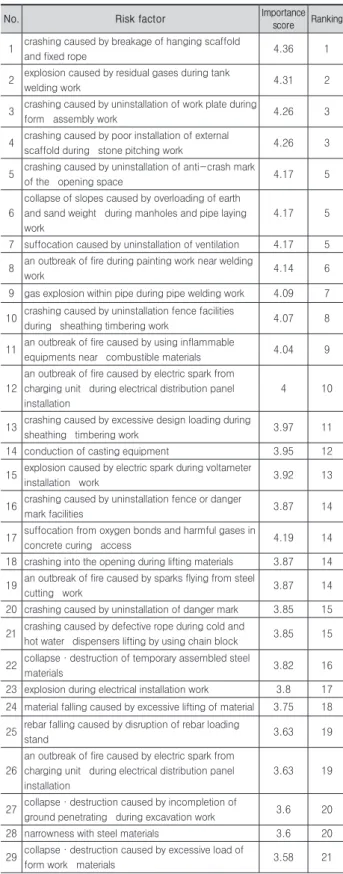
상기 4.2.1절의 조사 분석 결과에 따라 4M의 관리 요인별 플랜트 시공단계 위험요인의 중요도 및 순위를 분석한 결과 를 정리하면 다음의 <Fig. 3>과 같다.
Fig. 3. Risk Importance Analysis in Construction Phase
상기 <Fig. 3>과 같이 전문가 인식조사 분석을 통해 4M
의 관리 요인별 플랜트 시공단계의 위험요인의 중요도 및 순
위가 분석되었다. 분석 결과를 통해 각 관리 요인별 중요도
가 가장 높은 위험요인과 가장 낮은 위험요인을 알 수 있다.
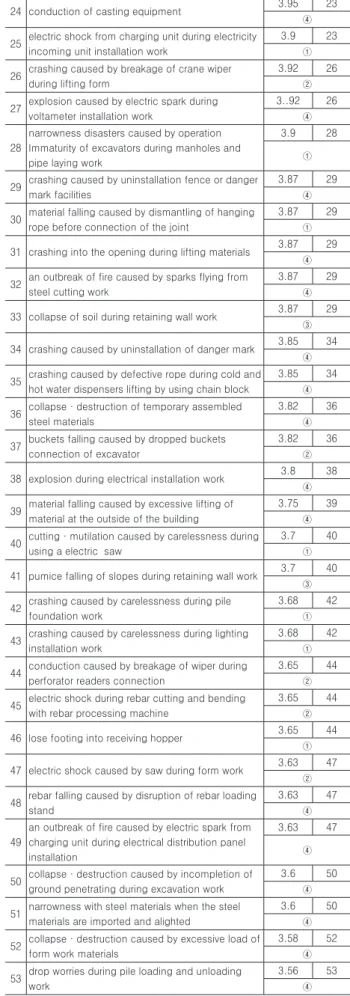
각 관리 요인별 위험요인에 대한 예방 및 관리 시 우선해야 할 위험요인을 사전에 분석할 수 있음을 알 수 있다. 또한, 본 연구에서 분석한 플랜트 시공단계의 모든 위험요인에 대 한 중요도 및 순위 4M 내용을 포괄적으로 표현하면 다음의
<Table 9>와 같다.
Table 9. Importance and ranking in Construction phase
①Machine Section ②Media Section ③Man Section ④Management Section
No Risk factor
Importance score Ranking
Contents
1 suffocation during epoxy painting work in confinedspaced of the basement
4.46 1
③ 2 crashing caused by breakage of hanging scaffold
and fixed rope
4.36 2
④ 3 suffocation from harmful gases during painting
work
4.36 2
③ 4 crashing caused by not wear vertical life rope with
the safety belt when using hanging scaffold
4.31 4
① 5 explosion caused by residual gases during tank
welding work
4.31 4
④ 6 crashing caused by uninstallation of work plate
during form assembly work
4.26 6
④ 7 crashing caused by poor installation of external
scaffold during stone pitching work
4.26 6
④ 8 crashed into the opening during waterproofing
work
4.21 8
① 9 suffocation from oxygen bonds and harmful gases
in concrete curing access
4.19 9
④ 10 crashing caused by uninstallation of anti-crash
mark of the opening space during back filing work
4.17 10
④
11
collapse of slopes caused by overloading of earth and sand weight during manholes and pipe laying work
4.17 10
④
12 suffocation caused by uninstallation of ventilation 4.17 10
④ 13 an outbreak of fire during painting work near
welding work
4.14 13
④ 14 gas explosion within pipe during pipe welding work 4.09 14
④
15
crashing into the opening caused by arbitrary dismantling of safety equipment and not following safety instruction
4.09 14
①
16 crashing caused by uninstallation fence facilities 4.07 16
④ 17 crashing on the go caused by not wear safety bar 4.04 17
① 18 an outbreak of fire caused by using inflammable
equipments near combustible materials
4.04 17
④ 19 electric shock caused by automatic electric shock
prevention device is not attached to AC arc welder
4 19
④ 20 crashing caused by excessive design loading
during sheathing timbering work
3.97 20
④ 21 crashing from removable scaffold during rebar
assembly
3.9 20
① 22 mutilation caused by uninstallation of cover for
high-speed cutter
3.9 20
② 23 crashing caused by breakage of the boom of
pump car during concrete casting work
3.95 23
②
24 conduction of casting equipment 3.95 23
④ 25 electric shock from charging unit during electricity
incoming unit installation work
3.9 23
① 26 crashing caused by breakage of crane wiper
during lifting form
3.92 26
② 27 explosion caused by electric spark during
voltameter installation work
3..92 26
④
28
narrowness disasters caused by operation Immaturity of excavators during manholes and pipe laying work
3.9 28
①
29 crashing caused by uninstallation fence or danger mark facilities
3.87 29
④ 30 material falling caused by dismantling of hanging
rope before connection of the joint
3.87 29
① 31 crashing into the opening during lifting materials 3.87 29
④ 32 an outbreak of fire caused by sparks flying from
steel cutting work
3.87 29
④ 33 collapse of soil during retaining wall work 3.87 29
③ 34 crashing caused by uninstallation of danger mark 3.85 34
④ 35 crashing caused by defective rope during cold and
hot water dispensers lifting by using chain block
3.85 34
④ 36 collapse·destruction of temporary assembled
steel materials
3.82 36
④ 37 buckets falling caused by dropped buckets
connection of excavator
3.82 36
② 38 explosion during electrical installation work 3.8 38
④ 39 material falling caused by excessive lifting of
material at the outside of the building
3.75 39
④ 40 cutting·mutilation caused by carelessness during
using a electric saw
3.7 40
① 41 pumice falling of slopes during retaining wall work 3.7 40
③ 42 crashing caused by carelessness during pile
foundation work
3.68 42
① 43 crashing caused by carelessness during lighting
installation work
3.68 42
① 44 conduction caused by breakage of wiper during
perforator readers connection
3.65 44
② 45 electric shock during rebar cutting and bending
with rebar processing machine
3.65 44
② 46 lose footing into receiving hopper 3.65 44
① 47 electric shock caused by saw during form work 3.63 47
② 48 rebar falling caused by disruption of rebar loading
stand
3.63 47
④
49
an outbreak of fire caused by electric spark from charging unit during electrical distribution panel installation
3.63 47
④
50 collapse·destruction caused by incompletion of ground penetrating during excavation work
3.6 50
④ 51 narrowness with steel materials when the steel
materials are imported and alighted
3.6 50
④ 52 collapse·destruction caused by excessive load of
form work materials
3.58 52
④ 53 drop worries during pile loading and unloading
work
3.56 53
④
54 collapse·destruction caused by poor rebar welding
3.56 53
① 55 collision to steel materials when steel materials are
alighted by using movable crane
3.56 53
④ 56 eye injuries caused by not wear goggles when
using hand grinder
3.56 53
① 57 narrowness with charging equipment during
electrical equipment dismantling work
3.56 53
① 58 crashing caused by duct is lost balance during
duct work
3.56 53
①
59 conduction during steel work 3.53 59
① 60 an outbreak of fire during concrete curing 3.51 60
④ 61 workers get burn from inflammable equipments 3.51 60
①
62
smashing caused by not placed of lifting equipment flagman during sheathing timbering work
3.46 62
④
63 narrowness with a jack during work near the hydraulic jack
3.41 63
① 64 narrowness with electric equipment during
transformers electrical equipment work
3.39 64
① 65 conduction caused by not possess temporary
lighting when passing a dark place
3.39 64
① 66 collision of workers during rebar bending operation 3.36 66
① 67 cutting·mutilation during steel work 3.36 66
① 68 wrap·trap caused by unsecuring of passage
during sheathing timbering work
3.34 68
① 69 traffic accident in the site during concrete work 3.36 69
④ 70 shortages of local technical labor 3.26 70
④
71 error of local laws review 3.26 70
④ 72 wrap·trap during form assembly work 3.24 73
④ 73 construction schedule delays caused by changed
design document
3.24 73
④ 74 construction schedule delays caused by error of
materials takeoff
3.24 73
④ 75 error of equipment Management Plan 3.26 73
④ 76 cultural differences and language problems 3.21 76
④ 77 shortages of local construction equipment 3.21 76
④ 78 cutting·mutilation caused by carelessness during
reinforcement work
3.19 78
①
79 shortages of local labor 3.19 78
④ 80 construction schedule delays caused by changed
procurement schedule
3.17 80
④ 81 shortages of local temporary facility 3.17 80
④ 82 shortages of local construction materials 3.14 82
④ 83 collision caused by uninstallation of restraining
facilities during pile foundation work
3.07 83
④ 84 skin disease caused by contact with concrete 2.9 84
①
상기 <Table 9>의 위험요인은 3.1절에서 도출된 플랜트 시 공단계에 해당하는 모든 위험요인을 순차적으로 나열한 것 으로, 상기 84가지 위험요인 항목 간 쌍대비교를 통해 위험 요인별 중요도 및 순위가 분석되었다. 플랜트 시공단계에 해 당하는 위험요인 중 “지하 밀폐공간에서 에폭시 도장 작업 중 질식”이 4.46로 가장 중요도가 높은 것으로 분석되었으 며, “개인보호구 미착용 후 레미콘 접촉에 의한 피부질환”이 2.90으로 가장 중요도가 낮은 것으로 분석되었다.
5. 결론
본 연구는 플랜트 시공 현장의 안전성 확보를 위한 플랜트 시공단계의 주요 위험요인 분류 및 위험요인별 중요도 분석 을 목적으로 수행되었다. 이를 위해 플랜트 시공단계의 위험 요인을 전문가 인식조사를 통해 플랜트공사 작업공종별 재해 현황 분석을 토대로 조사 분석하였다. 분석된 위험요인은 국 내의 플랜트 시공분야 관련 전문가를 대상으로 조사 분석을 실시하여 4M의 4가지 관리 요인으로 분류하였으며, 플랜트 시공단계 위험요인에 AHP 기법을 적용하여 4M의 관리 요 인 분류별 각 위험요인의 중요도를 분석하기 위한 목적으로 국내 플랜트 시공 및 안전 분야 관련 전문가를 대상으로 조사 분석을 수행하였다. 조사 분석 결과를 토대로 위험요인 항목 간 쌍대비교를 실시하여 위험요인별 중요도 및 순위를 분석 하여 제시하였으며, 상기 목적과 방법에 따라 도출된 결과는 다음과 같다.
첫째, 한국 산업안전 보건공단 플랜트공사 작업 공종별 재 해현황 분석을 토대로 조사한 플랜트 시공단계의 주요 위험 요인은 약 84가지로 도출되었다. 도출된 위험요인은 전문가 인식조사 분석을 통해 분류되었으며, 기계적 관리 요인에 해 당하는 위험요인은 26가지, 물질 및 환경적 관리 요인에 해당 하는 위험요인은 7가지, 인적 관리 요인에 해당하는 위험요 인은 4가지, 관리적 관리 요인에 해당하는 위험요인은 47가 지로 분류되었다.
둘째, AHP 기법을 적용하여 위험요인별 중요도 및 순위를 분석하기 위해 4M의 관리 요인 분류별 각 위험요인의 중요 도를 5점 척도로 조사 분석을 수행하였으며, 분석결과를 토 대로 쌍대비교를 실시하여 각 분류별 가장 높은 중요도의 위 험요인부터 가장 낮은 중요도의 위험요인까지 분석하여 제시 하였다.
셋째, 상기 분류별 위험요인을 플랜트 시공단계의 전체 위 험요인별 중요도를 분석하기 위해 AHP 기법을 적용하여 쌍 대비교를 수행하였으며, 분석 결과를 토대로 플랜트 시공단 계 내 가장 높은 중요도의 위험요인부터 가장 낮은 중요도의 위험요인까지 분석하여 제시하였다.
본 연구는 플랜트 시공 현장의 안전성 확보를 위해 시공단
계에서 사전에 고려되는 주요 위험요인을 관리 요인에 따라 분류하였으며, 위험요인별 중요도 및 순위를 분석하여 제시 하였다. 향후 플랜트 시공단계의 모든 위험요인을 추가적으 로 분석하고, 이를 데이터베이스화하여 플랜트 시공 현장의 위험에 대해 사전예방을 위한 기초 자료로써의 활용이 가능 하다 할 것이다. 또한 이를 각 플랜트 실 사례에 적용하여 시 공단계별 위험요인 분석 후 적립해 나아간다면 플랜트 시공 단계 위험요인 인식 및 사전 예방을 통해 현장 안전 도모를 기대해 볼 수 있다. 또한, 4M 기법을 플랜트 산업에 첫 도입 과 플랜트 시공단계의 주요 위험요인이 국내 자료에 한정되 어 도출되면서 전용적인 범위의 위험요인으로 한정하여 수행 되었다. 이는 지속적인 4M 기법 적용을 통해 전문가 인식조 사를 분석방법의 타당성을 검증하고 범용적인 범위의 위험요 인까지 가능하다는 것이 연구결과 분석되었다.
References