I. Introduction
A subcondylar fracture is a common type of mandibular fracture 1 . Treatments for subcondylar fractures have long been debated and extensively investigated 2,3 . Currently, there are two main treatment options for a subcondylar fracture:
the closed reduction and the open reduction. The advantage of the former is that invasive surgery is not required; howev- er, closed reductions are associated with higher complication rates relative to open reductions with fixation 4 . Thus, surgical procedures have been preferred for treating the subcondylar fracture 2 .
Surgical procedures for subcondylar fracture are performed with two main approach options: via the oral cavity and ex- tra-orally, via the skin. The intraoral approach boasts several advantages, including reducing the postsurgical facial scar, avoiding injury to facial nerves, and facilitating assessments of dental occlusion during surgery 5 . Nevertheless, it is a chal-
lenging technique to adopt, requires specialized instruments, and the surgeon must have additional training. In contrast, various extraoral approaches, including the retromandibular, Risdon, and periauricular approaches 6 , also exist, yet the drawbacks of an extraoral approach are that it can leave a sig- nificant facial scar and/or cause facial nerve damage 2 . Mean- while, treating a subcondylar fracture with a transparotid ap- proach may reduce the probability of complications such as facial nerve injuries 7-9 . Using this method, the parotid gland is dissected in the area where the facial nerve branches diverge.
However, both the retromandibular and preauricular incisions are established quite distantly from the parotid gland dissect- ing area; thus, the skin must be undermined and retracted anteriorly to access the surgical field.
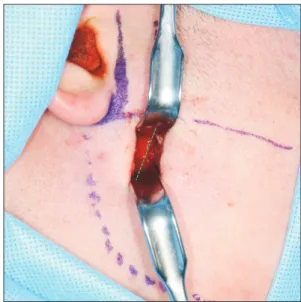
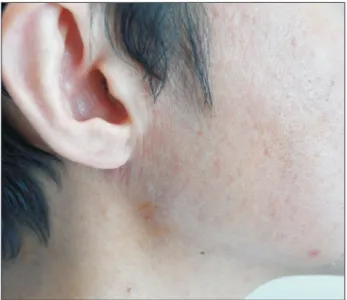
The present study aimed to develop a modified approach wherein an incision is created close to the fracture site, allow- ing more direct access. We reasoned that this approach could prevent injury to the facial nerve, necessitate a shorter inci- sion, and reduce the degree of retraction trauma at the surgi- cal site.
II. Technical Note
A 22-year-old male visited our hospital due to a traumatic injury. He had no specific medical history. Based on a facial computed tomography scan, he was diagnosed with a right
This is an open-access article distributed under the terms of the Creative Commons Attribution Non-Commercial License (http://creativecommons.org/
licenses/by-nc/4.0/), which permits unrestricted non-commercial use, distribution, and reproduction in any medium, provided the original work is properly cited.
CC