http://dx.doi.org/10.7839/ksfc.2020.17.4.133
토양 조건에 따른 농업용 트랙터의 견인 성능 분석
Analysis of Traction Performance for Agricultural Tractor According to Soil Condition
이남규
1․김용주
1,2*․백승민
2․문석표
1․박성운
3․최영수
4․최창현
5Nam Gyu Lee
1, Yong Joo Kim
1,2*, Seung Min Baek
2, Seok Pyo Moon
1,
Seong Un Park
3, Young Soo Choi
4and Chang Hyun Choi
5Received: 02 Nov. 2020, Accepted: 23 Nov. 2020
Key Words:Reclaimed Land(간척지), Paddy Field(논), Agricultural Tractor(트랙터), Tractive Efficiency(견인 효 율), Traction Performance(견인 성능)
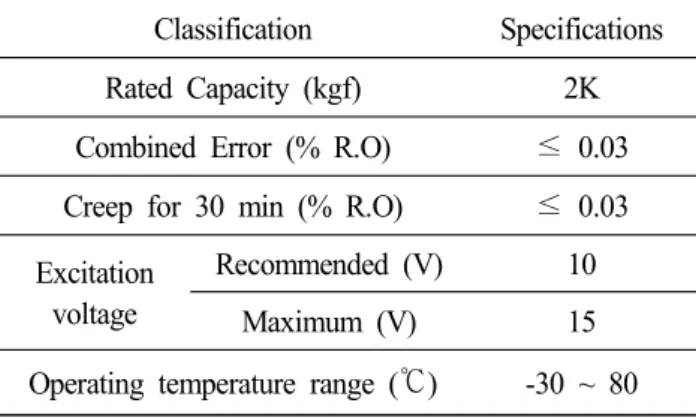
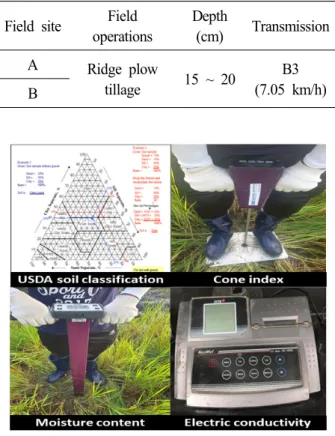
Abstract: Traction performance of a tractor varies depending on soil conditions. Sinkage and slip of the driving wheel for tractor frequently occur in a reclaimed land. The objective of this study was to develop a tractor suitable for a reclaimed land. Traction performance was evaluated according to soil conditions of reclaimed land and paddy field. Field experiments were conducted at two test sites (Fields A: paddy field; and Field B: reclaimed land). The tractor load measurement system was composed of an axle rotation speed sensor, a torque meter, a six-component load cell, GPS, and a DAQ (Data Acquisition System). Soil properties including soil texture, water content, cone index, and electrical conductivity (EC) were measured. Referring to previous researches, the tractor traveling speed was set to B3 (7.05 km/h), which was frequently used in ridge plow tillage. Soil moisture contents were 33.2%
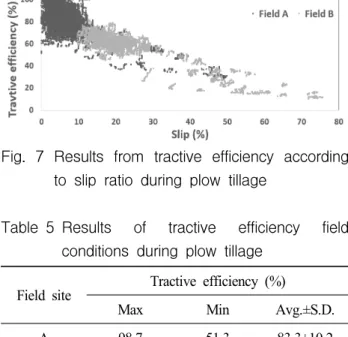
and 48.6% in fields A and B, respectively. Cone index was 2.1 times higher in field A than in field B. When working in the reclaimed land, slip ratios were about 10.5% and 33.1% for fields A and B, respectively. The engine load was used almost 100% of all tractors under the two field conditions. Traction powers were 31.9 kW and 24.2 kW for fields A and B, respectively. Tractive efficiencies were 83.3% and 54.4% for fields A and B, respectively. As soil moisture increased by 16.4%, the tractive efficiency was lowered by about 28.9%. Traction performance of tractor was significantly different according to soil conditions of fields A and B. Therefore, it is necessary to improve the traction performance of tractor for smooth operations in all soil conditions including a reclaimed land by reflecting data of this study.
* Corresponding author: [email protected]
1 Department of Biosystems Machinery Engineering, Chungnam National University, Daejeon, 34134, Korea
2 Department of Smart Agriculture System, Chungnam National University, Daejeon, Korea
3 Reliability Test Team, TYM ICT Co. Ltd., Gongju 32530, Korea 4 Department of Rural and Biosystems Engineering, Chonnam National University, Gwangju 61186, Korea
5 Dept. of Mio-Mechatronics Engineering, Sungkyunkwan University, Suwon 16419, Republic of Korea
Copyright Ⓒ 2020, KSFC
This is an Open-Access article distributed under the terms of the Creative Commons Attribution Non-Commercial License(http://
creativecommons.org/licenses/by-nc/3.0) which permits unrestricted non-commercial use, distribution, and reproduction in any medium, provided the original work is properly cited.
기호 설명
: slip ratio, %
: actual traveling speed, km/h
: theoretical traveling speed, km/h
: traction power, kW
: traction, kN
: sum of axle power, kW
: axle torque, Nm
: axle rotational speed, rpm
: tractive efficiency, %
1. 서 론
트랙터는 쟁기, 로타리, 베일러와 같은 다양한 농 작업기를 부착하여 작업을 수행하는 작업기계이다.
1,2)