New micropalaeontological evidence for a Late Triassic Shan-Thai orogeny
ABSTRACT: The Shan-Thai block is viewed as a remnant of Pale- otethys in South East Asia. The general consensus about its origin is that it happened through the rifting from Gondwanaland and final amalgamation to Eurasia, sealed by fluvial−shallow marine Jurassic deposits. As the main Paleotethyan closure, the Nan−Uttara- dit/Nan−Chantaburi and Bentong−Raub sutures were proposed by other workers. However, a suture further west, flanked by the Gondwana−Tethys divide (GTD), is advocated here as the main Paleotethyan closure. The Middle and Late Triassic radiolarian faunas were extracted from a chert-sequence in the Mae-Sot and Umphang areas of NW Thailand. The radiolarian faunas indicate early Ladinian, early−middle Norian, and Norian−Rhaetian, indi- vidually. The Triassic chert-sequence is overlain by the ‘Jurassic base-conglomerate’. The limestone and chert clasts in the conglom- erate yield Early−Late Triassic conodonts and Middle−Late Tri- assic radiolarians, respectively. Chert clasts in the conglomerate yield among others Norian−Rhaetian radiolarians that are correl- ative with those from TM3, while Early−Late Triassic conodonts are found in limestone clasts. The silici-pelagic origin of the clasts sug- gests the presence of an ocean before the end-Triassic orogeny along the Mae Sariang Zone that amalgamated the parts of the Shan-Thai block. This first finding of Late Triassic radiolarians from chert-sequence, next to the Middle Triassic and older radi- olarian faunas, adds another element to the reconstruction of the sequence now comprised in the Mae Sariang Zone, west of the Nan−Uttaradit Suture. The occurrence of Triassic limestone, as that of the Chaiburi Formation in the Mae Sariang Zone, or the Kodi- ang Limestone in the “Western Zone”, may elucidate the question about the provenance of the Triassic conodont-bearing limestone clasts in the Jurassic base-conglomerate that seals the Mae−Sari- ang Zone. The newly dated Triassic sequence is further sealed by the continental-shelf deposits of the Toarcian-early Bajocian Hua Fai Group.
Key words: radiolarian chert, conodont limestone, provenance, Shan- Thai Terrane, end-Triassic orogeny
1. INTRODUCTION
The Mae Sot−Umphang area (NW Thailand) is structur- ally a part of the Shan-Thai Terrane. For the Triassic devel- opment, the details on the formal nomenclature that have been established in Thailand are derived from Chonglak- mani and Grant-Mackie (1993) and Carey et al. (1995), com-
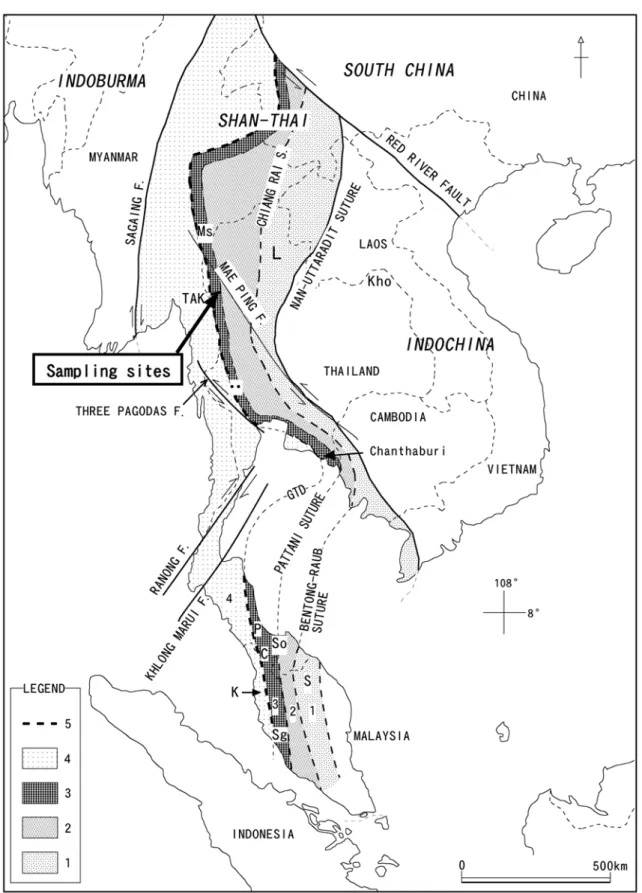
plemented by several authors. Hirsch et al. (2005) delineated the tectonostratigraphic terranes of SE Asia (Fig. 1), mainly based on Hada et al. (1999), Ueno (1999), Chonglakmani et al. (2001), Myo Min et al. (2001), Bunopas et al. (2002) and Charusiri et al. (2002). After a Late Paleozoic history of detachment from Gondwana, it transited into the lower lat- itudes of the Sibumasu Province in the Middle Permian and became a part of the low latitude Cathaysian Province dur- ing the Late Permian (Shi and Archbold, 1998). The Jurassic so called ‘base-conglomerate’ is significant for the under- standing of the tectonic evolution of the Shan-Thai Terrane to the Asian Continent (Hada et al., 1999). The section along the Tak−Mae Sot highway, NW Thailand, exposes well this significant Shan-Thai Terrane event. According to Hirsch et al. (2005), the studied section belongs to the Mae Sariang Zone. The Permian−Triassic sequence is topped by the pre- Jurassic TM3 bedded-chert that yields Middle and Late Tri- assic radiolarians. The ‘Jurassic base-conglomerate’ TM4 is composed of varicoloured clasts of limestones and cherts in a reddish silt matrix. The limestone clasts yield Early−Late Triassic conodonts and the chert clasts contain Middle and Late Triassic radiolarians, similar to those from TM3. The research was carried out in the frame of the Japan−Thai
‘Shan-Thai’ IGCP 434 working group. For two consecutive years, 2001−2002, our team conducted a week-long field work in the Mae Sot and Umphang areas, Tak Province, north- western Thailand.
2. GEOLOGICAL OUTLINE
Southeast Asia consists of four major tectonic terranes, the names of which sometimes vary: South China, Indoch- ina, Shan-Thai and West Burma. The main difficulty con- sists in unraveling end-Middle Permian from Late Triassic Palaeo-Tethyan scars.
The Shan-Thai consists primarily of a metamorphic cra- ton and Late Paleozoic−Early Mesozoic sediments. Its east- ern boundary in the Nan-Uttaradit suture zone, originally a Lower Permian basin containing radiolarian cherts and ser- pentinite, ending in siliciclastic turbidites and occluded in late Middle Permian (Helmcke, 1984), marks the main suture
Keisuke Ishida*
Ariko Nanba Francis Hirsch Takeshi Kozai Assanee Meesook
}}
Laboratory of Geology, Faculty of Integrated Arts and Sciences, University of Tokushima, 1-1 Minamijosanjima, Tokushima 770-8502, Japan
Laboratory of Geosciences, Faculty of Science Education, Naruto University of Education, 748 Takashima, Naruto 772-8502, Japan
Bureau of Geological Survey, Department of Mineral Resources, Bangkok 10400, Thailand
*Corresponding author: [email protected]
Fig. 1. Tectonostratigraphic terranes of SE Asia. After Hirsch et al. (2005); modified after Hada et al. (1999); Ueno (1999); Bunopas et al. (2002); Chonglakmani et al. (2001); Charusiri et al. (2002); Gondwana-Tethys Divide after Myo Min et al. (2001). Triassic basins after Chonglakmani and Grant-Mackie (1993) and Meesook et al. (2002). Legend. 1: Sukhothai Zone; 2: Inthanon Zone; 3: Mae Sariang Zone; 4: “Western Zone” (Tengchon-Tenasserim and Phuket); 5: Gondwana-Tethys Divide (GTD): Triassic basins of K: Kodiang Lime- stone; Kho: Khorat Group; L: Lampang-Phrae Basin; Cc: Chaiburi Formation; So: Songkhla Basin; Ms: Mae Sariang Basin; P: Phat- thalung Basin; S: Semantan Formation; Sg: Semanggol Formation; TAK: study section.
between Shan-Thai and Indochina terranes (Barr and Mac- Donalds, 1987: Carey et al., 1995). East of it, the Phetchabun fold and thrust belt (Helmcke, 1984) also includes ophio- lites from a Permian oceanic seaway that closed in the Late Middle Permian. Its Mesozoic cover consists of continental Carnian−Norian deposits of the Khorat Group (Chonglakmani et al., 2001).
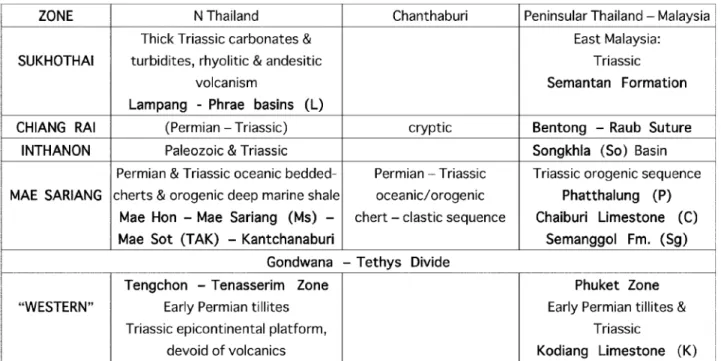
The Shan-Thai is subdivided into several zones from the east to west (Figs. 1 and 2; Hirsch et al., 2005). Among them, The Mae Sariang Zone extends along the NS-trending Tertiary strike-slip valley of Mae Nam Yuam in NW Thai- land. It consists of Permian and Triassic ribbon-cherts and pelagic limestone that Hahn and Siebenhuner (1982) and Fontaine and Suteethorn (1988) attribute to the Shan-Thai Terrane. The pelagic and synorogenic siliclastics in the Mae Sariang−Kanchanaburi Basin suggest an end-Triassic orogeny.
Above the pelagic sequence, follow synorogenic siliciclas- tic turbidites, which for Chonglakmani et al. (1991) witness a strong Triassic orogenic event that dissected the Shan Thai Terrane. The latter would thus consist of metamorphic complexes situated during Early Permian in a warm climate, alongside which Gondwana derived terranes docked during a Triassic orogenic event. A conglomerate with radiolarite pebbles yielding radiolarians determines the age of the Mae Sariang orogeny. The region east of Mae Sariang might be regarded as the Paleo-Eurasian margin of Paleotethys while the region west of Mae Sariang has a Gondwanian origin (Caridroit et al., 1993). Sediments that are similar to the Mae Sariang are found in the Semanggol Formation (Sash- ida et al., 1995), east of the Langkawi Island, Malaysia. Fon- taine and Suteethorn (1988) first mentioned pelagic limestone
along the highway Tak−Mae Sot. Only a narrow belt in the west is built up of Gondwana derived terranes, which docked during the Middle to Late Triassic (e.g., Hirsch et al., 2006).
The “Western Zone” of Gondwanian origin yields gla- cio-marine sediments. They consist to the north of the Baos- han craton, which is topped by Asselian oolitic limestone with Pseudoshwagerina. Separated from the latter by the Nujiang fault, the Tengchong−Tenasserim Zone encompasses crystalline pebbles of glacial-marine origin, as young as Stephano-Asselian, covered by late Early Permian limestone.
The Phuket Zone represents the Western units further south.
3. TRIASSIC TECTONO-STRATIGRAPHY OF THE MAE SARIAG ZONE
Recently, microfossil dating has clarified the detailed dis- tribution and stratigraphy of Triassic formations in Thailand and Malaysia (e.g., Sashida and Igo, 1999; Metcalfe et al., 1999; Hada et al., 1999). The Mae Sariang Zone contains rocks of Triassic chert-, carbonate-, and turbiditic facies that originate from the pelagic ocean which are believed to be of synorogenic nature.
3.1. Turbiditic Facies
From the Mae Sariang and Kanchanaburi Basins, a sequence of presumably Lower to Upper Triassic is found. In the Mae Sariang area, the Mae Sariang Formation consists of a sequence of shale, sandstone and conglomerate, intercalated with chert and limestone. Daonella and Halobia, allow its correlation with similar rocks in the Lampang Group. The
Fig. 2. Realms composing Shan-Thai (after Hirsch et al., 2005).
turbiditic facies of the Mae Sariang Zone is characterized by Daonella sumatrensis. At 34 km of the Tak−Mae Sot road, mudstone with Halobia, wood fragments and poorly preserved radiolarians occur (Meesook personal communi- cation). In the Mae Sot Basin, along the Thai-Myanmar border, the over 900 m of shale and sandstone of the Mae Sariang Formation contain limestones that yield Jovites, Juvavites and Choristoceras, brachiopods, bivalves and algae (Tamura et al., 1975; Chonglakmani and Grant-Mackie, 1993).
3.2. Chert Facies
In NW Thailand, intensely folded chert and siliceous black shale formations north of Chiang Mai were informally named as “Fang Chert” (Bunopas, 1981). Caridroit et al. (1990), Caridroit (1991, 1993), and Sashida et al. (1993) reported the occurrence of Paleozoic and Early Mesozoic radiolari- ans from the siliceous clastic rock sequences in North Thai- land. Late Permian to Middle Triassic radiolarians were reported from the chert beds at Ban Huai Tin Tang, near the Thai−Myanmar border, north of Chiang Mai. Among them, Triassic radiolarians belong to the Parentactinia nakatsug- awaensis and Eptingium manfredi assemblages of Anisian age (Sashida and Igo, 1999). At km 34 of the Tak−Mae Sot road, bedded-chert yielded well-preserved radiolarians (Ishida et al., 2004). In the Sra Kaeo-Chanthanaburi area, east Thai- land, red bedded-chert of the Chanthaburi chert-clastic sequence (Hada et al., 1999) yielded Eptingium manfredi assemblage at Trat, near the Gulf of Thailand (Sashida and Igo, 1999).
In Peninsular Thailand, the turbidites of the Na Thawi For- mation are imbricated with the Chaiburi limestone (see below) and chert. These correlate with the deep marine and oceanic Mae Sariang facies (Chonglakmani, 2002). The thin-bedded chert at Khao Chiak yielded the Entactinia nikorni assem- blage together with late Spathian to early Anisian conodonts Neospathodus homeri and N. timorensis near Phatthalung (Sashida and Igo, 1999).
In the Semanggol area in Kedah (Malaysia), Teoh (1991) subdivided Paleozoic and Mesozoic of the Sungai Tiang area of central Kedah into the Mahang (Lower Silurian), Kubang Pasu (Carboniferous), and Semanggol (Middle to Upper Triassic) formations. Burton (1973) subdivided the for- mation into the Lower Chert, Middle Rhythmite, and the Upper Conglomerate members. Sashida and Igo (1999) extracted late Middle and Late Permian radiolarians from the lower Chert Member. As illustrated in the review paper of Sashida and Igo (1999), the Triassic in the Alor Setar (Alor Star) region consists of a sequence of chert followed by tur- bidites and covered by conglomerates, depicted alongside the Kodiang limestone. Koike (1973) described conodonts.
3.3. Carbonate Facies
Most limestones in the Phatthalung area were viewed as
Permian (Ratburi Limestone). Igo et al. (1988) and Sashida and Igo (1992) have reported early Middle Triassic con- odonts and late Early Triassic radiolarians from the lime- stone at Khao Chiak, now described as the Chaiburi Formation (Ampornmaha, 1995). The Chaiburi Formation is subdi- vided into the following three members in ascending order.
3.3.1. Phukhaothong member
66 m of bedded to massive, light gray dolomites with some chert nodules, yielding the conodonts Neospathodus kummeri Sweet and Neospathodus waageni Sweet (Dienerian to Smithian);
3.3.2. Chiak limestone member
300 m of gray to dark gray bedded-limestone, with many chert layers, nodules and lenses intercalated in laminated- limestone beds. Laminated lime-mudstone yield radiolarians, ostracods, gastropods and echinoids. The lower part can be dated by the conodonts Neospathodus timorensis (Nogami), Neospathodus kockeli (Tatge), Neogondolella burgarica (Budurov and Stefanov) as Spathian to middle Anisian, gradually changing into bioclastic wackestone.
3.3.3. Phanomwang limestone member
A 90 m thick mostly massive limestone, including coral reef-limestone, yielding calcisponges, scleractinian corals, mol- lusks, echinoids, crinoids and foraminifers, the age of which is Carnian. Sardsud (2002) confirmed three Late Triassic con- odont zones: Epigondolella abneptis subsp. A, E. a. subsp. B, and E. postera zones that represent lower−middle Norian.
4. TRIASSIC−JURASSIC ROCKS IN THE MAE SOT AND UMPHANG AREAS
In both the Tak−Mae Sot and Umphang areas, the nature of the Permian and Triassic contacts as well as the relation between chert beds and Halobia-bearing turbidites of Car- nian age remains unclear (Meesook et al., 2002). In the Mae Sot Basin, marine Jurassic rocks are well exposed.
The marine Lower Jurassic Hua Fai Group (Meesook and Grant-Mackie, 1996), 900 m in thickenss, is exposed along the unsealed road to the Huai Mae Sot power station 7 km east of Mae Sot and along Huai Mae Sot (Fig. 3). The group consists of limestone-marl-mudstone-dominated sequences which have yielded bivalve and ammonite macrofaunas.
The base is estimated to unconformably overlie on the Trias- sic strata, and the top of the group is interrupted at the fault- bounded margin of the Tertiary basin. The group is subdi- vided into the following three formations in descending order.
4.1. Pha De Formation
390 m, consisits mainly of limestone-marl dominated thinnning-upward sequences. Late Aalenian – early Bajocian
age is suggested by the occurrence of ammonites Grapho- ceras sp., Eutmetoceras sp., and Docidoceras sp.
4.2. Doi Yot Formation
370 m thick is composed of mudstone with interbedded lime- stones. Occurrence of Onychoceras sp., Pseudolioceras sp. and Leioceras sp. indicates late early Toarcian – early Aalenian.
4.3. Khun Huai Formation
140 m thick from the basal conglomerate, consists of limestone-marl dominated sequences interbedded with mud- stone. In the type section, the lower part of the formation is assumed to be unconformable on marine Triassic strata because of the presence of a limestone-chert conglomerate (TM4) between the two. This contact is located about half- way between the Weir and Ban Kun Huai. Early Toarcian ammonite Dactylioceras sp. dates the formation. The upper part is conformably overlain by the Doi Yot Formation.
4.4. Relation Between Pre-Jurassic Chert And Hua Fai Group
The section along the Tak - Mae Sot highway, NW Thai- land, is topped by the pre-Jurassic chert (TM3) containing very fine vitritic-tuff, and yielded radiolarians of Middle to Late Triassic age (cf. Ladinian to Norian). It is overlain by
the base-conglomerate (TM4) and continental-shelf depos- its of the Jurassic Khun Huai Formation of the Hua Fai Group (Fig. 4). Along the Mae Sot–Umphang road, at km 138–139, a cherty acid tuff (MU-1) is similar to TM3 and yielded Middle Triassic radiolarians. Lithology and micro- fossil content provide clues as to the age of the TM3 chert and both the origin and age of the clasts within the TM4 conglomerate.
4.4.1. TM3
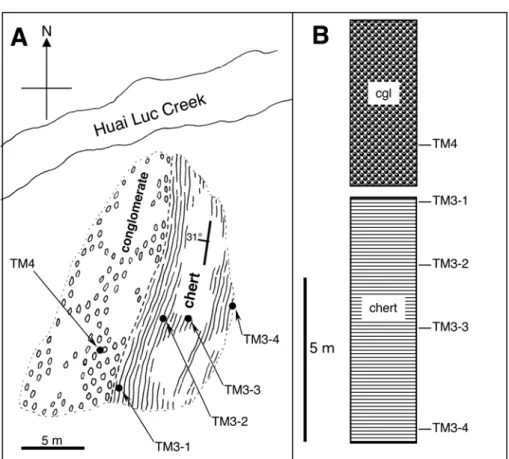
The chert unit is composed of 5 to 10 cm thick, dark-gray to black well-laminated bedded sequences. The TM3 chert commonly contains a large amount of fine vitric tuff as well as radiolarian shells (Fig. 5). From the top of the sequence, four horizons, TM3-1 (topmost), TM3-2 (2 m below), TM3- 3 (4 m below), and TM3-4 (7m below) were sampled for microfossils (Fig. 4).
4.4.2. TM4
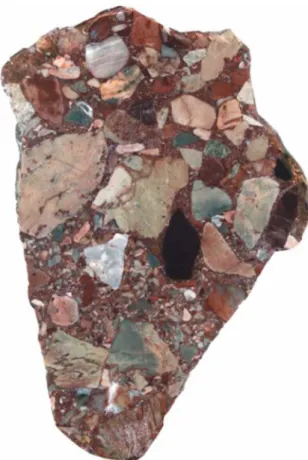
The unit is a poorly-sorted conglomeratic breccia formed by a kind of gravity flow. The conglomerate is mainly com- posed of varicolored clasts of limestones and cherts (Fig. 6).
The clasts are subangular to subrounded, and the matrix contains reddish silt. The maximum size of gravels exceeds 20 cm. The chert fragments are well-laminated, dark gray to black and reddish-brown in color, commonly less than 3 cm in diameter, and contain vitric tuff materials and radiolari- ans. The difference of the color probably depends on the
Fig. 3. (A) Geological outline map of Jurassic Hua Fai Group and Triassic Pha de Formation in the east of Mae Sot, with section line and sample locality (after Tantiwanit et al., 1985).
Permian (P) and Triassic (Tr) forma- tions of the Lampang Group; Khun Huai (J1), Doi Yot (J2) and Pha De (J3) formations of the Hua Fai Group (Jurassic). Q: Quaternary; WE: section line; f: fault. (B) Stratigraphic position of the TM3 chert and TM4 base-con- glomerate in the Section along the Tak -Mae Sot highway, NW Thailand.
TM4 and TM3: sampling localities;
ch: chert; ls limestone; cg: conglomer- ate; ms/ss: alternation of sandstone and mudstone.
effect of weathering because they are basically the same tex- ture and the reddish-brown colored fragments are stained.
The limestone fragments, usually less than 5 cm in diameter, vary from yellowish, reddish and grayish in color. The yel- lowish fragments, dominantly included in the conglomer- ate, are wackestone with a significant amount of thin small bivalve shells. The grayish clasts are packstone and grain- stone dominated by crinoid stems. The reddish fragments are packstone with bioclasts of echinoids and corals and some ooids. The other limestone fragments are gray lime- mudstones. Among them, limestone fragments contain Early and Late Triassic conodonts, whereas the chert fragments contain Middle and Late Triassic radiolarians.
5. MICROFOSSIL AGE
5.1. Radiolarians from the TM3 Chert
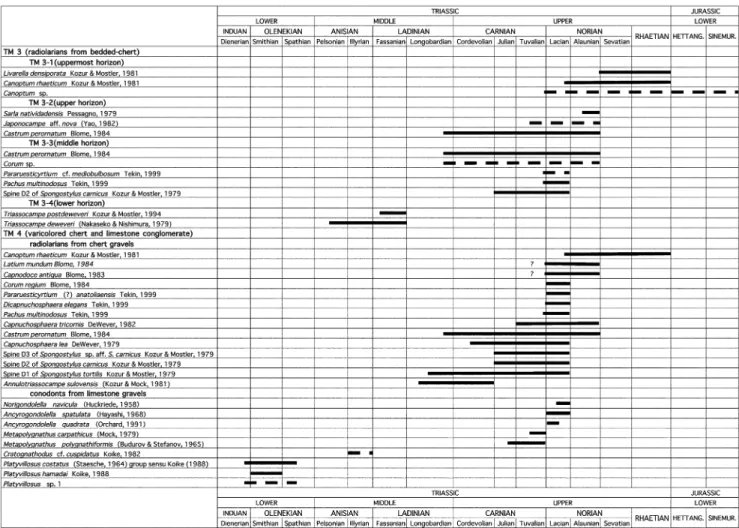
The upper part of the TM3 chert ranges from upper Mid- dle to Upper Triassic (Figs. 7 and 8).
5.1.1. TM3-1
The uppermost horizon of the chert sequence yielded Canoptum rhaeticum Kozur and Mostler, 1981, Canoptum sp., Livarella densiporata Kozur and Mostler, 1981. From the range of the species (e.g., Carter, 1993; Sugiyama, 1997) found in the TM3-1, the horizon is Upper Norian to Rhaetian.
Fig. 4. Sketch (A) and column (B) showing the locality of the TM3 chert and TM4 conglomerate and the strati- graphic positions of the sampled hori- zons.
Fig. 5. Cross section of the TM3 bedded-chert, dark-gray to black, well-laminated, containing a large amount of fine vitric tuff mate- rials (whitish bands and dotted grains).
5.1.2. TM3-2
2m below the top of the sequence yielded Sarla natividadensis Pessagno in Pessagno et al. (1979), Castrum perornatum Blome, 1984, and Japonocampe aff. nova (Yao, 1982). Co-occurrence of these two species indicates middle Norian horizon.
5.1.3. TM3-3
4m below the top of the sequence, the chert yielded Castrum perornatum Blome, 1984, Pararuesticyrtium cf. mediobul- bosum Tekin, 1999, Corum sp., Pachus multinodosus Tekin, 1999, and Spine D2 of Spongostylus carnicus Kozur and Mostler, 1979. Based on the co-occurrence of the species, the horizon TM3-3 belongs to Lower Norian.
5.1.4. TM3-4
7 m below the top of the sequence yielded Triassocampe deweveri (Nakaseko and Nishimura, 1979), Triassocampe postdeweveri Kozur and Mostler, 1994. Co-occurrence of the two species indicates that TM3-4 belongs to lower Ladinian.
5.2. Radiolarians from the TM4 Gravels
Latest Middle to Late Triassic radiolarians were
5.2.1. Latest Ladinian−early Carnian
An additional species, Annulotriassocampe sulovensis (Kozur and Mock) in Kozur and Mostler (1981) is older.
This species ranges from late Ladinian (M. cochleata /?
P. priscus Subz.) to early Carnian in the Sugozu Measured Section of the Antalya Nappes, Turkey, East-Central Oregon, USA, and Busuanga Island, Philippines (Tekin, 1999).
5.2.2. Latest Carnian−early Norian
Latium mundum Blome, 1984, Capnodoce antiqua Blome, 1983, Corum regium Blome, 1984, Pararuesticyrtium (?) anatoliaensis Tekin, 1999, Dicapnuchosphaera elegans Tekin, 1999, Pachus multinodosus Tekin, 1999, Capnuchosphaera tricornis De Wever, 1982, Castrum perornatum Blome, 1984, Capnuchosphaera lea De Wever in De Wever et al. (1979), Spine D3 of Spongostylus sp. aff.
S. carnicus Kozur and Mostler, 1979, Spongostylus car- nicus Kozur and Mostler, 1979 in Tekin (1999), Spine D2 of Spongostylus carnicus Kozur and Mostler, 1979, Spine D1 of Spongostylus tortilis Kozur and Mostler, 1979. They are regarded as cosmopolitan in low latitude Late Triassic (Bragin and Krylov, 1996; Tekin, 1999).
5.2.3. Early Norian-Rhaetian
Canoptum rhaeticum Kozur and Mostler, 1981 is known from the Lower Norian (Navicula Subzone of Spatulatus A.Z.) to Rhaetian of the Zlambachgraben, Austria (Kozur and Mostler, 1981). Sugiyama (1997) extended the range of this specific group from late Norian (TR8C) to Early Juras- sic (Hettangian/Sinemurian).
5.3. Conodonts from the TM4 Gravels
Olenekian, late Anisian, late Carnian, and early Norian conodonts were extracted from the limestone gravels in the TM4 conglomerate (Figs. 7, 10−12).
5.3.1. Olenekian
Platyvillosus costatus (Staesche, 1964) sensu Koike (1988), Platyvillosus hamadai Koike, 1982a, and Platyvillosus sp. 1 (Fig. 10). Platyvillosus costatus occurs in the middle part of the Campil beds (Upper Scythian) of St. Vigil, South Tyrol, Italy (Staesche, 1964). Platyvillosus hamadai is firstly reported from the lower part of the Gunong Keriang Limestone in the Peninsular Malaysia with co-occurrence of Dienerian to late Smithian conodonts of Neospathodus dieneri Sweet, and N. pakistanensis Sweet as well as Platyvillosus costatus (Koike, 1982b). The co-occurrence of P. hamadai and P. cos- tatus was also reported from the Neospathodus dieneri−N.
conservatives Zone (Smithian) of the lower part of the Taho Limestone (Koike, 1982b).
Fig. 6. Cross section of the TM4 base conglomerate. The poorly- sorted breccia is mainly composed of varicolored clasts of lime- stones and cherts (subangular to subrounded), and the matrix con- tains reddish clay. The maximum length of the specimen is 18.5 cm.
5.3.2. Late Anisian
A specimen was identical to Cratognathodus cf. cuspi- datus Koike, 1982b (Fig. 11: 4a, b). Cratognathodus cusp- idatus has originary descrived by Koike (1982b) from the dark gray thin-bedded biomicritic limestone member of the Bukit Kalong Limestone, in Kedah, West Malaysia. Based on the co-occurrence of Gladigondolella tethydis, Neogon- dolella bulgarica, Neospathodus kockeli, the fauna indi- cates a late Anisian age.
5.3.3. Late Carnian
Metapolygnathus carpathicus (Mock, 1979), and Metapolyg- nathus polygnathiformis (Budurov and Stefanov, 1965) were recognized (Fig. 12). M. carpathicus belongs to the Tropites subbulatus Zone and the lower Klamathites macrolobatus Zone (uppermost Carnian: mid-upper Tuvalian) of Silicka brezova, Slovakian Karst (Mock, 1979). The range of M. polyg- nathiformis is late Carnian (late Julian to latest Tuvalian).
5.3.4. Early Norian
Norigondolella navicula (Huckriede, 1958), Ancyrogon- dolella spatulata (Hayashi, 1968), Ancyrogondolella quadrata
(Orchard, 1991) were identified (Figs. 11 and 12). The fauna in the TM4 conglomerate has a similarity to the early Norian Hisaidani fauna of Tethyan affinity, characterized by the specific predominance of Ancyrogondolella spatulata, A. quadrata and A. triangularis (Ishida and Hirsch, 2001;
Hirsch and Ishida, 2002).
6. DISCUSSION: PROVENANCE OF THE TM4 GRAVELS While the age of the TM4 gravels may vary, all of them are Triassic. Chert and limestone lithologies correspond to age groups, suggesting a stratigraphical sequence at their origin. Chert gravels are uppermost Ladinian−lower Carnian, lower Norian, and mid-upper Norian−Rhaetian. Limestone gravels are Olenekian, lower Anisian, upper Carnian−lower Norian, and middle−upper Norian. Among them, lower Norian gravels are probably dominant, encompassing both chert and limestones (Fig. 7).
6.1. Chert Gravels
The radiolarian assemblage from the chert gravels in the
Fig. 7. List and range of microfossils from the TM3 chert and gravels in TM4 conglomerate.
TM4 conglomerate can be compared with that of the TM3 chert-sequence. Both latest Ladinian−early Carnian and lat- est Carnian−Rhaetian species are found. Among them, Can- optum rhaeticum (Norian−Rhaetian), Castrum perornatum (latest Ladinian−middle Norian), Pachus multinodosus (lat- est Carnian−early Norian), and Spine D2 of Spongostylus carnicus (late Ladinian−early Norian) are common in both TM3 and TM4. Based on the dominant occurrence of spec- imens and specific numbers, Lower Norian chert gravels are contained abundantly in the chert gravels of TM4 con- glomerate. The reddish brown-colored stained chert frag- ments as well as the dark-gray to black-colored ones in the TM4 conglomerate contain vitric-tuff material of the same
lithology as the TM3 chert beds. Therefore, the chert grav- els in the TM4 conglomerate were probably derived from a bedded-chert, equivalent to that of TM3.
At the end of Triassic time, pre-Jurassic siliceous pelagic facies has docked, and widery eroded to form the Lower Jurassic shallow-marine cover formations, like the conti- nental-shelf deposits of the Toarcian−early Bajocian Hua Fai Group in the Shan-Thai Terrane. The first discovery of Late Triassic (Norian−Rhaetian) radiolarian faunas from bedded-cherts, next to the Middle Triassic and older ones, adds another element to the reconstruction of the sequence of the Mae Sariang Zone. The pelagic origin of the siliceous clasts suggests that an ocean was still present shortly before
Fig. 8. Middle and Late Triassic (Ladinian−Norian) radiolarians from the TM3 chert. Scale bars indicate 0.1 mm. TM3-1: 3 -8, 16, 21, 22; TM3-2: 7−13; TM3-3: 1, 2, 9, 14, 15, 20; 17, 18, 19; 1, 2:
Corum sp.; 3, 4, 5, 6: Canoptum rhaeticum Kozur and Mostler, 1981; 7: Japonocampe aff. nova (Yao, 1982); 8: Canoptum sp.; 9:
Pachus multinodosus Tekin, 1999; 10, 11: Sarla natividadensis Pessagno in Pessagno et al. (1979); 12, 13, 14: Castrum perorna- tum Blome, 1984; 15: Spine D2 of Spongostylus carnicus Kozur and Mostler, 1979; 16, 21, 22: Livarella densiporata Kozur and Mostler, 1981; 21, 22: inner molds; 17: Triassocampe deweveri (Nakaseko and Nishimura, 1979); 18: Triassocampe postdeweveri Kozur and Mostler, 1994; 19: Nassellaria gen. and sp. indet., inner mold; 20: Pararuesticyrtium cf. mediobulbosum Tekin, 1999.
Fig. 9. Middle -Late Triassic (late Ladinian−Norian) radiolarians from the chert gravels in the TM4 conglomerate. Scale bars indi- cate 0.1 mm. 1, 2: Canoptum rhaeticum Kozur and Mostler, 1981;
3: Corum regium Blome, 1984; 4: Pachus multinodosus Tekin, 1999; 5: Castrum perornatum Blome, 1984; 6: Latium mundum Blome, 1984; 7, 8: Spine D3 of Spongostylus sp. aff. S. carnicus Kozur and Mostler, 1979; 9, 10, 11: Spine D2 of Spongostylus car- nicus Kozur and Mostler, 1979; 12, 13: Spine D1 of Spongostylus tortilis Kozur and Mostler, 1979; 14, 18: Capnuchosphaera tricor- nis De Wever, 1982; 15, 16, 17: Capnuchosphaera lea De Wever in De Wever et al. (1979); 19: Dicapnuchosphaera elegans Tekin, 1999; 20, 21: Capnodoce antiqua Blome, 1983; 22, 23: Pararu- esticyrtium (?) anatoliaensis Tekin, 1999; 24, 25: Annulotriasso- campe sulovensis (Kozur and Mock) in Kozur and Mostler (1981).
the end of the Triassic, to which the Mae Sariang orogeny brought an end. This final closure of the Paleo-Tethys took place due West of the Nan−Uttaradit Suture of the Indoch- ina Block and the Sukhothai Terrane, amalgamating the east- ern and western parts of the Shan-Thai Block. It may be noteworthy that the Triassic radiolarian faunas of the Shan- Thai Block are characteristically Tethyan low latitude faunas.
6.2. Limestone Gravels
The provenance of the limestone clasts in the TM4 con-
glomerate from a nearby source still remains problematic. Three time intervals, Olenekian, late Anisian, and late Carnian−early Norian are indicated by conodonts (Figs. 7, 10, 11, and 12).
One of the possible match of the ages of TM4 limestone pebbles in the Mae Sariang Zone are the Chaiburi Forma- tion in Peninsular Thailand, yielding Early, Middle and Late Triassic conodonts and late Early Triassic radiolarians from a limestone of Khao Chiak near Phatthalung (Igo et al., 1988;
Sashida and Igo, 1992; Sardsud, 2002). Ladinian and Car- nian ages have not yet been confirmed.
In northwest Peninsular Malaysia, the Kodiang/Chuping limestones yield Olenekian, Anisian, Ladinian, Carnian and Norian conodont faunas (Ishii and Nogami, 1966; Nogami,
Fig. 10. Early Triassic (Olenekian) conodonts from the limestone gravels in TM4 conglomerate. Scale bars indicate 0.1 mm. 1a, b:
Platyvillosus hamadai (Koike, 1982b), 1a: basal (with some organic attachments of spongy textured polygonal fragments), and 1b: oral views of Pa element; 2a, b, c: Platyvillosus costatus (Staesche, 1964) sensu Koike (1988), 2a: oral, 2b: lateral, and 2c: basal views of Pa element; 3a, b, c: Platyvillosus costatus (Staesche, 1964) sensu Koike (1988), 3a: oral, 3b: lateral, and 3c: basal views of Pa element; 4a, b, c: Platyvillosus costatus (Staesche, 1964) sensu Koike (1988), 4a: oral, 4b: lateral, and 4c: basal views of Pa ele- ment; 5a, b, c, d: Platyvillosus sp. 1, 5a: lateral, 5b: basal, 5c:
oblique oral, and 5d: oral views of Pa element.
Fig. 11. Middle and Late Triassic (late Anisian and early Norian) conodonts from the limestone gravels in TM4 conglomerate. Scale bars indicate 0.1 mm. 1a, b, c: Ancyrogondolella quadrata (Orchard, 1991), 1a: oral, 1b: basal, and 1c: lateral views of Pa element (inter- mediate stage); 2a, b, c: Norigondolella navicula (Huckriede, 1958), 2a: oral, 2b: basal, and 2c: lateral views of Pa element; 3a, b: Gen.
et sp. indet., 3a: lateral, and 3b: basal views of coniform element;
4a, b: Cratognathodus cf. cuspidatus Koike, 1982b, 4a: lateral, and 4b: basal views of Pa element.
1968; Koike, 1973, 1982b; Metcalfe, 1990). Therefore, depend- ing on their distance, it is also possible to postulate that the rocks were transported across the Gondwanian−Tethyan Divide (GTD) at the closure of the Mae Sariang Terrane by the docking of the “Western Zone”. It might be a part of the erosive event that is also characterized by the formation of the TM4 breccia.
The possible derivation of limestone clasts in the TM4 conglomerate from limestone of the type of the Chaiburi Formation or Si Sawat Limestone in the Mae Sariang Zone, and further from the Kodian Limestone in the “Western Zone” should be retained. It may as well elucidate the ques- tion about the provenance of the Triassic conodont-bearing limestone clasts, found in the base-conglomerate of the
Toarcian−Aalenian continental-shelf deposits of the Hua Fai Group that seals the Mae-Sariang Zone.
7. CONCLUSIONS
(1) Microfossil ages of siliceous pelagic sediments in the Mae Sariang Zone and in the overlying conglomerate eluci- date the timing of the Palaeo-Tethyan closure that is sealed by the continental-shelf deposits of the Toarcian-Aalenian Hua Fai Group.
(2) The section along the Tak−Mae Sot highway, NW Thailand, topped by the pre-Jurassic chert (TM3) contain- ing significant fine vitritic-tuff, suggests the presence of an ocean shortly before the end-Triassic Mae Sariang orogeny.
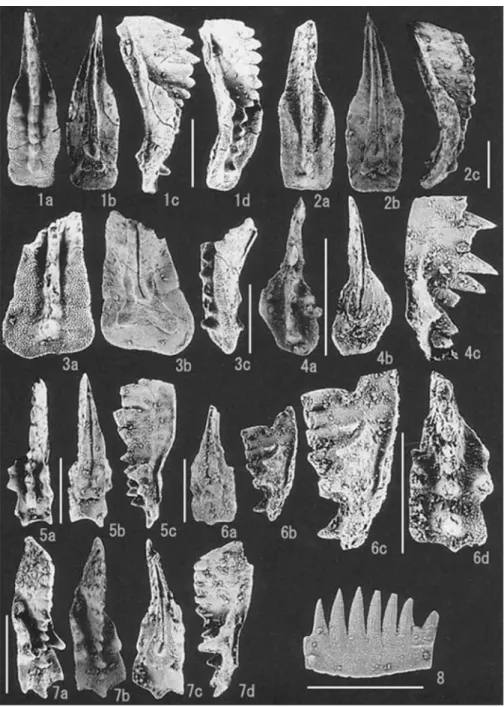
Fig. 12. Late Triassic (late Carnian−
early Norian) conodonts from the limestone gravels in TM4 conglom- erate. Scale bars indicate 0.1 mm. 1a, b, c, d: Metapolygnathus polygnathi- formis (Budurov and Stefanov, 1965), 1a: oral, 1b: basal, 1c: lateral, and 1d:
oblique oral views of Pa element; 2a, b, c: Metapolygnathus polygnathifor- mis (Budurov and Stefanov, 1965), 2a:
oral, 2b: basal, and 2c: lateral views of Pa element; 3a, b, c: Metapolygnathus carpathicus (Mock, 1979), 3a: oral, 3b: basal, and 3c: lateral views of Pa element (free blade and anterior end of platform were broken); 4a, b, c: Ancy- rogondolella spatulata (Hayashi, 1968), 4a: oral, 4b: basal, and 4c: lat- eral views of Pa element (Juvenile stage); 5a, b, c: Ancyrogondolella spat- ulata (Hayashi, 1968), 5a: oral, 5b:
basal, and 5c: lateral views of Pa ele- ment (intermediate stage); 6a, b, c, d:
Ancyrogondolella spatulata (Hayashi, 1968), 6a: basal, 6b, 6c: lateral, and 6d: oral views of Pa element (interme- diate stage); 7a, b, c, d: Ancyrogon- dolella spatulata (Hayashi, 1968), 7a:
oblique oral, 7b: oral, 7c: basal, and 7d:
lateral views of Pa element
(intermediate - mature stage); 8: Ancy- rogondolella or Norigondolella sp., lateral view of Pa element (Juvenile stage).
(3) Lithology and microfossil content provide clues as to the age of the TM3 chert and both the origin and age of the clasts within the TM4 base-conglomerate. This first finding of the -youngest age-Late Triassic (Norian−Rhaetian) radiolar- ian faunas from the bedded-cherts (TM3) in the Mae Sariang Zone, next to the Middle Triassic and older radiolarian fau- nas, adds another element to the reconstruction of the sequence now comprised in the Mae Sariang Zone, west of the Nan− Uttaradit Suture.
(4) The examination of the limestone clasts within the TM4 base-conglomerate suggests their provenance from the limestone biostratigraphic intervals. The possible sources of the clasts are the limestones correlative with the Chaiburi Forma- tion or Si Sawat Limestone in the Mae Sariang Zone, and fur- ther from the Kodian Limestone in the “Western Zone”.
ACKNOWLEDGMENTS: We thank our colleagues Mr. Wattana Tansathien and Mr. Wirote Saengsrichan (Bureau of Geological Sur- vey, Bangkok, Thailand) who assisted us in the field. The Thai Depart- ment of Mineral Resources provided scientific and logistic support in the field. The authors also thank to Dr. Michael Orchard (Geolocical Survey of Canada) who discussed us about the collected conodonts.
We are indebted to Dr. Fe Tumanda Mateer, Dr. Niall J. Mateer, Dr.
Carla Dimalanta, an anonymous reviewer and Prof. Graciano P. Yumul Jr. of the University of the Philippines and the DOST-Philippine Coun- cil for Industry and Energy Research and Development for their help in improving the manuscript.
REFERENCES
Ampornmaha, A., 1995, Triassic carbonate rocks in the Phatthalung area, Peninsular Thailand. Journal of Southeast Asian Earth Sci- ences, 11(3), 225−236.
Barr, S.M. and Mac Donalds, A.S., 1987, Nan river suture zone, northern Thailand. Geology, 15, 907−910.
Blome, C.D., 1983, Upper Triassic Capnuchosphaeridae and Cap- nodocinae (Radiolaria) from east-central Oregon. Micrpaleontology, 29(1), 11−49.
Blome, C.D., 1984, Upper Triassic radiolaria and radiolarian zona- tion from Western North America. Bulletins of American Pale- ontology, 85(318), 1−87.
Bragin, N.J. and Krylov, K.A., 1999, Early Norian Radiolaria from Cyprus. Geodiversitas, 21(4), 539−569.
Budurov, K. and Stefanov, S., 1965, Gattung Gondolella aus der Trias Bulgariens. Acad. Bul. Des Sci., Travaux geologigues de Bulgarie, Paleontologie, 7, 31−48.
Bunopas, S., 1981, Paleogeographic history of western Thailand and adjacent parts of Sout-East Asia −A plate tectonics interpretation.
Ph-D. Thesis, Victoria University of Wellington, New Zealand, 810p.;
1982. Geol. Survey Paper, Department of Mineral Resources, Thai- land, Bangcok, 5, 180 p.
Bunopas, S., Vella, P., Fontaine, H., Hada, S., Burrett, C., Haines, P., Potisat, S., Wongwanich, T., Chaodanrong, P., Howard, K.T. and Khositanoui, S., 2002, Growing of Asia in the Late Triassic Con- tinent-Continent Collision of Shan-Thai and Indochina against South China. In: Mantajit, N. (ed.), The Symposium on Geology of Thailand (Proceedings), Bangkok, Aug. 26−31, 129−135.
Burton, C.K., 1973, Mesozoic. In: Gobett, D.J. and Hutchison C.S.
(eds.), Geology of Malaysia Peninsular, Wiley-Interscience, New York, 97−141.
Carey, S.P., Burrett, C.F., Chaodumrona, P., Wongwanich, T. and Chonglakmani, C., 1995, Triassic and Permian conodonts from the Lampang and Ngaol groups, northern Thailand. Courier For- schungsinstitut Senckenberg, 182, 497−513.
Caridroit, M., 1991, Taxonomic study on Carboniferous and Permian Radiolaria from NW Thailand. Paleontologic, Stratigraphic and tectonic significances. Sixth Meeting of the International Asso- ciation of Radiolarian Paleontologists (INTRERAD VI, Abstact), Florence, Oct. 4−6, 21.
Caridroit, M., 1993, Permian Radiolaria from NW Thailand. In: Tha- nasuthipitak, T. (edit.), Proceedings of the International Symposium on Biostratigraphy of Mainland Southeast Asia: Facies and Pale- ontology, Chang Mai, Jan. 31−Feb. 5, 83−96.
Caridroit, M., Fontaine, H., Jongkanasoontorn, Y., Suteethorn, V. and Vachard, D., 1990, First results of a palaeontological study of Northwest Thailand. CCOP Technical Secretariat, 27, 337−350.
Caridroit, M., Bohlke, D., Lumjuan, A., Helmcke, D. and De Wever, P., 1993, A mixed radiolarian fauna (Permian/Triassic) from clas- tics of the Mae Sariang area, northwestern Thailand. In: Thana- suthipitak, T. (edit.), Proceedings of the International Symposium on Biostratigraphy of Mainland Southeast Asia: Facies and Pale- ontology, Chang Mai, Jan. 31−Feb. 5, 401−413.
Carter, E.S., 1993, Biochronology and paleontology of uppermost Triassic (Rhaetian) radiolarians, Queen Charlotte Islands, British Columbia, Canada. Mmoires de Gologie Lausanne, (11), 1−175.
Charusiri, P., Daorerk, V., Archibald D., Hisada, K. and Ampaiwan, T., 2002, Geotectonic Evolution of Thailand: A New Synthesis.
Journal of the Geological Society of Thailand. (1), 1−20.
Chonglakmani, C., 2002, Current status of Triassic stratigraphy of Thailand and its implication for geotectonic evolution. In: Man- tajit, N. et al. (eds.), Proceedings of the Symposium on Geology of Thailand, Department of Mineral Resources, Bangkok, 1−3.
Chonglakmani, C. and Grant-Mackie J.A., 1993, Biostratigraphy and facies variation of the marine Triassic sequences in Thailand.
International Symposium on Biostratigraphy of Mainland SE Asia:
Facies and Paleontology (Proceedings 1), Chiang Mai, Jan. 31−
Feb. 5, 97−123.
Chonglakmani, C., Gabel, J., Helmcke, D., Lamchuan, A. and Meischner, D., 1991, Geodynamic interpretation of marine Triassic basins of Northern Thailand (Abstract). GEOSEA VII, Bangkok, 13.
Chonglakmani, C., Feng, Q., Meishner, D., Ingavat-Helmcke, R. and Helmcke, D., 2001, Correlation of tectono-stratigraphic units in northern Thailand with those of Western Yunnan (China). Journal of the China University of Geosciences, 12, 207−213.
De Wever, P., 1982, Radiolaires du Trias et du Lias de la Tths (Sys- tematique, Stratigraphie). Socit Geologique Du Nord, 1(7), 1−
356; 2(7), 357−599, Villeneuve D−Ascq.
De Wever, P., Sanfilippo, A. and Gruber, B., 1979, Triassic radiolar- ians from Greece, Sicily and Turkey. Micropaleontology, 25(1), 75−110.
Fontaine, H. and Suteethorn, V., 1988, Late Paleozoic and Mesozoic fossils of West Thailand and their environments. Committee for cooperation of joint prospecting for mineral resources in Asian offshore areas (CCOP), 20, 1−108.
Hada, S., Bunopas, S., Ishii, K. and Yoshikura, S., 1999, Rift-drift histry and the amalgamation of Shan-Thai and Indochina/East Malaya Blocks. In: Metcalfe, I. (ed.), Gondowana Dispersion and Asian Accretion. IGCP321 Final Results Volume, A.A. Balkema, Rotterdam, 67−87.
Mai, Li, Thong Pha Phum). Bundesan, Geowissen Rohstoffe, Han- nover, 76 p.
Hayashi, S., 1968, The Permian conodonts in chert of the Adoyama Formation, Ashio mountains, central Japan. Earth Science (Chikyu Kagaku), 22, 63−77, Tokyo.
Helmcke, D., 1984, The orogenic evolution (Permo-Triassic) of cen- tral Thailand. Implications on palaeogeographic models for main- land SE-Asia. Memoires de la Societe Geologique de France, N.S.
(147), 83−91.
Hirsch, F. and Ishida, K., 2002, The Izanami Plateau: Pre-accretion- ary origin of Japan’s low latitude Triassic pelagic carbonates.
Eclogae Geologicae Helvetiae, 95, 43−55.
Hirsch, F., Ishida, K., Kozai, T. and Meesook, A., 2005, The welding of Shan-Thai. In: Ueno, K, Hara, H., Kamata, Y. and Hisada, K.
(eds), Proceedings of the First International Symposium on Geo- logical Anatomy of East and South Asia (IGCP 516), Tsukuba, Oct. 10−17, 38−41.
Hirsch, F., Ishida, K., Kozai, T. and Mesook, A., 2006, The welding of Shan-Thai. Geosciences Journal, 10, 195−204.
Huckriede, R., 1958, Die Conodonten der mediterranen trias und ihr stratigraohisher Wert. Palaeontology & Zoology, 32, 141−175, Stuttgart.
Igo, H., Nagano, N. and Nakinbodee, V., 1988, Middle Triassic conodonts from southern Thailand (preliminary report). Annual Report of the Institute of Geoscience, the University of Tsukuba, (14), 46−50.
Ishida, K. and Hirsch, F., 2001, Taxonomy and faunal affinity of late Carnian -Rhaetian conodont in the Southern Chichibu Belt, Shikoku, SE Japan. Rivista Italiana di Paleontologia e Stratigra- fia, 107(2), 227−250.
Ishida, K., Nanba, A., Hirsch, F., Kozai, T. and Meesook, A., 2004, Microfossil analysis of the Shan-Thai Terrane Jurassic basal con- glomerate in NW Thailand. Proceedings and Abstracts of the sixth International Symposium of IGCP 434 “Cretaceous geol- ogy and resources in South, East Asia and adjacent areas”, Ha Noi (Viet Nam), Nov. 2−9, 29−30.
Ishii, K. and Nogami, Y., 1966, Discovery of Triassic conodonts from the so-called Paleozoic limestones in Kedah, Malaya. Journal of Geoscience, Osaka City University, 9, 93−98.
Koike, T., 1973, Triassic Conodonts from Kedah and Pahang, Malay- sia. In Kobayashi, T. and Toriyama, R. (eds.), Geology and Palae- ontology of Southeast Asia. University of Tokyo Press, Tokyo, 12, 91−113.
Koike, T., 1982a, Review of some platform conodont of the Middle and Late Triassic in Japan. Science Reports of the Yokohama National University, Sec. II, 29, 15−27.
Koike, T., 1982b. Triassic conodont biostratigraphy in Kedah, West Malaysia. Geology and Palaeontology of Southeast Asia. Univer- sity of Tokyo Press, Tokyo, 23, 9−51.
Koike, T., 1988, Lower Triassic conodonts Platyvillosus from the Taho Limestone in Japan. Science Reports of the Yokohama National University, Sec. II, 35, 61−79.
Kozur, H. and Mostler, H., 1979, Beirrage zur Erforschung der meso- zoischen Radiolarien. Teil III: Die oberfamilien Actinomacea HAECKEL, 1862 emend., Artiscacea HAECKEL, 1882, Multiarcusallacea nov.
Der Supmellaria und triassische Nassellaria. Geologisch-Palae- ontologische Mitteilungen Innsbruck, 9(1, 2), 1−132.
Kozur, H. and Mostler, H., 1981, Beirrage zur Erforschung der meso- zoischen Radiolarien. Teil IV: Thalassosphaeracea HAECKEL,
Geologisch-Palaeontologische Mitteilungen Innsbruck, Sonderband, 1−208.
Kozur, H. and Mostler, H., 1994, Anisian to Middle Carnian radi- olarian zonation and description of some stratigraphically impor- tant radiolarians. Geologisch-Palaeontologische Mitteilungen Innsbruck, Sonderband, 3, 39−255.
Meesook, A. and Grant-Mackie, J.A., 1996, Marine Jurassic lithos- tratigraphy of Thailand. Journal of Southeast Asian Earth Science, 14(5), 377−391.
Meesook, A., Suteethorn, V., Chaodumrong, P., Teerarungsipul, N., Sardsud, A. and Wangprayoon T., 2002, Mesozoic Rocks of Thai- land: A summary. In: Mantajit, N. (ed.), The Symposium on Geol- ogy of Thailand, (Proceeding), Bangkok, Aug. 26−31, 82−85.
Metcalfe, I., 1990, Stratigraphic and tectonic implications of Triassic conodonts from northwest Peninsular Malaysia. Geological Mag- azine, 127, 567−578.
Metcalfe, I., Spiller, F.C.P., Benpei, L., Haoruo, W., and Sashida, K., 1999, The Palaeo-Tethys in Mainland East and Southeast Asia:
contributions from radiolarian studies. In: Metcalfe, I. (ed.), Gon- dowana Dispersion and Asian Accretion, IGCP321 Final Results Volume, A.A.Balkema, Rotterdam, Netherlands, 259−281.
Mock, V.R., 1979, Gondolella carpathica n. sp., eine wichtige tuvalische Conodontenart. Geologisch-Palaeontologische Mitteilungen Inns- bruck, 9, 171−174.
Myo Min, K., Feng, Q., Chonglakmani, C., Meishner, D., Ingavat- Helmcke, R. and Helmcke, D., 2001, Tracing disrupted outer margin of Paleoeurasian continent through Union of Myanmar. Journal of the China University of Geosciences, 12, 201−206.
Nakaseko, K. and Nishimura, A., 1979, Upper Triassic Radiolaria from Southwest Japan. Science Report of the College of General Educa- tion of the Osaka Univ., 28(2), 61−109.
Nogami, Y., 1968, Triassic-conodonten von Timor, Malaysien und Japan (Palaeontological Study of Portuguese Timor, 5). Memoire of the Faculty of Science of the Kyoto University, Geology &
Mineralogy, 34, 115−136.
Orchard, M.J., 1991, Upper Triassic conodont biochronology and new index species from the Canadian Cordillera. In: Orchard, M.J.
and Mc Cracken A.D. (eds.), Ordovician to Triassic conodont paleontology of the Canadian Cordillera, Geological Survey of Canada, Bulletin, 417, 299−335.
Pessagno, E.A.Jr., Finch W. and Abbot, P.L., 1979, Upper Triassic Radiolaria from the San Hipolito Formation, Baja California.
Micropaleontology, 25(2), 160−197.
Sardsud, A., 2002, Triassic conodont faunas and zonation in the Chaiburi Formation from the Phattalung area, Peninsular Thai- land. In: Mantajit, N. (ed.), The Symposium on Geology of Thai- land, (Proceeding), Bangkok, Aug. 26-31(2002), 82−85.
Sashida, K. and Igo, H., 1992, Triassic radiolarians from a limestone exposed at Khao Chiak near Phatthalung, southern Thailand.
Transactions and Proceedings of the Paleontological Society of Japan, New Series, (168), 1296−1310.
Sashida, K. and Igo, H., 1999, Occurrence and tectonic significance of Paleozoic and Mesozoic Radiolaria in Thailand and Malaysia.
In: Metcalfe, I. (ed.) Gondowana Dispersion and Asian Accre- tion. IGCP321 Final Results Volume, A.A. Balkema, Rotterdam, 175−196.
Sashida, K., Igo, H., Hisada, K., Nakornsri, N. and Ampornmaha, A., 1993, Occurrence of Paleozoic and Early Mesozoic Radiolaria in
Thailand (preliminary report). Journal of Southeast Asian Earth Sciences, 8, 97−108.
Sashida, K., Adachi, S., Igo, H. Koike, T. and Ibrahim, B.A., 1995, Middle and Late Permian radiolarians from the Semanggol Forma- tion, northwest Peninsular Malaysia. Transactions and Proceedings of the Paleontological Society of Japan, New Series, 177, 43−58.
Shi, G.R. and Archbold, N.W., 1998, Permian marine biogeography of SE Asia. In: Hall, R. and Holloway, J.D. (eds.), Biogeography and Geological Evolution of SE Asia, Backhuys Publication, Leiden, p. 57−72.
Staesche, U., 1964, Conodonten aus dem Skyth von Sudtirol. Neues Jahrbuch fuer Geologie und Palaeontologie Abhandlungen, 119, 247−306.
Sugiyama, K., 1997, Triassic and Lower Jurassic radiolarian bios- tratigraphy in the siliceous claystone and bedded chert units of the southeastern Mino Terrane, Central Japan. Bulletin of the Mizunami Fossil Museum, (24), 79−193.
Tamura, M., Hashimoto, W., Igo, H., Ishibashi, T., Iwai, J., Kobayashi, T., Koike, T., Pitakpaivan, K., Sato, T. and Yin, E.H., 1975, The Triassic System of Malaysia, Thailand and some adjacent areas.
In: Kobayashi, T. and Toriyama, R. (eds.), Geology and Palae- ontology of Southeast Asia, University of Tokyo Press, Tokyo,
14, 103−149.
Tantiwanit, W., Raksaskulwong, L. and Chitmanee, S., 1985, Geological map of Amphoe Mae Sot Quadrange (Sheet 4742-III), scale 1:50,000.
Geological Survey Division, Department of Mineralogy and Resouces, Bangkok.
Tekin, U.K., 1999, Biostratigraphy and systematics of late Middle to Late Triassic radiolarians from the Taurus Mountains and Ankara region, Turkey. Geologisch-Palaeontologische Mitteilungen Inns- bruck, 5, 1−296, Innsbruck.
Teoh, L.H., 1991, Geology and mineral resources of the Sungai Tiang area, Kedah Darul Aman. Geological Survey of Malaysia Map Report 5, 93 p.
Ueno, K., 1999, Gondwana/Tethys Divide in East Asia: Solution from Late Paleozoic Foraminiferal Paleobiography. Proceedings of the International Symposium Shallow Tethys (ST), Chiang Mai, 5, 45−54.
Yao, A., 1982, Middle Triassic to Early Jurassic radiolarians from the Inuyama Area, Central Japan. Journal of Geosciences, Osaka City Umiversity, 25, 53−70.
Manuscript received September 14, 2005 Manuscript accepted June 29, 2006