This is an Open Access article distributed under the terms of the Creative Commons Attribution Non-Commercial License (http: //creativecommons.org/licenses/by- nc/4.0/) which permits unrestricted non-commercial use, distribution, and reproduction in any medium, provided the original work is properly cited.
Copyright: © 2019 Korean Journal of Agrcultural Science
https://doi.org/10.7744/kjoas.20180053
ANIMAL
Effect of the Yea-Sacc yeast culture on growth performance, nutrient digestibility and fecal score in weanling pigs
Yanjiao Li, Tianshui Li, Inho Kim
*Department of Animal Resource and Science, Dankook University, Cheonan 31116, Korea
*Corresponding author: [email protected]
Abstract
The influence of dietary supplementation with a yeast culture on growth performance, fecal score and nutrient digestibility was evaluated in weaned pigs in a 6-week feeding trial. A total of 50 weaning pigs with an initial average body weight (BW) of 7.46 ± 1.60 kg were randomly allotted into 1 of 2 dietary treatments according to the initial BW. There were 5 replicate pens in each treatment with 5 pigs per pen. The dietary treatments were as follows:
1) control, basal diet (CON) and 2) 0.10% yeast culture, basal diet supplemented with 0.1%
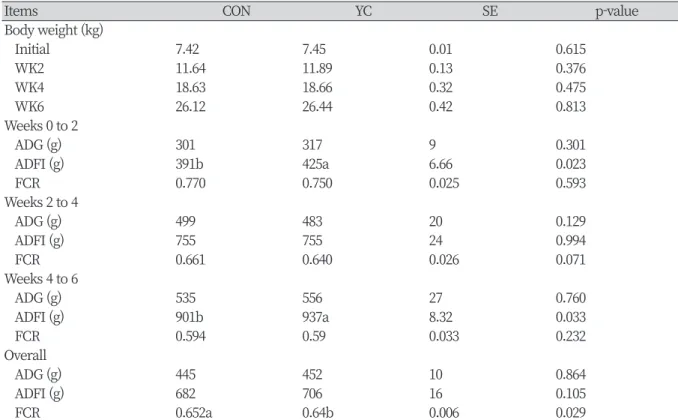
yeast culture (YC). The average daily feed intake was significantly improved with the dietary supplementation of the yeast culture compared with the control during phases 1 and 3.
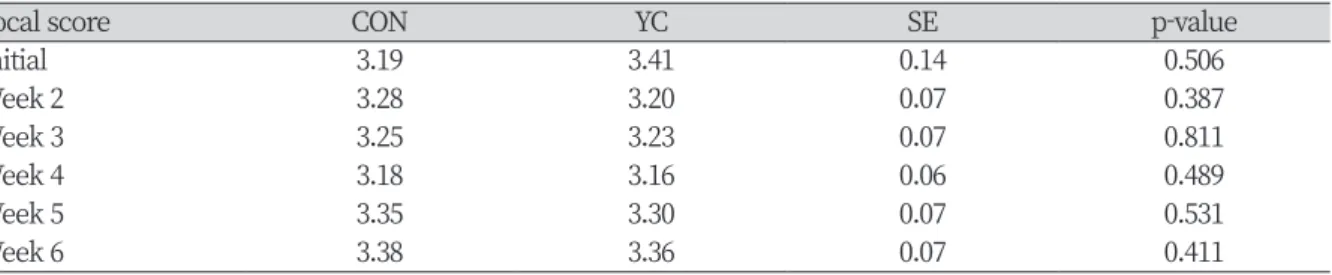
Overall (0 to 6 weeks), dietary supplementation with the 0.1% yeast culture had a significant effect on the feed conversion ratio (FCR). There was no significant difference in the fecal score between the CON and YC dietary treatments. In addition, no difference in the apparent total tract digestibility was observed between the CON and YC dietary treatments. Collectively, the results of this study indicate that dietary supplementation of 0.1% yeast only improved the feed intake of weaning pigs; however, yeast culture supplementation did not affect the average daily gain, feed efficiency, total tract digestibility of dry matter, and nitrogen and energy levels as well as the fecal scores.
Keywords: fecal score, growth performance, nutrient digestibility, weaning pigs, yeast culture
Introduction
Weaning pigs face multiple challenges during the transition phase of their lives . These challenges include the stress of separation from sows and littermate , a different food source , co - mingling with unrelated litters , alteration in housing environment , transportation stress etc . ( Campbell et al ., 2013 ).
As a result of these stress related changes , the piglets are deprived of growth , have reduced feed efficiency ( Jensen et al ., 1997 ), reduced immune functions , changes in intestinal integrity and incidence of diarrhea . It has been reported that about 11 % of mortality rate in post weaning piglets is due to the incidence of diarrhea ( Owusu - Asiedu et al ., 2003 ). Thus , post weaning diarrhea is the one OPEN ACCESS
Accepted: July 24, 2018 Revised: July 4, 2018 Received: February 1, 2018 DOI:
Citation: Li Y, Li T, Kim I. 2019. Effect of the Yea-Sacc yeast culture on growth performance, nutrient digestibility and fecal score in weanling pigs. Korean Journal of Agricultural Science. https://
doi.org/10.7744/kjoas.20180053
of the major cause of economic loss in pig industry .
To alleviate the post - weaning diarrhea , nutritional regulation may play an important role . Several feed additives such as nutraceuticals , acidifier , pre / probiotics , yeast culture , minerals , and phytogenic are added to weaning pigs ’ diet as an alternative antimicrobial growth promoter ( Vondruskova et al ., 2010 ; Debski , 2016 ).
The use of yeast as a source of protein , vitamins , and minerals in animal feeds has a long history ( Anupama and Ravindra , 2000 ; Bekatorou et al ., 2006 ). The protein found in yeast cell has been reported by several researchers to be very effective in accelerating growth and improving the health of ruminant animal by stimulating rumen acetogens ( Halász and Lásztity , 1991 ; Klein and Favreau , 1995 ; Kurtzman et al ., 2011a , b ). In addition , the use of yeast cell wall polysaccharides as feed additive has been found to improve the health of growing pigs ( Sauerwein et al ., 2007 ). The inclusion of yeast culture in the diet has been demonstrated to improve the gastro intestinal tract ’ s morphological structure and promote the digestive system function of piglets ( Giang et al ., 2010 ).
Materials and methods
Experiment design, animals, diets and facilities
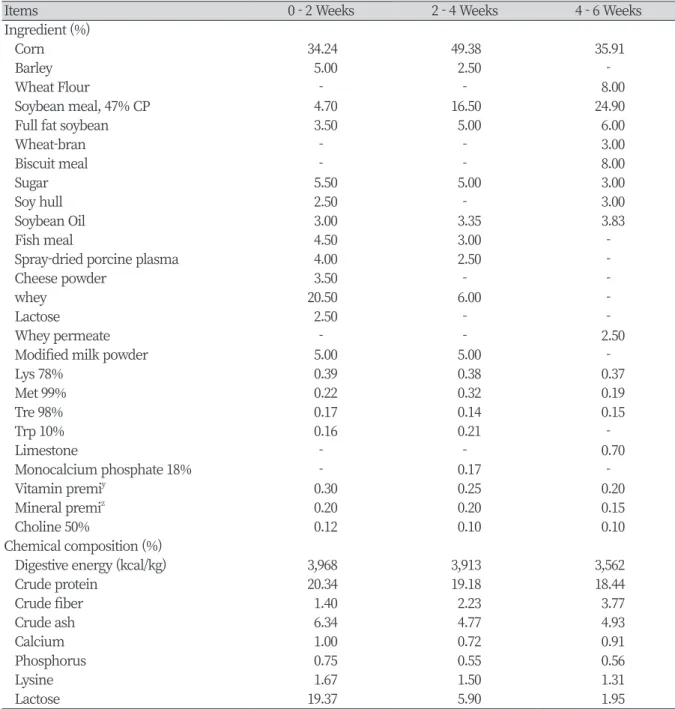
A total of 50 weaned pigs , initial body weight ( BW ) 7 . 46 ± 1 . 60 kg , they were randomly allotted to 2 treatments according to initial BW . There were 5 replicate pens in each treatment with 5 pigs per pen . They were fed 6 weeks . The dietary treatments included : 1 ) control , basal diet ( CON ); 2 ) 0 . 10 % yeast culture , basal diet supplemented with 0 . 1 % yeast culture ( YC ) ( Yeast culture concentration [ 0 . 10 %] is based on the recommended amount of company ' s experimental protocal ). In the present study , we used dried yeast culture ( Yea - Sacc
®, Alltech , Lexington , USA ). All experimental diets were formulated to meet or exceed the nutrient requirements recommended by the NRC ( 2012 ) ( Table 1 ).
All of the weaning pigs were housed in an environmentally controlled nursery facility with slatted plastic floor and a mechanical ventilation system . The environmental temperature was maintained at 30 ℃ for the first week of the experiment . The environmental temperature was reduced by 1 ℃ per week over the next three weeks . The relative humidity was 60 - 65 %, and these weaning pigs were provided light for 16 h daily throughout the experiment . There was a stainless steel feeder and one nipple water in each pen for weaning pigs . They were free to eat and drink water throughout the experiment .
Experimental sample preparation and measurements
The weaning pigs were weighed individually initially , at 2 weeks , 4 weeks and 6 weeks of the experiment . Weaning pigs ’ feed intake was recorded at the end of each phase on a pen basis to calculate the average daily gain ( ADG ), average daily feed intake ( ADFI ) and feed conversion ratio ( FCR ). To evaluate the apparent total tract digestibility of dry matter ( DM ), nitrogen ( N ), gross energy ( GE ) was determined using 2 g / kg of chromic oxide added in the diets as an indigestible marker during the last seven days of each phase . All weaning pigs were fed diets with chromic oxide from d 36 to 42 . Fecal samples were randomly collected from three pigs of each pen in the last three days of each phase . Fecal samples were pooled and dried in an air forced drying oven at 60 ℃ for 72 h . All feed and fecal samples were analyzed for DM , N and energy following the procedures outlined by the AOAC ( 2000 ) and then the apparent total tract digestibility were calculated .
At 08 : 00 and 20 : 00 hours , fecal score was evaluated and recorded initially , on weeks 2 , 3 , 4 , 5 , and 6 . The fecal score was
determined as the average value of five pigs of each pen using a 5 - grade score system ( Hu et al ., 2012 ), with grade of 1 standing for hard , dry pellets in a small , hard mass , grade of 2 for hard formed stool that remains firm and soft , grade of 3 for soft formed and moist stool that retains its shape , grade of 4 for soft unformed stool that assumes the shape of the container , and grade of 5 for watery liquid stool that can be poured . Scores were recorded on a pen basis following the observations of individual pig and signs of stool consistency in the pen .
Table 1. Composition of the experimental diets (as-fed-basis).
Items 0 - 2 Weeks 2 - 4 Weeks 4 - 6 Weeks
Ingredient (%)
Corn 34.24 49.38 35.91
Barley 5.00 2.50 -
Wheat Flour - - 8.00
Soybean meal, 47% CP 4.70 16.50 24.90
Full fat soybean 3.50 5.00 6.00
Wheat-bran - - 3.00
Biscuit meal - - 8.00
Sugar 5.50 5.00 3.00
Soy hull 2.50 - 3.00
Soybean Oil 3.00 3.35 3.83
Fish meal 4.50 3.00 -
Spray-dried porcine plasma 4.00 2.50 -
Cheese powder 3.50 - -
whey 20.50 6.00 -
Lactose 2.50 - -
Whey permeate - - 2.50
Modified milk powder 5.00 5.00 -
Lys 78% 0.39 0.38 0.37
Met 99% 0.22 0.32 0.19
Tre 98% 0.17 0.14 0.15
Trp 10% 0.16 0.21 -
Limestone - - 0.70
Monocalcium phosphate 18% - 0.17 -
Vitamin premi
y0.30 0.25 0.20
Mineral premi
z0.20 0.20 0.15
Choline 50% 0.12 0.10 0.10
Chemical composition (%)
Digestive energy (kcal/kg) 3,968 3,913 3,562
Crude protein 20.34 19.18 18.44
Crude fiber 1.40 2.23 3.77
Crude ash 6.34 4.77 4.93
Calcium 1.00 0.72 0.91
Phosphorus 0.75 0.55 0.56
Lysine 1.67 1.50 1.31
Lactose 19.37 5.90 1.95
y
The vitamin and mineral premix supplied per 1 kg of the diet: 20,000 IU of vitamin A, 3,000 IU of vitamin D
3, 80 IU of vitamin E, 12 mg of vitamin K, 150 mg of vitamin C, 20 mg of riboflavin, 60 μg vitamin B
12, 50 mg of D-pantothenic acid, 60 mg of biotin, 80 mg of niacin, 2 mg of vitamin B
6.z