This is an Open Access article distributed under the terms of the Creative Commons Attribution Non-Commercial License (http: //creativecommons.org/licenses/by- nc/4.0/) which permits unrestricted non-commercial use, distribution, and reproduction in any medium, provided the original work is properly cited.
Copyright: © 2018 Korean Journal of Agrcultural Science
https://doi.org/10.7744/kjoas.20180016
ANIMAL
Effects of yeast culture ( Saccharomyces cerevisiae) supplementation on growth performance, fecal score, and nutrient digestibility of weaning pigs
Xiao Liu, Tianshui Li, In Ho Kim
*Department of Animal Resource and Science, Dankook University, Cheonan 31116, Korea
*Corresponding author: [email protected]
Abstract
Weaning pigs often face post-weaning challenges such as diarrhea, low feed intake, and body weight (BW) loss which affects the health and economic value of weaning pigs. Interestingly, the use of yeast cultures (YCs) as feed supplements for pigs has increased markedly in recent years. This study evaluated the effects of yeast cultures (Saccharomyces cerevisiae) on the growth performance, fecal score, and nutrient digestibility of weaning pigs. A total of 50 crossed healthy weaning pigs [(Yorkshire × Landrace) × Duroc] with an average BW of 7.46
± 1.60 kg (28 day of age) were used in a 6-week experiment. The experiment was divided into 3 phases (Phase 1, 1 - 2 weeks; Phase 2, 2 - 4 weeks; Phase 3, 4 - 6 weeks). Dietary treatments were as follows: 1) CON: basal diet and 2) CON + 0.50% YC. During phase 1, the average daily gain (ADG) and average daily feed intake (ADFI) were significantly increased (p < 0.05) in the weaning pigs fed YC supplementation diets compared with the weaning pigs fed the CON diet. During phase 3 as well as overall, the gain/feed ratio (G/F) was significantly increased (p < 0.05) in the YC supplementation group compared with the pigs fed the CON diet. In conclusion, the supplementation of YCs in the diet positively affected the growth performance of weaning pigs during the first two weeks after weaning.
Keywords: fecal score, growth performance, nutrient digestibility, saccharomyces cerevisiae, yeast culture
Introduction
It is well known that weaning pigs often face post - weaning challenges , such as diarrhea , low feed intake , body weight ( BW ) loss ( Pluske et al ., 1996 ). These affect the health of weaning pigs , thereby affect the economic value of pigs . Interest in the use of yeast culture ( YC ) as feed supplements for pigs has been increased markedly in recent years . Fully fermented YC is a dried product containing yeast and various metabolites of yeast fermentation . Actually , YC has been used in feeding dairy cows to improve milk production ( Robinson and Garrett , 1999 ). Recently , a report showed that OPEN ACCESS
Accepted: March 15, 2018 Revised: March 9, 2018 Received: October 18, 2017 DOI:
Citation: Liu X, Li T, Kim IH. 2018.
Effects of yeast culture (Saccharomyces cerevisiae) supplementation on growth performance, fecal score, and nutrient digestibility of weaning pigs. Korean Journal of Agricultural Science. https://
doi.org/10.7744/kjoas.20180016
feeding YC to gestating and lactating sows improved litter weight gain ( Kim et al ., 2008 ). Mathew et al . ( 1998 ) and Bontempo et al . ( 2006 ) showed that feeding YC to weaning pigs improve the average daily gain ( ADG ) and average daily feed intake ( ADFI ). A commonly used yeast culture is the Saccharomyces cerevisiae fermentation product . Saccharomyces cerevisiae is one kind of yeast which is used to ferment yeast culture ( Minervini et al ., 2012 ). A Saccharomyces cerevisiae fermentation product is produced during fermentation of an unmodified strain of Saccharomyces cerevisiae , including the products of fermentation , residual yeast cells , yeast cell wall fragments , and the media used during fermentation ( Shen et al ., 2011 ). Some research indicated that supplementation with YC enhanced the growth performance , nutrient digestion , reproductive performance of pigs , and so on ( Vander Peet - Schwering et al ., 2007 ; Kim et al ., 2008 ; Kim et al ., 2010 ). Yeast culture ( Saccharomyces cerevisiae ) has been shown to improve total tract nutrient digestibility of nursery pigs ( Shen et al ., 2009 ).
However , another report showed that feeding yeast culture to animals had no significance in growth performance ( Martin et al ., 1992 ). Thus this study was conducted to determine the effects of YC ( Saccharomyces cerevisiae ) on growth performance , fecal score , and nutrient digestibility of weaning pigs .
Materials and Methods
All animals received human care as outlined in the guide for the care , and use of experimental animals ( Animal Care Committee , Dankook University , Korea ).
Animals and diets
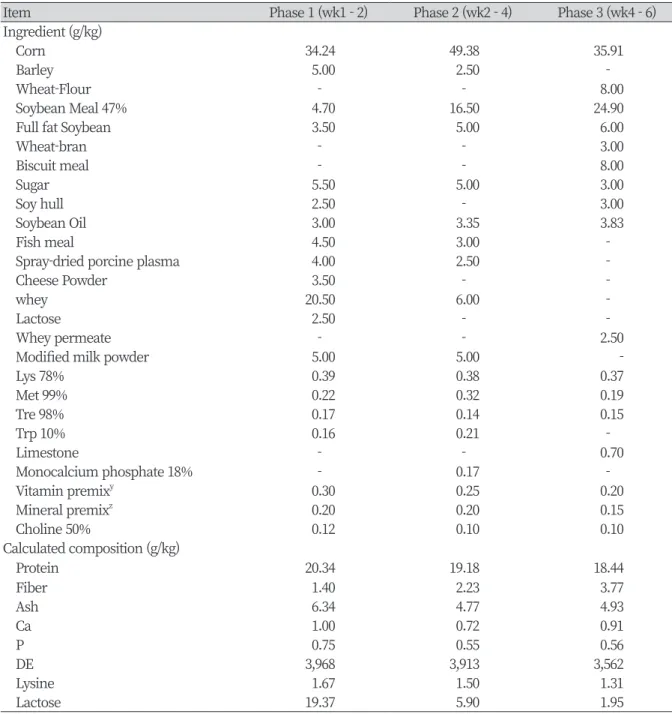
A total of 50 crossed healthy weaning pigs [( Yorkshire × Landrace ) × Duroc ] with an average BW of 7 . 46 ± 1 . 60 kg ( 28 d of age ) were used in a 6 weeks experiment that was divided into 3 phases of 2 week each . Pigs were randomly allotted to 1 of 2 experimental diets according to initial BW in a randomly complete block design . There were 5 replicated pens per treatment with 5 pigs per pen . Dietary treatments were 1 ) CON : basal diet , 2 ) CON + 0 . 50 % YC . All diets were formulated to meet or exceed the recommendation of NRC ( 2012 ) for weaning pigs , and were fed in a mash form ( Table 1 ). The product has been evaluated in this trial was yeast culture ( XPC , Diamond V original XPC
TMYeast culture , Cedar Rapids , IA , USA ).
All pigs were housed in an environmentally controlled nursery room . The stainless steel pens were 0 . 5 m × 0 . 6 m × 2 . 0 m with a slatted plastic floor . Each pen was provided with a stainless steel feeder and a nipple waterer that allowed ad libitum access to feed and water throughout the experiment . Ventilation was provided by a mechanical system and lighting was automatically regulated to provide 12 h of artificial light per day . The ambient temperature within the room was approximately 30 ℃ at the start of the experiment and decreased by 1 ℃ each week .
Chemical analysis
Feed and fecal samples were ground to pass through a 1mm screen , after which were analyzed for dry matter ( DM ) ( method 934 . 01 ; AOAC , 2000 ), crude protein ( CP , method 990 . 03 ; AOAC , 2000 ), crude fat ( method 920 . 39 ; AOAC , 1995 ). Nitrogen ( N ) was determined by the machine ( Kjeltec 2300 Nitrogen Analyzer ; Foss Tecator AB , Hoeganaes Sweden ), and CP was calculated as N × 6 . 25 . Energy was analyzed by oxygen bomb calorimeter ( Parr 1600 Instrument Co ., Moline , IL , USA ).
Chromium was analyzed by UV absorption spectrophotometry ( Shimadzu UV - 1201 ; Shimadzu , Kyoto , Japan ) following the
method described by Williams et al . ( 1962 ). Digestibility was calculated using chrome oxide as an indigestible marker .
Sampling and measurements
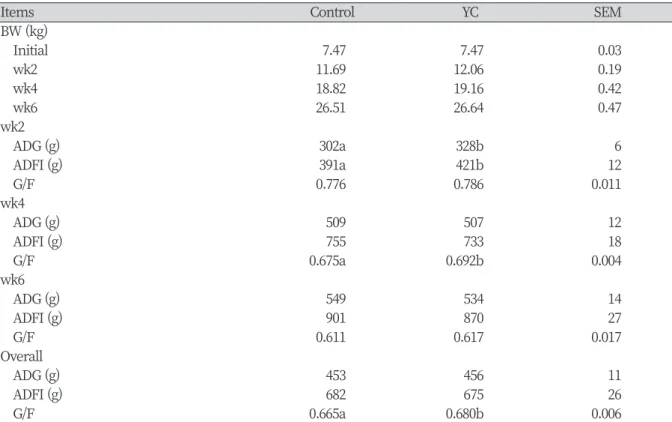
Individual pig BW , and feed refusals were recorded on Wk 2 , 4 , and 6 to calculate ADG , ADFI , and growth efficiency ( gain / feed ratio , G / F ). On Wk 6 , the experimental diets were supplemented with 0 . 2 % chromium oxide ( Cr
2O
3) as a non - digestible marker to calculate the apparent nutrient digestibility . After 7 d , fresh fecal samples were obtained from each pig by anal massage . Representative samples were stored at - 20 ℃ until analyzed . Before chemical analysis , the fecal samples were thawed , and dried at 60 ℃ for 72 h , after which they were finely ground to a size that could pass through a 1 mm screen .
Table 1.Compositions of basal weaning pig diets (as-fed basis).
Item Phase 1 (wk1 - 2) Phase 2 (wk2 - 4) Phase 3 (wk4 - 6)
Ingredient (g/kg)
Corn 34.24 49.38 35.91
Barley 5.00 2.50 -
Wheat-Flour - - 8.00
Soybean Meal 47% 4.70 16.50 24.90
Full fat Soybean 3.50 5.00 6.00
Wheat-bran - - 3.00
Biscuit meal - - 8.00
Sugar 5.50 5.00 3.00
Soy hull 2.50 - 3.00
Soybean Oil 3.00 3.35 3.83
Fish meal 4.50 3.00 -
Spray-dried porcine plasma 4.00 2.50 -
Cheese Powder 3.50 - -
whey 20.50 6.00 -
Lactose 2.50 - -
Whey permeate - - 2.50
Modified milk powder 5.00 5.00 -
Lys 78% 0.39 0.38 0.37
Met 99% 0.22 0.32 0.19
Tre 98% 0.17 0.14 0.15
Trp 10% 0.16 0.21 -
Limestone - - 0.70
Monocalcium phosphate 18% - 0.17 -
Vitamin premix
y0.30 0.25 0.20
Mineral premix
z0.20 0.20 0.15
Choline 50% 0.12 0.10 0.10
Calculated composition (g/kg)
Protein 20.34 19.18 18.44
Fiber 1.40 2.23 3.77
Ash 6.34 4.77 4.93
Ca 1.00 0.72 0.91
P 0.75 0.55 0.56
DE 3,968 3,913 3,562
Lysine 1.67 1.50 1.31
Lactose 19.37 5.90 1.95
y
Provided per kg of complete diet: vitamin A, 11,025 IU; vitamin D3, 1103 IU; vitamin E, 44 IU; vitamin K, 4.4 mg;
riboflavin, 8.3 mg; niacin, 50 mg; thiamine,4 mg; D-pantothenic, 29 mg; choline, 166 mg; and vitamin B 12 , 33 μg.
z