This is an Open Access article distributed under the terms of the Creative Commons Attribution Non-Commercial License (http: //creativecommons.org/licenses/by- nc/4.0/) which permits unrestricted non-commercial use, distribution, and reproduction in any medium, provided the original work is properly cited.
Copyright: © 2020 Korean Journal of Agrcultural Science
ANIMAL
Effect of dietary ractopamine supplementation on growth performance, meat quality and
fecal score in finishing pigs
Md-Raihanul Hoque
1,†, Yu-Mi Im
2,†, In Ho Kim
1,*1
Department of Animal Resource & Science, Dankook University, Cheonan 31116, Korea
2
Department of Nursing, Dankook University, Cheonan 31116, Korea
†
These authors equally contributed to this study as first author.
*Correspondence: [email protected]
Abstract
An experiment was designed to assess ractopamine supplementation on growth, meat quality and carcass, and fecal scores of pigs. The 96 crossbred pigs ([Yorkshire× Landrace]
× Duroc) had an average body weight of 72.8 ± 2.5 kg. Randomized allocation was followed in the allotment of the pigs according to their body weight into 1 of 2 dietary treatments: 1) CON, basal diet and 2) RAC (ractopamine hydrochloride), CON + 1% ractopamine with 12 replication pens per treatment including equal numbers of barrows (2) and gilts (2) per pen.
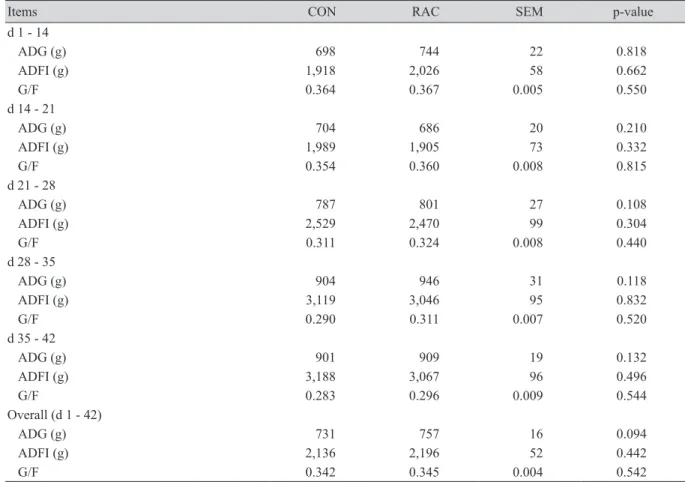
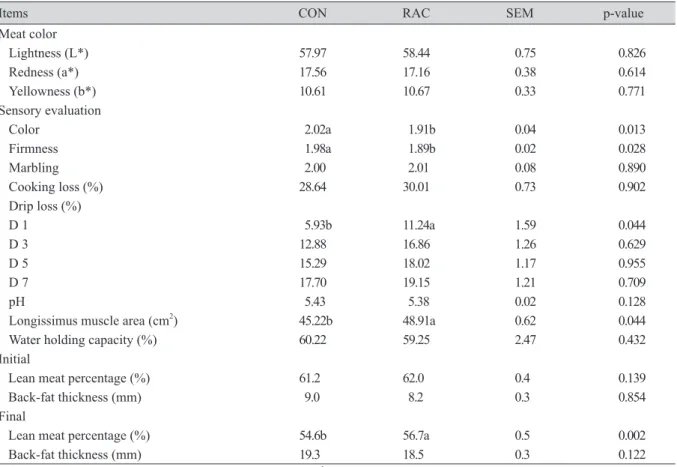
At the end of the experiment, the lean meat percentage was higher (p < 0.05) for the RAC group compared to the CON group. Dietary ractopamine supplementation did not influence (p > 0.05) the growth performance and fecal score throughout the experimental period. In regard to sensory evaluation, higher (p < 0.05) scores for color and firmness were observed in the RAC group than in the CON group. Drip loss (p < 0.05) was higher in the ractopamine fed diet group compared to the control diet group at day 1. Additionally, longissimus muscle was improved (p < 0.05) in the ractopamine treated diet group than in the control diet group. In conclusion, in the early stage, ractopamine supplementation may not influence the growth performance, but it improves the leanness in the meat of finishing pigs.
Keywords: carcass characteristics, finishing pigs, growth performance, meat quality, ractopamine
Introduction
Research interests in pig farming have been shifted its focus among average daily gain, feed intake, conversion efficiency, carcass weight and meat quality. Now a days, lean meat has become a primary concern for meat consumers. Ractopamine, which is a beta-adrenoreceptor agonist, acts as a repartitioning agent, helps to bring lean tissue deposition in finishing pigs at market weight (Watkins et al., 1990; Crome et al., 1996). Ractopamine hydrochloride (RAC) is pharmacologically phenethanolamine. In literatures, properties and effects of ractopamine on pork meat structure OPEN ACCESS
Accepted: July 14, 2020 Revised: July 10, 2020 Received: May 08, 2020
Citation: Hoque MR, Im YM, Kim IH.
2020. Effect of dietary ractopamine s u p p l e m e n t a t i o n o n g r o w t h performance, meat quality and fecal score in finishing pigs. Korean Journal of Agricultural Science 47:707-715. https://
doi.org/10.7744/kjoas.20200098
and quality have been described (Anderson et al., 1987; Prince et al., 1987; Uttaro et al., 1993; Crome et al., 1996). These literatures mentioned ractopamine�s function in lean meat production and improved growth performance in pig. In the long history of pig farming numerous production changes have been brought in the United States. Recent noticeable changes have been brought on genetics and management practices. Breeding for lean pig and lean meat production is one of the changed objectives that has been prompted by the consumers � demand. The increasing addition of synthetic amino acids in lower protein diets is also a management change of the recent practices. Usually, older pigs deposit more fat during their final growth of marketing weight (Gu et al., 1992; Schwab et al., 2007). Ractopamine is being used in the United States since December, 1999. In May, 2006; a range of 5 to 10 ppm of ractopamine use in the daily diet of finishing swine has been set by the Food and Drug Administration (FDA). Many studies had been conducted using ractopamine on finishing pigs.
But different countries have different desired body weight for marketing of finishing pigs. Moreover, Rickard et al. (2017) reported declining effect of ractopamine in finishing pigs (over 136 kg) after 21 days of use. To elucidate the effect of ractopamine on the finishing pig marketing system in South Korea, this study was planned and performed. The objective of this study was to assess the growth performance, feed efficiency, carcass weight and meat quality response of finishing pigs to ractopamine.
Materials and Methods
Treatment and management of animals were deployed by following the standards of the animal care and use committee of Dankook university.
Experimental design, animals and housing
Population sample of 96 finishing pigs ([Yorkshire × Landrace] × Duroc) possessing an average body weight (BW) of 72.8 ± 2.5 kg were selected for this experiment. According to body weight they were divided into pens and then allotted to two (2) experimental batches in a randomized way. Each treatment had 12 replicate pens of 4 pigs (2 gilts and 2 barrows·pen
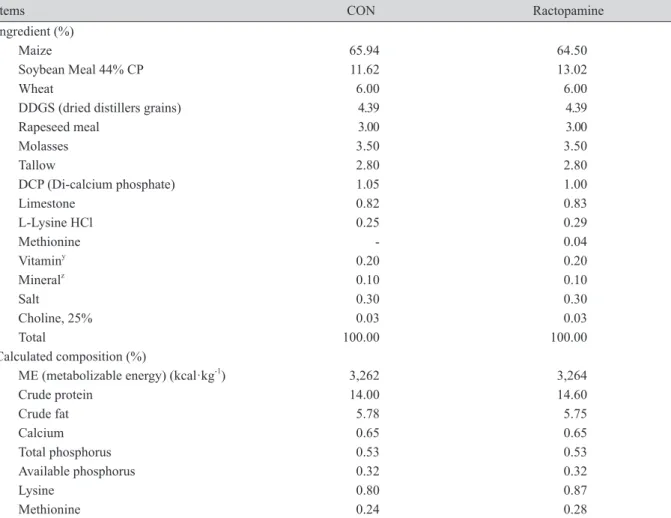
-1). The investigation duration was 6 weeks. Dietary treatments were designated as: 1) CON, basal diet, 2) CON + 1% ractopamine. The given diets were formulated according to NRC (2012) to meet or exceed pigs � nutrient requirements (Table 1). In a controlled house where pigs were allotted, the temperature was maintained at 24 ℃. Each pen had an area of 1.8
× 1.8 m
2including self-feeder and nipple drinkers to assure ad libitum feed and water access.
Sampling and measurements
During this 6 week long experimental period BW and abstained feed was recorded on a pen basis. From these BW and feed record average daily gain (ADG), average daily feed intake (ADFI), and gain to feed ratio (G : F) were calculated.
Concluding the experiment, one pig per pen were slaughtered at a local slaughterhouse. Obtained carcasses were chilled
for 24 hour at 2℃. From between 10th and 11th ribs right loin samples were taken for meat quality analysis. Before
evaluating sensory meat color, marbling, and firmness score the meat samples were thawed to room temperature. Six (6)
trained personnel panelist team performed the sensory evaluation of color, firmness and marbling on a basis of three-point
assessment system (NPPC, 1999). Just after the subjective scores, the lightness (L*), redness (a*), and yellowness (b*) values
were measured at two (2) different surfaces of each sample. For this subjective evaluation CR-410 Chromameter (Konica
Minolta Sensing Inc., Osaka, Japan) was used. At the same time, pH values were taken using a pH meter for twice per sample
(Fisher Scientific, Pittsburgh, PA, USA). The water holding capacity (WHC) was calculated abiding the methods elucidated by Kauffman et al. (1986). For WHC 0.2 gm meat from each sample was cut and put in a filter paper (125-mm-diameter) at 26℃. Then the filter paper was kept under a pressure of 3 kg weight for 3 minutes. The border area of the pressed meat sample and the extended moisture area were portrayed and then measured. For area measurement MT-10S digitizing area- line sensor (M.T. Precision Co., Ltd., Tokyo, Japan) was used. For the calculation of WHC, water: meat area was estimated (a higher ratio indicates decreased WHC). The LM surface of the 10th rib was traced marked. Then, using the antecedent digitizing area-line sensor the area was measured. Drip loss was measured following the method described by Honikel (1998).
From each sample approximately 4 g of meat was cut and hanged in a plastic bag. Meat weight was checked in D 1, D 3, D 5, and D 7. Meat samples (2 gm) were cooked at 80 ℃ in a water bath to bring the core temperature of the fillet to 72℃. After cooking, samples were weighed again and the cooking loss percentage was calculated (Albrecht et al., 2019).
From day 10 to 17 fecal samples from each pen (1 gilt and 1 barrow) were collected by rectal massaging for diarrhea score observation. Individual person took subjective diarrhea scores each day (d 10 to 17) based on the following: 1 = hard feces, 2 = well-formed feces, 3 = sloppy and soft feces, 4 = semi-liquid and unformed feces, 5 = Watery liquid feces Scores were tabulated on a pen basis just after observations of stool consistency of the pigs in the pen. The score is presented as average daily diarrhea of individual pig score.
Table 1. Compositions of the basal finishing diets (as-fed basis).
Items CON Ractopamine
Ingredient (%)
Maize 65.94 64.50
Soybean Meal 44% CP 11.62 13.02
Wheat 6.00 6.00
DDGS (dried distillers grains) 4.39 4.39
Rapeseed meal 3.00 3.00
Molasses 3.50 3.50
Tallow 2.80 2.80
DCP (Di-calcium phosphate) 1.05 1.00
Limestone 0.82 0.83
L-Lysine HCl 0.25 0.29
Methionine - 0.04
Vitamin
y0.20 0.20
Mineral
z0.10 0.10
Salt 0.30 0.30
Choline, 25% 0.03 0.03
Total 100.00 100.00
Calculated composition (%)
ME (metabolizable energy) (kcal·kg
-1) 3,262 3,264
Crude protein 14.00 14.60
Crude fat 5.78 5.75
Calcium 0.65 0.65
Total phosphorus 0.53 0.53
Available phosphorus 0.32 0.32
Lysine 0.80 0.87
Methionine 0.24 0.28
y
Provided for each kg of complete diet: 1,103 IU vitamin D3; 11,025 IU vitamin A; 44 IU vitamin E; 4.4 mg vitamin K; 50 mg niacin; 8.3 mg riboflavin; 4 mg thiamine; 29 mg d-pantothenic; 166 mg choline; 33 μg vitamin B12.
z