This is an Open Access article distributed under the terms of the Creative Commons Attribution Non-Commercial License (http: //creativecommons.org/licenses/by- nc/4.0/) which permits unrestricted non-commercial use, distribution, and reproduction in any medium, provided the original work is properly cited.
Copyright: © 2019 Korean Journal of Agrcultural Science
https://doi.org/10.7744/kjoas.20190013
ANIMAL
Effect of anise flavor on the performance of sows and their litters with different weaning ages
Hao Yang Sun
†, Yan Lei
†, Inho Kim
*Department of Animal Resource and Science, Dankook University, Cheonan 31116, Korea
*
Corresponding author: [email protected]
†
These authors contributed equally to this work as the first authors.
Abstract
This study was conducted to evaluate the effect of dietary supplementation of anise flavor on the performance of lactating sows and suckling pigs at different weaning ages. A total of 120 sows (Landrace × Yorkshire) were used in this experiment. Sows were fed with a commercial lactation diet (60 sows) or diet with flavor (60 sows) during days 100 to 114 of gestation period and the whole lactation period. Piglets were allotted to 2 dietary treatments based on their initial body weight (BW) using a 2 × 2 factorial arrangement of treatments with 2 levels of anise flavor (0 or 0.5 g/kg) and weaning periods (weaned at 21 day or 28 day after birth).
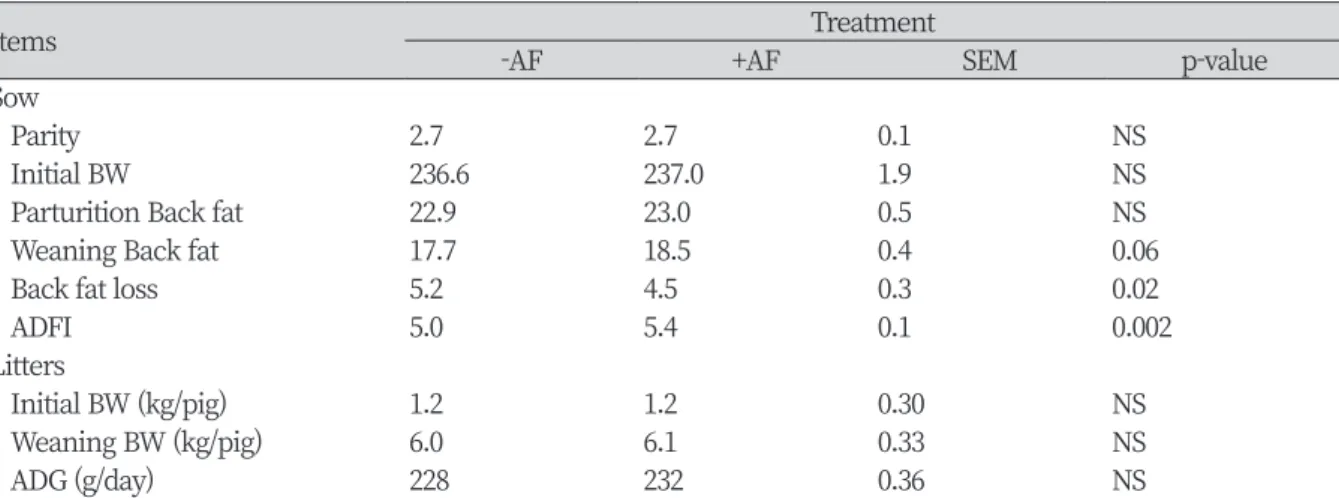
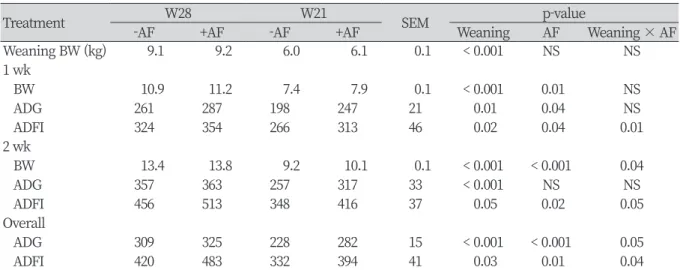
Sows fed with flavor supplemented diets had higher (p < 0.05) back fat and average daily feed intake (ADFI) at weaning, lower (p < 0.05) back fat loss than those fed with non-flavor diets. Sows weaned at 28 day had higher (p < 0.05) weaning back fat and lower (p < 0.05) back fat loss than those weaned on 21 day. During weaning, piglet average daily gain (ADG), ADFI, digestibility of dry matter (DM), nitrogen (N), and gross energy (GE) and fecal score were affected by anise flavor, respectively. In conclusion, dietary flavor supplementation could increase feed intake of lactating sows, improve growth performance and reduce weaning stress of piglets, especially effective in the early weanling piglets. Meanwhile, interactive effects were observed about the piglet performance between weaning ages and anise flavor supplementation after weaning.
Keywords: flavor, litter and weaning pig, sow
Introduction
Feed intake and metabolic state during lactation influence weaning - to service - intervals ( WSI ), subsequent farrowing rates and total - born litter sizes ( Bilkei , 1995 ). Therefore , an insufficient feed intake by sows during lactation is a serious problem , because sow requires large amount of energy for high milk production during lactation . During lactating period , low feed intake leads to greater body weight ( BW ) loss , reduced milk production , and reproductive problems that may lead to culling of the sow ( Baidoo et al ., 1992 ; Eissen et al ., 2000 ). During the past years , due to genetic selection for large OPEN ACCESS
Accepted: April 19, 2019 Revised: April 1, 2019 Received: September 10, 2018 DOI:
Citation: Sun HY, Lei Y, Kim I.
2019. Effect of anise flavor on the performance of sows and their litters with different weaning ages. Korean Journal of Agricultural Science. https://
doi.org/10.7744/kjoas.20190013
litter size , sows are facing heavy burden for milk production ( Auldist et al ., 1998 ). It has been reported that flavor increased feed intake of lactating sows and improved growth performance of piglets ( Wang et al ., 2014 ). However , the effectiveness of these feed additives has not been consistently observed . Some studies failed to demonstrate an effect of dietary flavor or sweeteners on performance of pigs ( McLaughlin et al ., 1983 ; Munro et al ., 2000 ).
The age of weaning can be a major determinant of the total annual production and , ultimately , the profitability in modem swine production units . While a number of factors must be considered when determining optimal weaning age , including management capabilities , available facilities , and effects on the sow , the ability to maintain the health and performance of the weaned pig must be of major concern ( Varley and Cole , 1976 ; Levis , 1990 ). Some authors noted that early weaning could enhance the reproductive performance of sows , efficient utilization of housing and reduce pathogen or antigens to piglets ( Alexander et al ., 1980 ; Harris , 2000 ) consequently making pig production more economical .
However , it has been widely reported that in pigs less than 30 days of age , enzymatic and secretory functions in the gastrointestinal tract may not yet be fully functional and / or may lack efficiency in degrading plant - based substrates ( Tarvid et al ., 1994 ). Mathew et al . ( 1996 ) found that greater fluctuations in bacterial populations , pH , and dry matter occur in pigs weaned at 21 day of age compared with pigs weaned at 28 day of age . It means pigs weaned at 28 day has more stable gut environment than the pigs weaned at 21 day . Sufficient feed intake is beneficial to the development of the intestine ( McCracken et al ., 1995 ; Pluske et al ., 1996 ; Spreeuwenberg et al ., 2001 ).
Feed intake closely relates with the development of the intestine , higher feed intake can promote the growth of intestine . Therefore , we hypothesize that anise flavor supplementation in the basal diet would improve the development of the intestine in weaning pig through the increase in feed intake . Thus , the objective of the present study was to test whether the supplementation of anise flavor ( AF ) would improve the growth performance , nutrient digestibility , and fecal score at different weaning age .
Materials and Methods
The experimental protocol used in this study was approved by the Animal Care and Use Committee of Dankook University . The flavors used in the present study were provided by DadHank Biotechnology Corporation ( Chengdu , China ) as non - hygroscopic powder .
Experimental design, animals, and diets
A total of 120 sows ( Landrace × Yorkshire ), with an average BW of 236 . 7 kg ( 14 day before farrowing ) were used in this
experiment . Gestating sows were fed on a commercial lactation diet ( 60 sows ) or diet with added anise flavor ( 60 sows )
during 100 to 114 day of gestation . On 104 day of gestation , sows were moved into farrowing crates in an environmentally
regulated farrowing house . The diets ( Table 1 and 2 ) were formulated to meet or exceed the NRC ( 2012 ) nutrient requirements .
Farrowing crates ( 2 . 1 m × 0 . 6 m ) contained an area ( 2 . 1 m × 0 . 6 m ) for newborn pigs on each side . Supplemental heat was
provided for piglets using heat lamps ( 500 W ), which maintained the temperature for newborn piglets constant at 35 ° C .
Drinking nipples provided water ad libitum to the piglets . After farrowing , all piglets were cross - fostered to another sow in
the same group . Each sow fostered ten piglets . All piglets received injections of 1 mL of iron dextran and the males were
castrated 3 day after birth . No creep feed was given during the lactation period . The back fat of sows was measured 6 cm off
the midline at 10th rib using a real - time ultrasound instrument ( Piglot 105 , SFK Technilogy , Herlev , Denmark ). At the day before farrowing and 21 day after farrowing . During the lactation period , feed intake of the sow was recorded daily to determine the average daily feed intake ( ADFI ). On 21 day after farrowing , the BW of piglets was checked , and then the sows , fed diets with flavor and their litters , were selected to continue the following experiments . Piglets were allotted to 2 dietary treatments based on their initial BW using a 2 × 2 factorial arrangement of treatments with 2 level of anise flavor ( 0 or 0 . 5 g / kg ) and weaning period ( weaned at 21 day or 28 day after weaning ). From 104 day of gestation until farrowing , sows were fed 2 . 5 kg of the experimental diet per day . On the day of parturition , sows were not offered feed . First day after farrowing , sows were fed with 1 . 5 kg experimental feed and 2 . 0 kg at the second day . Daily feed allowance increased gradually , one week after farrowing , sows were allowed ad libitum to the experimental lactation feed and water . All diets were provided in meal forms and divided into 2 daily meals .
Sampling and measurements
Sow body weight were checked on 7 day before farrowing , within a few hours after farrowing and at weaning . Individual all piglet BW and feed intake was assessed on 7 and 14 day after weaning for calculation of average daily gain ( ADG ) and ADFI . Chromium oxide ( 0 . 2 %) was added to the diet as an indigestible marker ( Fenton and Fenton , 1979 ) at each phase for 7 d before fecal collection to determine apparent total tract digestibility ( ATTD ) of dry matter ( DM ), nitrogen ( N ), and gross
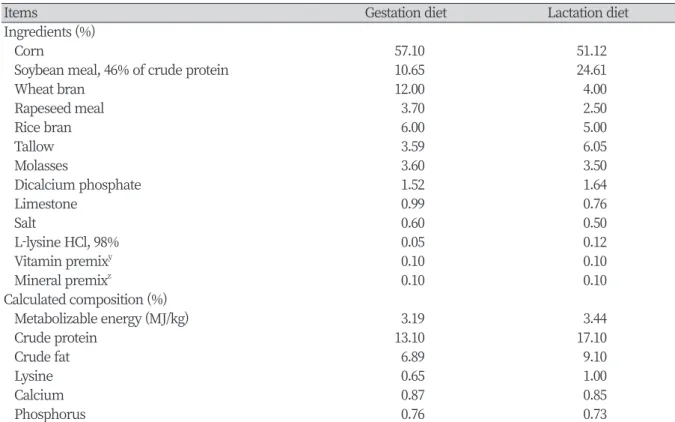
Table 1. Sow diet composition (as-fed basis).
Items Gestation diet Lactation diet
Ingredients (%)
Corn 57.10 51.12
Soybean meal, 46% of crude protein 10.65 24.61
Wheat bran 12.00 4.00
Rapeseed meal 3.70 2.50
Rice bran 6.00 5.00
Tallow 3.59 6.05
Molasses 3.60 3.50
Dicalcium phosphate 1.52 1.64
Limestone 0.99 0.76
Salt 0.60 0.50
L-lysine HCl, 98% 0.05 0.12
Vitamin premix
y0.10 0.10
Mineral premix
z0.10 0.10
Calculated composition (%)
Metabolizable energy (MJ/kg) 3.19 3.44
Crude protein 13.10 17.10
Crude fat 6.89 9.10
Lysine 0.65 1.00
Calcium 0.87 0.85
Phosphorus 0.76 0.73
y
Provided per kilogram of complete diet: vitamin A, 10,000 IU; vitamin D3, 2,000 IU; vitamin E, 48 IU; vitamin K3, 1.5 mg; riboflavin, 6 mg; niacin, 40 mg; d-pantothenic, 17 mg; biotin, 0.2 mg; folic acid, 2 mg; choline, 166 mg;
vitamin B6, 2 mg; and vitamin B12, 28 μg.
z
Provided per kilogram of complete diet: Fe (as FeSO
4•7H
2O), 90 mg; Cu (as CuSO
4•5H
2O), 15 mg; Zn (as ZnSO
4), 50
mg; Mn (as MnO
2), 54 mg; I (as KI), 0.99 mg; and Se (as Na
2SeO
3•5H
2O), 0.25 mg.
energy ( GE ). On the last 2 day of the experiment , fecal samples were collected from 2 pigs daily in each pen . All feed and fecal samples were stored at - 20 ° C until analysis . Before chemical analysis , fecal samples were dried at 57 ° C for 72 h , after which they were ground to pass through a 1 - mm screen . All feed and fecal samples were analyzed for DM ( Method 930 . 15 ; AOAC , 2007 ), CP ( Method 990 . 03 ; AOAC , 2007 ), and crude fat ( Method 920 . 39 ; AOAC , 2007 ). Chromium was analyzed via UV absorption spectrophotometry ( Shimadzu UV - 1201 , Shimadzu , Kyoto , Japan ). The GE was analyzed by an oxygen bomb calorimeter ( Parr Instrument Co ., Moline , USA ). The ATTD was then calculated using the following formula according to Stein et al . ( 2006 ): Digestibility (%) = { 1 - [( Nf × Cd )/( Nd × Cf )]} × 100 , where Nf = nutrient concentration in feces (%
DM ), Nd = nutrient concentration in diet (% DM ), Cd = chromium concentration in diet (% DM ), and Cf = chromium concentration in feces (% DM ).
Detection of estrus was conducted twice per day from weaning onward , at 8 : 30 and 16 : 00 every day . A sow was considered to be in estrus when exhibiting a standing response induced by a backpressure test when in the presence of a boar .
Subjective diarrhea scores were recorded daily from birth 1 to 7 day by the same person and were based on the following : 1 = well form feces , 2 = sloppy feces , 3 = diarrhea ( Marquardt et al ., 1999 ). Scores were recorded on a pen basis following the
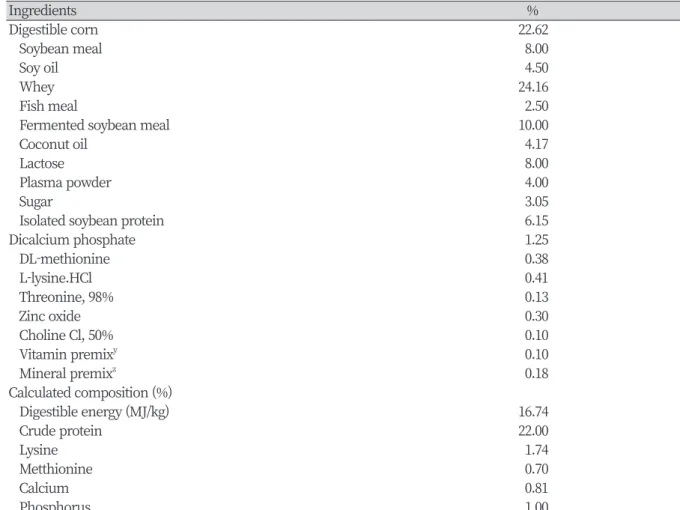
Table 2. Piglet diet composition (as-fed basis).
Ingredients %
Digestible corn 22.62
Soybean meal 8.00
Soy oil 4.50
Whey 24.16
Fish meal 2.50
Fermented soybean meal 10.00
Coconut oil 4.17
Lactose 8.00
Plasma powder 4.00
Sugar 3.05
Isolated soybean protein 6.15
Dicalcium phosphate 1.25
DL-methionine 0.38
L-lysine.HCl 0.41
Threonine, 98% 0.13
Zinc oxide 0.30
Choline Cl, 50% 0.10
Vitamin premix
y0.10
Mineral premix
z0.18
Calculated composition (%)
Digestible energy (MJ/kg) 16.74
Crude protein 22.00
Lysine 1.74
Metthionine 0.70
Calcium 0.81
Phosphorus 1.00
y
Provided per kilogram of complete diet: vitamin A, 1,298 IU; vitamin D3, 260 IU; vitamin E, 2.4 IU; menadione (sodium bisulfate form), 143 μg; vitamin B12, 3.3 μg; riboflavin, 880 μg; d-pantothenic acid, 2.6 mg; niacin, 4.4 mg.
z