• 검색 결과가 없습니다.

Effect of supplementation oreganum aetheroleum essential oil on growth performance in sows and growth performance, fecal score in weanling pigs

N/A
N/A
Protected

Academic year: 2021

Share "Effect of supplementation oreganum aetheroleum essential oil on growth performance in sows and growth performance, fecal score in weanling pigs"

Copied!
8
0
0

로드 중.... (전체 텍스트 보기)

전체 글

(1)

OPEN ACCESS

Citation: Park JW, Yun HM, Park JH, Lee IS, Kim IH. 2016. Effect of supplementation oreganum aetheroleum essential oil on growth performance in sows and growth performance, fecal score in weanling pigs. Korean Journal of Agricultural Science 43:794-801.

DOI: https://doi.org/10.7744/kjoas.20160083 Editor: Jung Min Heo, Chungnam National University, Korea

Received: September 1, 2016 Revised: November 10, 2016 Accepted: November 13, 2016 Copyright: ©2016 Korean Journal of Agricultural Science.

This is an Open-Access article distributed under the terms of the Creative Commons Attribution Non- Commercial License which permits unrestricted non- commercial use, distribution, and reproduction in any medium, provided the original work is properly

ANIMAL

Effect of supplementation oreganum aetheroleum essential oil on growth performance in sows and growth performance, fecal score in weanling pigs

Jae Won Park1, Hyeok Min Yun1, Jae Hong Park1, Il Seok Lee2, In Ho Kim1*

1Department of Animal Science, Dankook University, Cheonan 31116, Korea

2Department of General Education, Dankook University, Cheonan 31116, Korea

*Corresponding author: [email protected]

Abstract

This study was conducted to evaluate the effect of supplementation Oreganum aetheroleum essential oil on reproductive performance in sows and growth performance of their offspring of weaning pig. 12 sows (Landrace × Yorkshire) were randomly assigned within parities to 1 of 3 dietary treatments to give 4 replicates per treatment. Dietary treatments were as follows: 1) CON (basal diet) 2) ANT (basal diet + Efrotomycin 0.08%) and 3) ORE (basal diet + Oreganum aetheroleum essential oil 0.05%), EXP. 1, diets were fed from d 107 of gestation to weanling.

EXP. 2, diets were fed from after weaning to 3 weeks. In the Exp.1, no significant difference (p

> 0.05) was observed in sow’s average parity, sow backfat thickness, the number of piglets, feed intake of sows, the average of piglet weight, and piglet survival ratio between CON, ANT, and ORE treatments. Besides, in the Exp. 2, the inclusion of efrotomycin and Oreganum aetheroleum essential oil in the diets significantly (p < 0.05) increased final body weight, ADG, ADFI, and G/F in weanling pigs. In addition, weanling pigs fed ANT and ORE diets led to decrease the number of weanling pigs with diarrhea as well as fecal score. In conclusion, supplementation of efrotomycin and Oreganum aetheroleum essential oil enhanced growth performance, and decreased the number of weanling pigs with diarrhea and fecal score.

However, no significant effect on grow performance was observed in sow and piglet.

Keywords: essential oil, Oreganum aetheroleum, performance, sows, weanling pigs

Introduction

항생제는 가축 산업에서 가축의 생산성의 향상과 사료효율의 개선 및 질병과 폐사 발생을 절 감시킬 목적으로 광범위하게 이용하였다(Cromwell, 2002). 그러나 많은 나라에서 항생제의 사용 으로 인하여 항생제 내성균 발생 등의 부작용에 대한 관심이 증가하였고 이에 따라 전 세계적으 로 항생제의 사용을 규제하거나 금지시키고 있으며 항생제 사용을 대체하기 위하여 유기산, 효 소제, 프리바이오틱스, 프로바이오틱스 및 에센셜 오일 등에 대한 많은 연구가 이루어지고 있다 (Windisch et al., 2008; Cho et al., 2014; Upadhaya et al., 2014; Zhao and Kim, 2015).

에센셜 오일은 식물의 2차 대사물질로 꽃, 씨앗, 가지, 껍질, 허브, 과일 및 뿌리 등에서 추출되

(2)

유익성이 인정되었고 성장촉진, 항염증, 항산화, 식욕촉진 및 소화와 대사작용에 폭넓은 효능을 나타내어 가축산업 에 전반적으로 이용하고 있다(Kołacz et al., 1997; Cho et al., 2006; Grela and Semeniuk, 2006;Windisch et al., 2008;

Brenes and Roura, 2010; Huang et al., 2010; Yan et al., 2010; Ao et al., 2011).

Oreganum aetheroleum 에센셜 오일은 Oreganum vulgare ssp.를 증기 증류하여 추출하고 페놀성 물질이 풍부하여 항산화, 미생물 억제 및 살균활성에 뛰어난 효과를 나타낸다(Ecomomou et al., 1991; Tsimidou et al., 1995; Sivropoulou et al., 1996; Adam et al., 1998; Botsoglou et al., 2002). Oreganum aetheroleum 에센셜 오일의 주 성분은 carvacrol 및 thymol로 에센셜 오일내 78 - 82%의 높은 비율로 존재하며(Voslářová et al., 2007), 이러한 carvacrol 및 thymol의 성 분으로 인하여 강력한 항산화 및 항병성 활성을 한다(Scalbert et al., 2005).

Khattak et al. (2014)의 연구에 의하면 basil, caraway, laurel, lemon, oregano, sage, tea 및 thyme의 에센셜 오일 복합 제를 육계 사료내 첨가시 증체량 및 사료효율이 향상되었고 융모 및 융와의 폭을 개선시킨다고 보고하였고 Zeng et al. (2015)의 연구 또한 이유자돈 사료내 Oreganum aetheroleum 에센셜 오일 첨가시 생산성, 사료효율, 영양소 소화 율 및 혈액내 면역물질이 개선되었다고 보고하였다.

따라서, 본 연구에서는 모돈 및 자돈 사료내 Oreganum aetheroleum 에센셜 오일의 첨가가 모돈의 번식성적, 자돈 의 생산성 및 설사발생에 미치는 영향에 대해 알아보고자 실시하였다.

Materials and Methods

시험동물 및 시험설계

모돈(Landrace × Yorkshire)은 총 12두 공시하였으며, 분만시부터 이유시 (포유 21일)까지 21일간 사양시험을 실 시하였다. 시험설계는 1) CON (Antibiotic free diet), 2) ABT (CON + 0.08% Efrotomycin) 및 3) T3 (CON + 0.05%

Oreganum aetheroleum essential oil)로 3 처리구이며, 각 4두씩 배치하여 시험을 실시하였다.

시험사료 및 사양관리

사양시험은 단국대학교 시험농장에서 실시하였으며, 시험사료는 NRC (2012)요구량에 따라 배합한 옥수수-대두 박 위주의 사료로 임신·포유모돈 사료급여 프로그램에 따라 제한 및 무제한 급여 하였으며, 물은 자동급수기를 이용 하여 자유로이 먹을 수 있도록 조절하였다.

조사항목

1) 포유모돈 및 포유자돈 생산성

포유모돈의 체중 및 등지방 두께는 개시시(분만시) 및 종료시(포유 21일)에 측정하였다. 사료섭취량은 급여량에 서 잔량을 감하여 계산하였고, 등지방 두께는 Piglog 105 (Carometec Food Technology, Denmark)를 이용하여 P2지 점 (마지막 늑골에서 좌우 6.5 cm 부위)의 등지방을 측정하였다. 포유자돈의 체중은 생시 및 이유시(포유 21일)에 측 정하였다.

2) 이유자돈의 생산성

증체량은 개시시 및 종료시(21일)에 각 개체별로 체중을 측정하였다. 일당사료섭취량은 체중 측정시 사료급여량

에서 잔량을 제하여 계산하였고, 사료효율은 일당증체량을 일당사료섭취량으로 나누어 산출하였다.

(3)

3) 이유자돈의 분변지수

분변지수는 구간별로 포유 7일, 14일 및 21일에 측정하여 Score로 수치화하여 평균을 내었다(0, nomal; 1, soft feces; 2, mild diarrhea; 3, severe diarrhea, Values in brackets represent mean fecal score).

통계처리

모든 자료는 SAS (2013)의 General Linear Model Procedure를 이용하여 분산분석을 실시하였고, 유의성이 있을 경우 Duncan's multiple range test (Duncan, 1955)로 처리 후 평균간의 유의성을 검정하였다(p < 0.05).

Results

1) 포유모돈 번식성적 및 포유자돈 생산성

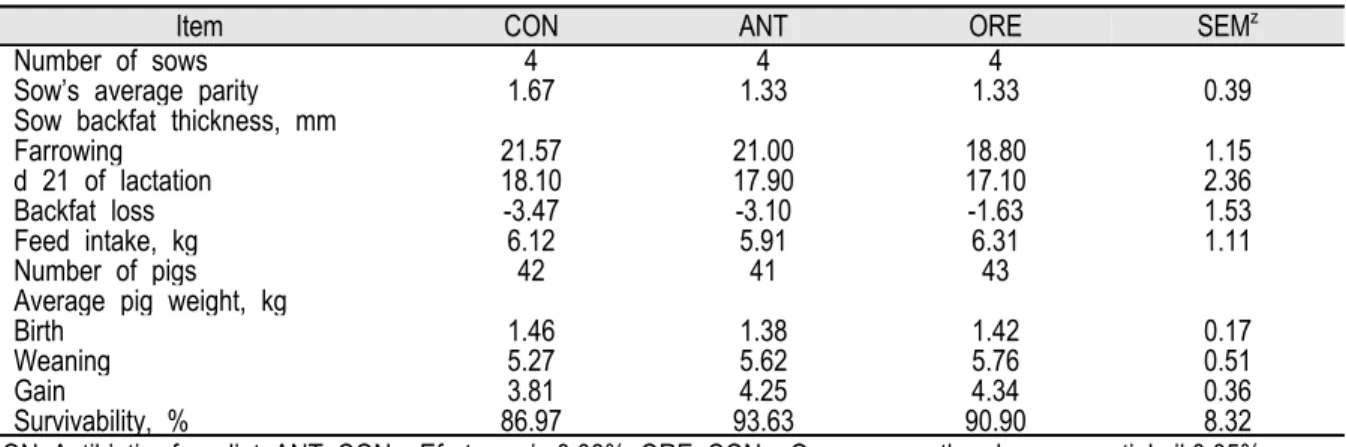
포유모돈 사료내 Oreganum aetheroleum 에센셜 오일의 첨가가 번식성적 및 포유자돈의 생산성에 미치는 영향은 Table 2에 나타내었다. 포유모돈의 번식성적 및 포유자돈의 생산성에 있어 처리구간 유의적인 차이를 나타내지 않 Table 1. Composition of experimental diets (as-fed basis).

Items Lactation diet

Ingredients, %

Corn (USA) 55.89

Wheat hard 3

Distillers Dried Grains and Solubles 7

Soybean meal (EXP) 22.2

Rapeseed meal 2

Tallow 4.25

Molasses 2.5

Lysine-sulfate 0.22

Methionine (99%) 0.04

Limestone 0.45

Dicacium Phosphate 1.28

Vitamine premix

y

0.2

Choline CL, 50% 0.07

Mineral premix

z

0.1

Salt 0.6

MgO 0.2

Calculated composition  

Dry matter 86.6

Ash 5.2

CP 17.5

EE 6.54

ME (kcal/kg) 3,200

y

Provided per kilogram of complete diet: vitamin A - 10,000 IU; vitamin D3 - 2,000 IU; vitamin E - 48 IU; vitamin K3 - 1.5 mg;

riboflavin - 6 mg; niacin - 40 mg; d-pantothenic acid - 17 mg; biotin - 0.2 mg; folic acid - 2 mg; choline - 166 mg; vitamin B6 - 2 mg; and vitamin B12 - 28 mg.

z

Provided per kilogram of complete diet: Fe (as FeSO

4

·7H

2

O) - 90 mg; copper (as CuSO

4

·5H

2

O) - 15 mg; zinc (as ZnSO

4

) - 50

mg; Mn (as MnO

2

) - 54 mg; I (as KI) - 0.99 mg; and Se (as Na

2

SeO

3

·5H

2

O ) - 0.25 mg.

(4)

Table 2. Effects of supplementation oreganum aetheroleum essential oil on growth performance in sow and piglet.

Item CON ANT ORE SEM

z

Number of sows 4 4 4

Sow’s average parity 1.67 1.33 1.33 0.39

Sow backfat thickness, mm

Farrowing 21.57 21.00 18.80 1.15

d 21 of lactation 18.10 17.90 17.10 2.36

Backfat loss -3.47 -3.10 -1.63 1.53

Feed intake, kg 6.12 5.91 6.31 1.11

Number of pigs 42 41 43

Average pig weight, kg

Birth 1.46 1.38 1.42 0.17

Weaning 5.27 5.62 5.76 0.51

Gain 3.81 4.25 4.34 0.36

Survivability, % 86.97 93.63 90.90 8.32

CON, Antibiotics free diet; ANT, CON + Efrotomycin 0.08%; ORE, CON + Oreganum aetheroleum essential oil 0.05%.

z
Standard error of means.

2) 이유 후 자돈 생산성

이유자돈 사료내 Oreganum aetheroleum 에센셜 오일의 첨가가 생산성에 미치는 영향은 Table 3에 나타내었다. 종 료시 체중, 일당증체량, 일당사료섭취량 및 사료효율에 있어 ANT 및 ORE 처리구가 CON 처리구보다 유의적으로 높게 나타났다(p < 0.05).

Table 3. Effects of supplementation oreganum aetheroleum essential oil on growth performance in weaning pigs (Exp. 2).

Item CON ANT ORE SEM

z

Initial BW, kg 5.27 5.62 5.76 0.51

Final BW, kg 10.08b 11.98a 11.91a 0.18

ADG, g 229b 303a 293a 8

ADFI, g 422b 465a 456a 5

G/F 0.543b 0.651a 0.642a 0.025

CON, Antibiotics free diet; ANT, CON + Efrotomycin 0.08%; ORE, CON + Oreganum aetheroleum essential oil 0.05%.

z

Standard error of means.

Means in the same row with different superscripts differ (p < 0.05).

3) 이유 후 자돈 설사발생

이유자돈 사료내 Oreganum aetheroleum 에센셜 오일의 첨가가 설사발생에 미치는 영향은 Table 4에 나타내었다.

이유자돈의 설사두수에 있어 CON 처리구가 ANT 및 ORE 처리구보다 많은 결과를 나타내었고 설사지수 또한 높은 결과를 나타내었다.

Table 4. Clinical response of 21days after dietary oreganum aetheroleum essential oil in weaning pigs (Exp. 2).

Item No. of pigs

No. of pigs with diarrhea on

7days 14days 21days

No. of pigs (Fecal score

z

)

CON 38 9 (1.5) 7 (1.5) 3 (1.0)

ANT 39 5 (1.0) 0 (0.0) 0 (0.0)

ORE 40 5 (1.0) 1 (1.0) 0 (0.0)

CON, Antibiotics free diet; ANT, CON + Efrotomycin 0.08%; ORE, CON + Oreganum aetheroleum essential oil 0.05%.

z

Fecal score is the mean fecal consistency score: 0, nomal; 1, soft feces; 2, mild diarrhea; 3, severe diarrhea, Values in

brackets represent mean fecal score.

(5)

Discussion

오늘날 많은 연구에서 가축의 성장촉진, 항염증, 항산화, 식욕촉진 및 소화와 대사작용 등 폭넓은 효능으로 생산성 을 향상시키고자 essential oil을 사용하고 있다(Kołacz et al., 1997; Cho et al., 2006; Grela and Semeniuk, 2006;

Windisch et al., 2008; Brenes and Roura, 2010; Huang et al., 2010; Yan et al., 2010; Ao et al., 2011).

본 연구에서는 사료내 Oreganum aetheroleum의 첨가효능을 평가하였고 결과적으로 모돈에서는 효과를 나타내 지 않았지만 자돈에 있어 일당증체량, 일당사료섭취량 및 사료효율을 개선시키고 설사 발생 두수 및 설사지수를 감 소시키는 것으로 나타났다.

Gertenbach and Bilkei (2001)의 연구에 따르면 이유후 자돈사료내 1,000 mg/kg의 oregano를 첨가시 증체량이 향 상되는 결과를 나타내었고 Walter and Bilkei (2004)의 연구에서는 육성-비육돈 사료내 oregano essential oil 사용시 성장지체 개선 및 면역시스템이 향상된다고 보고하였다. 또한 Walter and Bilkei (2004)의 연구에서 oregano essential oil 유래 carvacrol을 육성-비육돈 사료내 첨가할 경우 일당증체량과 사료효율이 유의적으로 개선된다고 보고하였 다. Allan and Bilkei (2005)의 연구에 의하면 모돈 사료내 oregano essential oil을 첨가할 경우 번식성적이 향상된다고 보고하였다. 이와 같은 결과는 oregano essential oil의 항균성, 항염증성, 항산화 및 식욕 개선 효능이 일당 사료섭취 량을 개선시키고 사산율을 감소시켜 생시자돈 수를 개선시켜주는 것으로 추정된다. Bilkei (1995)의 연구 또한 모돈 사료내 oregano essential oil 첨가시 생시자돈수가 개선되었다고 보고하였다. Khajarern and Khajarern (2002)의 연구 에서는 모돈사료내 origanum essential oil 첨가시 성장촉진, 소화율 향상, 섭취량 개선을 통한 일당섭취량 증가뿐만 아니라 성장성, 번식성적 및 모유생산을 개선하는 결과를 나타내었고, origanum essential oil의 carvacrol과 thymol 성분이 장내 세포 및 융모의 성장을 촉진시킨다고 보고하였다.

Docic and Bilkei (2003)의 연구에서 포유자돈에 oregano essential oil 사용시 Escherichia coli에 대한 높은 저항성 을 나타내었고 Burt et al. (2003)의 연구 또한 oregano essential oil의 이용시 많은 장관내 병원균에 대해서 강력한 항 균성을 나타내어 oregano essential oil의 이용이 병원성 미생물 저항성에 효과적인 결과를 나타내었다. 이외에도 Günter and Bossow (1998) 및 Gertenbach and Bilkei (2001)등의 많은 연구에서도 사료내 oregano essential oil의 첨가 시 일당증체량, 일당사료섭취량 및 사료효율이 개선된다고 보고하였다.

그러나 Simitzis et al. (2010)의 연구에 따르면 양돈 사료내 0.25, 0.5, 1.0 mL/kg의 oregano essential oil 첨가시 생시 체중 및 일당증체량에 유의적인 효능이 나타나지 않는다고 보고하였고, Ariza-Nieto et al. (2011)의 연구에서는 임신 돈 및 포유돈 사료내 250 mg/kg의 oregano essential oil 첨가시 생산성 및 면역반응에 영향을 미치지 않는다고 보고하 였다. 이외에도 다양한 연구에서 또한 자돈 사료내 carvacrol 및 oregano essential oil을 첨가시 생산성에 영향을 미치 지 않는다고 보고하였다(Neill et al., 2004; Nofrarías et al., 2006; Manzanilla et al.,2006).

양돈 사료내 Oregano의 이용은 설사 예방에 탁월한 효능을 나타내어 성공적인 항생제 대체효과를 가져온다 (Baumann et al., 2003). 또한, Giannenas et al. (2003)의 연구에서는 닭콕시듐 공격접종시 육계 사료내 oregano essential oil 첨가구에서 대조구보다 긍정적인 효능이 나타난다고 보고하였다.

많은 연구자들이 oregano essential oil 사용시 항산화, 항미생물 및 항염증 효능을 나타낸다고 보고하였다(Azuma et al., 1986; Aeschbach et al., 1994; Didry et al., 1994). 또한 양돈 소화관내에서 소화를 촉진하고 장관대사를 조절하 며 항균효능을 통하여 장내 미생물 균총을 정상화 시켜준다(Azuma et al., 1986; Sivropoulou et al., 1996; Günter and Bossow, 1998; Tsinas et al., 1998).

이외에도 다양한 연구를 통하여 oregano의 주요 생리활성 물질인 thymus 및 carvacrol 성분이 병원성 미생물에 대

한 강력한 항균성을 나타낸다는 많은 결과가 보고되어 가축 사료내 Oregano essential oil의 사용시 질병 저항성 및 장

(6)

이와 같이 많은 연구에서 사료내 에센셜오일 첨가시 가축 생산성이 향상되고 강력한 항균력을 통하여 병원성 미 생물에 대한 저항성 및 장내 환경을 개선하는 것으로 보고하고 있다. 본 연구 또한 자돈 사료내 Oreganum aetheroleum의 첨가시 에센셜오일의 항균, 항산화, 항염증, 소화와 대사작용 및 장내 융모와 융와의 개선 등의 다양 하고 유익한 생리활성 효능을 통하여 자돈의 일당증체량, 일당사료섭취량 및 사료효율이 유의적으로 개선되고 병원 성 미생물의 저항성 및 장내 환경 개선을 통하여 설사 발생 두수 및 설사지수가 감소하는 것으로 사료되며 모돈에 있 어서도 유의적인 차이는 보이지 않았지만 포유기간동안의 등지방 손실, 포유자돈의 성장성 및 폐사율에 있어 개선 의 가능성을 나타내었다.

Conclusion

결론적으로 모돈 및 자돈사료내 Oreganum aetheroleum의 첨가시 모돈에 있어서는 유의적인 효과를 나타내지는 않았지만 등지방 손실, 포유자돈 성장성 및 폐사율의 개선 가능성을 나타내었고 자돈에 있어서는 일당증체량, 일당 사료섭취량 및 사료효율을 유의적으로 개선하고 설사 발생 두수 및 설사지수를 감소하는 효과를 나타내었다.

Acknowledgements

본 논문은 농촌진흥청 공동연구사업(과제번호 PJ011212)의 지원에 의하여 수행되었습니다.

References

Adam K, Sivropoulou A, Kokkini S, Lanaras T, Arsenakis M. 1988. Antifungal activities of Origanum vulgare ssp. Hirtum, Mentha spicata, Lavandula angustifolia and Salvia fruticosa essentials oils against human pathogenic fungi. Journal of Agricultural and Food chemistry 46:1739-1745.

Aeschbach R, Loliger J, Scott BC. 1994. Antioxidant actions of thymol, carvacrol, 6-gingerol, zingerone and hydroxytyrosol. Food thymol, carvacrol, 6-gingerol, zingerone and hydroxytyrosol. Food and Chemical Toxicology 32:31-36.

Allan P, Bilkei G. 2005. Oregano improves reproductive performance of sows. Journal of Theriogenology 63:716-721.

Ao X, Yan L, Zhou TX, Wang JP, Meng CW, Kim HJ, Cho JH, Kim IH. 2011. Effects of Saururus chinensis extract supplementation on growth performance, meat quality and slurry noxious gas emission in finishing pigs. Livestock Science 138:187-192.

Ariza-Nieto C, Bandrick M, Baidoo SK, Anil L, Molitor TW, Hathaway MR. 2011. Effect of dietary supplementation of oregano essential oils to sows on colostrum and milk composition, growth pattern and immune status of suckling pigs. Journal of Animal Science 89:1079-1089.

Azuma Y, Ozasa N, Ueda Y, Takagia N. 1986. Pharmacological studies on the antiinflammatory action of phenolic compounds.

Journal of Dental Research 1986:53-56.

Baumann B, Brikle G, Pinkas M. 2003. Effect of dietary oregano extract on the development of swine dysentery in a pure-culture challenge model. Biologische Tiermedizin 11:296-299.

Bilkei G. 1995. Herd health strategy for improving the reproductive performance of pigs. Proc 8th “In-between” Symposium of International Society for Animal Hygiene Hung Vet Journal 10:766-768.

Bilkei G, Gertenbach W. 2001. Retrospektive untersuchung des kombinationseffektes hoher vitamin e- und pflanzlicher oregano-futterzusätze auf die entwicklung von verzögert wachsenden mastschweinen. Tiermedizin Biologie 3:83-87.

Botsoglou NA, Florou-Paneri P, Christaki E, Fletouris DJ, Spais AB. 2002. Effect of dietary oregano essentials oil on performance of

dickens and on iron-induced lipid oxidation of breast thigh and abdominal fat tissues. British PoultryScience 43:223-230.

(7)

Brenes A, Roura E. 2010. Essential oils in poultry nutrition: main effects and modes of action. Animal Feed Science and Technology 158:1-14.

Burt SA, Reinders RD. 2003. Antibacterial activity of selected plant essential oils against Escherichia coli O157:H7. Letters in Applied Microbiology 36:162-167.

Cho JH, Chen YJ, Min BJ, Kim HJ, Kwon OS, Shon KS, Kim IH, Kim SJ, Asamer A. 2006. Effects of essential oils supplementation on growth performance, IgG concentration and fecal noxious gas concentration of weaned pigs. Asian-Australasian Journal of Animal Sciences 17:374-378.

Cho JH, Kim HJ, Kim IH. 2014. Effects of phytogenic feed additive on growth performance, digestibility, blood metabolites, intestinal microbiota, meat color and relative organ weight after oral challenge with clostridium perfringens in broilers. Livestock Science 160:82-88.

Cossentino S, Tuberoso CIG, Pisano B, Satta M, Mascia V, Arzedi E, Palmas F. 1999. In-vitro antimicrobial activity and chemical composition of Sardinian Thymus essential oils. Letters in Applied Microbiology 29:130-135.

Cromwell GL. 2002. Why and how antibiotics are used in swine production. Animal Biotechnology 13:7-27.

Didry N, Dubreuil L, Pinkas M. 1994. Activity of thymol, carvacrol, cinnamaldehyd and eugenol on oral bacteria. Pharm Acta Helv cinnamaldehyd and eugenol on oral bacteria. Pharmaceutica Acta Helvetiae 69:25-28.

Docic M, Bilkei G. 2003. Differences in antibiotic resistance in Escherichia coli, isolated from east-european swine herds with or without prophylactic use of antibiotics. Journal of Veterinary Medicine. B Infectious Diseases and Veterinary Public Health 50:27-30.

Duncan DB. 1955. Multiple range and multiple F tests. Biometrics 11:1-42.

Ecomomou RM, Oreopoulou V, Thomopoulos CD. 1991. Antioxidant properties of some plant extracts of the Labiatae family. Journal of the American Oil Chemical Society 68:109-113.

Gertenbach W, Bilkei G. 2001. Der einfluss von pflanzlichen futterzusatzstoffe in kombination mit linolensaure auf die immuninduzierte wachstumsverzo gerung nach dem absetzen. Tiermedizin Biologie 3:88-92.

Giannenas I, Florou-Paneri P, Papazahariadou M, Christaki E, Botsoglou NA, Spais AB. 2003. Effect of dietary supplementation with oregano essential oil on performance of broilers after experimental infection with Eimeria tenella. Archives of Animal Nutrition 57:99-106.

Grela ER, Semeniuk V. 2006. Konsekwencje wycofania antybiotykowych stymulatorów wzrostu z żywienia zwierząt. Medycyna Weterynaryjna 62:502-507.

Günter KD, Bossow H. 1998. The effect of etheric oil from Origanum Origanum vulgaris (Ropadiar®) in the feed ration of weaned pigs on their daily feed intake, daily gains and food utilization (abstract). Proc 15th International Pig Veterinary Congress, Birmingham 223.

Huang Y, Yoo JS, Kim HJ, Wang Y, Chen YJ, Cho JH, Kim IH. 2010. Effects of dietary supplementation with blended essential oils on growth performance, nutrient digestibility, blood profiles and fecal characteristics in weanling pigs. Asian- Australasian Journal of Animal Sciences 23:607-613.

Khajarern J, Khajarern S. 2002. The efficacy of origanum essential oils in sow feed. International Pig Topics 17:17.

Khattak F, Ronchi A, Castelli P, Sparks N. 2014. Effects of natural blend of essential oil on growth performance, blood biochemistry, cecal morphology, and carcass quality of broiler chickens. Poultry Science 93:132-137.

Kołacz B, Bodak E, Świtała M, Gajewczyk P. 1997. Herb as agents affecting the immunological status and growth of piglets weaned with body weight deficiency. Journal of Animal Feed Science 6:269-279.

Lambert RJW, Skandamis PN, Coote PJ, Nychas GJE. 2001. A study of the minimum inhibitory concentration and mode of action of

(8)

Manzanilla EG, Nofrarías M, Anguita M, Castillo M, Perez JF, Martin-Orue SM, Kamel C, Gasa J. 2006. Effects of butyrate, avilamycin, and a plant extract combination on the intestinal equilibrium of early-weaned pigs. Journal of Animal Science 84:2743-2751.

Neill CR, Nelssen JL, Tokach MD, Goodband RD, DeRouchey JM, Dritz SS, Groesbeck CN, Lawrence KR, Hastad CW, Gottlob RO, Hildabrand BM. 2004. Evaluating oregano oil as a growth enhancer in nursery pig diets. Swine Day 29-31.

Nofrarías M, Manzanilla EG, Pujols J, Gibert X, Majo N, Segales J, Gasa J. 2006. Effects of spray-dried porcine plasma and plant extracts on intestinal morphology and on leukocyte cell subsets of weaned pigs. Journal of Animal Science 84:2735-2742.

Scalbert A, Manach C, Morand C, Remesy C, Jimenez L. 2005. Dietary polyphenolsand the prevention of diseases, Critical Reviews in Food Science and Nutrition 45:287-306.

Simitzis PE, Symeon GK, Charismiadou MA, Bizelis JA, Deligeorgis SG. 2010. The effects of dietary oregano oil supplementation on pig meat characteristics. Meat Science 84:670-676.

Sivropoulou A, Paranikolaou E, Nikolaou C, Kokkini S, Lanars T, Asenakis M. 1996. Antimicrobial and cytotoxic activities of origanum essential oils. Journal of Agricultural and Food Chemistry 44:1202-1205.

Tsimidou M, Papavergou E, Boskou D. 1995. Evaluation of oregano antioxidant aktivity in mackerel oil. Food Research International 1995 28:431-433.

Tsinas AC, Kyriakis SC, Bourtzi-Chatzopoulou E. 1998. Control of porcine proliferative enteropathy by in feed application of of porcine proliferative enteropathy by in feed application of origanum essential oils (abstract). Proc 15th International Pig Veterinary Congress. Birmingham. 220.

Upadhaya SD, Lee KY, Kim IH. 2014. Influence of protected organic acid blends and diets with different nutrient densities on growth performance, nutrient digestibility and faecal noxious gas emission in growing pigs. Veterinarni Medicina 59:491-497.

Voslářová E, Janáčková B, Rubešová L, Kozák A, Bedáňová I, Steinhauser L, Večerek V. 2007. Mortality rates in poultry species and categories during transport for slaughter. Acta Veterinaria Brno 76:101-108.

Walter BM, Bilkei G. 2004. Immunostimulatory effect of dietary oregano etheric oils on lymphocytes from growth-retarded low-weight growing-finishing pigs and productivity. Tijdschr Diergeneeskd 129:178-181.

Windisch W, Schedle K, Plitzner C, Kroismayr A. 2008. Use of phytogenic products as feed additives for swine and poultry. Journal of Animal Science 86:E140-E148.

Yan L, Wang JP, Kim HJ, Meng QW, Ao X, Hong SM, Kim IH. 2010. Influence of essential oil supplementation and diets with different nutrient densities on growth performance, nutrient digestibility, blood characteristics, meat quality and fecal noxious gas content in grower-finisher pigs. Livestock Science 128:115-122.

Zeng Z, Xu X, Zhang Q, Li P, Zhao P, Li Q, Liu J, Piao X. 2015. Effects of essential oil supplementation of a low-energy diet on performance, intestinal morphology and microflora, immune properties and antioxidant activities in weaned pigs. Animal Science Journal 86:279-285.

Zhao PY, Kim IH. 2015. Effect of direct-fed microbial on growth performance, nutrient digestibility, fecal noxious gas emission, fecal

microbial flora and diarrhea score in weanling pigs. Animal Feed Science and Technology. 200:86-92.

수치

Table 2. Effects of supplementation oreganum aetheroleum essential oil on growth performance in sow and piglet.

참조

관련 문서

Effects of dietary supplementation of Ecklonia cava with or without probiotics on the growth performance, nutrient digestibility, immunity and intestinal health in weanling

Feeding processed soy protein to weanling pigs increased growth performance, nutrient digestibility and apparent ileal digestibilities of DM, N and most amino acids

Key words : Pellet feed, banana meal, growth performance, fecal microflora, nutrient digestibility, blood metabolites, weaning

This study was conducted to evaluate the effects of dietary supplementation of plant flavo- noid (quercetin) on immune parameters, growth performance, and nutrient digestibility

In summary, supplementation with the enzyme mixture had beneficial effects on the ADG performance but failed to have a significant effect on growth performance

A study was conducted to determine the effects of feeding γ-aminobutyric acid (GABA) and hydrochloric acid (HCl) on the growth performance, nutrient digestibility and fecal

This study was done to evaluate the effects of a mixture of essential oils and organic acid supplementation on growth performance, blood profiles, leg bone length and

Effects of restricted feeding with fermented whole-crop barley and wheat on the growth performance, nutrient digestibility, blood characteristic, and fecal microbiota in