Korean J Intern Med 2018;33:902-910 https://doi.org/10.3904/kjim.2016.387
INTRODUCTION
Crohn’s disease (CD) is a chronic inflammatory condi- tion that may affect any part of the gastrointestinal tract [1]. The disease course of CD is extremely unstable and
is characterised by its repetitive flares. In fact, more than 90% of patients with CD experienced relapse within 20 years of their initial diagnosis, indicating the impor- tance of monitoring disease activity [2].
Although the Crohn’s Disease Activity Index (CDAI) Received : November 24, 2016
Revised : January 9, 2017 Accepted : April 2, 2017 Correspondence to Byung Ik Jang, M.D.
Division of Gastroenterology and Hepatology, Department of Internal Medicine, Yeungnam University College of Medicine, 170 Hyeonchung-ro, Nam-gu, Daegu 42415, Korea
Tel: +82-53-250-8096 Fax: +82-53-250-7088 E-mail: [email protected] This research was presented in United European Gastroenterolo- gy 2015, Barcelona, Spain.
1
Division of Gastroenterology, Department of Internal Medicine, Kyungpook National University School of Medicine, Daegu;
2Division of Gastroenterology, Department of Internal Medicine, Keimyung University School of Medicine, Daegu;
3Division of Gastroenterology, Department of Internal Medicine, Yeungnam University College of Medicine, Daegu;
4Division of Gastroenterology, Department of Internal Medicine,
5
Department of Medical Statistics, Catholic University of Daegu School of Medicine, Daegu, Korea
Background/Aims: E-health technologies have been implemented for the man- agement of Crohn’s disease (CD). We aimed to identify differences between pa- tient activities at home and at routine clinic visits using a web-based self-report- ing CD symptom diary (CDSD) and to determine the impact of this disparity on clinical outcomes.
Methods: Patients with CD from three tertiary hospitals were invited to assess their symptoms at least once a week using CDSD. We identified patients who showed disparities in disease activity (high activity at home but normal at the next hospital visit) and evaluated clinical outcomes of these patients such as un- scheduled visits due to flares using Kaplan-Meier analyses.
Results: One hundred and forty-three patients recorded their symptoms weekly for at least 3 consecutive months and were included. Forty-eight patients (33.6%) showed disparate disease activities between at home and at the next outpatient clinic visit. The cumulative risk of unscheduled visits was significantly higher in this disparity group than in the concordant group (p = 0.001). Disparity in activity (p = 0.003), and anti-tumor necrosis factor use (p = 0.002) were independent risk factors of unscheduled visits due to disease flares.
Conclusions: Disparity in disease activity is considerable in CD patients and is related to the risk of unscheduled hospital visit.
Keywords: Crohn disease; Disease activity; Mobile technology; Patients reporting outcome
Disparity in Crohn’s disease activity between
home and clinics is associated with unscheduled hospital visits due to disease flares
Eun Soo Kim
1, Yoo Jin Lee
2, Byung Ik Jang
3, Kyeong Ok Kim
3, Eun Young Kim
4, Hyun Seok Lee
1,
Seong Woo Jeon
1, Sang Gyu Kwak
5, and on behalf of Crohn’s and Colitis Association in Daegu-Gyeong-
buk (CCAiD)
is considered to be the gold standard for evaluation of disease activity, it has been criticised for being complex, impractical, and time-consuming; it is composed of 8 clinical variables requiring laboratory tests for haema- tocrit and physical examination of variables such as body weight and abdominal mass [3]. As patient symp- toms are assessed for the last 7 days, the CDAI may be subject to the risk of recall bias. Furthermore, many key clinical symptoms of disease activity occurring outside of the hospital may not be detected using CDAI during routine clinic visits. Therefore, real-time reporting of disease activity, which may be the ideal method to mon- itor activity of CD, is needed. In this context, a remote monitoring system using mobile technology could be the perfect solution.
Implementation of self-monitoring with e-health technologies in chronic diseases such as diabetes and congestive heart failure has resulted in improved dis- ease outcomes [4,5]. Several web-based reporting systems have also been developed to manage inflammatory bow- el disease (IBD). In a Danish study, an individualised ap- proach to infliximab treatment for CD using an online reporting system was shown to be practical and feasible [6]. Recently, a novel IBD monitoring index for use with mobile health technologies has been developed and val- idated [7]. This index was found to identify clinical dis- ease activity with an area under the receiver operating characteristic curve value of 0.9. However, these studies did not determine the significance of the disease activity recorded at home compared with the activity measured in routine outpatient clinic visits. There may be some patients who experienced clinical symptoms such as ab- dominal pain or diarrhoea at home but did not report them during their routine hospital visit; consequently, their health care providers may not have detected this activity. We hypothesize that this disparity (high activity at home but normal in the next outpatient clinic visit) in reported symptoms may influence a patient’s disease course.
We recently developed a web-based self-reporting Crohn’s Disease Symptom Diary (CDSD) using the http://www.cdsd.or.kr website and reported that it corre- sponded well to the CDAI, with a CDSD score of 5 as the cut-off value of clinical remission [8]. Patients can record their symptoms at any moment through a smartphone.
The aim of this study was to identify the differenc-
es between patients’ symptoms recorded at home and during routine hospital visits using the CDSD through mobile technology. We also assessed the impact of this discrepancy on clinical outcomes such as bowel resec- tion surgery, biologics use, and unscheduled visits due to disease flares. Finally, factors associated with a risk of unscheduled hospital visits during the follow-up period were evaluated.
METHODS
Patients and study design
This was a prospective multicentre observational ongo-
ing study that evaluated the feasibility and efficacy of the
CDSD. Patients from three tertiary referral hospitals in
the Daegu-Gyeongbuk area in southeastern Korea who
had been followed up for at least 6 months for CD were
eligible for inclusion. A diagnosis of CD was made based
on a detailed history, physical examination, and a com-
bination of histology, radiographic findings, laboratory
tests, and endoscopic figures. Between August 2012 and
October 2014, patients with CD were prospectively en-
rolled and invited to use the CDSD through a mobile
phone at http://www.cdsd.or.kr. They were asked to visit
the CDSD website and assess their symptoms at home
at least once a week. They were also asked to complete
a diary entry on the CDSD at their routine outpatient
clinic visit. Patients were advised to visit the CDSD on a
weekly basis even if they experienced no symptoms (in
remission). Demographic characteristics such as age at
diagnosis, sex, education level, and marital status and
clinical features of CD such as disease location and be-
haviour were recorded. Data regarding clinical outcomes
such as biologics use, bowel resection surgery, and un-
scheduled visits for disease flares were also obtained
during the follow-up period. All patients provided an
informed consent. Patients who could not use a smart-
phone were excluded from the study. If patients did not
record their symptoms on a weekly basis for at least 3
consecutive months, they were also excluded. The pro-
tocol was approved by the Institutional Review Boards
(IRB No. DSMC12-180) of all participating hospitals and
was registered in the WHO International Clinical Trials
Registry Platform (No. KCT0000759).
CDSD website
The features of the CDSD have been described in de- tail in a previous study [8]. Briefly, it was composed of five clinical parameters based on the Harvey-Bradshaw index: general well-being, abdominal pain, number of liquid stools per day, abdominal mass, and presence of CD-associated complications. The total score was cal- culated automatically, with a score of 5 indicating the cut-off value for clinical remission. As the CDSD was designed to be completed online by patients themselves, clinical images of uveitis, erythema nodosum, aphthous ulcer, pyoderma gangrenosum, anal fistula, and abscess were included to help patients better understand the parameters. Symptoms could be recorded by patients anytime and anywhere using a smartphone.
Definitions
Disparity in activity was defined when the CDSD score at home was higher than the score recorded at the next routine outpatient clinic according to a cut-off value of 5 (5 ≥ at home and 5 < at outpatient clinic) (Fig. 1A). When patients showed disparity more than 30% of whole activ- ity record, they were assigned as a disparity group. Con-
cordance in activity was defined when the CDSD score at home was in the same category as that recorded at the next routine outpatient clinic, again with a cut-off value of 5. Based on this definition, concordance group was categorised into following three groups: (1) concordance high (CH): both activities at home and the next outpa- tient clinic were greater than a CDSD score of 5 (Fig. 1B);
(2) concordance low (CL): both activities at home and the next outpatient clinic were equal to or less than a CDSD score of 5 (Fig. 1C); and (3) concordance both (CB): both cycles (1 and 2) appeared during the entire observation (Fig. 1D). Three authors (E.S.K., B.I.J., and S.W.J.) from each hospital discussed and decided the main pattern of graph for each patient.
An unscheduled visit was indicated when patients un- expectedly had the emergency department (ED) visits, outpatient clinic visits, or unscheduled hospitalization during the follow-up period because of disease flares such as severe abdominal pain, intestinal bleeding, fe- ver, and perianal abscess. When clinical outcomes oc- curred before patient’s main graph pattern was made, they were excluded. Therefore, clinical outcomes were considered only after the observational time frame of
Figure 1. Real patient’s graph patterns of different disease activity. (A) Disparity. (B) Concordance high. (C) Concordance low.
(D) Concordance both. A black bold line indicates CDSD score 5 as a cut-off value of clinical remission. A square indicates an outpatient clinic visit. Black arrows point the key pattern of the activity graph. CDSD, Crohn’s disease symptom diary.
Time (day)
CDSD score
15 10 5
0
Time (day)
CDSD score
15 10 5 0
Time (day)
CDSD score
15 10 5
0
Time (day)
CDSD score
15 10 5 0
A
C
B
D
the graph pattern in each patient.
Statistical analysis
Summary for characteristics variables were performed using descriptive analysis, the values of mean ± standard deviation (SD) presented for quantitative variables and the values of frequency (%) for qualitative variables.
For the univariate analysis of continuous variables, ei- ther two sample t test or the Mann-Whitney U test was used as appropriate. For the univariate analysis of cate- gorical variables, chi-square test was used. Kaplan-Mei- er survival analysis and log-rank or Breslow test were used as survival tools to evaluate clinical outcomes. For the multivariate analysis of factors associated with un- scheduled visits due to disease flares, a Cox-proportion- al hazard ratio was used. Variables that showed a p value
< 0.05 in log-rank or Breslow test were included for mul- tivariate analysis. All tests were two-sided and a p value of < 0.05 indicated statistical significance. All statistical analyses were performed using SPSS version 18.0 (SPSS Inc., Chicago, IL, USA).
RESULTS
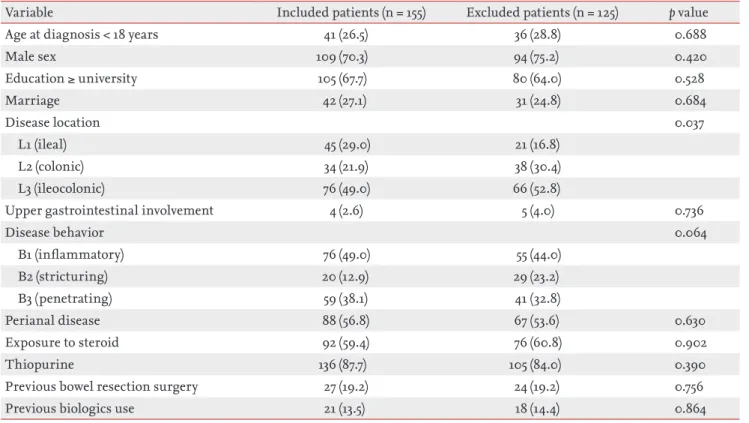
Of the 280 patients with CD who were invited, 155 (109 men; mean age 26.9 ± 9.1 years; median follow-up, 24 months) were included in the study (Fig. 2). Of the 125 patients who were excluded, 106 did not record their activity for at least 3 consecutive months, 15 did not re- cord data, and four refused to participate. Additional 12 patients were excluded because their clinical outcomes occurred before their main activity pattern (disparity or concordance) was determined. Therefore, data of 143 (102 men; mean age, 27.2 ± 9.3 years; median follow-up, 20 months) was finally evaluated. Overall, 48 patients (48/143, 33.6%) showed discrepant activity (high at home but nor- mal at the next routine outpatient clinic visit), whereas 95 patients (95/143, 66.4%) reported concordant activity. For the concordant group, a large proportion (68/95, 71.6%) showed low activity (CDSD score ≤ 5) both at home and at the hospital (CL), and two patients (2/95, 2.1%) had cy- cles of high activity (CDSD score > 5) both at home and at the hospital (CH). Twenty-five patients (25/95, 26.3%) had both concordant cycles of high and low activity at the same time during the observation period (CB).
There were no significant differences between dispar- ity and concordance groups regarding baseline charac- teristics including sex, age, disease duration, education, marital status, disease location, disease behaviour, ex- posure to steroids, thiopurine use, bowel resection sur- gery, and biologics use before enrolment (Table 1).
Impact of disparity in activity on clinical outcomes The disparity group appeared to have a higher cumula- tive risk of anti-tumor necrosis factor (TNF) agent use than concordance group although it failed to achieve statistical significance (log rank p = 0.114, Breslow p = 0.144) (Fig. 3A). Regarding bowel resection surgery, no significant difference was observed between groups (log rank p = 0.696, Breslow p = 0.592) and Kaplan-Meier sur- vival graph could not be depicted because of small num- ber of surgery cases during follow-up period. The time from inclusion in the study to an unscheduled visit due to flares was significantly shorter in the disparity group compared with the concordant group (log rank p = 0.001, Breslow p < 0.001) (Fig. 3B).
Risk factors of unscheduled hospital visits
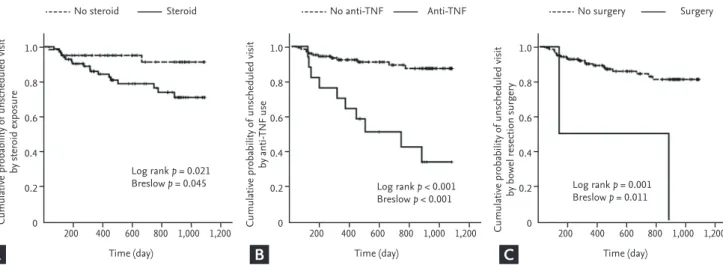
Next, we estimated the risk factors of unscheduled hospital visits due to disease flares using Kaplan-Mei- er analysis. In addition to disparity in activity between home and hospital visits, exposure to steroids (log rank Figure 2. The f low chart of patients participating in the study. CH, concordance high; CL, concordance low; CB, con- cordance both.
aNumber of patients whose clinical outcomes occurred before observation period of main graph pattern.
280 Invited patients
155 Patients recording data over consecutive 3 months
125 Withdrawals 15 Not recording data 4 Refused to participate 106 Recorded data < 3 months
3 CH 72 CL 27 CB
2 CH
5a 1a 4a 2a
68 CL 25 CB
53 Disparity
48 Disparity
p = 0.021, Breslow p = 0.045) (Fig. 4A), anti-TNF use (log rank p < 0.001, Breslow p < 0.001) (Fig. 4B) and bowel
resection surgery after enrolment (log rank p = 0.001, Breslow p = 0.011) (Fig. 4C) were significantly related with Table 1. Baseline demographics and characteristics of patients
Variable Disparity (n = 48) Concordance (n = 95) p value
Male sex 31 (64.6) 71 (74.7) 0.250
Age at diagnosis, yr 22.9 ± 8.3 25.0 ± 8.7 0.161
Age at inclusion, yr 25.7 ± 8.9 27.9 ± 9.5 0.147
Follow-up duration, mon 21.9 ± 10 20.2 ± 10.2 0.332
Education ≥ university 28 (58.3) 69 (72.6) 0.110
Marriage 10 (20.8) 29 (30.5) 0.183
Disease location 0.410
L1 (ileal) 17 (35.4) 26 (27.4)
L2 (colonic) 8 (16.7) 24 (25.3)
L3 (ileocolonic) 23 (47.9) 45 (47.4)
Upper gastrointestinal involvement 2 (4.2) 2 (2.1) 0.607
Disease behavior at inclusion 0.282
B1 (inflammatory) 21 (43.8) 52 (54.7)
B2 (stricturing) 9 (18.8) 9 (9.5)
B3 (penetrating) 18 (37.5) 34 (35.8)
Perianal disease 25 (52.1) 56 (58.9) 0.533
Exposure to steroid 31 (64.6) 52 (54.7) 0.204
Thiopurine 45 (93.8) 81 (85.3) 0.124
Previous bowel resection surgery 10 (20.8) 15 (15.8) 0.497
Previous biologic use 8 (16.7) 13 (13.7) 0.804
Values are presented as number (%) or mean ± SD.
Figure 3. Kaplan-Meier analysis of (A) anti-TNF use, and (B) unscheduled hospital visits according to disparity and concor- dance pattern of disease activity. TNF, tumor necrosis factor.
1.0
0.8
0.6
0.4
0.2
0
Log rank p = 0.114
Breslow p = 0.144 Log rank p = 0.001
Breslow p < 0.001
200 400 600
Time (day)
Cumulative probability of anti-TNF use by disease activity patterns Cumulative probability of unscheduled visit by disease activity patterns
800 1,000 1,200
1.0
0.8
0.6
0.4
0.2
0 200 400 600
Time (day)
800 1,000 1,200 Concordance Disparity
A B
cumulative risk of unscheduled hospital visits. How- ever, there were no significant differences in this risk in terms of sex, education level, thiopurine use, disease behaviour, or disease location. Multivariate Cox propor- tional hazard analysis revealed that disparity in activity (hazard ratio [HR], 3.82; 95% confidence interval [CI], 1.56 to 9.38; p = 0.003), and anti-TNF use after enrolment (HR, 4.34; 95% CI, 1.75 to 10.75; p = 0.002) were independent risk factors of unexpected hospital visits due to disease flares (Table 2).
We attempted to evaluate cumulative risk factors of bowel surgery, but failed due to small number of sur- gery case during follow-up. We found that steroid expo- sure (log rank p = 0.036) and stricturing behaviour (log rank p = 0.010) were cumulative risk factors of anti-TNF use during follow-up period. Among them, the latter re- mained as an independent risk factor of anti-TNF use in multivariate Cox proportional hazard analysis (HR, 3.98;
95% CI, 1.20 to 13.27; p = 0.024) (data not shown).
DISCUSSION
This prospective observational study with 143 CD pa- tients with a median 20-month follow-up period demonstrated that activity that differed between the home and routine outpatient clinic visits negatively af- fected the patients’ disease outcomes. These findings indicate the importance of robust monitoring of activ- ity when patients with CD are at home by using mo- bile technology. To the best of our knowledge, this is the first study to determine the implications of remote monitoring of CD activity using a smartphone on the prediction of disease course.
Patient-reported outcomes (PRO) have been rec- ognised as a promising measure for evaluating health status in IBD interventions [9,10]. Patient-reported dis- ease activity was shown to be an independent predictor of clinical disease activity in patients with CD, even after including common IBD symptoms such as abdominal pain and stool frequency, similar to the parameters of Table 2. Multivariate analysis of the risk factors of the unscheduled hospital visits due to disease flares
Risk factor Hazard ratio (95% confidence interval) p value
Disparity of activity 3.82 (1.56–9.38) 0.003
Exposure to steroid 2.62 (0.87–7.90) 0.087
Anti-tumor necrosis factor use 4.34 (1.75–10.75) 0.002
Bowel resection surgery 2.28 (0.46–11.24) 0.311
1.0 0.8 0.6 0.4 0.2 0
Log rank p = 0.021
Breslow p = 0.045 Log rank p < 0.001
Breslow p < 0.001
Log rank p = 0.001 Breslow p = 0.011
200 400 600
Time (day)
Cumulative probability of unscheduled visit by steroid exposure Cumulative probability of unscheduled visit by anti-TNF use Cumulative probability of unscheduled visit by bowel resection surgery
800 1,000 1,200
1.0 0.8 0.6 0.4 0.2
0 200 400 600
Time (day)
800 1,000 1,200
1.0 0.8 0.6 0.4 0.2
0 200 400 600
Time (day) No steroid Steroid
800 1,000 1,200 No anti-TNF Anti-TNF No surgery Surgery