Research Report
Development of a Small Sized Cymbidium Variety ‘Snow Bell’ with Light Pink Colored Flower and Frangrance
Mi-Seon Kim
*, Pue-Hee Park, and Byung-Woo Yae
Floriculture Research Division, National Institute of Horticultural & Herbal Science, Suwon 441-440, Korea
Abstract: A Cymbidium variety ‘Snow Bell’ (C. kanran × C. Jack Frost) was developed at the National Institute of Horticultural
& Herbal Science, Rural Development Administration in 2011. A cross between C. kanran with small-sized greenish colored flowers and C. Jack Frost with bright pink colored flowers, was conducted in 1999. Based on flower color, leaf shape, flower stalk, and vigor one line was selected. Evaluation and selection trials were conducted from 2006 to 2010. ‘Snow Bell’ has a light pink sepal (RHS, R56D), red lip (R56A) and a leaf length of 47.5 cm. The average number of flowers on each peduncle is 13.8 and the flower diameter is 6.2 cm. The characteristics of petals and sepals show some incurve and some spreading. ‘Snow Bell’ has a vigorous growth and a round flower. It has an adequate peduncle height of 50.7 cm compared with leaf length of 47.5 cm, and start blooming in December. In electronic nose analysis, the degree of fragrance between ‘Snow Bell’ and the C. kanran was similar and both of them showed strong scents, although they had different fragrance patterns.
Additional key words:
breeding, crossing, hybridization, orchid flower*Corresponding author: [email protected]
※ Received 29 May 2013; Revised 19 March 2014; Accepted 2 April 2014.
Ⓒ 2014 Korean Society for Horticultural Science
Introduction
Cymbidium, or boat orchid, is a genus of 52 evergreen species in the orchid family Orchidaceae. This genus is distributed in tropical and subtropical Asia (such as Northern India, China, Japan, Malaysia, Philippines, and Borneo) and Northern Australia. The larger flowered species from which the large flowered hybrids are derived grow at high altitudes (Du Puy and Cribb, 2007).
Most of Cymbidium species native to temperate regions, such as C. kanran and C. ensifolium have strong fascinating scents. On the other hand, most of the species that are native to subtropical regions have very weak or no scent, except for the C. eburneum, C. canaliculatum, C. hookeerianum, C. suavissimum, and C. tracyanum species which have strong scents (Du Puy and Cribb, 2007).
The classic hybrids are divided into two groups, called the standards and the miniatures. The standards are large- flowered and usually less fragrance, while the miniatures
are small-flowered, and some of them have light fragrance.
The fragrant Cymbidium hybrids are obtained from crossing classic types with species which are native to temperate regions. Some good examples of these hybrids are Peter Pan ‘Greensleeves’ (C. ensifolium × C. Miretta), Maureen Carter (C. sinense × C. Sleeping Beauty), and Golden Elf
‘Sundust’ (C. ensifolium × C. Enid Haupt). Also these hybrids
are more manageable in size and more free-blooming than
the classic hybrids. The commercially well-known C. Golden
Elf ‘Sundust’, having a parentage, C. ensifolium (50%) and
C. eburneum (6.25%), has a strong fragrance. Recently,
Cymbidium export has become a promising business compared
with other flower crops in Korea. Cymbidium produced in
Korea is exported to China during the Chinese New Year
season, and export earnings amounted to about US$ 15.2
M in 2011 (MFAFF, 2012). To establish a continuous and
stable export system and domestic market, the supply of
domestically produced seedlings and breeding of new
fragrant cultivars are essential. Since 2003, thirty-three
Artificial cross Selection 1
stcharacterization trial 2
ndcharacterization trial
1999-2000 2001-2004 2005-2007 2008-2010
‘99-1007-1’
C. kanran (♀)
·
‘99-1007-5’
‘99-1007-7’
‘99-1007-7’ (V
1) ‘99-10007-7’
‘Snow Bell’
· C. Jack Frost
(♂) ·
·
‘99-1007-55’
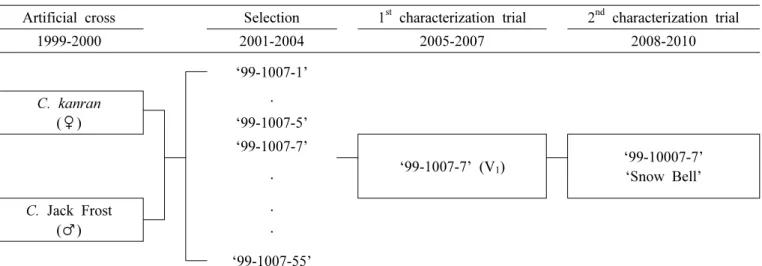
Fig. 1. Pedigree diagram of Cymbidium var. ‘Snow Bell’.
hybrids have been bred by the National Institute of Horti- cultural & Herbal Science (NIHHS) of the Rural Development Administration (Kim et al., 2006, 2010, 2011, 2012).
The most popular oriental, C. kanran has strong scented greenish flowers and blooms from the beginning of December.
It produces about 10 sprays of beautiful flowers.
In some reports, in order to develop fragrant floricultural crops, the electronic nose was used to analyze patterns of scents (Been and Kim, 2003; Lee et al., 2003; Park et al., 2011). Mother plant, C. kanran has fragrance and attractive flowers, but grows slowly from 4 to 5 years from plantlets to flowering and has short flower longevity. The aim of this breeding program was to produce flowers with long base life, various colors, fragrance, and vigorous variety.
This new hybrid combined the characteristics of C. kanran with strong fragrant flowers and spreading shape, and C.
Jack Frost with light pink flower color and long vase life and vigorous growth to obtain a fragrant variety with bright colored, round flower, vigorous growth and flower longevity of more than 20 days.
Origin
The new cultivar, C. Snow Bell, is a cross bred between C. kanran, a small-sized fragrant plant, and C. Jack Frost, a small to medium sized plant with light pink petals and light red lip developed at the NIHHS in 2011. Fifty-five seedlings were obtained after planting and acclimatization was done in the greenhouse. Varietal evaluation, selection and breeding were done for nine years (1999-2010).
The characteristics were evaluated based on the manual for agricultural investigation and guidelines for the conduct
of tests for distinctness, uniformity and stability for Cymbidium (UPOV, 1999).
Analysis of Fragrance Pattern
Samples were collected through the solid phase micro extraction (SPME) method and analyzed using αFOX 2000 (Alpha-MOS, France) electronic nose with six (6) metal oxide semi-conductors. Each sample was analyzed three times.
Principal component analysis (PCA) was used to distinguish the fragrance patterns obtained from the combination of responses of the six sensors. The Alpha Soft Version 12.0 statistical program was used for analysis.
Description
The cultivar named ‘Snow Bell’ (Fig. 1) was finally selected for its distinguishing characteristics such as flower color and shape, length of flower stalk, leaf attitude, and vigorous growth. This hybrid was bred with the objective of combining good qualities such as C. kanran fragrance and C. Jack Frost flower shape, bright color, vigorous growth and flower longevity of more than 20 days.
C. kanran, a mother plant with greenish colored flowers,
some spreading flower shape, and small sized plant with
relatively strong scent, was similar to the fragrance and
small-sized plant of ‘Snow Bell’. In 2010, a consumer
preference survey was conducted during the Cymbidium
show in NIHHS to determine a new variety. By 2015, the
orchid farmers will be supplied with ‘Snow Bell’ variety
after producing more plantlets.
Table 1. Leaf and plant characteristics of ‘Snow Bell’ compared with parents.
Cultivars Length (cm) Width (cm) Leaf shape Plant size Pseudo bulb shape
C. kanran (Mother plant) 38.4 ± 2.7 1.1 ± 0.3 Upright Small Elliptic
Jack Frost (Pollen plant) 62.3 ± 4.9 2.1 ± 0.5 Semi-upright Medium Circular
Snow Bell 47.5 ± 5.4
z1.6 ± 0.2 Semi-upright Small Circular
Silk Road (Control) 53.0 ± 4.8 1.7 ± 0.61 Straight Small Elliptic
z
Mean ± standard error of 20 plants.
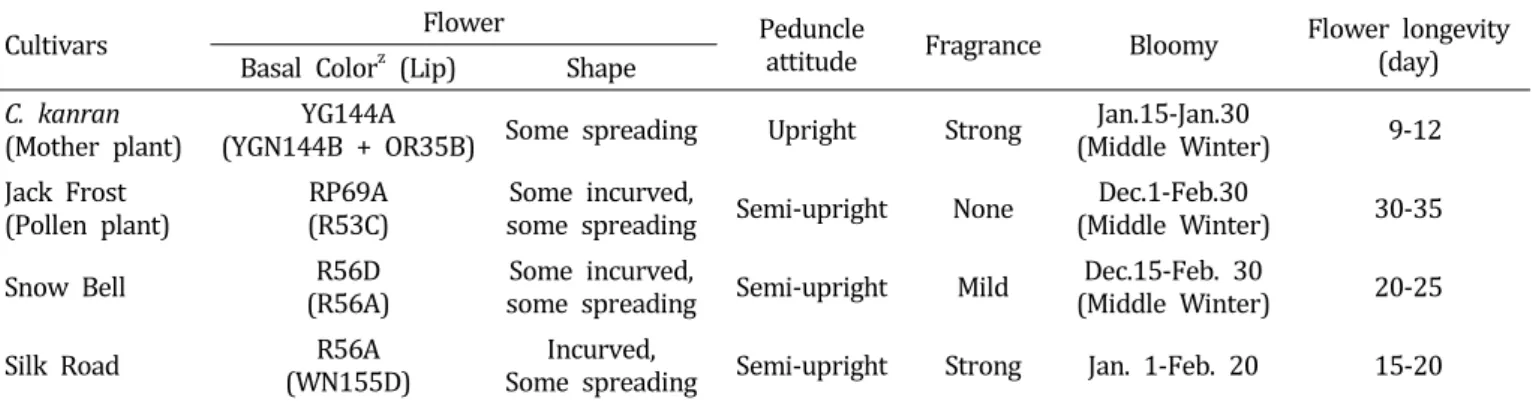
Table 2. Flower characteristics of Cymbidium ‘Snow Bell’ compared with parents.
Cultivars Flower Peduncle
attitude Fragrance Bloomy Flower longevity (day) Basal Color
z(Lip) Shape
C. kanran
(Mother plant) YG144A
(YGN144B + OR35B) Some spreading Upright Strong Jan.15-Jan.30
(Middle Winter) 9-12 Jack Frost
(Pollen plant) RP69A
(R53C) Some incurved,
some spreading Semi-upright None Dec.1-Feb.30
(Middle Winter) 30-35
Snow Bell R56D
(R56A) Some incurved,
some spreading Semi-upright Mild Dec.15-Feb. 30
(Middle Winter) 20-25
Silk Road R56A
(WN155D) Incurved,
Some spreading Semi-upright Strong Jan. 1-Feb. 20 15-20
z
Based on the Royal Horticultural Society (RHS, 2001) color chart.
Performance Plant
The C. Snow Bell is a sturdy, small sized plant with along straight leaf shape and a semi-upright flower spikes arising from pseudobulbs above the ground at approximately 35 mm. When mature, the plant displays multispiking characteristics in an 18 cm diameter pot. Plant height is approximately 47.5 cm from the base of the pseudobulb to the tip of the leaf. The leaf width is wider than the mother plant and leaf shape resembles that of the pollen parent (Table 1). This variety can withstand low temperature (5-7°C) during the winter season in Korea without damage or loss of flower buds.
Flower
The light pink colored flower of ‘Snow Bell’ was mixed with C. kanran, as a female parent with greenish colored flowers and C. Jack Frost, as a male plant with light pink flowers. The type of flower and leaf was similar with female parent with some incurve and spreading shape.
The basal color of the flower is light pink (RHS, R56D close to white) with light red line (R56A) on the sepal and same colored (R56A) spotting on lip when it is fully
opened. This flower color is brilliant compared with pollen plant. The ‘Snow Bell’ has small bright pink fragrant flowers that are arranged bilaterally on the raceme. The petals and sepals show some incurve and spreading shape. The flowering season is mid-winter (December to February), under optimal cultural conditions (Sakamoto, 1996). Inflorescences that are uncut typically exceed 30 days in a wide range of environmental conditions. Spike habit is strong and erect without any arching (Table 2).
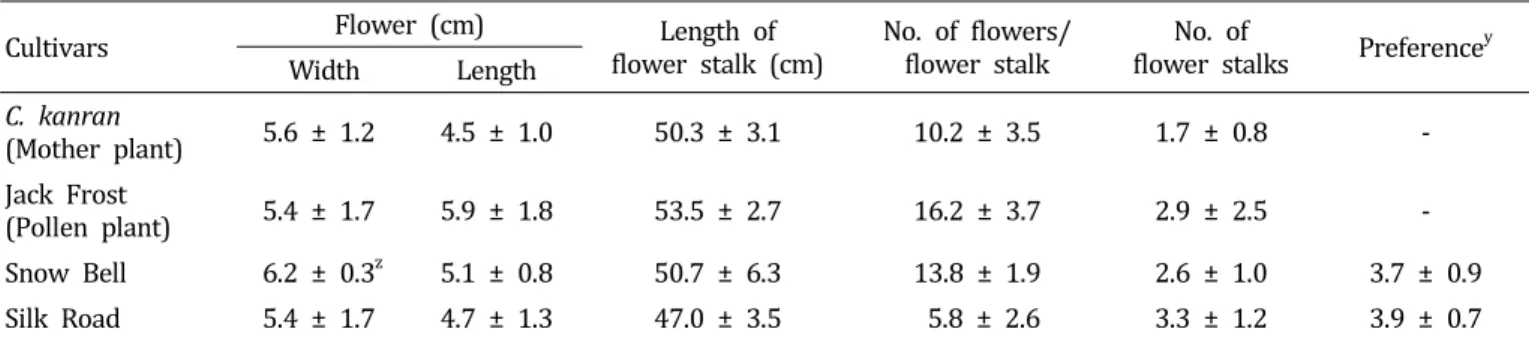
The flowers of ‘Snow Bell’ (Fig. 2) have a natural horizontal spread of 6.2 cm and a vertical spread of 5.1 cm, which are larger than those of C. kanran 5.6 cm and 4.5 cm, respectively. The flower size is reduced as compared with the pollen plant, but is much larger than the species.
The number of flowers per flower stalk is 13.8 when the plant is 36 months from in vitro deflasking and increased compared with the mother plant.
The length of flower stalk is about 50.7 cm and it produces 2.6 spikes per mature pseudobulb. The ‘Snow Bell’ is a middle-of-winter-season pot Cymbidium.
Also, the flower longevity of this new hybrid is about 20-25 days, extended to more than 10 days compared with the mother plant.
From these results, the hybrid was improved in more
round flower shape and extended longevity compared with
A B C D
Fig. 2. Flower characteristics of the C. kanran (A), ‘Jack Frost’ (B), and ‘Snow Bell’ (C, D).
Table 3. Flower characteristics of Cymbidium ‘Snow Bell’ compared with parents.
Cultivars Flower (cm) Length of
flower stalk (cm) No. of flowers/
flower stalk No. of
flower stalks Preference
yWidth Length
C. kanran
(Mother plant) 5.6 ± 1.2 4.5 ± 1.0 50.3 ± 3.1 10.2 ± 3.5 1.7 ± 0.8 -
Jack Frost
(Pollen plant) 5.4 ± 1.7 5.9 ± 1.8 53.5 ± 2.7 16.2 ± 3.7 2.9 ± 2.5 -
Snow Bell 6.2 ± 0.3
z5.1 ± 0.8 50.7 ± 6.3 13.8 ± 1.9 2.6 ± 1.0 3.7 ± 0.9 Silk Road 5.4 ± 1.7 4.7 ± 1.3 47.0 ± 3.5 5.8 ± 2.6 3.3 ± 1.2 3.9 ± 0.7
y
Preference evaluation was conducted at the Cymbidium exhibition held at NHRI in 2003. Poor (1) - Excellent (5).
z