J Vet Sci 2017, 18(S1), 269-280ㆍhttps://doi.org/10.4142/jvs.2017.18.S1.269
JVS
Received 30 Jun. 2017, Accepted 22 Jul. 2017
*Corresponding author: Tel: +1-706-546-3433; Fax: +1-706-546-3161; E-mail: [email protected] Journal of Veterinary Scienceㆍⓒ 2017 The Korean Society of Veterinary Science. All Rights Reserved.
This is an Open Access article distributed under the terms of the Creative Commons Attribution Non-Commercial License (http://creativecommons.org/licenses/
by-nc/4.0) which permits unrestricted non-commercial use, distribution, and reproduction in any medium, provided the original work is properly cited.
pISSN 1229-845X eISSN 1976-555X
Evolution, global spread, and pathogenicity of highly pathogenic avian influenza H5Nx clade 2.3.4.4
Dong-Hun Lee1, Kateri Bertran1, Jung-Hoon Kwon2, David E. Swayne1,*
1U.S. National Poultry Research Center, Agricultural Research Service, U.S. Department of Agriculture, Athens, GA 30605, USA
2Avian Diseases Laboratory, College of Veterinary Medicine, Konkuk University, Seoul 05029, Korea
Novel subtypes of Asian-origin (Goose/Guangdong lineage) H5 highly pathogenic avian influenza (HPAI) viruses belonging to clade 2.3.4, such as H5N2, H5N5, H5N6, and H5N8, have been identified in China since 2008 and have since evolved into four genetically distinct clade 2.3.4.4 groups (A–D). Since 2014, HPAI clade 2.3.4.4 viruses have spread rapidly via migratory wild aquatic birds and have evolved through reassortment with prevailing local low pathogenicity avian influenza viruses. Group A H5N8 viruses and its reassortant viruses caused outbreaks in wide geographic regions (Asia, Europe, and North America) during 2014–2015. Novel reassortant Group B H5N8 viruses caused outbreaks in Asia, Europe, and Africa during 2016–2017. Novel reassortant Group C H5N6 viruses caused outbreaks in Korea and Japan during the 2016–2017 winter season. Group D H5N6 viruses caused outbreaks in China and Vietnam. A wide range of avian species, including wild and domestic waterfowl, domestic poultry, and even zoo birds, seem to be permissive for infection by and/or transmission of clade 2.3.4.4 HPAI viruses. Further, compared to previous H5N1 HPAI viruses, these reassortant viruses show altered pathogenicity in birds. In this review, we discuss the evolution, global spread, and pathogenicity of H5 clade 2.3.4.4 HPAI viruses.
Keywords: epidemiology, influenza in birds, poultry, transmission, virulence
Emergence and Evolution of HPAI H5Nx Clade 2.3.4.4
Wild birds, particularly those belonging to the orders Anseriformes (waterfowl, i.e., ducks, geese, and swans) and Charadriiformes (gulls and shorebirds), have long been recognized as natural hosts and reservoirs for all type A influenza viruses, also known as low pathogenicity avian influenza (LPAI) viruses [51]. These LPAI viruses have been isolated from more than 100 wild bird species belonging to more than 25 families, which confirms that LPAI viruses have a global distribution within free-living aquatic avian populations [8]. Highly pathogenic avian influenza (HPAI) viruses are not normally present in wild bird host reservoirs [38]. The first cases of HPAI, previously termed fowl plague, were reported in 1878 in chickens in northern Italy, which were followed by geographically dispersed outbreaks through the late 1800s to the 1950s in Europe, Asia, Africa, and North and South America [45]. In general, since 1959, HPAI outbreaks have been more geographically restricted with 42 distinct HPAI epizootics. The HPAI viruses arose from H5 or H7 LPAI viruses
[46] after circulation for weeks to years in gallinaceous poultry and have developed specific mutations in the hemagglutinin (HA) gene that have conferred the phenotypic trait of high pathogenicity [47]. Most previous HPAI virus epizootics have been geographically limited, involving farm-to-farm spread, and were eradicated from poultry by stamping-out programs;
i.e., the HPAI virus did not circulate in wild birds. However, an H5N1 HPAI virus was detected in 1996 in a domestic goose in Guangdong China (Gs/GD lineage) and, to date, unlike previous HPAI outbreaks, this lineage caused deaths in wild birds, poultry, and humans and has spread to over 80 countries in Asia, Europe, Africa, and North America, drastically changing the perspective on HPAI biology. The severity, size, and broad geographic distribution of the Gs/GD epizootic merits the term panzootic [45].
The H5N1 Gs/GD lineage HPAI virus has evolved into 10 genetically distinct virus clades (0–9) and multiple subclades [52]. Since 2008, HPAI subtypes H5N2, H5N5, and H5N8 bearing the genetic backbone of the Gs/GD lineage H5 clade 2.3.4 have been identified in poultry in China, especially in domestic ducks and poultry in live poultry markets, and those
subtypes have subsequently evolved into different subclades including 2.3.4.4 [12,53,55]. The H5 clade 2.3.4.4 HPAI viruses have undergone genetic reassortment with other clades of H5N1 viruses and with other local LPAI virus subtypes. In early 2014, outbreaks of novel reassortant H5N6 and H5N8 of clade 2.3.4.4 were reported in poultry and wild birds in China, Laos, and Vietnam [48] and in Japan and Korea [28], respectively.
Previous studies have confirmed the wide geographic dispersion of Gs/GD lineage H5 clade 2.3.4.4 HPAI viruses since late 2014 and the movement of this virus from East Asia to North America, West Asia, and Europe [10,26]. Genetic analyses have recently indicated that, since late 2012, the H5 clade 2.3.4.4 HPAI viruses have evolved into four distinct genetic groups [22]. Group A comprises H5N8 viruses identified in China in early 2014 and Korea, Japan, Taiwan, Canada, the United States (US), and European countries in 2014–2015.
Group B comprises H5N8 viruses identified in China in 2013–
2014 and Korea in 2014. Group C comprises H5N6 viruses identified in China and Laos in 2013–2014, and H5N1 viruses identified in China and Vietnam in 2014. Group D comprises H5N6 viruses identified in China and Vietnam in 2013–2014.
Spread of H5N8 HPAI Clade 2.3.4.4 Group A, 2014–2015
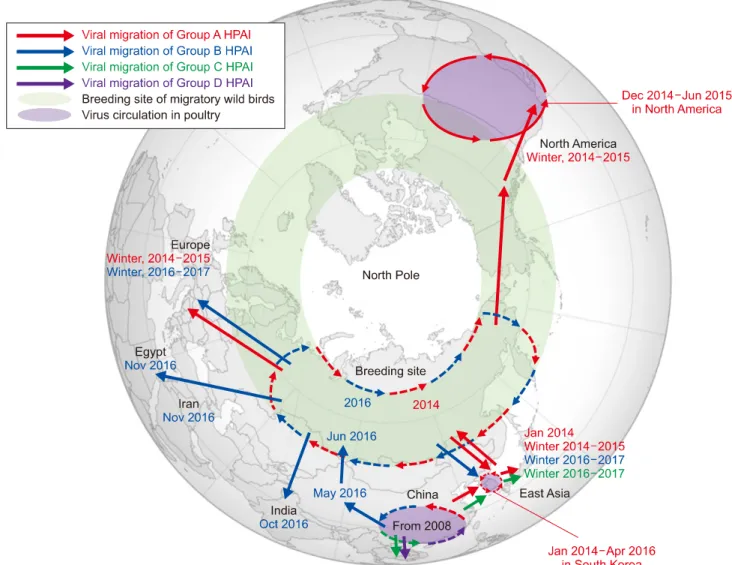
The Korean H5N8 outbreak in January 2014 was the first H5N8 epizootic reported outside China [28]. Migratory birds were suspected to have a key role in the introduction of groups A and B from Eastern China and in the subsequent spread during the 2014 Korean outbreak [14]. During the initial stage of this outbreak, identical viruses from each group were identified in poultry farms and wild birds near Donglim Lake, a wintering site for migratory birds in Korea, thereby suggesting that two different H5N8 HPAI viruses were introduced into Korea by wild birds during the same period [32]. As time passed, outbreaks caused by the Group A H5N8 HPAI virus predominated in the western region of Korea. Subsequently, the Group A H5N8 virus was identified in a long-distance migrant (Eurasian wigeon, Anas penelope) in Eastern Siberia in September 2014 [31] and in multiple wild bird species in East Asia, Europe, and the west coast of North America in November and December 2014 (Fig. 1) [10,26]. Results of phylogenetic studies indicated that Group A viruses further evolved into three distinct subgroups in circumpolar regions and disseminated to various regions: icA1 (Europe/East Asia), icA2 (North America/
East Asia), and icA3 (East Asia) subgroups. In Korea, Group A H5N8 viruses induced continuous outbreaks for 28 months, from January 2014 to April 2016, and mainly affected domestic duck farms [13,40]. Three subgroups of H5N8 viruses (icA1–3) were re-introduced to Korea by migratory birds, and another subgroup of Group A H5N8 viruses was identified in Korea; a subgroup that had been maintained in poultry farms in Korea
during 2014–2016 [19,21]. After dissemination from Korea to various regions, these Group A H5N8 HPAI viruses generated a variety of reassortant viruses that shuffled gene segments with those of prevailing LPAI viruses from wild aquatic birds in North America and Taiwan [22,27]. In North America, the Gs/GD lineage Group A H5N8 virus underwent reassortment with North American LPAI viruses to produce H5N1, H5N2, and H5N8 reassortant HPAI viruses [22]. The reassortant H5N2 HPAI virus predominated in the 2014–2015 US outbreak, mainly affecting commercial turkey and layer farms. This strain was eradicated from US poultry in June 2015 and was rarely detected in wild birds in 2016 [25]. In Taiwan, H5N2, H5N3, and H5N8 subtypes bearing the HA segment of the H5 clade 2.3.4.4 Group A have caused outbreaks in poultry and wild birds since January 2015 [27].
Spread of H5N8 HPAI Clade 2.3.4.4 Group B, 2014–2017
The Group B H5 clade 2.3.4.4 HPAI viruses have been detected in China since 2013 and are phylogenetically distinct from Group A H5N8 viruses that spread globally during 2014–
2015 [7,52]. In early 2014, outbreaks of H5N8 clade 2.3.4.4 groups A and B were reported in Korea, followed by outbreaks of Group A H5N8 in East Asia, Europe, and North America in late 2014 (Fig. 1) [26,28]. Interestingly, there have been no further reports of Group B virus in Korea since the initial report in January 2014 [26]. In China, several Group B viruses reassorted with LPAI viruses and were reported during 2013–
2014 mostly from domestic ducks and wild aquatic birds [7,29,41,53,56]. Novel reassortant Group B H5N8 viruses containing 5 Eurasian LPAI segments (PB2, PB1, PA, NP, and M) were identified from wild birds found dead in Qinghai Lake, China during May 2016 [30] and at Uvs-Nuur Lake in Siberia during June 2016 [24]. Subsequently, this novel reassortant Group B H5N8 strain has further reassorted with Eurasian LPAI viruses and disseminated from Siberia to be detected over a broad geographic region that includes Europe [36], Africa [39], the Middle East [9], and Asia [18,32]. That dissemination may be the result of the southward autumn migration of waterfowl during 2016 and was similar in the spread of H5N1 clade 2.2 in 2005–2006 [35] and H5N8 clade 2.3.4.4 Group A in 2014 [26,31] from Siberia to various countries in Eurasia.
Spread of H5N6 HPAI Clade 2.3.4.4 Group C, 2014–2017
While Group A and B H5N8 viruses caused global outbreaks during 2014–2015 and 2016–2017, the Group C H5N6 viruses have caused outbreaks in China since 2013 [6,37], and Group C viruses have been isolated from various host species including wild birds, poultry, pigeons, pigs, cats, and humans [4]. The
Fig. 1. Geographic map showing movement patterns of highly pathogenic avian influenza (HPAI) clade 2.3.4.4 viruses.
Group C H5N6 viruses disseminated to Laos and Vietnam in 2014 and Hong Kong in 2015 [54]. Recently, Bi et al. [4]
reported that at least 34 distinct genotypes of H5N6 HPAI virus have been identified through surveillance of live poultry markets in China during 2014–2016. In autumn 2016, Group C H5N6 viruses belonging to the G1.1.9 genotype were identified in Korea [15,20,25] and Japan [34], followed by continuous outbreaks in domestic poultry and wild birds in Korea (Fig. 1) [4]. Multiple novel reassortant H5N6 viruses containing different PA and NS genes of Eurasian LPAI viruses have been reported from Korea, and those novel viruses seem to have likely originated from the H5N6 viruses circulating in Guangdong province of China [25].
Pathogenicity of H5Nx HPAI Clade 2.3.4.4 in birds
Numerous experimental infections have been performed to
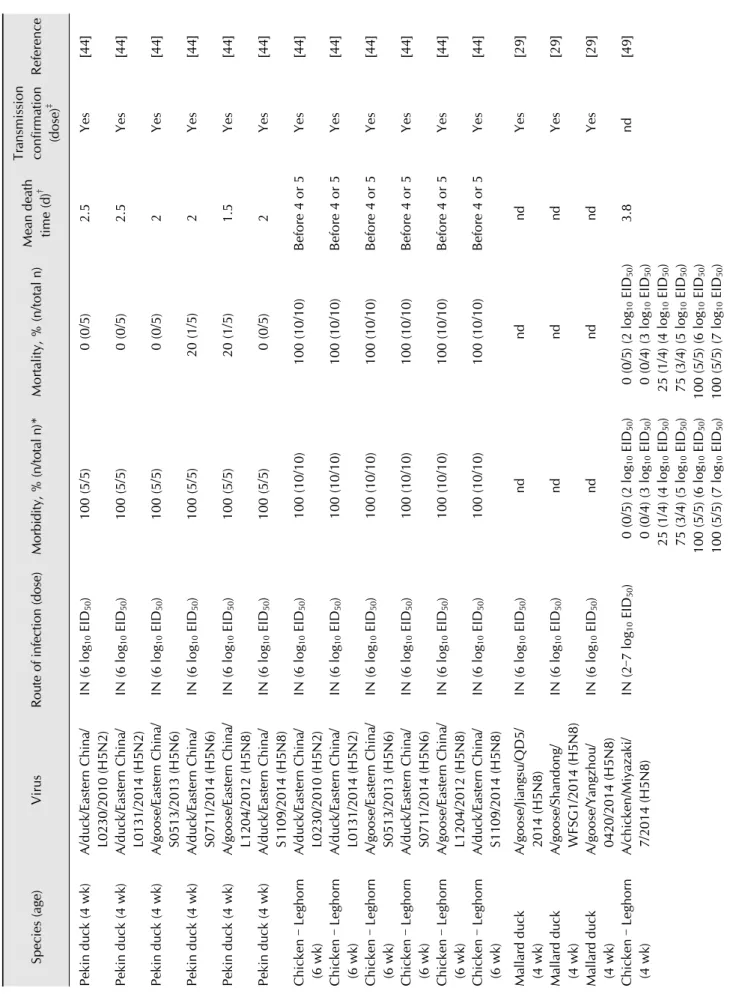
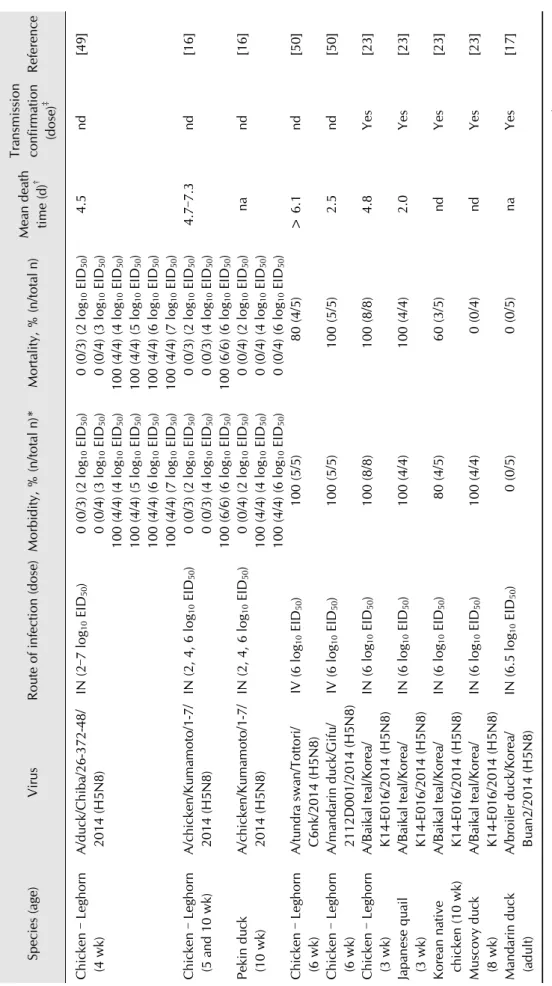
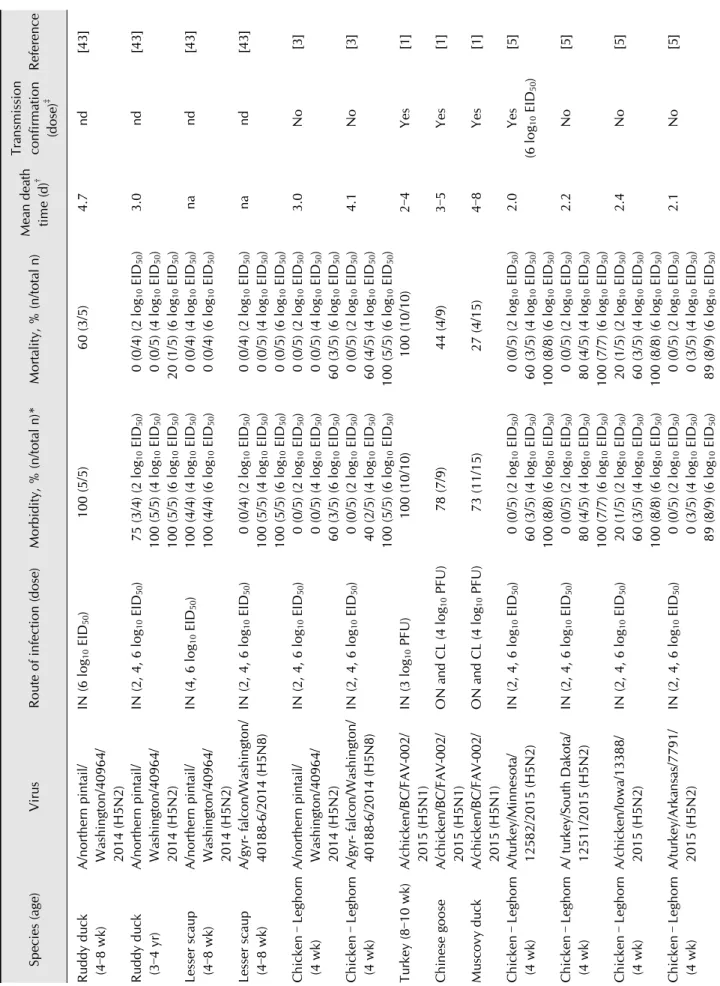
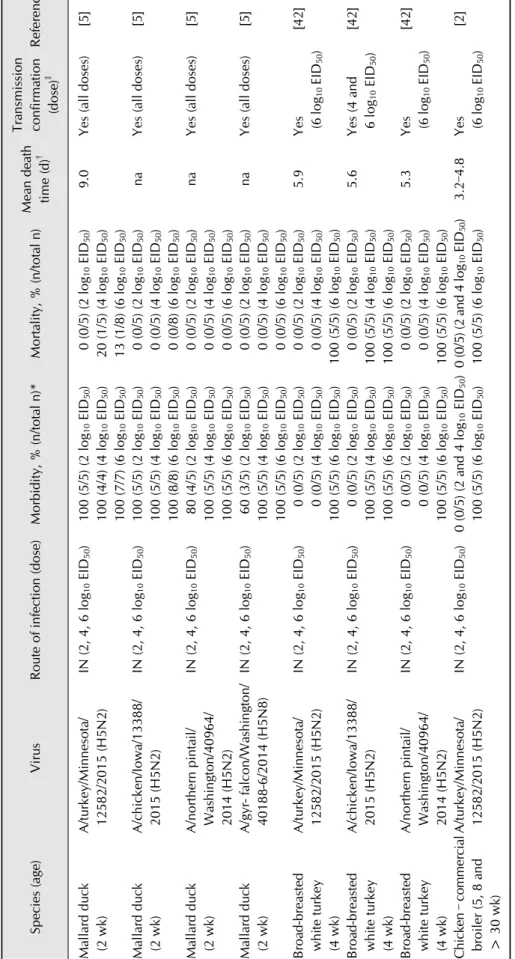
investigate the pathogenicity of clade 2.3.4.4 HPAI viruses in different bird species. To date, the majority of characterized viruses are Asian (Table 1) and North American (Table 2), but there are a few studies describing the pathobiology of natural cases of H5N8 HPAI virus infection in Europe.
Asian H5 HPAI clade 2.3.4.4
Subtypes H5N2, H5N6, and H5N8 clade 2.3.4.4 viruses isolated from apparently healthy ducks and geese in China were characterized in 4-week-old domestic Pekin ducks (Anas platyrhynchos domesticus) and layer chickens [44]. All reassortants caused systematic infection in ducks when challenged at 6 log10 mean egg infectious dose (EID50) and could be efficiently contact-transmitted with high titers shed consistently through oropharynx and cloaca. The infected ducks showed severe neurologic signs. Severe hemorrhages and necrosis in the heart and pancreas were observed at necropsy.
Acute necrosis of cardiac muscle cell, neuronophagia, and
Table 1. Asian H5 highly pathogenic avian influenza (HPAI) clade 2.3.4.4 experimental infections Species (age)VirusRoute of infection (dose)Morbidity, % (n/total n)*Mortality, % (n/total n)Mean death time (d)†Transmission confirmation (dose)‡Reference Pekin duck (4 wk)A/duck/Eastern China/ L0230/2010 (H5N2)IN (6 log10 EID50)100 (5/5)0 (0/5)2.5Yes[44] Pekin duck (4 wk)A/duck/Eastern China/ L0131/2014 (H5N2)IN (6 log10 EID50)100 (5/5)0 (0/5)2.5Yes[44] Pekin duck (4 wk)A/goose/Eastern China/ S0513/2013 (H5N6)IN (6 log10 EID50)100 (5/5)0 (0/5)2Yes[44] Pekin duck (4 wk)A/duck/Eastern China/ S0711/2014 (H5N6)IN (6 log10 EID50)100 (5/5)20 (1/5)2Yes[44] Pekin duck (4 wk)A/goose/Eastern China/ L1204/2012 (H5N8)IN (6 log10 EID50)100 (5/5)20 (1/5)1.5Yes[44] Pekin duck (4 wk)A/duck/Eastern China/ S1109/2014 (H5N8)IN (6 log10 EID50)100 (5/5)0 (0/5)2Yes[44] Chicken – Leghorn (6 wk)A/duck/Eastern China/ L0230/2010 (H5N2)IN (6 log10 EID50)100 (10/10)100 (10/10)Before 4 or 5Yes[44] Chicken – Leghorn (6 wk)A/duck/Eastern China/ L0131/2014 (H5N2)IN (6 log10 EID50)100 (10/10)100 (10/10)Before 4 or 5Yes[44] Chicken – Leghorn (6 wk)A/goose/Eastern China/ S0513/2013 (H5N6)IN (6 log10 EID50)100 (10/10)100 (10/10)Before 4 or 5Yes[44] Chicken – Leghorn (6 wk)A/duck/Eastern China/ S0711/2014 (H5N6)IN (6 log10 EID50)100 (10/10)100 (10/10)Before 4 or 5Yes[44] Chicken – Leghorn (6 wk)A/goose/Eastern China/ L1204/2012 (H5N8)IN (6 log10 EID50)100 (10/10)100 (10/10)Before 4 or 5Yes[44] Chicken – Leghorn (6 wk)A/duck/Eastern China/ S1109/2014 (H5N8)IN (6 log10 EID50)100 (10/10)100 (10/10)Before 4 or 5Yes[44] Mallard duck (4 wk)A/goose/Jiangsu/QD5/ 2014 (H5N8)IN (6 log10 EID50)ndndndYes[29] Mallard duck (4 wk)A/goose/Shandong/ WFSG1/2014 (H5N8)IN (6 log10 EID50)ndndndYes[29] Mallard duck (4 wk)A/goose/Yangzhou/ 0420/2014 (H5N8)IN (6 log10 EID50)ndndndYes[29] Chicken – Leghorn (4 wk)A/chicken/Miyazaki/ 7/2014 (H5N8)IN (2–7 log10 EID50) 0 (0/5) (2 log10 EID50) 0 (0/4) (3 log10 EID50) 25 (1/4) (4 log10 EID50) 75 (3/4) (5 log10 EID50) 100 (5/5) (6 log10 EID50) 100 (5/5) (7 log10 EID50) 0 (0/5) (2 log10 EID50) 0 (0/4) (3 log10 EID50) 25 (1/4) (4 log10 EID50) 75 (3/4) (5 log10 EID50) 100 (5/5) (6 log10 EID50) 100 (5/5) (7 log10 EID50)
3.8nd[49]
Table 1. Continued Species (age)VirusRoute of infection (dose)Morbidity, % (n/total n)*Mortality, % (n/total n)Mean death time (d)†Transmission confirmation (dose)‡Reference Chicken – Leghorn (4 wk)A/duck/Chiba/26-372-48/ 2014 (H5N8)IN (2–7 log10 EID50) 0 (0/3) (2 log10 EID50) 0 (0/4) (3 log10 EID50) 100 (4/4) (4 log10 EID50) 100 (4/4) (5 log10 EID50) 100 (4/4) (6 log10 EID50) 100 (4/4) (7 log10 EID50) 0 (0/3) (2 log10 EID50) 0 (0/4) (3 log10 EID50) 100 (4/4) (4 log10 EID50) 100 (4/4) (5 log10 EID50) 100 (4/4) (6 log10 EID50) 100 (4/4) (7 log10 EID50)
4.5nd[49] Chicken – Leghorn (5 and 10 wk)A/chicken/Kumamoto/1-7/ 2014 (H5N8)IN (2, 4, 6 log10 EID50) 0 (0/3) (2 log10 EID50) 0 (0/3) (4 log10 EID50) 100 (6/6) (6 log10 EID50)
0 (0/3) (2 log10 EID50) 0 (0/3) (4 log10 EID50) 100 (6/6) (6 log10 EID50)
4.7–7.3nd[16] Pekin duck (10 wk)A/chicken/Kumamoto/1-7/ 2014 (H5N8)IN (2, 4, 6 log10 EID50) 0 (0/4) (2 log10 EID50) 100 (4/4) (4 log10 EID50) 100 (4/4) (6 log10 EID50)
0 (0/4) (2 log10 EID50) 0 (0/4) (4 log10 EID50) 0 (0/4) (6 log10 EID50)
nand[16] Chicken – Leghorn (6 wk)A/tundra swan/Tottori/ C6nk/2014 (H5N8)IV (6 log10 EID50)100 (5/5) 80 (4/5)> 6.1nd[50] Chicken – Leghorn (6 wk)A/mandarin duck/Gifu/ 2112D001/2014 (H5N8)IV (6 log10 EID50)100 (5/5)100 (5/5)2.5nd[50] Chicken – Leghorn (3 wk)A/Baikal teal/Korea/ K14-E016/2014 (H5N8)IN (6 log10 EID50)100 (8/8)100 (8/8)4.8Yes[23] Japanese quail (3 wk)A/Baikal teal/Korea/ K14-E016/2014 (H5N8)IN (6 log10 EID50)100 (4/4)100 (4/4)2.0Yes[23] Korean native chicken (10 wk)A/Baikal teal/Korea/ K14-E016/2014 (H5N8)IN (6 log10 EID50) 80 (4/5) 60 (3/5)ndYes[23] Muscovy duck (8 wk)A/Baikal teal/Korea/ K14-E016/2014 (H5N8)IN (6 log10 EID50)100 (4/4) 0 (0/4)ndYes[23] Mandarin duck (adult)A/broiler duck/Korea/ Buan2/2014 (H5N8)IN (6.5 log10 EID50) 0 (0/5) 0 (0/5)naYes[17] IN, intranasal; EID50, 50% egg infectious dose; nd, not determined; IV, intravenous; na, not applicable.
†* As determined by clinical signs, virus shedding, and/or seroconversion. Mean death time at ‡ the highest dose tested. Transmission as determined by clinical signs, mortality, virus shedding, and/or seroconversion of contact-exposed birds.
Table 2. North American highly pathogenic avian influenza (HPAI) clade 2.3.4.4 experimental infections Species (age)VirusRoute of infection (dose)Morbidity, % (n/total n)*Mortality, % (n/total n)Mean death time (d)†Transmission confirmation (dose)‡Reference Ruddy duck (4–8 wk)A/northern pintail/ Washington/40964/ 2014 (H5N2)
IN (6 log10 EID50)100 (5/5)60 (3/5)4.7nd[43] Ruddy duck (3–4 yr)A/northern pintail/ Washington/40964/ 2014 (H5N2) IN (2, 4, 6 log10 EID50)75 (3/4) (2 log10 EID50) 100 (5/5) (4 log10 EID50) 100 (5/5) (6 log10 EID50) 0 (0/4) (2 log10 EID50) 0 (0/5) (4 log10 EID50) 20 (1/5) (6 log10 EID50)
3.0nd[43] Lesser scaup (4–8 wk)A/northern pintail/ Washington/40964/ 2014 (H5N2)
IN (4, 6 log10 EID50)100 (4/4) (4 log10 EID50) 100 (4/4) (6 log10 EID50) 0 (0/4) (4 log10 EID50) 0 (0/4) (6 log10 EID50)nand[43] Lesser scaup (4–8 wk)A/gyr- falcon/Washington/ 40188-6/2014 (H5N8)IN (2, 4, 6 log10 EID50) 0 (0/4) (2 log10 EID50) 100 (5/5) (4 log10 EID50) 100 (5/5) (6 log10 EID50) 0 (0/4) (2 log10 EID50) 0 (0/5) (4 log10 EID50) 0 (0/5) (6 log10 EID50)
nand[43] Chicken – Leghorn (4 wk)A/northern pintail/ Washington/40964/ 2014 (H5N2)
IN (2, 4, 6 log10 EID50) 0 (0/5) (2 log10 EID50) 0 (0/5) (4 log10 EID50) 60 (3/5) (6 log10 EID50) 0 (0/5) (2 log10 EID50) 0 (0/5) (4 log10 EID50) 60 (3/5) (6 log10 EID50)
3.0No[3] Chicken – Leghorn (4 wk)A/gyr- falcon/Washington/ 40188-6/2014 (H5N8)IN (2, 4, 6 log10 EID50) 0 (0/5) (2 log10 EID50) 40 (2/5) (4 log10 EID50) 100 (5/5) (6 log10 EID50)
0 (0/5) (2 log10 EID50) 60 (4/5) (4 log10 EID50) 100 (5/5) (6 log10 EID50)
4.1No[3] Turkey (8–10 wk)A/chicken/BC/FAV-002/ 2015 (H5N1)IN (3 log10 PFU)100 (10/10)100 (10/10)2–4Yes[1] Chinese gooseA/chicken/BC/FAV-002/ 2015 (H5N1)ON and CL (4 log10 PFU)78 (7/9)44 (4/9)3–5Yes[1] Muscovy duckA/chicken/BC/FAV-002/ 2015 (H5N1)ON and CL (4 log10 PFU)73 (11/15)27 (4/15)4–8Yes[1] Chicken – Leghorn (4 wk)A/turkey/Minnesota/ 12582/2015 (H5N2)IN (2, 4, 6 log10 EID50) 0 (0/5) (2 log10 EID50) 60 (3/5) (4 log10 EID50) 100 (8/8) (6 log10 EID50)
0 (0/5) (2 log10 EID50) 60 (3/5) (4 log10 EID50) 100 (8/8) (6 log10 EID50)
2.0Yes (6 log10 EID50)[5] Chicken – Leghorn (4 wk)A/ turkey/South Dakota/ 12511/2015 (H5N2)IN (2, 4, 6 log10 EID50) 0 (0/5) (2 log10 EID50) 80 (4/5) (4 log10 EID50) 100 (7/7) (6 log10 EID50)
0 (0/5) (2 log10 EID50) 80 (4/5) (4 log10 EID50) 100 (7/7) (6 log10 EID50)
2.2No[5] Chicken – Leghorn (4 wk)A/chicken/Iowa/13388/ 2015 (H5N2)IN (2, 4, 6 log10 EID50)20 (1/5) (2 log10 EID50) 60 (3/5) (4 log10 EID50) 100 (8/8) (6 log10 EID50)
20 (1/5) (2 log10 EID50) 60 (3/5) (4 log10 EID50) 100 (8/8) (6 log10 EID50)
2.4No[5] Chicken – Leghorn (4 wk)A/turkey/Arkansas/7791/ 2015 (H5N2)IN (2, 4, 6 log10 EID50) 0 (0/5) (2 log10 EID50) 0 (3/5) (4 log10 EID50) 89 (8/9) (6 log10 EID50)
0 (0/5) (2 log10 EID50) 0 (3/5) (4 log10 EID50) 89 (8/9) (6 log10 EID50)
2.1No[5]
Table 2. Continued Species (age)VirusRoute of infection (dose)Morbidity, % (n/total n)*Mortality, % (n/total n)Mean death time (d)†Transmission confirmation (dose)‡Reference Mallard duck (2 wk)A/turkey/Minnesota/ 12582/2015 (H5N2)IN (2, 4, 6 log10 EID50)100 (5/5) (2 log10 EID50) 100 (4/4) (4 log10 EID50) 100 (7/7) (6 log10 EID50) 0 (0/5) (2 log10 EID50) 20 (1/5) (4 log10 EID50) 13 (1/8) (6 log10 EID50)
9.0Yes (all doses)[5] Mallard duck (2 wk)A/chicken/Iowa/13388/ 2015 (H5N2)IN (2, 4, 6 log10 EID50)100 (5/5) (2 log10 EID50) 100 (5/5) (4 log10 EID50) 100 (8/8) (6 log10 EID50)
0 (0/5) (2 log10 EID50) 0 (0/5) (4 log10 EID50) 0 (0/8) (6 log10 EID50)
naYes (all doses)[5] Mallard duck (2 wk)A/northern pintail/ Washington/40964/ 2014 (H5N2)
IN (2, 4, 6 log10 EID50) 80 (4/5) (2 log10 EID50) 100 (5/5) (4 log10 EID50) 100 (5/5) (6 log10 EID50) 0 (0/5) (2 log10 EID50) 0 (0/5) (4 log10 EID50) 0 (0/5) (6 log10 EID50)
naYes (all doses)[5] Mallard duck (2 wk)A/gyr- falcon/Washington/ 40188-6/2014 (H5N8)IN (2, 4, 6 log10 EID50) 60 (3/5) (2 log10 EID50) 100 (5/5) (4 log10 EID50) 100 (5/5) (6 log10 EID50)
0 (0/5) (2 log10 EID50) 0 (0/5) (4 log10 EID50) 0 (0/5) (6 log10 EID50)
naYes (all doses)[5] Broad-breasted white turkey (4 wk)
A/turkey/Minnesota/ 12582/2015 (H5N2)IN (2, 4, 6 log10 EID50) 0 (0/5) (2 log10 EID50) 0 (0/5) (4 log10 EID50) 100 (5/5) (6 log10 EID50) 0 (0/5) (2 log10 EID50) 0 (0/5) (4 log10 EID50) 100 (5/5) (6 log10 EID50)
5.9Yes (6 log10 EID50)[42] Broad-breasted white turkey (4 wk)
A/chicken/Iowa/13388/ 2015 (H5N2)IN (2, 4, 6 log10 EID50) 0 (0/5) (2 log10 EID50) 100 (5/5) (4 log10 EID50) 100 (5/5) (6 log10 EID50) 0 (0/5) (2 log10 EID50) 100 (5/5) (4 log10 EID50) 100 (5/5) (6 log10 EID50)
5.6Yes (4 and 6 log10 EID50)[42] Broad-breasted white turkey (4 wk)
A/northern pintail/ Washington/40964/ 2014 (H5N2) IN (2, 4, 6 log10 EID50) 0 (0/5) (2 log10 EID50) 0 (0/5) (4 log10 EID50) 100 (5/5) (6 log10 EID50) 0 (0/5) (2 log10 EID50) 0 (0/5) (4 log10 EID50) 100 (5/5) (6 log10 EID50)
5.3Yes (6 log10 EID50)[42] Chicken – commercial broiler (5, 8 and > 30 wk)
A/turkey/Minnesota/ 12582/2015 (H5N2)IN (2, 4, 6 log10 EID50)0 (0/5) (2 and 4 log10 EID50) 100 (5/5) (6 log10 EID50)0 (0/5) (2 and 4 log10 EID50) 100 (5/5) (6 log10 EID50)3.2–4.8Yes (6 log10 EID50)[2] IN, intranasal; EID50, 50% egg infectious dose; nd, not determined; PFU, plaque forming units; ON, oronasal; CL, cloacal; na, not applicable.
* As determined by clinical signs, virus shedding, and/or †‡ seroconversion. Mean death time at the highest dose tested. Transmission as determined by clinical signs, mortality, virus shedding, and/or seroconversion of contact-exposed birds.
multifocal necrosis of acinar cells were present, with viral antigen detected in alveolar epithelial cells, cerebrum, brain stem, and pancreas. Interestingly, virus titers in the brains of H5N6- and H5N8- inoculated ducks were significantly higher than those of H5N2- infected ducks. Similar results were obtained in chickens [44]. However, in accordance with other studies, Sun et al. [44] concluded that these H5 reassortants have reduced virulence compared to the parental H5N1 virus as evident by a decrease in the intravenous pathogenicity index (IVPI) and a lengthened mean death time. In another study, three H5N8 viruses isolated from apparently healthy domestic geese at a wholesale live-bird market in Eastern China in 2014 were demonstrated to be highly virulent to 4-week-old chickens and mallard ducks (Anas platyrhynchos) when challenged at 6 log10 EID50 [29]. All challenged birds were capable of efficiently transmitting to contacts, and showed systemic infection with myocardial necrosis as the main lesion [29].
Tanikawa et al. [49] compared the pathogenicity of chicken (Miyazaki/2014) and wild duck (Chiba/2014) Japanese Group A H5N8 viruses in chickens. All chickens inoculated with 4–6 log10 EID50 of Chiba/2014 became infected and died by 13 days post-challenge, whereas 25% and 75% of the chickens inoculated with 4 or 5 log10 EID50, respectively, of Miyazaki/2014 became infected and died. Both isolates replicated to high titers in both trachea and cloaca [49]. A Group A H5N8 virus isolated from a Japanese chicken farm during an outbreak in April 2014 was tested in chickens and 10-week-old Pekin ducks [16]. The challenge was lethal only in chickens inoculated with the highest dose tested (6 log10 EID50), and the virus was systemically present in tissues. In contrast, all doses (2, 4, 6 log10 EID50) resulted in asymptomatic infections in Pekin ducks, with consistent oral and cloacal shedding [16]. Recently, the pathogenicity of two Group A H5N8 viruses isolated from wild migratory birds in late 2014 in Japan was examined [50].
The viruses possessed atypical HA cleavage sequences: a swan isolate, Tottori/C6, had a novel polybasic cleavage sequence PLGERRRKR (the polybasic HA cleavage site is the prime virulence determinant of avian influenza viruses) and a mandarin duck (Aix galericulata) isolate, Gifu/01, had a heterogeneous mixture of consensus PLRERRRKR and variant PLRERRRRKR sequences. The Gifu/01 isolate caused higher and earlier mortality, higher viral titers systemically in tissues, and more severe lesions than those in the Tottori/C6 isolate after intravenous inoculation in chickens (6 log10 EID50), suggesting that the novel cleavage motif of the Tottori/C6 isolate did not directly affect the infectivity of the virus [50].
The pathogenicity of the Group A H5N8 virus that caused outbreaks in wild birds in Korea in 2014 was examined in a variety of bird species [23]. Although all species were permissive for infection and virus shedding at a challenge dose of 6 log10 EID50, severe infection was observed in layer chickens and Japanese quail (Coturnix japonica), mild
infection in Korean native chickens, and asymptomatic infection in Muscovy ducks (Cairnia moschata domestica).
Transmission to contact-exposed birds occurred in all tested species but was sporadic in chickens, intermediate in quail and Korean chickens, and consistent in 8-week-old Muscovy ducks [23]. When compared to the previously reported H5N1 HPAI viruses, Lee et al. [23] concluded that the Group A H5N8 virus has low pathogenicity and transmissibility in poultry species.
Recently, a Group A H5N8 isolate from a broiler duck farm showed efficient respiratory replication in adult mandarin ducks and transmission to contacts at a challenge dose of 6.5 log10 EID50, along with asymptomatic infection and gross lesions only in a few tissues [17].
North American H5 HPAI clade 2.3.4.4
Representative Eurasian Group A H5N8 and its reassortant Group A H5N2 viruses detected in wild birds at the end of 2014 in North America have been tested in a variety of avian species [3,5,42,43]. Recently, the pathogenesis of these clade 2.3.4.4 wild bird viruses was investigated in juvenile and adult ruddy ducks (Oxyura jamaicensis) and juvenile lesser scaups (Aythya affinis), as representatives of wild diving duck species [43].
These species showed asymptomatic infection at relatively low challenge doses (as low as 2 log10 EID50 for adult ruddy ducks and 4 log10 EID50 for juvenile ruddy ducks and lesser scaups), with oral and cloacal virus shedding and systemic virus presence in infected tissues. Age differences in susceptibility to disease were also observed [43]. Interestingly, shorter shed duration and lower titers would suggest that these diving ducks are less susceptible to efficiently transmit the viruses than mallards [5]. In another study using these same North American wild bird viruses in chickens, pathobiological features were consistent with HPAI virus infection, but other results such as susceptibility to infection only at high challenge doses (4 or 6 log10 EID50) and lack of contact-exposed transmission indicated that these wild bird viruses were poorly adapted to chickens [3].
Interestingly, the novel reassortant H5N1 virus that was isolated from backyard chickens in British Columbia, Canada at the end of 2014 was shown experimentally to have a wide host range [1]. This virus was highly pathogenic to chickens, as determined by the IVPI value [1]. In turkeys (Meleagris gallopavo), juvenile Muscovy ducks, and adult Chinese geese (Anser cynoides domesticus), the virus caused systemic infection at challenge doses of 3–4 log10 plaque forming units and was efficiently transmitted to and caused mortality in naïve contact birds [1].
Subsequently in 2015, the H5N2 HPAI virus outbreak in the US Midwest affected commercial turkey and layer farms.
Experimentally, four poultry H5N2 viruses exhibited higher virus adaptation to chickens than that of the wild duck 2014 US index H5N2 virus, but they still transmitted poorly to contact- exposed chickens [5]. At the same time, these poultry isolates retained high adaptation to mallards; two of the H5N2 poultry