Author contributions: G.S.R. initiated the project and supervised the study. K.A.P., Z.J., H.S.A., J.Y.L., E.A.J., and E.B.C. performed experiments and data analyses. K.E.K., H.J.S., and J.E.L. discussed the interpretation of the data. K.A.P. and G.S.R. wrote the manuscript.
This is an Open Access article distributed under the terms of the Creative Commons Attribution Non-Commercial License, which permits unrestricted non-commercial use, distribution, and reproduction in any medium, provided the original work is properly cited.
Copyright © Korean J Physiol Pharmacol, pISSN 1226-4512, eISSN 2093-3827
INTRODUCTION
Brown adipose tissue (BAT) is characterized by multilocular lipid droplets, mitochondria-rich adipocytes, and the expression of uncoupling protein 1 (UCP1) [1,2]. BAT is more resistant to obesity-induced inflammation and oxidative stress than white adipose tissue (WAT) [3]. However, reductions in BAT function dramatically contribute to the development of obesity and/or diabetes [4,5], and BAT dysfunction has been associated with in- flammation and oxidative stress in both of these conditions [6,7].
Therefore, BAT may be a useful target for treatments of obesity and/or diabetes [8]. However, more precise mechanisms are re- quired for the amelioration of obesity-induced BAT dysfunction.
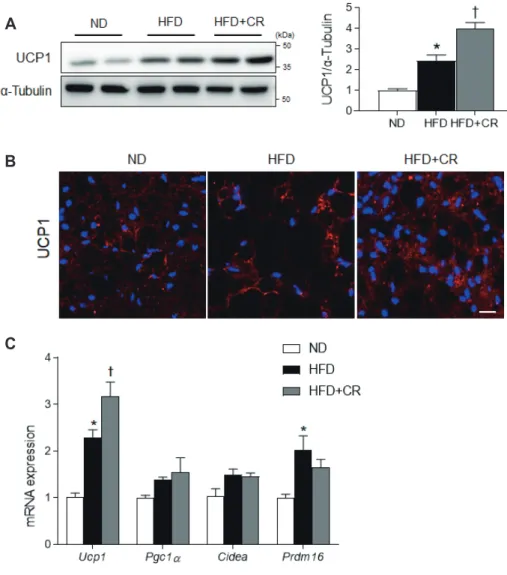
Lipocalin 2 (LCN2) is a critical regulator of BAT activation [9,10]. Its deficiency leads to an increase in body weight and impairs adaptive thermogenesis [11]. In response to cold, LCN2 upregulates the expression of UCP1, which mediates BAT ther-
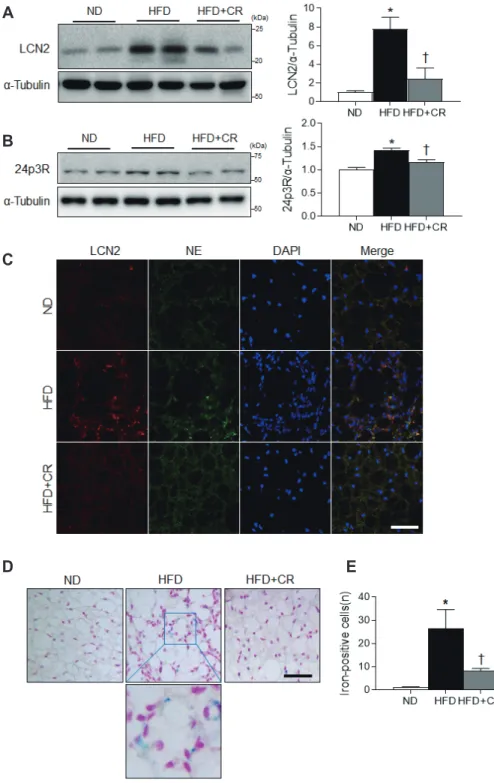
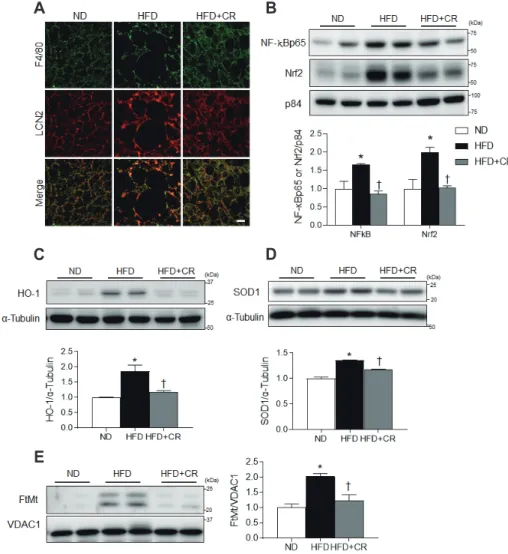
mogenic activity [9,10]. Notably LCN2, which was originally iso- lated from neutrophilic granules, has been linked to obesity and adipocyte inflammation because nuclear factor-kappa B (NF-B) transactivates its expression [12,13]. Furthermore, LCN2 is be- lieved to be an iron-binding protein [14] that can induce oxidative stress [15]. Based on these findings, we propose that LCN2 plays an important role in the regulation of iron-mediated inflamma- tion and oxidative stress in the BAT of obese mice.
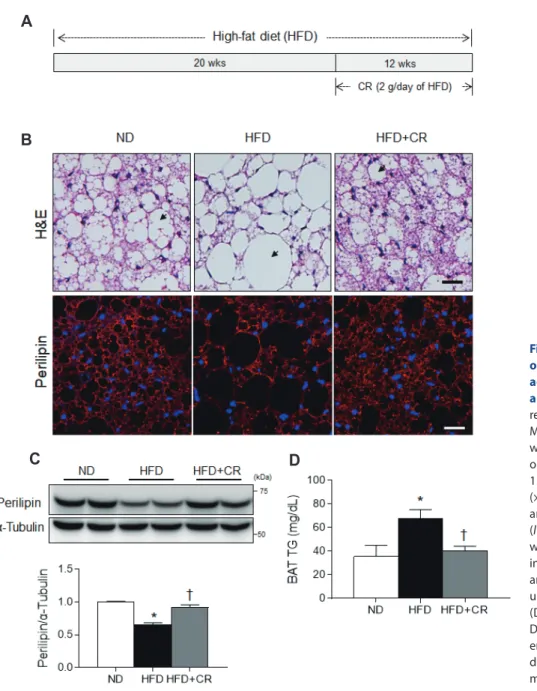
Caloric restriction (CR) has been shown to reverse obesity- induced insulin resistance by reducing adiposity [16] and increas- ing mitochondrial biogenesis [17]. However, its effects on inflam- mation and oxidative stress in mice fed a high-fat diet (HFD) are unclear. Hence, we investigated the protective effects of CR on LCN2-mediated inflammation and oxidative stress in the BAT of HFD-fed mice.
Original Article
Effects of caloric restriction on the expression of lipocalin-2 and its receptor in the brown adipose tissue of high-fat diet-fed mice
Kyung-Ah Park
1, Zhen Jin
1, Hyeong Seok An
1, Jong Youl Lee
1, Eun Ae Jeong
1, Eun Bee Choi
1, Kyung Eun Kim
1, Hyun Joo Shin
1, Jung Eun Lee
2, and Gu Seob Roh
1,*
1