• 검색 결과가 없습니다.

Comparison and Convergence of the Blank Space in Chinese and Japanese Graphic Design -Focusing on the Expression of Blank Space in Poster Design

N/A
N/A
Protected

Academic year: 2021

Share "Comparison and Convergence of the Blank Space in Chinese and Japanese Graphic Design -Focusing on the Expression of Blank Space in Poster Design"

Copied!
10
0
0

로드 중.... (전체 텍스트 보기)

전체 글

(1)

Comparison and Convergence of the Blank Space in Chinese and Japanese Graphic Design

-Focusing on the Expression of Blank Space in Poster Design-

Wenqian Xie

1

, Won-Seok Kim

2*

1

Division of Formative Design, Kongju National University

2

Division of Formative Design, Kongju National University

중국과 일본 그래픽 디자인에서의 여백의 비교 및 융합연구

-포스터 디자인에서 여백 표현을 중심으로-

혜문천

1

, 김원석

2*

1

공주대학교 조형디자인학부,

2

공주대학교 조형디자인학부

Abstract Comparison and Convergence of the Blank Space in Chinese and Japanese Graphic Design This study discusses the philosophical foundation in Chinese and Japanese aesthetics. Most of the contemporary graphic designs in China lack influence or individual philosophy on aesthetics. In analyzing and comparing the use of blank-leaving in graphic design works showed that the traditional artistic sense of the blanks can enrich the cultural connotations of design and raise the artistic creation of the works. This paper used “convergence” to create a new approach on Chinese contemporary graphic design, especially on poster design. The application of blank-leaving in the graphic design has positive impact in the creation of excellent graphic design works that provide references and inspiration to develop a new blank on my own design.

• Key Words : Convergence, Blank Space, Zen and Tao, Graphic Design, Poster Design

요 약 중국과 일본 그래픽 디자인에서의 여백의 비교 및 융합연구

이 논문은 중국과 일본의 상이한 미적, 철학적 차이의 이해와 융합을 기반으로 그래픽 디자인 분야에서 여백을 통한 새로운 표현 창출을 위한 방법에 대해 논했다. 그래픽 디자인에서 동양의 특징적인 여백을 표현하는 것은 디자인의 예술적 표현과 문화적 의미를 풍부하게 하고 디자인의 창작의 가능성을 높을 수 있다. 이 연구에서는 먼저, 중국과 일본의 미술 및 디자인에서의 여백에 대한 인식과정과 표현과정을 중국의 전통회화의 철학과 일본의 현대 그래픽 디자인의 방법이 적용된 포스터 디자인을 통해 비교∙분석한다. 이를 기반으로 포스터 디자인에서 여 백을 통해 중국 현대 그래픽 디자인의 새로운 접근방법으로써 융합의 개념을 적용해 그래픽 작업에서의 표현의 가능성을 확장한다. 또한, 여백에 대한 융합적 개념에 의한 표현 창출은 자신의 작품에 새로운 가능성을 제공한다.

• 주제어 : 융합, 여백, 선(禪)과, 도(道), 그래픽 디자인, 포스터 디자인

*Corresponding Author : 김원석([email protected])

Received March 9, 2017 Revised April 17, 2017

Accepted June 20, 2017 Published June 28, 2017

(2)

1. Background and Introduction

In the recent years, China has recognized the importance of commercial graphic design as a means to strengthen the country's economy. As a result designers in China have worked to actively meet demands requiring high quality in graphic design. The contemporary graphic design field has undergone 20 years of development, achieving positive results in the process. Like all fields of specialization in the course of its development, it has experienced various different problems. The language of art and design flourished simultaneously with the emergence of different graphic languages and also with the enrichment of expressions in the genre. The creation of poster design in China often focused on graphics, use of text and other image elements but neglected the application of blank space.

In terms of producing a good design style certain areas require to be left empty as it directly affects proportion in the overall layout, size and placing of different graphics, images and others. Therefore the application of blank space whether it is a poster or something else is crucial. This is perhaps the focal point in the creation of graphic design as well as in understanding 2-dimensional space. Poster design is known as the most effective way of incorporating expression into the formal nature of graphic design. For Chinese contemporary graphic design, the use of blank space is a sign of maturity. This is helpful for the country to embody aesthetical implication of its culture in graphic design works, which has reflective significances on the current phenomenon that the design field in China can easily imitate the design language of the West.

Our daily living has become more complex as many people incorporate the art of simplicity into their lives.

The development of a country’s design approach can be said to be a reflection of daily life led by a specific culture. Visiting Tokyo has been eye-opening as the Japanese people, particularly in the urban context, used graphic design in a different way. Neon signs, billboards, and luminous screens caught attention and allowed the observer to swoon in wonder. The graphic

minutiae of the Japanese culture is equally compelling:

tickets, till receipts, food packaging, confectionery wrappers and printed ephemera of all kinds instantly become collectable items, encouraging visitors to take back a suitcase filled with evidence of superior visual culture. Comparing this to the reality of Chinese graphic design, it is possible to state that often they are crapped with too much information using graphic design, text, images and so on. For the viewers it is almost impossible to either identify or understand messages simultaneously as loosing the focal direction of design. With any merchandising strategy that requires to include certain details, confusion must be avoided as it will eventually affect the economy. The focus on aesthetics in graphic design is undeniably important. Simple designs easily attract the attention of people and everyday practical designs seen by the general public on a daily basis, indirectly influences the overall aesthetics of a particular culture. Moreover profound thoughts can be evoked through effective graphic design initiatives which will eventually elevate the general standard of living and the aesthetics of a country. Sometimes, it is difficult to understand design philosophies or intentions of designers in terms of their conveyance. Bearing all this in mind, it is crucial to experiment with open or blank spaces in graphic design as without the incorporation of space, there would be no beauty.

Consequently the psychology, in terms of a

country's aesthetics, is formed in its long-term social

practice. Through a long historical development, each

nation has established its own ideology, philosophy, and

tradition within its social environment. All have

significant influences on people’s consciousness and

behavior. Also, each element affects and cultivates the

national activities and characteristics in aesthetics. Li

Zehou, a Chinese aesthetician, stated that ‘Chinese

philosophy is not tending or peaking at religions, not

aesthetics. Chinese philosophy transforms cognition to

aesthetics, but not to religions, it is to gain an

aesthetics-oriented life design, attitude, and

(3)

conception’[1]. The thought of Zen Buddhism is rooted in the customs and emotions of Japanese people. The Zen way of thinking, and methods in aesthetics have gradually become the nation’s way of thinking and behaving. Certainly, the Japanese Zen Buddhism’s thoughts and aesthetics have been incorporated in their design works. In contrast, China is behind in this way, in the application and the cultivation of its national philosophical aesthetics in contemporary design, and in particular graphic design.

2. Contextual Review

2.1 The Blank Space in Traditional Arts of China

[Fig. 1] Chinese painting, Prown, Qi Baishi

Historically Chinese paintings were a reflection of the culture's philosophy and social transitions, as a result the aesthetical pursuit and value were depicted in paintings. Understanding the world with “Dao” impacts the cultural level of Chinese humanism. In traditional Chinese art, particularly classical paintings, much attention was given to propaganda along with self-expression based on emotion. The empty space in paintings is an in-depth understanding or practicing of

"Dao". Chinese philosophy and aesthetics also focuses on the notion of "nothingness", which is shown as empty spaces in paintings. Many painters have put emphasis on the empty space. In Chinese paintings, an empty space does not only set off the main feature but

also enhances concepts in aesthetics, such as the continuation of key elements in paintings. “Dao” is distant and spacious, containing within its belief the notion of infinite void.

The principles of traditional Chinese paintings derived from Daoism, which emphasizes the union of humanity and nature as shown in individual creativity.

Lao Zi stated, ‘Knowing the white, retaining the black, it is the form of the world’ (Laozi, Chapter 28). The white in Chinese paintings suggest emptiness, while blank signify solidity. In Chinese calligraphy, an empty space is used in ‘designing the white.’ In Chinese literature, it lies where it is without words. In music, silence creates more sound than actual sound itself. In painting, it is as if one’s mind can reach there without the touch of any brush and ‘formless conveys the image grander’ (Laozi, Chapter 41). In traditional Chinese paintings it was not necessary to fill an entire sheet of paper. It was more customary in practice to leave a section blank for viewers to imagine. “The great sound seems soundless; the great image seems formless” is the realization of noumenon of “Dao.” An ancient Chinese once summarized aesthetic forms by stating, “Beauty made relies on what is not visible to the eye." These blanks are called “white space.” They become a reserve for expressing the authors’ ideas, and a significant artistic technique for “virtual” serving of the “real,” “non-being” at the same time as supporting the “being.” Philosophically, the white space reflects on the relationship between “virtual” and “real,”

“in-motion” and “in-position” in paintings.

2.2 The Blank Space in Traditional Art of Japan

[Fig. 2] Japanese ink painting, six-panel pine trees,

Hasegawa Tohaku

(4)

The root of traditional Japanese culture and aesthetics has been largely influenced by Chinese philosophy and culture. Confucianism, Buddhism, and Taoism were introduced into Japan at different times.

Combining the belief of Chinese Confucianism, Buddhism, and Taoism with Japan's own inherent characteristics enabled the notion on “Zen” to develop and it is quite different from Confucianism, Buddhism, and Taoism. The understanding of “Zen” is the focal core in identifying Japanese aesthetics. Some western scholars even believe that the Japanese culture and character is Zen. It has played a critical role in the establishment of the Japanese character. It has touched on all levels of Japanese’s cultural life,[3] according to D.T. Suzuki, a Japanese scholar.

The early Japanese art was influenced by Zen Buddhism’s way of thinking, which came from India to China, then from China to Japan. The embodiment of such influence could be found in ancient Japanese scenic paintings having large white areas and simple outlines. The connection between Zen and art is important because of the inspiration that Zen gives to the artist and the better understanding of psychological conditions in art that is created prevailed in any other civilization [2]. The Zen school of Buddhism also stresses that ‘form is emptiness, emptiness is form.’

Kenya Hara, a Japanese contemporary graphic designer, cited white means “empty” in certain circumstances. White, as “no color,” translates into a symbol of “non-being.” Also, empty does not mean

“nothing” or “zero-energy.” In many cases, it refers to a state that will be filled in the future. Based on this assumption, “white” is regarded as “the powerful communication energy” in his own book [3].

3. Expression of Blank Space in Graphic Design

3.1 Japanese vs. Chinese in Graphic Design The Japanese have long practiced a conscientious and open-design aesthetics in all their creations to

accommodate limited resource and space. These are reflected in Muji’s advertising design. The modern Japanese graphic style evolved from many sources.

Japanese characters in their language originally derived from Chinese letters, which are logograms that represent the entire word, thus giving the written text a highly symbolic and idiomatic expression. It is a feature that can still be seen in Japanese graphics today. The designers of post-World War Ⅱ period were inspired by flat, asymmetric compositions with influence from the masters of the floating world, wood-block printing. Another influence was the tradition of Japanese family crests. Modernism and constructivism were also highly influential forces in the creation of modern Japanese graphic design [4].

D. T. Suzuki said, “We need to pay attention to some characteristics of Japanese art, which are inseparable from Zen Buddhism. That can be derived from Zen.”[5] Gang Seungkyoo, Future’s Keyword, Convergence. Century Daily News Media, 2009. Due to the infiltration of Zen aesthetics, Japanese art and design tend to be still and simple. All areas of daily life and culture were effected by the aesthetics based on Japanese Zen practices. Combining Zen concepts with design has been the most effective method for designers to express their own inherent cultural characteristics and experiences.

The simple form, complex logic, and profound

connotation constitutes the highest Japanese aesthetics

realm. Japanese designs with strong national themes

enhanced the struggle of Japanese designers to refine

core values in their own culture. Most Japanese graphic

designs attempt to use the void-arranged method

instead of traditional Western design, that tends to

follow solid-arranged concept. Layouts of Japanese

graphic designs are mostly asymmetry, which is

generally more active than symmetrical ones. By

contrast, Chinese graphic designers prefer to apply

symmetry in layouts in preliminary stages of planning.

(5)

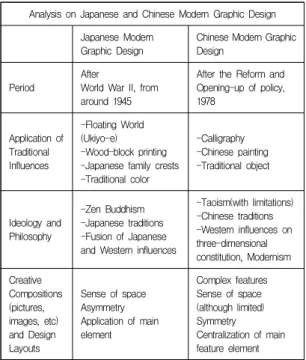
<Table 1> Compare and Contrast of Japanese and Chinese Modern Graphic Design

Analysis on Japanese and Chinese Modern Graphic Design Japanese Modern

Graphic Design Chinese Modern Graphic Design

Period After

World War II, from around 1945

After the Reform and Opening-up of policy, 1978

Application of Traditional Influences

-Floating World (Ukiyo-e) -Wood-block printing -Japanese family crests -Traditional color

-Calligraphy -Chinese painting -Traditional object

Ideology and Philosophy

-Zen Buddhism -Japanese traditions -Fusion of Japanese and Western influences

-Taoism(with limitations) -Chinese traditions -Western influences on three-dimensional constitution, Modernism Creative

Compositions (pictures, images, etc) and Design Layouts

Sense of space Asymmetry Application of main element

Complex features Sense of space (although limited) Symmetry Centralization of main feature element

Asymmetry is also a significant feature of Japanese traditional aesthetics, which comes from the concept of the spatial arrangement applied to traditional architecture. The garden and tea-room must be put in an essential place in traditional Japanese life style, embodying the basic characteristics of asymmetry layout. Traditional landscapes infiltrate Taoist’s free thoughts while and manifesting asymmetrical characteristics. However they were only limited to the royal and the powerful class of people, evidently the general public could not experience such aesthetics.

The tea gardens and the tea-rooms are also intentional forms deliberating asymmetry and unevenness. In contrast to the fullness of symmetry, asymmetry is an affirmation of imperfect forms and incomplete beauty.

In terms of layout design in modern and contemporary Japanese graphic design, the same principles are practiced.

3.2 Japanese vs. Chinese Graphic Designers Koichi Sato is a modern Japanese graphic designer.

Wang Shouzhi, a Chinese design theorist, described

Sato by stating, “he conveys the stillness, inaction, and plain, which emphasizes self-cultivation and pays attention to the spiritual realm of purity and emptiness.

His posters are regarded as a visual carrier of the Japanese culture and Zen Buddhism thoughts on his creation” [6]. In the rapidly changing world of global design, Sato has found an integrating point based on concept on nature, color theory, and aesthetics rooted in Japanese Zen Buddhism. From Sato’s posters, one is able to see the impact transmitted by Zen thoughts to create finesse and stillness using details and tranquil elements in emotional expressions.

Kan Tai-keung is a modern Chinese graphic designer who always focuses on Chinese culture and learning additionally as aesthetics.

<Table 2> Compare and Contrast of Representational Graphic Designs of Japan and China

Comparing Japanese and Chinese Graphic Designers

Posters by Designers

Koichi Sato(Japanese) Kan Tai-keung(Chinese)

Philosophical

Basis Zen Buddhism Taoism

Traditional

Elements Traditional objects Traditional color

Chinese calligraphy Chinese painting Traditional objects Creative

Compositions Overall planning Centralized planning

Placing Asymmetry Symmetry

Color Japanese traditional color Traditional color based on Chinese ink brush painting Artistic

Tendency Zen-like stillness Confucianism, Buddhism, Taoism
He also merges his design with traditional Eastern

philosophy. He does not merely reply on the usage of

(6)

traditional graphics and existing elements today in the Chinese culture but rather he endeavors to infuse quintessence of Chinese culture into his design.

Samples of Kan Tai-keung’s works adopt a composition method with a large area of white space and common impressionistic techniques found in Chinese ink brush paintings. The empty spaces can also be called “place-arranged,” which is a kind of artistic approach that painters commonly applied to express some artistic concepts, thoughts, and feelings.

The root of Chinese design today can be seen in Tai-keung’s works, where he has flexibility in including traditional Chinese culture and an element of modernity.

3.3 Blank Space in Creative Composition found in Chinese Paintings and Poster Designs

What is “blank-leaving”? Professor Kong Liuqing wrote in his work, “Traditional Antique Colored Decoration Type and Composition Point of View, “what we refer to blank-leaving is about blank areas in differing shapes left in vessels that creates a contrast with background color or intentionally left spaces through the incorporation of intense decoration or empty spaces depending on how the foundation picture is colored or designed." Chinese philosophy emphasizes nothingness, resulting from empty spaces in Chinese paintings and artistic concepts[7]. Traditional Chinese paintings, as the quintessence of Chinese culture, have great artistic values and achievements of far-reaching influence. One prominent characteristic of Chinese painting is its treatment of empty space as solid space.

The main philosophical thought of China and Japan is reflected in their aesthetics, which includes nothingness and emptiness. The emptiness is reflected in artworks - a kind of blank space.

Same as the principle on painting, it emphasizes the configuration of virtual space, in which both the blank and the drawing are parts of the whole. Blank conversions and layouts are actually expressions in

themselves. Therefore blank-leaving can be a space without any ink, an arbitrary color or decorative graphics. In a certain design, the blank is used as a modeling element because it is featured with images.

Its form, size, and proportion determines the quality and capability of conveying information. The blank and the entity are inter-dependent. The blank can make entity create visual dynamics that gain tension.

The principles in aesthetics applied to Chinese paintings are “mutualism of blankness and fullness”

and “beauty from blankness.” Similarly, this technique of blank-leaving is applied to contemporary graphic design in China. Through the analysis of Japanese modern poster design, it has been proven that designers applied the concept on empty spaces in the same way as it was used in Chinese paintings. Modern Japanese graphic designers mainly process four aspects to explore blank spaces in poster design - (1) composition, (2) color, (3) thought.

4. Convergence of Methodological Approach in Poster Design 4.1 Methodology

There are many words to describe the 21st century, such as the age of information, the society of knowledge or creative society. In the technical expression, this is also called digital society/or era.

Although there are many definitions, perhaps the new fusion of social convergence could be the most appropriate description of the 21st century. Currently, the social issue relating to fusion is all about convergence. In the history of man-kind/or civilization, communication connected to fusion and differentiation enabled human beings to develop. The general trend of fusion is convergence. The mathematical equation 1+1

= 2, but convergence is not only about numbers and sums. In simple terms, it can be regarded as a reintegration of a new concept: convergence [8].

Thomas Friedman said, “Today more than ever, the

(7)

traditional boundaries between politics, culture, technology, finance, national security and ecology are disappearing. You often cannot explain one without referring to the others, and you cannot explain the whole without reference to them all.” Generally, convergence is the coming together of two or more distinct entities or phenomena. Convergence can be used to describe things that are in the process of coming together. In this context, the term can be applied to combining Chinese philosophy with modern Japanese graphic design based on individual creativity at the same time as thinking about emptying of space.

China and Japan have similar orientation in their cultural and ideological system. Zen Buddhism has played an essential role in the establishment of Japanese aesthetics. The concept on Zen Buddhism is deeply rooted in much of people’s customs and emotions in Japan. The Zen way of thinking and practice of aesthetics have gradually become the Japanese’s way of thinking and behavior. It covers all level of Japan’s cultural life even in art and modern design. Regarding poster designs, for example, emptiness and stillness of Zen Buddhism can be experienced through Hara Kenya’s and Koichi Sato’s works. Under such influence, Japanese graphic designers created their own unique works using modern techniques based on design theories, color, composition and overall layouts.

4.2 Convergence of Blank Space in Creative Composition

Zen Buddhism has influenced creative compositions in modern Japanese graphic design as they focus much on experimenting with space - emptiness and blank space, which is a virtual-real comparison, giving a deep sense of Zen, while accepting “stillness and emptiness.” Based on the analysis conducted on modern Japanese graphic design, it is possible to see that individual creativity embraces such notions with the basic layouts taking on a asymmetrical approach at the same time as maintaining compositional balance.

Elements are placed organically, relying on the interaction of form and white space.

From the expression power of design, Wang Shou Zhi pointed that graphic design is all about design activities in plane spaces, which involves design content in two-dimensional space and layout [9]. The designer’s responsibility is not to fill the space but instead use the space reasonably. The composition in the Chinese paintings or also called the

“place-arranged,” that is, the empty space of a painting should be arranged.

Straightforward, even, and cumbersome compositions must be avoided in ink brush painting, which, on the contrary, must get away from mediocrity and rigidness to be well arranged and properly proportioned. The composition that is not only sparse but also dense, not only compact but also scattered plays an important role in realizing rhythm, change, charm, and liveliness of ink brush painting. Artists should both follow the law of nature and subjective management. They should use all artistic means to extract, accept and summarize, to reflect on reality, thoughts, and beauty. From the representative graphic works of Japan and China, designers referred to traditional Chinese techniques in blank-leaving to create the preliminary design layout.

4.3 Convergence of Blank Space of Color Modern graphic design seen from the view point of Zen Buddhism, there is no emphasis on finely drawn images and application of a wide range of color. Rather the requirements are such that colors need to be simple with different changes. The white space can actually be any color that represents negative space in design. The white space in design is not only limited to white as a tone. The “white” of blank space is not referring to the color but to the space. The white can be achieved either by mixing all colors in the spectrum or by removing ink from all other pigments. In short, the white is both “the full-color” simultaneously as being

“the colorless. The texture of “white” can powerfully

(8)

evoke material qualities inherent in specific objects, while arousing a sense of “emptiness” and “void” that relates to time and space, linking also to the concept of

“nonexistence” and “zero”.

Lao Zhi said, “Five colors dazzle the eyes.” This proves that Taoists endeavored to maintain the original characteristics of color through low lightness. In regards to colorful spectrum, black and white abandon the ornate decoration and avoid brilliance in color.

White is unusual because it can be considered as being colorless. The blank-leaving of color is regarded as a natural photography or other color’s background.

Japanese modern graphic works portray a natural scene with their muted color moving away from white. The most significant feature of Koichi Sato’s works is the subtle gradient of color. Another is the gradual transition between different colors and the gradient of an object’s background shadow that is similar to the feather in Photoshop. This technique neither belongs to Western classical light irradiation nor the method of throwing almost all light sources in Eastern tradition.

Instead, it is only to express color and volume.

4.4 Convergence of Blank Space of Thought Traditional Japanese aesthetics and Chinese Taoist thought/philosophy have a common ground -

“nothingness and harmony” or “acting through inaction”, that is, refining external representations of objects with the naive aesthetic concept of Zen, or showing the most profound meanings of objects with extreme simple elements. This design method of restoring the essence permeated with extremely subtle aesthetics based on Zen philosophy. The original appearance of objects is restored by removing their external cumbersome modification, which achieves the return to simplicity. Simple form, complex logic, and profound implication has become China’s highest realm in aesthetics.

One famous Chinese professor of philosophy wrote in his paper, noting the four hundred years of Zennist Buddhism, that a new insight, a set of intellectual

habits, and a source of reference materials has been given by Chinese philosophy. Aesthetics is a term with a rich and complex history. Adrian Shaughnessy defines it as a ‘set of principles concerned with the nature and appreciation of beauty, especially in art.’ It describes aesthetics as a ‘branch of philosophy which deals with the questions of beauty and artistic taste’

[10]. Traditional Chinese aesthetics is Daoist’s aesthetics, which is based on emotion. Chinese artists have learned to feel and follow their emotions and present them in artworks. Zen focuses on an innermost way of "heart" aesthetics. Under Zen Buddhism’s influence, Japanese modern graphic design practices stillness in images with simple and rich ink changes to express a quiet and profound realm.

The simpler things are presented they become tenser and stronger in information. Simple contents do not require much complexity in terms of decoration as they maintain their own distinct features. It is expected that the Chinese aesthetics philosophy can have an impact on the contemporary graphic design. In terms of applying traditional Chinese culture, it expresses the spirit and thought of China, rather than just simple symbols. Therefore traditional culture or aesthetics philosophy can be transformed into modern thoughts in reference to different periods and living environments.

In Hara’s design although they do not have definite Japanese elements, nonetheless his work delivers Japanese charm and design philosophy. As graphic designers, they should be concerned about the application of blank space in design and relate traditional ideas with modern living while pouring modern emotion into it and not merely applying old thoughts rigidly.

5. Conclusion

Contemporary Chinese graphic design in the course

of its development encountered universal problems. As

most of the layouts of modern Chinese graphic design

tend to include too many elements, communication

(9)

decreased through posters. This paper examines the application of the void or the blank space as used historically in traditional paintings and aesthetics to explore a different realm in artistic expressions and design. The paper focused on Chinese traditional philosophy such as Daoism and Japanese traditional belief and practice of Zen Buddhism. Both have a common property - “nothingness and harmony” or

“acting through inaction”, that is, refining external representations of objects with the naive concept in aesthetics of Zen, or showing profound meanings of objects with extreme simple elements. This design method of restoring the essence is permeated with extreme subtle philosophy in aesthetics based on Zen.

Simple form, complex logic, and profound implication becomes China’s highest realm in aesthetics. By contrast, most of the Japanese graphic designs represent traditions such as Zen-like stillness or concept of emptiness. Most contemporary graphic designs in China are all about the absence of effect or the expression of its own aesthetics philosophy. In this context, the term refers to the combination of Chinese philosophy and the layout modern Japanese graphic designs into a new way of expressing the void through individual designs. Based on the comparison of Chinese aesthetics philosophy and Japanese Zen theory, the simpler things provide tenser and stronger information.

For a designer, the most important aspect of aesthetics is to develop a way of seeing. The simple content does not require much complex decoration because it has its own distinct features. In Chinese paintings, using blank space creates an artistic concept of “mutualism of blankness and fullness” and “beauty from blankness,”

Similarly, in modern graphic designs Chinese aesthetics philosophy can have an effect on personal graphic design. Even without definite features of China, design works can have Chinese charm with a design philosophy. This paper used “convergence” to create a new approach on Chinese contemporary graphic design, especially on poster design, which is a collaboration of the Chinese painting philosophy and Japanese modern

graphic design method. The modern Japanese graphic designers mainly process four aspects to explore the blank space in poster design. These four aspects are blank-leaving of a composition, color, thinking, and artistic concept. The application of blank-leaving in graphic design has positive impact in the creation of excellent graphic design works that provide references and inspirations to develop new and effective designs.

REFERENCES

[1] Li Zehou, "Chinese Aesthetics", SDX Joint Publishing Company, 2008.

[2] Arthur Waley, "Zen Buddhism and Its Relation to Art". LUZAC&CO.London, 1922.

[3] Kenya Hara, "White", Guangxi Normal University Press. 2008.

[4] Gang Seungkyoo, Future’s Keyword, Convergence.

Century Daily News Media, 2009

[5] Philip B. Meggs and Alston W. History of Graphic Design, 4th edition. Wiley, 2005

[6] Daisetz T. Suzuki, BuJu, "Zen and Japanese Culture", Unity Press, 2016.

[7] Kenya Hara, "Designing Design", Guangxi Normal University Press, 2007.

[8] Wang Shouzi, "A History of Graphic Design", China Youth Publishing Group, 2002.

[9] Zong Baihua, "Aesthetics for a walk", ShangHai RenMin Publishing House, 1981.

[10] Li Fugui, "Nothingness and Beauty", Southwest Jiaotong University Publishing, 2015

[11] Adrian Shaughnessy, "Graphic Design: A User’s Manual". Laurence King Publishing Ltd. 2009.

[12] Jerrold Levinson. Hybrid Art Form, "Journal of Aesthetic Education, Vol.18, No.4, University of Illinois Press, 1984

[13] M. H. Lee, "The History of Cultural Interchange and Cultural Conflict between East and West", Seoul: Korean Studies Information, 2009

[14] Herbert Read, "The Meaning of Art", London:

(10)

Penguin Books, 1964

[15] H. Kim, "The study of spatial expression by blankness", Hongik University, 2010

[16] S. M. An, “Study on the Convergence between Spatial Design Education and On·Offline Communication Methods”, Journal of digital Convergence , Vol. 13, No. 5, pp. 317-327, 2015.

[17] K. G. Kim, J. Y. Park, "Cultural Differences impact on the ERP System Implementation," Journal of IT Convergence Society for SMB, Vol. 6, No. 2, pp.

1-9, 2016.

[18] J. C. Lee, “A Classification Algorithm using Extended Representation”, Journal of the Korea Convergence Society, Vol. 8. No. 2, pp. 27-33, 2017.

저자소개

혜 문 천(Wenqian Xie) [정회원]

•2010년 7월 : 중국 다렌공업대학 교, 시각디자인학과

•2011년 10월 : Univeitisty of Southampton Winchester School of Art, Communication Design (디자인학 석사)

•2014년 3월 ~ 현재 : 국립공주대학교 예술대학 조형 대자인학부 도자디자인전공 박사과정 재학중

<관심분야> : 시각디자인, 도자

김 원 석(Won-Seok Kim) [정회원]

•1984년 8월 : 목원대학교 산업미 술학과 학사

•1988년 2월 : 홍익대학교 산업미 술대학원 석사

•1990년 4월 ~ 현재 : 국립공주대 학교 예술대학 조형대자인학부 교수

<관심분야> : 도자, 공예

수치

Graphic Design Chinese Modern GraphicDesign

참조

관련 문서

After analyzing the influence of design award indicators(technology, concept, visual expression, communication and benefits) on future design technologies,

Evaluating the impact of a facilitated learning community approach to professional development on teacher practice and student achievement.. Engineering by

Edit the layout in the design magazine, the nature of the design, the designers are trying to convey the power of the message depends on the magazine

A Contrastive Study on the Proverbs of Family Relationship of Korean and Chinese..

Design consulting service focusing on design development is dominant in Korean design industry. There has been design consulting service supported by

In this architectural design field, the space with new concept and organic space come into sight, escaping from the space concept in the geometric and

In terms of the mould design, the effects of runner system design and the mould temperature on filling characteristics, the weldline formation, the

Underground Sewage Treatment Plant, Trondheim, Norway 19.. Underground Sewage Treatment Plant,