녹차 첨가 서리태 청국장의 항산화 증진 효과
조은주
1ㆍ박현영
1ㆍ김현영
2*
1부산대학교 식품영양학과 및 노인생활환경연구소, 2경남과학기술대학교 식품과학부
Increased antioxidative effects of Seolitae Chungkukjang added with green tea powders
Eun Ju Cho
1, Hyun Young Park
1, Hyun Young Kim
2*
1
Department of Food Science and Nutrition, Pusan National University, Busan 609-735, Korea
2
Department of Food Science, Gyeongnam National University of Science and Technology, Jinju 660-758, Korea
Received on 25 January 2012, revised on 6 February 2012, accepted on 23 March 2012
Abstract : To increase antioxidative activity and minimize off-flavor of Chungkukjang, Seoliate as main ingredient and green tea as minor ingredient were selected. The protective efffect of green tea for Chungkukjang was evaluated under in vitro. Seolitae Chungkukjang added with green tea (SCG) was prepared on the basis of the protective effect of green tea from oxidative stress. Green tea showed the strong protective effect against nitric oxide (NO) and superoxide anion (O
2-) radicals. The SCG perparation method was as follows. Seolitae was cleaned and washed, soaked in 1.5-fold water (15℃) of Seolitae weight for 48 hr. Seolitae was steamed about 40 min by autoclave and then cooled about 40℃. Bacillus subtilis was inoculated and 5.0-fold green tea of weight was added, and then it was fermented for 60 hr at 40℃. According to the preparation method, Seolitae Chungkukjang (SC) and Seolitae Chungkukjang added with green tea 5.0% (SCG5.0) were prepared. Among the Chungkukjang groups SCG5.0 exerted more effective scavenging activity of NO than SC.
In addition, SC added with green tea 5.0% showed high O
2-scavenging effect. These results suggest the antioxidative potential against free radical-induced oxidative damage of SCG.
Key words : Seoliate, Green tea, Chungkukjang, Antioxidative activity, NO, O
2-*Corresponding author: Tel: +82-55-751-3277 E-mail address: [email protected]
I. 서 론
유산소 호흡을 하는 거의 모든 생물체의 세포에서 발생 되는 reactive oxygen species(ROS)는 독성이 매우 강한 물질로서, 생체물질의 자가 산화, 방사선, 화학물질에 의한 외부자극에 의해 생성될 수 있는 것으로 알려져 있다 (Fridovich, 1978; Kodama, 1988). 이러한 활성산소의 종 류로는 superoxide anion(O
2-), hydrogen peroxide(H
2O
2), singlet oxygen(
1O
2), hydroxyl radical(・OH), peroxyl radical(RO・) 등이 있다. 또한 reactive nitrogen species (RNS)로서 nitric oxide(NO)는 반응성이 크고 반감기가 아 주 짧은 특징을 갖는 활성산소로 대식세포, 호중구 등에서
생성되며 O
2-와 쉽게 반응하여 반응성이 매우 높은 산화제 인 peroxynitrite(ONOO
-)를 생성한다(Maliski 등, 1993;
Radi 등, 1991). 이들 활성산소는 여러 가지 환경적 요인이 나 병리적인 요인들에 의하여 과잉으로 생성될 수 있으며 이들의 과다 생성과 활성산소를 제거하고 방어하는 항산화 방어체계의 결핍은 항산화 방어체계간의 불균형을 일으켜, 산화적 스트레스를 발생시킨다(Cadenas와 Davies, 2000;
Bokov, 2004). 또한 산화적 스트레스의 증가는 암과 심혈 관 질환 및 알츠하이머와 같은 만성 질환의 병리학적 진행 과 노화과정의 중요한 원인이 되는 것으로 알려져 있다 (Cavalca 등, 2001; Gibson과 Huang, 2005).
청국장은 삶은 콩에 고초균을 번식시켜 만든 전통 발효
식품으로 가장 짧은 기일에 완성할 수 있으면서도 그 풍미
가 독특하고 영양적, 경제적으로도 가장 효과적인 콩의 섭
취방법으로 인정되고 있다. 또한 최근 많은 연구자들에 의해 콩에서 기인된 isoflavone, phytic acid, saponin, trypsin inhibitor, tocopherol, 불포화지방산, 식이섬유, 올리고 당 등의 각종 생리활성물질과 항산화물질 및 혈전용해효소 를 다량 함유하고 있기 때문에 기능성식품으로서의 중요성 이 강조되고 있다(Pratt 1972; Hammerschmidt와 Pratt, 1978; Pratt와 Bibrac, 1979; Coward와 Barnes, 1993).
오랫동안 청국장이 전통식품으로 사용되어 왔음에도 불구 하고 영양학적인 우수성과 생리 기능성에 관한 연구는 비 교적 최근에 이루어지고 있다. 청국장에 관한 연구로는 청 국장 제조의 발효에 관한 연구가 주를 이루며, 청국장의 기능성에 관한 연구로는 혈중콜레스테롤 저하, 고혈압 예 방, 항암, 항산화, 혈전용해 및 골다공증 예방 등 다양한 효과에 대한 보고가 있다(Iwai 등, 2002; Sung 등, 1984;
Choe 등, 2004; Youn 등, 2002; Kim 등, 2003; Suh 등, 1982; Yoo 등, 1998; Shon 등, 2002). 반면 기능성 증진에 대한 연구는 그다지 행해지지 않은 실정이다.
항산화 기능성 증진 및 이취제거를 위해 많이 이용되어 지는 녹차는 다양한 기능성이 인정되고 있는데, 특히 항산 화효과, 항암효과, 항균효과, 혈압강하효과 등이 알려져 있다 (Hibasami 등, 1998; Liao 등, 1995; Yukihiko와 Tadashi, 1989; Okubo 등, 1998; Abe 등, 1995; Sagesaka-Mitane 등, 1996). 또한, 청국장 제조 시 대부분의 경우 대두가 주 원료로 사용되고 있으나, 대두 대신 기능성을 증진시킬 수 있는 재료로서 서리태를 들 수 있다. 서리태는 종피의 안토 시아닌 색소가 여러 가지 기능성을 나타내는 것으로 보고 되고 있다(Francis, 1989; Mazza와 Miniati, 1993; Kim 등, 2005). 본 연구에서는 청국장의 항산화 기능성 증진을 위해 부재료로 녹차를 첨가하여 서리태 청국장을 제조한 후 in vitro 상에서 라디칼 소거능을 살펴보았다.
II. 재료 및 방법
1. 청국장의 제조
선별한 대두와 서리태를 수세하여 1.5배의 물을 첨가하 여 15℃에서 48시간 동안 침지하고 수절한 후 121℃에서 40분 동안 증자한 후 냉각시켰다. 녹차분말을 증자콩에 대 해 5.0%를 첨가하고 Bacillus subtilus 를 원료의 0.3%
(v/w) 접종하여 40℃에서 60시간 발효시켰다.
2. 시료 조제 및 추출
5.0% 녹차를 첨가한 서리태 청국장 시료를 동결 건조시 킨 후 시료 중량 20배의 methanol(MeOH)로 실온에서 12 시간 동안 추출하는 과정을 총 3번 반복한 후 회전식 진공 농축기를 이용하여 농축시킨 후 -80℃의 냉동고에 보관하 면서 항산화 실험에 사용하였다.
3. NO 소거효과
50 mM의 phosphate-buffer에 녹인 각 농도별 시료 200 μℓ에 5 mM sodium nitroprusside(SNP) solution 800 μℓ를 혼합하여 25℃에서 150분간 배양하였다. 이 혼 합액을 96-well plate에 주입하고 150 μℓ의 griess reagent 를 넣어 실온에서 10분간 배양한 후 540 nm에서 흡광도를 측정하였다(Sreejayan Rao, 1997).
4. 0
2-소거효과
50 mM PBS에 0.125 mM ethylenediamminetetraacetate (EDTA), 62 μM nitro blue tetrazolium(NBT), 98 μM NADH를 혼합한 용액을 96-well plate에 200 μℓ를 취하 고, 50 mM의 phosphate-buffer에 녹인 각 농도별 시료 25 μℓ를 혼합한 후, 33 μM 의 phenazine methosulfate 를 혼합하여 540 nm에서 흡광도를 측정하였다 (Ewing과 Janero, 1995).
5. 통계분석
실험 결과는 평균 ± 표준편차로 나타내었고, 대조군과 실험군의 실험 결과는 one way ANOVA로 검증한 후 Duncan’s multiple range test로 유의수준 0.05에서 유의 성을 검증하였다.
III. 결과 및 고찰
Nitric oxide는 내피세포 호중구 등에서, 생성될 뿐만
아니라 nitric oxide synthase(NOS)에 의해 citrulline으
로 전환 시에도 생성되며 대부분의 기관에서 세포내 messen-
ger로 작용하고 혈관의 항상성 유지 및 신경전달 물질로서
Table 1. NO scavenging activity of the MeOH extract from green tea.
Material Concentration (㎍/mL) NO scavenging effect (%)
Green tea 5 35.5 ± 1.5
c10 38.9 ± 1.4
c50 95.5 ± 4.6
a100 89.1 ± 4.6
bValues are mean ± SD.
a~c
Means with the different letters are significantly different (p<0.05) by Duncan’s multiple range test.
Table 2. Superoxide anion scavenging activity of green tea.
Material Concentration (㎍/mL) O
2-scavenging effect (%)
Green tea 100 54.6 ± 2.6
a250 51.9 ± 2.3
b500 48.6 ± 1.8
cValues are mean ± SD.
a~c
Means with the different letters are significantly different (p<0.05) by Duncan’s multiple range test.
작용한다. NO는 과잉으로 생성될 경우 단순 세포확산을 통해 iron-sulfur center나 thiol group을 포함한 mito- chondrial enzyme을 불활성화시키거나, 분자적 산소와 함 께 nitrosating agent를 형성하는 자동산화 과정을 거쳐 DNA deamination을 통한 돌연변이를 일으키거나, O
2-와 반응하여 더 강력한 산화제인 ONOO
-를 생성시킨다(Maliski 등, 1993; Radi 등, 1991). ONOO
-는 자극을 받은 대식세 포, 호중구, 내피세포에서 생성되며, 동맥경화성 심장질 환, 급성 폐렴, 만성 염증시 in vitro 에서도 생성된다. 또한 pKa 6.8에서 peroxynitrous acid(ONOOH)로 전환되어 nitrogen dioxide, nitronium ion 및 hydroxyl radical의 전구체로 작용한다. NO와 O
2-에 의해 형성된 ONOO
-는 in vitro 및 in vivo 에서 가장 강력한 산화제로 단백질, 아미노 산, DNA 등과 반응하여 세포 및 조직 손상을 야기할 뿐만 아니라 노화, 암, 관절염, 동맥경화, 피부 염증 등 여러 질 환과 관련되는 것으로 보고되고 있다(Althaus 등, 1994;
Haenen 등, 1997; Pannala 등, 1997; Lin 등, 1997; Halliwell, 1997). 따라서 과잉으로 생성된 NO을 제거함으로써 NO에 의한 독성으로부터의 보호효과를 기대할 수 있으며 강력한 산화제인 ONOO
-의 생성경로를 차단할 수 있다. Table 1은 기능성 증진을 위해 부재료로 사용할 녹차의 NO 소거 효과 를 in vitro 상에서 검토한 결과로 녹차의 NO 소거능은 아 주 우수하여 50 ㎍/㎖에서 95.5%의 효과를 보였다,
O
2-는 활성산소 중 가장 먼저 생성되고 반응성이 약하지 만 일부 분자를 직접 공격할 수 있다. O
2-는 ・OH보다 훨씬
느리기는 하나 glutathione peroxidase를 불활성화시킬 수 있으며 부분적으로 catalase를 불활성화시킬 수 있다.
또한 O
2-는 DNA를 직접적으로 변형시키지는 못하지만 반 응을 촉진할 수 있을 정도의 transition metals이 존재할 때 hydroxyl radicals 형성을 촉진한다. Table 2는 in vitro 상에서 O
2-의 생성을 유도한 후, 녹차추출물의 O
2-소 거 활성을 측정한 결과이다. 녹차추출물은 100 ㎍/㎖의 농 도에서 54.6%, 250 ㎍/㎖에서 51.9%, 500 ㎍/㎖에서 48.6%의 O
2-소거능을 나타내어 모든 농도에서 약 50% 정 도의 소거능을 보였으나 농도 의존적이지는 않았다(Table 2).
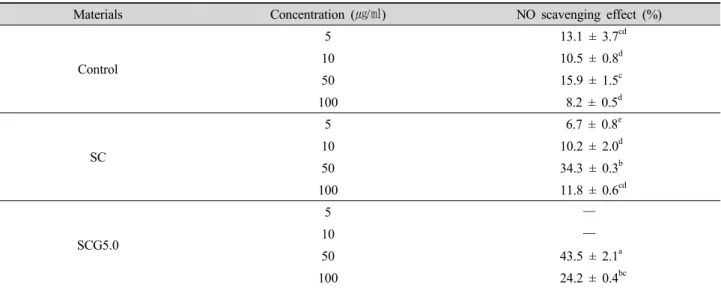
Table 3은 청국장 MeOH 추출물의 NO 소거효과를 나타 낸 결과이다. 일반대두청국장은 50 ㎍/㎖에서 15.9%, 100
㎍/㎖에서 8.2%의 낮은 NO 소거능을 나타냈다. 서리태 청 국장은 50 ㎍/㎖에서 34.3%, 100 ㎍/㎖에서 11.8%를 나타 내어 일반청국장보다는 다소 높은 소거능을 나타내었다.
또한 녹차를 5% 첨가한 서리태 청국장은 50 ㎍/㎖에서 43.5%, 100 ㎍/㎖에서 24.2%의 NO 소거능을 나타내어 녹 차 첨가 서리태 청국장이 일반대두청국장과 서리태청국장 보다 NO 소거효과가 높았다. 또한, 청국장의 in vitro 에서 의 O
2-소거효과를 검토한 결과(Table 4), 일반 청국장과 서리태 청국장의 O
2-소거효과는 거의 관찰되지 않았다. 반 면 SCG5.0에서만 소거효과를 나타내었는데 100 ㎍/㎖과 500 ㎍/㎖의 처리농도에서 각각 20.1%와 33.9%의 O
2-소
거능을 보였다. 또한 이전의 연구에서 녹차 5% 첨가 서리태
청국장이 관능검사결과에서 향, 맛 및 종합적 기호도가 일
Table 3. NO scavenging activity of Chungkukjang.
Materials Concentration (㎍/㎖) NO scavenging effect (%)
Control
5 13.1 ± 3.7
cd10 10.5 ± 0.8
d50 15.9 ± 1.5
c100 8.2 ± 0.5
dSC
5 6.7 ± 0.8
e10 10.2 ± 2.0
d50 34.3 ± 0.3
b100 11.8 ± 0.6
cdSCG5.0
5 ―
10 ―
50 43.5 ± 2.1
a100 24.2 ± 0.4
bcValues are mean ± SD.
a~e
Means with the different letters are significantly different (p<0.05) by Duncan’s multiple range test.
Control: Soybean Chungkukjang, SC: Seolitae Chungkukjang, SCG5.0: SC added with green tea 5.0%
Table 4. Superoxide anion scavenging activity of Chungkukjang.
Material Concentration (㎍/㎖) O
2-scavenging effect (%)
SCG5.0
100 20.1 ± 1.4
b250 20.6 ± 0.9
b500 33.9 ± 1.3
aValues are mean ± SD.
a~b
Means with the different letters are significantly different (p<0.05) by Duncan’s multiple range test.
SCG5.0: SC added with green tea 5.0%
반청국장에 비해 우수한 것으로 나타났다(Park과 Cho, 2008). 따라서 녹차 5% 첨가 서리태 청국장이 관능적 특성 은 물론 항산화 활성을 증진시킬 것으로 사료된다.
IV. 결 론
본 연구에서는 청국장의 항산화 기능성증진과 관능적 품 질개선을 위해 서리태에 녹차를 첨가하여 청국장을 제조한 후 항산화능을 검토하였다. 먼저 항산화 기능성 증진을 위 해 사용할 부재료인 녹차는 NO와 O
2-에 대한 소거능이 우 수하여 활성산소의 연쇄반응을 blocking할 수 있는 활성산 소 소거제로써의 뛰어난 기능을 확인하였으며 이러한 결과 를 바탕으로 녹차를 첨가하여 서리태청국장을 제조한 후 항산화활성을 검토한 결과, 녹차 5% 첨가한 서리태청국장 이 in vitro 상에서 NO와 O
2-소거능이 우수함을 확인하였 다. 따라서, 녹차 첨가 서리태 청국장은 NO와 O
2-에 의해
유발된 산화적 스트레스를 개선함으로써 이로 인한 질병을 예방하는 항산화제로서 역할을 할 것으로 사료된다.
참 고 문 헌