약학회지 제43권 제 2 호 263~273{1999) Yakhak Hoeji Vol. 43, No. 2
흰쥐의 척수에서 Glutamate가 매개하는 Nociceptive Response에
있어서 Protein kinase C의 관련성
김 성 정• 박 전 희■이 영 욱• 양 성 준• 이 종 은• 이 병 천•손 외 동• 허인회*
중앙대학교 약학대학 약러학교설 (Received March 16, 1999)
The Involvement of Protein kinase C in Glutamate-Mediated Nociceptive Response at the Spinal Cord of Rats
Sung Jeong Kim, Cheon Hee Park, Young Wook Lee, Seong Ju n Yang, Jong Un Lee, Byung Cheon Yi, Uy Dong Sohn and In Hoi Huh짧 Department o f Pharmacology, College o f Pharmacy, Chung Ang University, Seoul 156-756, Korea
Abstract— When glutamate was injected intrathecally. the result is similar to those produced by TPA in jected. The involvement of protein kinase C (PKC) in the nociceptive responses in rat dorsal hom neu
rons of lum bar spinal cord was studied. In test with formalin, a PKC inhibitor (chelerythrine) inhibited dose-dependently the formalin-induced behavior response. Neomycin also inhibited it significantly.
But. a PKC activator (12-Otetradecanoylphorbol-13-ester. TPA) showed reverse effect. W hen gluata- mate was injected intrathecally, we observed the result is smilar to those produced by TPA injection.
On the other hand, intrathecal injection of glutamate induced thermal and mechanical hyperalgesia.
In Tail-flick test, we examined the involvement of PKC on the glutamate-indeced thermal hyperalgesia.
Chelerythrine showed an inhibitory effect and TPA enhanced thermal response. Glutamate decreased the mechanical threshold significantly. A pretreatment of chelerythrine and neomycin inhibited glu
tamate-induced mechanical hyperalgesia, but the effect of neomycin was not significant. TPA had little effect on the mechanical nociceptive response. These results suggest that the PKC activation through metabotropic receptor at postsynaptic region of spinal cord dorsal hom neurons m ay influence on the persistent nociception produced by chemical stim ulation with formalin, thermal and m echanical hy
peralgesia induced by glutamate.
Keywordsn PKC, 12-0-tetradecanoylphorbol-13-ester (TPA), nociceptive responses, glutamate, hy
peralgesia.
G lutam ate는 m am m alian CN S에서 작용하는 주 요한 excitatory am ino acid(EAA) 신경전달물질로 long-term potentiation과 neurotoxicity등과 같은 여러 가지 neuronal response에 관여하는 것으로 알 려져 있다.느인 CNS에서외 excitatory synaptic tran- smission은 3가지 type외 glutamate receptor 즉, ionotropic NMDA(N-methyl-D-aspartate) recep- tor외* amino-3-hydroxy-5-methyl-4-isoxazole pro
* 본 논문에 관한 문의는 이 저자에게로 (전화) 02-820-5597 ( 팩스) 02-826-8752
pionic acid(AMPA)/kainate receptor, 그러고 meta- botropic receptor^닉 1 외해 매개된다.^'^^ 특허 감각신경 으로 이루어져 있는 척수의 dorsal hom cell들은 EAAs인 glutamate, aspartate등에 의해 대부분 흥분 되는데. 이러한 말초 자극에 외해 일어나는 척수내에서 외 NM DA receptor 활성은 말초부위의 신경손상이나 염증반응에 따른 hyperalgesia(통각과민현상: 유해자 국에 대해 민감하게 반응을 보이는 상태)를 일으키는 것 으로 알려져 있다.^
Fig. 1에 나타나 있는 바와 같어, NM DA receptor 는 ligand-gated channel로서 Ca고수유입을 촉진하고
264 김 성 정 • 박 전 희 • 이영욱• 양 성 준 • 이중은• 이 병 천 • 손 의 동 ■허인회
Glutamate
membrane alteration Fig 1 — A possible mechanism by which glutamate leads
to central sensitization of spinal cord dorsal horn neurons. A high level of neural acitivity induced by peripheral injury, such as formalin injury stimulates a release of glutamate from dorsal horn neurons. PK C: protein kinase C. NMD A : N-methyl-D-aspartate. AM PA; arnino-3-hydroxy- 5methyl-4-isoxazole propionic acid, PLC^ phos
pholipase C. PIP2스 phosphatidyl inositol bis phos
phate. NM DA; N-methyl-D-aspartate, DAG: di- acylglycerol :IP3;inositol-3--phosphate. Ca/CaM PK : calcium/calmodulin protein kinase.
AMPA/low-affmity kainate receptor는 N aV K "는 flux를 활성 화시 키 고, metabotropic receptor는 PLC 활성이라는 세포내 신호전달 경로와 coupling되 어 있어 PI 경로를 통해 세포내 저장소로부터 유 리시키고 DAG를 통해서는 PKC를 활성시킨다/^ 현재 AM PA에 의한 NM DA responses조절에 대해서는 보 고된 바가 많지만, NM DA receptor가 매개하는 반응 에 대한 metabotropic receptor의 역 할에 대해서는 최 근에 연구되기 시작했다.^^^^ R at의 sciatic nerve를 결 찰하여 유도한 chronic constriction injury(CCI) 병 태 model에서 나타나는 therm al hyperalgesia와 spontaneous pain behaviors를 PKC transloca
tion/activation inhibitor인 G M l ganglioside가 억 제하였고^^^ 이들의 lum bar 척수를 autoradiograp- hic assay하여 본 결과 dorsal horn lam inae FVT에 서 membrane-bound PKC가 증가된 것을 볼 수 있었 다 m 4) 또한 NMDA를 직접 척수강 내로 주입하여 유 발된 therm al hyperalgesia현상이 PKC억제에 의해 억제되었다는 보고도 있다."®^ Worley와 W illis등은 척 수에 있는 substantia gelatinosa에 PKC가 고농도로 존재한다베는 사실과 phorbol ester(PMA)에 외한
PKC 활성이 mechanical, therm al stim uli에 대한 primate spinothalamic neurons외 반응을 중강시켰 다는 사실을 발견하였는데 , 이로써 dorsal hom neu- rons외 sensitization process에서외 PKC의 역할이 확인되었다/"^ 한편, form alin에 의한 조직손상 후 나 타나는 persistent nociceptive responses가 spinal cord dorsal horn neuron-^ sensitization^l 외존한 다는 사설이 밝혀지면서 이들에 대한 여러 가지 in- tracellular messengers에 대한 연구가 진행되고 있는 데, 최근 이러한 formalin에 의한 반응이 EAAs에 외 해 메개된다는 것이 중명되었다."®^ form alin이나 EAAs가 짧은 시간 동안에 일으키는 dorsal hom neurons의 depolarization이 나 Wind-up (activity- dependent hyperexcitability) 현상은 NM DA re- ceptor가 주로 매개하는 것으로 알려졌고. Ap-와 C- fiber에 의한 반응과 반복적인 C-fiber stim ulation후 일어나는 discharge는 non-selective EAA agonist 가 매개. 지속적인 discharge는 NMDA가 메개하는 것 으로 보여진다.^^^ Torence 등은 이러한 formalin과 같 은 말초자국에 의해 primary afferent fiber에서 EAAs와 substance P가 동시에 유리되어 glutama- te가 일으키는 neuronal activity틀 증강시킨다는 것 을 입중하였는데.오이는 substance P와 glutamate 모두가 IP3system과 voltage-gated Ca모우channel을 통한 influx틀 자극함으로써 일어나는 세포내
농도 상승과 PKC 활성에 주로 외존하는 것으로 알려졌다.""^ 이러한 주장들은 PLC 억제제들와 PKC 억제제들 처리 후 관찰한 formalin test에서 그 no- ciceptive behaviour response가 억제되고, phorbol ester에 의한 PKC 활성에 의해 증강되었다는 연구결 과로 확인되었다.^^
위의 보고들로 EAAs 의 작용으로 활성화된 PKC 가 이돌의 반응을 매개할 뿐 아니라. 그러한 반응들이 PKC에 외해서 조절될 수 었옴을 알 수 있다."^^ 그러나.
이에 대한 자세한 mechanism은 아직 밝혀지지 않은 상 태이다. 단지 PKC activation이 neurotransmission에 영향을 즐 수 있다는 몇 가지 가능한 가설돌이 제시되고 있다. PKC에 의한 receptor protein의 phospho- rylation은 receptor subunits 외 assembly뿐 아니라 receptors의 desensitization, open-channel prob
ability, 그리고 aggregation 등을 조절하는 것■으■로 보 고 있는데 이 에 의 한 ligand-gated ion channel 조절로
J. Pharm. Soc. Korea
Nociceptive Response와 Protein kinase C.
neuronal plasticity가 일어나는 것으로 본다.^
최근 연구에서 삼차 신경핵에서 분리한 neurons외 NMDA에 대한 반응이 PKC활성에 의해 강화됨 이 보고 되었는데. 이는 PKC에 의한 단백 인산화에 외해 NM- DA channel opening외 확률이 높아졌고. NMDA re- ceptor-channel complex의 voltage-dependent Mg오'*^
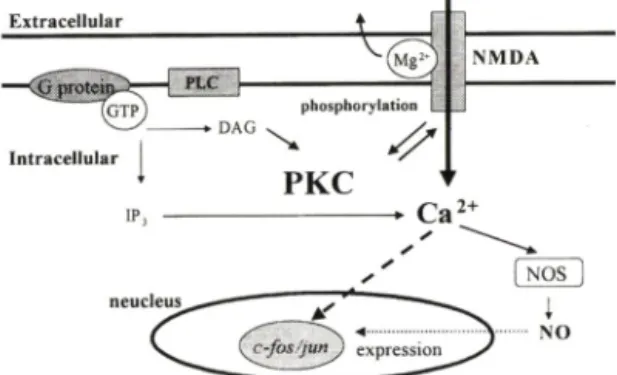
block이 감소되었다는 사실로 설명될 수 있다.*'® 따라 서 PKC activity는 NMDA가 일으키는 세포내 Ca오^중 가에 펄요하고 submaximal effect concentrations에 서의 NM DA외 반응을 강화시킨다고 할 수 있다. 또 하 나외 가설로는. nitric oxide synthase(NOS)를 활성화 시켜 그 결과로 유리된 NO가 post-와 presynaptic process 모두에 영향을 준다는 것이다.® 여기서 NM- DA는 PKC에 의존적으로 NOS를 선택적으로 자극한다 는 시•실이 알 려 졌 다 또 한 , 유리된 NO와 활성화된 PKC에 의해 핵내에서 유전자들의 발현이 중가된다는 주장도 있다(Fig. 2). PKC activation이 GABA수용체 를 억제하는 기전** 또한 말초자국에 외한 dorsal hom neurons의 반웅성 중가를 설명헤 즐 수 있다. 또한 PKC 활성 자체가 sensory neuron외 presynaptic terminals에서부터의 신경전달물질외 유리를 중가시켜 neuronal sensitization (hyperalgesia)# 일으킨다는 보고™도 있으나, PKC에 의한 EAAs 유리 중가는 일시 적인 것으로 밝혀졌다.
이에 본 연구는 앞에서외 여러 가지 연구보고들로 미 루어 보아 PKC 가 척수에서외 nociceptive signal
Extracellular
Fig 2 — Model of various described alternatives in
volved in the neuronal plasticity regulated by PKC activation. PK C: protein kinase C. N O S;
nitric oxide synthase, N M D A : N-methyl-D-as- partate, PLC; phospholipase C. NMDA: DAG:
diacylglycerol; IP3; inositol-3-phosphate. GTP:
guanine triphosphate.
transduction에 관여하고 있옴을 확인하고 실험에 임하 였다. R at의 척수에서외 EAA, 톡히 glutam ate에 초점 을 맞추어 이외 중가로 일어나는 persistent nocicep
tive behaviours (formalin test) 와 hyperalgesia틀 mechanical, thermal stim uli에 대한 반웅성 번화로 확인하고 이에 있어서외 PKC외 관련성을 알아보고자 하였다. 또한 이둘외 반응이 metabotropic glutam ate receptor! : 통한 PLC 경로를 통해서 일어나는지도 검 토하였다.
실험방법
시약 및 기기 - LrGlutamic acid는 Gibco에서, chelerythrine는 Calbiodiem에서, Neomycin sul
fate , 12-O-Tetradecanoylphorbol-l 3-acetate (TPA) 는 Sigma에서 구입하였고, pentobarbital sodium, a- tropine sulfate은 Merck에서 구입하여 사용하였다. 기 타 시 약은 1급 시약을 사용하였다.
실험동몰 - Sprague-Dawley계 수컷 흰쥐를 삼육 동물(Korea)에서 구입하여 항온 • 항습(21±2°C. 50±
2%) 조건하에서 인공으로 12시간 명암주기(0 9 : 00-^
21 : 00)를 만돌어 주어 사료와 식수는 자유롭게 섭취시 키면서 3일이상 순화기간을 거친 후 , 체중 200-250 g 되는 동물을 실험 전에 12시간 절식시켜 용하였다.
약물 투여 방법 (Intrathecal injection method) - 척 수강 속으로 약물을 주입하는 방법으로 form alin test 를 위해서는 단시간에 수술이 가능하고 정확한 약물주 입 이 7}■능한 direct transcutaneous intrathecal in jection Method크안를 이용하였고. tail-flick과 paw
pressure test를 하기 위해서는 장기간 catheter를 꽂 아두고 약물을 반복적으로 안전하게 투여하는 방법으로 써 Y aksh와 Rudy, 그러고 LoPachin가 함께 개발. 개 선한 chronic catheterization method^ ■씨를 참고하 여 이를 변형하여 사용하였다.
직접 척추 간국내 바늘 삼업 (Direct transcutaneous injection)
흰쥐를 던저 20분 전에 atropined mg/kg, i.p .)으 로 전마취한 후 pentobarbital sod.(40 mg/kg, i.p.) 으로 마취한다. 마취된 쥐를 수술대 위에 고정시키고 등 쪽 하단부의 털을 깎아낸 다옴. bethadine용액으로 감 염을 예방한다. 제 1척추에서부터 손으로 만져 요추부
김 성 정 • 박 전 희 ■이영욱• 양 성 준 • 이종은■이 병 천 • 손 의 동 ■허인회
위외 위치를 찾아 그 위 피부를 1.5 cm정도 절개하여 좌우로 젖힌 뒤 머리 제작해 놓은 26i/2-G needle에 polyethylene tube(PE-50)를 연결한 것을 Ls와 Lg사 이에 삽입한다. PE tube내부는 0.9% 생리식염수로 층 전한다(내부용적 6 H/). 삼업시 관내에 충만시킨 생리 식염수가 척수강내로 빨려 둘어가는 모세관 현상과 외 부 이물질외 유입을 막기 위하여 tube 바깥 끝을 가열
• 밀봉하고 혈액응고로 인한 needle 폐쇄를 피하기 위 해 heparinWOO un it/m /)를 needle 끝에 묻혀서 삼입 한다. 삼입 성공여부는 쥐의 꼬리가 측면으로 움직이는 것으로 확인하고, needle이 움직이거나 빠지지 않도록 plastic tube(길이 1 c m ,내경 0.7 cm)를 취하여 한쪽 끝을 잘라 바깥쪽으로 펼친 뒤 절개부위 양쪽사이에 넣 어 needle을 감싸고 그 주위와 그 사이 공간에 머리 준 버한 cranioplast cement를 부어 고정시킨다. 이윽고, 혀를 빼내어 기도를 확보하고 heating pad를 사용, 39°C내외의 온도조건 하에서 2시간 방치하고 마취에서 희복이 되면 cage당 한 마리씩 넣어 항온 ■ 항습 사육기 (Environm ental control set) 안에서 48시간 방치 , 수 술 후유중 (large central dorsal vessel hemorrage, motor problem)여부 및 사료와 식수를 제대로 섬취하 는지 면밀히 관찰한다.
척수 지주막하강내 샵관(Chronic catheterization into subarachnoid space; i.t. cannulation)
앞에서와 동일하게 마취한 쥐를 stereotaxic appa
ratus 위에 올려놓고 ear bar를 흰쥐의 양쪽 고막 앞부 분에 있는 acoustic meati에 끼운 뒤 위턱외 절치를 holder에 걸어서 조인다. 후두부의 털을 깎아내고 소득 액으로 소득한다. 후두골과 제 1번 경추 연접부(atlantcr occipital portion)을 절개하여 근육 층을 좌우로 젖힌 뒤 , atlanto-occipital membrane (dura) 이 나타나면 가볍게 절개하여 PE tube(PE-10, 7 cm와 PE-50, 5 cm를 연결하여 그 내부는 생리식염수로 층전한다. 내부 용적 12 띠)로 제작한 cannula를 subarachnoid spa- ce로 밀어 넣어 제 1-5번 요추부분 흑은 요추팽대부 (lumbar enlargement) 에 이르도록 한다. 삽관이 성공 하면, 관이 움직이지 않도록 앞에서와 같이 고정시키고, 마취에서 회복되기를 기다렸다가 한 마리씩 cage안에 넣어 사료와 식수를 제공하여 72시간 동안 방치한다. 실 험 전에 운동이상을 보이거나 상태가 좋지 않은 쥐둘은 실험에서 제외하였다. 실험이 끝나면 tube안으로1%
methylene blue 10 띠를 주입하고 ether 과량으로 처 사시킨 후 해부하여 염색부위를 육안으로 확인하고, 삽 관이 잘못된 것은 걸과분석에서 제외하였다.
약물투여
수술 후 정상적으로 회복된 쥐를 움직이지 않도록 고 정시킨 후 약물은 1회 주입량이 2 [117}되도록 조제해 서 microsyringe를 사용하여 tube를 통해 20~ 30초 동안 서서히 주입함으로써 급격한 뇌압상승을 피했다.
이어 tube에 잔류하고 있는 약물이 모두 척수강내로 둘 어가도록 tube의 내부용적만큼 생리식염수를 추가로 주입하였다.
Formalin test - 말초로 주입한 formalin은 두 감각신 경섬유 A-fiber, C-fiber가 각각 시간차이를 두고 반응하 는 독특한 2상의 반응을 유도한다. 특히 2상 (formalin투 여 20분 후) 에서 나타나는 persistent nociceptive re- sponse(chronic pain)는 척수내에서 홍분성 아미노산외 유리에 의해 매개되는 것으로 알려져 있다.® 본 실험에 서는 척수강내로 투여한 약물이 이에 미치는 영향을 알 아보고자 실험하였다.
먼저 투명한 cage( 10x 20 cm plexiglas box) 에 관찰 이 용이하도록 반사거울을 한쪽면에 설치하고, 사육한 흰쥐를 cage안에 10분간 방치하여 환경에 적응시킨다.
시험약물을 2 씩 척수강 내로 주입하고 30분 후(glu- tamate 투여 10분 후)에 2.5% formalin용액 50 |4를 발바닥에 주사한 뒤 나타나는 행동반응을 50분동안 관 찰한다. 이때 nociceptive score은 50분동안 5분간격으 로 관찰되는 행동반응에 다옴 4개외 behavioural ca- tegories에 속히는 score를 결정하고, 그 각각에 소요되 는 시간(sec)을 곱하여 합산하여 계산한다.®
0 ; 주사한 발에 변화없옴
1 ; 주사한 발을 약간 바닥에서 든 상태 2 ; 주사한 발을 올려 들고 있옴 3; 주사한 발을 할거나 물어뜯거나 흔듬
Tail-flick test - 척수강내로 투여한 약물의 ther- m al stim uli에 대한 효과를 검정하는데 사용하였다.
R adiant heat를 꼬리의 하단 1/3되는 부위에 가하여 tail flick esponse를 보이는 시간(TF latency; sec)를 측정하였다. 모든 약물의 투여 전에는 Tail-flick U nit 외 voltage를 조절해서 회피반응이 4~6초(CRT:
control reaction time, baseline tail flick latency)
}. Pharm. Soc. Korea
-0-SAL
■들- CHE 10-^M -*-CHE 10-"^M
-^NEO
5 1 0 1 5 2 0 2 5 3 0 3 5 4 0 4 5 5 0
Time (min)
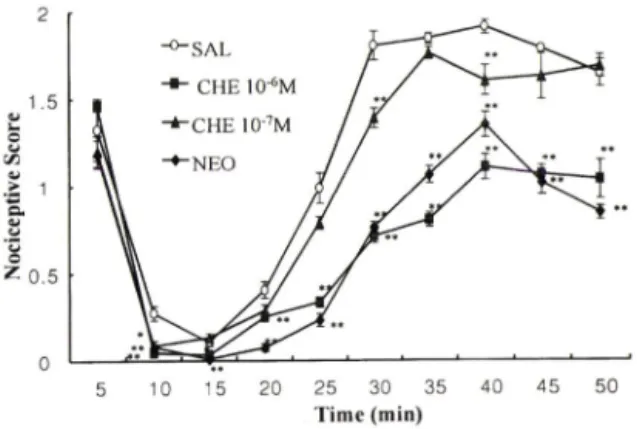
Fig 3 — Nociceptive responses induced by 2.5% formalin injection in rats preteated with i.t. saline, che- lerythrine (10~®. 10~^ M ). neomycin (20 mg). n = 6 for each group. Significant differences from saline group (*p<0.05. **p<0.01). SAL: saline. C H E : chelerythrine, N E O ; neomycin.
PLC inhibitor를 사용하여 동일한 실험을 하였다.
PKC 활성화가 formalin 투여에 의한 nociceptive re- sponse에 머처는 영향
PKC inhibitor와 PLC inhibitor 전처러의 효과 - 수 슬에서 회복된 흰쥐외 lumbar cord내로 saline(SAL)과 potent, selective한 PKC inhibitor인 chelerythrine (CHE). 그리고 PLC inhibitor인 neomycin(NEO)을 직접 주입하고. 30분 후에 한쪽 발바닥에 2.5 % for
m alin 50 [il 주입한 다옴 50분 동안 5분 간격으로 no
ciceptive score를 결정하여 이를 Fig. 3에 나타내었다.
척수강내로 주입한 chelerythrine은 form alin이 일 으키는 nociceptive response중 glutam ate가 메 개하 는 것으로 알려진 2상의 반응을 농도외존적으로 억제하 였다. 또한 PLC inhibition에 의해서도 이 반응이 유 의성있게 억제되는 것으로 보아 form alin의 2상반응이 metabotropic glutam ate receptor를 통한 PKC ac- tivation에 의해 매개되고 있음을 알 수 있다. 이러한 걸과는 Torence 등이 form alin과 같은 말초자국에 의 해 prim ary afferent fiber에서 EAAs와 substance P가 동시에 유리되어 glutam ate가 일으키는 neuro- nal activity를 중강시킨다는 것을 입증한 결과®와 일 치한다. 이는 substance P와 glutam ate 모두가 IP 3 system과 voltage-gated Ca오우channel을 통한 Ca고'"
influx를 자국함으로써 일어나는 세포내 Ca^■"농도 상 승과 PKC activation에 주로 의존하는 보고와""^
안에 일어나도록 빛의 강도를 조정하였다. 조직상헤를 막기 위 하여 설정하는 cut off time 은 12초로 하고 처 옴 5분간격으로 측정한 값 3개의 산술평균값을 base- line latency로 정한다. 괴검약물은 glutam ate투여 30분 전에 투여하고 glutam ate처리 후 0, 5. 10, 15분 간격으로 TF latency를 측정하여 이 중 가장 작은 값 을 취하여 아래의 식으로부터 TF latency effect(%)를 계산하여 약물외 효과를 비교하였다.
TF latency effect(%) =
(maximal decrease in tail flick latency after drug baseline latency Vbaseline latency x 100
Paw pressure test(Randall-selitto method) - 척수 강 내로 glutam ate를 투여하고 투여 직후. 5. 10. 30분 간격으로 통중외 역치를 측정하여 최대로 동통이 유발 된 때를 관찰한다. 이 때로부터 30분 전에 피검약물을 투여하고 glutam ate로 인한 통각의 역처감소에 미치 는 이들외 영 향을 관찰하였다.
측정방범은 Analgesy-meter로 흰쥐 발등에 일정 (66g/sec) 한 압력을 가할 때 흰쥐가 소리를 지르거나.
발을 빼내려는 순간외 추이동거러에 추 무게를 곱한 값 을 통각외 역치로 정하였다. 역처값은 15초 간격으로 세 번 반복 측정하여 산술평균값을 취하였다.
Nociceptive threshold changes(%) = (postdrug threshold-predrug threshold)/
predrug threshold x 100
통계처리 - 모든 실험결과는 평균치와 표준오차룰 계산하였고, 각 군간의 차이는 Student ^te st를 사용 하여 P값이 0.05미만일 때 통계적으로 유의성이 있다 고 관정하였다.
실험결과 및 고찰
R at외 척수에서외 EAA. 톡히 glutamate에 초점을 맞추어 이의 중가로 일어나는 persistent nociceptive behaviours (formalin test) 와 hyperalgesia를 me
chanical. thermal stim uli에 대한 반응성 번화로 확인 하고 이에 있어서의 PKC외 관련성을 알아보고자 PKC 활성화제와 PKC inh ib itor* 사용하였으며 그리 고 이들의 반응이 metabotropic glutamate receptor를 통한 PLC 경로를 통해서 일어나는지를 알아보기 위해
Nociceptive Response와 Protein kinase C. 267
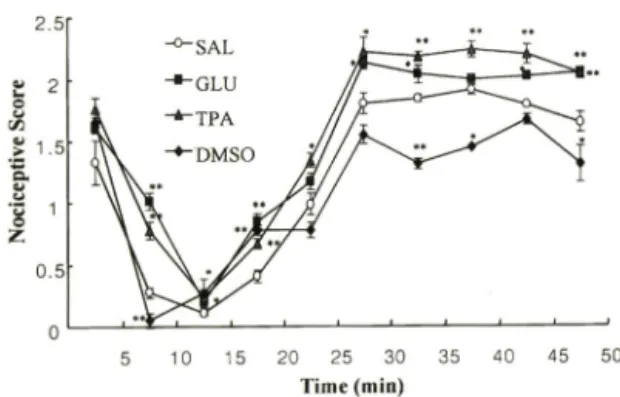
Fig 4 — Nociceptive responses induced by 2.5% formalin injection in rats preteated with i.t. saline, 1%
DMSO, 12-CHetradecanoylphorbol-13-ester (100 ng). glutamate (40 mg). n=6 for each group. Sig
nificant differences from saline group (*p<0.05, **
p<0.01). DMSO: dimethylsufoxide. TPA: 12-Ote- tradecanoylphorbol-13-esteri GLU: glutamate.
PLC 억제제들과 PKC 억제제둘 처리 후 관찰한 for- m alin test에서 nociceptive behaviour response가 억제되고, phorbol ester에 의한 PKC activation에 의해 중강되었다는 연구결과를 미루어보아^ > 위가설을 더욱 뒷받침해주고 있다.
TPA와 외인성 glutamate가 formalin 반응에 미치는 영향 버교 - Agonist로 작용하는 glutamate(GLU)틀 주업한 후 10분 뒤와 PKC 활성화제 인 12-Otetrade- canoylphorbol-13-acetate(TPA)률 30분 전처러한 후 주입 한 formalin에 대한 반응을 saline처리군과 함께 나 타내어 그 작용을 비교하였다(Fig. 4). Glutamate는 saline처리군의 반응을 2상에서 유의성있게 증강시켰 고, TPA 역시 glutamate와 유사한 효과를 나타내었다.
외부에서 주입한 glutamate의 반응과 TPA의 반응이 유사한 것으로 보아 척수내로 유리된 glutamate가
PKC를 활성화시켜 작용을 나타낸다는 사실, 즉 NM- DA receptor외 반응이 PKC활성화에 외해 중강된다는 것이 간접적으로 증명되었다. 또한, 이둘이 formalin외 2상 반응만을 선택적으로 증강시킨 것으로 미루어 보아 glutamate가 메개하는 persistent nociception 에 PKC가 관여함을 재확인할 수 있었다. 한편, 여기서 vehicle로 사용한 1% DMSO는 2상의 후반부의 반응을 약간 감소시키는 것으로 나타났으나, 이를 vehicle로 사 용한 TPA는 DMSO의 영향을 배제한다면 위외 for
m alin 이 유도하는 반응을 더욱 증강시킬 것으로 생각된 다. 이는 glutamate등 PKC 활성화제로 작용하는 것들 이 IPs system과 voltage정ated Ca요'*' channel을 통한 influx룰 자극함으로써 일어 나는 세포내 Ca^우농도 상승과 PKC 활성화에 주로 의존하는 것으로 알려져 있 다는 보고^"*와 비숫함을 함을 알수 있었다.
척수의 Subarachnoid space내로 투여한 glutamate 가 일으키는 hyperalgesia에 있어서의 PKC역할
척수강내로 투여된 오I인성 glutamate의 hyperal- gesic effects - 척수강으로 glutamate (40 나g) 를 투여 하면. 투여 직후 짧은 시간동안 hyperalgesia가 일어나 는데 이는 척수의 dorsal hom 에 감각전도로가 존재하 며 또 여기에 glutam ate receptor가 분포되어 있기 때 문이다 3^ Glutam ate외 효과는 Tail-flick test에서 는 투여 전. 0. 5, 10. 15. 30분에 , Paw pressure test 는 투여전. 5. 10, 30분 후에 각각 실험을 실행하여 그 경시적인 % M PE값외 변화를 Table I에 나타내었다.
Tail-flick test를 통한 therm al nociceptive test에서 는 투여후 약 15분 후에 최대 반응을 나타내었고. me
chanical nociceptive threshold는 30분 후에 최대로
0 .00 0 .00 0.0 0 0 .00
-5.95+0.32 -6.57i0.51 0.32+0.05 -14.94±0.62 -11.95±0.91 -22.09±1.52 0.32±0.05 -14.94+0.62
-2.88±0.14 -37.36±1.77"*
2.29±0.11 - 8.16±0.37 0.46+0.02 - 25.98± 1.20"' Table I — Hyperalgesic effect of intrathecally administered glutamate (40 mg) in Tail-flick (TF) test and Paw pres-
% MPE
Saline Glutamate Saline Glutamate
( S ---H ^ 논_________ 대나빠표으"
Minus values are expression of recessed antinociceptive effect from i.t. administration. %MPE : Percent max
imal possible effect, which can not show analgesic rate but effect of substances to tested group. %MPE = (test la- tency-control latency)/(cut off time latency-control latency) x 100. a : Indication of maximally induced no
ciception time after glutamate (40 mg) injection.
}. Pharm. Soc. Korea 김 성 정 • 박 전 희 • 이영욱• 양 성 준 • 이중은• 이병천• 손 외 동 • 허인희
10 15 30
감소하는 것을 볼 수 있었다. 아래 Table I에 나타나 있 는 바와 같이 척수강내로 주입된 glutam ate는 ther
m al stim uli와 mechanical stim uli에 대한 정상쥐의 nociceptive threshold를 둘 다 감소시켰지만 me
chanical nociceptive response 보다는 thermal response에 더 큰 영향을 주는 것으로 나타났다. Glu- tam ate가 mechanical nociceptive response보다는 therm al response에 더 많은 영향을 주는 것은 각각 그 자극을 전달하는 primary afferent fiber가 다르다 는 차이도 있겠지만, 척수 감각신경로에 분포하고 있어 이를 메개하는 glutam ate receptor외 selectivity와 activity외 차이 즉 주로 작용하는 NM DA receptor가 thermal hyperalgesia률 메개 하는 한편, mechan
ical hyperalgesia는 non-N M D A ^ metabotropic receptor에 의해 일어나는 것이라는 최근의 주장^®
과 어느 정도 일치하는 것이라고도 볼 수 있으나, 이에
Fig 5 — Dose-dependent effect of chelerythrine (10~든. 10~^
M) on thermal Tail flick latencies induced by glu
tamate (40 mg). n = 6 for each group. Significan
tly different from saline (p<0.01). **Significantly dif
ferent from glutamate alone (p<0.01).
CH E : dieleiythiine, GLU: glutamat.
SAL: saline.
-5
0 SAL GLU+SAL GLU+NEO NEO
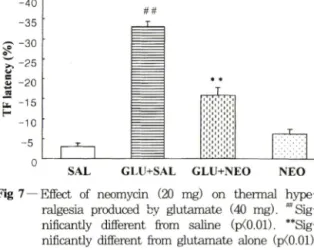
Fig 7 — Effect of neomycin (20 mg) on thermal hype
ralgesia produced by glutamate (40 mg). **Sig
nificantly different from saline (p<0.01). **Sig- nificantly different from glutamate alone (p<0.01).
n = 6 for each group. SALi saline. G L U ; gluta- mate. N E O : neomycin.
Fig 6
SAL TPA D M S O GLU+SAL GLU+TPA Effect of 12-0-tetradecanoylphorbol-13-ester (100 ng) on the thermal hyperalgesia produced by glu
tamate (40 mg). n = 6 for each group. * Significan
tly different from saline (p<0.01). ** Significantly different from glutamate alone (p<0.01). SAL: sa
line, TPA: 12-0-tetradecanoylphorbol-13-ester, GLU : glutamate, DMSO; dimethylsufoxide.
관하여는 더 깊은 연구가 필요하다고 사료된다.
Tail-flick test룹 통한 glutamate가 유발한 thermal hyperalgsia 반응 - Fig. 5과 6는 glutam ate 중가로 일 어나는 therm al hyperalgesia가 PKC activation에 의해 매개되는 것인지틀 알아보기 위해 PKC in h ib i
tor 인 chelerythrine과 PKC activatior인 TPA를 각 각 30분 전에 전처처 한 후에 glutam ate를 투여하여 유 발되는 Tail flick latency를 측정한 결과이다. 측정은 glutam ate 투여 직후 0. 10. 15분후에 측정하여 그 중 최대값을 비교하여 나타낸 것이다. 즉 . i.t.로 투여한 chelerythrine은 농도의존적으로 glutam ate의 반응 을 억제한 반면, TPA틀 전처처한 군에서는 Tail flick threshold가 glutam ate 단득 처리군에서 보다 더 감 소되었다. 이것은 수용체를 통해 전달된 신호가 세포내 에서 PKC를 활성화시켜 이를 통해 감각신경로의 과도 홍분이 일어난 것이라 볼 수 있다. 이는 기존의 보고®
와 일치하는 것으로 PKC활성화가 N M D A수용체를 인 산화시켜 NM DA receptor를 매개하여 나타나는 therm al hyperalgesia를 증강시켰다고 설명할 수 있 다. 한편. 척수내로 단득 투여된 약물 자체는 TF la tency 에 영향이 없는 것으로 나타났다.
한편 이러한 glutamate외 작용에 관여하는 PKC/}
PIP2 경로를 통한 metabotropic receptor에 의해 ac
tivation 되는 것인지를 살펴보기 위해 PLC inhibitor인 neomycin을 사용하여 실험하였다. Neomycin 20 |xg을 전처리 한 후 glutamate를 투여한 후 T aiH lick test를 실행하였다. 앞에서 한 formaline test에서의 결과와 유 사하게 neomycin이 glutamate외 Tail flick latency에 Nociceptive Response와 Protein kinase C.
J lf e L
-40 - 3 5
g , - 3 0
| ' - 2 5
2 -20 S-15 -10
-5
r
3221r0>/o> X351B
I il
I
- 5 0 - 4 5
? - 4 0 - 3 5 g - 3 0 S - 2 5
^ -20
- 1 5
-10
미처는 영향을 감소시켰다(Fig. 7). 이는 metabotro- pic receptor를 통한 intracellular messenger sys- tem에 의해 NMDA 수용체의 작용이 조절되고 있옴을 보여주는 것이다. 이는 metatropic receptor가 PLC를 거처는 세포내 신호전달 경로와 coupling 되어 있어 생 성된 IP3를 통해서 세포내 저장소로부터 Ca"■"을 유리시 키고 DAG를 통해서는 PKC를 활성화 시 킨다는 보고와 일치한다.^^ 또한. Neomycin 단득 처리는 이러한 ther
m al stim uli에 대한 반응에 그다지 뚜렷한 영향을 미처 지 못하는 것으로 보아. PLC 경로는 정상적인 상태에서 보다는 glutamate의 유러가 항진된 상태에서의 ther
m al nociception process에 더 크게 관여하고 있옴을 확인할 수 있었다.
PKC 관련억울들01 glutamate에 의해 감소된 말초 mechanical nociceptive threshold에 미치는 영향 - Fig. 8은 척수내로 직접 투여한 glutamate에 외혜 감소 된 mechanical nociceptive threshold를 chelerythri- ne. neomycin 그러고 TPA 모두 중가시켰음을 보여준 다. 특히 chelerythrine은 농도 10~^ M 에서 saline 투여 군외 threshold와 유사한 수준으로 이를 상승시켰으나, neomycin과 TPA의 작용은 유외성이 없는 것으로 나타 났다. 또한. 전처리한 TPA가 예상과는 달러 . glutama- te의 반응을 중강시키기는 커녕 오히려 억제시키는 결과 를 나타냈는데. 이러한 결과로 보아 PLC activation을 거쳐 일어나는 PKC activation과정이 mechanical nociception에는 그다지 영 향 미 처 지 않는다고 할 수 있다.
SAL GLU+SAL GLU+CHE GLU+NEO GLU+TPA
Fig 8 —Effect of saline, chelerythrine (10~® M). neomycin (20 mg), and TPA (100 ng) on mechanical thres
hold decrease induced by glutamate (40 mg). * Sig
nificantly different from saline (p<0.01). ** Sig
nificantly different from glutamate alone (p<0.01).
n = 6 for each group. SAL: saline. GLU: gluta
mate, CH E; chelerythrine, N E O: neomycin. TPA;
12-Otetradecanoylphorbol-13-ester.
본 실험에서는 척수내에서 유리된 EAA(glutamate 사용)가 일으키는 nociceptive response에 있어서 PKC activation이 미처는 영향에 대해 알아보았다. 이 는 PKC inhibitor로 사용한 chelerythrine이 forma
lin 으로 유발되는 persistent nociception response뿐 아니라 척수로 주입한 glutamate가 매개하는 hyperal- gesia를 용량 외존적으로 억제함으로써 중명되었다. 즉 PKC가 formalin 반응에서 C-fiber가 일으키는 2상 (EAA 유리에 의해 매개되는 반응)에 관여함을 확인하 였고, 또한 EAA receptor 직접 자국으로 나타나는 thermal ■ mechanical hyperalgesia에도 영향을 주는 것으로 보아. 이 때에 활성화되는 PKC가 spinal cord dorsal hom neurons내에서외 EAA가 관여하는 noci
ceptive process에서 intracellular messenger로서 작 용한다고 볼 수 있다.
현재까지 밝혀진 바로는 척수내에 유러된 EAA로 인 한 NM DA receptor 활성화로 thermal hyperal- gesia가 유발되고, mechanical hyperalgesia는 me- tabotrophic receptor를 통해 일어나는 것으로 알려져 있는데. 본 실험 결과. 비록 mechanical hyperal- gesia에 대한 관련성은 미 약하게 나타났지만. 이 돌 re
ceptors 의 작용 모두에 PKC가 관여하고 있옴이 보여 진다. 이는 유리된 glutam ate가 metabotropic re- ceptor를 자극. 이를 통하여 PKC가 membrane으로 translocation되고 membrane에 존재하는 여러 ion channel돌외 phosphorylation을 유도함으로써 이들 의 ion permeability를 조절. 결과적으로는 neu
ronal synaptic plasticity를 초래한다는 것을 뒷받침 한다. 한편. CNS에서의 PKC의 활성화는 이러한 EAA의 작용에 관여하는 것 이외에 serotonin에 의한 glycine외 작용항진과 같은 억제성 전달과정도 매개하 는 것으로 보여진다.^^ 이러한 nociceptive response 에 있어서의 PKC외 facilitatory(excitatory) effect는 presynatic site에서 활성화되어 neuropeptides의 유 리를 촉진시킨다는 사실들로 한층 더 중명될 수 있을 것 이다.
결 론
흰쥐의 척수에서외 통각전달에 있어서 excitatory amino acid인 glutamatG가 일으키는 persistent no- ciception과 hyperalgesia에 있어서의 protein k i
/. Pharm. Soc. Korea
270 김 성 정 • 박 전 희 • 이영욱• 양 성 준 • 이중은• 이 병 천 • 손 의 동 • 허인회
5 0 5 0 5 0 5 0 5
-
S93U8G
Nociceptive Response외■ Protein kinase C. 271
nase C (PKC) activation이 미처는 영향을 알아보기 위 한 실험으로부터 얻은 결론은 다옴과 같다.
척수강내로 투여한 PKC inhibitor chelerythrine 10~일과 10"구 M 은 formalin 에 대한 persistent no
ciception response를 용량 의존적으로 억제한 반면, PKC 활성화제 인 12-0-tetradecanoylphorbol-13- acetate(TPA) 100 ng는 외 인성 glutam ate와 유사하 게 form alin에 대한 반응을 증가시켰다. 또한 Glu- tam ate가 매개하는 therm al hyperalgesia에서 che
lerythrine 10~® M 은 이를 유의하게 억제하였고 TPA는 증강작용을 보였다.
Phospholipase C inhibitor인 neomycin 20 냐g은 formalin의 반응과 glutam ate에 의한 therm al no
ciceptive response룰 모두 억제하였는데 이로써.
metabotropic receptor틀 통한 PKC activation이 이 에 관련되어 있음을 알 수 있다.
한편, glutam ate에 의해 일어나는 mechanical no
ciceptive threshold 감소 현상 (mechanical hy
peralgesia) 에 있어서는 이돌의 반응이 chemicals와 therm al stim uli에 대한 반응과 비교해 볼때 그다지 유외성을 나타내지 못하였다.
이상과 같은 결과로 척수내에서의 흥분성 아미노산외 작용에 있어서 PKC의 관련성이 증명되었으나. 말초에 가하는 자국외 종류에 따라 차별적 인 반응이 나타나는 것을 볼 수 있었다. 이에 신경세포내에서외 signal transduction 경로에 있어서 다양한 PKC의 역할에 대해서는 더 많은 세부적인 연구가 필요하다고 본다.
문 헌
1) Collingridge, G. L. and Singer. W. : Excitatory amino acid receptors and synaptic plasticity.
Trends. Pharmacol. Sci.., 11, 290 (1990).
2) Zieglgansberger, W. and Toile, T. R. : The phar
macology of pain signalling. Curr. Opin. Neu- robiol, 3. 611 (1993).
3) Neugebauer, V., Lucke, T. and Schaible, H. G. : Requirement of metabotropic glutamate re
ceptors for the generation of inflammation-evok
ed hyperexcitability in rat spinal cord neurons.
Eur. J. Neurosci., 6, 1179, (1994).
4) Sroblewski, J. T. and Danysz, W. : Modulation of glutamate receptors : molecular mechanisms
and fuctional implications. Brain Res., 29, 441 (1989).
5) Collingride. G. L. and Lester, R. A. J. : Ex
citatory amino acid receptors in the vetebrate central nervous system. Pharmacol Rev., 40, 143 (1989).
6) Mao, J., Price D. D. and Mayer, D. J. : Mechan
isms of hyperalgesia and mophine tolerance : a current view of their possible interactions. P ain, 62, 259 (1995).
7) Berridge, M. J. : Inositol triphosphate and di- acylglycerol: Two interacting second m es
sengers. Annu. Rev. Biochem.. 56, 159 (1987).
8) Ceme, R. and Randic, M. : Modulation of AMPA and NMDA responses in rat spinal dorsal hom neurons by trans-l-aminocyclopentane-1,3-di- carboxylic acid. Neurosci. Lett., 144. 180 (1992).
9) Palecek, J., Paleckova, V.. Dougherty, P. M. and Willis, W. D. : The effect of t-ACPD, a meta
botropic excitatory amino acid receptor agonist, on the responses of primate spinothalamic tract neurons. Pain, 56, 261 (1994).
10) U golini, A.. Corsi, M. and Bordi, F. : Po
tentiation of NMDA and AMPA Responses by Group I mGlu R in spinal cord motoneurons.
Neuropharmacology, 36(8), 1047 (1997).
11) Mao, J., Price, D. D., Hayes, R. L., Lu, J. and Mayer. D. J. : Intrathecal G M l ganglioside and local nerve anesthesia reduce nociceptive beha
viors in rats w ith experim ental peripheral mononeuropathy. Brain. Res,, 584, 28 (1992).
12) Worley, P. F., Baraban, J. M. and Snyder, S.
H. : Heterogeneous localization of protein k i
nase C in rat brain ; autoradiograghic analysis of phorbol ester receptor binding, h Neurosci., 6.
199 (1986).
13) Mao, J., Price, D. D., Mayer, D. J. & Hayes, R.
L. • Pain-related increase in spinal cord mem
brane-bound Protein kinase C following peri
pheral nerve injury. Brain Res., 588, 144 (1992).
14) Mao, J., Price, D. D., Phillips, L. L., david, J. L.
and Mayer, J. : Increases in protein kinase C gamma immunoreactivity in the spinal cord dor
sal hom of rats with painful mononeuropathy.
Neurosci. Lett., 198. 75 (1995).
272 김 성 정 • 박 전 희 • 이영욱• 양성준• 이종은• 이 병 천 • 손 의 동 • 허인희
15) Meller, S. T., Dykstra, C. and Gebhart. C. F. ; Acute thermal hyperalgesia in the rat is pro
duced by activation of N-methyl-D-aspartate receptors and protein kinase C and production of nitric oxide. Neuroscience, 71(2), 327 (1996).
16) Saito, N., Kikkawa, U., Nishizuka. Y. & Tanaka.
C. H. : Distribution of protein kinase C-like im- munoreactive neurons in rat brain. J. Neurosci., 8, 369 (1988).
17) Palecek, J.. Paleckova. V., Dougherty. P. M.
and Willis, W. D. '■ The effect of phorbol esters on the responses of Primate spinothalamic neu
rons to mechanical and thermal stimuli. /. Neu- rophysiol., 71(2), 529 (1994).
18) Coderre, T. J. and Melzack, R. ; The con
tribution of excitatory amino acids to central sen
sitization and persistent nociception after for
malin-induced tissue injury. J. Neurosci., 12(9), 3665 (1992).
19) Coderre, T. J. and Yashpal, K. : Intracellular messengers contributing persistent nociception and hyperalgesia induced by L-glutamate and substance P in the rat formalin pain model Eur.
J. Neurosci., 6, 1328 (1994).
20) Coderre, T. J. : Contribution of protein kinase C to central sensitization and persistent pain following tissue injury. Neurosci. Lett,, 140. 181 (1992).
21) Urban. L., Thompson, S. W. N. and Dray, A. : Modulation of spinal excitability ; co-operation between neurokinin and excitatory amino acid neurotransmitters. Trends. Neurosci., 17(10). 432 (1994).
22) Mao. J.. Price, D. D. and Mayer. D. J. : Ther
mal hyperalgesia in association with the de
velopment of morphine tolerence in rats '• roles of excitatory amino acid receptors and protein kinas C. L Neurosci., 14(4), 2301 (1994).
23) Kelso, S. R., Nelson, T. E. and Leonard. J. P. ; Protein kinase C-mediated enhancement of NMDA currents by metabotropic glutamate re
ceptors in xenopus oocytes. /. Physiol., 449. 705 (1992).
24) Aanonsen, L. M.. Lei. S. and Wilcox, G. L. : Ex
citatory amino acid receptors and nociceptive
neurotransmission in rat spinal cord. P ain, 41, 309 (1990).
25) Swope, S. L., Moss, S. J., Blackstone, C. D.
and Huganir, R. L. : Phosphorylation of ligand- gated ion channels : a possible mode of synap
tic plasticity. FASEB. 6. 2514 (1992).
26) Chen, L. and Huang. L. Y. : Protein kinase C reduces Mg오'" block of NMDA-receptor chan
nels as a mechanism of modulation. Nature, 356, 521 (1992).
27) Murphy, N. P.. Cordier, J., Glowinski, J. and Premont, J. : Is protein kinase C activity re
quires for the N-methyl-D-aspartate-evoked rise in cytosolic Ca오"' in mouse striatal neurons?
Eur. J. Neurosci.. 6. 854. (1994).
28) Ben~Ari, Y.. Aniksztejn, L. and Bregestovski. P.
: Protein kinase C modulation of NMDA cur
rents - an important link for LTP induction.
Trends. Neurosci., 15. 333 (1992).
29) Bockaert. J. A. : Nitric-oxide synthase activity selectively stimulated by NMDA receptors de
pends on protein kinase C activation in mouse striatal neurons. Eur. J. Neurosci., 4, 425 (1992).
30) Leidenheimer, N. J., Mcquilkin, S. J.. Hahner, L. D.. whiting, P. and Harris, R. A. ■ Activation of protein kinase C selectively inhibits the gam- ma-aminobutyric acid receptor^role of desen
sitization. M o l Pharmacol., 41, 116 (1992).
31) Barber, L. A and Vasko M. R. : Activation of protein kinase C augments peptide release from rat sensory neurons. /. Neurochem., 67, 72 (1996).
32) Mestre. C.. Pelissier, T.. Fialip. J., Wilcox, G.
and Eschalier, A. : A method to perform direct transcutaneous intrathecal injection in rats. I Pharmacol Toxicol Methods., 32(4), 197 (1994).
33) Yaksh, T. L. and Rudy, T. A. : Chronic cathet
erization of the spinal subarachnoid space. Phy
siol Behav., 17, 1031 (1976).
34) LoPachin, R. M. and Rudy. T. A. : An improved method for chronic catheterization of the rat spi
nal subarachnoid space. Physiol Behav., 27, 559 (1981).
35) Yamamoto, T., Tony, M. D. and Yaksh, L. : Comparison of the antinociceptive effects of pre-
Pharm. Soc. Korea
Nociceptive Response와 Protein kinase C. 273
and posttreatment with intrathecal morphine and MK-801, an NMDA antagonist, on the for
malin test in the rat. Anesthesiology, 77, 757 (1992).
36) Coderre, T. J. and Empel, I. V. '■ The utility of ex
citatory amino acid (EAA) antagonists as anal
gesic agents. I. Comparison of the nociceptive ac
tivity of various classes of EAA antagonists in mechanical, thermal and chemical nociceptive teste. Pain, 59. 345 (1994).
37) Farooqui. A. A. and Horrocks, L. A. : Ex
citatory amino acid receptor, neural membrane
phospholipid metabolism and neurological di
sorders. Brain Res. Rev., 16, 171 (1991).
38) Mayer, M. L. and Westbrook, G. L. : The phy
siology of excitatory amino acid in vetebrate central nervous system. Prog. Neurobiol., 28. 197
(1987).
39) Tian-Le Xu. T. L.. Nabekura, J. and Akaike, N. ■ Protein kinase Omediated enhancement of gly
cine response in rat sacral dorsal commissural neurones by serotonin. /. Physiol., 496(2). 491
(1996).