Probiotic Potential of Indigenous Bacillus sp. BCNU 9028 Isolated from Meju
Hwa Jin Shin
1, Ji Hun Bang
1, Hye Jung Choi
2, Dong Wan Kim
3, Cheol Soo Ahn
4, Young-Kee Jeong
5and Woo Hong Joo
1,21
Department of Biology, Changwon National University, Changwon 641-773, Korea
2
Department of Biology and Interdisciplinary Program in Biotechnology, Changwon National University, Changwon 641-773, Korea
3
Department of Microbiology, Changwon National University, Changwon 641-773, Korea
4
Cho-A Pharm. Co, LTD., Haman-kun 637-810, Korea
5
Department of Biotechnology, Dong-A University, Busan 604-174, Korea
Received February 29, 2012 /Revised April 4, 2012 /Accepted May 17, 2012
Spore-forming bacteria are being used as probiotic supplements for human and animal use, due to their low pH stability and ability to survive the gastric barrier. In this study, the BCNU 9028 strain was screened from meju, a Korean fermented soybean food starter. Biochemical and physiological characteristics, as well as 16S rDNA sequence analyses, indicate that this strain belongs to the genus Bacillus. Bacillus sp. BCNU 9028 showed a 92% survivability at pH 2.5 and could also withstand 0.3%
ox bile. Furthermore, it was postulated that Bacillus sp. BCNU 9028 could prevent biofilm formation and adherence of food-borne pathogens such as Listeria monocytogenes, S. aureus and E. coli on the basis of its autoaggregation and coaggregation capacity with food-borne pathogens. It was shown that BCNU 9028 has good abilities to adhere to the intestinal tract from its hydrophobic character (63.3%).
The Bacillus sp. BCNU 9028 strain especially elicited antibacterial activity against both Gram-positive and -negative pathogens. These findings suggested that the Bacillus sp. BCNU 9028 strain could be used as a potential probiotic.
Key words : Antibacterial activity, Bacillus sp., coaggregation, Meju, probiotic
*Corresponding author
*Tel:+82-55-213-3453, Fax:+82-55-213-3459
*E-mail : [email protected]
서 론
인간의 위장관내에는 10
13~10
14의 미생물 세포들이 자연군 총을 이루며 존재한다. 이들은 병원체와 경쟁하며 장내의 상 피세포에 집락을 형성하는 것을 막아 감염을 예방한다[4]. 하 지만 영양의 결핍, 스트레스, 항생제 과용 등은 장내에 유익한 정상군총의 균형유지에 부정적인 영향을 준다[7]. 그 결과 장 내의 면역력이 저하됨으로써Staphylococcus aureus및 shigella sp. 등과 같은 병원성 세균이 이상 증식돼 이질과 같은 질병이 발생하게 된다[14,21].
한편, 오늘날 건강 증진을 위해 체내 자연군총을 새롭게 형 성하거나 변화시키기 위해 선택적으로 섭취하는 미생물인 프 로바이오틱스(probiotics: 그리스어로 pro는 ‘위한’, bios는 ‘생 명’ 이라는 뜻)는 인체 의약품인 정장제나 유산균 제제, 사료첨 가제로서의 생균제등으로 사용되고 있다. 일반적으로 프로바 이오틱스로 사용되는 미생물들은 위장의 위산, 담낭의 담즙 및 소장에서 분비되는 각종 소화효소와 같은 저해환경으로부 터 저항력을 가지며 대장과 직장에 도달해 증식하고 정착하는 능력을 구비해야 한다[11,16]. 또한 프로바이오틱스는 장내군 총의 정상화를 돕고, 유해세균의 정착을 억제함으로써 부패산
물의 생성을 감소와 질병예방[3], 항암작용, 면역의 활성화, 혈 중 콜레스테롤 저하 및 항산화 등의 효용성이 입증되었다 [17,19].
현재, 프로바이오틱스로는 Lactobacillus acidophilus, Lactobacillus sporogenes, Enterococuus faecium, Bacillus poly- fermenticus, Bacillus subtilis등이 주로 연구되었다. 그 중 Bacillus속은 산업적으로 중요한 종으로 오랜 세월 동안 식품, 의약품 및 각종 발효 산업에서 사용되어 안전성이 확립되어 있다[2,15]. 또한 중요한 효소인 protease, amylase, glucanase 및 cellulase를 생성하며[28], 폴리펩타이드형과 같은 항균 활 성물질을 생산해 식중독균 외에도 위암의 원인인 Helicobacter pylori에 대한 항균력을 가짐으로써 프로바이오틱스로 적합한 특성을 갖는다[24]. 이미 1958년 이탈리아에서 일반의약품으 로서 B. clausii를 성분으로 한Enterogermina의 상품화를 시작 으로 Bacillus 속 사용 프로바이오틱스는 최소 50년 이상 사용 되어 왔으며, 미국의 nature's first Food, 일본의 bispan 및 중국의 medilac-vita등 여러 나라에서 프로바이오틱 상품으로 시판되고 있다[6]. 최근 Bacillus속을 이용한 프로바이오틱스에 관한 산업적 관심이 증대되고 있으나 국내에서 개발되어 사용 된 Bacillus속 생균제는 없으며 연구 또한 미비한 실정이다.
따라서 본 연구팀은 한국인에게 맞는 새로운 생균제를 개발
하고자 한국의 재래식 식품인 메주에서 Bacillus 속을 탐색,
분리하여 BCNU 9028라 명명하였으며 내산성 및 인공 담즙산
에 대한 내성, 병원성 세균에 대한 길항능력, 세포표면의 소수 성 등 이용 가능성을 조사하여 보고하는 바이다.
재료 및 방법
분리 및 동정
수집한 일반 가정의 재래식 메주 1 g을 nutrient broth (NB) 에 첨가하여 37℃에서 48시간 배양하였다. 내열성 및 protease 활력이 높은 균주를 분리하기 위해 80℃ 항온기에서 중탕 후 1% (w/v) skim milk (Difco, Bacton Dikinson France S. A., France)가 함유된 nutrient agar (NA)에서 배양하여 skim milk 분해능이 우수한 균주를 스크리닝하여 최종 선발하였다 [33]. 선발된 균주의 생리학 및 생화학적 특성을 조사하기 위하 여 Bergey's manual of systematic bacteriolog에 기술된 방법 에 준하여 전분 분해능, gelatin 액화력, catalase 생산능 및 탄 소원 자화능 등을 조사하였으며 균주의 분자생물학적 동정을 위해 27F (5’-AGAGTTTGATCCTGGCTCAG-3’)와 1492R (5’-GGTTACCTTGTTACGACTT-3’) primer를 사용해 16S rDNA를 PCR로 증폭하여 염기서열을 분석하였다. 이 결과를 BLAST 프로그램을 이용해 GeneBank의 database에 등록된 16S rDNA염기서열을 비교하였으며 clustal X2.0 (CLC bio, Denmark)을 사용하여 상동성을 분석한 후 최종적으로 neigh- bor joining method를 기반으로 계통수를 구축하였다[26,29].
항생제 감수성
National committee for clinical laboratory standards (NCCLS, 2002)에 준하여 디스크확산법으로 선발균의 항생제 감수성을 검사하였다. 18시간 배양한 균을 10
8CFU ml
-1이 되 도록 균체수를 조정한 후 NA에 도말하였다. 선발 균을 접종한 배지에 항생제를 각각 첨가한 후 37℃에서 24시간 배양한 뒤 생육저해환을 조사하였다. 항생제로는ampicillin, tetracy- cline, streptomycin, gentamicin, chlorhamphenichol을 사용 하였다.
안전성 시험
분리된 균주의 인체안전성을 확인하기 위하여 적혈구의 분 해현상인 β-용혈성 여부를 검사하였다. Sheep blood agar (아 산제약)에 분리균주를 streaking 한 후 37℃에서 48시간 배양 하여 균체 주위에 투명환의 생성여부로 판단하였으며, 양성반 응 대조군으로 S. aureus ATCC 6538을 사용하였다. 그 외 인체 내 유해효소는 생성확인배지를 이용하여 tryptophanase, ure- ase, phenylalanine deaminase (PAD)의 생성 여부를 확인하 였다[14].
산 및 인공 담즙 내성
산성 pH에 대한 분리균주의 내성을 확인하기 위해, pH가
각각 2.5, 3.0, 4.0 인 0.8% NaCl, 0.02% KH
2PO
4, 0.015%
Na
2HPO
4를 함유한 HCl용액에 배양액을 접종 후 4시간 동안 배양하였다. 인공담즙산에 대한 내성은 0.3% oxgall (Sigma Co., USA)이 첨가된 NB에 배양액을 접종 후 24시간 동안 배양 하였다. 산 및 인공 담즙산에 대한 생존률은 시간별로 시료를 채취하여 NA에 접종해 총균수(cfu/ml)를 측정하여 조사하였 다[12,23].
항균스펙트럼 조사
병원성 세균에 대한 항균활성 측정을 위해 그람양성 세균인 Bacillus cereus KCTC 3624 (ATCC 14579), Listeria mono- cytogenes KACC 10764 (ATCC 15313), Staphylococcus aureus IMSNU 11088 (ATCC 6538)와 그람음성 세균인 Escherichia coli IMSNU 10080 (ATCC 10798), Shiggella sonnei KCTC 2518 (ATCC 25931), Salmonella typhimiurium KCTC 1926 (ATCC 14028) 및 인체병원성 진균인 Aspergillus niger KACC 40280 (ATCC 4695)와 Candida albicans KACC 30062 (ATCC 10231) 총 8종을 사용하였다. 이들 균주들은 한국생명공학연구원생 물자원센터(Korean Collection for Type Culture, KCTC), 한국농 업미생물자원센터(Korean Agricultural Culture Collection, KACC), 서울대학교미생물연구소(Institute of Microbiology Seoul National University, IMSNU)에서 분양받았다. 항균 스 펙트럼은 평판배지확산법으로 조사하였다.
세포표면 소수성
미생물세포의 장내 부착성은 세포표면의 구조와 조성에 많 은 영향을 받는데, 특히 세포표면의 소수성이 주요한 요인으 로 알려져 있다[8,23]. 용매에 대한 미생물의 부착능(microbial adhesion to solvents, MATS)은 Doyle과 Rosenberg의 방법을 변형하여 측정하였다[8]. 배양액으로부터 균체를 회수(5,000×
g, 15 min)후 PBS를 사용하여 약 10
8CFU ml
-1되도록 현탁액을 만들어 흡광도(600 nm)를 측정하였다(A
0). 현탁액에 동량의 소수성이 높은 유기용매를 가하여 충분히 voltexing후 30분간 실온에서 정치하였다. 두 층이 나뉘게 한 후 유기용매를 제외 한 현탁액의 흡광도(600 nm)를 측정(A
1)해 실험균주가 용매에 부착하는 정도를 계산하였다.
MATS (%)=(1-A
1/A
0)×100
본 실험에서 사용한 유기용매는 소수성이 높은xylene, n-hexadecane과 미생물 세포표면의 전자 공여체의 특성을 나 타내는 chloroform (polar acidic solvent) 및 전자수용체 특성 을 나타내는 ethyl acetate (polar basic solvent)를 사용하였다 [18].
응집반응
BCNU 9028의 응집정도 검사는 Doyle과 Rosenberg의 방법
을 응용하여 실험하였다[9]. NB에 실험균주를 18 시간 배양 후 원심분리(5,000× g, 15 min)를 이용해 회수한 뒤 두 번 washing하였다. 회수된 균체를 각각 PBS와 실험균주의 상층 액에 재현탁하여 10
8CFU ml
-1인 현탁액을 만들었다. 또한 NA 의 집락을 PBS를 이용하여 현탁액을 제조하였고 각각의 현탁 액을 10초간 voltexing 후 5시간 동안 배양하였으며 시간별로 흡광도(600 nm)를 측정한 후 자가결합정도(auto -aggregation) 를 계산하였다.
Auto-aggregation (%)={1-(A
t/A
0)}×100 A
t=1, 2, 3, 4, 5시간별 흡광도 측정값 A
0=0시간 흡광도 측정값
병원성 균주로는 E. coli, L. monocytogenes, S. aureus를 사용 하였다. 병원성균과 응집정도는 실험균주와 병원성 균의 현탁 액 동량(2 ml)을 각각 혼합 후, 1시간 뒤 상층부 1 ml을 채취하 였으며 흡광도(600 nm)를 측정(A)해 응집정도(coaggregation) 를 다음의 식과 같이 계산하였다.
Coaggregation (%)=[{(A
x+A
y)/2}-A(x+y)]/{(A
x+A
y)/2}×100 A
x, A
y=각 두 균주의 초기 흡광도 측정값
A
(x+y)=혼합 후 흡광도 측정값
결 과
균주의 동정 및 안전성
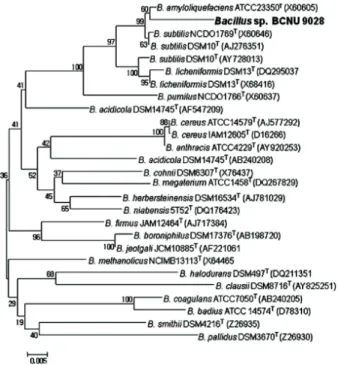
일반가정의 재래식 된장에서 아포성(spore-forming) 간균 인 Bacillus를 분리하기 위해 열안정성 및 protease효소를 분비 하는 특성을 이용하여 BCNU 9028를 최종 선발하였다. 생리학 적 및 생화학적 특성은 Table 1에 제시하였다. BCNU 9028은 그람양성 간균으로 운동성이 없는 호기성 균주이며 내생포자 를 형성하였다. 최적 배양온도는 35℃였으며, 넓은 온도와 다 양한 pH, 12%의 높은 염분 농도에서도 안정적으로 생육하였 다. 자화능 조사에서 다양한 탄소원을 이용하는 것으로 나타 났으며, 특히 glucose, fructose 및 mannitol을 생육에 이용하 는 것으로 나타났다. 또한 amylase, protease, gelatinase 및 catalase등 다양한 효소를 분비하는 것으로 나타났다. 균주의 정확한 동정을 위해 16S rDNA gene의 염기서열을 분석 후 GeneBank에 등록된 표준균주(type strain)들의 16S rDNA gene의 염기서열들과 blast search한 결과, Bacillus subtilis 및 Bacillus amyloliquefaciens와 99% 상동성을 보였으며, 계통적으 로도 B. subtilis와B. amyloliquefaciens의 subcluster에 속하는 균 주로 확인 되었다(Fig. 1). 안전성 시험결과 BCNU 9028은 비 병원성인 α-용혈현상을 보였으며, 유해효소인 tryptophanase, urease, PAD를 생성하지 않는 것으로 확인되었다. 그러므로, 전체적으로 안전한 것으로 판단된다(Table 2).
Table 1. Biochemical and physiological characteristics of
Bacillus
sp. BCNU 9028Contents BCNU 9028
Growth under anaerobic conditions -
Gram staining +
Motility -
Sporulation +
Voges-Proskauer test -
Growth temperature range 15-50℃
Optimum growth temperature 35℃
Growth pH range 2-9
Growth in the presence of NaCl (%) 3-12 Assimilation of
Arabinose -
Fructose ++
Glycine -
Glucose ++
Lactose -
Mannitol ++
Mannose -
Raffinose -
Starch +
Sucrose +
Xylose +
Production of
Amylase -
Protease ++
Gelatinase +
Catalase +
Oxidase -
+, high activity; -, no activity
Values are mean with SD of three replications.
Fig. 1. A phylogenetic tree, showing the position of
Bacillus
sp.
BCNU 9028 among theBacillus
species.Table 2. Production of haemolysin and harmful enzyme by
Bacillus
sp. BCNU 9028Organisms Haemolysin Phenylalanine deaminase a Tryptophanaseb Ureasec
S. aureus
ATCC 6538 β- -E. coli
ATCC 10798 + -P. mirabillis
ATCC 49565 + - +L. acidophilus
ATCC 4356 γ-Bacillus sp
. BCNU 9028 α- - - -a Phenylalanine deaminase activity, decomposition of 10% FeCl2 b Typtophanase activity, Kovac’s reagent
c Urease activity, deconposition of phenol red Values are mean with SD of three replications.
항생제 감수성
사용된 항생제의 농도 구간은 NCCLS를 참고하였다.
BCNU 9028은 다양한 항생제에 대하여 감수성을 가지는 것으 로 나타났다. 세포벽합성저해 항생제인 ampicillin과 단백질합 성저해 항생제인 tetracycline, chloramphenicol, gentamicin모 두에 대하여 감수성을 나타내었다(Table 3). ampicillin (10 ug) 에 대하여 31 mm의 생육 저해환을 보였으며, streptomycin (10 ug)에 대하여 18 mm, tetracycline (30 ug)은 24 mm로 나타났으며, chloramphenicol (30 ug), gentamycin (10 ug)에 대하여 각각 24 mm, 30 mm의 생육 저해환을 나타냈다.
내산성 및 내담즙산성
pH 3, 4로 조정된 HCl용액에서 4시간 후 초기접종농도 7.82 log cfu/ml에서 각각7.81 log cfu/ml, 7.20 log cfu/ml로 생존하는 것으로 나타나 초기접종농도와 동일한 수준인 90%
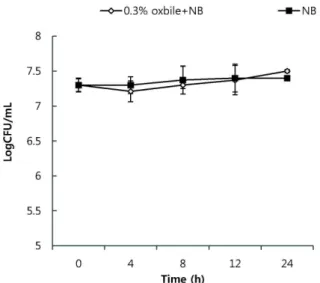
이상의 생존율을 보였다. 같은 조건 하에 pH 2.5로 조정했을 때4시간 후 총균수는 5.59 log cfu/ml 정도 생존하는 것으로 나타났다(Fig. 2). 인공담즙산에 대한 내성을 확인한 결과 장 내군총으로서 견뎌야 하는 기준농도인 0.3%에서 내성을 가 졌으며, 특히 초기접종균수(7.34 log cfu/ml)보다 증식(7.52 log cfu/ml)하였음을 확인할 수 있었다. 그러므로 시험에 사 용된 Bacillus sp. 균주는 안정성면에서도 우수한 것으로 확인 되었다(Fig. 3).
Table 3. Antibiotic resistance of
Bacillus
sp. BCNU 9028 Antibiotic (ug)a Diameter ofinhibition (mm)b Result
Ampicilllin (10) 31±0.5 S
Gentamycin (10) 27±0.6 S
Streptomycin (10) 18±0.6 S
Tetracyclin (30) 24±0.3 S
Chloramphenicol (30) 30±1.0 S
a Antibiotic-impregnated discs (6 mm) with amount, in ug shown in brackets.
b Diameter of inhibition on three individual experiments.
Values are mean with SD of three replications. (S)=
susceptible.
Fig. 2. Colony forming unit of
Bacillus
sp. BCNU 9028 in pH 2.5, 3.0 and 4.0.Fig. 3. Colony forming unit rates of
Bacillus
sp. BCNU 9028 in artificial bile acid after treated for 24 hr at 37℃.항균활성 측정
그람양성 세균 2종, 그람음성 세균 4종 및 인체병원성 진균
2종을 대상으로 BCNU 9028의 항균 및 항진균 활성을 조사한
결과, 주로 그람양성 세균과 인체병원성 진균에 대해 넓은 항
균 스펙트럼을 가지고 있었으며 그람양성 세균과 그람음성
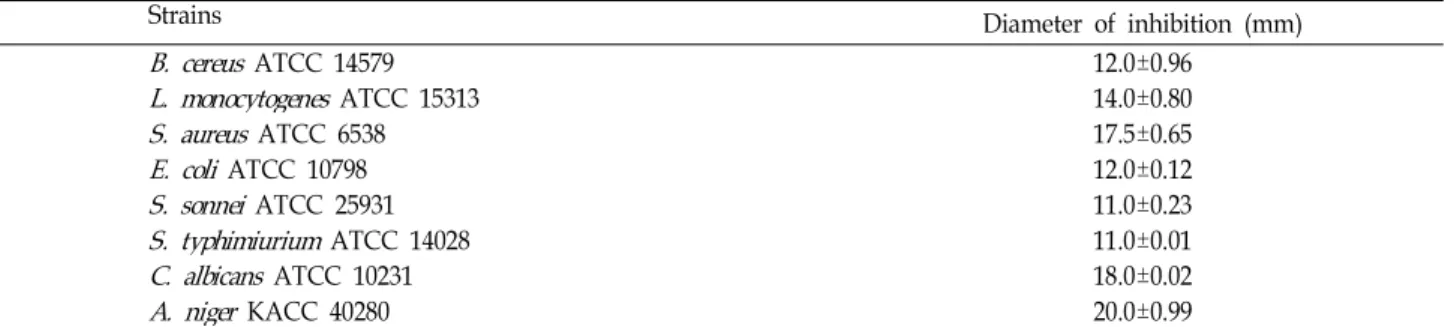
Table 4. Antimicrobial activity of
Bacillus
sp. BCNU 9028 against test human pathogenic bacteriaStrains Diameter of inhibition (mm)
B. cereus
ATCC 14579 12.0±0.96L. monocytogenes
ATCC 15313 14.0±0.80S. aureus
ATCC 6538 17.5±0.65E. coli
ATCC 10798 12.0±0.12S. sonnei
ATCC 25931 11.0±0.23S. typhimiurium
ATCC 14028 11.0±0.01C. albicans
ATCC 10231 18.0±0.02A. niger
KACC 40280 20.0±0.99Values are mean with SD of three replications.
세균에 비해 인체병원성 진균에서 상대적으로 높은 억제환이 나타났다(Table 4). 그람양성 세균인 B. cereus와 L. mono- cytogenes에 대해서 각각 12 mm와 14 mm의 억제환을 보였다.
S. aureus에 17.5 mm의 넓은 억제환을 나타냈으며, 그람음성 세균인 E. coli에 대해서는 12 mm의 억제환이 나타났으며, S.
sonnei와 S. typhimiurium에 대해서 11 mm의 억제환을 나타냈 다. 그리고 인체 병원성 효모인 C. albicans와 인체 병원성 진균 인 A. niger에 대해서도 각각 18 mm, 20 mm로 진균에 대해 넓은 항균 스펙트럼을 가진 것으로 확인되었다(Fig. 4).
소수성과 응집능력 측정
소수성이 높은 용매에 미생물의 소수성 표면이 부착하는 정도를 측정한 결과, BCNU 9028의 소수성 정도는 xylene에 대해 63%, n-hexadecane에 대해서는 59.4%로 나타났다. 전 자 공여체인 ethylacetate (17.2%) 보다 choloroform (20.02%)에 대한 부착능이 높게 나왔으므로, 전자 수용체적 인 특성이 강함이 확인되었다(Table 5). NB에서 회수 후 PBS에 현탁한 균주의 자가결합정도(52.6%)와 상층액에 현 탁한 균주의 자가결합정도(48.8%)는 비슷하게 나타났으므로 washing과정 중 소수성과 관련있는 세포표면 물질이 소실 되지 않음이 확인되었다. NA에서 배양한 균체의 자가결합
Fig. 4. Antagonistic effect of
Bacillus
sp. BCNU 9028 on the growth of (A)B. cereus
, (B)L. monocytogenes
, (C)S. aur- eus
, (D)E. coli
, (E)S. sonnei
, (F)S. typhymirium,
(G)C.
albicans
(H)A. niger
after 24 hr of incubation.Fig. 5. Comparison of the autoaggregation ability of
Bacillus
sp.BCNU 9028 resuspended in phosphate buffered saline (pH 6.5) after grown on NA (◆) in NB (■) or re- suspended in their own culture supernatant fluid (△).
Error bars represent standard deviations of the mean val- ues of results from three replicate experiments.
Table 5. Percent hydrophobicity of
Bacillus
sp. BCNU 9028 against various solventsSolvent Hydrophobicity (%)
Xylene 63.3±8.5
Hexadecane 59.4±2.6
Chloroform 12.0±2.0
Ethyl acetate 17.2±6.2
Values are mean with SD of three replications.
Table 6. Coaggregation ability of
Bacillus
sp. BCNU 9028 after 1 hr incubation at room temperature in phosphate buf- fered saline (pH 6.5)Bacteria Coaggregation with
BCNU9028 (%)
L. monocytogenes
ATCC 15313 6.57±0.07E. coli
ATCC 10798 7.86±1.30S. aureus
ATCC 6538 8.24±1.42 Values are mean with SD of three replications.정도(40%)가 NB에서 회수한 균체보다 낮은 자가결합정도를 보였는데, 이는 고체배지보다 액체배지에서 균이 잘 생육하 는 것과 약간의 상관성이 있을 것으로 판단된다(Fig. 4.). 병 원성균과의 응집정도 측정 결과 L. monocytogenes (6.57%), E. coli (7.86%), S. aureus (8.24%) 모두 6~8% 차이로 낮은 응 집정도를 확인하였다(Table 6).
고 찰
프로바이오틱스로서 가져야 하는 가장 중요한 특성은 GRAS (generally recongnized as safe) 미생물로서 숙주의 장 내에서 생존력이 우수해야 하며, 유익한 장내 미생물의 증식 및 유해균 억제 또는 배변을 원활하게 하는 기능성이 필요하 다[32]. 최근 Scientific commission on animal nutrition (SCAN), Scientific committee on food (SCF) 및 Scientific committee on plants (SCP)는 사료, 식품의 생산에 사용되는 미생물의 안전성 평가에 대한 일반 접근법으로 QPS (qualified presumption of safety, 안전성의 정성 추정법)를 제안하였으 며 2008년 유럽식품안전청(European Food Safety Authority, EFSA)에 의하여 식품·사료용으로 첨가될 수 있는 미생물들이 목록화되었다. QPS에 인정되는 조건은 식중독, 장독성 및 계 면활성이 없어야 하며, 한국 전통 대두 발효식품(청국장, 메주) 의 우점 Bacillus속인 B. subtilis, B. pumilis, B. licheniformis 및 B. amyloliquefaciens는 모두 QPS목록에 등재되어있다[3,9]. 본 연구에 사용한 BCNU 9028은 메주에서 분리하여 B. subtilis, B. amyloliquefaciens와 99%의 상동성을 가지며 유럽식품안전 청에서 인정된 안전한 균주라고 볼 수 있으나 현재 여러 나라 에서 유통되고 있는 일부 Bacillus속 제품들에 대하여 안전성 에 대한 문제들이 제기되고 있으므로 병원성 유전자의 확인과 임상연구를 통한 보다 정확한 안전성 검토가 사료된다.
프로바이오틱스는 위액 및 담즙에서 안정적이며, 소화효소 에 의해 분해되지 않는 성질을 가지고 있어야 한다[5]. El- Naggar 등[10]이 보고한 B. subtilis, L. brevis, L. plantarum 균주 가 pH 3.0의 조건에서 2시간째의 생존율이 각각45%, 57%, 12%인 것에 비하면 BCNU 9028은 보다 높은 내산성을 지니면 서 동시에 담즙에 대한 높은 저항성을 나타내어 프로바이오틱 스로 적합한 안정성을 갖추었다고 할 수 있다. 프로바이오틱 스 선발기준 중에서 안정성과 더불어 장관세포에 대한 부착성 은 매우 중요하다. 국내 야쿠르트 중앙연구소(2006)는 부착성 이 우수한 균주 선발 시 1차적으로 분리균주의 세포표면 소수 성정도 측정을 통한 선발가능성을 보고하였고[20], Todorov 등[30]은 9개의 유산균주의 소수성과 Caco-2 세포에 대한 부착 능이 상관관계가 있음을 보고한 바 있다. 소수성이 높은 균주 는 L. curvatus ET 06 (61.9 ~ 64.6%), P. acidilactici ET 34 (51.3%) 균주 였으며, Caco-2 세포 부착능은 각각 12.6%, 13.7%
로 나타났다. Ananthaya Sansawat [1]이 보고한 n-hex-
adecane, xylene에 대하여 25.6%, 32.2%의 소수성을 가지는B.
subtilis P 33의 자가결합정도는14.3%이며Caco-2 세포에 4.2 log cfu/ml 부착한 점과 비교했을 때 BCNU 9028은 보다 높은 소수성(59.4~63%)과 자가결합정도(15%)를 가지므로, 부착능 이 높을 것으로 기대된다. 하지만 Ouwehand 등(1999)은 소수 성은 부착에 도움을 주는 것은 맞지만 강한 상관관계를 발견 하지 못하였다는 연구결과가 있으므로, BCNU 9028의 Caco-2 세포 부착능과 동물실험을 통한 구체적인 부착능에 대한 연구 결과가 필요할 것으로 생각된다[20,32].
본 연구는 한국 전통 식품 유래 Bacillus속 균주를 프로바이 오틱스 제제로 개발 및 생산하기 위하여, 메주로부터 BCNU 9028을 최종 선발하였고 우수한 안정성을 확인했으며 높은 세포표면 소수성과, 자가결합정도를 가져 적절한 조건을 구비 하였다고 판단된다. 프로바이오틱스 균주의 응집능력 역시 장 부착능과 상관관계가 있으며, 병원성균과의 낮은 응집정도는 병원체의 생물막형성과, 장점막세포에 부착하는 것을 저해하 는 중요한 역할을 한다[25]. Xu 등[33]은 L. paracasei가 L. mono- cytogenes와 38%, L. casei는 S. aureus와 28.7%의 응집정도를 가지는 것을 보고하였다. 이와 비교할 때, BCNU 9028의 병원 성균과 낮은 응집반응은 병원성균이 장점막에 부착하는 것을 저해하고, 8종의 병원성균에 대한 길항능력을 가져 장내유해 균 억제 및 저해에 유용한 효과를 가져 감염예방에 탁월할 것으로 판단되며, BCNU 9028이 분비하는 항균물질에 대한 활용의 범위가 넓을 것으로 기대된다[22,30]. 위 결과로부터 BCNU 9028균주는 프로바이오틱스로서 산업적 이용 가능성 이 있는 것으로 판단된다.
한편 프로바이오틱스 정장제 Biosporin은 B. subtilis와 B.
licheniformis의 혼합제제로서 그 구성원인 B. subtilis 2335가
위암의 원인균인 H. pylori를 저해하는 항균물질인 amicouma-
cin A를 분비한다는 연구결과가 있으며 일본제품에서 분리되
어 Bispan제품에서 사용되고 있는 Bacillus poyfermenticus SCD
역시 polyfermenticin SCD라고 명명된 박테리오신을 생성한
다고 보고되고 있다[6,17]. 또한 일본의 콩 발효 식품인Natto에
서 분리된 B. subtilis var. Natto가 분비하는 serine protease로
알려진 Nattokinase는 혈전용해의 기능성과 더불어 상용화되
어 시판되고 있다. 그리고 BCNU 9028균주와 subcluster를 구
성하는 B. subtilis는 subtilin, botrycin 및 sulfactin와 같은 펩타
이드 항균물질 및 여러가지 효소를 분비하는 특징을 가진다
[27,28]. 따라서 그람양성 세균 2종과 그람음성 세균 3종 및
인체병원성 진균 2종에 대해 항균활성을 가지는 BCNU 9028
는 장에 머물면서 병원성 균주를 효과적으로 억제하는 항균물
질을 생산할 것으로 기대할 수 있으며 본 균주가 생성하는
protease, amylase, glucanase 및 cellulase 등의 효소들은 천연
보존제등 다양한 관련 산업에 활용될 수 있을 것으로 기대되
므로 본 연구에서 사용한 균주에 의해 생산되는 항균물질과
유용효소에 대한 지속적인 연구가 필요하다.
감사의 글
본 연구는 교육과학기술부 및 한국연구재단의 지역혁신인 력양성사업으로 연구되었기에 이에 감사드립니다.
References
1. Ananthaya, S. and Thirabunyanon, M. 2009. Anti-
Aeromonas hydrophila
activity and characterization of novel probiotic strains ofBacillus subtilis
isolated from the gastro- intestinal tract of giant freshwater prawns.Mj. Int. J. Sci.
Technol
. 3, 77-87.2. Casula, G. and Cutting, S. M. 2002.
Bacillus
Probiortics: spore germination in the gastrointestinal tranct.Appl. Environ.
Microbiol.
68, 2344-2352.3. Cho, K. M., Math, R. K., Hong, S. Y., Asraful Islama, S. M., Mandannaa, D. K., Cho, J. J., Yun, M. G. Kim, J. M. and Yun, H. D. 2009. Iturin produced by
Bacillus pumilus
HY1 from Korean soybean sauce (kanjang
) inhibits growth of afla- toxin producing fungi.Food Cont.
20, 402-406.4. Collado, M., Meriluoto, C. J. and Salminen, S. 2007.
In vitro
analysis of probiotic strain combinations to inhibit pathogen adhesion to human intestinal mucus.Food Res Int
. 40, 629-636.5. Conway, P. L., Gorbach, S. L. and Goldin, B. R. 1987.
Survival of lactic acid bacteria in the human stomach and adhesion to intestinal cells.
J. Dairy Sci.
70, 1-12.6. Cutting, S. M. 2010.
Bacillus
probiotics.Food Microbiol
. 28, 214-220.7. DeRoos, N. M. and Katan, M. B. 2000. Effect of probiotic bacteria on diarrhea, lipid metabolism and carcinogenesis.
Am. J. Clin. Nutr. Rev
. 71, 405-11.8. Doyle, R. J. and Rosenberg, M. 1995. Measurement of micro- bial adhesion to hydrophobic substrates.
Methods Enzymol.
253, 532-550.
9. EFSA. 2009. EFSA Panel on Biological Hazards (BIOHAZ);
Scientific Opinion on the maintenance of the list of QPS mi- croorganisms intentionally added to food or feed (2009 up date).
EFSA J
. 7, 92.10. El-Naggar, M. Y. M. 2004. Comparative study of probiotic cultures to control the growth of
Escherichia coli
O157: H7 andSalmonella typhimurium. Biotechnol
. 3, 173-180 11. FAO/WHO. 2002. Joint FAO/WHO (Food and AgricultureOrganization/ World Health Organization) working group report on drafting guidelines for the evaluation of probiotics in food. London, Ontatiio, Canada.
12. Fernandez, M. F., Boris, S. and Barbes, C. 2003. Probiotic properties of human lactobacilli strains to be used in the gastrointestinal tract.
Lett. Appl. Microbiol
. 94, 449-455.13. Gilliland, S. E., Staley, T. E. and Bush, L. J. 1984. Importance of bile tolerance of
Lactobacillus acidophillus
used as a dietary adjunct.J. Dairy Sci
. 67, 3045-3051.14. Goosney, D. L., Knoechel, D. G. and Finlay, B. B. 1999.
Enteropathogenic
E. coli
,Salmonella
, andShigella
: masters ofhost cell cytoskeletal exploitation.
Emerg. Infect Dis.
5, 216-223.15. Green, D. H., Wakeley, P., Page, R., Barnes, A., Baccigalupi, A. L., Ricca, E. and Cutting, S. M. 1999. Characterization of two
Bacillus
probiotics.Appl. Environ. Microbiol
. 65, 4288-4291.16. Homma, N. 1998. Bifidobacteria as a resistance factor in hu- man beings.
Bifodobac. Microfl
. 7, 35-43.17. Jun, K. D., Lee, K. H., Kim, W. S. and Paik, H. D. 2000.
Microbiological identification of medical probiotic Bispan strain.
Kor. J. Appl. Microbiol. Biotechnol.
28, 124-127.18. Kos, B., Suskovic, J., Vukovic, S., Simpraga, M., Frece, J. and Matosic, S. 2003. Adhesion and aggregation ability of pro- biotic strain
Lactobacillus acidophilus
M92.J. Appl. Microbiol
. 94, 981-987.19. Lin, M. Y. and Yen, C. L. 1999. Antioxidative abillity of lactic acid bacteria.
J. Agric. Food Chem
. 47, 1460-1466.20. Lim, K. S. and Huh, C. S. 2006. Adhesion of Bifidobacteria to Caco-2 cells and in Relation to Cell Surface Hydrophobicity.
Korean J. Food Sci. Ani. Resour.
26, 497-502.21. Lynne, A. M. and Foley, S. L. 2008. Food animal-associated
Salmonella
challenges: pathogenicity and antimicrobial resistance.J. Anim. Sci.
86, E173-E187.22. Mengaud, J., Ohayon, H., Gounon, P., Mege, R. M. and Cossart, P. 1996. E-Cadherin is the receptor for internalin, a surface protein required for entry of
L. monocytogenes
into epithelial cells.Cell
84, 923-932.23. Patel, A. K., Ahir, J. J., Pawar, S. P., Chaudhari, B. L. and Chincholkar, S. B. 2009. Comparative accounts of probiotic characteristics of
Bacillus
spp. isolated from food wasts.J.
Foodres
. 42, 505-510.24. Pinchuk, I. V., Bressollier, P., Verneuil, B., Fenet, B. I. sor- okulova, N., megraud, F. and Urdaci, M. C. 2001. In Vitro Anti-
Helicobacter pylori
Activity of the Probiotic StrainBacillus subtilis
3 Is Due to Secretion of Antobiotics.Antimicrob. Agents Chemother.
45, 3156-3161.25. Rijnaarts, H. H. M., Norde, W., Bouwer, E., Lyklema, J. J.
and Zehnder, A. J. B. 1993. Bacterial adhesion under static and dynamic conditions.
Appl. Environ. Microbiol
. 52, 1723-1728.26. Saito, N. and Nei, M. 1987. The neighbor-joining method, a new method for reconstructing phylogenetic trees.
Mol.
Biol. Evol.
79, 426-434.27. Tagg, J. R., Dajani, A. S. and Wannamaker, L. W. 1976.
Bacteriocins of gram-positive bacteria.
Bacteriol
.Rev
. 40, 722-756.28. Tagg, J. R., Ray, B. and Jack, R. W. 1995. Bacteriocins of gram-positive bacteria.
Microbiol
.Rev
. 59, 71-200.29. Thompson, J. D., Higgins, D. G. and Gibson, T. J. 1994.
CLUSTAL W: Improving the sensitivity of progressive mul- tiple sequence alignment through sequence weighting, posi- tion-specific gap penalties and weight matrix choice.
Nuclic Acid Res
. 22, 4673-4680.30. Todorv, S. D. and Dicks, L. M. T. 2008. Evaluation of lactic acid bacteria from kefir, molasses and olive brine as possible probiotics based on physiological properties.
Ann. Microbiol.
초록:메주로부터 분리한 토착
Bacillussp. BCNU 9028의 프로바이오틱스로서 이용 가능성 신화진
1․방지훈
1․최혜정
2․안철수
3․정영기
4․김동완
3․주우홍
1,2*
(
1창원대학교 생물학과,
2창원대학교 생명공학협동과정,
3조아제약(주),
4동아대학교 생명공학과,
5창원대학 교 미생물학과)
포자형성균은 사람과 동물용의 프로바이오틱 제제로서 사용되어져 왔다. 포자형성균의 낮은pH에 대한 안정성 과 위내 생육저해 환경에 생존능은 프로바이오틱 제제로서 매력적이다. 본 연구는, 한국 전통 대두 발효 식품의 종균인 BCNU 9028균주를 메주로부터 분리하였다. 생리학적, 생화학적 특성과 16S 리보좀 DNA 염기서열 분석 결과 BCNU 9028균주는 Bacillus에 속하는 것을 확인하였다. Bacillus sp. BCNU 9028은 pH 2.5에서 92%의 생존률 을 보였으며, 0.3% 담즙산에서도 저항성을 나타냈다. 그리고, 식품 병원성균과의 응집정도와 자가결합능에의해 Bacillus sp. BCNU 9028는 Listeria monocytogenes, S. aureus 및 E. coli와 같은 식품 병원성균의 생물막형성과 부착 을 저해할 수 있는 것을 확인하였다. BCNU 9028의 소수성 특성(63.3%)은 장관내 부착능이 우수할 것으로 나타났 다. 특히, Bacillus sp. BCNU 9028균주는 그람양성 및 그람음성 병원성균 모두에 항균력을 갖는 것을 확인하였다.
이상의 결과로Bacillus sp. BCNU 9028균주가 프로바이오틱스로서 이용가능성이 있음을 제시하였다.
58, 661-670.
31. Todorv, S. D., Botes, M., Guigas, C., Schilinger, U., Wiid, I. M., Wachsman, B. Holzapfel, W. H. and Dicks, L. M. T.
2008. Boza, a natural source of probiotic lactic acid bacteria.
J. Appl. Microbiol.
104, 465-477.32. Xiaohua, G., Defa, L., Wenqing, L., Xiangshu, P. and Xiaoling, C. 2006. Screening of
Bacillus
Strains as potentialprobiotics and subsequent confirmation of the in vivo effec- tiveness of
Bacillus subtlis
MA139 in pigs. Antonie van Leeuwenhoek
. 90, 139-146.33. Xu, H., Jeong, H. S., Lee, H. Y. and Ahn, J. 2009. Assessment of cell surface properties and adhesion potential of selected probiotic strains.