185 https://doi.org/10.21289/KSIC.2016.19.4.185
선박용 압력조절밸브의 마찰 특성에 관한 연구
선박용 압력조절밸브의 마찰 특성에 관한 연구
Study on Friction Characteristics of Pressure Control Valve for Ship Engine
최원식*, 박인수*, 강창원*, 샌디*, 정성원**
Won-Sik Choi*, In-Soo Park*, Chang-Won Kang*, Pratama Pandu Sandi*, Sung-Won Chung**
<Abstract>
Low operational cost and high efficiency is absolute requirements in the mass production of the ship engine. Increasing the performance of the fuel injection system in the diesel engine is one kind of solution to improve the efficiency. Modern diesel engines are using electronic control module as the main controller in the fuel injection control system, however the mechanical system still involved in the modern control system. In modern ship engine, a control valve was used in injection fuel to regulate the flow of the fuel. High pressure and friction are intensively occur within this part, therefore high wear resist and low friction coefficient material including fine lubricating are needed. This study is to figure out the wear resist material and proper lubricant in the control valve fuel injection. The experiment has been tested using pin on disk in several treatments those are used various lubricants and non-lubricant condition. Two kinds of lubricant were used in this experiment such as INDERIN AW-32 and paraffin oil. INDERIN AW-32 has a better result compared to non-lubricant condition, which are 20% performance increases than non-lubricant condition. SCM 440 was providing small friction coefficient in the lower velocity. The friction coefficient was constantly maintains at 0.1 m/s of velocity or above respectively with the increment of the loads. Using INDERIN AW-32 and paraffin oil the lowest friction coefficient occurred at the lower load, and increases side by side with the increment of loads.
Keywords : Friction, Wear, Pin on disk, Ship Engin
* 최원식, 바이오산업기계공학과, 부산대학교 경상남도 밀양시 삼랑진읍 삼랑진로 1268-50 우편번호 50463
**
교신저자, 정회원, 부산대학교 바이오산업기계공학과 교수경상남도 밀양시 삼랑진읍 삼랑진로 1268-50 우편번호 50463
* Professor, Dept. of Bio-Industrial Machinery Eng.,Pusan Natl. Univ Miryang 50463 REPUBLIC OF KOREA
E-mail: [email protected] Tel:+82-55-350-5425
** Corresponding Author, Professor, Dept. of Bio-Industria Machinery Eng.,Pusan Natl. Univ
Miryang 50463 REPUBLIC OF KOREA
E-mail : [email protected], Tel: +82-55-350-5422
1. 서 론
Since humans started to use engines that use diesel fuel to transport all logistics, the engines and generators of cars and ships have been evolved. The requirements for the evolution were to improve the efficiency of the engine itself and to reduce the fuel consumption due to the 20th century oil shock. However, in the modern times, the harmful substances in the exhaust gas is should be considered.
In the case of a marine diesel engine as shown in Fig. 1, the output generated by driving the engine is mainly used as a periodical propulsion power, a generator for generating electricity used in a ship is operation, and device for generating hydraulic pressure, which is the power of various mechanical devices. Most of the diesel fuel is used for structural reasons such as required output, size and size of the engine and economical reasons.
Fig.1. Structure of electrically controlled RT-flex engine
Increasing the performance of the pressure control valve in the diesel engine is one kind of solution to improve the efficiency of the engine. As shown in Fig. 2, high pressure and friction are intensively occur within this part, therefore high wear resist and low friction coefficient material including fine lubricating are needed.(1,2)
Fig.2. Pressure control valve
There are many research related with friction and wear such as in piston rings.
(3,4). However, there is no research related to the pressure control valve friction characteristics. This study is to figure out the wear resist material and proper lubricant in the control valve fuel injection.
2. Material and Method
2.1. The experimental equipment
In this research, in order to measure the
friction characteristics of the tested samples,
pin-on-disc tribometer was used. The
187
선박용 압력조절밸브의 마찰 특성에 관한 연구equipment used in this paper is shown in Fig. 1. The pin-on-disc tribometer operates according to ASTM G99-95a standards. The device consists of a rotating disc, and a stationary pin that is placed under a specified load.
Fig.3. Pin-on-disk wear test system
2.2. Material
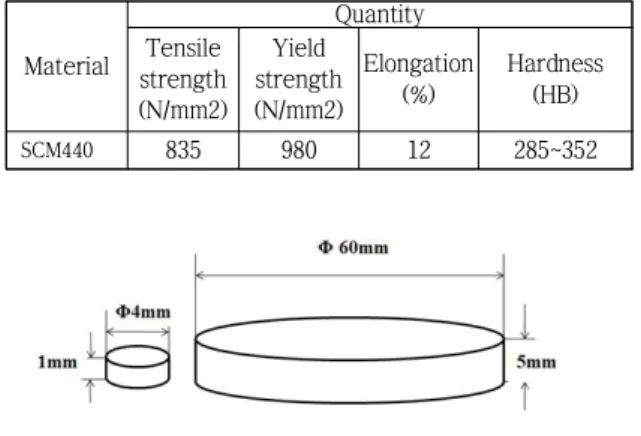
A pin and disk were made of SCM 440 bearing steel. The chemical composition of pin and disk are shown in Table 1.
Furthermore, the mechanical properties of the material is shown in Table 2.
Material Element
C Si Mn P S Cu Ni Cr Mo
SCM440 0.38
~ 0.43
0.15
~ 0.35
0.60
~ 0.90
~0.030 ~ 0.025
0.90
~ 1.20
0.15
~ 0.30
Table 1. Chemical composition of the pin & disk
Material
Quantity Tensile
strength (N/mm2)
Yield strength (N/mm2)
Elongation (%)
Hardness (HB)
SCM440 835 980 12 285~352
Table 2. Mechanical properties of the pin & disk
Fig.4. Schematic of Specimen of Pin & Disk
In this research, as shown in Fig. 4 pin has a thickness of 1 mm and a diameter of 4 mm. The disk specimen is 60 mm in diameter and 5 mm in thickness.
2.3. Experimental Method
The pins and discs were ultrasonically cleaned and mounted on a friction / wear tester. Inderon AW-32 Oil and Paraffin Oil were used as the lubricant. The load added in experimental conditions were 2N, 4N, 6N, 8N and 10N in the order. The rotational velocity were 0.06 m/s, 0.10 m/s, 0.14 m/s, 0.18 m/s, 0.22 m/s, 0.26 m/s, 0.30 m/s and 0.34 m/s.
Fig.5. Model of the friction and wear test
3. Result and Discussion
3.1. Without Lubrication
Fig. 6 shows the value of the friction coefficient of the test specimen at the speed with increasing load without supplying lubricant to the disk and pin. The coefficient of friction is in the range of 0.018 to 0.0528.
When the vertical load increased from 2N to 4N, the decrease of the friction coefficient was greatly changed to 0.015, and when the vertical load increased from 4N to 10N, the decrease rate was relatively small. When the vertical load increased from 4N to 10N, the friction coefficient decreased linearly.
However, at 0.22 m/s, the variation of friction coefficient showed a minimum change of 0.0015 when increasing from 6N to 8N. The variation of friction coefficient with load decreased 63.9% at the maximum 0.1m/s and 59.7% at the minimum 0.3 m/s.
Fig.6. Friction coefficient of pin non lubricated
Fig. 7 shows the value of the friction coefficient of the test specimen as a load
with increasing speed without supplying lubricant to the disk and pin. The coefficient of friction is in the range of 0.018 to 0.0528.
As a result of the experiment under the vertical load 2N, the fluctuation of the friction coefficient was small. The friction coefficient decreased to 0.225 m/s at the vertical load of 4N, but increased again to 0.3 m/s. There was a slight decrease in the friction coefficient up to 0.225 m/s at the vertical load of 6N, but then the friction coefficient increased with increasing speed. In 8N, the friction coefficient increased to 0.225 m/s and the friction coefficient decreased when the speed increase. The friction coefficient increased up to 0.3m / s at the vertical load of 10N and the friction coefficient decreased at the speed increase.
Fig.7. Friction coefficient as a function duty number with pin non lubricated
Fig. 8 shows the friction coefficient of the
specimen as the load is increased with
increasing duty number without lubricating
the disc and pin. The coefficient of friction is
in the range of 0.018 to 0.0528. As the duty
number increases, the variation of friction
189
선박용 압력조절밸브의 마찰 특성에 관한 연구coefficient increases with the load of friction coefficient. respectively. When vertical loads 2N and 6N was applied, the friction coefficient increased linearly, but there was a decreasing value at other loads.
Fig.8. Friction coefficient of load as a function of velocity with non lubricated
3.2. Parafin Oil Lubrication
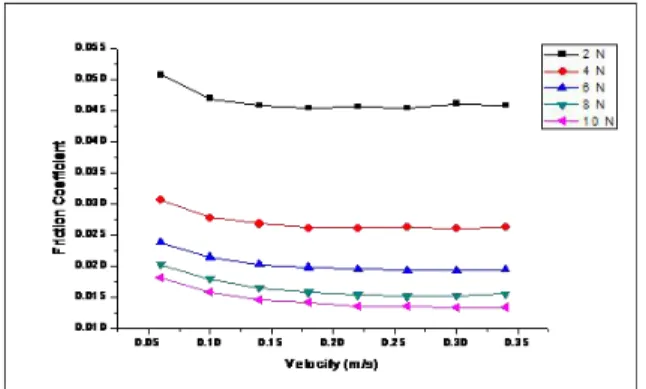
Fig. 9 shows the value of friction coefficient of specimen using paraffin oil for disk and pin as the load increases with increasing speed. The coefficient of friction is in the range of 0.013 to 0.050. The speed was tested in eight steps from 0.06 m / s to 0.34 m / s. When the vertical load was changed from 2N to 4N, the friction coefficient showed 0.02 deviation. When the load increased from 6N to 10N, 0.005 deviation occurred. As the load increased, the deviation between the loads decreased. In the paraffin oil test, the coefficient of friction was stably maintained at a speed of 0.1 m / s or higher.
Fig.9. Friction coefficient of paraffin oil lubricated pin
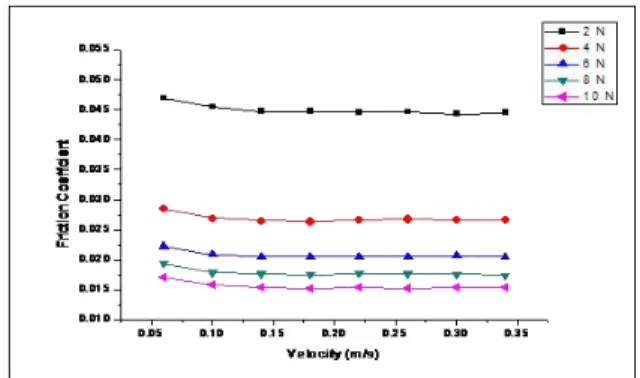
Fig. 10 shows the friction coefficient values
of the test specimens as the speed increases with increasing the load, using paraffin oil on the disk and pins. The coefficient of friction is in the range of 0.013 to 0.050. The speed was tested in eight steps from 0.06 m/s to 0.34 m/s. As the load increased, the coefficient of friction decreased. When the vertical load increased from 2N to 4N, the reduction rate of the friction coefficient was 39% of the total reduction rate. The variation of friction coefficient from 4N to 10N increased linearly Respectively.
Fig.10. Friction coefficient as a function duty
number with pin paraffin oil
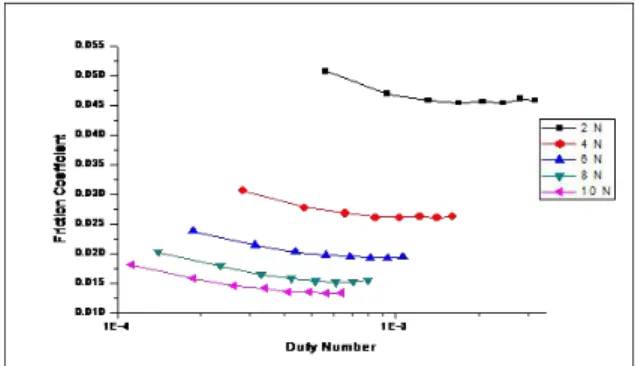
Fig. 11 shows the friction coefficient of the specimen using paraffin oil on the disk and pin as the load increases with increasing duty number. The coefficient of friction is in the range of 0.013 to 0.050. As the duty factor increased, the decrease in the friction coefficient maintained a gentle linearity.
However, in a test with a vertical load of 2N, two friction rises occurred at 0.22 m/s and 0.30 m/s, and 0.26 m/s and 0.34 m/s, respectively. the friction coefficient decreased continuously under load of 6N or more.
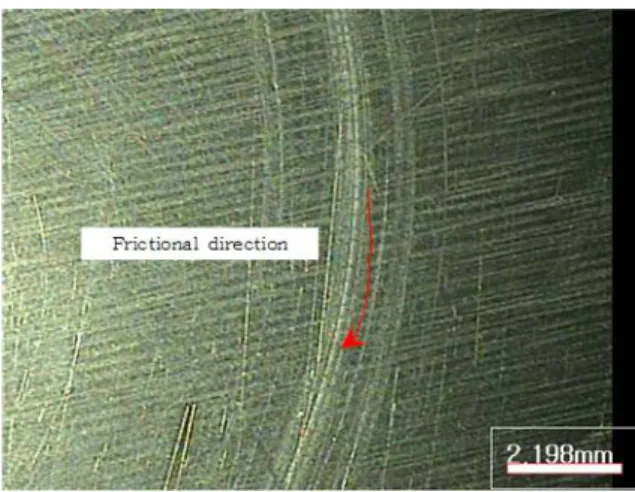
Figure 11 shows the wear status of the disc.
Fig.10. Friction coefficient of load as a function of velocity with paraffin oil
Fig.11. Frictional direction with paraffin oil
3.3. AW-32 Oil Lubrication
Fig. 12 shows the friction coefficient value of the test specimen as the load increases with the speed using Inderon AW-32 oil on the disk and pin. The coefficient of friction is in the range of 0.015 to 0.046. The speed was tested in eight steps from 0.06 m/s to 0.34 m/s. At 0.06 m/s, the friction coefficient was 0.018 at maximum between 2N and 4N, and at 6N to 10N, the deviation was 0.005.
As the speed increased, the variation of the friction coefficient was small. The friction coefficient was linearly decreased at the speed of 0.1m / s or more in the Inderon AW-32 Oil test.
Fig.12. Friction coefficient with pin AW-32 Oil
Fig. 13 shows the friction coefficient of the
test specimen at the speed with increasing
load, using Inderon AW-32 oil on the disk
and pin. The coefficient of friction is in the
range of 0.015 to 0.046. The speed was
tested in eight steps from 0.06 m/s to 0.34
m/s. As the vertical load increased, the
coefficient of friction decreased. When the
load increased from 2N to 4N, the rate of
191
선박용 압력조절밸브의 마찰 특성에 관한 연구decrease of friction coefficient increased to 40% of the total reduction rate, and the change in vertical load decreased linearly from 4N to 10N.
Fig.13. Friction coefficient used oil inderon AW 32 Oil as a function of load
Fig. 14 shows the friction coefficient of the test specimen as a load according to the increase of duty number by using Inderon AW-32 oil on the disk and pin.
The coefficient of friction is in the range of 0.015 to 0.050. As the duty factor increased, the decrease in the friction coefficient maintained a gentle linearity.
Fig.14. Friction coefficient of load as a function of velocity with AW-32 oil
Fig.15. Frictional direction with AW-32 oil
However, in the 2N vertical load test, two friction rises occurred at 0.22m / s and 0.30m / s, and 0.26m / S and 0.34 m / s, respectively. And decreased continuously at a vertical load of 6N or more. Fig. 15 shows the disc wear.
4. Conclusion
In this research the friction coefficients of
SCM440 without lubrication, paraffin oil, and
AW-32 oil lubrication were investigated. The
lubrication effect of AW-32 oil was about
20% as compared with no lubrication. The
friction coefficient of SCM440 showed that
the coefficient of friction increased when the
speed was slowest and when the load was
the smallest. The friction coefficient of
SCM440 under paraffin oil lubrication
showed that the friction coefficient increased
when the friction rate was slowest at the
lowest load, and the friction coefficient was
stable at the speed of 0.1 m/s or more. As a
result of AW-32 oil test, the coefficient of friction of SCM440 showed that the coefficient of friction increased when the friction rate was slow when the least load was applied, and the coefficient of friction decreased linearly when the speed was 0.1 m/s or more.
Acknowledgments
This work was supported by 2-Year Research Grant of Pusan National University.
Reference
[1] Se-Doo Oh and Young-Ze Lee, "The friction and wear of boundary lubricated sliding surfaces using three different surface profile spacing", Journal of the KSTLE, Vol.
17, No. 5, October 2001, pp. 399~405.
[2] Sang-Wook Lee, Man-Sik See, Young-Pil Koo, Yong-Joo Cho and No-Gill Park,
"Effect of characteristic of surface roughness on friction and wear in sliding", 한국윤활학회, 1998.10.01., pp, 292~299.
[3] Kyung-Seob Shin, Chung-Woo Cho and Young-Ze Lee "The effects of surface roughness on Wear-life of DLC coating in dry sliding", Jounal of the KSTLE, Vol.
21, No. 3, June 2005, pp. 130~135.
[4] Kee-Joo Kim, Seok-Jong Yoo, Byung-Ik Choi "Effect of DL Ccoating-layer on engine wear characteristics for improving fuel consumption of automotive engine"
Transactions of KSAE, Vol.18, No.1, 2010, pp.112~119.
[5] Soo-Chul Lee, Nam-Seok Kim, Ki-Woo Nam, Eok-Hwan Ahn and Hyun-Soo Kim,
“Study on wear properties of GCV materials with DLC coating”, 한국해양공학회지, 제24권 제6호, February 2010, pp. 71~75.
[6] Yon-Sang Choyi, Young-Hee Kim, Sang- Min Byun and Heung-Sik Park, “A experimental study on wear characteristics of Cu Alloy for piston hed and bush material of hydraulic servo cylinder”, Journal of the KSTLE, Vol. 25, N0. 5, October 2009, pp. 330~334.
[7] Young-Jun Jang, Young-Hun Chae, Jong-Joo Rha and Seok-Sam Kim, “Nano wear behavior of a-C films with variation of surface roughness”, Journal of the KSTLE, Vol. 20, No. 3, June 2004, pp. 125~131.
[8] Tae-Sik Ahn, Dae-Hyun Cho, Chung-Soon Oh and Young-Ze Lee, “Friction, wear and scuffing life of piston rings with several coating for low friction diesel enging”, Journal of the KSTLE, Vol .23, No. 4, June 2007, pp. 170~174.
[9] Dong-Kwan Jang and Dae-Eun Kim,
“Friction and wear characteristics and reliability estimation of aircraft brake system“, Journal of the KSPE, Vol. 20, No. 11, November 2003.
[10] Su-Yeon Lee, Kuk-Tea Youn, Seok-Hwan Huh and Chan-Gyu Lee, “The change in diffusion coefficient and wear characteristic in carbonitriding layer of SCM415 steel”, Journal of the KISE, Vol.
44, No. 5, 2011.
(접수:2016.10.05.,수정:2016.10.13.,개제확정:2016.11.08)