녹차분말 첨가가 쌀밥의 항산화 활성 및 물성에 미치는 영향
⁃ 연구노트 ⁃
양진우1․이경민1․함현미2․곽지은2․김영화3․정헌상1․이준수1
1충북대학교 식품생명・축산과학부
2농촌진흥청 국립식량과학원 중부작물부
3경성대학교 식품응용공학부
Effects of Green Tea Powder Addition on Antioxidant Activities and Texture Properties of Cooked Rice
Jinwoo Yang1, Kyeongmin Lee1, Hyeonmi Ham2, Jieun Kwak2, Younghwa Kim3, Heon Sang Jeong1, and Junsoo Lee1
1Division of Food and Animal Sciences, Chungbuk National University
2Department of Central Area, National Institute of Crop Science, Rural Development Administration
3School of Food Biotechnology and Nutrition, Kyungsung University
ABSTRACT Green tea (Camellia sinensis L.) is consumed as a popular beverage worldwide, particularly in Asia.
In this study, the effects of green tea powder addition on the antioxidant activities and texture properties of cooked rice were investigated. Texture analysis was carried out by texture profile analysis. Total polyphenols and total flavonoids were determined using spectrophotometric methods, and antioxidative activities were determined based on DPPH and ABTS radical scavenging activities, reducing power, and lipid peroxidation inhibitory activity. Antioxidant contents and antioxidative activities increased with a higher amount of green tea powder. However, there was no difference in texture properties between cooked rice with green tea powder and the control group. In conclusion, addition of green tea powder to cooked rice would be useful to increase antioxidant contents and antioxidative activities without alteration of texture properties.
Key words: rice, green tea, polyphenol, antioxidant, texture
Received 17 January 2017; Accepted 16 May 2017
Corresponding author: Junsoo Lee, Division of Food and Animal Sciences, Chungbuk National University, Cheongju, Chungbuk 28644, Korea
E-mail: [email protected], Phone: +82-43-256-2566
서 론
쌀(Oryza sativa L.)은 주식으로 이용하는 중요한 식량자 원 중 하나로, 우리나라를 포함한 동아시아 지역에서는 대부 분 쌀을 주식으로 하고 있다. 쌀은 낟알의 길이에 따라 장립 종, 중립종, 단립종으로 나누어지며, 낟알의 모양에 따라 인 디카형 및 자포니카형으로 나뉜다(1). 최근 식습관의 변화에 의해 쌀 소비량이 점차 줄어들고 있음에 따라 가공기술을 접목하여 다양한 쌀 가공품을 제조하기 위한 연구가 진행되 고 있다. 또한, 생활수준 향상과 건강을 추구하는 식생활의 선호로 인해 건강기능성 식품에 대한 선호도가 증가하고 있 다. 이와 더불어 생리활성을 갖는 식품성분들에 대한 관심이 증가하고 있으며 일상적인 식생활을 통한 기능성 성분의 섭 취가 바람직한 것으로 여겨지고 있다(2). 따라서 식품산업에 서는 이에 부합하기 위해 기존의 식품이 가지는 기호성을
유지하면서 이와 동시에 건강기능성이 부여된 식품을 개발 하기 위한 다양한 연구가 진행되고 있다.
차나무(Camellia sinensis L.)는 동백나무과에 속하는 다 년생 상록 관목수로 이 식물의 잎은 다양한 식품 및 음료의 원료로 활용되고 있다(3). 차는 찻잎의 발효 정도에 따라서 녹차(green tea), 우롱차(oolong tea), 홍차(black tea)로 분류된다(4). 이 중 녹차는 대중적인 기호도를 가지고 있을 뿐만 아니라 체내의 다양한 생리활성을 조절하는 기능을 갖 는 것으로 알려져 있다. 녹차에는 비타민, 무기질, 탄닌, 카 테킨류, 카페인 및 아미노산류 등 다양한 성분을 함유하는 것으로 알려져 있으며(5), 이러한 성분들은 항암(6), 항혈전 (7), 혈압 저하(8), 항돌연변이(9), 항산화(10), 항당뇨(11) 등의 다양한 생리활성을 나타낸다고 보고되고 있다. 녹차는 찻잎을 우려서 마실 때보다 녹차분말을 직접 이용하였을 때 항산화 성분 및 식이섬유를 비롯한 다른 영양성분을 효과적 으로 섭취할 수 있다는 장점이 보고되었다(12). 따라서 녹차 분말을 활용한 식품에 대하여 다양한 분야에서 연구가 되고 있다. 녹차분말을 첨가한 밀가루(13), 빵(14), 떡(15) 등의 연구가 진행되었으며, 녹차 추출물을 첨가한 밥의 저장성에 대한 연구도 진행되어 있다(16). 하지만 녹차분말을 첨가한
밥의 생리활성에 대한 연구는 아직 부족한 실정이다.
이에 본 연구에서는 녹차분말을 농도별로 첨가하여 취반 한 밥의 물성과 항산화 활성을 평가하였다. 이를 통해 다양 한 생리활성을 가지고 있는 녹차분말을 밥에 활용하여 건강 기능성이 부여된 식품의 개발을 위한 기초자료를 제시하고 자 하였다.
재료 및 방법
재료 및 시약
국내에서 재배되어 가공된 백미(철원, 품종: 운광)와 녹차 분말(녹차원(주), 충남 금산군)을 청주지역 대형마트에서 구 입하여 사용하였다. Gallic acid, (+)-catechin, TroloxⓇ, β-carotene, 1,1-diphenyl-2-picrylhydrazyl(DPPH), di- ammonium salt of 2,2-azino-bis(3-ethylbenzothiazo- line-6-sulfonic acid)(ABTS), potassium persulfate, po- tassium ferricyanide, ferric chloride 등은 Sigma-Al- drich Co.(St. Louis, MO, USA)에서 구입하여 사용하였다.
녹차물 제조 및 취반
실험에 사용한 녹차분말은 시중에서 판매되고 있는 시음 용 녹차분말을 물에 1, 2, 3%(w/v)로 용해 후 취반에 이용되 는 물을 대체하였다. 백미상태의 쌀 200 g을 수세한 후 증류 수와 농도별 녹차물을 1.5배(v/w) 가하여 취반하였다. 취반 은 전기밥솥(CR-0322P, Cuckoo Co., Seoul, Korea)을 이 용하여 동일한 조건으로 진행하였다. 조리한 밥의 영양소 잔존율(true retention)은 다음과 같은 식으로 계산하였다 (17).
True retention (%)= Nc×Gc ×100 Nr×Gr
Nc=mg nutritive component per gram of sample cooked weight
Gc=sample cooked weight (g)
Nr=mg nutritive component per gram of sample raw weight
Gr=sample raw weight (g)
메탄올 추출물 제조
취반된 밥을 동결건조(FD5508, Ilshin Lab Co., Seoul, Korea) 한 후 마쇄하여 시료 10 g에 100% 메탄올 300 mL 가한 다음 상온에서 24시간 동안 shaking incubator를 이용 하여 추출하였다(18). 추출 후 고형분은 Whatman filter paper(Whatman No. 2, Whatman International, Kent, UK)를 이용하여 분리하였고, 상징액은 vacuum evapo- rator(EYELA, Tokyo, Japan)를 이용하여 메탄올을 제거하 여 추출물을 제조하였다. 제조된 추출물은 dimethyl sulf- oxide를 이용하여 재용해하여 실험에 사용하였다. 제조된 메탄올 추출물은 -20°C에서 보관하면서 실험에 사용하였다.
총폴리페놀 함량 측정
총폴리페놀 함량은 Turkmen 등(19)의 방법에 의해 측정 하였다. 총폴리페놀 함량은 각 추출액 100 μL에 2% Na2CO3 용액 2 mL를 가하고 3분간 방치한 후 1 N Folin-Ciocalteu reagent 100 μL를 가하였다. 30분 후 반응액의 흡광도 값을 720 nm에서 측정하였고, gallic acid를 이용하여 검량선을 작성한 후 시료의 총폴리페놀 함량은 mg gallic acid equiv- alent(GAE)로 나타내었다.
총플라보노이드 함량 측정
총플라보노이드 함량은 Zhishen 등(20)의 방법에 의해 측정하였다. 각 시료에 5% NaNO2 75 μL를 가한 후 10%
AlCl3・6H2O 150 μL를 넣고 5분간 방치하였다. 1 M NaOH 500 μL를 가한 후 510 nm에서 흡광도를 측정하였으며, catechin을 이용하여 검량선을 작성한 후 시료의 총플라보 노이드 함량은 mg catechin equivalent(CE)로 나타내었다.
DPPH 라디칼 소거능 측정
DPPH 라디칼 소거능은 Dietz 등(21)의 실험법을 변형하 여 측정하였다. 각각의 추출물 200 μL에 메탄올에 용해된 0.2 mM DPPH 용액 1 mL를 첨가하여 30분간 방치한 후 반응액의 흡광도 값을 520 nm에서 측정하였다. 표준물질로 서 TroloxⓇ를 이용하여 검량선을 작성한 후 시료의 항산화 력(TroloxⓇ equivalent antioxidant capacity, TEAC)을 계산하였다.
ABTS 라디칼 소거능 측정
ABTS 라디칼 소거능의 측정은 Re 등(22)의 방법을 변형 하여 측정하였다. ABTS 7.4 mM과 potassium persulfate 2.6 mM을 하루 동안 암소 방치하여 ABTS radical anion을 형성시킨 후 이 용액을 734 nm에서 흡광도 값이 1.0이 되도 록 증류수로 희석하여 실험에 이용하였다. 희석된 ABTS 용 액 1 mL에 추출물 200 μL를 가하여 흡광도의 변화를 60분 후에 측정하였다. 표준물질로서 TroloxⓇ를 이용하여 검량 선을 작성한 후 시료의 항산화력(TroloxⓇ equivalent anti- oxidant capacity, TEAC)을 계산하였다.
환원력 측정
환원력은 Mau 등(23)의 방법에 의해 측정하였다. 추출물 250 μL에 0.2 M sodium phosphate buffer(pH 6.6) 250 μL, 1% potassium ferricyanide(w/v) 250 μL를 각각 혼합 하여 50°C에서 30분간 반응시킨 후 1% trichloroacetic acid(w/v)를 가하였다. 위 반응액을 1,000 rpm에서 10분간 원심분리 후 상층액 500 μL에 증류수 500 μL를 혼합하고, 0.1% ferric chloride(w/v) 100 μL를 가하여 반응액의 흡광 도 값을 700 nm에서 측정하였다.
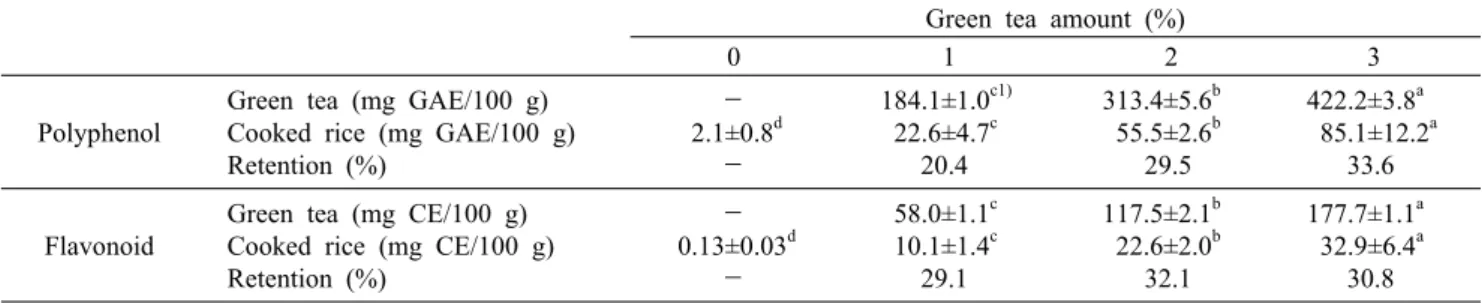
Table 1. Total polyphenol and total flavonoid contents of green tea and cooked rice with green tea Green tea amount (%)
0 1 2 3
Polyphenol
Green tea (mg GAE/100 g) Cooked rice (mg GAE/100 g) Retention (%)
- 2.1±0.8d
-
184.1±1.0c1) 22.6±4.7c 20.4
313.4±5.6b 55.5±2.6b
29.5
422.2±3.8a 85.1±12.2a 33.6
Flavonoid
Green tea (mg CE/100 g) Cooked rice (mg CE/100 g) Retention (%)
- 0.13±0.03d
-
58.0±1.1c 10.1±1.4c 29.1
117.5±2.1b 22.6±2.0b
32.1
177.7±1.1a 32.9±6.4a 30.8 Each value is expressed as the mean±standard deviation (n=3).
1)Means with different letters within the same row are significantly different (P<0.05).
β-Carotene bleaching test
β-Carotene-linoleic acid system을 이용한 항산화 효 과의 측정은 Elzaawely 등(24)의 방법을 변형하여 측정하 였다. Chloroform 50 mL에 β-carotene 25 mg을 용해한 후 round bottom flask에 β-carotene 용액 3 mL를 취하고 40°C 이하의 온도에서 rotary evaporator를 이용하여 chloroform을 제거하였다. 제거한 플라스크에 linoleic acid 40 mg, Tween 40 40 mg 및 증류수 100 mL를 첨가하여 격렬히 진탕하여 emulsion 용액을 제조하였다. 이 emul- sion 용액 3 mL에 시료 추출물 200 μL를 첨가하여 50°C의 수조에서 1시간 동안 반응시킨 후, 470 nm에서의 반응 전의 흡광도와 반응 후의 흡광도를 통해 지질의 과산화 억제능력 을 측정하였다.
물성 측정
녹차분말의 첨가조건에 따른 취반한 밥의 물성은 Lee (25)의 방법을 변형하여 물성 측정기(TA.XTExpress en- hanced, Stable Micro System, Surrey, UK)를 이용하여 측정하였다. 측정은 취반 후 완전립 상태의 밥알을 3개씩 선별하여 10회 이상 반복실험을 진행하였다. 물성은 hard- ness를 포함하여 7항목의 물성을 조사하였다. 기기의 측정 조건은 texture profile analysis(TPA)를 통해 20 mm의 cylinder probe를 이용하여 pre-test speed 0.5 mm/s, return speed 0.5 mm/s, trigger 10 g, test distance 2.0 mm, test speed 0.5 mm/s의 조건으로 측정하였다.
자료분석 및 통계처리
통계분석은 SAS ver. 9(SAS Institute, Cary, NC, USA) 소프트웨어를 이용하여 실시하였다. 데이터 간의 유의차는 one way ANOVA의 Duncan’s multiple range test를 통해 P<0.05 수준에서 검증하였다.
결과 및 고찰
취반 시 녹차분말의 첨가에 따른 폴리페놀 및 플라보노이 드 함량 변화
녹차분말의 첨가 수준에 따른 쌀밥의 폴리페놀과 플라보
노이드의 함량 변화를 분석하였다. 녹차분말을 첨가한 쌀밥 의 폴리페놀 및 플라보노이드의 함량은 취반한 쌀밥을 동결 건조 한 후 메탄올 추출을 통해 그 함량을 분석하여 mg 수준 으로 나타내었다(Table 1). 이전 연구를 통해 곡류의 추출물 제조 시 메탄올을 사용하였을 때 추출물의 항산화 활성이 가장 높게 나타났다. 따라서 본 연구에서도 추출물을 제조하 기 위해 메탄올을 추출용매로 사용하였다(18). 취반 시 물을 3%의 녹차물로 대체하여 조리하였을 때 폴리페놀의 함량이 85.1 mg GAE/100 g의 함량을 보였으며 플라보노이드는 32.9 mg CE/100 g의 함량을 나타내었다(Table 1). 녹차를 첨가하지 않은 쌀밥에서는 폴리페놀과 플라보노이드의 함 량이 매우 낮게 검출되었다. 또한, 폴리페놀과 플라보노이드 의 함량은 첨가된 녹차분말의 농도에 따라서 증가하는 경향 을 보였다. 이때 첨가된 녹차분말에 함유된 폴리페놀 및 플 라보노이드의 함량은 취반 후 잔존하는 함량과 비교 시 약 70%의 손실을 보였다. 취반 후 항산화 성분의 높은 손실률 을 나타내는 것은 조리 과정에서 발생하는 고온 및 고압으로 인한 폴리페놀과 플라보노이드의 파괴 및 산화로 야기되는 것으로 생각된다(26).
페놀성 화합물은 식물계에 널리 분포되어 있는 2차 대사 산물의 하나로서 다양한 구조와 분자량을 갖는 물질로 이들 은 phenolic hydroxyl기를 가지고 있으므로 단백질 및 기타 거대분자들과 쉽게 결합할 수 있는 특징을 갖고 있으며 이로 인해 다양한 생리활성을 갖는다(27). 녹차는 다량의 폴리페 놀 성분을 함유하는 것으로 보고되고 있으며 그중에서도 플 라보노이드 물질의 일종인 카테킨류가 녹차의 주요 생리활 성 물질로 알려져 있다. 이러한 카테킨류 성분들은 강한 항 산화력을 나타낼 뿐만 아니라 다양한 생리활성 기능을 나타 내는 것으로 보고되고 있다(28). 따라서 취반 시 녹차분말의 첨가는 쌀밥에 폴리페놀의 함량을 증가시킴으로써 다양한 생리활성 효과를 증진할 수 있을 것으로 예상한다.
취반 시 녹차분말의 첨가에 따른 항산화 활성 변화 쌀밥의 취반 시 녹차분말의 첨가에 따른 항산화 활성의 변화를 측정하였다. 실험에 사용한 시료는 동결건조 후 메탄 올 추출물을 제조하여 항산화 실험을 진행하였다. 추출물의 항산화력을 DPPH와 ABTS 라디칼 소거능 및 환원력과 지
0 2 4 6 8
0% 1% 2% 3%
DPPH radical scavenging activity . mg TEAC/10 mg extract .
d
A
a b
c
0 2 4 6 8
0% 1% 2% 3%
ABTS radical scavenging activity . mg TEAC/10 mg extracts .
a
b
d
c
B
Fig. 1. DPPH (A) and ABTS (B) radical scavenging activity of methanolic extract cooked rice with green tea power. Values are the mean±standard deviation (n=3). Results were analyzed by ANOVA, Duncan’s multiple range test. Means with different letters (a-d) above the bars are significantly different (P<0.05).
0 0.3 0.6 0.9 1.2 1.5
0% 1% 2% 3%
Reducing power (Abs at 700 nm) .
d
A a
b
c
0 10 20 30 40 50 60
0% 1% 2% 3% Trolox
1.5mM
Inhibition of llipid peroxidation (%) .
d
B a
b
bc c
Fig. 2. Reducing power (A) and inhibition of lipid peroxidation (B) of methanolic extract cooked rice with green tea power. Values are the mean±standard deviation (n=3). Results were analyzed by ANOVA, Duncan’s multiple range test. Means with different letters (a-d) above the bars are significantly different (P<0.05).
Table 2. Texture parameters measured on cooked rice under different concentrations of green tea power Green tea amount (%)
0 1 2 3
Hardness (g) Adhesiveness (g・s) Springiness Chewiness Gumminess Cohesiveness Resilience
1,314.9 -166.9 0.774 412.4 537.4 0.411 0.207
±359.9
±72.2
±0.087
±91.2
±128.4
±0.027
±0.021
2,308.8 -219.4 0.708 507.1 694.8 0.414 0.212
±144.049
±89.5
±0.081
±222.2
±263.5
±0.035
±0.033
1,692.6 -200.6 0.705 458.6 657.6 0.389 0.201
±443.0
±86.6
±0.138
±155.0
±182.9
±0.030
±0.017
1,773.8 -140.8 0.656 478.1 711.5 0.402 0.214
±528.8
±65.3
±0.151
±217.5
±220.8
±0.029
±0.022 Each value is expressed as the mean±standard deviation (n=10).
질의 과산화 억제능력을 통해 측정하였다. 그 결과 녹차분말 을 첨가하지 않은 쌀밥에서는 DPPH와 ABTS 라디칼 소거 능을 보이지 않은 반면에 녹차분말을 첨가하였을 때는 첨가 한 녹차분말에 농도 의존적으로 라디칼 소거능력이 증가하 는 것으로 나타났다(Fig. 1). 이러한 결과는 첨가된 녹차분 말의 농도에 따라 증가한 폴리페놀과 플라보노이드의 함량 에 의한 효과로 생각된다. DPPH와 ABTS 라디칼 소거능의 실험에서 실험 결과의 차이는 각각의 항산화 메커니즘의 차 이로 인해 발생한 것으로 판단된다(29). 생체 내의 free 라 디칼은 반응성이 강해 여러 생체물질과 쉽게 반응하여 체내
조직의 손상을 일으키거나 DNA의 변성을 유발하는 것으로 보고되고 있다(30). 따라서 라디칼 소거능을 이용한 항산화 력의 측정은 항산화력을 갖는 새로운 소재의 개발에 있어서 많이 이용되고 있다.
메탄올 추출물의 환원력을 측정한 결과 DPPH와 ABTS 라디칼 소거능과 마찬가지로 녹차분말의 첨가 농도에 의존 적으로 환원력이 증가하는 경향을 보였다(Fig. 2A). 또한, linoleic acid의 자동산화시스템을 이용하여 메탄올 추출물 의 지질과산화 억제효과를 측정하였다. Fig. 2B에 나타난 바와 같이 녹차분말을 3% 첨가하였을 때 억제능력이 28.25
%로 가장 높게 나타내었다. 이를 통해 생체막의 구성 지방산 의 하나인 linoleic acid의 산화를 억제함에 따라서 녹차분말 을 첨가한 밥은 생체 내에서 산화적 스트레스에 의해 유도되 는 여러 만성질환에 대하여 예방할 수 있는 좋은 식품이 될 수 있을 것으로 생각된다.
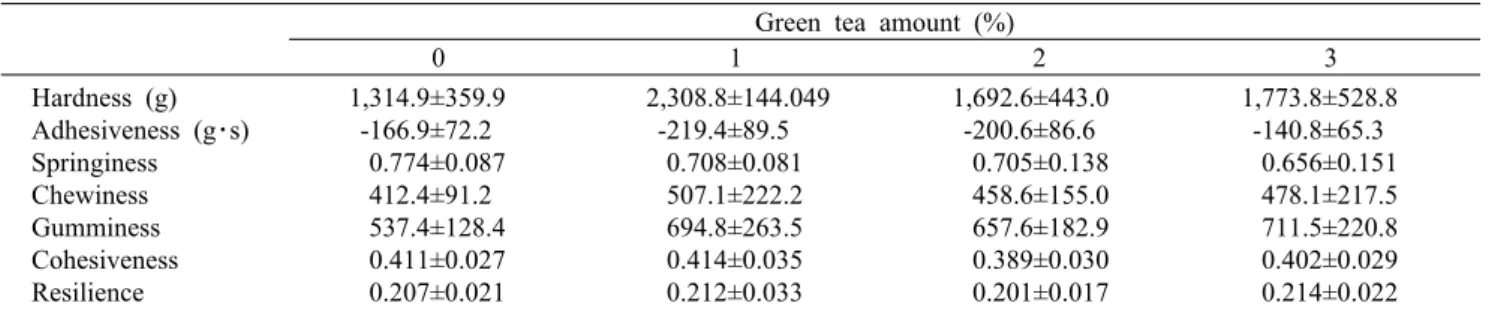
취반 시 녹차분말의 첨가에 따른 쌀밥의 물성 변화 녹차분말을 첨가하여 취반한 쌀밥의 물성을 측정한 결과 는 Table 2와 같았다. 물성을 측정한 결과 녹차분말을 농도 별로 첨가하여 취반하였을 때 쌀밥의 기계적 물성에 있어서 유의적인 차이를 보이지 않았다. 이는 취반 시 가수율이 쌀 밥의 조직에 영향을 미칠 수 있다고 보고한 결과(25)와 비교 하여 녹차분말을 첨가하여 취반하였을 때에는 녹차분말의 농도와 관계없이 쌀의 호화가 일어난다는 것을 알 수 있다.
이때 쌀의 호화과정에서 녹차분말이 영향을 미치지 않음으 로써 취반 후에도 쌀밥의 물성에 영향을 미치지 않았다. 따 라서 이러한 결과를 통해 취반 시 녹차분말을 첨가하여도 기존의 쌀밥과 식감의 차이가 나지 않을 것으로 생각된다.
요 약
본 연구는 소비자가 추구하는 기능성 식품의 다양한 개발을 위해 녹차를 쌀밥에 접목시킴으로써 녹차의 생리활성이 부 여된 기능성 쌀밥의 개발 가능성 검토를 위해 실시하였다.
녹차분말을 첨가한 쌀밥의 항산화 활성과 생리활성 물질의 변화 및 물성 변화를 알아보기 위해 취반 시 사용되는 물에 녹차분말을 1, 2, 3%로 첨가하여 취반하였다. 이후 제조된 밥은 동결건조 후 메탄올 추출물을 이용하여 항산화 성분 및 항산화 활성을 분석하였다. 또한, 취반 후 물성을 측정하 여 그 변화를 알아보았다. 취반 후 녹차분말의 함량이 증가 할수록 폴리페놀과 플라보노이드의 함량이 농도 의존적으 로 증가하는 경향을 보였다. 쌀밥의 항산화 활성은 첨가한 녹차분말의 농도에 의존적으로 ABTS 및 DPPH 라디칼 제 거능력이 증가하는 경향을 보였으며 환원력 및 지질과산화 억제 효과에서도 첨가된 녹차분말에 의존적으로 활성이 증 가하였다. 반면 녹차분말을 첨가한 쌀밥의 물성을 측정한 결과 녹차를 첨가하였을 때 경도가 증가하는 경향을 보였으 나 유의적인 차이를 보이지 않았다. 이 연구 결과를 통해 녹차분말을 첨가하여 취반할 경우 식감을 유지하면서 녹차 의 생리활성 물질도 부여할 수 있어 기능성 쌀 가공식품으로 서의 적극적인 활용이 가능할 것으로 생각된다.
감사의 글
본 연구는 농촌진흥청의 연구비 지원(과제번호 PJ011037) 에 의해 수행되었으며 이에 감사드립니다.
REFERENCES
1. Han SH, Choi EJ, Oh MS. 2000. A comparative study on cooking qualities of imported and domestic rices (Chuchung byeo). Korean J Soc Food Sci 16: 91-97.
2. Kim JH, Nam SH, Kim MH, Sohn JK, Kang MY. 2007.
Cooking properties of rice with pigmented rice bran extract.
Korean J Crop Sci 52: 60-68.
3. Kim DY. 1989. The status and prospect of Korean green tea. Food Science and Industry 22(3): 2-12.
4. Graham HN. 1992. Green tea composition, consumption, and polyphenol chemistry. Prev Med 21: 334-350.
5. Kang ST, Yoo UH, Nam KH, Kang JY, Oh KS. 2007.
Antioxidative effects of green tea extract on the oxidation of anchovy oil. J Agric Life Sci 41(3): 47-53.
6. Chung FL, Schwartz J, Herzog CR, Yang YM. 2003. Tea and cancer prevention: studies in animals and humans. J Nutr 133: 3268S-3274S.
7. Hodgson JM, Puddey IB, Burke V, Beilin LJ, Mori TA, Chan SY. 2002. Acute effects of ingestion of black tea on postprandial platelet aggregation in human subjects. Br J Nutr 87: 141-145.
8. Negishi H, Xu JW, Ikeda K, Njelekela M, Nara Y, Yamori Y. 2004. Black and green tea polyphenols attenuate blood pressure increases in stroke-prone spontaneously hyperten- sive rats. J Nutr 134: 38-42.
9. Wang ZY, Cheng SJ, Zhou ZC, Athar M, Khan WA, Bickers DR, Mukhtar H. 1989. Antimutagenic activity of green tea polyphenols. Mutat Res Genet Toxicol 223: 273-285.
10. Sung H, Nah J, Chun S, Park H, Yang SE, Min WK. 2000.
In vivo antioxidant effect of green tea. Eur J Clin Nutr 54:
527-529.
11. Sabu MC, Smitha K, Kuttan R. 2002. Anti-diabetic activity of green tea polyphenols and their role in reducing oxidative stress in experimental diabetes. J Ethnopharmacol 83: 109- 116.
12. Heo HY, Joo NM, Han YS. 2004. Optimization of jelly with addition of green tea powder using a response surface methodology. Korean J Food Cook Sci 20: 112-118.
13. Hwang SY, Choi OK, Lee HJ. 2001. Influence of green tea powder on the physical properties of the bread flour and dough rheology of white pan bread. Korean J Food Nutr 14: 34-39.
14. Im JG, Kim YH. 1999. Effect of green tea addition on the quality of white bread. Korean J Soc Food Sci 15: 395-400.
15. Hong HJ, Choi JH, Yang JA, Kim GY, Rhee SJ. 1999.
Quality characteristics of Seolgiddeock added with green tea powder. Korean J Soc Food Sci 15: 224-230.
16. Roh HJ, Shin YS, Lee KS, Shin MK. 1996. Effect of water extract of green tea on the quality and shelf life of cooked rice. Korean J Food Sci Technol 28: 417-420.
17. Miles CW, Ziyad J, Bodwell CE, Steele PD. 1984. True and apparent retention of nutrients in hamburger patties made from beef or beef extended with three different soy proteins.
J Food Sci 49: 1167-1170.
18. Seo SJ, Chol Y, Lee SM, Kong S, Lee J. 2008. Antioxidant activities and antioxidant compounds of some specialty rices. J Korean Soc Food Sci Nutr 37: 129-135.
19. Turkmen N, Sari F, Velioglu YS. 2006. Effects of extraction solvents on concentration and antioxidant activity of black and black mate tea polyphenols determined by ferrous tar- trate and Folin-Ciocalteu methods. Food Chem 99: 835-841.
20. Zhishen J, Mengcheng T, Jianming W. 1999. The determi- nation of flavonoid contents in mulberry and their scaveng-
ing effects on superoxide radicals. Food Chem 64: 555-559.
21. Dietz BM, Kang YH, Liu G, Eggler AL, Yao P, Chadwick LR, Pauli GF, Farnsworth NR, Mesecar AD, van Breemen RB, Bolton JL. 2005. Xanthohumol isolated from Humulus lupulus inhibits menadione-induced DNA damage through induction of quinone reductase. Chem Res Toxicol 18: 1296- 1305.
22. Re R, Pellegrini N, Proteggente A, Pannala A, Yang M, Rice-Evans C. 1999. Antioxidant activity applying an im- proved ABTS radical cation decolorization assay. Free Radic Biol Med 26: 1231-1237.
23. Mau JL, Lin HC, Song SF. 2002. Antioxidant properties of several specialty mushrooms. Food Res Int 35: 519-526.
24. Elzaawely AA, Xuan TD, Tawata S. 2005. Antioxidant and antibacterial activities of Rumex japonicus HOUTT. Aerial parts. Biol Pharm Bull 28: 2225-2230.
25. Lee SJ. 1996. Water addition ratio affected texture proper- ties of cooked rice. J Korean Soc Food Sci Nutr 25: 810-
816.
26. Volf I, Ignat I, Neamtu M, Popa VI. 2014. Thermal stability, antioxidant activity, and photo-oxidation of natural poly- phenols. Chem Pap 68: 121-129.
27. Lee SO, Lee HJ, Yu MH, Im HG, Lee IS. 2005. Total poly- phenol contents and antioxidant activities of methanol ex- tracts from vegetables produced in Ullung island. Korean J Food Sci Technol 37: 233-240.
28. Rhee SJ, Kim KR, Kim HT, Hong JH. 2007. Effects of cat- echin on lipid composition and adipose tissue in obese rats fed high fat diet. J Korean Soc Food Sci Nutr 36: 540-547.
29. Kim JB, Ki JM, Lee YM, Baek IS, Lee SC. 2014. Antiox- idant activity and acetylcholinesterase inhibitory activity of ark shell (Scapharca broughtonii). Korean J Food Cook Sci 30: 212-218.
30. Machlin LJ, Bendich A. 1987. Free radical tissue damage:
protective role of antioxidant nutrients. FASEB J 1: 441-445.