INTRODUCTION
The core strength of the elderly has a close relationship with the bal- ance ability in daily life (Akuthota & Nadler, 2004; Granacher, Gollhofer, Hortobágyi, Kressig, & Muehlbauer, 2013; Koh, Park, Park, Hong, & Shim, 2016). Most falls occur as a result of loss of stability during daily life activities, such as sit-to-stand movement (Pavol, Runtz, Edwards, & Pai, 2002), simply turning around movement (Nevitt, Cummings, & Hudes, 1991). Core muscle plays an important role on to perform movements that requires dynamic balance capabilities such as walking, running, and stair climbing (Willardson, 2007; Willardson, Fontana, & Bressel, 2009).
Core muscles are a kinetic link that facilitates the transfer of torque and momentum between the upper and lower extremities during activities
of daily living (Behm, Drinkwater, Willardson, & Cowley, 2010). Previous studies have suggested that the core strengthening of the elderly through trainings improves a "Short Physical Performance Battery (SPPB)"
score for activities in daily function (Johnson, Larsen, Ozawa, Wilson, &
Kennedy, 2007; Suri, Kiely, Leveille, Frontera, & Bean, 2009), spinal mobility, and balance and functional mobility (Granacher et al., 2013).
Stability can be predicted based on physical constraints such as muscle strength, size of base of support, and floor surface contact forces with- in an environment (Pai & Patton, 1997). In particular, during balance performance, the primary goal is to control the whole-body center of mass (WCM) in relation to base of support (Lugade, Lin, & Chou, 2011;
Shumway-Cook, Brauer, & Woollacott, 2000). Even though core strength may be highly associated to ability to control WCM for the stabilization
6Department of Mechanical Engineering, Kyunghee University, Global Campus, Kyung-gi, South Korea
Received : 10 November 2018 Revised : 03 January 2019 Accepted : 04 January 2019
Corresponding Author Yang Sun Park
Department of Physical Education, College of Performing Arts and Sports, Hanyang University, #318 Olympic Gym, 222 Wangshimni-ro, Seongdong-gu, Seoul, 04763, South Korea
Tel : +82-2-2220-4199 Fax : +82-2-2220-1337 Email : [email protected]
Objective: The purpose of this study was to examine the effect of the core muscle strength enhancement of the elderly on 8 weeks training using the core exercise equipment for the elderly on the ability to control the whole-body center of mass in posture stabilization.
Method: 16 females (10 exercise group, 6 control group) participated in this study. Exercise group took part in the core strength training program for 8 weeks with total of 16 repetitions (2 repetitions per week) using a training device. External perturbation during standing as pulling force applied at the pelvic level in the anterior direction was provided to the subject. In a UCM model, the controller selects within the space of elemental variables a subspace (a manifold, UCM) corresponding to a value of a performance variable that needs to be stabilized. In the present study, we were interested in how movements of the individual segment center of mass (elemental variables) affect the whole-body center of mass (the performance variable) during balance control.
Results: At the variance of task-irrelevant space, there was significant test * group interactions (F1,16=7.482, p<.05). However, there were no significant main effect of the test (F1,16=.899, p>.05) and group (F1,16=1.039, p>.05). At the variance of task-relevant space, there was significant test * group interactions (F1,16=7.382, p<.05). However, there were no significant main effect of the test (F1,16=.754, p>.05) and group (F1,16=1.106, p>.05).
Conclusion: The results of this study showed that the 8 weeks training through the core training equipment for the elderly showed a significant decrease in the and . This result indicates that the core strength training affects the trunk stiffness control strategy to maintain balance in the standing position by minimizing total variability of individual segment CMs.
Keywords: Uncontrolled manifold analysis, Elderly, Core training, Whole body CoM, Segment CoMs
of balance, much attention has been paid to strengths and functional performance in the elderly. However, it is little known whether the core strength training of the elderly improves the control ability of stability.
The central nervous system (CNS) controls balance of human body to coordinate multiple segments for the stabilization of the WCM. The location of the WCM is determined by the position and orientation of these segments. This multi-segment system yields significantly higher degrees of freedom than the dimension of the WCM coordinates and therefore causes the difficulty in regulating and coordinating these seg- ments (Hsu, Chou, & Woollacott, 2013). Previous studies investigated that age-related differences in multi joint coordination to control the WCM during balance recovery (Wu, McKay, & Angulo-Barroso, 2009), and also investigated how children utilize the variability of multiple body segment movement to facilitate the control during quiet stance (Hsu et al., 2013). However, to our knowledge, no study has been conducted to examine how elderly core strength training utilize the variability of multiple body segments to facilitate the control of the WCM during quiet standing.
The uncontrolled manifold (UCM) approach has been employed in studying multi joint coordination in recent postural control research (Hsu, Scholz, Schoner, Jeka, & Kiemel, 2007; Latash, Krishnamoorthy, Scholz, & Zatsiorsky, 2005; Scholz & Schöner, 1999). The UCM analysis provides decomposition of movement variability of multi joints into task-irrelevant (variance in Uncontrolled manifold space, VUCM) and task-relevant (variance in orthogonal space to the uncontrolled mani- fold space, VORT) variabilities to explain the stabilization of WCM in terms of multi-segment system (Schoner, 1995; Scholz & Schöner, 1999;
Krishnamoorthy, Yang, & Scholz, 2005; Hsu et al., 2007). The purpose of this study was to examine the effect of the core muscle strength enhancement of the elderly on 8 weeks training using the core exercise equipment for the elderly on the ability to control the WCM in posture stabilization.
METHODS
16 female (10 exercise group: mean age: 75±5 yrs; mean mass: 62±
8 kg; mean height: 151±7 cm, 6 control group: mean age: 77±5 yrs;
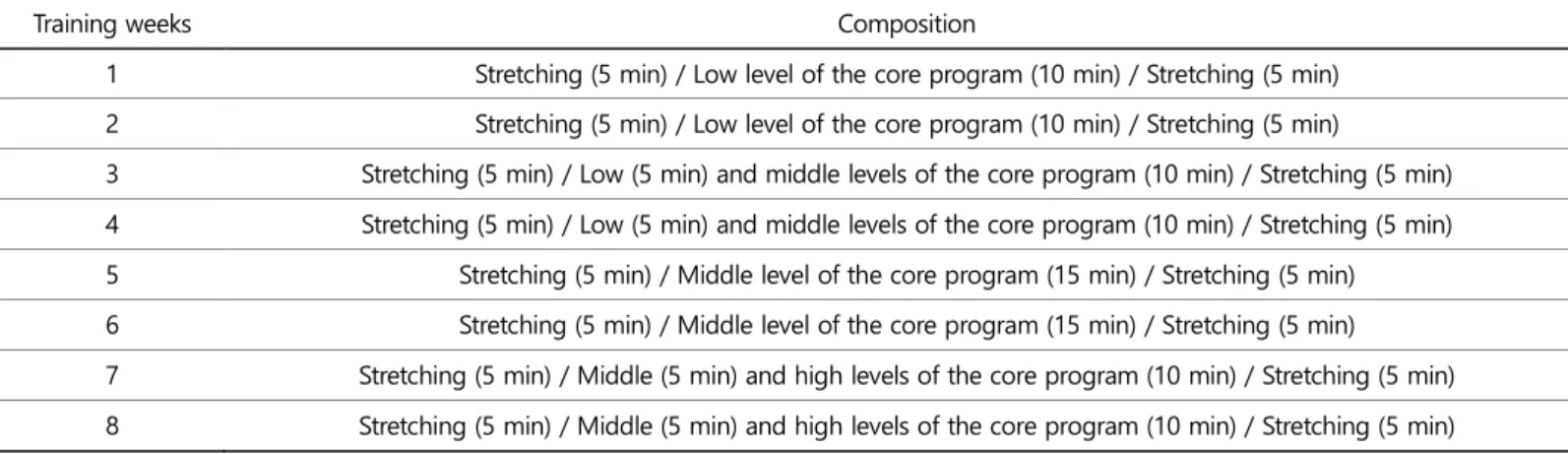
mean mass: 61±8 kg; mean height: 150±8 cm) with no history of mus- cular skeletal disease or injuries were recruited for this study. Exercise group took part in the core strength training program for 8 weeks with total of 16 repetitions (2 repetitions per week) using a training device (Figure 1-A). The training device we developed was useful for streng- thening the core trunk muscles by inducing instability on the surface of the subject's seat (gym ball shaped) while performing upper limb ex- ercise only (pulling on the arms). All participants performed full body stretching for five minutes before and after the training to prevent injury. Major training was conducted separately by low, middle and high level. The level of training was divided into the number of movements per song in which the arms were pulled and held. The low level was set to 44 times per song, the middle level was 74 times, and the high level was set to 128 times on average. The detail of the training program is shown in (Table 1). The equipment was easy to maneuver by the elderly and could provide information of the center of gravity as exercise feedback during core muscle exercise (Koh et al., 2016). This study was approved by the institutional review board (IRB) at Hanyang University.
In this study, six infrared high-speed cameras were used to capture movements during stimulation (100 field/sec, Shutter speed 1/500, 6Hz low pass filter), 19 reflection markers were attached to each subject's body and the position of the WCM was obtained. The focus of this study was on control of the anterioi-posterior (AP) position of the WCM because the perturbation direction was anterior. The tester instructed the subjects not to lean against the spring connected to a belt at the waist. The examiner instructed the subject to gaze forward while main- taining a standing posture with both arms naturally lowered within the basal plane. To unify the subjects' position, the location of the feet were presented shoulder width and then stood naturally. Perturbation stimu- lation was given in the form of a waist-pull in which the line connected Figure 1. (A) shows a core exercise training equipment for elderly. (B) shows an experiment setup using a perturbation device.
to the belt worn on the waist was pulled as far as possible in the front and back direction of the subject due to the force of the spring con- nected to the motor. Subjects were instructed to try to maintain their balance from moving as much as possible when external perturbation stimuli came. Motor-driven anterior waist-pull perturbations were given twice at a random time interval. The time profile of the perturbation force was 400 ms ramp up to target force of 30 N (Figure 1-B). All measurements were performed before and after training.
The obtained position data were analyzed by using Kwon 3d XP soft- ware (VISOL, Inc., Seoul, Korea) for WCM and center of mass of 14 in- dividual segments (head, trunk, upper arm, fore arm, thigh, shank and foot)(CM). In a UCM model, the controller selected within the space of elemental variables a subspace corresponding to a value of a perfor- mance variable that needs to be stabilized. In the present study, we were interested in how movements of the individual segment CM (elemental variables) affect the WCM position (the performance variable) during balance recovery. Analysis phase was defined as period from onset perturbation to after 2 sec. MatLAB programs (MatLAB 7, MathWorks, Inc., Natick, MA, USA) were written for data processing and analysis.
Whole-body center of mass ( ) was computed by weighted sum- mation of segment's center of mass ( )
= ∙
where is a 1 by n matrix with the ith element, ∑ and is an n by 1 matrix for positions.
UCM analysis is a linear transformation that transform the element variables (i.e. segment's ) into task-relevant and task-irrelevant spaces where the performance variable (i.e. ) is affected or unaffected, respectively.
The task-irrelevant space was determined by the null space spanned by the basis vector
0 = ∙
Segment's in task-irrelevant space ( ) was obtained through projection of segment's onto the null space
= ∙
and the component perpendicular to the null space, segment's in task-relevant space ( was obtained as follows:
= −
where and are the DOFs of the element variable and the perfor- mance variable, respectively.
The amount of variability of in each space was estimated as vari- ance normalized by its DOF as:
= !"
= !"
Data were processed by using IBM SPSS Statistics 21.0, two way re- peated measures ANOVA was used to verify the difference between the test (pre and post) and groups (exercise and control). For the post hoc test, a paired t-test used to compare the test (pre and post), and an independent t-test was performed to compare between the groups (exercise and control). The significance level of all statistics was set at p<.05.
RESULTS
Figure 2 shows the results of and of two groups over 8 weeks of core training in the elderly. At the variance of task-irrelevant space, there was significant difference in test * group interactions (F1,16
=7.482, p<.05). However, there were no significant main effect of the test (F1,16=.899, p>.05), group (F1,16=1.039, p>.05) (Figure 2-A) and post-hoc test. At the variance of task-relevant space, there were signifi-
cant test * group interactions (F1,16=7.382, p<.05). However, there were no significant main effect of the test (F1,16=.754, p>.05), group (F1,16= 1.106, p>.05) (Figure 2-B), and post-hoc test.
DISCUSSION
The purpose of this study was to examine the effect of the core muscle strength enhancement of the elderly on 8 weeks training using the core exercise equipment for the elderly on the ability to control the WCM in posture stabilization during external perturbation. The results of this study showed that the 8 weeks training through the core training equipment for the elderly showed a significant decrease in the
and .
One of the characteristics of the elderly is that as the aging process progresses, the task-irrelevant variability (i.e. VUCM) decreases and the task-relevant variability (i.e. VORT) increases (Park, Sun, Zatsiorsky, & Latash, 2011; Verrel, Lövdén, & Lindenberger, 2012; Hsu et al., 2013). Previous study has found that during a constant force production task with four fingers, the task-relevant variability of the finger forces increased when the finger force and moment are controlled by the elderly (Park et al., 2011). Also, it was reported that the elderly deteriorated the ability to coordinate multi joint for stabilization of the WCM by decreasing the task-irrelevant variability and increasing the task-relevant variability (Hsu et al., 2013). Verrel et al. (2012) also found that the elderly decreased the task-irrelevant variability during one arm pointing task. This study shows that the task-relevant variability (i.e. VORT) decreases. We sug- gested that the exercise effect through the movement of the core re- duced the error value while the elderly maintained the center.
Previous study demonstrated the training effects of core exercise equipment for elderly (Koh et al., 2016). This study reported that im- proving the ability to maintain the center of pressure in the center after the core strength training. The results of daily function test showed a significant improvement in SPPB score (going up and down 4 stairs and the gait speed), rising from a chair 5 times and one-leg static balance test with open eyes. In the current study, we found that both and decreased after core strength training. and
refers to the variability of individual segment CMs which does not affect and does affect changes in the WCM, respectively. Based on the results from the previous study and the decreased variability in present study, these results indicates that the core strength training affects the trunk stiffness control strategy to maintain balance in the standing position by minimizing total variability of individual segment CMs.
Previous studies found that the effect of core muscle training increase the stiffness of trunk muscles (Bergmark, 1989; Panjabi, 1991). It was also reported that increasing the stiffness of the joint or muscle is highly related to the stability of the posture. Several studies have suggested that an increase in joint stiffness due to muscle co-contraction might improve lower limb stability and motion (Gribble & Ostry, 1999; Koshland, Galloway, & Nevoret-Bell, 2000; Lacquaniti & Maioli, 1989; Osu et al., 2002; Thoroughman & Shadmehr, 1999). In addition, other stiffness studies have also been reported that the stiffness of the calf muscles has highly influenced on the stability of dynamic movements (Nashner, 1976; Winter, Patla, Prince, Ishac, & Gielo-Perczak, 1998; Winter, Patla, Rietdyk, & Ishac, 2001). Thus, in the current study, the core exercise effect may affect the stiffness of joints (especially hip joints) related to trunk muscle, mullus muscle, and gluteus maximus, leading to the re- duction of total variability of individual segment CMs.
According to Haiil et al. (1999), excessive variability could reflect in- juries or disease and altering motor control patterns. In Hsu et al. (2007) study, movement variability reflects flexible control of exercise perfor- mance. In order to adapt to the pattern of movement, the elderly may need to have appropriate amount of movement variability (Harbourne
& Stergiou, 2009). In the consistent with findings in the previous studies, our findings in the current study suggested that the effect of core strength training improves balance ability in the elderly by minimizing total variability of individual segment CMs. In conclusion, the core ex- ercise training effect may contribute to the stiffness of the muscle and joint of the elderly, leading to the reduction of the movement variability at an optimal level to maintain the posture.
The limitation of this study is that the analysis of the UCM of the WCM analysis in each segment CMs has not been analyzed as a re- lational relationship. These restrictions are thought to have to be done Figure 2. The results of (A) and (B). (*, p<.05; interaction between test and group).
REFERENCES
Akuthota, V. & Nadler, S. F. (2004). Core strengthening1. Archives of Physical Medicine and Rehabilitation, 85, 86-92.
Behm, D. G., Drinkwater, E. J., Willardson, J. M. & Cowley, P. M. (2010). The use of instability to train the core musculature. Applied Physiology, Nutrition, and Metabolism, 35(1), 91-108.
Bergmark, A. (1989). Stability of the lumbar spine: a study in mechanical engineering. Acta Orthopaedica Scandinavica, 60(sup230), 1-54.
Granacher, U., Gollhofer, A., Hortobágyi, T., Kressig, R. W. & Muehlbauer, T. (2013). The importance of trunk muscle strength for balance, functional performance, and fall prevention in seniors: a systematic review. Sports Medicine, 43(7), 627-641.
Gribble, P. L. & Ostry, D. J. (1999). Compensation for interaction torques during single-and multijoint limb movement. Journal of Neuro- physiology, 82(5), 2310-2326.
Harbourne, R. T. & Stergiou, N. (2009). Movement variability and the use of nonlinear tools: principles to guide physical therapist practice.
Physical Therapy, 89(3), 267-282.
Hsu, W.-L., Chou, L.-S. & Woollacott, M. (2013). Age-related changes in joint coordination during balance recovery. Age, 35(4), 1299-1309.
Hsu, W.-L., Scholz, J. P., Schoner, G., Jeka, J. J. & Kiemel, T. (2007). Control and estimation of posture during quiet stance depends on multi- joint coordination. Journal of Neurophysiology, 97(4), 3024-3035.
Johnson, E. G., Larsen, A., Ozawa, H., Wilson, C. A. & Kennedy, K. L.
(2007). The effects of Pilates-based exercise on dynamic balance in healthy adults. Journal of Bodywork and Movement Therapies, 11(3), 238-242.
Koh, K., Park, Y. S., Park, D. W., Hong, C. K. & Shim, J. K. (2016). Develop- ment of Core Strength Training Equipment and Its Effect on the Performance and Stability of the Elderly in Activities of Daily Living.
Korean Journal of Sports Biomechanics, 26(2), 229-236.
Koshland, G. F., Galloway, J. C. & Nevoret-Bell, C. J. (2000). Control of the wrist in three-joint arm movements to multiple directions in the horizontal plane. Journal of Neurophysiology, 83(5), 3188-3195.
Krishnamoorthy, V., Yang, J.-F. & Scholz, J. P. (2005). Joint coordination during quiet stance: effects of vision. Experimental Brain Research, 164(1), 1-17.
Lacquaniti, F. & Maioli, C. (1989). The role of preparation in tuning anti-
al. (2002). Short-and long-term changes in joint co-contraction associated with motor learning as revealed from surface EMG.
Journal of Neurophysiology, 88(2), 991-1004.
Pai, Y.-C. & Patton, J. (1997). Center of mass velocity-position predictions for balance control. Journal of Biomechanics, 30(4), 347-354.
Panjabi, M. (1991). The intersegmental and multisegmental muscles of the lumbar spine. A biomechanical model comparing lateral sta- bilizing potential.
Park, J., Sun, Y., Zatsiorsky, V. M. & Latash, M. L. (2011). Age-related changes in optimality and motor variability: an example of multi- finger redundant tasks. Experimental Brain Research, 212(1), 1-18.
Pavol, M. J., Runtz, E. F., Edwards, B. J. & Pai, Y.-C. (2002). Age influences the outcome of a slipping perturbation during initial but not re- peated exposures. The Journals of Gerontology Series A: Biological Sciences and Medical Sciences, 57(8), M496-M503.
Scholz, J. P. & Schöner, G. (1999). The uncontrolled manifold concept:
identifying control variables for a functional task. Experimental Brain Research, 126(3), 289-306.
Schoner, G. (1995). Recent developments and problems in human move- ment science and their conceptual implications. Ecological Psych- ology, 7(4), 291-314.
Shumway-Cook, A., Brauer, S. & Woollacott, M. (2000). Predicting the probability for falls in community-dwelling older adults using the Timed Up & Go Test. Physical Therapy, 80(9), 896-903.
Suri, P., Kiely, D. K., Leveille, S. G., Frontera, W. R. & Bean, J. F. (2009).
Trunk muscle attributes are associated with balance and mobility in older adults: a pilot study. PM&R, 1(10), 916-924.
Thoroughman, K. A. & Shadmehr, R. (1999). Electromyographic correlates of learning an internal model of reaching movements. Journal of Neuroscience, 19(19), 8573-8588.
Verrel, J., Lövdén, M. & Lindenberger, U. (2012). Normal aging reduces motor synergies in manual pointing. Neurobiology of Aging, 33(1), 200. e201-200. e210.
Willardson, J. M. (2007). Core stability training: applications to sports conditioning programs. The Journal of Strength & Conditioning Research, 21(3), 979-985.
Willardson, J. M., Fontana, F. E. & Bressel, E. (2009). Effect of surface sta- bility on core muscle activity for dynamic resistance exercises. In- ternational Journal of Sports Physiology and Performance, 4(1), 97 -109.
Winter, D. A., Patla, A. E., Prince, F., Ishac, M. & Gielo-Perczak, K. (1998).
Stiffness control of balance in quiet standing. Journal of Neuro- physiology, 80(3), 1211-1221.
Winter, D. A., Patla, A. E., Rietdyk, S. & Ishac, M. G. (2001). Ankle muscle stiffness in the control of balance during quiet standing. Journal
of Neurophysiology, 85(6), 2630-2633.
Wu, J., McKay, S. & Angulo-Barroso, R. (2009). Center of mass control and multi-segment coordination in children during quiet stance. Ex- perimental Brain Eesearch, 196(3), 329-339.