DOI http://dx.doi.org/10.7235/hort.2013.12225
아카풀코나리에서 Differential Slot Blot을 이용한 약발현 유전자 목록작성
서은정1*ㆍ유희주2ㆍ한봉희3ㆍ임용표4ㆍ정미정1ㆍ이성곤1ㆍ김동헌1ㆍ장안철1ㆍ예병우5
1농촌진흥청 국립농업과학원 농업생명자원부, 2가톨릭대학교 생명과학과, 3농업기술실용화재단 종자사업팀,
4충남대학교 원예학과, 5농촌진흥청 국립원예특작과학원 화훼과
Cataloguing of Anther Expressed Genes through Differential Slot Blot in Oriental Lily (Lilium Oriental Hybrid ‘Acapulco’)
Eun-Jung Suh1*, Hee Ju Yu2, Bong Hee Han3, Yong Pyo Lim4, Mi-Jeong Jeong1, Seong-Kon Lee1, Dong-hern Kim1, An-Cheol Chang1, and Byeong Woo Yae5
1Molecular Breeding Division, National Academy of Agricultural Science, Rural Development Administration, Suwon 441-857, Korea
2Department of Life Science, Catholic University, Bucheon 420-743, Korea
3Department of Seed Service, The Foundation of Agriculture Technology Commercialization and Transfer, Suwon 441-100, Korea
4Department of Horticulture, Chungnam National University, Daejeon 305-764, Korea
5Floriculture Research Division, National Institute of Horticultural & Herbal Science, Rural Development Administration, Suwon 441-440, Korea
Abstract. Anther is the major organ of flower in responsible to reproduction and outward appearance. From anther- specific cDNA library of Lilium Oriental Hybrid ‘Acapulco’, 2000 expressed sequence tags were selected randomly. Differential slot blot analysis with cDNA probes from the anther and leaf was used to get anther- expressed clone and 570 non-redundant ESTs were obtained and sequenced. Compared to the GenBank database using BLASTX algorithm, 191 clones showed significant similarity but others (66.5%) did not measured to known sequence. Functional categories according to gene ontology (GO) annotation included sequence representing a significant portion of protein in cell and cell part respectively. A transcriptional analysis at 7 different organs and developmental stage was performed using northern blot with thirty ESTs as putative anther specific gene.
This report suggest that selection of anther expressed clone using differential slot blot was considered as very effective tool and our current study can provide fundamental information on the lily anther including pollen furthermore.
Additional key words: anther, ESTs (expressed sequence tags)
*Corresponding author: [email protected]
※ Received 13 December 2012; Revised 9 April 2013; Accepted 6 May 2013. 본 연구는 농촌진흥청 어젠다 과제(과제번호 PJ0086162012) 연구비에 의해 이루어진 것임. Electronic supplementary material: The online version of this article (doi: http://dx.doi.org/10.7235/hort.2013.12225) contains supplementary material, which is available to authorized users.
ⓒ 2013 Korean Society for Horticultural Science
서 언
약은 개화식물에서 웅성생식을 담당하는 기관으로서 약 의 형태를 만들면서 약 내에서 화분을 생성하는 매우 복합 적으로 이루어지는 생화학적 과정이라고 할 수 있다. 약의 형태가 만들어질 때 약은 각각의 약주머니 안에서 감수분열
세포를 만들면서 안쪽에서 바깥으로 epidermis, endothecium, middle layer, tapetum의 조직을 만들어 약의 모양을 이루게 된다(Zhang et al., 2010b). 여러 단계의 과정을 거치는 동안 에 시기적, 공간적으로 수천 개의 유전자가 약에서 발현하 게 되는데 애기장대의 경우 약 3500개의 유전자가 약에서 발현한다고 하며 옥수수에서는 2000-7000개의 화분특이적
ISSN 1226-8763
Kor. J. Hort. Sci. Technol. 31(5):598-606, 2013
인 유전자가, 담배에서는 대략 10,000개의 유전자가 발현된 다(Chen et al., 1993).
ESTs(expressed sequencing tags)는 대량 염기서열 분석 기법을 기반으로 하여 동・식물에서 발현되는 유전자의 정보 를 수집해 목록을 작성하는 작업으로 1991년에 Adams et al.(1991)이 인간의 뇌로부터 만들어진 cDNA library에서 무 작위로 선택된 609개의 cDNA를 ESTs로 명명하면서 시작 되었다. 이후 database에 모아진 ESTs의 수는 급격하게 증 가하여 1995년 중반에 이미 GenBank에 등록된 ESTs의 수 가 일반 유전자의 수를 넘어섰고 2000년 6월에는 GenBank database의 62%를 차지하는 4천6백만 개가 ESTs인 것으로 확인되었다. 일반적으로 cDNA library로부터 생성된 ESTs 는 타켓으로 하는 기관의 모든 유전자를 표현할 수 있는 것 으로 알려져 있다. 그러나 실제로는 그때 그때 만들어지는 mRNA의 발현량에 따라 다르게 나타나 다량 발현되는 유전 자들이 중복적으로 선택되면서 상대적으로 발현량이 적은 유 전자의 경우 ESTs를 이용하여 유전자를 분석하는 효율이 떨 어지고 비용도 증가하게 된다(Bonaldo et al., 1996; Fernández et al., 2003). 이를 해결하기 위해서 cDNA를 normalization 을 거쳐서 사용하거나(Ko, 1990; Patanjali et al., 1991; Soares et al., 1994), subtractive hybridization 기법을 사용하여 많이 발현하는 유전자를 제거하여 특정 유전자만을 회수하여 분 석하는 방법이 시도되기도 했다(Bonaldo et al., 1996; Hays et al., 2001). 이외에도 DNA dot blot hybridization을 이용 하여 ESTs 중 novel한 유전자를 찾기 위한 시도도 있었는데 (Lee et al., 1998) 배추에서 약 특이적인 유전자를 이 방법 을 통해 얻은 바 있다(Kim et al., 1997). 현재까지 작물의 약 에 관련된 EST로는 옥수수의 sperm cell에서 1100개의 ESTs 가 발표되었으며(Ueda et al., 2000) 2006년에는 Okada가 generative cell에서 886개의 ESTs를 분리하였다(Okada et al., 2006). 이후 나리의 cDNA microarray를 통해 generative cell에서 대량 발현되는 전사체 목록을 작성하기도 했다(Okada et al., 2007).
나리는 전세계 절화용 화훼시장의 5%를 차지하는 작목 으로 나리류(Lilium spp)는 백합과, Lilium 속에 속하는 구근 식물로 주로 절화, 분화 및 정원용으로 이용되는데, 전 세계 에 130종의 나리속 식물이 자생하며 아시아에 71종, 유럽 및 러시아에 22종, 북아메리카에 37종이 각각 자생하고 있다 (Shimizu, 1987). 나리의 게놈 크기는 120,000Mb(Mayer and Mewes, 2001)로 동・식물을 통틀어 가장 크며 밀이나 귀리와 더불어 인간보다 더 큰 게놈 크기를 갖기 때문에 게놈 시대인 현재까지도 유전자 연구는 쉽지 않다. 나리에서 약은 좀 더 나은 품종생산을 위한 교배에 이용될 뿐만 아니라 꽃의 품질
을 결정하는 주요 요소 중의 하나로서 나리의 품종육성을 위 해서는 약의 색깔이나 임성, 개약에 대한 연구가 필요하다.
본 연구에서는 나리 약에서 발현되는 유전자의 cDNA library 를 differential slot blot 방법을 통해 약에서 주로 발현되는 ESTs 클론을 모아 유전정보를 수집하고 이 중 약에서만 발 현되는 유전자를 찾아 이에 대한 특성을 구명하고자 하였다. 본 실험 결과로 얻어진 ESTs는 게놈 크기가 큰 작물의 게놈 연구를 위한 기초 자료가 될 수 있으며 또한 향후 유전육종 시 나리의 형질개량(개약, 내병성, 화색 등)을 위한 기초적 인 자료를 마련하는 계기가 될 것으로 보인다.
재료 및 방법
식물재료 및 시료 채취
본 실험에 사용한 아카풀코 나리(Lilium Oriental Hybrid
‘Acapulco’)는 Netherland Bulb Company(USA, Easton Pennsylvania)에서 구매하였으며 구의 직경이 16-18cm 되는 것을 피트모스와 펄라이트를 섞은 상토에 심어 국립원예특 작과학원 온실에서 15-25°C로 재배하였다. 약 cDNA library 제작에 사용한 나리의 시료는 꽃봉오리 크기가 5cm, 9cm, 11cm, 그리고 개화한 꽃의 약을 채취하여 사용하였다.
총 RNA 추출 및 cDNA library 제작
cDNA library 제작 및 screening에 사용한 총 RNA는 Verwoerd et al.(1989)의 hot phenol 방법을 이용하여 분리하 였으며 Poly(A)+ RNA는 식물체의 총 RNA로부터 Quickprep Micro mRNA purification kit(Amersham Pharmacia, Pittsburgh, USA)를 이용하여 지침에 따라 분리하였다. 약 cDNA library 는 시기별 약으로부터 추출한 Poly(A)+ RNA를 이용하여 Gubler and Hoffman(1983)의 방법에 따라 일차로 합성하였으 며 Uni-ZAP XR 벡터 DNA를 사용한 packaging은 Gigapack III packing Extract(Stratagene, Santa Clara, USA)로 제조회 사의 지침에 따라 수행하였다. 제조한 cDNA library의 총 pfu(plaque forming unit)는 cDNA library 원액을 10-2에서부 터 10-6까지 희석하여 얻은 pfu로부터 계산하였다. Uni-ZAP XR 벡터로부터 pBluescript II SK(+) 파아지미드로의 mass in vivo excision을 수행하기 위한 숙주세포로는 대장균 균주 XL1-Blue MRF를 사용하였고 단일 클론을 얻기 위한 파아 지미드의 숙주세포로는 대장균 균주 SOLR를 사용하였다.
플라스미드 DNA의 추출
박테리아로부터 플라스미드 DNA는 알칼리 융해방법 (Birnboim et al., 1979)을 사용하여 분리하였다. 염기서열분석
을 위해 선별된 플라스미드 DNA는 350μL TE(Tris-EDTA) 버 퍼를 더한 후 400μL의 polyethylene glycol 용액(13% PEG, 2.5 M NaCl)을 처리하여 얼음에 10분간 두었다. 플라스미드 DNA 는 4°C, 12,000×g에서 10분간 원심 분리한 후 70% 에탄올로 씻은 다음 말려 400μL의 TE버퍼에 녹였다. 이 용액에 동량의 페놀/클로로포름(1:1)으로 추출한 후 2배의 에탄올과 1/4배의 10 M ammonium acetate를 첨가하여 -70°C에서 30분간 처리 하였다. 침전시킨 플라스미드 DNA는 4°C에서 10분간 원심 분리하여 얻고 70% 에탄올로 씻은 후 말려 10μL의 멸균수에 녹인 뒤 정량하여 염기서열분석을 위한 반응에 사용하였다.
Differential Slot Blot
약에서 발현되는 유전자를 선별하기 위한 differential slot blot은 Ausubel et al.(1995)의 방법을 변형하여 수행하였다.
나리 전 발달단계의 약으로부터 만들어진 cDNA library로부 터 무작위적으로 2000개의 cDNA 클론을 선발하였고 각각의 이름은 1-1000번까지의 클론은 Acapulco Lily의 첫 자와 알 파벳(Aa, Ab, Ac, …)을 이용하여 ALAa1-1000, 1001-2000 번까지의 클론은 ALAb1-1000으로 명명하였다. 추출한 플 라스미드 cDNA 2000개를 각각 2set씩 다음과 같이 제작하 여 약에서 발현되는 유전자 선별을 위한 혼성화 반응에 이 용하였다. Blotting에 사용한 시료는 1μg・μL-1로 희석한 약 의 플라스미드 DNA 1μL에 멸균수 399μL를 더한 다음 4N NaOH를 50μL, 100mM EDTA(pH 8.0)를 50μL 넣어서 800ng 씩 분주하여 사용하였다. 준비한 시료는 100°C에서 10분간 처리한 뒤 얼음에 방치하였고 나일론 막은 물에 적신 후 6X SSC에 10분간 처리한 다음 slot blotter(Hoefer, USA)에 설 치하였다. 각각의 slot을 TE 버퍼 200μL씩 넣어 감압하여 세 척하고 희석한 플라스미드 DNA를 넣어 감압한 뒤, 다시 0.4N NaOH를 200μL 넣어서 감압하였다. 감압을 제거한 다음 나일 론 막을 빼내 2X SSC에 씻어서 건조시켰다. Differential slot blot을 위한 혼성화 반응을 위한 탐침은 아카풀코 나리의 약(전 발달단계)와 잎으로부터 분리한 총 RNA로 만든 first-strand cDNA를 이용하였다. 혼성화 반응 후 X-ray 필름(Agfa)에 감광된 영상을 이용하여 두 종류의 탐침에 대해 발현에 크 게 차이 나는 ESTs (○) 200개, 발현에 차이가 적은 ESTs (◇) 447개를 선발하였다.
수동・자동 염기서열 분석 및 데이터 베이스 작성
수동 염기서열의 결정은 pBluescript II SK(+) 파아지미 드 벡터에 클로닝된 DNA를 Sanger et al.(1977)의 방법에 따라 T3 primer(5'-AATTAACCCTCACTAAAGGG-3')로 DNA sequencing kit version 2.0(USB)을 사용하였으며 자
동 염기서열은 플라스미드 DNA를 T3 primer(5'-AATTAA CCCTCACTAAAGGG-3')와 DNA sequencing kit(BigDyeTM Terminator Cycle Sequencing Ready reaction, PE Applied Biosystems, USA)로 염기서열 결정을 위한 PCR 반응 후 100%
에탄올과 sodium acetate를 이용하여 정제한 다음 ABI prism 310 genetic Analyzer(PE Applied Biosystems, USA)로 분 석하여 부분적인 염기서열을 얻었다. 염기서열에서 ORF(open reading frame) 추정 및 유사 유전자와의 아미노산 비교에는 Lasergene(DNASTAR Inc.)을 이용하였으며 염기서열의 확인은 BLASTX algorithm을 이용하여 기능을 추정하고 확 인된 cDNA는 GenBank(http://www.ncbi.nlm.nih.gov)에 등 록하여 accession number를 받았다(CF651029- CF651218, DW717821- DW718195). cDNA의 염기서열확인은 E-value 값이 10-4 이하(Cho et al., 2006)인 것만 서로 유사성이 있는 것으로 인정하였다. 유전자들의 functional category를 분류하 기 위해서 애기장대 데이터 베이스인 Agrigio(http://bioinfo.
cau.edu.cn/agriGO/index.php)에서 지시하는 대로 분석을 하고 기능별로 분류하였다.
탐침 제조 및 혼성화 반응
약 발현 클론에 대한 RNA 발현분석을 위해 탐침으로 사 용할 cDNA 클론은 XbaI/XhoI으로 절단하여 전기영동한 후, Ultra clean 15TM(MoBio, USA)를 사용하여 cDNA 절편 부분 만을 분리한여 사용하였다. DNA 표지는 RediprimeTM II DNA labeling system(Amersham pharmacia)을 이용하여 제조회사 의 지침에 따라 [- 32P] dCTP로 표지한 다음 Probe Quant G-50 Micro columns(Amersham Pharmacia)을 이용하여 표 지된 DNA만을 분리하였다. 표지된 탐침 DNA는 95°C에서 5분간 가열하여 변성시킨 후 실험에 사용하였다. 2X saline- sodium citrate(SSC)/0.1% sodium dodecyl sulphate(SDS) 용액 으로 65°C에서 10분, 1X SSC/0.1% SDS 용액으로 65°C에서 15분, 0.2X SSC/0.1% SDS로 65℃에서 5분간 세척한 뒤, 마 지막으로 0.2X SSC에서 씻어내었다. 세척한 막은 건조시킨 뒤 2장의 증폭막과 함께 -80°C에서 X-ray 필름에 노출시켰 다. 약 특이 발현을 확인하기 위한 Northern 혼성화 반응은 식물체 기관(잎, 화피, 암술, 자방, 수술대, 약, 화분)및 발달단 계별(5cm, 9cm, 11cm, 개화한 꽃의 약)로부터 총 RNA를 분 리하여 Sambrook et al.(1989)의 방법에 따라 수행하였다.
결과 및 고찰 약 발현 ESTs의 선발
약 발달 단계별로 추출한 총 RNA로부터 분리한 Poly(A)+
Fig. 1. Differential slot blot of cDNA clones from lily anther library to identify the genes expressed in anther. Duplicated dot blot were prepared and hybridized with 32P-labeled first-strand cDNA probes prepared from anther mRNA (left) and leaf mRNA (right).
The spot differing in intensity between the membrane (○, specifc; ◇, preferentially expressed; □, constitutively) were selected for sequencing.
Table 1. Number of isolated, selected, sequenced and non- redundant clone by anther specific cDNA library using differential slot blot.
Total ESTs No. of ESTs clone
Isolated 2,000
Differential ESTs as putative anther-
expressed clone 647
Sequenced 570
Non-redundunt ESTs 520
Average insert size (bp) 356
RNA로 제조한 약 cDNA library의 총 pfu는 8.4 × 10⁶pfu였 다. 무작위로 선택한 2000개 ESTs의 플라스미드 DNA를 추 출하여 각각의 클론에 이름을 부여한 다음(재료 및 방법 참 조) 동일한 양이 되게 희석하여 differential slot blot에 사용 하였다. 잎과 약으로부터 합성한 first-strand cDNA를 탐침 으로한 혼성화 반응결과 두 종류의 탐침에 대해 발현에 크 게 차이 나는 ESTs(○), 발현에 차이가 적은 ESTs(◇), 약과 잎에 둘 다 발현되는 ESTs(□)으로 분류하였다(Fig. 1). 약 발현 ESTs를 선별하기 위해서 약과 잎에서 둘 다 발현되는 ESTs(□)를 배제하고, 약에서 주로 발현될 것으로 보이는 ESTs(◇) 447개와 약에서만 발현될 것으로 추정되는 ESTs (○) 200개를 합하여 총 647개의 클론을 선발하였다.
BLASTX 프로그램을 이용한 약 발현 ESTs의 기능 분석 약 발현 ESTs 중 발현에 크게 차이가 나서 약에서만 발현 될 것으로 추측되는 200개의 ESTs는 플라스미드 DNA를 추출하여 PEG로 정제한 다음 Sanger et al.(1977)의 방법에 따라 수동염기서열 분석을 수행하였으며 발현의 차이가 적 었던 447개의 ESTs 클론은 ABI prism 310 genetic analyzer (PE Applied Biosystems, USA)를 이용하여 자동염기서열로 분석하였다. ESTs 염기서열은 벡터 부위를 수동이나 프로그
램으로 제거한 다음 BLASTX로 분석하였다. Differential slot blot의 발현 차이로 선발한 647개의 약 ESTs 중 수동 및 자동염기서열을 통해 염기서열을 얻을 수 있었던 ESTs 클 론의 개수는 570개로 평균 염기서열은 356bp였다(Table 1).
570개의 ESTs를 BLASTX 프로그램을 이용한 분석 결과 기 능추정이 가능한 클론은 191개로 전체 EST 중 약 33.5%의 클 론이 GenBank에서 확인되었다. 그 외에 hypothetical protein 이 121개, predicted protein이 36개, unknown으로 확인된 클 론이 34개 등으로 의미있는 유의성을 보이지 않는 클론이 전 체의 약 66.5%로 확인되었다(Supplemental table). 570개의 약 발현 ESTs를 모아 ESTs 내에서 반복성을 조사하였는데, 200bp 이상 염기서열을 분석한 ESTs에 대해 일치도를 비교 하여 70% 이상 100% 이하의 일치도를 보이는 경우에 동일 한 EST로 판단하였으며(Hays et al., 2001) 그 결과 비반복적 인 것으로 확인된 ESTs는 총 520개로 확인되었다(Table 1).
GO Functional Category에 따른 유전자 기능별 분류 520개의 비반복적인 ESTs의 기능별 분류를 위해서 Gene Ontology(GO) annotation(Du et al., 2010) 사용하여 세 가 지 category(biological process, molecular function, cellular component)로 분류하였다(Fig. 2). GO annotation은 애기장 대 게놈을 기반으로 한 TAIR GO slim을 이용하여 분석하 는 방법으로 사용한 cut-off는 FDR(False Discovering Rate) 값 0.05 이하를 기준으로 하였다. 그 결과 520개의 ESTs 중 TAIR(The Arabidopsis Information Resource)와 서로 유사 한 클론은 총 119개로 나머지 402개는 애기장대의 어떤 유 전자와도 일치하지 않았다. 119개의 클론을 가지고 기능별 분류결과 biological process에서는 33개의 세부카테고리에 골고루 분포되어 있었는데 특히 macromolecule metabolic process, cellular macromolecule metabolic process, response to stimulus에 관련된 유전자들이 주로 분포하는 것으로 확
A
B
C
Fig. 2. Functional classification of ‘Acapulco’ lily unique sequence based on gene ontology categories. Out of 520 ESTs, 119 ESTs matched to TAIR (The Arabidopsis Information Resource) were classified Gene Ontology based on AgriGio web site (http://bioinfo.cau.edu.cn/agriGO/index.php). Major categories are biological processes (A), molecular function (B), and cellular components (C).
인되었다. Molecular function 카테고리에서는 주로 protein binding이나 transferase activity 관련 효소들이 발현되었다.
특히 cellular component category의 경우 cell과 cell part 관
련 유전자들에 집중적으로 분포하고 있는데 GenBank를 통 해 확인한 결과에서도 화분에 관련된 유전자들이 다수 확인 된 사실과 카테고리 분류결과를 연결해서 볼 때 본 실험에
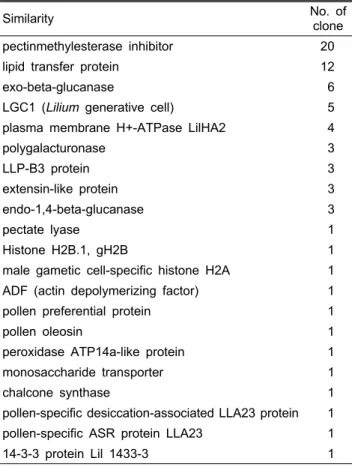
Table 2. Anther expressed ESTs identified to Lilium based on BLASTX search.
Similarity No. of
clone
pectinmethylesterase inhibitor 20
lipid transfer protein 12
exo-beta-glucanase 6
LGC1 (Lilium generative cell) 5
plasma membrane H+-ATPase LilHA2 4
polygalacturonase 3
LLP-B3 protein 3
extensin-like protein 3
endo-1,4-beta-glucanase 3
pectate lyase 1
Histone H2B.1, gH2B 1
male gametic cell-specific histone H2A 1 ADF (actin depolymerizing factor) 1
pollen preferential protein 1
pollen oleosin 1
peroxidase ATP14a-like protein 1
monosaccharide transporter 1
chalcone synthase 1
pollen-specific desiccation-associated LLA23 protein 1 pollen-specific ASR protein LLA23 1
14-3-3 protein Lil 1433-3 1
서 선발한 약 발현 유전자들이 약의 발달단계상 가장 급격 하게 세포성장이나 구성이 필요한 시점인 화분관 신장이나 화분 발아에 관련한 유전자일 것으로 추정할 수 있었다
약 발현 ESTs와 기존에 보고된 백합발현 유전자와의 관련성 기능을 추정한 약 발현 ESTs 중 백합에서 발현되는 유전 자와 유사한 것으로 확인된 클론만 모아서 정리해 본 결과 (Table 2), 가장 많이 확인된 유전자는 PMEI(pectin methyl esterase inhibitors)로서 총 20개의 ESTs 클론이 확인되었 다. 그 다음으로는 LTP(lipid transfer protein)로서 12개의 클론이, 나머지는 약에서 기존에 보고된 효소류들(exo-beta- glucanase, polygalacturinase, endo-1,4-beta glucanase) 등이 보고되었다. Pectin methyl esterase inhibitors는 화분관 끝 에서 세포벽의 안전성을 조절하는 중요한 조절 효소로 알려 져 있다(Zhang et al., 2010b). Pectin은 약에서 화분관의 외 벽을 이루는 섬유질 구성성분으로 PME(pectin methyl eaterase) 의 탈에스테르화를 통해 만들어 진다. 화분 발아 시 화분관 이 신장될 때 필요한 팩틴의 원활한 공급을 위해 적절하게 PME의 활성을 조절하는 효소가 바로 PMEI이다(Parre and Geitman, 2005). 실제로 애기장대와 유사한 PMEI를 배추에 서 분리하여 애기장대에 안티센스로 형질 전환한 결과 부분
적으로 화분발아를 저해해서 종자가 잘 맺히지 않은 것으로 보아(Zhang et al., 2010b) 아마도 화분발아에 주요한 영향 을 주는 유전자로 생각된다. 여러 종류의 식물로부터 분리 된 LTP는 큐틴 생합성, ß-oxidation, somatic embrogenesis, 식물의 방어작용, 약의 발달, 화분관신장 등에 관여하는 것 으로 알려져 있는데 약에서 발현되는 LTP는 융단조직에서 합성한 지질을 소포자로 이동시켜 화분벽을 형성하는 과정 에 관여하는 것으로 추정하고 있다(McCormick, 1991). 최 근에 벼에서 분리한 LTP인 OsC6의 경우 벼의 약 발달과정 에서 감수분열 후반의 약 발달에 관여한다고 보고된 바 있 다(Zhang et al., 2010a). 기능을 추정할 수 있었던 ESTs 중 백합에서 밝혀진 유전자들과의 관련성을 비교해 본 결과 기 존에 다른 작물의 약과 화분에서 발현된다고 알려진 유전자 들과 유사하였다. 특히 Okada et al.(2006, 2007)이 generative cell ESTs과 microarray를 통해 화분특이적인 것으로 보고 한 유전자들 목록에 부합하는 클론들이 많은 것으로 보아 본 실험에서 differential slot blot으로 선발한 ESTs들이 대 체적으로 약에서 발현되는 유전자이고 특히 화분에서 발현 이 높은 유전자들이 다수 포함된 것으로 사료된다.
약 발현 유전자의 발현양상 조사 및 약에서의 기능
Differential slot blot을 통해 선별한 클론 중 약에서만 발 현될 것으로 추정되는 30개 약 발현 유전자를 선발하여 약 을 포함한 타 기관에서의 발현양상을 확인하기 위해서 잎 (leaf), 화피(tepal), 암술(stigma), 자방(ovary), 수술대(filament), 화분을 포함한 약(anther), 만개한 꽃의 약으로부터 분리한 화분(pollen)으로부터 총 RNA를 분리한 다음 30개의 약 특 이 발현 유전자를 각각 탐침으로 하여 혼성화 반응을 수행 하였다(Fig. 3). 혼성화 반응 결과 30개의 약 특이 발현 유전 자는 다른 기관에서는 전혀 발현되지 않았고 ALAa27 등 26 개의 유전자는 약과, 만개한 꽃의 약으로부터 추출한 화분에 서 발현을 하였으며 ALAa9, ALAa86, ALAa608, ALAb846 은 약에서만 발현되는 것을 확인할 수 있었다. 기관별 RNA 혼성화 반응 결과 약에서만 발현을 보인 4개의 유전자는 약 의 기관 내(sporophytic tissue)에서, 나머지 28개는 약과 화 분에서 둘 다 발현하는 유전자로 추정되었다.
약 발현 유전자 30개의 발달단계에 따른 발현양상을 조사 하기 위해서 5cm, 9cm, 11cm 꽃봉오리 및 만개한 꽃의 약 으로부터 총 RNA를 분리하여 30개 약 발현 유전자 각각을 탐침으로 하여 혼성화 반응을 수행하였다(Fig. 4). 발달별 발 현양상은 ALAa27 등(ALAa 87, 779, 930, ALAb424, 425, 494, 505, 796, 865) 10개의 유전자가 9cm부터 개화 시까지 지속적으로 발현이 증가하였으며 ALAa195 등(ALAa328,
Fig. 3. RNA blot analysis of putative anther-specific genes in lily organs. About 10 μg of total RNA from each tissues were analyzed. The blots were hybridized with 32P-labeled individual cDNAs. L, leaf; T, tepal; S, stigma; O, ovary; F, filament; A, anther (with pollen); P, pollen.
Fig. 4. RNA blot analysis of anther-specific genes during anther development. Total RNA from developmental stages of anther were used as described in figure 3. The anther developmental stages were : 1, 5 cm-sized young growing bud; 2, 9 cm-sized elongated bud; 3, 11 cm-sized bursting bud; 4, full blossoming (after anthesis).
333, 354, 397, 442, ALAb164, 315, 440, 491, 837, 920)은 9cm까지는 거의 발현하지 않다가 11cm 발달 단계에서 발 현이 시작되어서 개약까지 유지되는 유전자로 확인되었다.
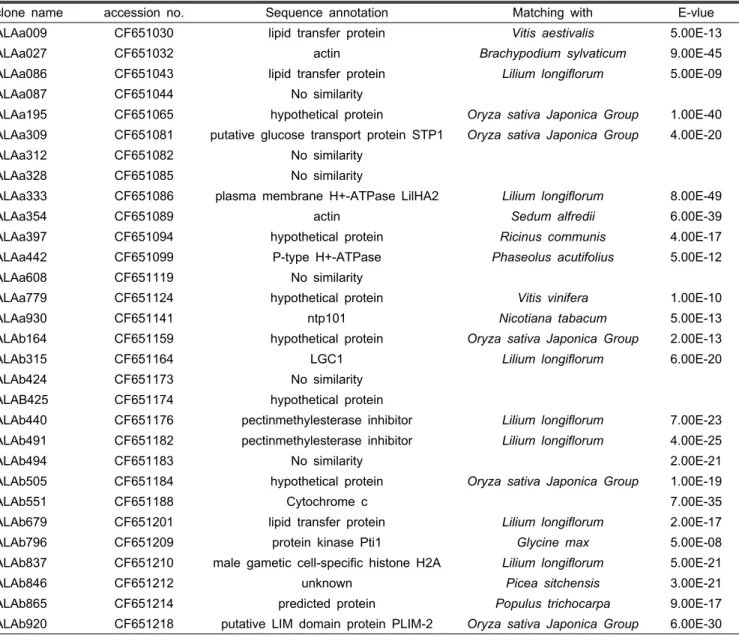
Mousavi et al.(1999)이 보고한 L. logiflorum의 약 발달 단 계에 따르면 5-9cm 꽃봉오리의 약은 callase에 의해서 4분 체로부터 소포자가 방출되고 화분이 성숙하여 유사분열에 들어가는 전 단계라고 한다. 본 실험에 사용한 아카풀코 나 리는 봉오리가 11cm 정도가 되면 약의 색깔이 노랑에서 벽 돌 색으로 전환되는 시기로서 약 내에서도 급격한 변화가 있을 것으로 추정된다. ALAa195 등과 같이 11cm에서 발현 을 시작해서 개약까지 발현되는 클론들을 살펴보면 기능추 정이 안 되는 몇몇 유전자가 있기는 하나 actin(ALAa354), 백합에서 보고된 plasma membrane H+-ATPase(ALAa333), LGC1(Lilium generative cell, ALAb315), pectinmethylesterase inhibitor(ALAb 440, 491), male gametic cell-specific histone H2A(ALAb837), putative LIM domain protein PLIM-2 (ALAb920)으로 확인되었다(Table 3). 이러한 유전자들은 주로 후반기 화분발달에 관여하는 유전자로 추정되는데 실 제로 plasma membrane H+-ATPase는 약에서 화분립의 발 아에 관여하여 화분관 신장시 필요한 이온의 유입이나 영양
분, 수분을 조절해서 화분관 원형질 막을 강화해 주는 역할 을 한다(Fejjo et al., 1995). 또 LGC1은 주로 약이나 화분에 서 다량 발현되어 수정에 관여하는 것으로 밝혀졌으며(Xu et al., 1999b), male gametic cell-specific histone H2A은 나 리화분의 생식세포발달에 관여하는 유전자로 프로모터 영역 의 발현을 조사해 본 결과 화분의 생식 핵에만 발현되는 것으 로 구명되었다(Ueda et al., 2005; Xu et al., 1999a). 예외적 으로 ALAa009, ALAa086, ALAa608, ALAb846, ALAa312 클론은 다른 유전자와는 다르게 9cm 봉오리 단계에서 발현 이 강하게 되어서 점차 약해지는 양상을 보이는데 ALAa009, ALAa086의 경우 약에서 발현되는 LTP(Lipid Tranfer Protein) 와 유사한 것으로 추정되며 최근 벼에서 확인된 LTP인 OsC6 는 벼 약의 tapetal cytoplasm, tapetum과 middle layer사이 의 조직, 약의 cuticle에서 발현되어 화분의 exine과 임성에 영향을 준다고 한다(Zhang et al., 2010a). 발달별 RNA 발현 에서 주로 9-11cm 꽃봉오리에서 발현이 시작되어서 발현량
Table 3. Functional annotation of anther specific-clone confirmed with RNA blot analysis.
clone name accession no. Sequence annotation Matching with E-vlue
ALAa009 CF651030 lipid transfer protein Vitis aestivalis 5.00E-13
ALAa027 CF651032 actin Brachypodium sylvaticum 9.00E-45
ALAa086 CF651043 lipid transfer protein Lilium longiflorum 5.00E-09
ALAa087 CF651044 No similarity
ALAa195 CF651065 hypothetical protein Oryza sativa Japonica Group 1.00E-40
ALAa309 CF651081 putative glucose transport protein STP1 Oryza sativa Japonica Group 4.00E-20
ALAa312 CF651082 No similarity
ALAa328 CF651085 No similarity
ALAa333 CF651086 plasma membrane H+-ATPase LilHA2 Lilium longiflorum 8.00E-49
ALAa354 CF651089 actin Sedum alfredii 6.00E-39
ALAa397 CF651094 hypothetical protein Ricinus communis 4.00E-17
ALAa442 CF651099 P-type H+-ATPase Phaseolus acutifolius 5.00E-12
ALAa608 CF651119 No similarity
ALAa779 CF651124 hypothetical protein Vitis vinifera 1.00E-10
ALAa930 CF651141 ntp101 Nicotiana tabacum 5.00E-13
ALAb164 CF651159 hypothetical protein Oryza sativa Japonica Group 2.00E-13
ALAb315 CF651164 LGC1 Lilium longiflorum 6.00E-20
ALAb424 CF651173 No similarity
ALAB425 CF651174 hypothetical protein
ALAb440 CF651176 pectinmethylesterase inhibitor Lilium longiflorum 7.00E-23
ALAb491 CF651182 pectinmethylesterase inhibitor Lilium longiflorum 4.00E-25
ALAb494 CF651183 No similarity 2.00E-21
ALAb505 CF651184 hypothetical protein Oryza sativa Japonica Group 1.00E-19
ALAb551 CF651188 Cytochrome c 7.00E-35
ALAb679 CF651201 lipid transfer protein Lilium longiflorum 2.00E-17
ALAb796 CF651209 protein kinase Pti1 Glycine max 5.00E-08
ALAb837 CF651210 male gametic cell-specific histone H2A Lilium longiflorum 5.00E-21
ALAb846 CF651212 unknown Picea sitchensis 3.00E-21
ALAb865 CF651214 predicted protein Populus trichocarpa 9.00E-17
ALAb920 CF651218 putative LIM domain protein PLIM-2 Oryza sativa Japonica Group 6.00E-30
이 늘거나 감소하는 클론이 다수였는데 이들은 주로 약의 일부 조직들이 퇴화하면서 화분생성 및 발달에 집중하는 시 기에 관련한 유전자일 것으로 추정된다. 본 실험에서는 약 에서 발현되는 ESTs 클론을 랜덤하게 선택하여 differential slot blot을 이용하여 약에서 주로 발현되는 유전자를 선발 한 다음 일차적으로 BLASTX 분석을 통해서, 이차적으로는 30개의 클론을 이용해서 RNA 발현까지 조사해 본 결과 Padmanabhan and Sahi(2011)의 사례처럼 다수의 유전자로 부터 일부 조직이나 시그널 특이발현 유전자를 선별하는데 매우 효과적인 접근인 것으로 생각된다.
초 록
약은 생식과 화형을 결정짓는 꽃의 주요한 기관 중 하나
이다. 오리엔탈나리인 아카풀코로부터 만든 약 특이적 cDNA library로부터 2000개의 ESTs를 무작위로 선발하였다. 잎과 약을 cDNA 탐침으로 이용한 differential slot blot이 약에서 발현되는 클론들을 얻기 위해 사용되었으며 570개의 비반 복적 ESTs를 얻었고 염기서열분석을 하였다. BLASTX 알 고리즘을 이용하여 GenBank에 비교해서 191개의 클론이 의미 있는 유사성을 보였지만 나머지(66.5%)는 기존에 보고된 염기서열에 확인되지 않았다. Gene ontology(GO) annotation 에 따른 기능분류결과 대체적으로 세포와 세포구성 부분에 서 주요하게 단백질이 확인되었다. 7개의 다른 기관과 발달 단계에서 전사체 분석은 약특이적일 적으로 추정되는 30개 의 클론을 가지고 노던혼성화반응을 이용하여 수행하였다.
이러한 결과는 differential slot blot을 이용하여 약에 발현되 는 유전자를 선별하는 것이 매우 효과적인 방법인 것으로
간주되며 또한 지금의 연구가 앞으로 나리의 화분을 포함한 약에 대한 기초정보를 제공할 수 있을 것으로 생각한다.
추가 주요어 : 약, 유전자목록 인용문헌
Adams, M.D., J.M. Kelley, J.D. Gocayne, M. Dubnick, M.H.
Polymeropoulos, H. Xiao, C.R. Merril, A. Wu, B. Olde, R.F.
Moreno, A.R. Kerlavage, W.R. McCombie, and J.C. Venter.
1991. Complementary DNA sequencing: expressed sequencing tags and human genome project. Science 252:1651-1656 Ausubel, F., R. Brent, R.E. Kingston, D.D. Moore, J.G. Seidman,
J.A. Smith, and K. Struhl. 1995. Short protocols in molecular biology. 3rd ed. Wiley, USA.
Birnboim, H.C. and J. Doly. 1979. A rapid alkaline extraction procedure for screening recombinant plasmid DNA. Nucl.
Acids Res. 7:1531-1520.
Bonaldo, M.F., G. Lennon, and M.B. Soares. 1996. Normalization and substraction: Two approaches to facilitate gene discovery.
Genome Res. 6:791-806.
Chen, R. and A.G. Smith. 1993. Nucleotide sequence of a stamen- and tapetum-specific gene from Lycopersicon esculentum. Plant Physiol. 101:413.
Cho, E.M., L. Liu, W. Farmerie, and N.O. Keyhani. 2006. EST analysis of cDNA libraries from the entomopathogenic fungus Beauveria (Cordyceps) bassiana. I. Evidence for stage-specific gene expression in aerial conidia, in vitro blastospores and submerged conidia. Microbiology 152:2843-2854.
Du, Z., X. Zhou, Y. Ling, Z. Zhang, and Z. Su. 2010. AgriGO:
A GO analysis toolkit for the agricultural community. Nucleic Acids Res. 38:W64-W70.
Feijó, J., R. Malhó, and G. Obermeyer. 1995. Ion dynamics and its possible role during in vitro germination and tube growth.
Protoplasma 187:155-167.
Fernández, P., N, Paniego, S. Lew, H.E. Hopp, and R.A. Heinz.
2003. Differential representation of sunflower ESTs in enriched organ-specific cDNA libraries in a small scale sequencing project. BMC Genomics 2003. 4:40.
Gubler, U. and B.J. Hoffman. 1983. A simple and very efficient method for generating cDNA libraries. Gene 25:263-269.
Hays, D.B. and D.Z. Skinner 2001. Development of an expressed sequence tag (EST) library for Medicago sativa. Plant Sci.
161:517-526.
Kim, H.U. and T.Y. Chung. 1997. Characterization of three anther-specific genes isolated from Chinese cabbage. Plant Mol. Biol. 33:193-198.
Ko, M.S. 1990. An ‘equalized cDNA library’ by the reassociation of short double-stranded cDNAs. Nucl. Acids Res. 18:5705-5711.
Lee, C.M., Y.J. Lee, M.H. Lee, H.G. Nam, T.J. Cho, T.R. Hahn, M.J. Cho, and U. Sohn. 1998. Large-scale analysis of expressed genes from the leaf of oilseed rape (Brassica napus L.). Plant Cell Rep. 17:930-936.
Mayer, K. and H.W. Mewes. 2001. How can we deliver the large plant genomes?: Stratagies and perspectives. Curr. Opin. Plant.
Biol. 5:173-177.
McCormick, S. 1991. Molecular analysis of male gametogenesis in plants. Trends Genet. 7:298-303.
Mousavi, A., R. Hiratsuka, H. Takase, K. Hiratsuka, and Y. Hotta.
1999. A novel glycine-rich protein is associated with starch grain accumulation during anther development. Plant Cell Physiol. 40:406-416.
Okada, T., P.L. Bhalla, and M.B. Singh. 2006. Expressed sequence tag analysis of Lilium longiflorum generative cells. Plant Cell Physiol. 47:698-705.
Okada, T., M.B. Singh, and P.L. Bhalla. 2007. Transcriptome profiling of Lilium longiflorum generative cells by cDNA microarray. Plant Cell Rep. 26:1045-1052.
Padmanabhan, P. and S.V. Sahi. 2011. Suppression subtractive hybridization reveals differential gene expression in sunflower grown in high P. Plant Physiol. Biochem. 49:584-591.
Parre, E. and A. Geitmann. 2005. Pectin and the role of the physical properties of the cell wall in pollen tube growth of Solanum chacoense. Planta 220:582-592.
Patanjali, S.R., S. Parimoo, and S.M. Weissman 1991. Construction of a uniform-abundance (normalized) cDNA library. Proc.
Natl. Acad. Sci. USA 88:1943-1947.
Sambrook, J., E.F. Fritsch, and T. Maniatis. 1989. Molecular cloning: A laboratory manual. 2nd ed. Cold Spring Harbor Laboratory Press, New York.
Sanger, F., S. Nicklen, and A.R. Coulson. 1977. DNA sequencing with chain termination inhibitors. Proc. Natl. Acad. Sci. 74:
5463-5467.
Shimozu, M. 1987. Species and hybrids (Japanese), p. 148-165.
In: The lilies of Japan. Seibundo Shinkosha, Tokyo.
Soares, M.B., M.D. Bonaldo, P. Jelene, L. Su, L. Lawton, and A. Efstratiadis. 1994. Construction and characterization of a normalized cDNA library. Proc. Natl. Acad. Sci. USA 91:
9228-9232.
Ueda, K., Y. Kinoshita, Z.J. Xu, N. Ide, M. Ono, Y. Akahori, I.
Tanaka, and M. Inoue. 2000. Unusual core histones specifically expressed in male gametic cells of Lilium longiflorum.
Chromosoma 108:491-500.
Ueda, K., M. Suzuki, M. Ono, N. Ide, I. Tanaka, and M. Inoue.
2005. Male gametic cell-specific histone gH2A gene of Lilium longiflorum: Genomic structure and promoter activity in the generative cell. Plant Mol. Biol. 59:229-238.
Verwoerd, T.C., B.M. Dekker, and A. Hoekema. 1989. A small- scale procedure for the rapid isolation of plant RNAs. Nucl.
Acids Res. 6:2362.
Xu, H.L., I. Swoboda, P.L. Bhalla, and M.B. Singh 1999a. Male gametic cell-specific expression of H2A and H3 histone genes.
Plant Mol. Biol. 39:607-614.
Xu, H.L., I. Swoboda, P.L. Bhalla, and M.B. Singh 1999b. Male gametic cell-specific gene expression in flowering plants. Proc.
Natl. Acad. Sci. USA 96:2554-2558.
Zhang, D.S., W.Q. Liang, C.S. Yin, J. Zong, F.W. Gu, and D.B.
Zhang. 2010a. OsC6, encoding a lipid transfer protein, is required for postmeiotic anther development in rice. Plant Physiol. 154:149-162.
Zhang, G.Y., J. Feng, J. Wu, and X.W. Wang. 2010b. BoPMEI1, a pollen specific pectin methylesterase inhibitor, has an essential role in pollen tube growth. Planta 231:1323-1334.