ORIGINAL ARTICLE
Comparative Leaf Characteristics of Quercus Mongolica and Rhododendron Schilippenbachii Plants Inhabiting at South- and North- Facing Slopes around Mountain Ridge
Yong Mok Park
*Department of Life Science, Cheongju University, Cheongju 360-764, Korea
Abstract
Leaf characteristics of two representative deciduous-tree species in Korean peninsula were compared to assess directional ridge effect on leaf traits of both species. Leaf mass per unit area (LMA) of Rhododendron schilippenbachii in south-facing ridge slope was significantly higher than that in north-facing ridge slope, while Quercus mongolica did not change LMA.
Leaf mass of Q. mongolica was increased depending on leaf size irrespective of slope. However, leaf mass of R.
schilippenbachii changed differently in responding to expansion of leaf area between both slopes resulting from retardation of leaf expansion in south-facing slope. R. schilippenbachii showed higher leaf nitrogen concentration per unit area (LNCA) in south-facing slope than that in north-facing slope, while Q. mongolica indicated no difference in LNCA between south- and north-facing slopes. However, both species revealed no significant difference in leaf nitrogen concentration per unit mass (LNCM) between south- and north-facing slopes. LNCA of Q. mongolica was about two times higher than that of R.
schilippenbachii. These results indicate that there is a difference in leaf characteristics including leaf thickness and nitrogen allocation between Q. mongolica and R. schilippenbachii, suggesting the difference of plasticity.
Key words : Allocation, Leaf mass per unit area, Leaf nitrogen concentration per unit area, Plasticity
1. Introduction
1)The degree of light availability in an individual plant or plant community levels is known to be a key factor in determining photosynthetic carbon gain.
Many studies have reported a close relationship between leaf characteristics and light conditions within a closed canopy and/or within tree crown (Ellsworth and Reich, 1993; Evans, 1993; Pons et al., 1993).
Leaf nitrogen concentration, one of the representative leaf characteristics, varies spatially at a given canopy or even leaf position within a tree crown according to light availability (Anten et al., 1996a, b; Hirose and
Werger 1987, 1994; Le Roux et al., 1999). This resulted from different allocation of nitrogen into leaves according to light conditions in canopy layers and/or the position of leaves in tree crown. Many studies have also reported a strong correlation between LNCA and light availability in leaves within canopy (DeJong and Doyle, 1985; Ellsworth and Reich, 1993; Gulmon and Chu, 1981; Hirose and Werger, 1987; Niinemets, 1995, 1997; Reich and Walters, 1994). LMA that related to leaf structural trait is also a useful parameter in relation to light availability of individual leaves within canopy (Eschrich et al., 1989; Ishida et al., 1999; Kimura et al., 1998;
Received 25 September, 2013; Revised 10 October, 2013;
Accepted 21 October, 2013
*Corresponding author : Yong Mok Park, Department of Life Science, Cheongju University, Cheongju 360-764, Korea
Phone: +82-10-4222-8531 E-mail: [email protected]
ⓒ The Korean Environmental Sciences Society. All rights reserved.
This is an Open-Access article distributed under the terms of the Creative Commons Attribution Non-Commercial License (http://
creativecommons.org/licenses/by-nc/3.0) which permits unrestricted non-commercial use, distribution, and reproduction in any medium, provided the original work is properly cited.
Le Roux et al., 2001; Meir et al., 2002; Uemura et al., 2000). Thus, leaf nitrogen concentration and LMA are widely used in evaluating physiological and ecological responses of plants related to photosynthetic performance in a variety of levels (Kull and Kruijt, 1999; Sinoquet et al., 2001).
It is well known that tree species in a cool temperate forest clearly show vertical distribution along elevation of mountain according to temperature gradient. Recent climate change by elevated temperature may bring different responses of plants which may result in ecosystem change such as distributional change of plant species, particularly, in a cool temperate forest of mountain area (Walther, 2004). Thus, plants inhabiting near summit of mountain in a cool temperate forest must be vulnerable to elevated temperature because mountain ridge forms unique habitat environmentally for plants including relatively low temperature, exposure to intense solar radiation, and strong winds. In spite of vulnerability relatively little attention has been paid for plants inhabiting mountain ridge.
R. schilippenbachii and Q. mongolica are representative tree species in Korean peninsula, vegetation geographically and widely distributed in mountain area from the central part to the southern part of the Korean peninsula (Kim 1992). In the middle part of Korean peninsula, Q. mongolica and R. schilippenbachii are tree species forming the tree layer and shrub layer in the broad- leaved deciduous forest, respectively (Kim, 1992). In Mt. Jiri (1,915.4 m at peak) located in the southern part of the Korean peninsula, R. schilippenbachii and Q. mongolica are distributed at south- and north-slopes facing each other around 1,000 m near mountain ridge (Park et al., 2006).
In this paper, I analyzed leaf characteristics of R.
schilippenbachii and Q. mongolica plants to assess how oppositely facing habitat affects leaf ecophysiology.
2. Materials and methods
The study was carried out at two sites located near mountain ridge in Mt. Jiri where Q. mongolica and R.
schilippenbachii are dominantly distributed. Q.
mongolica site (N35
o17’51.2”, E127
o33’ 16.6”) is dominated by Q. mongolica including Symplocos chinensis var. leucocarpa for. pilosa, Tilia taquetii, and Acer pseudo-sieboldianum. In R. schilippenbachii site (N35
o17’ 35.2”, E127
o32’52.7”), R. schilippenbachii is dominantly distributed and R. mucronulatum var.
ciliatum and Sasa borealis are sparsely colonized.
Both sites are about 100m away each other along ridge line. For sample collection, each site was further divided into south- and north-facing slopes.
Both slopes facing each other in each site are about 20m away from the ridge line and gently inclined.
Overall physiognomy of forest including species composition was similar between both slopes in each site. Sampling was conducted from randomly selected trees around sites in June and August. Leaf sampling was performed from randomly selected representative trees in each slope. Leaves were cut and put immediately into plastic bag in an icebox, and then transported to laboratory for measurement. After leaf area measurement using leaf area meter (AAm-8, Hayashi Denkou, Tokyo, Japan) leaf dry mass was determined after drying at 80
oC for 48 h and then leaf nitrogen content in leaves was determined with semi-microkjeldahl system (VA-SA-1, MRK, Tokyo, Japan). Statistical analysis was performed with SPSS software package (SPSS 12.0 , 2004) for windows.
3. Results and discussion
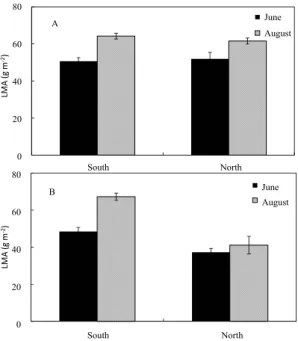
R. schlippenbachii plant showed significant differences
in LMA between south- and north- facing habitats
(p<0.05), and between June and August in south-
facing slope (p<0.05). However, Q. mongolica did
not show any significant differences between slopes,
and between months during summer season though the value was slightly higher in August than June (Fig. 1).
0 20 40 60 80
South North
June August
LMA (g m-2) B 0 20 40 60 80
South North
June August
LMA (g m-2)
A
Fig. 1. Changes in leaf dry mass per unit area (LMA) of Q.
mongolica (A) and R. schlippenbachii (B) plants at south- and north- facing slopes in Mt. Jiri. Vertical bars on the columns represent mean with standard errors (n = 46).
Light availability in the field varies spatially and temporally in a given plant community, and even in an individual plant depending on leaf position in the canopy (Niinemets, 2007). Light availability within plant canopy and/or an individual plant decreases depending on leaf area index exponentially and the degree of the declining changes according to leaf developmental stage and growth form of plant (Monsi and Saeki, 1953). On the other hand, plants modify their characteristics in response to available light conditions, indicating acclimation of plants. LMA indicating a structural character related to leaf thickness is an important characteristic in relation to light conditions in the field because it may determine
the extent of photosynthetic carbon gain, leading to plant survival under strong sunlight conditions in the field. High LMA shown in R. schlippenbachii plants in south-facing slope may be a similar characteristic to sun leaf, which means efficient light use by producing thicker leaves under high light conditions (Atwell et al., 1999). Thus, relatively high solar irradiance in south-facing slope may be responsible for high LMA of R. schlippenbachii plants in south-facing slope, compare with north-facing slope.
0 20 40 60 80 100
0 20 40 60 80 100
South North
LMA (g m-2)
Leaf area (cm2) B 0
100 200 300 400 500 600 700
0 20 40 60 80 100
South North
Leaf mass (mg)
A
0 50 100 150 200 250 300 350
0 10 20 30 40 50 60
South North
Leaf mass (mg)
C
0 20 40 60 80 100
0 10 20 30 40 50 60
South North
LMA (g m-2)
Leaf area (cm2) D
Fig. 2. Leaf mass (A, C) and leaf dry mass per unit area (LMA; B, D) as a function of leaf area for the leaves of Q. mongolica (left) and R. schlippenbachii (right) plants at south- and north- facing slopes in Mt. Jiri.
Leaf mass increased with increase of leaf area irrespective of plant species (Fig. 2a, c). Q. mongolica showed almost same pattern in leaf mass increase in both slopes, while R. schlippenbachii showed different increase pattern in dry mass as leaf area was increased. Furthermore, this trend was shown in the relationship between leaf area and LMA (Fig. 2b, d).
This may be due to the difference in the extent of
plasticity in responding to light conditions between
the two species. In addition, it may also be caused by
leaf attaching pattern originating from their growth form. Q. mongolica is characterized by alternate phyllotaxis with elongated oval-typed leaf, while R.
schlippenbachii shows fasciculation-typed phyllotaxis with extended obovoid-form leaf which can be easily influenced by mutual-shading. As a result, R.
schlippenbachii with relatively shortened duration time of solar irradiance may produce leaves acclimated to shade conditions in north-facing slope. Generally, plants produce two types of leaf according to light availability (Atwell et al, 1999). Leaves that develop in sunny environments have high photosynthetic capacity compared with those from shaded environments (Atwell et al, 1999).
0.0 0.3 0.6 0.9 1.2
South North
June August
LNCA(g m-2)
B 0.0 0.5 1.0 1.5 2.0 2.5
South North
June August
LNCA (g m-2)
A
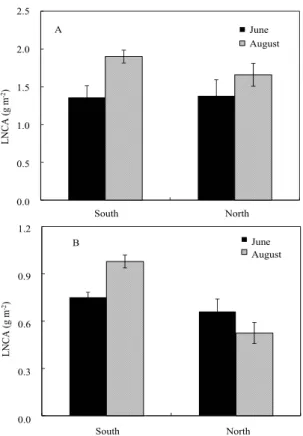
Fig. 3. Leaf nitrogen concentration per unit area (LNCA) for the leaves of Q. mongolica (A) and R. schlippenbachii (B) plants at south- and north- facing slopes in Mt.
Jiri. Vertical bars on the columns represent mean with standard errors (n = 46).
Leaf nitrogen is distributed along light availability within canopy to maximize carbon assimilation per unit leaf nitrogen (Hirose and Werger, 1987) and LNCA is proportional to the irradiance available at the leaf position (Dejong and Doyle, 1985; Niinemets, 1995, 1997). A significant difference in LNCA of R.
schlippenbachii plant was shown between slopes (p<0.05), while no significant difference in that of Q.
mongolica was revealed between them (Fig. 3).
However, in LNCM there is no significance in both species irrespective of slopes and months (Fig. 4).
0 10 20 30 40
South North
June August
LNCM (mgg-1)
A
0 5 10 15 20 25
South North
June August
LNCM (mgg-1)
B
Fig. 4. Leaf nitrogen concentration per unit mass (LMCM) for the leaves of Q. mongolica (A) and R. schlippenbachii (B) plants at south- and north- facing slopes in Mt.
Jiri. Vertical bars on the columns represent mean with standard errors (n = 46).
Leaf nitrogen content is strongly correlated with
photosynthetic capacity including carboxylation capacity
and electron transport rate (Hikosaka, 2004). As leaf
nitrogen is expressed as unit area base a strong correlation is revealed between leaf nitrogen concentration and light availability, whereas the correlation appears inconsistently as it is expressed as unit mass base (Ellsworth and Reich, 1993; Niinemets, 1995, 1997;
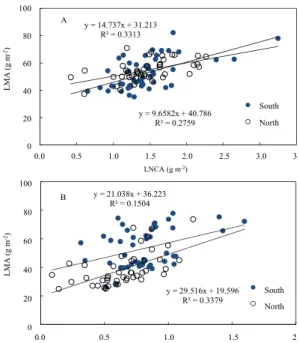
Reich and Walters, 1994). Leaf thickness, palisade depth and mesophyll cell density may contribute to the different results of correlation between LNCM and light availability (Thomson et al., 1992; Witkowski and Lamont, 1991). As tested in relationship between LNCA and LMA no clear relationship was shown irrespective of species (Fig. 5).
y = 14.737x + 31.213 R² = 0.3313
y = 9.6582x + 40.786 R² = 0.2759
0 20 40 60 80 100
0.0 0.5 1.0 1.5 2.0 2.5 3.0 3
South North LMA (g m-2)
LNCA (g m-2) A
y = 21.038x + 36.223 R² = 0.1504
y = 29.516x + 19.596 R² = 0.3379
0 20 40 60 80 100
0.0 0.5 1.0 1.5 2
South North LMA (g m-2)
B
Fig. 5. Relationship between leaf nitrogen concentration per unit area (LNCA) and leaf dry mass per unit area (LMA) of Q. mongolica (A) and R. schlippenbachii (B) plants.
Though LNCA is strongly influenced by light availability and LMA is the result of structural modification to light conditions (Ellsworth and Reich, 1993; Hirose and Werger, 1987; Niinemets, 1995, 1997).
Sometimes non-linear relationship was revealed and no significant effect of light on leaf nitrogen
concentration is shown as water stress effect is exerted (Rodriguez-Calcerrada et al., 2007). Leaves of R. schlippenbachii in north-facing slope that showed low LMA must be shade-typed leaf (Fig. 1) because shade-adapted plant species shows low LMA, compared with sun-adapted plant species (Lambers et al., 1998). Under high LMA photosynthetic nitrogen use efficiency and nitrogen allocation to Rubisco and thylakoids tend to decrease (Hassiotou et al., 2010). Nitrogen allocation into Rubisco and thylakoids that are directly connected to photosynthetic capacity are important to maximize photosynthetic carbon gain (Field, 1983; Lambers et al., 1998).
Consequently, the different values in LMA and LNCA of both species depending on slope may be species-specific characteristic because those in R.
schlippenbachii were revealed about a half of the values in Q. mongolica irrespective of slope direction (Figs. 3 and 4). Taking all the results into account the difference shown in both species according to slope direction is resulted from the species-specific responses reflecting plasticity of each species. However, the difference in LMA and LNCA of R. schlippenbachii between south- and north-facing slopes may reflect shading effect partly due to shortened duration time of solar irradiance and partly due to growth form making up the shrub layer in the community.
Acknowledgement
This work was supported by the research grant of Industrial Science Research Institute of Cheongju University in 2011-2012. Thanks are due to Dr.
Hwang Jeong-Sook for the use of SPSS for statistical analysis.
References
Anten, N. P. R., Werger, M. J, A., 1996a, Canopy
structure and nitrogen distribution in dominant and
subordinate plants in a dense stand of Amaranthus
dubius L. with a size hierarchy of individuals,