서 론
경구피임약은 세계적으로 흔하게 사용되는 피임 방법이다.1) 미국 에서는 약 1,200만 명의 여성이 경구피임약을 복용하고 있고 이 중에 서 30세 미만의 여성에서 경구피임약의 복용률이 제일 높은 것으로 알려져 있다.2) 이 연령대는 최대 골량이 형성되는 중요한 시기이므로 경구피임약이 골밀도에 어떤 영향을 미치는지 관심을 가질 필요가 있다.3)
골다공증은 골밀도 및 골질의 감소로 특징으로 하는 골격계 질환 이다.4) 특히 골다공증성 골절은 이환율 및 사망률과 관계되어 있고, 의료비용의 증가, 삶의 질 감소와 연관되어 있다.5) 따라서 골다공증 을 유발할 수 있는 골밀도 감소와 관련된 원인들을 알아내고 교정 하는 것이 필요하다.
그 동안 골밀도 감소와 연관된 다양한 원인들이 연구되어 왔고 위 험인자로 유전적 요인, 생활습관 및 영양, 질병, 약제 등이 보고되었 다.4) 그 중 경구피임약 복용이 골밀도 및 골다공증성 골절의 관련성
Original Article
폐경 전 경구피임약 복용기간과 골밀도 간의 상관관계:
2008-2010년도 국민건강영양조사 자료 분석
최예진, 김하윤, 김동현, 임희경, 노용균, 최민규*
한림대학교 강남성심병원 가정의학과
The Association of Oral Contraceptive Use and Bone Mineral Density in Korean Premenopausal Women: A Cross Sectional Study from the Korea National Health and Nutrition Examination Survey 2008–2010
Yeo Jin Choi, Ha Yoon Kim, Dong Hyun Kim, Hee Kyung Lim, Yong Kyun Roh, Min Kyu Choi*
Department of Family Medicine, Hallym University Kangnam Sacred Heart Hospital, Seoul, Korea
Background: The aim of this study was to evaluate the effects of oral contraceptives (OCs) on bone mineral density according to the duration of OC use.
Methods: This was a cross-sectional study that used data of 4,068 participants aged 19–50 years. The participants were premenopausal women who participated in the Korean National Health and Nutrition Survey 2008–2010. The study participants were classified into three categories: those who had never used OC, those with short-term usage (≤1 years), and those with long-term usage (>1 years). Logistic regression analysis was performed to compare each of the groups’ total femur bone mineral density (BMD), femoral neck BMD, and lumbar spine BMD by adjusting any confounding factors such as age, height, weight, alcohol consumption, smoking, exercise, energy intake, income, menarche age, and parity.
Results: Out of the participants of 4,068 women, 3,620 participants (89.0%) had never used OC, 352 participants (8.7%) were short-term OC users, and 96 participants (2.3%) were long-term OC users. After adjusting the confounding factors, we found that the duration of OC use is not associated with BMD values. Women who had never given birth and were long-term OC users had high BMD values. Although women who had never given birth and were long-term OC users seemed to have slightly higher BMD values than the others, the P-values were still not significant.
Conclusion: This study suggests that the duration of OC use is not associated with BMD values.
Keywords: Oral Contraceptives; Bone Density; Premenopause
https://doi.org/10.21215/kjfp.2017.7.3.315 eISSN 2233-9116Korean J Fam Pract. 2017;7(3):315-321
KJFP
Korean Journal of Family PracticeReceived May 13, 2016 Revised August 16, 2016 Accepted September 1, 2016
Corresponding author Min Kyu Choi Tel: +82-2-829-5270, Fax: +82-2-829-5365 E-mail: [email protected]
Copyright © 2017 The Korean Academy of Family Medicine
This is an open-access article distributed under the terms of the Creative Commons At- tribution Non-Commercial License (http://creativecommons.org/licenses/by-nc/4.0) which permits unrestricted noncommercial use, distribution, and reproduction in any medium, provided the original work is properly cited.
Yeo Jin Choi, et al. Oral Contraceptive Use and Bone Density in Korean Premenopausal Women
Korean Journal of Family Practice
KJFP
에 대한 연구가 진행되어 왔으나 결과는 일관성이 없었다. 청소년과 젊은 여성을 대상으로 한 연구에서는 경구피임약 복용군과 비복용 군에서 골밀도에 차이는 없었다고 보고하였고6-12) 다른 연구에서는 경구피임약 복용이 골밀도 증가를 방해한다고 보고하였다.13-19) 또한 폐경 전 한국인 여성에게 경구피임약 복용기간과 골밀도와 어떤 상 관관계가 있는지에 대한 연구는 부족했다. 따라서 본 연구를 통해 폐경 전 19–50세 한국인 여성에게 경구피임약 복용기간에 따라 골 밀도에 어떤 영향이 있는지 알아보고자 한다.
방 법
1. 연구 대상자
연구는 한국질병관리본부에서 조사 및 발표한 2008년부터 2010 년까지의 국민건강영양조사 자료를 바탕으로 단면연구로 진행되었 다. 국민건강영양조사는 전국 규모의 건강 및 영양조사로 조사 자료 는 공개적으로 이용 가능하므로 윤리위원회(Institutional Review Board) 승인이 필수적이지 않다.20) 국민건강영양조사는 건강 설문 조사, 영양조사, 검진조사로 구성되어 있다. 국민건강영양조사에는 만 19세 이상 여성이 경구피임약 복용경험 및 기간을 기입한 건강 설 문 조사와 검진을 통해 만 10세 이상 대상자에게 시행한 골밀도 검사 가 포함되어 있어 이 자료를 통해 연구를 진행하였다. 연구 대상자는 2008년부터 2010년까지 국민건강영양조사를 통해 건강 설문조사에 응답한 전체 인원 29,235명 중 남성 9,459명을 제외하였고, 19세 미만 7,424명, 50세 초과 5,854명을 제외하였다. 이 중 폐경된 여성 270명, 류 마티스 관절염 진단받은 여성 46명, 골절의 과거 병력이 있는 여성 1 명, 골밀도 검사 결과가 없는 1,655명, 건강 설문 조사에서 경구피임약
복용 여부를 기재하지 않는 여성 458명을 제외하여 최종적으로 4,068 명의 여성이 연구대상에 포함되었다. 이를 Figure 1로 표현하였다.
2. 변수 정의
연구 대상자들은 건강 설문 조사를 통해 초경연령, 가구당 소득, 신체활동, 음주량, 흡연량, 분만력, 경구피임약 복용 등을 자기 기입 식으로 조사하였고, 교육 정도, 영양조사 항목은 면접방법으로 조 사하였다. 신장, 체중, 골밀도 검사는 검진조사를 통해 조사하였다.
소득은 4사분위로 나누어 표현하였고, 교육 정도는 초등학교 졸업 이하, 중학교 졸업, 고등학교 졸업, 대학교 중퇴 이상으로 분류하였 다. 신체활동은 적절한 신체활동을 한 사람의 비율로 나타내었다. 적 절한 신체활동이란 미국대학스포츠의학회(American College of Sports Medicine)와 미국심장학회(American Heart Association)에서 권고하는 적절한 신체활동 기준인 30분 이상의 중등도-고강도 운동 을 주 5회 이상 하였거나 20분 이상의 고강도 운동을 주 3회 이상 한 경우로 정의하였다.21) 음주량은 비음주자, 하루 30 g 이하 알코올 음 주자, 하루 30 g 초과 음주자의 비율로 나타내었다. 흡연량 항목은 대 상자가 기입한 내용을 바탕으로 비흡연자, 과거 흡연자, 현재 흡연자 로 분류하였다. 분만력 항목은 건강 설문 조사를 통해 출산경험이 있다고 기입한 자와 없다고 기입한 자로 분류하였다. 영양조사팀에 의해 대상자들에게 개인별 24시간 회상 조사를 실시하였고, 이를 통 해 1일 에너지 섭취량(kcal)과 1일 칼슘 섭취량(mg)을 산출하였다. 경 구피임약 사용 기간은 건강 설문 조사에 응답자들이 응답한 내용을 바탕으로 세 그룹으로 분류하였다. 경구피임약 복용한 적이 없는 비 복용군, 0–12개월 이내로 복용한 단기간 복용군, 12개월 초과하여 복용한 장기간 복용군으로 분류하였다. 검진을 통해 대상자들을 상
Persons included in Korean National Health and Nutrition Examination Survey (2008, 2009, 2010) (N=29,235)
19 50 years women were included in the analysis (n=4,068)
Men (n=9,459)
<19 years (n=7,424)
>50 years (n=5,854)
Postmenopausal women (n=270) Have rheumatoid arthritis (n=46) Have fracture history (n=1) Did not have BMD values (n=1,655) Missing values (n=458)
Figure 1. Study population. Data for this study were collected through the Korean National Health and Nutrition Examination Survey from 2008 to 2010. Of these 29,235 participants, 9,459 men and 7,424 under 19 years old participants and over 50 years old participants were excluded. In addition 270 postmenopausal women, 46 rheumatoid arthritis women who were diagnosed by doctor, 1 patient who had fracture history were excluded. A further 1,655 participants were exclud- ed because they did not have BMD val- ues. We excluded 458 participants those with missing values. The 4,068 subjects included in our final sample.
BMD, bone mineral density.
최예진 외. 폐경 전 경구피임약 복용기간과 골밀도 간의 상관관계 Korean Journal of Family Practice
KJFP
대로 검진한 신체계측에서 신장과 체중 자료를 바탕으로 체질량지 수를 계산하였다. 골밀도 검사는 국민건강영양조사 검진을 통한 데 이터를 이용하였다. 대퇴골 전체(total femur), 대퇴골 경부(femur neck), 요추(lumbar spine)의 골밀도는 Dual-Energy X-ray Absorptiom- etry (DISCOVERY QDR-4500W; Hologic Inc., Bedford, MA, USA)를 통 해 측정하였다.
3. 통계분석
본 연구는 국민건강영양조사를 이용하여 복합표본 분석 방법을 사용하였다. 조사대상자에 대한 연구는 연속형 변수는 평균±표준 오차, 범주형 변수는 평균과 퍼센트 표준오차로 제시하였고, 각각 ANOVA 및 카이제곱 검정으로 피임약 복용 여부에 따라서 군간 차 이를 검정하였다. 피임약 복용군 간에 골밀도는 나이 등의 변수를
고려한 공분산 분석을 통하여 보정평균을 제시하였다. 모든 통계 데 이터는 SAS 통계프로그램(ver. 9.3; SAS Institute, Cary, NC, USA)을 사 용하였다. 모든 Table에서 P값이 0.05 미만인 경우 통계적으로 의미 있는 것으로 정의하였다.
결 과
1. 피임약 복용기간에 따른 연구 대상자들의 일반적 특성
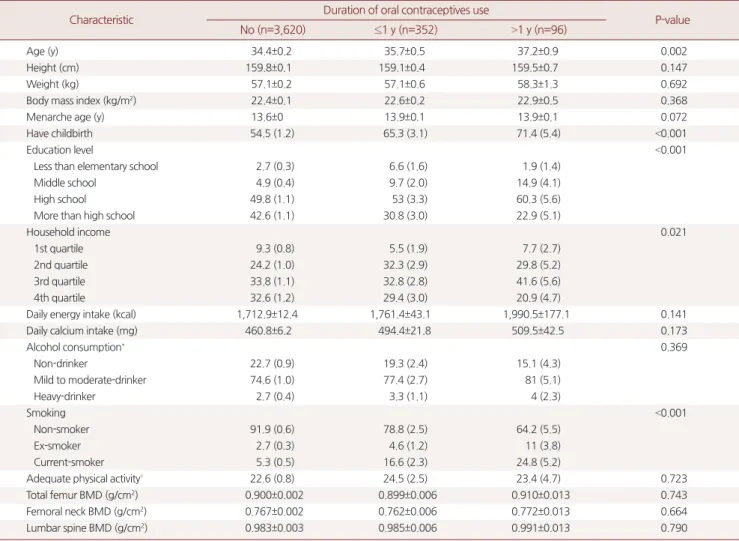
연구 대상자 4,068명 중 피임약 비복용군 3,620명, 피임약 복용기간 이 1년 이하인 군이 352명, 피임약 복용기간 1년 초과한 군이 96명이 었다. 각 군별 평균나이는 비복용군에서 34.4±0.2세, 1년 이하 복용군 에서 35.7±0.5세, 1년 초과 복용군에서 37.2±0.9세(P=0.002)로 피임약 장기 복용군으로 갈수록 평균 나이가 많은 것으로 나타났고, 월소Table 1. Baseline characteristics of the study population by duration of oral contraceptives use
Characteristic Duration of oral contraceptives use
P-value
No (n=3,620) ≤1 y (n=352) >1 y (n=96)
Age (y) 34.4±0.2 35.7±0.5 37.2±0.9 0.002
Height (cm) 159.8±0.1 159.1±0.4 159.5±0.7 0.147
Weight (kg) 57.1±0.2 57.1±0.6 58.3±1.3 0.692
Body mass index (kg/m2) 22.4±0.1 22.6±0.2 22.9±0.5 0.368
Menarche age (y) 13.6±0 13.9±0.1 13.9±0.1 0.072
Have childbirth 54.5 (1.2) 65.3 (3.1) 71.4 (5.4) <0.001
Education level <0.001
Less than elementary school 2.7 (0.3) 6.6 (1.6) 1.9 (1.4)
Middle school 4.9 (0.4) 9.7 (2.0) 14.9 (4.1)
High school 49.8 (1.1) 53 (3.3) 60.3 (5.6)
More than high school 42.6 (1.1) 30.8 (3.0) 22.9 (5.1)
Household income 0.021
1st quartile 9.3 (0.8) 5.5 (1.9) 7.7 (2.7)
2nd quartile 24.2 (1.0) 32.3 (2.9) 29.8 (5.2)
3rd quartile 33.8 (1.1) 32.8 (2.8) 41.6 (5.6)
4th quartile 32.6 (1.2) 29.4 (3.0) 20.9 (4.7)
Daily energy intake (kcal) 1,712.9±12.4 1,761.4±43.1 1,990.5±177.1 0.141
Daily calcium intake (mg) 460.8±6.2 494.4±21.8 509.5±42.5 0.173
Alcohol consumption* 0.369
Non-drinker 22.7 (0.9) 19.3 (2.4) 15.1 (4.3)
Mild to moderate-drinker 74.6 (1.0) 77.4 (2.7) 81 (5.1)
Heavy-drinker 2.7 (0.4) 3.3 (1.1) 4 (2.3)
Smoking <0.001
Non-smoker 91.9 (0.6) 78.8 (2.5) 64.2 (5.5)
Ex-smoker 2.7 (0.3) 4.6 (1.2) 11 (3.8)
Current-smoker 5.3 (0.5) 16.6 (2.3) 24.8 (5.2)
Adequate physical activity† 22.6 (0.8) 24.5 (2.5) 23.4 (4.7) 0.723
Total femur BMD (g/cm2) 0.900±0.002 0.899±0.006 0.910±0.013 0.743
Femoral neck BMD (g/cm2) 0.767±0.002 0.762±0.006 0.772±0.013 0.664
Lumbar spine BMD (g/cm2) 0.983±0.003 0.985±0.006 0.991±0.013 0.790
Values are presented as mean±standard error for continuous variables and percentages (standard error) for categorical variables.
BMD, bone mineral density.
*Mild to moderate drinker defined as consumption of one to three drinks a day. Heavy drinker defined as consumption more than three drinks a day. †Adequate physi- cal activity defined as doing 30 minuites of moderate-intensity physical activity on five or more days a week or 20 minuites of vigorous intensity physical activity on three or more days a week.
Yeo Jin Choi, et al. Oral Contraceptive Use and Bone Density in Korean Premenopausal Women
Korean Journal of Family Practice
KJFP
득은 비복용군에서 월소득 4사분위 이상인 비율이 32.6%, 1년 이하 복용군에서 29.4%, 1년 초과 복용군에서 20.9% (P=0.021)로 나타났다 (Table 1). 교육수준에 있어서 대학교 중퇴 이상 학력 비율이 비복용 군에서 42.6%, 1년 이하 복용군에서 30.8%, 1년 초과 복용군에서 22.9% (P<0.001)로 고학력자의 비율이 비복용군에서 높게 나타났다.
현재 흡연하는 비율은 비복용군에서 5.3%, 1년 이하 복용군에서 16.6%, 1년 초과 복용군에서 24.8% (P<0.001)로 비복용군에 비해 피임 약 1년 이하 복용군, 1년 초과 복용군에서 유의하게 높게 나타났다.
출산력과 관련하여 출산경험이 있다고 응답한 비율이 비복용군 에서 54.5%, 1년 이하 복용군에서 65.3%, 1년 초과 복용군에서 71.4%
(P<0.001)로 피임약 복용군에서 비복용군에 비해 출산경험이 있는 자의 비율이 통계적으로 유의하게 높았다. 그 외에 초경연령, 신체활 동, 음주량, 에너지 섭취량, 1일 칼슘 섭취량은 세 군간에 통계적으로 의미 있는 차이가 없었다.
2. 피임약 복용기간에 따른 골밀도
변수를 보정하지 않은 단순 골밀도 측정결과를 살펴봤을 때, 세 군간의 대퇴골 전체 골밀도(P=0.743), 대퇴골 경부 골밀도(P=0.664), 요추 골밀도(P=0.790)로 피임약 복용기간에 상관없이 세 군간에 평 균값의 차이는 유의하지 않았다(Table 1).
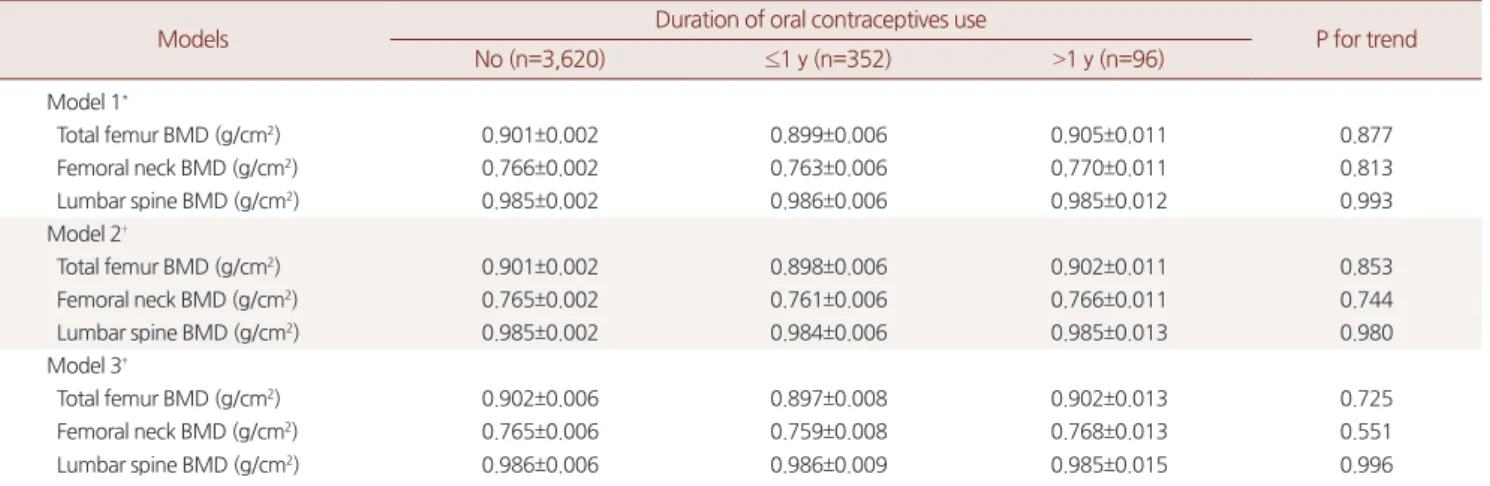
Table 2에는 골밀도에 영향을 미치는 변수를 보정한 세 군간에 골 밀도를 나타내었다. Model 1은 나이, 키, 몸무게를 보정한 골밀도 결 과이고, Model 2는 나이, 키, 몸무게, 음주량, 흡연 여부, 운동량을 보 정한 결과이다. Model 3은 나이, 키, 몸무게, 음주량, 흡연 여부, 운동 량, 에너지 섭취량, 1일 칼슘 섭취량, 초경나이, 출산력을 보정한 골밀
도 결과이다. 보정한 변수가 가장 많은 Model 3 골밀도 결과에서 대 퇴부 전체 골밀도에서 피임약 비복용군이 0.902±0.006 g/cm2, 1년 이 하 복용군에서 0.897±0.008 g/cm2, 1년 초과 복용군에서 0.902±0.013 g/cm2 (P=0.725)로 세 군 간에 유의한 차이는 보이지 않았다. 대퇴부 경부 골밀도에서 피임약 비복용군이 0.765±0.006 g/cm2, 1년 이하 복 용군에서 0.759±0.008 g/cm2, 1년 초과 복용군에서 0.768±0.013 g/cm2 (P=0.551)로 피임약 복용에 따른 골밀도 변화 양상은 일정하지 않은 것으로 보인다. 요추 골밀도는 피임약 비복용군이 0.986±0.006 g/cm2, 1년 이하 복용군에서 0.986±0.009 g/cm2, 1년 초과 복용군에서 0.985±0.015 g/cm2 (P=0.996)로 세 군 간에 유의한 차이는 보이지 않았 다. 피임약 복용기간에 따라 골밀도가 증가하거나 감소하지 않았고 세 군간에 대퇴골 전체 골밀도, 대퇴골 경부 골밀도, 요추 골밀도에 유의한 차이 및 변화 양상은 없었다.
3. 출산 여부에 따른 피임약 복용 및 골밀도
연구 대상자 중 출산경험이 있다고 응답한 비율이 비복용군에서 54.5%, 1년 이하 복용군에서 65.3%, 1년 초과 복용군에서 71.4%
(P<0.001)로 피임약 복용군에서 비복용군에 비해 출산경험이 있는 자의 비율이 높게 나타났다. 이에 따라 출산력 여부에 따라 피임약 비복용군, 1년 이하 복용군, 1년 초과 복용군의 대퇴골 전체 골밀도, 대퇴골 경부 골밀도, 요추 골밀도를 측정하여 출산 여부에 따른 피 임약 복용 및 골밀도를 살펴보았고, 나이, 키, 몸무게, 음주량, 흡연 여 부, 운동량, 에너지 섭취량, 1일 칼슘 섭취량, 초경 나이를 보정한 골밀 도 결과를 Table 3에 제시하였다. 출산력이 없는 군에서 대퇴골 전체 골밀도 평균은 피임약 비복용군에서 0.894 g/cm2, 피임약 1년 이상 복
Table 2. Adjusted mean BMD by duration of oral contraceptives use
Models Duration of oral contraceptives use
P for trend
No (n=3,620) ≤1 y (n=352) >1 y (n=96)
Model 1*
Total femur BMD (g/cm2) 0.901±0.002 0.899±0.006 0.905±0.011 0.877
Femoral neck BMD (g/cm2) 0.766±0.002 0.763±0.006 0.770±0.011 0.813
Lumbar spine BMD (g/cm2) 0.985±0.002 0.986±0.006 0.985±0.012 0.993
Model 2†
Total femur BMD (g/cm2) 0.901±0.002 0.898±0.006 0.902±0.011 0.853
Femoral neck BMD (g/cm2) 0.765±0.002 0.761±0.006 0.766±0.011 0.744
Lumbar spine BMD (g/cm2) 0.985±0.002 0.984±0.006 0.985±0.013 0.980
Model 3‡
Total femur BMD (g/cm2) 0.902±0.006 0.897±0.008 0.902±0.013 0.725
Femoral neck BMD (g/cm2) 0.765±0.006 0.759±0.008 0.768±0.013 0.551
Lumbar spine BMD (g/cm2) 0.986±0.006 0.986±0.009 0.985±0.015 0.996
Values are presented as mean±standard error.
BMD, bone mineral density.
*Model 1 was adjusted for age, height, weight. †Model 2 was adjusted for age, height, weight, alcohol consumption, smoking, adequate physical activity. ‡Model 3 was adjusted for the factors in model 2 plus daily energy intake, menarche age, parity.
최예진 외. 폐경 전 경구피임약 복용기간과 골밀도 간의 상관관계 Korean Journal of Family Practice
KJFP
용한 군에서 0.940 g/cm2 (P=0.125)였고, 대퇴골 경부 골밀도는 피임약 비복용군에서 0.765 g/cm2, 피임약 1년 이상 복용한 군에서 0.810 g/
cm2 (P=0.152), 요추 골밀도는 피임약 비복용군에서 0.978 g/cm2, 피임 약 1년 이상 복용한 군에서 1.017 g/cm2 (P=0.518)로 나타났다. 출산력 이 없는 군에서 대퇴골 전체 골밀도, 대퇴골 경부 골밀도, 요추 골밀 도 모두에서 피임약 비복용군에 비해 1년 이상 복용한 군에서 골밀 도가 높게 나타났으나 통계적인 유의성은 없었다.
출산력이 있는 군에서 골밀도를 비교해 봤을 때, 대퇴골 전체 골 밀도 평균은 피임약 비복용군에서 0.908 g/cm2, 피임약 1년 이상 복 용한 군에서 0.892 g/cm2 (P=0.349), 대퇴골 경부 골밀도는 피임약 비 복용군에서 0.766 g/cm2, 피임약 1년 이상 복용한 군에서 0.752 g/cm2 (P=0.177), 요추 골밀도는 피임약 비복용군에서 0.991 g/cm2, 피임약 1 년 이상 복용한 군에서 0.976 g/cm2 (P=0.561)로 대퇴골 전체 골밀도, 대퇴골 경부 골밀도, 요추 골밀도 모두에서 피임약 비복용군에 비해 1년 이상 복용한 군에서 골밀도가 낮게 나타났으나 통계적인 유의 성은 보이지 않았다.
고 찰
본 연구는 2008–2010년 국민건강영양조사 자료를 이용하여 19–50세 여성 4,068명을 대상으로 경구피임약 복용기간과 골밀도 간 의 상관관계를 알아보기 위하여 시행되었다. 피임방법의 하나로서 경구피임약 복용은 높은 피임 성공률을 보이는 방법이다. 그러나 국 내 여성들의 경구피임약 복용률은 2.5%로 타 선진국의 복용률과 비 교했을 때 낮은 실정이다.22) 피임약 복용률이 낮은 이유 중 하나로 경 구피임약이 여성의 건강에 좋지 않다는 선입견으로 막연히 복용을
꺼리는 경우가 많고, 실제로 그 동안 경구피임약과 유방암, 난소암, 자궁내막암과의 상관관계에 대한 연구가 많이 진행되어 왔다.2) 그러 나 폐경 전 여성에게 경구피임약 복용과 골밀도의 상관관계에 대해 서는 아직 명확한 결론이 도출되어 있지 않고, 실제로 여러 연구에서 상반된 결과를 나타내는 경우가 많았다.6)
25–45세 여성 524명을 대상으로 캐나다에서 진행된 한 코호트 연 구에서 나이, 키, 몸무게, 체지방률, 흡연, 음주량을 보정한 후 경구피 임약 복용과 골밀도의 상관관계를 비교하였을 때, 경구피임약 복용 군에서 비복용군에 비해 요추 골밀도, 대퇴골 전자의 골밀도가 유의 하게 낮았다.6)
반면 22–34세 여성 67명을 대상으로 미국에서 진행된 무작위 대 조군 연구에서 경구피임약 복용군과 비복용군에서 골밀도에 차이 는 유의하지 않았다.8) 710명의 20–69세 호주 여성을 대상으로 피임약 복용기간에 따른 골밀도 간의 상관관계를 연구한 인구 기반 연구 (population based study)에서 폐경 전 여성에서 피임약 복용군의 척추 골밀도는 비복용군에 비해 3.3% 증가하는 결과를 보였다.23) 이 연구 는 기존 연구에서 상반된 연구 결과를 보이고, 아직까지 폐경 전 한 국 여성을 대상으로 피임약 복용기간과 골밀도 간의 관련성을 알아 본 연구가 없는 상황에서 상관관계를 알아보았다는 의의가 있겠다.
연구 결과 피임약 장기 복용군일수록 평균연령이 높고, 흡연자 비 율이 높으며, 대학교 중퇴 이상의 학력자의 비율이 낮다. 또한 고소 득자의 비율이 낮으며, 출산력 있는 자의 비율이 높은 것으로 나타 났다. 본 연구에서 나이, 키, 몸무게, 음주량, 흡연량, 운동량, 에너지 섭취량, 1일 칼슘 섭취량 등의 골밀도에 영향을 끼칠 수 있는 변수를 보정하였을 때, 19–50세 한국여성에 있어서 경구피임약 복용기간에 따라 대퇴골 전체 골밀도, 대퇴골 경부 골밀도, 요추 골밀도의 저하 는 없는 것으로 나타났다.
즉, 두 요인 간의 유의한 관련성이 없음을 확인하였고, 이어서 피 임약 비복용군과 장기 복용군에서 가장 큰 통계적 차이를 보인 출 산력 여부로 대상자를 나눈 후 피임약 복용기간과 골밀도를 비교해 보았다. 이는 골밀도에 영향을 끼칠 수 있는 다른 변수들을 보정한 골밀도 결과로 출산력 여부가 피임약 복용기간에 따른 골밀도 변화 양상에 어떤 영향을 끼치는지 확인하기 위함이었으나 연관성에 대 한 통계적으로 유의한 결과가 나타나지 않았다.
여성호르몬인 에스트로겐은 골에 다양한 영향을 끼치는 것으로 알려져 있다. 에스트로겐은 골 해면질에 골전환율(bone turnover)을 떨어뜨려 골밀도를 증가시키고, 성장판을 닫게 하여 골의 길이 증가 를 막고, 골막조직(periosteal tissue)에 영향을 끼친다.24) 따라서 폐경 후 급속한 골소실에 에스트로겐 호르몬 결핍이 중요한 역할을 하는 것으로 밝혀져 있다.23) 현재 국내에서 시판중인 경구피임약에는 에티 Table 3. Adjusted mean BMD by parity and duration of oral contracep-
tives use*
Duration of oral contraceptives use P for trend No
(n=3,620)
≤1 y (n=352)
>1 y (n=96) Total femur BMD (g/cm2)
No childbirth 0.894 0.882 0.940 0.125
Have childbirth 0.908 0.906 0.892 0.349
Femoral neck BMD (g/cm2)
No childbirth 0.765 0.764 0.810 0.152
Have childbirth 0.766 0.756 0.752 0.177
Lumbar spine BMD (g/cm2)
No childbirth 0.978 0.978 1.017 0.518
Have childbirth 0.991 0.992 0.976 0.561
Values are presented as mean.
BMD, bone mineral density.
*All data was adjusted for age, height, weight, alcohol consumption, smoking, adequate physical activity, daily energy intake, menarche age
Yeo Jin Choi, et al. Oral Contraceptive Use and Bone Density in Korean Premenopausal Women
Korean Journal of Family Practice
KJFP
닐 에스트라디올(ethinyl estradiol)이 20 μg, 30 μg, 35 μg 포함되어 있 다.22) 실제로 적은 용량(<20 μg)의 에티닐 에스트라디올이 포함된 경 구피임약은 고용량(>30 μg)의 에티닐 에스트라디올이 포함된 경구피 임약보다 더욱 체내 자연적으로 생성되는 에스트로겐인 17β-estradiol 의 역할과 비슷하다고 알려져 있다.25) 에스트로겐은 골량 유지에 중 요한 호르몬으로, 경구용 피임약이 에스트로겐 제제이기 때문에 골 밀도 감소에 대한 방어효과를 생각해 볼 수 있다.26) 본 연구는 에스 트로겐의 이와 같은 영향을 바탕으로, 경구피임약을 복용한 폐경 전 19–50세 한국 여성에 경구피임약 복용기간과 골밀도에 관한 영향을 알아보고자 한 연구이다.
출산력이 골밀도에 미치는 영향에 대해 다양한 연구결과들이 있 다. 특히 아시아 인종에서는 다른 인종과는 다르게 출산력이 골밀도 저하에 영향을 끼친다는 연구결과가 있다.27) 이에 따라 본 연구에서 는 골밀도에 영향을 끼치는 요인으로서 출산력과 피임약 복용기간 에 따른 골밀도 변화를 살펴보았다. 연구 결과 출산력 여부와 피임 약 복용기간에 따른 골밀도 변화양상이 통계적으로 유의하지 않음 을 확인하였다.
본 연구의 강점은 국민건강영양조사 자료를 바탕으로 한 연구이 므로 대표성 있는 자료로 한국 젊은 여성에서 피임약 비복용군과 단 기간 복용군, 장기간 복용군에서 보이는 여러 요인의 차이와 이에 따른 골밀도의 차이를 비교한 점이다. 또한 골밀도에 영향을 끼칠 수 있는 변수들을 보정하여 경구피임약 복용기간과 골밀도 간의 상관 관계를 분석하였다. 특히 경구피임약 비복용군과 장기 복용군에서 가장 큰 차이를 보인 출산력 여부와 관련하여 피임약 복용기간에 따 른 골밀도를 다시 비교해 보았다는 점도 강점으로 꼽을 수 있다.
본 연구의 제한점은 우선 본 연구가 단면연구이기 때문에 경구피 임약 복용기간과 골밀도 간의 상관관계를 설명하기에 충분하지 않 다는 점이다. 또한 피임약 복용기간에 대한 자료가 대상자들이 스스 로 설문 기입한 자료이기 때문에 회상오류가 있을 수 있다는 점을 들 수 있다. 그리고 현재 국내에서 시판 중인 경구피임약에 포함된 에티 닐 에스트라디올의 용량이 시판 약마다 다른데, 국민건강영양조사 에 포함된 설문조사에는 단순히 경구피임약 복용기간만을 기입하 도록 하였다. 따라서 약품별 용량을 고려하여 골밀도 복용기간과 골 밀도 변화 양상을 확인할 수 없었다는 점 역시 본 연구의 제한점이 라고 할 수 있다.
본 연구는 국민건강영양조사를 바탕으로 국내 19–50세 여성을 대상으로 경구피임약 복용기간과 골밀도 간의 상관관계를 분석한 연구이다. 폐경 전 한국 여성에서 경구피임약 비복용군, 단기간 복 용군, 장기간 복용군 간의 골밀도를 비교하여 경구피임약 복용이 골 밀도에 미치는 유의한 차이가 없음을 확인하였다. 여러 연구를 통해
경구피임약과 골밀도의 상관관계에 대한 결론이 도출되지 않은 상 황에서 경구피임약 복용이 골밀도 변화와 유의한 관계가 없다는 결 과는 의미 있다고 하겠다. 추후 더 많은 대상자를 포함하여 경구피 임약과 골밀도 간의 병태생리학 기전에 관한 다양한 연구가 진행되 어야 할 것이다.
요 약
연구배경:
폐경 전 한국 여성에 있어 경구피임약 복용기간과 골밀 도 간의 상관관계를 보고자 하였다.방법:
2008년부터 2010년도에 실시된 국민건강영양조사를 바탕으 로 한 단면 연구로 19세부터 50세까지의 폐경 전 여성 4,068명을 대상 으로 하였다. 경구피임약 복용기간에 따라 비복용군, 1년 이하 복용 군, 1년 초과 복용군으로 나누어 각 복용군별로 대퇴골 전체 골밀도, 대퇴골 경부 골밀도, 요추부 골밀도를 비교하였다. 또한 출산력 여부 에 따라 경구피임약 복용기간과 골밀도의 상관관계를 분석하였다.결과:
4,068명의 대상자 중 경구피임약 비복용자는 3,620명(89.0%), 1 년 이하 복용자는 352명(8.7%), 1년 초과 복용자는 96명(2.3%)이었다.장기 복용군일수록 평균 연령 및 흡연자 비율이 높고, 대학교 중퇴 이상의 학력자의 비율이 낮다. 또한 고소득자의 비율이 낮고, 출산 력 있는 자의 비율이 높은 것으로 나타났다. 경구피임약 복용기간과 대퇴골 전체 골밀도, 대퇴골 경부 골밀도, 요추부 골밀도와 유의한 차이 및 변화양상은 없었다. 그러나 출산력이 없는 여성에서는 피임 약 장기 복용군에서 골밀도가 높게 나타났으나 통계적으로 유의하 진 않았다.
결론:
폐경 전 여성에서 경구피임약 복용기간과 골밀도 간의 유의한 상관관계는 없다.중심단어:
경구피임약; 골밀도; 폐경 전REFERENCES
1. Benagiano G, Bastianelli C, Farris M. Contraception today. Ann N Y Acad Sci 2006; 1092: 1-32.
2. Chandra A, Martinez GM, Mosher WD, Abma JC, Jones J. Fertility, family planning, and reproductive health of U.S. women: data from the 2002 Na- tional Survey of Family Growth. Vital Health Stat 23 2005; (25): 1-160.
3. Martins SL, Curtis KM, Glasier AF. Combined hormonal contraception and bone health: a systematic review. Contraception 2006; 73: 445-69.
4. Holroyd C, Cooper C, Dennison E. Epidemiology of osteoporosis. Best Pract Res Clin Endocrinol Metab 2008; 22: 671-85.
5. Choi EJ, Kim KH, Koh YJ, Lee JS, Lee DR, Park SM. Coffee consumption and bone mineral density in korean premenopausal women. Korean J Fam
최예진 외. 폐경 전 경구피임약 복용기간과 골밀도 간의 상관관계 Korean Journal of Family Practice
KJFP
Med 2014; 35: 11-8.
6. Prior JC, Kirkland SA, Joseph L, Kreiger N, Murray TM, Hanley DA, et al.
Oral contraceptive use and bone mineral density in premenopausal women:
cross-sectional, population-based data from the Canadian Multicentre Os- teoporosis Study. CMAJ 2001; 165: 1023-9.
7. Recker RR, Davies KM, Hinders SM, Heaney RP, Stegman MR, Kimmel DB.
Bone gain in young adult women. JAMA 1992; 268: 2403-8.
8. Nappi C, Di Spiezio Sardo A, Greco E, Tommaselli GA, Giordano E, Guida M. Effects of an oral contraceptive containing drospirenone on bone turn- over and bone mineral density. Obstet Gynecol 2005; 105: 53-60.
9. Reed SD, Scholes D, LaCroix AZ, Ichikawa LE, Barlow WE, Ott SM. Longi- tudinal changes in bone density in relation to oral contraceptive use. Con- traception 2003; 68: 177-82.
10. Cromer BA, Bonny AE, Stager M, Lazebnik R, Rome E, Ziegler J, et al. Bone mineral density in adolescent females using injectable or oral contracep- tives: a 24-month prospective study. Fertil Steril 2008; 90: 2060-7.
11. Petitti DB, Piaggio G, Mehta S, Cravioto MC, Meirik O. Steroid hormone contraception and bone mineral density: a cross-sectional study in an inter- national population. The WHO Study of Hormonal Contraception and Bone Health. Obstet Gynecol 2000; 95: 736-44.
12. Lloyd T, Taylor DS, Lin HM, Matthews AE, Eggli DF, Legro RS. Oral contra- ceptive use by teenage women does not affect peak bone mass: a longitudi- nal study. Fertil Steril 2000; 74: 734-8.
13. Hartard M, Kleinmond C, Wiseman M, Weissenbacher ER, Felsenberg D, Erben RG. Detrimental effect of oral contraceptives on parameters of bone mass and geometry in a cohort of 248 young women. Bone 2007; 40: 444- 50.
14. Polatti F, Perotti F, Filippa N, Gallina D, Nappi RE. Bone mass and long-term monophasic oral contraceptive treatment in young women. Contraception 1995; 51: 221-4.
15. Cromer BA, Stager M, Bonny A, Lazebnik R, Rome E, Ziegler J, et al. Depot medroxyprogesterone acetate, oral contraceptives and bone mineral density in a cohort of adolescent girls. J Adolesc Health 2004; 35: 434-41.
16. Almstedt Shoepe H, Snow CM. Oral contraceptive use in young women is associated with lower bone mineral density than that of controls. Osteopo- ros Int 2005; 16: 1538-44.
17. Berenson AB, Rahman M, Breitkopf CR, Bi LX. Effects of depot medroxy- progesterone acetate and 20-microgram oral contraceptives on bone min- eral density. Obstet Gynecol 2008; 112: 788-99.
18. Pikkarainen E, Lehtonen-Veromaa M, Möttönen T, Kautiainen H, Viikari J.
Estrogen-progestin contraceptive use during adolescence prevents bone mass acquisition: a 4-year follow-up study. Contraception 2008; 78: 226-31.
19. Beksinska ME, Kleinschmidt I, Smit JA, Farley TM. Bone mineral density in a cohort of adolescents during use of norethisterone enanthate, depot-me- droxyprogesterone acetate or combined oral contraceptives and after dis- continuation of norethisterone enanthate. Contraception 2009; 79: 345-9.
20. Kim SH, Kim TH, Hwang HJ. The relationship of physical activity (PA) and walking with sarcopenia in Korean males aged 60 years and older using the Fourth Korean National Health and Nutrition Examination Survey (KNHANES IV-2, 3), 2008-2009. Arch Gerontol Geriatr 2013; 56: 472-7.
21. Haskell WL, Lee IM, Pate RR, Powell KE, Blair SN, Franklin BA, et al. Physi- cal activity and public health: updated recommendation for adults from the American College of Sports Medicine and the American Heart Association.
Med Sci Sports Exerc 2007; 39: 1423-34.
22. Jung HJ. Is it good? The issue of distribution of emergency contraceptives and medication guidance. Research institute for healthcare policy. [Internet].
2012; 10: 76-82; Jul 2012 [cited 2016 Apr 25]. Available from: http://webzine.
rihp.re.kr/webzine_201207/print/w_07_01_print.html.
23. Scholes D, Ichikawa L, LaCroix AZ, Spangler L, Beasley JM, Reed S, et al.
Oral contraceptive use and bone density in adolescent and young adult women. Contraception 2010; 81: 35-40.
24. Perry RJ, Farquharson C, Ahmed SF. The role of sex steroids in controlling pubertal growth. Clin Endocrinol (Oxf) 2008; 68: 4-15.
25. Mishell DR Jr, Thorneycroft IH, Nakamura RM, Nagata Y, Stone SC. Serum estradiol in women ingesting combination oral contraceptive steroids. Am J Obstet Gynecol 1972; 114: 923-8.
26. Berenson AB, Rickert VI, Grady JJ. A prospective study of the effects of oral and injectable contraception on bone mineral density. Obstet Gynecol 2000;
95(Suppl 1): S6.
27. Zhang YY, Liu PY, Deng HW. The impact of reproductive and menstrual history on bone mineral density in Chinese women. J Clin Densitom 2003;
6: 289-96.