Purification and Characterization of Xylanase from Bacillus sp. A-6
Choi, Suk Ho*
Division of Animal Science and Life Resources, Sangji University, Wonju 220-702, Korea
A xylanase was purified from the culture supernatant of Bacillus sp. A-6 by using ultrafiltration and ion exchange chromatography on the column of SP-Sepharose using 5 mM acetate buffer, pH 5.0. The xylanase was eluted from the column at the concentration less than 0.05 M NaCl. The eluted xylanase was shown to be a single protein band in SDS-PAGE. Zymogram analysis indicated that the protein band in SDS-PAGE had the enzyme activity to hydrolyze oat spelt xylan. The molecular weights of the xylanase were 15,000 based on SDS-PAGE and 14,100 based on gel filtration chromatography. Thin layer chromatography showed that the xylanase hydrolyzed oat spelt xylan into xylobiose and high-molecular-weight xylooligosaccharides. The rel- ative activities of the heated xylanase decreased to 80% at 40oC after 7 hr and less than 40% at 60oC after 1 hr.
Key words: Xylanase, Bacillus, oat spelt xylan, purification
Introduction
Xylan, the main component of hemicellulose in the cell wall of plant, is widely distributed along with cellulose in plant kingdom and is a polysaccharide which consists of xylose linked with β-1,4 glycosidic bonds which form main backbone structure and other minor substituent sugars [2].
Thus, xylanase plays the most important role in degrada- tion of xylan by disintegrating the main backbone structure of xylan into xylose and/or xylooligosaccharides [3, 21].
Isolation of xylanase-producing microorganism and biochemical characterization of xylanase have been extensively studied [3, 4, 12, 19]. Xylanases are produced by fungi, bacteria, yeast, marine algae, protozoans etc., but the principal commercial source is filamentous fungi [11, 17]. Driven by industrial demands for enzymes that can operate under process conditions, a number of extremo- philic xylanases have been isolated, in particular those from thermophiles, alkaliphiles and acidophiles, while little attention has been paid to cold-adapted xylanases [5].
Xylanase is widely utilized for pulp biobleaching, fruit beverage clarification, bakery production, and livestock feed supplementation [3, 12]. Microbial xylanases have been applied particularly to livestock feed supplementation in livestock industry [1, 6, 20]. The grain by-products
frequently used as raw materials for livestock feed contain non-starch polysaccharides (NSP), such as xylan and β- glucan, which are indigestible for monogastric animals including pigs and chickens and young ruminant animals with immature digestive organs. The NSPs absorb water and form adhesive mucous materials in the intestine to prevent digestive enzymes from accessing to nutrients and to slow down proceeding of digesta in the intestine, which causes decrease in feed uptake and intestinal disorder. In order to ameliorate the digestion problem, livestock feed can be supplemented with the NSP-digesting enzymes, such as xylanase and β-glucanase, so the viscosity of digesta in the intestine is lowered and nutrient utilization efficiency is improved [1]. Furthermore, low manure output and decreased nitrogen excretion may reduce environmental pollution [8].
Mesotrophic Bacillus spores are available commercially as probiotics for human use as dietary supplements and animal feed to prevent gastrointestinal infection [10]. The mechanisms for which Bacillus probiotics can inhibit the infection include immunomodulation and synthesis of antimicrobials. Bacillus may also contribute to digestive function of animals by producing xylanase after germina- tion in the intestine and to prevention of environmental pollution by enhancing degradation of livestock manure.
In the previous study [14], xylanase-producing mesotro- phic Bacillus sp. A-6 was isolated from rice bran. The objectives of this study were to purify xylanase from the culture of Bacillus sp. A-6 and examine its physicochemi-
*Corresponding author
Tel: 82-33-730-0543, Fax: 82-33-730-0503 E-mail: [email protected]
cal and enzymatic characteristics.
Materials and Methods
Culture for production of xylanase
Bacillus sp. A-6 isolated from rice bran in the previous study [14] was cultured at 30oC for 24 hr in 250 mL of xylan medium. The composition of the xylan medium is oat spelt xylan 5 g, tryptone 10 g, beef extract 5 g, Tween 80 1 g, (NH4)2SO4 1.4 g, KH2PO4 2 g, urea 0.3 g, CaCl2 0.3 g, MgSO4·7H2O 0.1 g, FeSO4·7H2O 5.0 mg, MnSO4·H2O 1.6 mg, ZnSO4·7H2O, 1.4 mg, CoCl2 2.0 mg, and distilled water 1 l. The pH of the medium was adjusted to 9.0. The inoculum (1%) obtained after culturing sequentially twice in 25 mL of the xylan medium at 30oC for 24 hr was transferred into the medium. The culture was incubated at 30oC for 24 hr in a shaking incubator at 100 rpm.
Purification of xylanase from the culture
The culture was centrifuged at 2,100 × g for 30 min and the supernatant obtained after the centrifugation was concentrated into 25 mL using a Stirred Cell (Millipore, USA) installed with the ultrafiltration membrane (PBCC, NMWL: 5,000, Millipore). The concentrated culture super- natant was dialyzed in 5 mM sodium acetate, pH 5.0 and introduced into a column (1.5 cm×10 cm) of SP-Sepharose (GE) which was equilibrated with the same buffer. The adsorbed xylanase was eluted with a linear gradient of 0~0.2 M NaCl. The volumes of the fractions in the chro- matography were 10 mL. Absorbances at 280 nm and xylanase activities of the fractions were measured. The fractions showing xylanase activities were collected and frozen.
Measurement of xylanase activity
Xylanase activity in the sample was assayed using oat spelt xylan as substrate. The reducing sugar released from the xylan was determined by 3,5-dinitrosalicylic acid method [15]. The substrate solution consists of 0.5% oat spelt xylan in 50 mM sodium phosphate, pH 7.0. The substrate solution (0.5 mL) was mixed with xylanase sample (0.125 mL) and incubated at 40oC for 30 min. And then 3,5-dinitrosalicylic acid reagent (0.75 mL) was added to the reaction solution, which was then heated at 100oC for 15 min. Absorbance at 550 nm was meausured. Xylose (0~10 mM) was used as standard solution. One unit of
xylanase activity was defined as the amount of enzyme producing reducing sugar equivalent to 1 mmol xylose per min.
SDS-PAGE
Sodium dodecyl sulfate-polyacrylamide gel electro- phoresis (SDS-PAGE) [13] was used to determine purity and molecular weight of xylanase. The molecular weight markers (Bio-Rad) for SDS-PAGE consisted of myosin (200,000), β-galactosidase (116,250), phosphorylase b (97,400) bovine serum albumin (66,200), ovalbumin (45,000), carbonic anhydrase (31,000), trypsin inhibitor (21,500), lysozyme (14,000), and aprotinin (6,500).
Zymogram analysis
Zymogram analysis of xylanase was performed in SDS- PAGE using polyacrylamide gel containing 0.1% oat spelt xylan. The polyacrylamide gel was washed in 25% isopro- panol for 1 hr and then with 0.1 M phosphate, pH 7.0 for 10 min 4 times and incubated at 40oC for 30 min. The gel was stained with 0.1% Congo red and washed with 1 M NaCl and then 0.5% acetic acid [18].
Fast protein liquid chromatography
Fast protein liquid chromatography (FPLC) was per- formed using a gel filtration column, Protein Pak Glass Column (Waters) to determine molecular weight of the xylanase. The eluent was 0.05 M Tris-HCl, pH 7.5, 0.1 M KCl and flow rate was 0.6 mL/min. The void volume (Vo) and elution volumes (Ve) of the column were determined by using Blue dextran and molecular weight markers, respectively. The molecular weight markers (Sigma-Aldrich Co.) were cytochrome C (12,400), carbonic anhydrase (29,000), and bovine serum albumin (66,000).
Protein determination
Protein concentration was determined using BCA Pro- tein Assay Reagent (Pierce). Bovine serum albumin was used for calibration curve.
Thin layer chromatography
Thin layer chromatography (TLC) was used to analyze sugar composition of oat spelt xylan hydrolyzed with the purified xylanase. 0.5 mL of 0.5% oat spelt xylan in 50 mM phosphate, pH 7.0 was added with 0.125 mL of the xylanse (4.1 mg/mL) and then the mixture was incubated at
40oC for 1, 1.5, and 2 hr. The xylan hydrolyzates were separated on TLC plate of silica using a developing solution consisting of n-butyl alcohol and water (85:15).
The TLC plate was sprayed with 0.5% aniline, 0.5%
diphenylamine, and 0.5% phosphoric acid and heated at 100oC for 10 min.
Heat stability
The purified xylanase (4.1 mg/mL) in 50 mM sodium phosphate, pH 7.0 was heated at 40, 50, and 60oC in water bath for up to 7 hr. The heated samples were taken every hour in order to measure the xylanase activities. The relative activities were calculated by dividing the xylanase activities of the heated samples with that of the unheated sample.
Results and Discussion
Bacillus sp. A-6 was cultured in 250 mL of the xylan medium at 30oC for 24 hr. The supernatant obtained after centrifugation of the culture was concentrated into 25 mL by using the ultrafiltration membrane in order to facilitate dialysis. Although the molecular weight cut-off of the ultrafiltration membrane was 5,000, yield of the ultrafiltra- tion concentrate was 70% (Table 1), which indicated some loss of xylanase during ultrafiltraton. Considering the molecular weight of the xylanase, the enzyme should be completely retained by the ultrafiltration membrane and the yield should be almost 100%. Specific activity of the ultrafiltration concentrate was 17.8 U/mg, which indicated purification of 1.3 fold.
The ultrafiltration concentrate was loaded into the column of SP-Sepharose and the column was extensively washed with 5 mM sodium acetate, pH 5.0, until absorbanace at 280 nmof the eluent decreased below 0.005. The column was eluted by using a gradient from 0 to 0.2 M NaCl. The chromatogram in Fig. 1 showed that the xylanase was eluted from the column at the concentration below 0.05 M NaCl. There were no other protein peaks which were eluted
later in the chromatography.
Ion exchange chromatography on the SP-Sepharose column resulted in dramatic increase of the specific activities of the xylanase samples from 17.8 to 3,130 U/mg, from which purification of 225 fold was calculated. Total protein decreased from 324 to 0.81 mg (Table 1), which suggested that most proteins in the ultrafiltration concentrate were washed from the column with 5 mM sodium acetate, pH 5.0 before elution with the NaCl gradient in the chro- matography (Fig. 1).
SDS-PAGE analysis of the ultrafiltration concentrate showed several major polypeptides with molecular weights of 150,000, 23,000, and 10,000 and numerous minor polypeptides (Fig. 2 lane B). The fraction obtained from ion exchange chromatography was shown to contain a single polypeptide with the molecular weight of 15,000 (Fig. 2 lane C). The zymogram using oat spelt xylan as substrate of the fraction showed the clear zone at the same site of the polypeptide (Fig. 2 lane D) suggesting that the single polypeptide in SDS-PAGE gel is xylanase.
FPLC on gel filtration column, Protein Pak Glass Column (Waters) was used to determine the molecular weight of the
Table 1. Purification of xylanase from Bacillus sp. A-6.
Step Vol
(mL)
Tota protein (mg)
Tota activity (U)
Specific activity (U/mg)
Purification (fold)
Yield (%)
Culture supernatant 250 589 8,180 13.9 1.0 100
Ultrafiltration concentrate 125 324 5,750 17.8 1.3 170
Ion exchange chromatography 130 0.81 2,530 3,130 225 131
Fig. 1. Ion exchange chromatography of ultrafiltration concen- trate from culture supernatant of Bacillus sp. A-6 on a column of SP-Sepharose. The column (1.5× 10 cm) was washed with 5 mM actetate, pH 5.0 and elution was carried out with a linear gra- dient from 0.0 to 0.2 M NaCl in the same buffer. Fractions of 10 mL were collected. ●, absorbance at 280 nm; ■, xylanase activity (unit/mL); ---, NaCl concentration.
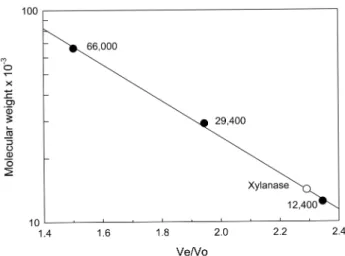
purified xylanase in the physiological solution of 0.05 M Tris-HCl, pH 7.5, 0.1 M NaCl (Fig. 3). The ratio of elution volume (Ve) to void volume (Vo) for the xylanase was 2.25. Comparing with the ratios of Ve/Vo for molecular weight markers, the molecular weight of the xylanase was derived to be 14,100, which was similar with 15,000 in SDS-PAGE. These results showed that the xylanase existed in a monomeric protein in the physiological solution.
Thin layer chromatography in Fig. 4 of oat spelt xylan
which was hydrolyzed with the xylanase for 1, 1.5, and 2 hr showed that the xylan hydrolyzate contained xylobiose and high-molecular-weight xylooligosaccharides, but not xylose and arabinose. There was no difference between the TLC patterns of the xylan hydrolyzates with different incubation times.
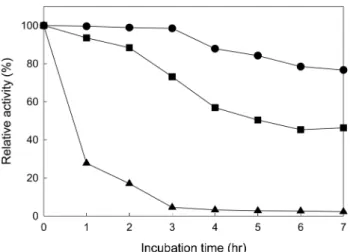
Heat stability of the purified xylanase was determined by heating the purified xylanase at 40, 50, and 60oC in a water bath for 1~7 hours and measuring relative activities of the heated samples of the xylanase (Fig. 5). The relative activities were still more than 80% after heating at 40oC for 7 hr. The relative activities remained at 50% at 50oC for 7 hr, but drastically decreased to less than 40% after 1 hr at 60oC, indicating inactivation of the xylanase. These results indicated that the purified xylanase from Bacillus SP-6 is relatively heat-labile.
Some strains of Bacillus which had ability to hydrolyze xylan were reported to produce two groups of xylanases [7, 9, 16, 21]. One group was basic (pI 8.3 to 10.0) with low molecular weight (16,000 to 22,000) by SDS-PAGE, and the other group was acidic with high molecular weight (43,000 to 50,000). Xylanases purified from Bacillus circulans WL-112 had molecular weights of 85,000 and 15,000 which yielded xylose and xylobiose, respectively.
The range of optimum pH of both enzymes was 5.5-7.0 [7].
The xylanase from the culture supernatant of Bacillus sp.
A-6 was adsorbed to SP-Sepharose, a cation exchange gel, in 5 mM sodium acetate, pH 5.0, during the purification, but not to DEAE-Sephacel, an anion exchange gel, in Fig. 2. SDS-PAGE and zymogram of xylanase fractions from
purification steps. lane 1, protein molecular weight markers; lane 2, ultrafiltration concentrate; lane 3, purified xylanase; lane 4, zymogram of purified xylanase.
Fig. 3. Thin layer chromatogram of xylan hydrolysates treated with the purified xylanase from Bacillus sp. A-6. The xylan hydrolyzates were analyzed after treating oat spelt xylan with the xylanase for 1~2 hr. lane 1, 1 hr; lane 2, 1.5 hr; lane 3, 2 hr; lane 4, xylose and xylobiose; lane 5, arabinose.
Fig. 4. Molecular weight determination of the purified xyla- nase using gel filtration chromatography in FPLC. ●: bovine serum albumin (66,000), carbonic anhydrase (29,000), cyto- chrome C (12,400), ○: xylanase.
10mM Tris-HCl, pH 8.0, in an initial study for purification (results were not shown), which suggested that the xylanase should be a basic protein. The molecular weights of the xylanase were 15,000 and 14,100 in SDS-PAGE and gel filtration column, respectively. The xylanase hydrolyzed oat splet xylan into xylobiose and xylooligosaccharides.
These results suggested that the xylanase in this study might belong to the first group which consists of basic low- molecular-weight proteins. Further studies are necessary to investigate the presence of acidic high-molecular-weight xylanase in the culture supernatant of Bacillus sp. A-6.
Many studies concerning purification and characteriza- tion of xylanase from Bacillus gave focus on thermostable alkalophilic enzymes which may be used for paper bleach- ing [1, 6, 20]. However, the objective of isolation and characterization of the xylanase and xylanase-producing Bacillus sp. A-6 [14] was to develop probiotics which may help degradation of NSP in the animal intestine and reduc- tion of manual output [3, 12]. The xylanase purified in this study was a heat-sensitive enzyme, of which the activity decreased to less than 40% at 60oC after 1 hour, indicating inactivation of the xylanase. Thus, the enzyme itself does not seem to be effective as a feed additive, because it may be inactivated during the manufacture of feed, where the enzyme is often heat-treated during spray-drying of enzyme and pelletizing of feed.
The previous study [14] showed that the optimum pH and temperature for the enzyme activities were 7.0 and 50oC, respectively. The optimum temperature of Bacillus sp. A-6 for enzyme production was 30oC. The relatively
low temperature and neutral pH for optimal enzyme activity and the low temperature for optimal enzyme production may enable Bacillus sp. A-6 to promote degradation of xylan during fermentation of feed and degradation of animal feces at ambient temperature. Thus, the mesotrophic Bacillus sp. A-6 producing the xylanase may be applied as probiotics to promote animal production and to prevent environmental pollution.
Acknowledgement
The present research was supported in 2005 by Sangji University
REFERENCES
1. Adeola, O. and M. R. Bedford. 2004. Exogenous dietary xylanase ameliorates viscosity-induced anti-nutritional effects in wheat-based diets for White Pekin ducks (Anas platyrinchos domesticus). Br. J. Nutr. 92: 87-94.
2. Aspinali, G. O. 1959. Structural chemistry of the hemicellu- loses. Adv. Carbohydr. Chem. 14: 429-468.
3. Beg, Q. K., M. Kapoor, L. Mahajan, and G. S. Hoondai.
2001. Microbial xylanases and their industrial applications: a review. Appl. Microbiol. Biotechnol. 56: 326-338.
4. Biely. P. 1985. Microbial xylanolytic systems. Trends Bio- techonol. 3: 286-290.
5. Collins, T., G. Gerday, and G. Feller. 2005. Xylanases, xyla- nase families and extremophilic xylanases. FEMS Mirobiol.
Rev. 29: 3-23
6. Cowieson, S. J., M. Hruby, and M. Faurschou Isaksen. 2005.
The effect of conditioning temperature and exogenous xyla- nase addition on the viscosity of wheat-based diets and the performance of broiler chickens. Br. Poult. Sci. 46: 717-24.
7. Esteben, R., J. R. Villanueva, and T. G. Villa. 1992. β-D- Xylanases of Bacillus circulans WL-12. Can. J. Microbiol.
28: 733-793.
8. Graham, H., P. H. Simmins, and J. Sands. 2003. Reducing environmental pollution using animal feed enzymes. Com- mun. Agric. Appl. Bio. Sci. 68: 285-289.
9. Honda, H., T. Kudo, and K. Horikoshi. 1985. Two types of xylanases of alkalophilc Bacillus sp. No. C-125. Can. J.
Microbiol. 31: 538-542.
10. Hong, H. A., L. H. Duc, and S. M. Cutting. 2005. The use of bacterial spore formers as probiotics. FEMS Microbiol. Rev.
29: 813-835.
11. Kim, K. C., S.-S. Yoo, Y.-A. Oh, and S.-J. Kim. 2003.
Isolation and characteristics of Trichoderma harzianum FJ1 producing cellulases and xylanase. J. Microbiol. Biotechnol.
13: 1-8
12. Kulkarni, N., A. Shendye, and M. Rao. 1999. Molecular and biotechnological aspects of xylanases. FEMS Microbiol. Rev.
Fig. 5. Thermal stability of the purified xylanase. The xylanase solutions in 0.05M sodium phosphate, pH 7.0 were held at the var- ious temperatures (▲, 60oC; ■, 50oC; ●, 40oC) for 7 hr.
23: 411-456.
13. Laemmli, U. K. 1970. Cleavage of structural proteins during the assembly of the head of bacteriophage T-4. Nature (London) 227: 680-685.
14. Lee, J.-H. and S. H. Choi. 2006. Xylanase production by Bacillus sp. A-6 isolated from rice bran. J. Microbiol.
Biotechnol. 16: 1856-61.
15. Miller, G. L. 1959. Use of dinitrosalicylic acid reagent for determination of reducing sugar. Anal. Chem. 31: 426-428.
16. Okazaki, W., T. Akiba, K. Horikosh, and R. Akahoshi 1985.
Purification and characterization of xylanases from an alkalophilic thermophilic Bacillus spp. Agric. Biol. Chem.
49: 2033-2039.
17. Polizeli, M. L., A. C. Rizzatti, R. Monti, H. f. Terenzi, J. A.
Jorge, and D. S. Amorim. 2005. Xylanases from fungi: pro- perties and industrial applications. Appl. Microbiol. Bio- technol. 67: 577-591.
18. Ratanakhanokchal, K., K. L. Kyu, and M. Tanticharoen.
1999. Purification and properties of a xylan-binding endoxy- lanase from alkaliphilic Bacillus sp. Strain K-1. Appl.
Environ. Microbiol. 65: 694-697.
19. Sunna, A. and G. Antranikian. 1997. Xylanolytic enzymes from fungi and bacteria. Crit. Rev. Biotecchnol. 17: 39-67.
20. Wang, Z. R., S. Y. Qiao, and W. Q. Lu, and D. F. Li. 2005.
Effects of enzyme supplementation on performance, nutrient digestibility, gastrointestinal morphology, and volatile fatty acid profiles in the hindgut of broilers fed wheat-based diets.
Poult. Sci. 84: 875-881.
21. Wong, K. K. Y., L. U. L. Tan, and J. N. Saddler. 1988.
Multiplicity of β-1,4-xylanase in microorganisms: Functions and Applications. Mcirobiol. Rev. 52: 305-317.
(Received March 2, 2009/Accepted April 16, 2009)
국문초록
Bacillus sp. A-6의 Xylanase의 정제와 특성
최석호*
상지대학교 동물생명자원학부
Bacillus sp. A-6의 배양액의 상등액으로부터 한외여과와 5 mM sodium acetate, pH 5.0 용액으로 평형화된 SP- Sepharose column을 사용한 이온교환 크로마토그래피에 의해 xylanase를 정제하였다. Column에 흡착된 xylanase는
0.05 M NaCl 이하의 농도에서 용출되었다. 용출된 xylanase가 SDS-PAGE에서 단일 펩티드 밴드로 분리되어 순수함
을 확인하였으며 oat spelt xylan을 기질로한 zymogram에서 xylan을 분해하는 밴드로 나타났다. Xylanase의 분자량 은 SDS-PAGE에서 15,000이었고 겔여과 크로마토그래피에서 14,100 이었다. 박층막 크로마토그래피에서 xylanase가 oat spelt xylan을 xylobiose와 xylooligosaccharide로 분해함을 보였다. Xylanase를 가열할 때에 상대활성도가 40oC에 서 7시간 후에 80%로 감소하였으며 60oC에서는 1시간 후에 40% 이하로 감소하였다.