Ⅰ. Introduction
Clematis mandshurica Rupr. (Ranuncu-
laceae) has been widely used for the treatment of various diseases in oriental medicine. Herbs of Clematis family have been used to treat rheumatic arthritis and other inflammatory conditions, such as laryngitis, skin and breast
위령선 약침이 콜라겐으로 유도된 골관절염 모델에서 흰쥐의 PAG 영역에서 NOS 발현에 미치는 영향
양국정1․김순중2․서일복3․박세근4․김정선4․서정철5․최선미6․이혜정7․김이화1
1세명대학교 한의과대학 경혈학교실, 2재활의학교실, 3해부학교실, 4한방식품영양학과;
5대구한의대학교 한의과대학 침구학교실; 7 6한국한의학연구원 의료연구부;
경희대학교 동서의학대학원 의과학과
Effects of Clematis mandshurica Rupr. on Nitric Oxide Synthase in the Periaqueductal Gray of Collagenase-
induced Rat Osteoarthritis Model
Kook-Jung Yang1, Soon-Joong Kim2, Il-Bok Seo3, Se-Keun Park4, Jeongseon Kim4, Jung-Chul Seo5, Sun-Mi Choi6, Hye-Jung Lee7, Ee-Hwa Kim1
1Dept. of Meridian & Acupoint, 2Dept. of Rehabilitation, 3Dept. of Anatomy, 4Dept. of Food & Nutrition in Oriental Medicine, College of Oriental Medicine, Semyung University ;
5Dept. of Acupuncture & Moxibustion, College of Oriental Medicine, Daeguhani University ;
6Department of Medical Research, Korean Institute of Oriental Medicine ;
7Dept. of Oriental Medical Science, Graduate School of East & West Medical Science, Kyung-Hee University
Abstract
목적 : 골관절염은 진통을 수반하는 퇴행성 관절질환이며, 장애를 일으키는 주요한 원인이 된다. 또한 노인들에 있어서 골관절염은 매우 흔한 질환이라 할 수 있다. Nitric oxide(NO)는 Nitric Oxide Synthase(NOS)에 의하여 칼슘의존성통로를 통하여 L-arginine 으로부터 합성되어지며, NO는 중추신경계에 있어서 중요한 세포사이의 전달자이다.
방법 : 본 연구에서는 위령선 으로부터 추출한 액이 콜라겐으로 유도된 관절염에 걸린 쥐의 dorsolateral periaqueductal gray(DL-PAG) 영역에서 nNOS(neuronal NOS)와 NOS에 대하여 미치는 영향 을 nNOS immunohistochemistry와 nicotinamide adenine dinucleotide phosphate-diaphorase(NADPH-d) 검사법을 통하여 조사하였다.
결과 : 골관절염이 유발된 흰쥐의 DL-PAG 영역에서 nNOS와 NOS의 발현억제가 관찰되었으며, 위령 선이 콜라겐으로 유도된 골관절염에서 감소된 nNOS와 NOS의 발현이 증가되었다.
결론 : 본 연구를 통하여 위령선은 골관절염이 유발된 흰쥐의 DL-PAG에서의 nNOS와 NOS의 발현 에 영향을 미친다는 결과를 얻을 수 있었다.
Key words : Acupuncture, Clematis mandshurica, Collagenase, Nitric oxide Osteoarthritis, Periaquaductal gray
▪교신저자 : 김이화, 충북 제천시 신월동 산21, 세명대학교 한의과대학 경혈학교실, Tel. 043-649-1348, Fax. 043-649-1702, E-mail : [email protected]
‧투고 : 2005/11/30 ‧수정 : 2005/12/13 ‧채택 : 2005/12/19
T h e K orea n Jou rn al of M erid ia n & A cu p oin t
infections1,2).
Osteoarthritis is a painful degenerative joint disease and a major cause of disability and represents the most common disease in the aging population3,4). In addition, the osteo- arthritis can originate from various causes, with trauma and concomitant synovitis of knee joint, and inflammatory mediator includ- ing interleukin-1 (IL-1), tumor necrosis fact- or-alpha (TNF-alpha), matrix metalloprotei- nases (MMPs), and nitric oxide (NO) play im- portant roles in the pathogenesis of osteo- arthritis5).
NO, synthesized from L-arginine throu- gh calcium-dependent pathways by nitric oxi- de synthase (NOS), is a free radical with sig- naling functions in the central nervous system (CNS). NO has been implicated in the regu- lation of autonomic functions, and it has been shown to play important roles in the neural, vascular, and immune systems6). Several iso- forms of NOS exist and fall into three major classes: inducible NOS (iNOS), endothelial NOS (eNOS), and neuronal NOS (nNOS). Of these, nNOS is mainly expressed in the CNS and has been implicated in signal transmis- sion6,7).
The midbrain periaqueductal gray (PAG) is believed to be an important component in the descending (endogenous) pain control sys- tem8). The descending pain control system is activated by electrical stimulation and local injection of morphine-like narcotics or opioid peptides at the PAG9-11). In immunohistoche- mical studies, the presence of NOS-staining
neurons has been demonstrated in the dorso- lateral PAG (DL-PAG).
In the present study, the effect of aque- ous extract of Clematis mandshurica on the expression of NOS and nNOS in the DL-PAG was investigated via nNOS immunohistoche- mistry, and nicotinamide adenine dinucleotide phosphate-diaphorase (NADPH-d) histoche- mistry, which takes advantage of the fact that NADPH-d-positive neurons are the same as those containing NOS7).
Ⅱ. Materials & Methods
1. Animals and Treatments
Male Sprague-Dawley rats weighing 200 ± 10 g (6 weeks of age) were used for the experiment. Each animal was housed at a controlled temperature (20 ± 2 ℃) and was maintained under light-dark cycles, each cycle consisting of 12 h of light and 12 h of dark- ness (lights on from 07:00 h to 19:00 h), with food and water made available ad libitum. The experimental procedures were performed in accordance with the animal care guidelines of the NIH and the Korean Academy of Medical Sciences. Animals were divided into three groups: the control group, the osteoarthritis (OA) group, the OA and Clematis mandshu- rica-treated group (n = 8 in each group).
To induce osteoarthritis in the experi- mental animals, a single intra-articular injec- tion of collagenase (50 mg/kg in saline; Sigma Chemical Co., St. Louis, MO, USA) into the knee joint was given to each anesthetized
animal on the first day and the third day of the experiment respectively, while animals of the control group received equivalent amounts of normal saline. Animals of the Clematis ma- ndshurica-treated groups were administered per os (P.O.) with aqueous extract of Clematis mandshurica at the 5 mg/kg dose for 15 days.
2. Preparation of Clematis mandshurica
To obtain the water extract of Clematis mandshurica, 200 g of Clematis mandshurica was added to distilled water, and extraction was performed by heating at 80 ℃, concentr- ated with a rotary evaporator and lyophilized.
The resulting powder, weighing 30 g (15 %), was dissolved in saline.
3. Tissue preparation
Animals were weighed and overdosed with Zoletil 50 (10 mg/kg, i.p.; Vibac Labora- tories, Carros, France). After a complete lack of response was observed, the rats were tra- nscardially perfused with 50 mM phosphate- buffered saline (PBS) and then with 4 % paraformaldehyde in 100 mM phosphate buffer (PB) at pH 7.4. The brains were dissected, postfixed in the same fixative overnight, and transferred into a 30 % sucrose solution for cryoprotection. Serial coronal sections of 40 μ m thickness were made using a freezing microtome (Leica, Nussloch, Germany).
4. NADPH-d histochemistry
For NADPH-d activity, ten sections on
average were selected from each brain in the region spanning from Bregma -5.30 mm to -8.30 mm according to the atlas by Paxinos and Watson12). In brief, free-floating sections were incubated at 37 ℃ for 60 min in 100 mM PB containing 0.3 % Triton X-100, 0.1 mg/ml nitroblue tetrazolium, and 0.1 mg/ml NADPH.
The sections were then washed three times with PBS and mounted onto gelatin-coated slides. The slides were air-dried overnight at room temperature, and coverslips were moun- ted using Permount.
5. nNOS immunohistochemistry
For analyzing the level of nNOS expres- sion, ten sections on average were selected from each brain in the region spanning from Bregma -5.30 mm to -8.30 mm according to the atlas by Paxinos and Watson12). Free- floating tissue sections were washed twice in 50 mM PBS and were then permeabilized in 0.2 % Triton X-100 for 30 min. After washing twice with PBS, sections were incubated overnight with mouse anti-nNOS antibody (Santa Cruz Biotechnology, Santa Cruz, CA, USA) at a dilution of 1:1000. Sections were washed twice in PBS and incubated for 1 h with biotinylated anti-rabbit antibody (1:200).
Bound secondary antibody was then amplified with Vector Elite ABC kit (Vector Laborato- ries, Burlingame, CA, USA). The antibody- biotin-avidin-peroxidase complexes were vis- ualized using 0.05 % diaminobenzidine. The sections were mounted onto gelatinized glass slides and air-dried, and cover slides were
mounted using Permount.
6. Data analysis
The area of PAG was measured using Image-ProPlus image analyzer (Media Cyber- netics Inc., Silver Spring, MD, USA). The to- tal numbers of nNOS-positive and NADPH-d -positive neurons in the PAG were counted hemilaterally under a light microscope (Olym- pus, Tokyo, Japan), and the results were ex- pressed as numbers of nNOS-positive and NADPH-d-positive cells per section of the area of the PAG region.
7. Statistical analysis
Data were analyzed using SPSS (ver- sion 10.0) by one-way analysis of variance (ANOVA) followed by Student's t-test, and results were expressed as mean standard err- or mean (S.E.M.). Differences were considered significant for p < 0.05.
Ⅲ. Results
1. Effects of Clematis mandshurica on the number of NADPH-d-positive cells in the DL-PAG
NADPH-d-positive cells were mainly localized in the dorsolateral area of the PAG, consistent with the findings of Rodella et al.13). Fig. 1. Photomicrographs of nicotinamide adenine dinucleotide phosphate-diaphorase (NADPH-d)-positive cells in the dorsolateral periaqueductal gray (DL-PAG). Sections were stained for NOS (blue).
Scale bar represents 100 μm. A; Control group, B; Osteoarthritis group, C; Osteoarthritis and Clematis mandshurica-treated group.
Fig. 2. Mean number of NADPH-d-positive cells in the DL-PAG in each group. A; Control group, B; Osteoarthritis group, C; Osteoar- thritis and Clematis mandshurica-treated group. *represents P < 0.05 compared to the control group. #represents P < 0.05 compared to the Osteoarthritis group.
0 20 40 60 80 100 120
A B C
Number of NADPH-d-positive cells (per section)
*
#
The number of NADPH-d-positive cells in the control group was 100.44 ± 1.56/section.
This number was decreased to 63.96 ± 3.10/
section in the OA group but was increased again to 79.36 ± 2.57/section in the OA and Clematis mandshurica-treated group.
2. Effects of Clematis mandshurica on the number of nNOS-positive cells in the DL-PAG
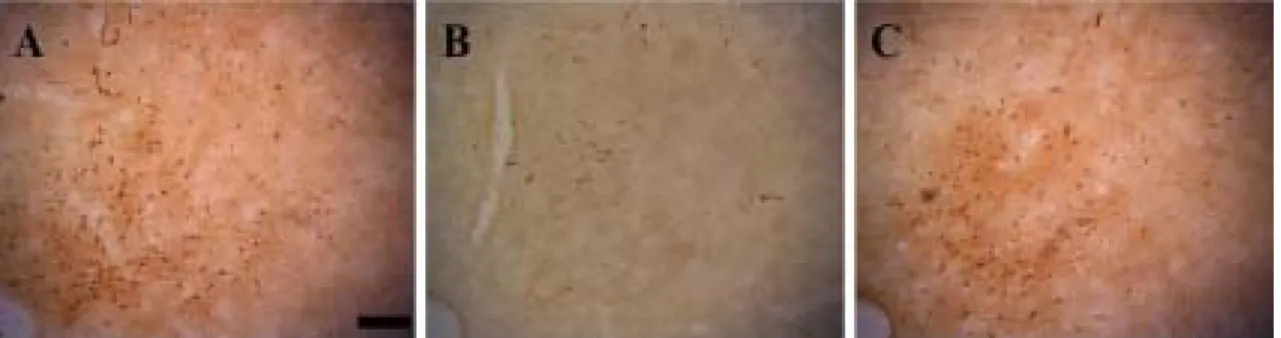
A similar pattern was observed for NOS expression. The number of nNOS-positive cells in the control group was 109.00 ± 2.57/section.
This number was decreased to 86.91 ± 1.75/
section in the OA group but was increased again to 101.06 ± 2.74/section in the OA and Clematis mandshurica-treated group.
Ⅳ. Discussion
The purpose of the present study was to investigate whether aqueous extract of Cle- matis mandshurica administration alters NOS expression in the PAG region of collagenase- induced osteoarthritis model. In the present study, Clematis mandshurica modulated oste- oarthritis-induced NOS expression associated with inflammation and pain in the PAG region of CNS.
Recently, alternative and complementary approaches such as the use of a wide array of Fig. 3. Photomicrographs of neuronal nitric oxide synthase (nNOS)-positive cells in the dorsolateral periaqueductal gray (DL-PAG). Sections were stained for NOS (reddish brown). Scale bar represents 100 μm. A; Control group, B; Osteoarthritis group, C; Osteoarthritis and Clematis mandshurica-treated group.
Fig. 4. Mean number of neuronal nitric oxide synthase (nNOS)-positive cells in the DL-PAG in each group. A; Control group, B; Osteoarthritis group, C; Osteoarthritis and Clematis mandshurica-treated group.
*represents P < 0.05 compared to the control group. #represents P < 0.05 compared to the Osteoarthritis group.
0 20 40 60 80 100 120
A B C
Number of nNOS-positive cells (per section)
*
#
natural, herbal, nutritional, and physical mani- pulations are becoming popular. For instance, dietary supplements containing soy protein or Harpgophytum procumbens extract have been shown to have some efficacy against the sy- mptoms of osteoarthritis14,15). Herbs of Clema- tis family possessed diuretic activity16), anti- microbial activity17), and anti-inflammatory activity1,2). In addition, purified extract from the mixture of three oriental herbs including Clematis mandshurica protect against collage- nase-induced rabbit osteoarthritis models by reducing proteoglycan degradation in cartila- ge18).
Osteoarthritis is the most common joint disorder and a major contributor to disability in the elderly19). Although there is a lack of agreement regarding the definition of osteoar- thritis, it is generally viewed as a degenera- tive disorder involving cartilage degradation.
Typically, the degenerative changes are acco- mpanied by a local inflammatory component that accelerates the joint destruction.
NO has been implicated in the patho- genesis of osteoarthritis and rheumatoid arth- ritis in experimental animal models of arthri- tis4,20). Previous studies have shown that me- chanical stress is an important modulator of NO in several cell types, including endothelial cells21), osteocytes22), and osteoblasts23). In articular cartilage, NO production is increased in chondrocytes exposed to fluid shear stress, while in isolated chodrocytes embedded in agarose, intermittent compression can decrea- se NO production24). Possible role of NO as an
inflammatory mediator remains controversial.
In particular, many studies have been made on NO release in osteoarthritis-affected chodro- cytes or osteoblasts, however no report has been made on the effect of osteoarthritis on the activity of PAG containing NOS, yet. In the present, decreased expression of nNOS and NOS was observed in the DL-PAG of collagenase-induced osteoarthritis rats. In the present results, decreased expression of nNOS and NOS was observed in the DL-PAG of collagenase-induced osteoarthritis rats, provi- ding physiological evidence of the involvement of NOS in the osteoarthritis. Because of the involvement of neuropathogenesis in collage- nase-induced osteoarthritis, it appears logical that drug which modulates NOS may be of use in reducing osteoarthritis-induced neuro- nal change.
Ⅴ. Conclusion
In the present results, the aqueous ex- tract of Clematis mandshurica treatment was enhanced the osteoarthritis-induced suppres- sion in the expression of nNOS and NOS in the DL-PAG. The present results suggest that Clematis mandshurica can exert its analgesic effects probably by modulating NOS expres- sions, and it is very possible that Clematis mandshurica can offer a valuable mode of therapy for the treatment of osteoarthritis.
Acknowledgements
This study is supported by Korea Ins-
titute of Oriental Medicine
References
1. Li RW, David LG, Myers SP, Leach DN.
Anti-inflammatory activity of Chinese medicinal vine plants. J Ethnopharmacol. 2003
; 85 : 61-7.
2. Li RW, Myers SP, Leach DN, Lin GD, Leach G. A cross-cultural study: anti-inflammatory activity of Australian and Chinese plants. J Ethnopharmacol. 2003 ; 85 : 25-32.
3. Jackson BD, Wluka AE, Teichtahl AJ, Morris ME, Cicuttini FM. Reviewing knee osteoarthritis-a biomechanical perspective. J Sci Med Sports. 2004 ; 7 : 347-57.
4. McCartney-Francis N, Allen JB, Mizel DE, Albina JE, Xie QW, Nathan CF, Wahl SM.
Suppression of arthritis by an inhibitor of nitric oxide synthase. J Exp Med. 1993 ; 128 : 749-54.
5. Stefanie SB, Ulrich K, Dominik MA, Anna M, Gereon L, Horst S, Hannsjrg WS. Peter F, Uwe B. Osteoarthritis of the knee clinical assessments and inflammatory markers.
Osteoarthr Cartil 2004 ; 12 : 469-75.
6. Dawson TM, Dawson VL, Snyder SH. A novel neuronal messenger molecule in brain: the free radical, nitric oxide. Ann Neurol. 1992
; 32 : 297-311.
7. Hope BT, Michael GJ, Knigge KM, Vincent SR. Neuronal NADPH diaphorase is a nitric oxide synthase. Proc Natl Acad Sci USA. 1991
; 88 : 2811-14.
8. Basbaum AI, Fields HL. Endogenous pain control system: brain stem spinal pathways
and endorphin circuitry. Annu Rev Neurosci.
1984 ; 7 : 309-38.
9. Millan MJ, Czlonkwski A, Millan MH, Herz A. Activation of periaqueductal grey pools of -endorphin by analgesic electrical stimu- lation in freely moving rats. Brain Res. 1987
; 407 : 199-203.
10. Fields HL, Heinricher MM, Mason P.
Neurotransmitters in nociceptive modulatory circuits. Annu Rev Neurosci. 1991 ; 14 : 219-45.
11. Bandler R, Shipley MT. Columnar organi- zation in the midbrain periaqueductal gray:
modules for emotional expression?. Trend Neurosci. 1994 ; 17 : 379-88.
12. Paxinos G, Watson C. The rat brain in stereotaxic coordinates. San Diego, Academic Press. 1997.
13. Rodella L, Rezzani R, Agostini C, Bianchi R.
Induction of NADPH-diaphorase activity in the rat periaqueductal gray matter after nociceptive visceral stimulation. Brain Res.
1998 ; 793 : 333-6.
14. Arjmandi BH, Khalil DA, Lucas EA, Smith BJ, Sinichi N, Hodges SB, Juma S, Munson ME, Payton ME, Tivis RD, Svanborg A. Soy protein may alleviate osteoarthritis symp- toms. Phytomedicine 2004 ; 11 : 567-75.
15. Gagnier JJ, Chrubasik S, Manheimer E.
Harpgophytum procumbens for osteoarthritis and low back pain: a systematic review. BMC Complement Altern Med. 2004 ; 4 : 13.
16. Alvarez ME, Maria AO, Villegas O, Saad JR.
Evaluation of diuretic activity of the con- stituents of Clematis montevidensis Spreng.
(Ranunculaceae) in rats. Phytother Res 2003
; 17 : 958-60.
17. Buzzini P, Pieroni A. Antimicrobial activity of extracts of Clematis vitalba towards pa- thogenic yeast and yeast-like microorgani- sms. Fitoterapia. 2003 ; 74 : 397-400.
18. Choi JH, Choi JH, Kim DY, Yoon JH, Youn HY, Yi JB, Rhee HI, Ryu KH, Jung K, Han CK, Kwak WJ, Cho YB. Effects of SKI 306X, a new herbal agent, on proteoglycan degra- dation in cartilage explant culture and colla- genase-induced rabbit osteoarthritis model.
Osteoarthr Cartil. 2002 ; 10 : 471-8.
19. GuccioneAA, Felson DT, Anderson JJ, Anthony JM, Zhang Y, Wilson PW, Kelly- Hayes M, Wolf PA, Kreger BE, Kannel WB.
The effects of specific medical conditions on the functional limitations of elders in the Framingham Study. Am J Public Health. 1994
; 84 : 351-8.
20. Clancy RM, Amin AR, Abramson SB. The role of nitric oxide in inflammation and immunity. Arthritis Rheum. 1998 ; 41 : 1141-51.
21. Gooch KJ, Dangler CA, Frangos JA. Exogen- ous, basal, and flow-induced nitric oxide production and endothelial cell proliferation.
J Cell Physiol. 1997 ; 171 : 252-8.
22. Rawlinson SC, Pitsillides AA, Lanyon LE.
Involvement of different ion channels in osteoblast' and ostecytes' early responses to mechanical strain. Bone. 1996 ; 19 : 609-14.
23. Johnson DL, McAllister TN, Frangos JA.
Fluid flow stimulates rapid and continuous release of nitric oxide in osteoblasts. Am J Physiol. 1996 ; 271 : E205-8.
24. Lee DA, Frean SP, Lees P, Bader DL. Dynamic mechanical compression influences nitric oxide production by articular chondrocytes seeded in agarose. Biochem Biophys Res Commun. 1998 ; 251 : 580-5.