치매환자 가족 부양자의 부양부담에 영향을 미치는 요인
권오대 *·김태완
†·박미영
‡이상도
§·이현아
||·이호원
¶대구경북치매연구회
대구가톨릭대학교 의과대학 신경과학교실*
대구파티마병원 신경과†
영남대학교 의과대학 신경과학교실‡
이상도 신경과의원§
계명대학교 의과대학 신경과학교실∥
경북대학교 의과대학 신경과학교실¶
Factors Affecting Caregiver Burden in Family Caregivers of Patients with Dementia
Oh Dae Kwon, M.D.*,Tae Wan Kim, M.D.
†, Mee Young Park, M.D.
‡, Sang-Doe Yi, M.D.
§, Hyon-Ah Yi, M.D.
||, Ho Won Lee, M.D.
¶, Daegu-Kyungpook Dementia Association
Department of Neurology*, School of Medicine, Catholic University of Daegu, Daegu; Department of Neurology†, Daegu Fatima Hospital, Daegu; Department of Neurology‡, College of Medicine, Yeungnam University, Daegu;Yi Sang-Doe Neurology Clinic§, Daegu; Department of Neurology||, School of Medicine, Keimyung University, Daegu; Department of Neurology¶, School of Medicine, Kyungpook National University, Daegu, Korea
Background: This study aimed to know the state of caregiver burden of family caregivers of patients with dementia and also to know factors associated with the severity of caregiver burden. Methods: Family caregivers of dementia patients were enrolled from five general hospitals in Daegu Metropolitan city, Ko- rea. The participants analyzed in the present study were 199 subjects who were 24 to 86 years old, living in Daegu or Kyungsang Bukdo province. Demographic features, general characteristics, characteristics of caring patients were collected and Burden Interview was done by a psychologist. Factors affecting caregiver burden were assessed using statistical analyses. Results: The average severity of caregiver burden of family caregivers were between mild and moderate. Factors affecting the severity of caregiver burden were caregiving days per week among caregiver’s characteristics and Neuropsychiatric Inventory and Geriatric Depression Scale among patient characteristics by multiple regression linear analysis.
Caregiving cost shows marginal significance. Interestingly, cognitive scales like Mini-Mental State Exami- nation, Clinical Dementia Rating, Physical and Instrumental Activities of Daily Living did not affect care- giver burden of family caregivers. Conclusions: This study showed that caregiving days per week of caregivers and neuropsychiatric symptoms including depressive mood of patients are closely related with caregiver burden of family caregivers of patients with dementia in Korea.
Received: November 11, 2013 Revision received: December 26, 2013 Accepted: December 26, 2013
Address for correspondence Oh Dae Kwon, M.D.
Department of Neurology, Daegu Catholic University Medical Center, School of Medicine, Catholic University of Daegu, 33 Duryugongwon- ro 17-gil, Nam-gu, Daegu 705-718, Korea Tel: +82-53-650-4298
Fax: +82-53-654-9786 E-mail: [email protected]
This work was supported by the grant of Research Institute of Medical Science, Catholic University
of Daegu (2012). Key Words: Caregivers, Dementia, Burden interview
서 론
치매는 노인인구에서 발생빈도가 높은 대표적인 노인성 질환이 다. 한국인의 평균수명이 연장되어 2000년에 이미 인구의 7% 이상 이 65세를 넘어선 고령화 사회가 되었고 인구의 14% 이상이 노인인 구인 고령 사회에 근접하고 있다[1]. 이미 한국 사회의 농촌 지역은 젊은이들이 도시로 이동하면서 농촌지역의 출산율이 급격히 떨어 진 결과로 인구의 20% 이상이 65세 이상인 초고령 사회가 되었다 [2]. 노인인구의 급속한 증가로 인하여 치매의 발병이 많아지는 것과 동반되어[3] 치매환자를 부양하는 부양자가 증가되고 있다. 부양부 담은 치매의 원인질환과 그 중증도 등의 환자의 특성과 부양자의 특성 및 부양 여건에 영향을 받을 수 있기 때문에 정량화가 어렵다
[4]. 또한 부양부담에 대한 연구결과는 특정한 기준을 세우기 어렵 기 때문에 연구자에 따라 결과가 다를 수 있으며 인종과 문화에 따 라서도 차이를 보일 수 있다[4, 5]. 우리나라는 2008년 7월부터 노인 장기요양보험을 시행하여 치매환자의 부양을 국가사업으로 시행 하고 있으며 이로 인하여 개인이 가정에서 부양하기 어려운 치매환 자들이 요양시설에 입소하는 것이 쉽게 되었다. 그렇지만 경도의 치 매환자들은 요양시설 입소가 제한적이며 유교적 전통에 따른 가족 부양의 선호가 있으므로 아직까지 많은 치매환자들이 가족의 부양 을 받고 있는 것으로 생각된다. 치매환자의 집이나 가족 보호자의 집 같은 요양시설 이외에서의 치매환자 부양에서 부양을 하는 가족 의 역할은 매우 크다. 치매를 진료하는 의사들은 진료실에서 종종 가족 부양자들이 받는 부양부담을 직간접적으로 체감할 수 있다.
© 2013 Korean Dementia Association
This is an Open Access article distributed under the terms of the Creative Commons Attribution Non-Commercial License (http://creativecommons.org/licenses/by-nc/3.0) which permits unrestricted non-commercial use, distribution, and reproduction in any medium, provided the original work is properly cited.
외국에서의 선행연구에서는 치매환자의 부양부담이 상당한 것으 로 보고되어 있고[6, 7] 국내 연구에서도 부양부담이 우울증상이나 불안 증상 또는 삶에 대한 만족도 저하로 나타나고 있다[8-11]. 국내 연구 중 임상의사에 의해 수행된 부양부담에 영향을 미치는 요인 에 대한 연구는 제한되어 있고[10] 노인장기요양법의 시행 이전에 된 연구이며 대상군의 숫자도 적으므로 추가적인 연구가 필요하다.
저자들은 본 연구를 통하여 대구경북지역에 거주하는 치매환자를 돌보는 가족 부양자들의 특성을 파악하고 이들의 사회경제학적인 여건을 조사하는 동시에 부양을 받는 치매환자들의 의학적, 사회적 특성을 조사하고자 하였다. 또한, 이를 통하여 가족부양자들의 부 양부담에 영향을 미치는 요인들을 찾고자 하였다.
대상과 방법
대상대구의 5개 종합병원에 치매로 등록되어 진료를 받고 있는 환자 의 가족 부양자 중에서 대구나 경상북도에 거주하면서 연구 대상 자의 선별기준에 부합하는 가족 부양자들 중에서 본 연구에 참여 하기를 동의하는 환자 199명에 대하여 설문조사를 하였으며, 이들 이 부양하는 환자의 인지기능에 대한 자료도 동의를 받아 수집하 였다. 본 연구는 대구가톨릭대학교병원 연구윤리위원회의 승인 이 후에 진행되었다.
가족 부양자의 선별 기준으로는 종합병원 신경과에서 치매로 진 단을 받은 환자와 적어도 6개월 이상 집에서 동거한 가족으로서 한 글을 읽고 쓸 줄 알며 본 연구에 동의한 사람으로 하였다. 치매 진단 은 Diagnostic and Statistical Manual of Mental Disorders 4th edition (DSM-IV) [12]의 치매기준에 만족하는 것을 원칙으로 하였다. 알츠 하이머형 치매는 National Institute of Neurological and Communica- tive Disorders and Stroke-the Alzheimer’s Disease and Related Disorders Association (NINCDS-ADRDA) [13]의 “probable” 기준에 부합하고, 혈관성 치매는 National Institute of Neurological Disorders and Stroke and the Association International pour is recherché et l’Enseignement en Neurosciences (NINCDS-AIREN) [14]의 “probable” 또는 “possible”에 맞는 환자를 대상으로 하였다. 파킨슨병 치매는 역시 DSM-IV 치매 진단기준을 만족하고 Emre 등[15]의 Parkinson’s disease dementia의 진단기준에 부합한 환자를 대상으로 하였다. 대상환자 모집은 2012 년 9월부터 2013년 2월까지 시행되었다. 한 명의 숙달된 임상심리사 가 연구에 참가한 5개 병원을 방문하여 치매환자를 부양하는 가족 부양자에 대하여 구조화된 설문조사를 시행하고 심리검사 항목을 시행하였으며 추가로 피부양자인 환자에 대한 정보를 수집하였다.
치매환자의 부양자는 치매증상 발생 후 적어도 6개월 이상 동거한 주 부양자로서 연구에 동의한 사람으로 하였다. 문맹자나 시각장 애, 청각장애, 언어장애 또는 인지장애가 심하여 설문조사가 힘든 경우는 제외하였다. 환자의 인지기능에 대한 내용은 1년 이내에 시 행된 진료기록을 기준으로 하였다. 한국형 간이정신상태평가(K- MMSE, Korean version of mini-mental state examination) [16]와 Global Deterioration Scale (GDS) [17]이 조사되었고 Clinical Dementia Rating (CDR) [18]은 Clinical Dementia Rating Sum of boxes (CDR-SB) 점수를 포함하여 조사하였고, 우울증상에 대하여는 노인우울척도검사 (Geriatric Depression Scale) [19]가, 기초적 일상생활능력의 척도로는 B-ADL (Barthel activities of daily living)이, 복합적 일상생활능력의 척 도로는 K-IADL (Korean version of instrumental activities of daily liv- ing) [20]이나 S-IADL (Seoul instrumental activities of daily living) [21]
중 한 가지가 병원의 사정에 따라 시행되었다.
가족부양자의 일반적인 특성을 조사하기 위해 부양자의 거주 지 역, 성별, 연령, 종교, 교육수준, 결혼상태, 직업, 월 소득을 조사하였 다. 환자와 관련된 특성으로서 부양자와 치매환자의 관계, 1일 부양 시간, 주당 환자를 부양하는 날짜, 보조 부양자의 유무, 부양을 위 해 사용하는 비용, 부양을 위해 하루 운전하는 시간 등을 측정하였 다. 부양자의 부양부담에 대한 조사로서 한국판 ZBI (Korean version of Zarit Burden Interview, ZBI-K) [22, 23], 부양보상감 척도[24, 25], Life Satisfaction Index-Z [26, 27], Beck depression inventory [28, 29], Beck An- xiety Inventory [30, 31]의 다섯 가지 설문이 시행되었다.
통계분석
분석에 포함된 변수들의 분포를 검토하고 환자와 가족 부양자의 특성, 부양 상황 및 일반적인 상황은 기술통계를 사용하였다. 부양 자의 부양부담과 다른 변수와의 연관성을 알기 위하여 우선 상관 분석을 시행하였다. 상관분석은 변수의 특성에 따라 Pearson 방법 과 Spearman 방법을 선택하여 적용하였다. 상관분석에서 유의하게 나온 변수를 대상으로 단순회귀분석을 시행하였으며 다중공선성 을 고려하여 다중회귀분석을 추가로 시행하였다. SPSS 19.0 version 의 통계프로그램을 사용하였고 유의수준은 양측검정에서 p<0.05 인 경우로 가정하였다.
결 과
대상군의 인구사회학적 특성모집된 가족부양자가 부양하는 치매환자의 일반적 특성으로 여
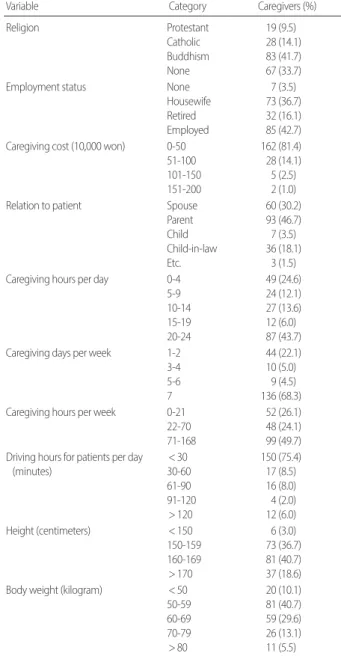
성이 남성보다 두 배 많았다. 여성의 평균 연령은 76세였고 평균학 력은 5년이었다. 환자의 인지기능은 K-MMSE 17점, CDR-SB 7점이었 다. S-IADL은 20점, 노인 우울척도는 16점이었다. 치매의 유형별로는 알츠하이머병 환자가 삼분의 이를 차지하였고 파킨슨병치매와 혈 관성 치매의 순서였다(Table 1). 가족 부양자의 인구사회학적 특성 으로는 여성이 더 많았고 연령대별로는 50대의 가족부양자가 가장 많았으며 다음이 50대 이하, 70대 순서였다. 교육 정도는 고졸이 가 장 많았고 대졸, 중졸 순서였다. 일일 환자부양시간은 20시간 이상 으로 전일인 경우가 가장 많았고 그 다음이 4시간 이하, 10-14시간 의 순서였다. 주당 환자 부양일수는 같이 살면서 매일 부양하는 경 우가 삼분의 이를 차지하였다. 부양을 위해서 운전을 하는 시간은 30분 이내가 사분의 삼 정도를 차지하였고 다음으로 30분에서 1시 간 운전하는 경우였다. 부양자의 대부분이 광역시에 살았으며 시, 군, 읍면의 순서였다. 보조부양자가 있는 경우가 절반이었으며 부양 자 스스로 평가한 자신의 건강상태는 좋은 경우와 보통인 경우, 그 리고 나쁜 경우가 각각 삼분의 일로 비슷하였다. 키는 160 cm에서 169 cm가 가장 많았고 그 다음이 150 cm에서 159 cm였다. 부양자의 체중은 50-59 kg이 가장 많았으며 다음이 60-69 kg이었다. 가족부양 자의 절반에서 직업이 없거나 전업주부였다. 월 가족수입은 200만 원 이하가 가장 많았고 201-400만 원이 그 다음이었으며 환자부양
에 드는 비용은 월 50만 원 이하가 대부분이었다(Table 2). 치매환자 를 부양하는 데 대한 부양부담(Burden Interview)은 평균 37.6±19.1 점이었다.
부양부담자의 부양부담에 영향을 미치는 요인
부양부담(ZBI-K)에 영향을 주는 요인을 찾기 위하여 상관분석을 시행하였다(Table 3). 유의한 상관관계가 있는 것으로 나온 요인으 로는 S-IADL이 가장 뚜렷한 양적 선형관계가 있는 것으로 나왔으 며 주당 환자부양일수, CDR, K-NPI, CDR-SB, 부양비용, 주 총 부양 시간의 순서였다. 그 외에 유의한 상관관계를 보인 요인들은 GDS,
Table 1. Clinical characteristics of dementia in the patients
Variable Category Patients (%)
Type of dementia AD VD PDD Unknown
124 (62.3) 21 (10.6) 29 (14.6) 25 (12.6)
K-MMSE 0-17
18-20 21-24 25-30
94 (47.2) 41 (21.0) 51 (26.2) 11 (5.6)
CDR 0.5
1 2 3 4
43 (21) 90 (45.2) 49 (24.6) 11 (5.5)
2 (1.0)
CDR-SB 0-2.5
3.0-5.5 6.0-8.5 9.0-24.0
12 (6.2) 91 (46.6) 42 (21.6) 50 (25.6)
K-NPI 0-5
6-11 12-23 24-106
47 (25.1) 45 (24.1) 47 (25.1) 48 (25.7)
GDepS 1-9
10-16 17-23 24-30
44 (25.0) 48 (26.7) 42 (22.2) 47 (26.1) AD, Alzheimer's disease; VD, vascular dementia; PDD, Parkinson disease dementia;
K-MMSE, Korean version of mini-mental state examination; CDR, clinical dementia rating; CDR-SB, clinical dementia rating sum of boxes; K-NPI, Korean version of neu- ropsychiatric inventory; GDepS, geriatric depression scale.
Table 2. Characteristics of family caregivers and caregiving situation
Variable Category Caregivers (%)
Religion Protestant
Catholic Buddhism None
19 (9.5) 28 (14.1) 83 (41.7) 67 (33.7)
Employment status None
Housewife Retired Employed
7 (3.5) 73 (36.7) 32 (16.1) 85 (42.7) Caregiving cost (10,000 won) 0-50
51-100 101-150 151-200
162 (81.4) 28 (14.1) 5 (2.5) 2 (1.0)
Relation to patient Spouse
Parent Child Child-in-law Etc.
60 (30.2) 93 (46.7) 7 (3.5) 36 (18.1)
3 (1.5) Caregiving hours per day 0-4
5-9 10-14 15-19 20-24
49 (24.6) 24 (12.1) 27 (13.6) 12 (6.0) 87 (43.7) Caregiving days per week 1-2
3-4 5-6 7
44 (22.1) 10 (5.0)
9 (4.5) 136 (68.3) Caregiving hours per week 0-21
22-70 71-168
52 (26.1) 48 (24.1) 99 (49.7) Driving hours for patients per day
(minutes)
< 30 30-60 61-90 91-120
> 120
150 (75.4) 17 (8.5) 16 (8.0) 4 (2.0) 12 (6.0) Height (centimeters) < 150
150-159 160-169
> 170
6 (3.0) 73 (36.7) 81 (40.7) 37 (18.6) Body weight (kilogram) < 50
50-59 60-69 70-79
> 80
20 (10.1) 81 (40.7) 59 (29.6) 26 (13.1) 11 (5.5)
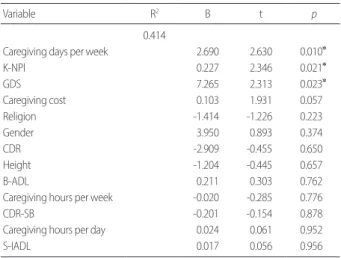
여성, 하루 부양시간, 종교가 있는 경우, 적은 키, B-ADL, 대도시 거 주였다. 상관분석에서 유의한 상관관계가 있는 것으로 나타난 요인 들을 단순회귀분석으로 분석하였다(Table 4). 상관분석과 동일하게 가장 유의한 관계가 있는 것으로 나타난 요인은 S-IADL이었고 주 당 환자부양일수, K-NPI, CDR-SB의 순서였다. 그 외에 유의한 관계 를 보인 요인으로는 부양비용, 주 총 부양시간, B-ADL, 적은 키, 일일 부양시간 등이었다. 입력방식과 단계선택의 다중회귀분석을 실시 하였으며 R2값이 더 큰 입력방식을 채택하였다. 상관분석과 단순회 귀분석과는 다르게 주당 환자부양일수(p= 0.010)가 가장 유의한 요 인으로 나왔으며 K-NPI (p= 0.021)와 GDS (p= 0.023)가 그 다음으로 유의한 관계가 있는 것으로 나타났다(Table 5). 또한, 부양비용은 유 의성에 근접한 p수치를 보였다(p= 0.057).
고 찰
본 연구는 치매 환자를 돌보는 가족부양자들의 부양부담을 평 가하고 가족부양자들의 인구사회학적인 특성과 부양을 받고 있는 환자들의 인지적, 인구사회학적인 특성을 파악하여 부양부담에 영 향을 미치는 요인을 평가하고자 하였다. 주당 환자부양일수가 가족 부양자의 부양부담에 영향을 미치는 가장 중요한 요인으로 나타났 으며 K-NPI로 측정된 환자의 신경행동증상과 GDS로 측정된 환자 의 우울증상도 영향을 미치는 것으로 나타났다. 기존의 한 국내연 구에서는 79명을 대상으로 부양부담에 미치는 인자를 조사하였으 며 환자의 우울증상과 부양자의 낮은 자발성 등이 부양부담에 영 향을 미치는 요인으로 나타났으며 환자의 우울증상은 본 연구의 결과와 일치하고 있다[10].
우리나라에서 국가시책으로 2008년부터 노인장기요양보험이 시 행되고 있지만 가족 중에서 치매환자를 부양하고 있는 가족 부양 자들의 부양부담은 아직까지 상당히 크다. 부양부담을 정량화하는 것은 어려운 일이지만 다양한 설문도구가 계발되어 보호자들의 부 양부담을 정량적으로 측정하려는 시도에 도움을 주고 있다[23, 25].
본 연구에서 사용된 부양부담 척도인 ZBI-K는 0-20점인 경우에는 부담 없음으로 평가하며 21-40점은 보통 부담, 41-60점은 심한 부담, 61-88점은 극심한 부담으로 평가한다[22, 23]. 치매환자의 부양부담 은 본 연구에서 평균 37.6±19.1점으로 나타났으며 보통부담과 심한 부담에 분포되어 있어 부양자 대부분이 적지 않은 부담을 느끼고 있는 것으로 나타났다.
가족부양자에 의해 부양받는 환자들은 CDR 1-2 사이의 경도에 Table 3. Correlations between Burden Interview and other variables
Variable Pearson coefficient
(Spearman) p value
(Spearman) N
Residence of caregivers -0.270 (-0.244) 0 (0.001) 199
B-ADL -0.214 0.003 188
Height -0.159 0.026 199
Religion -0.153 (-0.152) 0.032 (0.033) 197
Caregiving hours per day 0.154 0.029 199
Gender 0.176 (0.166) 0.013 (0.019) 199
GDS 0.225 (0.236) 0.002 (0.001) 195
Caregiving hours per week 0.228 0.001 199
Caregiving cost 0.234 0.001 197
CDR-SB 0.267 0.000 195
K-NPI 0.286 0.000 187
CDR 0.298 (0.341) 0 (0.000) 195
Caregiving days per week 0.325 0.000 199
S-IADL 0.343 0.000 109
p values are by correlation coefficient analysis.
N, number of patients; B-ADL, barthel activities of daily living; GDS, geriatric deteri- oration scale; CDR-SB, clinical dementia rating sum of boxes; K-NPI, Korean version of neuropsychiatric inventory; CDR, clinical dementia rating; S-IADL, Seoul instru- mental activities of daily living.
Table 4. Correlations between Burden Interview and other variables
Variable R2 B t p
Caregiving days per week 0.106 2.582 4.829 0.000
K-NPI 0.082 0.294 4.058 0.000
CDR-SB 0.071 1.243 3.854 0.000
S-IADL 0.118 0.538 3.779 0.000
Caregiving cost 0.055 0.125 3.363 0.001
Caregiving hours per week 0.052 0.064 3.290 0.001
B-ADL 0.046 -1.077 -2.993 0.003
Height 0.025 -0.393 -2.242 0.026
Caregiving hours per day 0.024 0.319 2.193 0.029 p values are by simple linear regression analysis.
K-NPI, Korean version of neuropsychiatric inventory; CDR-SB, clinical dementia rat- ing sum of boxes; S-IADL, Seoul instrumental activities of daily living; B-ADL, barth- el activities of daily living.
Table 5. Correlations between Burden Interview and other variables
Variable R2 B t p
0.414
Caregiving days per week 2.690 2.630 0.010*
K-NPI 0.227 2.346 0.021*
GDS 7.265 2.313 0.023*
Caregiving cost 0.103 1.931 0.057
Religion -1.414 -1.226 0.223
Gender 3.950 0.893 0.374
CDR -2.909 -0.455 0.650
Height -1.204 -0.445 0.657
B-ADL 0.211 0.303 0.762
Caregiving hours per week -0.020 -0.285 0.776
CDR-SB -0.201 -0.154 0.878
Caregiving hours per day 0.024 0.061 0.952
S-IADL 0.017 0.056 0.956
p values are by multiple linear regression analysis.
*p<0.05.
B-ADL, barthel activities of daily living; GDS, geriatric deterioration scale; CDR-SB, clin- ical dementia rating sum of boxes; K-NPI, Korean version of neuropsychiatric inven- tory; CDR, clinical dementia rating; S-IADL, Seoul instrumental activities of daily living.
서 중등도의 치매환자로 나타났다. 학력은 초등학교 졸업 정도의 수준을 가지고 있는데 이는 지역적 특성으로 인해서 수도권 지역의 환자들이 중졸 학력에 가까운 것에 비하여 상대적으로 낮은 것으 로 보인다[32]. 중증의 치매환자가 거의 없는 이유로는 중증도의 환 자들이 노인장기요양보험으로 인하여 대부분 요양시설에 입소하였 기 때문으로 보인다. 또한 환자들의 NPI 점수와 노인우울척도도 그 리 높지 않았는데 행동심리증상이나 우울증상이 심한 치매환자들 도 역시 요양시설에 입소하였을 것으로 생각된다.
예상과 달리 종교를 가지고 있는 사람들과 없는 사람들의 부양부 담의 차이가 나타나지 않았다. 이러한 결과는 종교를 가지고 있는 사람들에서 환자를 적극적으로 부양해야 하고 인내심을 가지고 환 자의 행동증상을 대해야 된다는 의무감이 종교를 통해 얻는 지지 를 상쇄하기 때문일 가능성이 있으며 한 선행 연구에서는 치매환자 를 부양하는 것이 부양자의 잘못된 행실로 인해서 받는 처벌이라고 생각하기 때문에 종교를 가지고 있는 사람의 부양부담이 증가될 수 있다고 하였다[33].
부양자의 취업 여부와 관련하여 2004년에 국내에서 시행된 한 선 행연구에 따르면 부양자 중 직장에 다니는 사람은 27%로서 직장인 보다 전업주부들이 더 많은 것으로 보고하였다[34]. 본 연구에서는 직장에 다니는 부양자의 비율이 43.1%에 달하여 위의 연구에 비하 여 높게 나왔으며 최근 여성의 취업률이 높아진 것과 연관이 있는 것으로 보인다.
부양자 중에서 배우자가 30%이고 나머지는 자녀들이나 며느리 또는 사위였다. 환자들의 평균 연령이 76세라는 것을 고려하면 배우 자가 살아있고 간병할 정도로 건강하다면 대부분 배우자가 환자를 부양하는 것으로 보이며 배우자가 사망하였거나 간병할 정도로 건 강하지 못할 때 자녀들이나 며느리 또는 사위가 부양을 맡는 것으 로 보인다. 본 연구에서 선행연구보다 배우자의 비율이 낮은 것은 본 연구에 등록된 환자들의 평균 연령이 3세 정도 높기 때문인 것으 로 보인다[11, 34]. 하루 부양시간을 볼 때 10시간 이상을 부양에 사 용하는 경우가 거의 삼분의 이를 차지하고 있어 한 집에 같이 살든 지 가까운 곳에 살면서 하루 종일 부양하는 경우에 해당하는 것으 로 보인다. 또한, 주 부양일수를 볼 때 매일 부양을 위해서 환자를 방 문하는 경우가 거의 70%에 달한다. 나머지 30%는 함께 살면서 부양 하는 환자의 배우자일 것이며 부양을 담당하는 자녀들의 절반 이 상이 매일 환자를 만나는 경우이며 동거하거나 가까운 곳에 거주 하는 것으로 보인다.
상관분석과 단순회귀분석에서는 주당 환자부양일수가 S-IADL 다음으로 부양부담에 영향을 미치는 것으로 나왔으나 다중회귀분 석에서는 그 유의성이 사라졌다. 다중회귀분석에서는 주당 환자부 양일수가 부양부담에 가장 큰 영향을 미치는 것으로 나타났다. 그 외에 부양부담에 영향을 미치는 요인으로서 환자의 K-NPI와 GDS
의 순서였고 이는 선행연구들과 일치하는 결과이다[35, 36]. 부양비 용은 유의성에 거의 근접한 관계를 보였다.
본 연구에서 주당 환자 부양일수가 부양부담에 가장 큰 영향을 미치는 요소로 나타났다. 상대적으로 하루에 부양하는 시간과 주 당 환자부양일수를 곱한 주 총 부양시간과 하루 동안의 부양시간 은 유의성이 없었다. 비록 주당 환자부양일수가 주 총 부양시간과 밀접한 관계가 있지만 주 총 부양시간이 길더라도 주 중에 환자를 방문하지 않는 날이 있을 수 있다. 또한 방문하는 날에 부양하는 시 간이 길더라도 보조 부양자에게 맡기고 쉬는 것이 부양부담을 덜어 줄 수 있다. 일본에서 시행된 한 선행연구에서 낮 시간의 일부라도 요양보호사가 방문해서 부양을 할 때 부양부담이 줄어들었고 가족 부양자가 느끼는 부양부담이 클수록 요양보호사의 방문이 주는 부 양부담의 감소는 컸다[37]. 이러한 선행연구의 결과와 본 연구의 결 과는 일치하기 때문에 부양부담을 줄이려면 부양시간도 줄여야 하 지만 부양방문일수를 줄이는 것도 중요하게 보인다.
환자의 신경행동증상을 보여주는 NPI에는 망상, 환각, 초조/공격 성, 우울/낙담, 불안, 다행감/들뜬기분, 무감동/무관심, 탈억제, 과민/
불안정, 이상운동증상, 수면/야간행동, 식욕/식습관의 변화 등의 요 소가 있다. 이러한 증상들이 심할 때 부양자의 부양부담이 늘어나 는 것은 자명하다[35]. 또한 GDS로 측정된 환자의 우울증상에 의하 여 부양자의 부양부담이 늘어나는 것은 환자의 우울증상이 부양 자에게 협조하는 정도를 낮출 뿐만 아니라 부양자에게도 우울한 기분이 전파되어 부양자의 부담을 늘이는 것으로 보인다[34].
최근 국내에 자동차가 많이 보급되어 운전을 하는 성인이 과거에 비해 많이 늘어남에 따라 운전시간에 따른 부양부담의 차이를 살 펴보았다. 환자부양을 위한 하루 운전 시간은 30분 이내가 대부분 이었으며 이는 같은 집에 사는 배우자나 같은 집에 사는 자녀 또는 자녀들의 배우자가 많기 때문에 방문을 위해 운전하는 경우가 많 지 않음을 시사한다. 하루 30분 이상 운전하는 경우가 많지 않았기 때문에 부양부담과의 유의성이 잘 나타나지 않은 것으로 생각된다.
치매환자의 가족부양자의 부양부담이나 생활의 질에 대한 연구 는 국내에서 많이 시행되어 있다[11, 22, 25, 34]. 본 연구는 대학병원 이나 종합병원에서 치매를 전문으로 하는 신경과 의사에 의하여 심리검사를 포함한 치매의 원인조사를 충분히 하고 정확한 진단기 준에 따라서 진단한 경우이기 때문에 간단한 선별검사만으로 치매 로 진단한 경우보다 신뢰할 수 있는 결과를 보여준다고 생각된다.
또한, 숙달된 임상심리사가 모든 자료를 수집하고 부양자들에 대한 설문을 시행했기 때문에 설문조사의 자료도 기존의 연구들에 비 하여 더 신뢰할 수 있을 것이다. 한 가지 아쉬운 점은 알츠하이머형 치매의 빈도가 매우 높고 상대적으로 혈관성 치매나 파킨슨병 치매 의 빈도가 낮았기 때문에 치매의 유형에 따른 부양부담의 비교가 어려웠던 점이다.
결론으로서, 본 연구를 통해 대구경북지역의 치매환자를 돌보는 가족부양자의 부양부담이 어느 정도인지 알 수 있었고, 부양부담에 영향을 미치는 치매환자의 요소와 부양자의 사회경제적인 요소들 을 알 수 있었다. 본 연구의 결과를 두고 볼 때 전통적으로 배우자나 한 명의 자녀가 치매환자 부양을 책임지는 모습은 부양자 간에 교 대로 부양을 해서 부양방문일수를 줄이는 노력이 필요하다고 생각 된다. 실제로 외래진료실에서 만나는 가족 부양자 중에서 수년간 치매환자를 부양한 경우에 부양부담이 심하여 우울증 증상을 보 이는 경우가 드물지 않기 때문이다. 또한 치매를 진료하는 임상의 사들은 환자의 신경행동증상과 우울증의 치료에 더 관심을 가지 고 적극적으로 치료해야 할 필요가 있을 것으로 생각된다.
참고문헌
1. Statistics Korea. Population Prospects of Korea and World. 2009.
2. Kwon O, Kwak J. Illiteracy effect on cognitive decline in a rural elderly population: a 3-year follow up study. Dementia and Neurocognitive Dis- orders 2011; 10: 52-7.
3. Kim KW, Park JH, Kim MH, Kim MD, Kim BJ, Kim SK, et al. A nation- wide survey on the prevalence of dementia and mild cognitive impair- ment in South Korea. J Alzheimers Dis 2011; 23: 281-91.
4. Torti FM Jr, Gwyther LP, Reed SD, Friedman JY, Schulman KA. A mul- tinational review of recent trends and reports in dementia caregiver bur- den. Alzheimer Dis Assoc Disord 2004; 18: 99-109.
5. Vetter PH, Krauss S, Steiner O, Kropp P, Moller WD, Moises HW, et al.
Vascular dementia versus dementia of Alzheimer’s type: do they have differential effects on caregivers’ burden? The Journals of Gerontology Se- ries B, Psychological Sciences and Social Sciences 1999; 54: S93-8.
6. Souetre E, Thwaites RM, Yeardley HL. Economic impact of Alzheimer’s disease in the United Kingdom. Cost of care and disease severity for non- institutionalised patients with Alzheimer’s disease. Br J Psychiatry 1999;
174: 51-5.
7. Sadik K, Wilcock G. The increasing burden of Alzheimer disease. Alzhei- mer Dis Assoc Disord 2003; 17 Suppl 3: S75-9.
8. Youn G, Knight BG, Jeong HS, Benton D. Differences in familism values and caregiving outcomes among Korean, Korean American, and White American dementia caregivers. Psychol Aging 1999; 14: 355-64.
9. Kim S, Yoon H, Kim J, Haley W. Factors affecting life satisfaction and de- pression of caregivers of the elderly with dementia: a comparative study of Korean and American caregivers. Journal of the Korea Gerontological Society 2003; 23: 193-221.
10. Kim J, Shin I, Yoon J. Determinants of care burden of caregiver in pati- ents with dementia. J Korean Neuropsychiatr Assoc 2001; 40: 1106-13.
11. Kim T, Kim S, Kim J, Kim E, Park K, Sung S, et al. The difference of care- giver burden in patients with alzheimer’s disease and vascular dementia.
J Korean Neurol Assoc 2005; 23: 463-70.
12. American Psychiatric A. Diagnostic and statistical manual of mental disorders: DSM-IV. Washington, D.C.: American Psychiatric Association, 1994; 886.
13. McKhann G, Drachman D, Folstein M, Katzman R, Price D, Stadlan EM. Clinical diagnosis of Alzheimer’s disease: report of the NINCDS- ADRDA Work Group under the auspices of Department of Health and Human Services Task Force on Alzheimer’s Disease. Neurology 1984; 34:
939-44.
14. Erkinjuntti T, Inzitari D, Pantoni L, Wallin A, Scheltens P, Rockwood K, et al. Research criteria for subcortical vascular dementia in clinical trials.
Journal of Neural Transmission Supplementum 2000; 59: 23-30.
15. Emre M, Aarsland D, Brown R, Burn DJ, Duyckaerts C, Mizuno Y, et al.
Clinical diagnostic criteria for dementia associated with Parkinson’s dis- ease. Movement disorders: official journal of the Movement Disorder So- ciety 2007 Sep 15; 22: 1689-707; quiz 837.
16. Kang Y, Na DL, Hahn S. Validity study on the Korean mini-mental state examination (K-MMSE) in demented patients. J Korean Neurol Assoc 1997; 15: 300-8.
17. Reisberg B, Ferris SH, de Leon MJ, Crook T. The Global Deterioration Scale for assessment of primary degenerative dementia. The American Journal of Psychiatry 1982; 139: 1136-9.
18. Hughes CP, Berg L, Danziger WL, Coben LA, Martin RL. A new clinical scale for the staging of dementia. The British Journal of Psychiatry: the Journal of Mental Science 1982; 140: 566-72.
19. Burke WJ, Roccaforte WH, Wengel SP. The short form of the Geriatric Depression Scale: a comparison with the 30-item form. Journal of Geri- atric Psychiatry and Neurology 1991; 4: 173-8.
20. Kang SJ, Choi SH, Lee BH, Kwon JC, Na DL, Han SH. The reliability and validity of the Korean instrumental activities of daily living (K-IADL). J Korean Neurol Assoc 2002; 20: 8-14.
21. Gu HM, Kim JH, Gwon UJ, Kim SH, Lee HS, Go HJ, et al. A study on the reliability and validity of Seoul-instrumental activities of daily living (S-IADL). J Korean Neuropsychiatr Assoc 2004; 43: 189-99.
22. Bae KY, Shin IS, Kim SW, Kim JM, Yang SJ, Mun JU, et al. Careburden of caregivers according to cognitive function of elderly persons. J Korean Soc Biol Ther Psychiatry 2006; 12: 66-75.
23. Zarit SH, Reever KE, Bach-Peterson J. Relatives of the impaired elderly:
correlates of feelings of burden. Gerontologist 1980; 20: 649-55.
24. Kim MC, Ahn SW, Han JW. Caregiver burden and rewards in new gen- eration and middle-aged couples. Journal of Korean Home Management Association 1996; 14: 97-110.
25. Kim SY. Factors affecting on the QOL of the demented elderly caregivers:
suggestions of political alternatives Social Welfare Policy 2003; 17: 77-105.
26. Wood V, Wylie ML, Sheafor B. An analysis of a short self-report measure of life satisfaction: correlation with rater judgments. Journal of Gerontol- ogy 1969; 24: 465-9.
27. Kim SY. Analysis of depression and life satisfaction predictors in primary caregivers of the elderly with stroke. Journal of Welfare for the Aged 2008;
39: 145-74.
28. Beck AT, Ward CH, Mendelson M, Mock J, Erbaugh J. An inventory for measuring depression. Arch Gen Psychiatry 1961; 4: 561-71.
29. Lee YH, Song JY. A study of the reliability and the validity of the BDI, SDS, and MMPI-D scales. Korean Journal of Clinical Psychology 1991; 10: 98- 113.
30. Beck AT, Epstein N, Brown G, Steer RA. An inventory for measuring clinical anxiety: psychometric properties. Journal of Consulting and Clin- ical Psychology 1988; 56: 893-7.
31. Yook SP, Kim ZS. A clinical study on the Korean version of Beck Anxiety Inventory: comparative study of patient and non-patient. Korean Jour-
nal of Clinical Psychology 1997; 16: 185-97.
32. Ryu HJ, Park AR, Kang HS, Kim HJ, Han SH. Proverb comprehension in early stage alzheimer’s disease and amnestic-mild cognitive impairment.
Dement Geriatr Cogn Disord 2010; 9: 1-7.
33. Herrera AP, Lee JW, Nanyonjo RD, Laufman LE, Torres-Vigil I. Religious coping and caregiver well-being in Mexican-American families. Aging &
mental health 2009; 13: 84-91.
34. Park KW, Kim SY, Kim EG, Kim JW, Kim TY, Sung S, et al. Factors af- fecting depression and life satisfaction in family caregivers of patients with dementia. J Korean Neurol Assoc 2005; 23: 776-83.
35. Gort AM, Mingot M, Gomez X, Soler T, Torres G, Sacristan O, et al. Use of the Zarit scale for assessing caregiver burden and collapse in caregiving at home in dementias. Int J Geriatr Psychiatry 2007; 22: 957-62.
36. Cheah WK, Han HC, Chong MS, Anthony PV, Lim WS. Multidimen- sionality of the Zarit Burden Interview across the severity spectrum of cognitive impairment: an Asian perspective. Int Psychogeriatr 2012; 24:
1846-54.
37. Okamoto M, Murashima S, Saito E. Effectiveness of day care service for elderly patients with dementia and their caregivers as observed by com- parison of days with and without day care services. [Nihon koshu eisei zasshi] Japanese Journal of Public Health 1998; 45: 1152-61.