The Relationship between Body Mass Index and Smoking Cessation Plans in Korean Adults
Ji Young Lee
1, Seon Mee Kim
1,*, Yoon Seon Choi
1, Yong Gyu Park
2, E Yeon Kim
1, So Jung Yoon
1, Jin Wook Kim
1, Jung Hwan Yoon
1, Man Kim
1, Hye Ran Jeon
11
Department of Family Medicine, Korea University Guro Hospital, Korea University College of Medicine, Seoul;
2Department of Biostatistics, College of Medicine, The Catholic University of Korea, Seoul, Korea
Background: Concerns regarding weight gain after smoking cessation may interfere with quitting smoking.
This study investigated the association between smoking cessation plans and body mass index (BMI, kg/m
2) in Korean adult smokers.
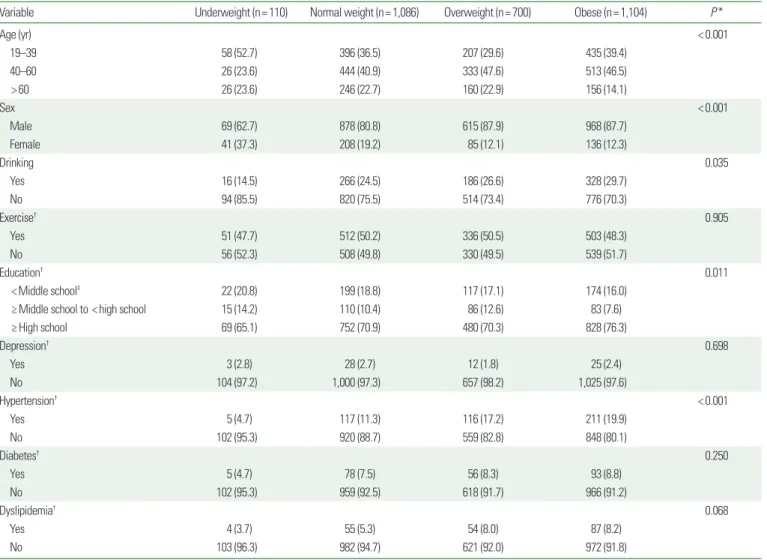
Methods: Using data from the sixth Korea National Health and Nutrition Examination Survey (2013–2015), 3,000 current smokers aged 19 years or older were selected and divided into four weight groups. The cohorts in- cluded an underweight group (BMI, <18.5 kg/m
2), normal weight group (BMI, ≥18.5 to <23 kg/m
2), over- weight group (BMI, ≥23 to <25 kg/m
2), and obese group (BMI, ≥25 kg/m
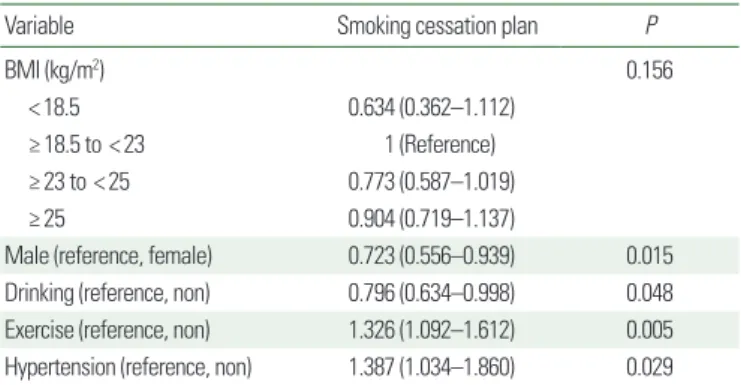
2). The relationship between BMI and smoking cessation plans in Korean adults was analyzed using multiple logistic regression analysis.
Results: Multiple logistic regression analysis showed sex (odds ratio [OR], 0.723; 95% confidence interval [CI], 0.556–0.939), high-risk drinking (OR, 0.796; 95% CI, 0.634–0.998), aerobic physical activity (OR, 1.326; 95% CI, 1.092–1.612), and hypertension (OR, 1.387; 95% CI, 1.034–1.860) were the significant factors related to smoking cessation plans. According to the BMI categories, the ORs of smoking cessation plans were numerically higher in the normal weight group than the other three groups. However, the difference was not statistically significant.
Conclusion: Normal weight subjects tended to have a greater number of smoking cessation plans than the other three weight groups, but the difference was not statistically significant. In the clinic, it is necessary to con- sider not only BMI but also other factors associated with a smoking cessation plans.
Key words: Obesity, Smoking cessation, Body mass index
Received June 16, 2017 Reviewed July 11, 2017 Accepted September 21, 2017
* Corresponding author Seon Mee Kim
https://orcid.org/0000-0002-1957-2928 Department of Family Medicine, Korea University Guro Hospital, Korea University College of Medicine, 148 Gurodong-ro, Guro-gu, Seoul 08308, Korea
Tel: +82-2-2626-3275 Fax: +82-2-837-0613 E-mail: [email protected]
INTRODUCTION
Several studies have revealed the effects of smoking on health.
Smokers have a higher incidence of various diseases compared with nonsmokers, including numerous types of cancer, chronic lung dis- ease, coronary artery disease, and cerebrovascular disease.
1Further- more, smokers are known to die prematurely, on average 10 years earlier than nonsmokers.
2-5Due to the outcomes mentioned above and several other risk fac- tors, efforts are being made to induce smoking cessation in the form of cigarette advertising restrictions, tobacco price hikes, smoking
cessation zones, and smoking cessation clinics. Consequently, ac- cording to the Korea National Statistical Office, the smoking rate has decreased by about 10%; from 35.2% in 1998 to 23.2% in 2013, and 70% of smokers want to quit the habit.
6However, even if at- tempts are made to stop smoking, due to demographic, sociological, or environmental reasons, the actual success rate is only 3%–5%.
7Some studies state that smoking cessation may increase body weight.
8,9Various responsible mechanisms have been suggested for weight gain after smoking cessation, such as associated changes in the serum concentrations of the appetite hormones, leptin and ghrelin.
10Moreover, the action of nicotine is associated with inef-
Copyright © 2017 Korean Society for the Study of Obesity
This is an Open Access article distributed under the terms of the Creative Commons Attribution Non-Commercial License (http://creativecommons.org/licenses/by-nc/4.0/) which per- mits unrestricted non-commercial use, distribution, and reproduction in any medium, provided the original work is properly cited.
2017-03-16 https://crossmark-cdn.crossref.org/widget/v2.0/logos/CROSSMARK_Color_square.svg