hpm
우리나라 성인 흡연자의 전자담배 이용경험과 금연행태의 관련성
이윤노1·김복미1·민인순1,2·함명일1,2
1순천향대학교 일반대학원 보건행정경영학과, 2순천향대학교 의료과학대학 보건행정경영학과
The Relationship between E-Cigarette Experience and Smoking Cessation Behavior among Current Smokers
Yoon Noh Lee1, Bokmi Kim1, In Soon Min1,2, Myung-Il Hahm1,2
1Department of Health Administration and Management, Soonchunhyang University Graduate School of Medical Science; 2Department of Health Administration and Management, College of Medical Science, Soonchunhyang University, Asan, Korea
Background: Electronic cigarette (e-cigarette) has rapidly increased. Even though e-cigarettes are actually not smoking cessation al- ternative supplies, some people perceive them as smoking cessation alternative supplies. The purpose of this study is to identify the relationship between e-cigarette experiences and smoking cessation behaviors among Korean adults.
Methods: Cross-sectional data was collected from 7,550 participants of Korea National Health and Nutrition Examination Survey in 2014. A total of 867 participants who were current smokers were enrolled in this study. Multi-variable logistic regression analysis were performed to identify the relationship between the smoking cessation behavior and the e-cigarette experience.
Results: The e-cigarette experience rate of current smokers was 22.1%. The e-cigarette experience rate was higher in groups with the higher income, the higher education level, and the white collar jobs. Smokers with experience of smoking cessation (odds ratio [OR], 3.03; 95% confidence interval [CI], 1.67 to 5.76) and with intention to smoking cessation in the future (OR, 1.59; 95% CI, 1.05 to 2.43) were more likely to experience the e-cigarette. Especially, smokers who used smoking cessation alternative supplies were more likely to experience the e-cigarette than smokers who did not use it (OR, 2.87; 95% CI, 1.59 to 5.18).
Conclusion: We confirmed that e-cigarette experiences were associated with smoking cessation experience, smoking cessation plan, and use of smoking cessation aid among smokers in Korea. Additional studies should be continued to confirm whether e-cig- arette are continuously influencing the smoking cessation of current smokers in South Korea as one of the smoking cessation alter- native supplies.
Keywords: Electronic cigarette; Smoking cessation behavior
서 론
전자담배는 전자식 니코틴 전달장치(electronic nicotine delivery system)이며, 니코틴 이외에도 향 및 기타 화학물질이 포함된다[1].
우리나라에서 전자담배는 건강증진법 시행령 제27조 2에 의거하 여 담배로 규정된다[2]. 전자담배는 2003년 처음 중국에서 개발된
이후 국내에서는 2008년부터 본격적으로 판매되었으며, 2014년에 는 전자담배의 수입이 전년 대비 약 3배 증가하는 등 지속적으로 증 가하고 있다[3,4].
전자담배는 건강에 대한 관심이 증대되는 것과 맞물려 일반담배 의 대체재로 급격히 성장하여 2014년 전 세계적으로 약 30억 달러 규모의 시장을 형성하고 있으며, 향후 전자담배가 전체 담배제품
https://doi.org/10.4332/KJHPA.2017.27.4.276
Correspondence to: Myung-Il Hahm
Department of Health Administration and Management, College of Medical Science, Soonchunhyang University, Graduate School of Medical Science, 22 Soonchunhyang-ro, Sinchang- myeon, Asan 31538, Korea
Tel: +82-41-530-3035, Fax: +82-41-530-3085, E-mail: [email protected] Received: October 10, 2017 / Revised: November 13, 2017 / Accepted after revision: November 28, 2017
© Korean Academy of Health Policy and Management This is an open-access article distributed under the terms of the Creative Commons Attribution Non-Commercial License (http://creativecommons.org/licenses/by-nc/4.0) which permits unrestricted non-commercial use,
distribution, and reproduction in any medium, provided the original work is properly cited.
중에서 차지하는 비율이 2050년 4%까지 상승할 것으로 예측된다 [5-7]. 전자담배 이용률 또한 급격한 증가세를 보이고 있다. 미국 성 인의 전자담배 경험률은 2010년 3.3%에서 2013년 8.5%로 3배 가까 이 증가했고, 특히 젊은 연령층에서 사용경험이 더욱 증가하였다 [8-10]. 영국에서도 현재 흡연자 중 전자담배 사용경험자가 2010년 5.7%에서 2012년 16.2%로 약 3배 증가했다[11]. 우리나라의 2014년 성인 남성의 전자담배 평생경험률도 13.9%로 전년 대비 2.3% 증가 하였다[12].
일반담배보다 더 고가임에도 불구하고 전자담배에 대한 이용이 지속적으로 증가하고 있는 것은 전자담배가 일반담배와 비슷하게 기체를 흡입하는 방식이라 심리적으로 비슷한 사용경험을 제공할 뿐 아니라 전자담배 판매회사들은 인터넷을 통해 금연을 도와주는 금연보조품으로 전자담배를 홍보하고 있기 때문이다[13]. 실증연구 결과 전자담배 사용자들은 “금연에 도움(64%),” “일반담배보다 덜 해로움(49%),” “일반담배의 흡연량 감소(47%)” 등을 전자담배 이 용 이유라고 밝혀 전자담배에 대한 왜곡된 인식이 확산되어 있는 것 을 확인할 수 있다[14]. 현재와 같이 금연을 지지하는 사회적 분위기 와 금연구역의 증가, 담뱃값 인상 등으로 금연을 결심하는 사람이 증가하는 상황에서 전자담배를 금연을 위한 징검다리로 생각하고 사용하는 사람이 증가하고 있는 것이다[3]. 소비자들은 전자담배가 금연에 도움을 준다고 생각하거나[15-18], 일반담배보다 덜 해롭거 나 안전하다고 생각하며[11,19-21], 아예 유해성 자체를 인지 못 하 는[22] 등 전자담배에 대한 정확한 사실을 인지하지 못한 채 점차 전 자담배가 금연용품이라는 잘못된 인식이 굳어지고 있다.
세계보건기구(World Health Organization)는 2014년 8월 전자담 배가 안전하다는 근거가 확보될 때까지 금연을 목적으로 전자담배 를 사용하지 말도록 공표하고, 전자담배에 대한 검증되지 않은 광고 규제를 강화할 것을 촉구했다[23]. 우리나라에서도 전자담배 판매 시 금연보조효과의 홍보를 금지하고 있으며[24], 2015년 1월 전자담 배가 일반담배와 동일한 발암성분이 들어있다고 발표하였다[25].
일반담배에 비해 상대적으로 역사가 짧은 전자담배는 금연효과 나 안전성에 대한 검증도 없이 이용률이 증가하는 상황이다. 따라 서 일반국민의 전자담배에 대한 인식개선이 필요하다. 전자담배가 일반담배와 같이 발암물질을 함유하고 있는 상황에서 금연보조제 로 인식된다는 것은 국민의 건강증진에 부정적 영향을 미치게 된 다. 국내에서도 전자담배와 금연행태와의 관계를 확인한 연구가 일 부 수행되었으나, 대부분 청소년을 대상으로 하였고 외국과 비교하 면 매우 부족한 실정이다[14,26,27]. 따라서 이 연구는 우리나라 성 인 흡연자를 대상으로 전자담배의 경험과 금연행태와 같은 전자담 배 경험과 관련된 요인을 확인하고자 하였다.
방 법
1. 연구대상 및 자료수집
이 연구는 ‘국민건강영양조사 제6기(2014년)’ 자료를 이용하여 우리나라 19세 이상 성인의 전자담배 경험과 금연행태와의 관련성 을 통해 전자담배에 대한 인식을 확인하고자 하였다. 국민건강영양 조사는 전 국민을 모집단으로 하며, 비례배분계통추출법으로 표본 조사구를 선정하고 층화집락계통추출법에 의해 표본가구를 추출 하였다.
이 연구의 최종 분석대상은 국민건강영양조사 제6기(2014년)의 전체 7,550명 중 결측치 제거 후 19세 이상의 현재 흡연자 867명을 대상으로 하였다. 현재 흡연자 중 전자담배 경험자는 192명이며, 금 연시도 경험자는 746명, 금연계획자는 619명이었다.
2. 변수정의
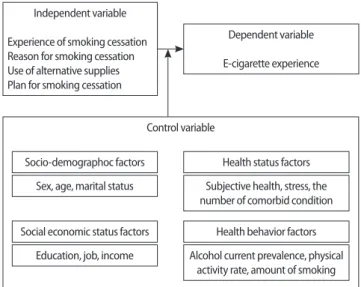
이 연구는 현재 흡연자를 대상으로 금연행태별 전자담배 경험 여부의 차이를 확인하고 금연행태와 전자담배 경험과의 관련성을 확인하고자 한 연구로, 금연행태는 금연시도, 금연이유, 금연보조 제 사용 여부, 향후 금연계획을 이용하였고, 전자담배 경험 여부를 종속변수로, 그리고 연구대상자의 일반적인 특성들을 통제변수로 하였다(Figure 1).
“지금까지 살아오는 동안 전자담배를 피워본 적이 있습니까?(Y/
N)”의 질문에 “예(yes)”로 응답한 경우를 전자담배 경험이 있는 것 으로 정의하였다. 금연행태는 (1) 금연경험(experience of smoking cessation), (2) 금연이유(reason for smoking cessation), (3) 금연보 조제 사용 여부(use of alternative supplies), (4) 향후 금연계획(plan for smoking cessation)을 통해 확인하였다. (1) 금연경험은 “최근 1 년 동안 담배를 끊고자 하루(24시간) 이상 금연한 적이 있습니
Figure 1. Study design.
Control variable
Socio-demographoc factors Health status factors
Social economic status factors Health behavior factors Sex, age, marital status Subjective health, stress, the
number of comorbid condition
Education, job, income Alcohol current prevalence, physical activity rate, amount of smoking Independent variable
Experience of smoking cessation Reason for smoking cessation Use of alternative supplies Plan for smoking cessation
Dependent variable E-cigarette experience
까?(Y/N)”라는 질문으로 측정하였다. (2) 금연계획은 “앞으로 1개 월 안에 담배를 끊을 계획이 있습니까?”라는 질문에 “1개월 안에 금연할 계획이 있다,” “6개월 안에 금연할 계획이 있다,” “6개월 이 내는 아니지만 언젠가는 금연할 생각이 있다” 중 하나를 선택한 경 우 ‘금연계획이 있는 것(yes)’으로 정의하였다. (3) 금연이유는 “담배 를 끊으려고 했던(금연을 결심한) 가장 큰 이유는 무엇 때문이었습 니까?”라는 질문에 “건강이 나빠져서,” “현재 건강은 이상 없지만 향후 건강에 대한 염려로”를 ‘건강을 위해(for health)’로, “가족의 건강을 위해,” “주위 사람들에게 피해를 주지 않기 위해(간접흡 연)”를 ‘주위 사람들을 위해(for surrounding people)’로, 그 외의 응 답한 이유를 ‘기타(others)’로 구분했다. (4) 금연보조제 사용 여부 는 “담배를 끊기 위해 사용했던 방법들에 모두 체크하시오”라는 질문에 “스스로(혼자서), 특별한 방법 없이 자신의 의지로”라고 답 한 경우에 ‘금연보조제 이용 안함(no)’으로, “니코틴 대체용품(니 코틴패치, 니코틴 껌, 니코틴 사탕 등),” “흡연욕구저하제(금연초, 쑥담배 등),” “의사 처방에 의한 약물치료(복용약),” “금연침”이라 고 답한 경우에 ‘금연보조제 이용함(yes)’으로 구분하였고, 그 외
“보건소 금연클리닉,” “금연상담전화(금연콜센터),” “인터넷, 정보 포탈사이트(금연길라잡이)”를 ‘기타(others)’로 정의하였다.
통제변수는 기존 문헌들 중 일반담배와 전자담배 흡연 간에 유 의한 관련성이 있는 것으로 확인된 요인들로 구성하였다[28,29]. 인 구사회학적 특성은 성별, 연령, 결혼상태로 구성하였으며, 사회경 제적 특성은 교육, 직업, 소득수준으로 구성하였다. 건강상태는 주 관적 건강상태, 스트레스 인지, 유산소신체활동 실천율, 하루평균 흡연량으로 구성하였다.
3. 분석방법
현재 흡연자의 특성 및 전자담배 경험 여부의 차이를 파악하기 위해 빈도분석과 카이제곱검정을 실시하였다. 금연행태별로(금연 경험, 금연이유, 금연보조제 사용 유무, 향후 금연계획) 전자담배 경험 여부의 차이를 확인하기 위해 카이제곱검정을 실시하였다. 현 재 흡연자의 금연경험, 금연이유, 금연보조제 사용 유무, 금연계획 과 전자담배 사용경험과의 연관성을 확인하기 위하여 각 변수별로 단변량로지스틱회귀분석(univariate logistic regression)을 실시하 였다. 통제변수를 보정한 다변량로지스틱회귀분석(multivariate lo- gistic regression)을 금연행태별로 추가 수행하여 해당 분석의 결과 를 비차비(odds ratio, OR)와 95% 신뢰구간(95% confidence inter- val, 95% CI)으로 제시하였다. 자료의 분석은 SAS ver. 9.4 (SAS In- stitute Inc., Cary, NC, USA) 프로그램을 이용하였으며, 유의수준 5%에서 검정을 실시하였다.
결 과
1. 연구대상자의 일반적인 특성
2014년 국민건강영양조사에 참여한 19세 이상 성인 참여자 중 흡연 관련 변수의 결측치를 제거한 4,771명의 현재 흡연자 867명 (18%)이 연구대상이었다. 현재 흡연자 867명 중 전자담배 경험률은 22.1% (192명)로 일반적인 특성은 Table 1과 같다. 현재 흡연자 중 남성은 86.5%였으며, 전자담배 경험률은 22.9% (172명)이고, 여성 이 17.1% (20명)이었다. 전자담배 경험한 군의 연령은 20–40대가 50 대, 60대에 비해 높았으며 전자담배를 경험하지 않은 군과 통계적 으로 유의한 차이가 있었다(p<0.0001). 현재 흡연자의 교육수준 은 고등학교 졸업이 38.2% (331명)로 가장 높았으나 전자담배 경험 률은 대학졸업 이상이 26% (80명)로 가장 많았으며, 전자담배를 경 험한 군과 전자담배를 경험하지 않은 군이 통계적으로 유의하였다 (p= 0.0001). 현재 흡연자 중 직업은 육체근로자와 사무직근로자가 36.3% (315명)와 40.7% (353명)로 근소한 차이를 보였으나, 전자담 배 경험률은 육체근로자의 16.5% (52명)에 비해 사무직근로자가 29.2% (103명)로 훨씬 높았다. 또한 전자담배를 경험한 군과 전자담 배를 경험하지 않은 군이 통계적으로 유의하였다(p= 0.0003). 현재 흡연자의 소득수준은 소득수준이 올라갈수록 줄어들었지만, 전 자담배 경험률은 소득수준이 올라갈수록 높아졌으며, 주관적 건 강상태의 현재 흡연자는 보통수준이 55.5% (481명)로 가장 높았으 나, 전자담배 경험률은 좋음이 26.5% (44명)로 가장 높았다. 현재 흡연자의 음주행태와 전자담배 경험률은 음주량이 많아질수록 경 험률이 높았다.
2. 현재 흡연자의 금연행태별 전자담배 경험 차이
Table 2는 현재 흡연자의 금연행태별 전자담배 경험률의 차이를 확인한 결과이다. 현재 흡연자 중 85.6% (742명)가 금연경험이 있었 다. 금연경험이 있는 군의 전자담배 경험률(24.3%)은 금연경험이 없는 군(9.6%)에 비해 통계적으로 유의하게 높았다( p= 0.0002). 현 재 흡연자 중 금연경험자는 742명이었다. 금연경험자 중 금연보조 제 사용경험이 있는 군은 68명(7.8%)으로 사용경험이 없는 군 (641 명, 73.9%)보다 적었다. 그러나 전자담배 경험률은 금연보조제 사 용경험이 있는 집단(28명, 41.2%)이 없는 집단(143명, 22.2%)에 비 해 높았다(p <0.0003). 현재 흡연자의 향후 금연계획은 617명 (71.2%)이 계획이 있다고 응답했으며, 금연계획이 있는 군의 전자 담배 경험률은 24.8% (153명)로, 금연계획이 없는 군의 전자담배 경 험률인 15.6%(39명)보다 높았으며, 통계적으로 유의하였다 (p<0.05).
3. 현재 흡연자의 금연형태별 전자담배 경험과의 관련성 현재 흡연자의 금연행태와 전자담배 경험률과의 관련성을 확인
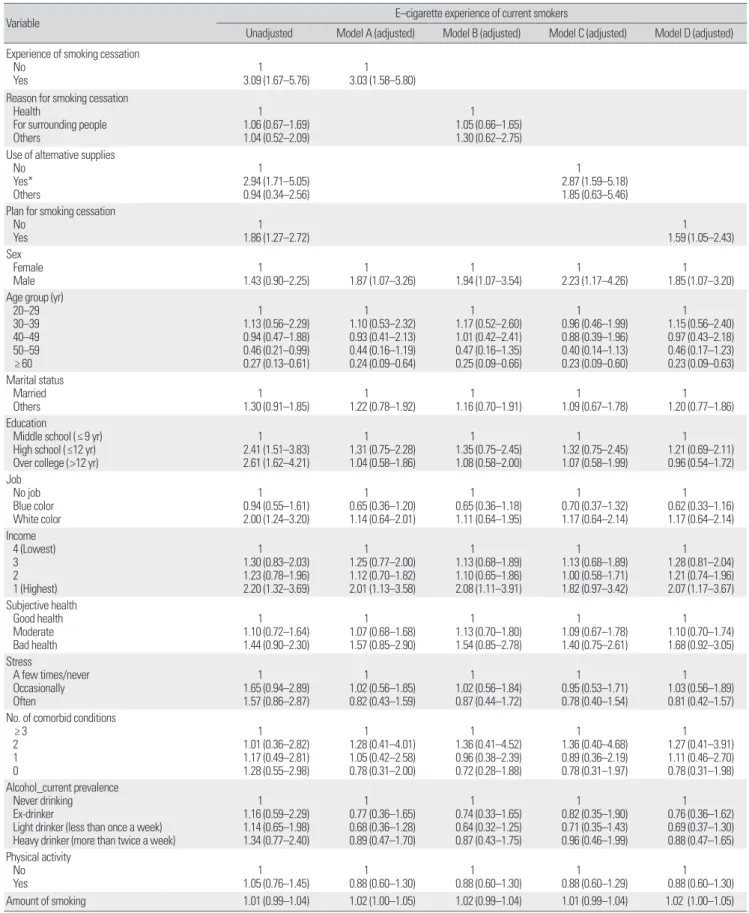
하기 위해 단변량회귀분석을 실시하였다(Table 3). 금연경험이 있 는 집단은 그렇지 않은 집단보다 전자담배 경험률이 3.09배(95%
CI, 1.61–5.76배) 높았으며, 금연이유에 따른 전자담배 경험률은 유
의한 차이가 없었다. 금연보조제를 사용한 경험이 있는 집단이 사 용한 경험이 없는 집단에 비해 전자담배 경험률이 2.94배(95% CI, 1.71–5.05배) 높았으며, 금연계획이 있는 경우가 없는 경우보다 전 Table 1. General characteristics of current smokers and e-cigarette experience of current smokers
Characteristic Total Electronic cigarette
p-value
Yes No
Total 867 (100.0) 192 (22.1) 675 (77.9)
Sex Female Male
117 (13.5) 750 (86.5)
20 (17.1) 172 (22.9)
97 (82.9) 578 (77.1)
0.1224
Age group (yr) 20–29 30–39 40–49 50–59 ≥ 60
87 (10.0) 213 (24.6) 205 (23.6) 160 (18.5) 202 (23.3)
26 (29.9) 65 (30.5) 56 (27.3) 24 (15.0) 21 (10.4)
61 (70.1) 148 (69.5) 149 (72.7) 136 (85.0) 181 (89.6)
<0.0001
Marital status Married Others*
624 (72.0) 243 (28.0)
132 (21.2) 60 (24.7)
492 (78.8) 183 (75.3)
0.1417
Education
Middle school (≤9 yr) High school (≤12 yr) Over college (>12 yr)
228 (26.3) 331 (38.2) 308 (35.5)
28 (12.3) 84 (25.4) 80 (26.0)
200 (87.7) 247 (74.6) 228 (74.0)
0.0001
Job No job Blue collar White collar
199 (23.0) 315 (36.3) 353 (40.7)
37 (18.6) 52 (16.5) 103 (29.2)
162 (81.4) 263 (83.5) 250 (70.8)
0.0003
Income 1 (Highest) 2 3 4 (Lowest)
243 (28.0) 238 (27.5) 218 (25.1) 168 (19.4)
44 (18.1) 48 (20.2) 47 (21.6) 53 (31.5)
199 (81.9) 190 (79.8) 171 (78.4) 115 (68.5)
0.0105
Subjective health Bad health Moderate Good health
220 (25.4) 481 (55.5) 166 (19.1)
45 (20.5) 103 (21.4) 44 (26.5)
175 (79.5) 378 (78.6) 122 (73.5)
0.3040
Stress
A few times/never Occasionally Often
129 (14.9) 475 (54.8) 263 (30.3)
21 (16.3) 112 (23.6) 59 (22.4)
108 (83.7) 363 (76.4) 204 (77.6)
0.2145
Alcohol_current prevalence Never drinking Ex-drinker
Light drinker (less than once a week) Heavy drinker (more than twice a week)
38 (04.4) 60 (06.9) 151 (17.4) 618 (71.3)
8 (21.1) 12 (20.0) 30 (19.9) 142 (23.0)
30 (78.9) 48 (80.0) 121 (80.1) 476 (77.0)
0.7555
No. of comorbid condition 0
1 2 ≥ 3
106 (12.2) 166 (19.1) 243 (28.0) 352 (40.6)
20 (18.9) 34 (20.5) 52 (21.4) 86 (24.4)
86 (81.1) 132 (79.5) 191 (78.6) 266 (75.6)
0.2681
Physical activity rate† No
Yes
416 (48.0) 451 (52.0)
87 (20.9) 105 (23.3)
329 (79.1) 346 (76.7)
0.7764
Amount of smoking 14.6± 7.9 15.3± 7.5 14.5± 8.1
Values are presented as number (%) or mean± standard deviation.
*Those who divorced or whose spouse had died. †Percentage of 2 hours 30 minutes of physical activity or high intensity physical activity for 1 hour and 15 minutes or physical activity combined with mid-range and high-intensity physical activity (high strength 1 minute, medium strength 2 minutes) in week.
자담배 경험률이 1.86배(95% CI, 1.27–2.72배) 높았다. 주관적 건강 상태, 스트레스, 만성질환 유무, 음주, 육체활동, 결혼상태에 따른 전자담배 경험의 유의한 차이는 없었다. 전자담배 경험률은 20대 에서 60대로 갈수록 감소하였으며, 직업, 교육수준, 소득수준에 있 어서 통계적으로 유의한 분포의 차이를 보였다. 무직에 비하여 육 체근로자는 통계적으로 유의한 차이가 없었으나, 사무직근로자는 2.00배(95% CI, 1.24–3.20배) 높았다. 교육수준이 높을수록, 소득 수준이 증가할수록 전자담배 경험률이 유의하게 높았다.
금연행태에 따른 전자담배 경험률과의 관련성을 확인하기 위해 통제변수를 보정하여 다변량회귀분석을 실시하였다. Model A는 금연경험 여부와 전자담배 경험률과의 관련성, model B는 금연의 이유에 따른 전자담배 경험률과의 관련성, model C는 금연보조제 사용 유무와 전자담배 경험률과의 관련성, model D는 금연계획 유무에 따른 전자담배 경험률과의 관련성을 확인하였다.
금연경험이 있는 연구대상자는 금연경험이 없는 연구대상자에 비하여 전자담배 경험률이 3.03배(95% CI, 1.58–5.80배) 높았다. 남 성이 여성에 비하여 전자담배 경험률이 1.87배(95% CI, 1.07–3.26 배) 높았으며, 20대에 비해 60대에서 전자담배 경험률이 0.24배 (95% CI, 0.09–0.64배) 낮았고, 소득수준이 가장 높은 집단에서 전 자담배 경험률이 2.01배(95% CI, 1.13–3.58배) 높았다. 금연이유는 전자담배 경험률과 관련성이 없었다. 금연보조제를 사용한 경험이 없는 군에 비해 사용경험이 있는 경우 전자담배 경험률이 2.87배 (95% CI, 1.59–5.18배) 높았다. 금연계획이 없는 경우에 비해 있는 경우 전자담배 경험률이 1.59배(95% CI, 1.05–2.43배) 높았다. 전자 담배 경험률은 소득수준이 낮은 경우에 비하여 높은 경우 대체로 높았다.
고 찰
전자담배는 금연을 도와주는 도구로 각종 매체를 통해 홍보되 면서 금연보조제로서 인식되고 있다. 전자담배를 사용하는 사람 들은 대개 일반담배 흡연자들이며[18,30], 그 사용목적을 금연에 두고 있다는 견해가 일반적이지만, 전자담배는 안전성이나 금연의 효과에 대한 충분한 검토나 연구가 이루어지지 않은 상황이다[13].
이 연구에서는 국민건강영양조사자료를 통해 우리나라 성인의 금 연행태별 전자담배 경험 여부의 차이, 그리고 금연행태와 전자담 배 경험률과의 관련성을 확인하고자 하였다.
연구결과, 현재 흡연자의 전자담배 경험률은 22.1% (192명)로 2014년 지역사회건강조사자료의 전자담배 경험률(22.4%)과 유사 하였다[29]. 현재 흡연자 중 남성은 22.9%가 전자담배 이용경험이 있었으며, 여성은 17.1%가 전자담배 경험이 있었다. 이는 여성 흡연 자들에 대한 부정적인 시각으로 인해 여성들이 흡연율을 자가보고 할 때 생기는 사회적 바람직성 반응경향(social desirability re- sponse bias)과 같이[31], 여성의 전자담배 경험률 또한 사회문화적 인 통념상 실제보다 과소평가 되었을 가능성도 존재한다. 전자담 배 경험률은 젊은 연령층에서 높았으며, 연령이 높아질수록 점차 낮아지는 결과를 보였는데, 이는 선행연구결과와 일치하였다 [10,15,32]. Pokhrel 등[33]은 연령이 낮을수록 금연보조 수단으로 전자담배를 선택한다는 결과를 보고하였다. 즉 젊은 연령층의 높 은 전자담배 경험의 이유 중 하나로 이들이 금연보조의 수단으로 전자담배를 사용하고 있을 가능성을 고려할 수 있는 것이다. 저소 득층은 일반담배 흡연율은 높은 반면, 전자담배 경험률은 낮았다.
반대로 고소득층은 일반담배 흡연율은 낮았으나 전자담배 경험률 Table 2. Smoking cessation behaviors among current smokers and e-cigarette experience of current smokers
Variable Total E-cigarette experience of current smokers
Yes No p-value
Total 867 (100.0) 192 (22.1) 675 (77.9)
Experience of smoking cessation No
Yes
125 (14.4) 742 (85.6)
12 (09.6) 180 (24.3)
113 (90.4) 562 (75.7)
0.0002 Reason for smoking cessation
For health
For surrounding people Others
487 (56.2) 187 (21.6) 68 (07.8)
121 (24.8)
43 (23.0) 16 (23.5)
366 (75.2) 144 (77.0) 52 (76.5)
0.9647 Use of alternative supplies
No Yes*
Others
641 (73.9)
68 (07.8) 30 (03.5)
143 (22.3)
28 (41.2) 7 (23.3)
498 (77.7)
40 (58.8) 23 (76.7)
0.0003 Plan for smoking cessation
No Yes
250 (28.8) 617 (71.2)
39 (15.6) 153 (24.8)
211 (84.4) 464 (75.2)
0.0013 Values are presented as number (%) or mean± standard deviation.
*Nicotine replacement products (nicotine patch, nicotine chewing gum, nicotine candy, etc.), smoking depressants (smoking cessation tobacco, herb tobacco, etc.), drug on doctor's prescription, and smoking cessation acupuncture.
Table 3. Results of multiple logistic regression analysis identifying factors associated with e-cigarette experience among current smokers
Variable E–cigarette experience of current smokers
Unadjusted Model A (adjusted) Model B (adjusted) Model C (adjusted) Model D (adjusted) Experience of smoking cessation
No Yes
1 3.09 (1.67–5.76)
1 3.03 (1.58–5.80)
Reason for smoking cessation Health
For surrounding people Others
1 1.06 (0.67–1.69) 1.04 (0.52–2.09)
1.05 (0.66–1.65)1 1.30 (0.62–2.75)
Use of alternative supplies No
Yes*
Others
1 2.94 (1.71–5.05) 0.94 (0.34–2.56)
2.87 (1.59–5.18)1 1.85 (0.63–5.46)
Plan for smoking cessation No
Yes
1 1.86 (1.27–2.72)
1.59 (1.05–2.43)1 Sex Female
Male
1 1.43 (0.90–2.25)
1 1.87 (1.07–3.26)
1 1.94 (1.07–3.54)
1 2.23 (1.17–4.26)
1 1.85 (1.07–3.20) Age group (yr)
20–29 30–39 40–49 50–59 ≥ 60
1 1.13 (0.56–2.29) 0.94 (0.47–1.88) 0.46 (0.21–0.99) 0.27 (0.13–0.61)
1 1.10 (0.53–2.32) 0.93 (0.41–2.13) 0.44 (0.16–1.19) 0.24 (0.09–0.64)
1 1.17 (0.52–2.60) 1.01 (0.42–2.41) 0.47 (0.16–1.35) 0.25 (0.09–0.66)
1 0.96 (0.46–1.99) 0.88 (0.39–1.96) 0.40 (0.14–1.13) 0.23 (0.09–0.60)
1 1.15 (0.56–2.40) 0.97 (0.43–2.18) 0.46 (0.17–1.23) 0.23 (0.09–0.63) Marital status
Married Others
1 1.30 (0.91–1.85)
1 1.22 (0.78–1.92)
1 1.16 (0.70–1.91)
1 1.09 (0.67–1.78)
1 1.20 (0.77–1.86) Education
Middle school (≤ 9 yr) High school (≤12 yr) Over college (>12 yr)
1 2.41 (1.51–3.83) 2.61 (1.62–4.21)
1 1.31 (0.75–2.28) 1.04 (0.58–1.86)
1 1.35 (0.75–2.45) 1.08 (0.58–2.00)
1 1.32 (0.75–2.45) 1.07 (0.58–1.99)
1 1.21 (0.69–2.11) 0.96 (0.54–1.72) Job No job
Blue color White color
1 0.94 (0.55–1.61) 2.00 (1.24–3.20)
1 0.65 (0.36–1.20) 1.14 (0.64–2.01)
1 0.65 (0.36–1.18) 1.11 (0.64–1.95)
1 0.70 (0.37–1.32) 1.17 (0.64–2.14)
1 0.62 (0.33–1.16) 1.17 (0.64–2.14) Income
4 (Lowest) 3 2 1 (Highest)
1 1.30 (0.83–2.03) 1.23 (0.78–1.96) 2.20 (1.32–3.69)
1 1.25 (0.77–2.00) 1.12 (0.70–1.82) 2.01 (1.13–3.58)
1 1.13 (0.68–1.89) 1.10 (0.65–1.86) 2.08 (1.11–3.91)
1 1.13 (0.68–1.89) 1.00 (0.58–1.71) 1.82 (0.97–3.42)
1 1.28 (0.81–2.04) 1.21 (0.74–1.96) 2.07 (1.17–3.67) Subjective health
Good health Moderate Bad health
1 1.10 (0.72–1.64) 1.44 (0.90–2.30)
1 1.07 (0.68–1.68) 1.57 (0.85–2.90)
1 1.13 (0.70–1.80) 1.54 (0.85–2.78)
1 1.09 (0.67–1.78) 1.40 (0.75–2.61)
1 1.10 (0.70–1.74) 1.68 (0.92–3.05) Stress
A few times/never Occasionally Often
1 1.65 (0.94–2.89) 1.57 (0.86–2.87)
1 1.02 (0.56–1.85) 0.82 (0.43–1.59)
1 1.02 (0.56–1.84) 0.87 (0.44–1.72)
1 0.95 (0.53–1.71) 0.78 (0.40–1.54)
1 1.03 (0.56–1.89) 0.81 (0.42–1.57) No. of comorbid conditions
≥ 3 2 1 0
1 1.01 (0.36–2.82) 1.17 (0.49–2.81) 1.28 (0.55–2.98)
1 1.28 (0.41–4.01) 1.05 (0.42–2.58) 0.78 (0.31–2.00)
1 1.36 (0.41–4.52) 0.96 (0.38–2.39) 0.72 (0.28–1.88)
1 1.36 (0.40–4.68) 0.89 (0.36–2.19) 0.78 (0.31–1.97)
1 1.27 (0.41–3.91) 1.11 (0.46–2.70) 0.78 (0.31–1.98) Alcohol_current prevalence
Never drinking Ex-drinker
Light drinker (less than once a week) Heavy drinker (more than twice a week)
1 1.16 (0.59–2.29) 1.14 (0.65–1.98) 1.34 (0.77–2.40)
1 0.77 (0.36–1.65) 0.68 (0.36–1.28) 0.89 (0.47–1.70)
1 0.74 (0.33–1.65) 0.64 (0.32–1.25) 0.87 (0.43–1.75)
1 0.82 (0.35–1.90) 0.71 (0.35–1.43) 0.96 (0.46–1.99)
1 0.76 (0.36–1.62) 0.69 (0.37–1.30) 0.88 (0.47–1.65) Physical activity
No Yes
1 1.05 (0.76–1.45)
1 0.88 (0.60–1.30)
1 0.88 (0.60–1.30)
1 0.88 (0.60–1.29)
1 0.88 (0.60–1.30)
Amount of smoking 1.01 (0.99–1.04) 1.02 (1.00–1.05) 1.02 (0.99–1.04) 1.01 (0.99–1.04) 1.02 (1.00–1.05)
Values are presented as odds ratio (95% confidence interval).
*Nicotine replacement products (nicotine patch, nicotine chewing gum, nicotine candy, etc.), smoking depressants (smoking cessation tobacco, herb tobacco, etc.), drug on doctor’s prescription, and smoking cessation acupuncture.
은 높았다. 이는 선행연구의 결과와 일치하는 결과이다[29].
현재 흡연자의 금연시도 경험률은 85.6% (742명)이었으며, 금연 시도 경험이 있는 사람은 없는 사람에 비해 전자담배 경험률이 3.03배 높았다. Kim [29]의 연구에서도 금연시도 경험을 지금까지 금연시도가 없었던 경우, 1년 이전에 금연시도 경험이 있었던 경우, 그리고 최근 1년 이내에 금연시도가 있었던 경우의 세 집단으로 구 분하여 분석하였고, 가까운 시일 내에 금연시도 경험이 있을수록 전자담배 평생경험률이 높았음을 확인하였다. 현재 흡연자 중 71.2%가 향후 금연계획이 있었으며, 이는 지역사회건강조사자료를 사용한 연구의 분포와도 유사하였다[29]. 전자담배 경험률은 금연 계획이 없는 경우는 15.6%, 금연계획이 있는 경우가 24.8%로 금연 계획이 있을수록 전자담배 경험률이 통계적으로 유의하게 높았다.
위 결과들은 선행연구에서 6개월 내 금연계획 여부에 따라 전자담 배 경험률에 차이가 있음을 보고한 결과와 일치했다[9,34]. 금연계 획이 있는 사람이 금연계획이 없는 사람에 비하여 전자담배 경험 률이 1.59배 통계적으로 유의하게 높았으며, 금연에 관심이 있다고 응답한 경우 그렇지 않은 사람과 비교해 전자담배 평생경험의 위험 이 유의하게 컸음을 확인한 연구결과와 부합하였다[35]. 금연시도 경험이 있는 집단의 금연보조제 사용 유무를 확인한 결과, 금연보 조제를 사용하지 않는 경우에 비해 사용한 집단의 전자담배 경험 률이 2.87배(95% CI, 1.59–5.18배) 높았다. 이는 현재 흡연자들이 전 자담배를 경험할 때 전자담배가 일반담배보다 덜 해롭고, 금연에 도움이 될 것이라고 생각에 전자담배를 사용할 것이라는 가설을 지지하게 한다[36].
현재까지 전자담배와 관련된 대부분의 국내 연구는 전자담배의 안전성에 대한 연구였으나, 금연보조제 사용 여부 등과 같은 금연 행태와의 전자담배 경험률과의 관련 요인을 확인한 연구는 청소년 을 대상으로 한 연구를 제외하고는 없었다[13,26]. 청소년에게 전자 담배는 금연보조제의 이유보다는 호기심이나 주변 친구의 영향이 훨씬 컸다[37]. 반면, 성인들의 전자담배 경험이유는 금연보조제 사 용 여부 등의 금연행태와 관련성이 높음을 확인할 수 있었다. 지금 까지 국민건강영양조사자료를 이용하여 전자담배의 소비와 관련 된 요인을 분석한 연구는 없었다.
이 연구를 해석함에 있어서 다음과 같은 고려가 필요하다. 첫째, 이 연구는 2차 자료를 활용한 단면자료연구의 한계성으로 인과관 계를 단정적으로 해석하는 데 주의가 필요하다. 즉 금연행태와 전 자담배 경험 유무 그리고 연구대상자의 일반적 특성들의 인과관계 를 확인하는 데에는 한계가 있다. 둘째, 금연행태요인들을 나열하 였을 뿐 특정요인의 경중을 밝히지 못했다는 한계점이 있다. 선행 연구들에서 고려되었던 니코틴 의존도나 담배가격 변화 등의 정보 를 포함하지 못했으며 전자담배 경험의 시기와 빈도, 기간, 그리고 니코틴 성분 포함 여부 등을 확인할 수 없었다. 셋째, 금연의 이유와 금연보조제의 사용 여부의 분석은 현재 흡연자 중에서 금연시도
가 있는 대상으로만 분석을 실시하였다. 즉 금연시도, 금연계획과 금연의 이유와 금연보조제 사용 유무와의 관련성을 분석하는 데 있어서 분석의 대상이 다르기 때문에 금연행태를 모두 포함한 다 변량회귀분석은 수행하지 못하였다. 넷째, 전자담배에 대한 이용경 험은 평생에 걸친 경험이지만 금연행태에 관련된 변수들은 최근 1 년 혹은 1개월 이내의 경험 여부에 따른 변수들이기 때문에 이들 간의 관련성을 해석하는 데에 있어서 주의가 필요하다. 마지막으로 이 연구의 자료는 단면연구의 한계로 설문응답자가 금연의 이유 및 보조제 사용 여부를 기억에 의존하는 한계가 있다.
이 연구는 우리나라 성인흡연자를 대상으로 전자담배와 관련된 요인을 확인한 연구로 전자담배 경험률과 금연경험, 금연계획, 금연 보조제 경험과의 관련성을 확인하였다. 또한 금연행태별 전자담배 경험의 차이와 금연행태가 전자담배 경험률과 관련된 요인인지 확 인하고자 하였다. 연구결과 금연시도 경험이 있는 경우, 금연보조 제를 사용한 경험이 있는 경우, 향후 금연계획이 있는 경우에 전자 담배를 경험한 경우가 많았다. 선행연구들을 고려한 이 연구의 결 과, 금연보조제를 사용하는 사람들이 전자담배를 금연보조제의 한 형태로 선택했을 가능성이 있다. 향후 전자담배 사용률이 지속 적으로 증가할 것으로 예상되는 가운데, 우리나라 성인 흡연자들 이 전자담배를 금연보조제의 잘못된 인식 여부를 확인할 수 있는 추가적인 연구가 필요하다. 아울러 국민들에게 전자담배가 금연보 조제가 아닌 담배의 한 종류라는 확실하게 인지시킬 수 있는 교육 과 홍보가 필요하다.
감사의 글
본 연구는 순천향대학교 학술연구비 지원으로 수행하였다.
REFERENCES
1. World Health Organization. Report on the scientific basis of tobacco product regulation: third report of a WHO study group. Geneva: World Health Organization; 2009.
2. Korea Health Promotion Foundation. Tobacco control issue report.
Seoul: Korea Health Promotion Foundation; 2015.
3. Lee S, Kimm H, Yun JE, Jee SH. Public health challenges of electronic cigarettes in South Korea. J Prev Med Public Health 2011;44(6):235-241.
DOI: https://doi.org/10.3961/jpmph.2011.44.6.235.
4. Korea Customs Service. Recent trends in tobacco imports: cigarettes and liquids have increased imports and cigarette cigarettes have decreased due to the increase in cigarette prices. Daejeon: Korea Customs Service;
2015.
5. Zhu SH, Sun JY, Bonnevie E, Cummins SE, Gamst A, Yin L, et al. Four hundred and sixty brands of e-cigarettes and counting: implications for product regulation. Tob Control 2014;23 Suppl 3:iii3-9. DOI: https://doi.
org/10.1136/tobaccocontrol-2014-051670.
6. World Health Organization. Backgrounder on WHO report on regula- tion of e-cigarettes and similar products. Geneva: World Health Organi-
zation; 2014.
7. Euromonitor International. E-cigarettes: a US $2 billion global industry?
who should be worried? [Internet]. London: Euromonitor International;
2012 [cited 2017 Oct 1]. Available from: http://blog.euromonitor.
com/2012/11/e-cigarettes-a-us2-billionglobal-industry-who-should-be- worried.html.
8. King AC, Smith LJ, McNamara PJ, Matthews AK, Fridberg DJ. Passive exposure to electronic cigarette (e-cigarette) use increases desire for com- bustible and e-cigarettes in young adult smokers. Tob Control 2015;24(5):
501-504. DOI: https://doi.org/10.1136/tobaccocontrol-2014-051563.
9. Schoenborn CA, Gindi RM. Electronic cigarette use among adults: Unit- ed States, 2014. NCHS Data Brief 2015;(217):1-8.
10. Vardavas CI, Filippidis FT, Agaku IT. Determinants and prevalence of e- cigarette use throughout the European Union: a secondary analysis of 26 566 youth and adults from 27 countries. Tob Control 2015;24(5):442- 448. DOI: https://doi.org/10.1136/tobaccocontrol-2013-051394.
11. Dockrell M, Morrison R, Bauld L, McNeill A. E-cigarettes: prevalence and attitudes in Great Britain. Nicotine Tob Res 2013;15(10):1737-1744.
DOI: https://doi.org/10.1093/ntr/ntt057.
12. Korea Centers for Disease Control and Prevention. The sixth Korea Na- tional Health and Nutrition Examination Survey (KNHANES VI-2), 2014: Korea Centers for Disease Control and Prevention report. Sejong:
Ministry of Health and Welfare; 2016.
13. Kim EY, Wang JW, Lee JH, Rhim KH. Comparison of characteristics of e- cigarette users and conventional cigarette smokers among Korean high school students. Korean Public Health Res 2013;39(2):117-128.
14. Seo HG; ITC Project. International Tobacco Control Policy Evaluation Project: ITC Korea national report. Sejong: Ministry of Health and Wel- fare; 2012.
15. Adkison SE, O’Connor RJ, Bansal-Travers M, Hyland A, Borland R, Yong HH, et al. Electronic nicotine delivery systems: international tobacco control four-country survey. Am J Prev Med 2013;44(3):207-215. DOI:
https://doi.org/10.1016/j.amepre.2012.10.018.
16. Vickerman KA, Carpenter KM, Altman T, Nash CM, Zbikowski SM. Use of electronic cigarettes among state tobacco cessation quitline callers.
Nicotine Tob Res 2013;15(10):1787-1791. DOI: https://doi.org/10.1093/
ntr/ntt061.
17. Foulds J, Veldheer S, Berg A. Electronic cigarettes (e-cigs): views of aficio- nados and clinical/public health perspectives. Int J Clin Pract 2011;
65(10):1037-1042. DOi: https://doi.org/10.1111/j.1742-1241.2011.02751.x.
18. Etter JF, Bullen C. Electronic cigarette: users profile, utilization, satisfac- tion and perceived efficacy. Addiction 2011;106(11):2017-2028. DOI:
https://doi.org/10.1111/j.1360-0443.2011.03505.x.
19. Park JR, Kim EJ, Lee CM. Are electronic cigarettes safer cigarettes? J Kore- an Soc Res Nicotine Tob 2011;2(2):69-78. DOI: https://doi.org/10.25055/
jksrnt.2011.2.2.69.
20. Kim JY, Seo SW, Choi JE, Lee S. Awareness of electronic cigarettes among the general population and medical experts. J Korean Soc Res Nicotine Tob 2015;6(2):102-117. DOI: https://doi.org/10.25055/jksrnt.2015.6.2.102.
21. Choi K, Forster J. Characteristics associated with awareness, perceptions, and use of electronic nicotine delivery systems among young US Mid- western adults. Am J Public Health 2013;103(3):556-561. DOI: https://
doi.org/10.2105/AJPH.2012.300947.
22. Sanders-Jackson AN, Tan AS, Bigman CA, Henriksen L. Knowledge about e-cigarette constituents and regulation: results from a national sur-
vey of U.S. young adults. Nicotine Tob Res 2015;17(10):1247-1554. DOI:
https://doi.org/10.1093/ntr/ntu276.
23. World Health Organization. Electronic nicotine delivery systems [Inter- net]. Geneva: World Health Organization; 2014 [cited 2017 Oct 1]. Avail- able from: http://apps.who.int/gb/fctc/PDF/cop6/FCTC_COP6_10-en.
24. Ministry of Health and Welfare. Adult male smoking rate, the first 30% pdf.
entry, to strengthen the concentration of non-pricing policy to achieve 29% by 2020. Sejong: Ministry of Health and Welfare; 2016.
25. Ministry of Health and Welfare. Electronic cigarette is cigarette, not smoking cessation aids! Sejong: Ministry of Health and Welfare; 2015.
26. Cho JH, Shin E, Moon SS. Electronic-cigarette smoking experience among adolescents. J Adolesc Health 2011;49(5):542-546. DOI: https://
doi.org/10.1016/j.jadohealth.2011.08.001.
27. Lee S, Grana RA, Glantz SA. Electronic cigarette use among Korean adoles- cents: a cross-sectional study of market penetration, dual use, and relation- ship to quit attempts and former smoking. J Adolesc Health 2014;54(6):
684-690. DOI: https://doi.org/10.1016/j.jadohealth.2013.11.003.
28. Jeong HM. A study on characteristics of current smokers and smoke free home [master’s thesis]. Seoul: Seoul National University; 2016.
29. Kim BR. Association between stages of change for smoking cessation and electronic cigarette use among adult smokers [master’s thesis]. Seoul:
Seoul National University; 2017.
30. Goniewicz ML, Zielinska-Danch W. Electronic cigarette use among teen- agers and young adults in Poland. Pediatrics 2012;130(4):e879-e885.
DOI: https://doi.org/10.1542/peds.2011-3448.
31. Park MB, Kim CB, Nam EW, Hong KS. Does South Korea have hidden female smokers: discrepancies in smoking rates between self-reports and urinary cotinine level. BMC Womens Health 2014;14:156. DOI: https://
doi.org/10.1186/s12905-014-0156-z.
32. Giovenco DP, Lewis MJ, Delnevo CD. Factors associated with e-cigarette use: a national population survey of current and former smokers. Am J Prev Med 2014;47(4):476-480. DOI: https://doi.org/10.1016/j.amepre.
2014.04.009.
33. Pokhrel P, Little MA, Fagan P, Kawamoto CT, Herzog TA. Correlates of use of electronic cigarettes versus nicotine replacement therapy for help with smoking cessation. Addict Behav 2014;39(12):1869-1873. DOI:
https://doi.org/10.1016/j.addbeh.2014.07.034.
34. Regan AK, Promoff G, Dube SR, Arrazola R. Electronic nicotine delivery systems: adult use and awareness of the ‘e-cigarette’ in the USA. Tob Control 2013;22(1):19-23. DOI: https://doi.org/10.1136/tobaccocon- trol-2011-050044.
35. Yong HH, Borland R, Balmford J, McNeill A, Hitchman S, Driezen P, et al. Trends in e-cigarette awareness, trial, and use under the different regu- latory environments of Australia and the United Kingdom. Nicotine Tob Res 2015;17(10):1203-1211. DOI: https://doi.org/10.1093/ntr/ntu231.
36. Goniewicz ML, Lingas EO, Hajek P. Patterns of electronic cigarette use and user beliefs about their safety and benefits: an internet survey. Drug Alcohol Rev 2013;32(2):133-140. DOI: https://doi.org/10.1111/j.1465- 3362.2012.00512.x.
37. Kong G, Morean ME, Cavallo DA, Camenga DR, Krishnan-Sarin S. Rea- sons for electronic cigarette experimentation and discontinuation among adolescents and young adults. Nicotine Tob Res 2015;17(7):847-854.
DOI: https://doi.org/10.1093/ntr/ntu257.