ISSN: 2233-601X (Print) ISSN: 2093-6516 (Online)
Received: April 23, 2018, Revised: November 5, 2018, Accepted: November 6, 2018, Published online: February 5, 2019
Corresponding author: Dong Seop Jeong, Department of Thoracic and Cardiovascular Surgery, Samsung Medical Center, Sungkyunkwan University School of Medicine, 81 Irwon-ro, Gangnam-gu, Seoul 06351, Korea
(Tel) 82-2-3410-1278 (Fax) 82-2-3410-0089 (E-mail) [email protected], [email protected]
© The Korean Society for Thoracic and Cardiovascular Surgery. 2019. All right reserved.
This is an open access article distributed under the terms of the Creative Commons Attribution Non-Commercial License (http://creativecommons.org/
licenses/by-nc/4.0) which permits unrestricted non-commercial use, distribution, and reproduction in any medium, provided the original work is properly cited.
Graft Strategy for Coronary Artery Bypass Grafting in Patients with Severe Left Ventricular Dysfunction
Tae Hee Hong, M.D., You Jin Ha, M.D., Dong Seop Jeong, M.D., Ph.D., Wook Sung Kim, M.D., Young Tak Lee, M.D.
Department of Thoracic and Cardiovascular Surgery, Samsung Medical Center, Sungkyunkwan University School of Medicine
Background: Optimal graft selection for coronary artery bypass grafting (CABG) in patients with severe left ventricular (LV) dysfunction remains debatable. We report an analysis of our experiences of isolated CABG in patients with severe LV dysfunction and the impact of graft strategy on long-term outcomes. Methods: We analyzed 209 patients with severe LV dysfunction (ejection fraction [EF] <30%) who underwent primary isolated CABG. Of these, 169 were revascularized with a bilateral internal thoracic arterial (ITA) graft (BITA group) and 40 were revascularized with a single ITA graft (SITA group). The mean follow-up duration was 22±32 months. Results: There were 18 early deaths (8.6%). Overall survival at 5 years was 66.7%. The rate of freedom from cardiac-related death at 5 years was 74.1%, and was significantly higher in patients who underwent off-pump CABG (p=0.005) and in the BITA group (p=0.023). Multivariate analysis demonstrated that old age (hazard ratio [HR], 2.548; 95% confidence interval [CI], 1.134–5.762; p=0.024), off-pump CABG (HR, 0.245; 95% CI, 0.090–0.661; p=0.006), and BITA grafts (HR, 0.333; 95% CI, 0.146–0.757; p=0.009) were correlated with cardiac mortality. Conclusion: CABG in patients with severe LV dysfunction (EF <30%) showed reasonable long-term outcomes. The rate of freedom from cardiac-related death was significantly higher in patients who underwent off-pump CABG and in the BITA group. Off-pump BITA grafting strategies can be ac- cepted as a viable primary option in patients with severe LV dysfunction if performed by an experienced surgeon.
Key words: 1. Coronary artery bypass 2. Cardiomyopathies 3. Mammary arteries
Introduction
Severe left ventricular (LV) dysfunction has be- come more common in patients with coronary artery disease, and remains a significant risk factor for car- diac mortality after revascularization [1-3]. Based on a multicenter trial demonstrating the long-term sur- vival benefit of coronary artery bypass grafting (CABG) in patients with severe ischemic cardiomyop-
athy, CABG is currently considered the standard of care in patients with ischemic LV dysfunction [3,4].
However, surgical strategies for LV dysfunction can vary across institutions and surgeons because of con- flicting evidence, especially in terms of graft selection and the use of off-pump techniques [5-7].
Several studies have described advantages of bi- lateral internal thoracic artery (ITA) grafting in terms of better mid-term results and acceptable operative https://doi.org/10.5090/kjtcs.2019.52.1.16
Table 1. Baseline characteristics of patients (n=209)
Characteristic Total (n=209) Bilateral ITA (n=169) Single ITA (n=40) p-value
Age (yr) 61.6±11.6 60.9±10.6 64.7±14.9 0.13
Female 30 (14.4) 21 (12.4) 9 (22.5)
New York Heart Association class 3–4 73 (35.1) 55 (32.5) 18 (46.2) 0.15
Canadian Cardiovascular Society class 3–4 58 (27.9) 44 (26.6) 14 (35.9) 0.29
Left ventricular ejection fraction (%) 23.6±4.1 23.8±4.0 22.5±4.7 0.062
Hypertension 113 (54.1) 87 (51.5) 26 (65.0) 0.172
Diabetes mellitus 112 (53.6) 23 (13.6) 5 (12.5) 0.83
Smoking 83 (39.7) 67 (39.6) 16 (40.0) 1.00
Acute myocardial infarction 77 (36.8) 54 (32.0) 23 (57.5) 0.005
Previous percutaneous coronary intervention 35 (16.7) 23 (13.6) 12 (30.0) 0.024
Cerebrovascular disease 39 (18.7) 33 (19.5) 6 (15.5) 0.663
Hyperlipidemia 64 (30.6) 55 (32.5) 9 (22.5) 0.294
Chronic obstructive pulmonary disease 4 (1.9) 4 (2.4) 0 0.733
Chronic renal failure 25 (12.0) 21 (12.4) 4 (10.0) 0.877
Peripheral vascular disease 22 (10.5) 19 (11.2) 3 (7.5) 0.684
Triple-vessel disease 181 (86.6) 154 (91.1) 27 (67.5) <0.001
Preoperative intra-aortic balloon pump 15 (7.2) 11 (6.5) 4 (10.0) 0.668
Emergency 22 (10.50) 12 (7.1) 10 (25.0) 0.002
Values are presented as mean±standard deviation or number (%).
ITA, internal thoracic artery.
risk [8,9]. However, the benefit of bilateral ITA (BITA) grafting has not been well demonstrated in patients with severe LV dysfunction. Most previous studies included patients with moderate LV systolic dysfunction (30%< ejection fraction [EF] ≤40%), whose prognostic characteristics might be quite dif- ferent from those of patients with an EF of 30% or less [6,10]. In this study, we report 15 years of in- stitutional experience with isolated CABG in patients with severe LV dysfunction (EF ≤30%) and present recommendations on the optimal strategy by analyz- ing the effects of graft selection and use of the off-pump technique on long-term survival outcomes.
Methods
1) Study design and population
This retrospective study was approved by the Institutional Review Board of Sungkyunkwan University and patient consent was waived based on the nature of this study. From January 2001 to December 2014, 3,730 consecutive patients underwent isolated CABG at Samsung Medical Center. We included patients who were preoperatively identified as having severe LV dysfunction (defined as an EF <30% in the LV).
We excluded patients who underwent a concomitant
valve or other major cardiac operation. We excluded patients who were revascularized with only a vein graft. Finally, 209 patients (aged 62.0±12.0 years, 30 women) were identified and reviewed in this study.
We divided the study population into 2 groups: 169 patients revascularized with a BITA graft (the BITA group) and 40 patients revascularized with a single ITA graft (the SITA group). A SITA was used for the following indications: (1) if the proximal right coro- nary artery had between 75% and 90% stenosis, (2) if the right ITA (RITA) was too short or would be traumatic to use, or (3) if vital signs required reduc- tion after graft harvest.
2) Operative technique
All patients underwent operation through a stand- ard median sternotomy. Off-pump CABG (OPCAB) with full skeletonization of the ITA was the primary strategy, as previously described [10]. On-pump CABG was performed in cases with severe hyper- trophy, because OPCAB is technically challenging, and extracorporeal membrane oxygenation or an in- tra-aortic balloon pump is needed before surgery.
BITA grafts were commonly performed as Y-compo- site grafts, composed of an in situ graft of the left ITA (LITA) and a free graft of the RITA. In general,
Table 2. Operative data
Variable Total (n=209) Bilateral ITA (n=169) Single ITA (n=40)
Coronary bypass strategies
Off-pump 96 (45.9) 81 (47.9) 15 (37.5)
On-pump beating 77 (36.8) 60 (35.5) 17 (42.5)
Conventional 36 (17.2) 28 (16.6) 8 (20.0)
Graft strategies
Pure ITA 67 (32.0) 63 (37.2) 4 (10.0)
Additional graft
Gastroepiploic artery 32 (15.3) 27 (15.9) 5 (12.5)
Radial 8 (3.8) 7 (4.14) 1 (2.5)
Saphenous vein graft 102 (48.8) 72 (42.6) 30 (75.0)
No. of anastomoses 4.5±1.3 4.8±1.2 3.5±1.3
Values are presented as number (%) or mean±standard deviation.
ITA, internal thoracic artery.
Table 3. Early clinical outcomes
Variable Total (n=209) Bilateral ITA (n=169) Single ITA (n=40) p-value
Early mortality 18 (8.6) 12 (5.2) 6 (15.0) 0.109
Postoperative bleeding 9 (4.3) 9 (5.3) 0 0.212
Postoperative myocardial infarction 2 (1.0) 1 (0.6) 1 (2.5) 0.347
Postoperative atrial fibrillation 45 (21.5) 36 (24.7) 9 (30.0) 0.541
Postoperative stroke 5 (2.4) 5 (3.0) 0 0.586
Postoperative acute kidney injury 40 (19.1) 24 (16.0) 16 (45.7) <0.001
Sternal wound infection 10 (4.8) 9 (5.3) 1 (2.5) 0.691
Postoperative cardiac arrest 18 (8.6) 16 (9.5) 2 (5.0) 0.535
Extracorporeal membrane oxygenation 9 (4.3) 9 (5.3) 0 0.212
Intra-aortic balloon pump 15 (7.2) 11 (6.5) 4 (10.0) 0.494
Values are presented as number (%).
ITA, internal thoracic artery.
the left anterior descending territory was revascular- ized with a LITA, and a sequential RITA graft was used for the circumflex territory. The distal extension of the RITA was typically anastomosed to the right coronary artery and branches. If an additional graft was required, a saphenous vein graft was preferred in cases of low-grade stenosis (≤90%) of the right coronary artery. We grafted all significant lesions larger than 1 mm in diameter.
3) Definitions and data collection
Early outcomes included clinical events that oc- curred within 30 days postoperatively, and late out- comes included events that occurred later than 30 days postoperatively. Cardiac death was defined as in-hospital mortality, death from myocardial in- farction (MI) or heart failure (HF), and sudden death.
Cardiac-related events included cardiac death, MI, HF, coronary reintervention, and hospitalization due to cardiovascular causes.
We defined postoperative stroke as a neurologic deficit that was unresolved for more than 24 hours and documented with neuroimaging. Acute kidney in- jury (AKI) was defined as a documented history of renal failure with a serum creatinine level greater than 1.5 mg/dL in patients without preoperative re- nal impairment and as a postoperative increase in serum creatinine of at least 1.0 mg/dL above base- line in patients with preoperative renal impairment.
Postoperative atrial fibrillation was defined as new- onset atrial fibrillation documented with an electro- cardiogram that was not restored to sinus rhythm at discharge. MI was defined as a new-onset pathologic Q wave on an electrocardiogram or a peak creatine
Fig. 1. Late outcomes in all patients. (A) Overall mortality. (B) Cardiac-related mortality. (C) Cardiac-related events. FU, fol- low-up.
kinase-MB level greater than 50 ng/mL.
Follow-up data was obtained either by regular vis- its to the outpatient clinic at 3-month intervals or a telephone questionnaire. Follow-up was completed on December 31, 2015. The mean follow-up duration was 22±32 months.
4) Statistical analysis
Categorical variables were compared using the Pearson chi-square test or the Fisher exact test, as appropriate. Normally distributed continuous varia- bles were reported as the mean±standard deviation and compared using the 2-sample Student t-test, and non-normally distributed continuous variables were compared using the Mann-Whitney U-test. We per- formed univariate analysis and multivariate Cox re- gression analysis to assess independent predictors of cardiac death. Forward and backward likelihood ratio procedures were used to determine the effects of combined factors. The Kaplan-Meier method was
used to calculate freedom from overall mortality, freedom from cardiac-related mortality, and freedom from cardiac-related events. All reported p-values were 2-sided, and those less than 0.05 were consid- ered to indicate statistical significance. All statistical analyses were carried out using IBM SPSS ver. 21.0 (IBM Corp., Armonk, NY, USA).
Results
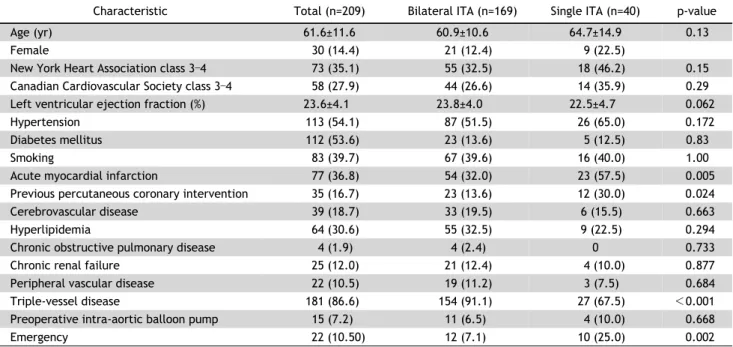
The prevalence of acute MI was 36.8% (77 of 209), and that of triple-vessel disease was 86.6%
(181 of 209). The mean EF was 23.6%. An emergent or urgent operation was performed in 28 patients (13.4%). Detailed baseline characteristics comparing the 2 groups are described in Table 1. Table 2 sum- marizes the operative data. The off-pump technique was used in 96 patients (45.9%), and BITA grafting was used in 169 patients (80.9%). The mean number of anastomoses was 4.5±1.3 per patient.
Fig. 2. Late outcomes by graft strategy. (A) Overall mortality. (B) Cardiac-related mortality. (C) Cardiac-related events. BITA, bi- lateral internal thoracic artery; SITA, single internal thoracic ar- tery; FU, follow-up.
1) Early clinical outcomes
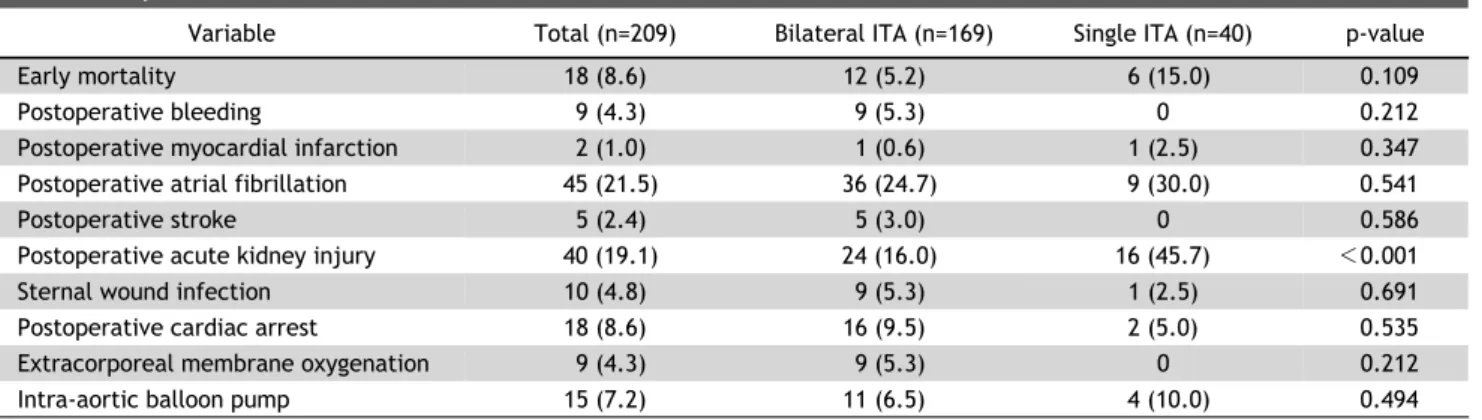
There were a total of 18 early deaths (8.6%), in- cluding 16 cardiac deaths and 2 non-cardiac deaths.
There was no statistically significant difference in early mortality between the 2 groups (5.2% in the BITA group versus 15.0% in the SITA group, p=
0.109). In terms of postoperative complications, bleeding, MI, AF, stroke, and wound infection did not show significant differences, but postoperative AKI was significantly more common in the SITA group (16% in the BITA group versus 45.7% in the SITA group, p<0.001). Postoperative MI occurred in 2 early events, and 1 of the patients died (Table 3).
2) Late clinical outcomes
There were a total of 24 late deaths, including 17 cardiac deaths and 7 non-cardiac deaths. The cause of non-cardiac death was lung cancer in 1 patient, respiratory arrest due to pneumonia in 2 patients, suicide in 1 patient, diabetes mellitus complications
in 2 patients, and septic shock in 1 patient.
A postoperative new-onset stroke occurred in 5 patients, and 4 of the cases occurred after 30 days. A total of 20 patients were readmitted after 30 days.
These patients experienced HF (n=11), arrhythmia (n=1), mediastinitis (n=1), wound infection (n=1), heart transplantation (n=1), unstable angina (n=1), and graft failure (n=2), and patients with graft failure underwent redo CABG.
Fig. 1 shows the survival curves of all patients, in- cluding overall survival, freedom from cardiac-related death, and freedom from cardiac-related events.
Overall survival at 5 years was 66.7%. The rate of freedom from cardiac-related death at 5 years was 74.1% (Fig. 1). We performed an inter-group analysis comparing the BITA and SITA groups to investigate the effect of graft strategy on late clinical outcomes.
We found a significant difference in overall survival and freedom from cardiac-related death, suggestive of better long-term outcomes for the BITA group than
Fig. 3. Late outcomes by CPB strategy. (A) Overall mortality. (B) Cardiac-related mortality. (C) Cardiac-related events. CPB, car- diopulmonary bypass; OPCAB, off-pump coronary artery bypass;
FU, follow-up.
the SITA group (Fig. 2). However, cardiac-related events were not significantly different between the 2 groups (p=0.354). Similarly, to evaluate the effect of CPB strategy, inter-group differences were analyzed between the OPCAB group and the CPB group (Fig.
3). All 3 late outcomes demonstrated better trends in the OPCAB group, as shown by the Kaplan-Meier sur- vival curves (p=0.001 for overall survival, p=0.005 for freedom from cardiac-related death, and p<0.001 for freedom from cardiac-related events).
3) Risk factor analysis for cardiac death
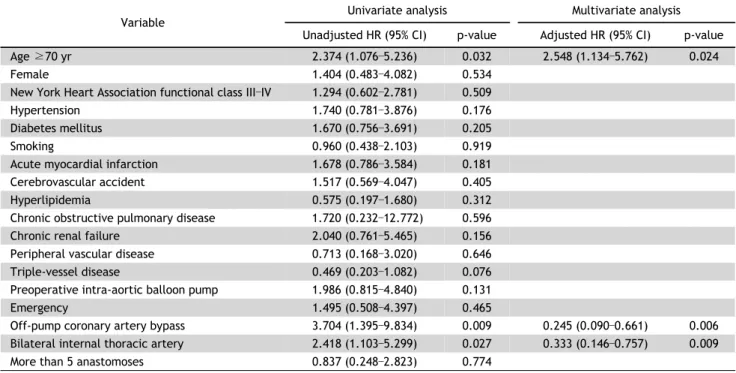
We performed a risk factor analysis of the entire study population to determine the effects of graft and CPB strategies on cardiac-related death, while adjusting for the effects of other variables. Multivariate Cox regression analysis revealed that advanced age (hazard ratio [HR], 2.548; 95% confidence interval [CI], 1.134–5.762; p=0.024), the off-pump technique (HR, 0.245; 95% CI, 0.090–0.661; p=0.006), and a
BITA graft (HR, 0.333; 95% CI, 0.146–0.757; p=0.009) were independent risk factors for late cardiac death (Table 4).
Discussion
Although evidence-based therapies have been widely used, severe LV dysfunction in the setting of significant coronary artery disease is still a challeng- ing problem [1-4]. According to the American College of Cardiology Foundation/American Heart Association (ACCF/AHA) 2013 heart failure clinical practice guidelines, either CABG or medical therapy is a rea- sonable treatment strategy for patients with severe LV dysfunction (EF <35%), HF, and significant coro- nary artery disease (class IIa, level of evidence B) [11]. However, a recent landmark trial, the Surgical Treatment for Ischemic Heart Failure (STICH) Extension Study, demonstrated the long-term benefit of CABG in patients with ischemic cardiomyopathy
Table 4. Factors associated with cardiac death (univariate and multivariate analyses)
Variable Univariate analysis Multivariate analysis
Unadjusted HR (95% CI) p-value Adjusted HR (95% CI) p-value
Age ≥70 yr 2.374 (1.076–5.236) 0.032 2.548 (1.134–5.762) 0.024
Female 1.404 (0.483–4.082) 0.534
New York Heart Association functional class III–IV 1.294 (0.602–2.781) 0.509
Hypertension 1.740 (0.781–3.876) 0.176
Diabetes mellitus 1.670 (0.756–3.691) 0.205
Smoking 0.960 (0.438–2.103) 0.919
Acute myocardial infarction 1.678 (0.786–3.584) 0.181
Cerebrovascular accident 1.517 (0.569–4.047) 0.405
Hyperlipidemia 0.575 (0.197–1.680) 0.312
Chronic obstructive pulmonary disease 1.720 (0.232–12.772) 0.596
Chronic renal failure 2.040 (0.761–5.465) 0.156
Peripheral vascular disease 0.713 (0.168–3.020) 0.646
Triple-vessel disease 0.469 (0.203–1.082) 0.076
Preoperative intra-aortic balloon pump 1.986 (0.815–4.840) 0.131
Emergency 1.495 (0.508–4.397) 0.465
Off-pump coronary artery bypass 3.704 (1.395–9.834) 0.009 0.245 (0.090–0.661) 0.006
Bilateral internal thoracic artery 2.418 (1.103–5.299) 0.027 0.333 (0.146–0.757) 0.009
More than 5 anastomoses 0.837 (0.248–2.823) 0.774
HR, hazard ratio; CI, confidence interval.
[3]. Based on these results, all-cause deaths, as well as deaths from cardiovascular events, were sig- nificantly lower in patients who received CABG plus optimal medical therapy than in those who received optimal medical therapy alone over a 10-year fol- low-up period. Thus, it is not surprising that CABG is part of the standard of care for treating patients with ischemic LV dysfunction who are amenable to an operation.
However, the optimal surgical strategies for CABG in patients with LV dysfunction are still inconclusive, and there is currently a lack of evidence [6,10,12]. In 2012, Dorman et al. [13] presented a propen- sity-matched study demonstrating that BITA was as- sociated with better long-term outcomes in patients with a reduced EF (30% to 50%). However, they failed to show the superiority of BITA in patients with an EF less than 30% [10]. In the same context, Gatti et al. [6] presented similar results in their study of 300 patients with an EF less than 35%, con- cluding that early postoperative improvement of EF was predictive of long-term survival benefits after BITA grafting.
The definition of severe LV dysfunction has been described and adopted in the literature. Since the
ACCF/AHA 2013 guidelines and the STICH trial se- lected an EF ≤35% as the cutoff point for severe LV dysfunction, it was presumed that the same criterion (or an EF less than 40%) was arbitrarily chosen in subsequent studies [5,6]. However, according to the American Society of Echocardiography’s Guidelines and Standards Committee, severe LV dysfunction is described as an EF less than 30%, which is thought to be a common criterion in the real-world assess- ment of ventricular systolic function by echocardiog- raphy [14]. More importantly, there is also evidence that patients with an EF of 30% or less are at higher risk for sudden cardiac death than patients with an EF between 30% and 40% during long-term fol- low-up after MI [15,16]. Therefore, patients with se- vere LV dysfunction (EF ≤30%) may have different prognostic characteristics from those of patients with moderate dysfunction (30%< EF ≤40%). Therefore, our study of surgical strategies for CABG in severe LV dysfunction (EF ≤30%) might represent a differ- ent perspective from that of previous studies with an EF cutoff of less <35% (or <40%).
Our study subjects were unique because we eval- uated the long-term outcomes or CABG in patients with an average EF of only 23%. Unlike previous
equivocal results in studies that assessed patients with an EF <35% (or <40%), our results showed that BITA grafting was a distinct factor that reduced late cardiac-related mortality. Thus, we believe that the long-term protective effect of BITA grafting be- comes more prominent as LV dysfunction becomes more severe. This hypothesis is supported by the lack of difference between the freedom from car- diac-related events curves of the BITA and SITA groups, despite significant differences between the 2 groups in overall mortality and freedom from car- diac-related morality (Fig. 2). Since the category of cardiac-related events included relatively mild events that do not lead to death, such as hospitalization and re-intervention, it can be assumed that BITA grafting does not provide additional benefits compared to SITA grafting in terms of reverse-remodeling or in- hibition of HF progression. However, the BITA group showed statistically significantly better results than the SITA group based on the univariate analysis of cardiac-related mortality. Because it is well known that more severe forms of adverse events frequently occur in patients with a low EF, our results can be interpreted as consistent with our hypothesis that the effects of BITA grafting are more pronounced in patients with a more severely diminished EF.
Several studies on the impact of off-pump techni- ques on long-term outcomes showed conflicting re- sults [5,7,17]. Until the results of ongoing trials (the coronary artery bypass grafting in high-risk patients randomised to off- or on-pump surgery trials) are presented, conclusions about CPB strategies will re- main inconclusive. At our institution, OPCAB is con- sidered as the initial strategy even in patients with severe LV dysfunction, and we consider switching to on-pump beating or conventional CABG when hemo- dynamics cannot be maintained. Therefore, our re- sults might include a selection bias for patients that have successfully completed OPCAB, who would be at a lower underlying risk. Therefore, it cannot be claimed that OPCAB has an absolute advantage over on-pump CABG based on our results. Nevertheless, OPCAB as an initial strategy in patients with severe LV dysfunction might yield acceptable outcomes.
There were several limitations of our study. First, this was a non-matched, retrospective study with in- herent methodological limitations. Our results might have been affected by multiple unmeasured con-
founders. Therefore, further well-designed matched studies or prospective trials will be required to con- firm our results. Second, since the surgical strategies for individual patients were decided based on the surgeon’s preference or institutional protocols, in- stead of objective criteria, the findings of the present study were subject to bias. Furthermore, our study was small, with a retrospective design. Therefore, larger prospective, randomized trials will be required to validate our results.
In conclusion, CABG for patients with severe LV dysfunction (<30%) showed reasonable long-term outcomes. Nonetheless, more extensive studies should be conducted, and it is important to select well- matched groups. Based on these results, off-pump BITA grafting strategies can be accepted as a viable primary option for patients with severe LV dysfunc- tion, if performed by experienced clinicians.
Conflict of interest
No potential conflict of interest relevant to this ar- ticle was reported.
ORCID
Tae Hee Hong: https://orcid.org/0000-0003-2708-8893 You Jin Ha: https://orcid.org/0000-0002-6936-7420 Dong Seop Jeong: https://orcid.org/0000-0002-6947-8403 Wook Sung Kim: https://orcid.org/0000-0003-0197-6366 Young Tak Lee: https://orcid.org/0000-0001-8790-6099
References
1. Velazquez EJ, Bonow RO. Revascularization in severe left ventricular dysfunction. J Am Coll Cardiol 2015;65:615-24.
2. Velazquez EJ, Lee KL, Deja MA, et al. Coronary-artery by- pass surgery in patients with left ventricular dysfunction.
N Engl J Med 2011;364:1607-16.
3. Velazquez EJ, Lee KL, Jones RH, et al. Coronary-artery by- pass surgery in patients with ischemic cardiomyopathy. N Engl J Med 2016;374:1511-20.
4. Kang SH, Lee CW, Baek S, et al. Comparison of outcomes of coronary artery bypass grafting versus drug-eluting stent implantation in patients with severe left ventricular dysfunction. Am J Cardiol 2017;120:69-74.
5. Yoo JS, Kim JB, Jung SH, Choo SJ, Chung CH, Lee JW.
Coronary artery bypass grafting in patients with left ven- tricular dysfunction: predictors of long-term survival and impact of surgical strategies. Int J Cardiol 2013;168:
5316-22.
6. Gatti G, Maschietto L, Dell’Angela L, et al. Predictors of immediate and long-term outcomes of coronary bypass surgery in patients with left ventricular dysfunction.
Heart Vessels 2016;31:1045-55.
7. Ueki C, Miyata H, Motomura N, Sakaguchi G, Akimoto T, Takamoto S. Off-pump versus on-pump coronary artery by- pass grafting in patients with left ventricular dysfunction. J Thorac Cardiovasc Surg 2016;151:1092-8.
8. Lytle BW, Blackstone EH, Sabik JF, Houghtaling P, Loop FD, Cosgrove DM. The effect of bilateral internal thoracic ar- tery grafting on survival during 20 postoperative years.
Ann Thorac Surg 2004;78:2005-12.
9. Kelly R, Buth KJ, Legare JF. Bilateral internal thoracic ar- tery grafting is superior to other forms of multiple arte- rial grafting in providing survival benefit after coronary bypass surgery. J Thorac Cardiovasc Surg 2012;144:1408- 15.
10. Cho SW, Lee YT, Sung K, et al. Early and midterm results of coronary artery bypass grafting in patients with ische- mic cardiomyopathy (LVEF<or=35%). Korean J Thorac Cardiovasc Surg 2006;39:604-10.
11. Writing Committee Members, Yancy CW, Jessup M, et al.
2013 ACCF/AHA guideline for the management of heart failure: a report of the American College of Cardiology Foundation/American Heart Association Task Force on practice guidelines. Circulation 2013;128:e240-327.
12. Mohammadi S, Kalavrouziotis D, Cresce G, et al. Bilateral internal thoracic artery use in patients with low ejection
fraction: is there any additional long-term benefit? Eur J Cardiothorac Surg 2014;46:425-31.
13. Dorman MJ, Kurlansky PA, Traad EA, Galbut DL, Zucker M, Ebra G. Bilateral internal mammary artery grafting en- hances survival in diabetic patients: a 30-year follow-up of propensity score-matched cohorts. Circulation 2012;
126:2935-42.
14. Lang RM, Bierig M, Devereux RB, et al. Recommendations for chamber quantification: a report from the American Society of Echocardiography’s Guidelines and Standards Committee and the Chamber Quantification Writing Group, developed in conjunction with the European Asso- ciation of Echocardiography, a branch of the European Society of Cardiology. J Am Soc Echocardiogr 2005;18:
1440-63.
15. Solomon SD, Zelenkofske S, McMurray JJ, et al. Sudden death in patients with myocardial infarction and left ven- tricular dysfunction, heart failure, or both. N Engl J Med 2005;352:2581-8.
16. Filsoufi F, Rahmanian PB, Castillo JG, Chikwe J, Kini AS, Adams DH. Results and predictors of early and late out- come of coronary artery bypass grafting in patients with severely depressed left ventricular function. Ann Thorac Surg 2007;84:808-16.
17. Keeling WB, Williams ML, Slaughter MS, Zhao Y, Puskas JD.
Off-pump and on-pump coronary revascularization in pa- tients with low ejection fraction: a report from the soci- ety of thoracic surgeons national database. Ann Thorac Surg 2013;96:83-8.