• 검색 결과가 없습니다.

Combined Bilateral Lung Transplantation and Off-Pump Coronary Artery Bypass

N/A
N/A
Protected

Academic year: 2021

Share "Combined Bilateral Lung Transplantation and Off-Pump Coronary Artery Bypass"

Copied!
4
0
0

로드 중.... (전체 텍스트 보기)

전체 글

(1)

ISSN: 2233-601X (Print) ISSN: 2093-6516 (Online)

− 461 −

Received: December 1, 2015, Revised: January 20, 2016, Accepted: January 29, 2016, Published online: December 5, 2016

Corresponding author: Hyo Chae Paik, Department of Thoracic and Cardiovascular Surgery, Yonsei University College of Medicine, 50-1 Yonsei-ro, Seodaemun-gu, Seoul 03722, Korea

(Tel) 82-2-2228-2140 (Fax) 82-2-393-6012 (E-mail) [email protected]

© The Korean Society for Thoracic and Cardiovascular Surgery. 2016. All right reserved.

This is an open access article distributed under the terms of the Creative Commons Attribution Non-Commercial License (http://creativecommons.org/

licenses/by-nc/4.0) which permits unrestricted non-commercial use, distribution, and reproduction in any medium, provided the original work is properly cited.

Combined Bilateral Lung Transplantation and Off-Pump Coronary Artery Bypass

Young Woo Do, M.D., Hee Suk Jung, M.D., Chang Young Lee, M.D., Jin Gu Lee, M.D., Young-Nam Youn, M.D., Hyo Chae Paik, M.D.

Department of Thoracic and Cardiovascular Surgery, Yonsei University College of Medicine

Coronary artery disease has historically been a contraindication to lung transplantation. We report a successful combined bilateral lung transplantation and off-pump coronary artery bypass in a 62-year-old man. The patient had a progressive decline in lung function due to idiopathic pulmonary fibrosis and a history of severe oc- clusive coronary artery disease.

Key words: 1. Lung transplantation 2. Coronary artery disease 3. Off-pump

4. Coronary artery bypass surgery

Case report

A 62-year-old man (height, 158 cm; weight, 63 kg;

blood typ e, A

) with a history of smoking (35 pack-years) was registered for lung transplantation with a diagnosis of idiop athic p ulmonary fibrosis.

The patient experienced a progressive decline in lung function for eight months. Symptoms did not im- p rove with medical treatment. The p atient’s status was New York Heart Association Functional Class III, and the patient had lost 5 kg over a 6-month period.

Room air arterial blood gas analysis showed an oxy- gen partial pressure of 59.1 mm Hg, partial pressure of CO

2

was 39.2 mm Hg, and oxygen saturation was 89.4%. A pulmonary function test revealed a forced vital capacity of 1.60 L (47% of predicted) and a forced expiratory volume in 1 second of 1.52 L (61%

of predicted). Computed tomography revealed sub- pleural and peribronchovascular reticulation with ma- crocystic honeycombing in both lungs (Fig. 1).

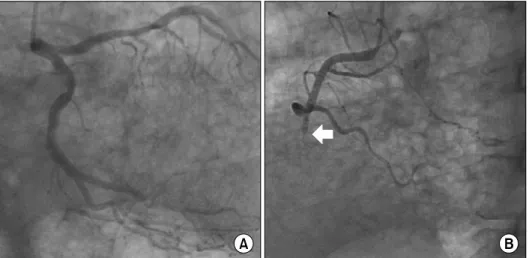
Coronary angiography revealed total occlusion at the mid-right coronary artery, and left ventricular ejection fraction of 61% (Fig. 2). Therefore, we con- cluded that the patient needed bilateral lung trans- plantation and also required coronary artery bypass surgery. We decided to perform the coronary artery bypass surgery followed by bilateral lung transplan- tation.

Two months after being listed for a lung trans- plant, a suitable donor lung was matched. The donor was a 49-year-old man (height, 170 cm; weight, 52.1 kg; blood type, A

) who had an intracranial hemo- rrhage. The total lung capacity of the recipient was 4.755 L, while that of the donor was 6.078 L, which was a donor-to-recipient size match of 127.8%.

Prior to the lung transplant, the patient’s vital signs were stable (heart rate of 98 beats per minute and arterial blood pressure of 115/75 mm Hg). After the induction of general anesthesia, a pulmonary arterial catheter was placed via the left internal jugular vein,

Korean J Thorac Cardiovasc Surg 2016;49:461-464 □ CASE REPORT □

https://doi.org/10.5090/kjtcs.2016.49.6.461

(2)

Young Woo Do, et al

− 462 −

Fig. 2. Preoperative coronary an- giography. (A) Normal left coronary artery (left anterior oblique view).

(B) Total occlusion of the mid right coronary artery (white arrow, left anterior oblique view).

Fig. 1. Preoperative chest computed tomography. Subpleural and peribronchovascular reticulation with macrocystic honeycombing is visible in both lungs.

and the pulmonary arterial pressures were initially 40–50/20–30 mm Hg.

The operation was performed as follows: under general anesthesia, a clamshell incision was made and the hila were prepared for lung transplantation.

At the same time, the left greater saphenous vein was harvested for coronary artery bypass. Following a minimal dissection in both hila, the saphenous vein was anastomosed to the ascending aorta using a Heartstring device (Heartstring Proximal Seal System, Guidant, IN, USA), and the right coronary artery was byp assed to the right p osterior descending artery via the off-pump technique using a tissue stabilizer. The patency of the saphenous vein was confirmed by a

flowmeter. After coronary revascularization, periph- eral venoarterial extracorporeal membrane oxygen- ation (ECMO) was started. A venous cannula was placed in the right femoral vein and an arterial can- nula was p laced into the right femoral artery. This was followed by sequential right and left lung trans- plantation. Each side started with bronchial anasto- mosis, followed by p ulmonary venous anastomosis with a side-biting clamp on the p ulmonary veins, and ended with pulmonary artery anastomosis. ECMO was discontinued and decannulated before the pa- tient was transferred from the operating room to the intensive care unit. The total ECMO time was 320 minutes, total operation time was 461 minutes, and total anesthesia time was 565 minutes.

Postoperatively, there was no primary graft dys- function or acute cellular rejection. Prednisone was used in combination with tacrolimus and mycopheno- late for maintenance immunosuppression. On post- operative day (POD) 3, heart rate ranged from 85 to 90 beats per minute, arterial blood pressure ranged from 110 to 120 mm Hg/70 to 80 mm Hg, and pul- monary arterial pressure ranged from 35 to 37 mm Hg/15 to 17 mm Hg.

The patient required a tracheostomy for recovery

due to respiratory failure after tracheal extubation on

POD 8. After 7 days of tracheostomy, ventilator wean-

ing was possible. The patient was transferred to the

general ward on POD 16, the tracheostomy tube was

removed on POD 30, and discharged on POD 37 in

good condition.

(3)

Lung Transplantation with Off-Pump Coronary Artery Bypass

− 463 −

Discussion

The presence of comorbidities in patients has pre- viously been considered to be a relative contraindi- cation for lung transplantation. In particular, coronary artery disease was considered to be a serious surgi- cal risk [1]. The first lung transplantation was per- formed at Severance Hospital in July 1996 [2], and since then, the number of lung transplantations has increased. At the same time, the inclusion criteria for lung transplantation have been expanded to include patients with higher surgical risk.

Whether patients with significant coronary artery disease are suitable candidates for lung transplanta- tion is unclear. Some reports have described the long-term survival outcomes following lung trans- plantation in cases with revascularized coronary ar- teries. One report demonstrated that the long-term survival following lung transplantation in patients with significant coronary artery disease was influ- enced by whether they received coronary revasculari- zation prior to lung transplantation [3]. However, some studies have reported successful results in the management of patients who simultaneously received coronary artery revascularization and lung transplan- tation [4,5]. Patel et al. [4] reported successful simul- taneous coronary artery bypass and lung transplan- tation in a small number of carefully selected patients.

Lee et al. [5] also reported combined lung trans- plantation and coronary bypass grafting in four select cases. However, p atients with multivessel disease or left ventricular dysfunction were not considered suit- able candidates for lung transplantation.

In this case, combined bilateral lung transplantation and coronary artery bypass grafting was performed in a p atient who had a single vessel disease with normal left ventricular function. In terms of surgical technique and devices, the off-pump technique was possible for the coronary bypass grafting through a clamshell incision. Using a saphenous vein graft might have enabled coronary artery grafting to be performed without much difficulty through the usual clamshell incision. In Korea at present, almost 50% of coronary graft bypass surgeries are performed via off-pump technique. Our previous study indicated that off-pump coronary artery bypass surgeries improved myocardial functioning and favored early and mid-term outcomes in the high-risk group [6].

Both single and bilateral lung transplantation have been accep ted as worthy of treatment for idiop athic p ulmonary fibrosis. Procedure selection should be carefully considering the following factors: recipient, donor, and transplant center. Although single lung transplantation reduced waitlist time and mortality, the long-term outcomes of bilateral lung trans- plantation were slightly superior [7]. The benefits of bilateral lung transplantation include better lung comp liance, imp roved lung volume, and avoidance of native lung disorders. For these reasons, we performed a bilateral lung transplantation.

Intraoperatively, we used ECMO for cardiopulmonary support. Our center has used both ECMO and con- ventional cardiopulmonary bypass in the lung trans- plantation procedure. However, ECMO has been con- sidered the method of choice since 2013 because of its advantages, such as less coagulopathy, less sys- temic inflammatory response, short postoperative re- covery time, and less p ulmonary and renal comp lica- tions [8,9]. With off-pump coronary artery bypass graft surgery, we could use ECMO for cardiopulmo- nary support instead of conventional cardiopulmo- nary bypass.

To the best of our knowledge, this case was the first successful bilateral lung transplantation com- bined with off-pump coronary artery bypass graft surgery in Korea, and we reported a satisfactory out- come following surgery.

Conflict of interest

No p otential conflict of interest relevant to this ar- ticle was reported.

References

1. Aurora P, Boucek MM, Christie J, et al. Registry of the International Society for Heart and Lung Transplantation:

tenth official pediatric lung and heart/lung transplan- tation report--2007. J Heart Lung Transplant 2007;26:1223-8.

2. Haam SJ, Lee DY, Paik HC. An overview of lung trans- plantation in Korea. Transplant Proc 2008;40:2620-2.

3. Seoane L, Arcement LM, Valentine VG, McFadden PM.

Long-term survival in lung transplant recipients after suc- cessful preoperative coronary revascularization. J Thorac Cardiovasc Surg 2005;130:538-41.

4. Patel VS, Messier RH, Palmer SM, Davis RD. Coronary artery

revascularization in eligible lung transplant recipients. J

(4)

Young Woo Do, et al

− 464 −

Heart Lung Transplant 2001;20:223.

5. Lee R, Meyers BF, Sundt TM, Trulock EP, Patterson GA.

Concomitant coronary artery revascularization to allow successful lung transplantation in selected patients with coronary artery disease. J Thorac Cardiovasc Surg 2002;

124:1250-1.

6. Youn YN, Yoo KJ, Lee KJ, Bae MK, Shim YH. The compar- ison study of early and midterm clinical outcome of off-pump versus on-pump coronary artery bypass grafting in patients with severe left ventricular dysfunction (LVEF <

or =35%). Korean J Thorac Cardiovasc Surg 2006;39:184-93.

7. Brown AW, Kaya H, Nathan SD. Lung transplantation in IIP:

a review. Respirology 2016;21:1173-84.

8. Bermudez CA, Shiose A, Esper SA, et al. Outcomes of intra- operative venoarterial extracorporeal membrane oxygen- ation versus cardiopulmonary bypass during lung trans- plantation. Ann Thorac Surg 2014;98:1936-42.

9. Machuca TN, Collaud S, Mercier O, et al. Outcomes of in-

traoperative extracorporeal membrane oxygenation ver-

sus cardiopulmonary bypass for lung transplantation. J

Thorac Cardiovasc Surg 2015;149:1152-7.

수치

Fig. 1. Preoperative chest computed tomography. Subpleural and  peribronchovascular reticulation with macrocystic honeycombing is visible in both lungs.

참조

관련 문서

CABG, Coronary Artery Bypass Grafting; Preop., preoperative; NYHA, New York Heart Association; AMI, acute myocardial infarction; IABP, Intraaortic balloon pump; CPR,

Background: Off-pump coronary artery bypass grafting (OPCAB) has shown better outcome in chronic renal failure (CRF) patients by avoiding the effects of cardiopulmonary bypass..

The comparison of clinical outcomes of off-pump versus on-pump coronary artery bypass grafting in high risk patients. Yokoyama T, Baumgartner FJ, Gheissari A,

Coronary artery bypass grafting in elderly patients: comparative results in a consecutive series of 469 patients older than 75 years. Favorable results of

We evaluated the risk factors associated with the development of sub- xiphoid incisional hernia in patients who underwent coronary artery bypass grafting

Compared with conventional coronary artery bypass graft (CABG), off-pump coronary artery bypass (OPCAB) has ad- vantages for performing transfusion-free surgery,

Background: A previous percutaneous coronary intervention (PCI) may affect the outcomes of patients who under- go coronary artery bypass grafting (CABG).. The objective of this

MACCE, major adverse cardiac and cerebrovascular events; TVR, target vessel revascularization; CABG, coronary artery bypass graft; PCI, percutaneous coronary intervention.. There was