49
Irinotecan and Cisplatin Combination Chemotherapy Plus Concurrent Thoracic Irradiation for Patients with Limited Disease Small Cell Lung Cancer
Purpose: To evaluate the antitumor activity and safety of irinotecan plus cisplatin combination chemotherapy with concurrent thoracic radiotherapy (TRT) in patients with limited disease (LD) small cell lung cancer (SCLC).
Materials and Methods: Patients with pathologically-confirmed LD SCLC with the following inclusion criteria were retrospectively analyzed: age ≥18 years;
measurable lesion; Eastern Cooperative Oncology Group Performance Status 0∼2; chemotherapy naïve; and adequate bone marrow and organ function.
Patients received an intravenous (IV) infusion of irinotecan (35 mg/m2 on days 1, 8, and 15) and cisplatin (60 mg/m2 on day 1), which was repeated every 4 weeks for up to 6 cycles. Concurrent TRT was administered with the beginning of chemotherapy. Irinotecan was increased to 60 mg/m2 after completion of TRT. Patients with a complete response (CR) subsequently received prophylactic cranial irradiation. Results: Nineteen patients were analyzed. There were 8 patients (42.1%) with CR, 9 patients (47.4%) with partial response, and 1 patient each (5.3%) with stable disease and progressive disease (PD). The overall response rate was 89.5%. The median pro- gression-free survival was 7.6 months (95% confidence interval [CI], 1.3∼14.0 months) and the median overall survival was 12.4 months (95% CI, 0.5∼24.2 months). The 2-year survival rate of the CR patients was 75.0%. No grade 4 hematologic toxicity was reported. Frequently reported toxicities were nausea (10 patients), radiation-induced pneumonitis (10 patients), and neutropenia (6 patients). Radiation-related severe toxicities were frequently reported. Three patients had treatment-related deaths. Conclusion: This study supports the activity and tolerability of irinotecan plus cisplatin with concurrent TRT in patients with LD SCLC. (J Lung Cancer 2011;10(1):49 55) Key Words: Small cell lung carcinoma, Irinotecan, Cisplatin, Radiotherapy
Junshik Hong, M.D.1 Yae Min Park, M.D.1 Seok Ho Lee, M.D.2 Kyu Chan Lee, M.D., Ph.D.2 Se Hoon Park, M.D., Ph.D.3 Jinny Park, M.D., Ph.D.1 Sun Jin Sym, M.D.1
Eun Kyung Cho, M.D., Ph.D.1 Dong Bok Shin, M.D., Ph.D.1 and Jae Hoon Lee, M.D., Ph.D.1 Departments of 1Internal Medicine and 2Therapeutic Radiology and On- cology, Gachon University Gil Hos- pital, Gachon University of Medicine and Science Graduate School of Medicine, Incheon, 3Department of Internal Medicine, Samsung Seoul Hospital, Sungkyunkwan University School of Medicine, Seoul, Korea Received: July 28, 2010 Revised: March 29, 2011 Accepted: May 6, 2011 Address for correspondence Eun Kyung Cho, M.D., Ph.D.
Department of Internal Medicine, Gachon University Gil Hospital, 1198, Guwol-dong, Namdong-gu, Incheon 405-760, Korea
Tel: 82-32-460-8301 Fax: 82-32-460-3233
E-mail: [email protected]
INTRODUCTION
Small cell lung cancer (SCLC) accounts for approximately 15% of all lung cancers (1), and is almost entirely attributable to cigarette smoking (2). SCLC is the most aggressive of all the lung cancer cell types. SCLC has a more rapid doubling time, a higher growth fraction, and earlier development of widespread metastasis compared to non-small cell lung cancer (NSCLC). Only one-third of patients diagnosed with SCLC
present with limited disease (LD).
As new chemotherapy regimens were developed in the mid-1970s, the median overall survival (OS) of patients with LD SCLC increased from 6 to 18 months, and the OS of patients with extensive disease (ED) reached 9 months.
Disappointingly, there has been almost no progress in the survivorship of SCLC since the mid-1980s (3).
Irinotecan, a topoisomerase I inhibitor, has raised significant interest as an alternative to etoposide, the standard agent of SCLC, when used in combination with platinum-based agents
(4-6). A Japanese phase III trial (7) reported that patients with ED SCLC who were treated with irinotecan plus cisplatin had a median OS of 12.8 months, whereas those treated with etoposide plus cisplatin achieved an OS of only 9.4 months (p=0.002). However, two other phase III trials performed in the United States failed to reproduce the superiority of irinotecan in patients with ED SCLC (8,9). Nevertheless, irinotecan is now considered an available option of chemotherapy for patients with ED SCLC (10).
For patients with LD SCLC, etoposide plus cisplatin with concurrent thoracic radiotherapy (TRT) is regarded as standard first-line treatment. TRT was introduced for the treatment of LD SCLC in the 1980s in an effort to achieve improved local control rate and fewer relapses at the primary site. As two meta-analyses demonstrated a survival advantage of approxi- mately 4% at 2 years (11,12), TRT became an essential component of treatment for patients with LD SCLC.
The aim of this study was to evaluate the safety profile and antitumor activity of combination chemotherapy of irinotecan and cisplatin with concurrent TRT in patients with LD SCLC.
MATERIALS AND METHODS 1) Patients
The data of patients with LD SCLC treated with combination chemotherapy (irinotecan and cisplatin) with concurrent TRT in a single institution (Gachon University Gil Hospital) between October 2004 and March 2009 were retrospectively reviewed.
Inclusion criteria for the analysis were as follows: >18 years of age; either histologically or cytologically-proven LD SCLC;
at least 1 measurable lesion; Eastern Cooperative Oncology Group Performance Status (ECOG PS) 0∼2; naïve for chemotherapy and TRT; and adequate bone marrow and organ function.
Before the initiation of therapy, each patient had the following as a staging work-up: history and physical examina- tion; complete blood count and serum chemistries; computed tomography (CT) of the chest; either magnetic resonance imaging (MRI) or enhanced CT of the brain; and bone scintigraphy.
LD was defined as tumors confined to one hemithorax, including bilateral mediastinal and supraclavicular nodes. The Institutional Review Board of the institution granted permission
for this retrospective study.
2) Combination chemotherapy
During the first cycle of chemotherapy, irinotecan (35 mg/m2 mixed with 500 mL of 5% dextrose water) was administered as a 90-minute intravenous (IV) infusion on days 1, 8, and 15.
Additionally, cisplatin (60 mg/m2 mixed with 150 mL of normal saline) was administered IV over 60 minutes on day 1. TRT was administered concurrently during the first cycle of chemotherapy. After the completion of radiation therapy, the dose of irinotecan was increased to 60 mg/m2 and administered in the same manner as the first cycle with cisplatin (60 mg/m2 IV on day 1). Chemotherapy cycles were repeated every 4 weeks.
In order to prevent cisplatin-induced nephrotoxicity, adequate pre- and post-chemotherapy hydration was performed on the patients. Patients received a 5-HT3 antagonist IV before the infusion of chemotherapy was started. If a patient had cholinergic symptoms related to irinotecan, atropine sulfate (0.5 mg IV) was given to the patient, and atropine was permitted to be repeated (up to 1.2 mg per day). Prophylactic atropine administration was also permitted to patients who previously complained of cholinergic symptoms. In patients with acute diarrhea, 4 mg of loperamide was administered, followed by 2 mg every 2 hours until cessation of the diarrhea.
A total of 6 cycles of chemotherapy were administered, unless there was documented disease progression, unacceptable toxicity, or patient refusal.
Dose adjustments at the start of a new cycle were based on the worst toxicity observed during the previous cycle. If the absolute neutrophil count (ANC) decreased to <1,500/mm3 or the platelet count decreased to <100,000/mm3, chemotherapy was withheld until the counts recovered to ≥1,500/mm3 and
≥100,000/mm3, respectively, before starting the next cycle of chemotherapy. The dose of irinotecan on day 8 or 15 was not administered if either the ANC was <2,000/mm3 or the platelet count was <50,000/mm3. The administration of irinotecan was delayed if there was any grade of diarrhea. For the subsequent chemotherapy cycles, the dose of irinotecan was reduced by 10 mg/m2 if grade 4 hematologic or grade 2 or 3 non-hematologic toxicity developed.
After the completion of each cycle, a safety evaluation, including an assessment of laboratory data and any clinical
Table 1. Patients’ Characteristics
Characteristics Number (%)
Age, yr 58*
Range 47∼74
Sex
Male 17 (90)
Female 2 (11)
ECOG performance status
0 3 (16)
1 13 (68)
2 3 (16)
Smoking
Ever 18 (95)
Never 1 (5)
N3 disease
Yes 9 (47)
No 11 (53)
Lactose dehydrogenase
Elevated 6 (32)
Not elevated 9 (47)
Not evaluated 4 (21)
Symptom at diagnosis
Cough 11 (58)
Sputum 4 (21)
Dyspnea 3 (16)
Chest pain 3 (16)
Hemoptysis 2 (11)
Weight loss 2 (11)
Fever 2 (11)
Paraneoplastic syndrome
Neurologic symptom 2 (11)
Hypercalcemia 0
SIADH 2 (11)
*Median age.
ECOG: Eastern Cooperative Oncology Group, SIADH: synd- rome of inappropriate diuretic hormone secretion.
adverse events, was performed. Patients were evaluated for tumor response by chest CT after 4 weeks of completing treatment. Patients were followed-up every 2 months after completion of the therapy until disease progression or death.
The tumor response was measured according to the World Health Organization criteria. To record adverse events, the National Cancer Institute Common Toxicity Criteria (version 3.0) was used.
3) Radiotherapy
A once-daily fraction of TRT (5 days/week, with 1.8 Gy/day) was administered; TRT was started on the first day of the first cycle, to a planned total dose of 54 Gy. The target volume and fields were individualized for each patient, based on a pre-treatment chest CT scan. The target volume for irradiation encompassed the area of the gross primary lesion with a 1.5 cm margin, lymph nodes >1 cm in size, uninvolved media- stinal nodes, and ipsilateral hilar nodes. If either supraclavicular or scalene lymph node metastases were detected, the nodes were included in the fields. Cone-down of the lesion and additional TRT (more than the planned 54 Gy) to the narrowed lesion was permitted according to the decision of the radiologic oncologists.
If grade 4 hematologic or grade 3 or 4 esophagitis occurred during TRT, the therapy was temporarily held and restarted after recovery to grade 3 or less hematologic toxicity or grade 2 or less esophagitis. If esophagitis did not recover, radiation was discontinued.
Patients who achieved a complete response (CR) received prophylactic cranial irradiation (PCI) starting 5 weeks after the end of chemotherapy. A total dose of 30 Gy was used in 10 fractions of 3 Gy.
4) Statistical analysis
The primary endpoint of this study was to evaluate both the toxicity and response rate of combination chemotherapy con- current with TRT in the patients with LD SCLC. Pro- gression-free survival (PFS) and overall survival (OS) were measured as a secondary endpoint. All eligible patients who received at least 1 cycle of chemotherapy were included for survival estimation and toxicity evaluation. PFS was defined as the time from commencement of treatment until disease progression or death. OS was calculated from the first time of
treatment to death from any cause. We additionally measured time to progression (TTP), in which the deaths of patients from other than progression were censored compared to PFS.
PFS and OS were calculated using the Kaplan-Meier method.
All statistical analyses were performed with the SPSS software version 15.0 (SPSS Inc., Chicago, IL, USA).
RESULTS 1) Patient characteristics
Nineteen patients (median age, 58 years; age range, 47∼74 years) received combination chemotherapy concurrent with TRT. Seventeen patients were male and most of the patients were smokers. The detailed patient characteristics are sum-
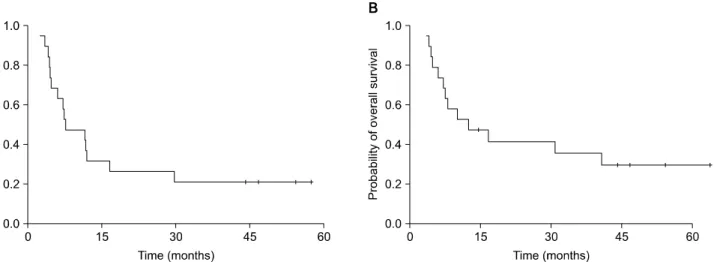
Fig. 1. Kaplan-Meier curves of (A) progression-free survival and (B) overall survival in 19 patients with limited disease small cell lung cancer (LD-SCLC) treated with irinotecan plus cisplatin chemotherapy with concurrent thoracic radiotherapy.
Table 2. Profile of Adverse Events during Treatment
Event
Number of patients (n=19) NCI-CTC grade*
1 2 3 4 5 3 to 5 (%)
Anemia 0 5 2 0 0 2 (11)
Neutropenia 1 3 2 0 0 2 (11)
Thrombocytopenia 1 1 1 0 0 1 (5)
Infection 0 2 0 0 2 2 (11)
Anorexia 0 1 2 0 0 2 (11)
Nausea 3 3 4 0 0 4 (21)
Vomiting 2 0 0 1 0 1 (5)
Diarrhea 1 0 2 1 0 3 (16)
Fatigue 0 2 1 0 0 1 (5)
Creatinine 2 0 0 0 0 0 (0)
Stomatitis 0 1 5 0 0 5 (26)
Esophagitis due to radiation 0 3 3 1 0 4 (21) Pneumonitis due to radiation 6 2 1 0 1 2 (11)
*Version is 3.0.
NCI-CTC: National Cancer Institute-Common Toxicity Criteria.
marized in Table 1. During a median follow-up of 44.2 months, 12 patients had either disease progression or relapse after a CR, and 13 patients died. The median number of cycles administered was 4 (range, 1∼5). Five of 8 patients with CR (26.3%) received PCI.
2) Treatment outcomes
All of the 19 patients were evaluable for tumor response; the best overall response was a CR in 8 (42.1%), partial response (PR) in 9 (47.4%), and stable disease (SD) in 1 patient each (5.3%). The overall RR was 89.5%. The median PFS was 7.6 months (95% CI, 1.3∼14.0 months) and the median OS was 12.4 months (95% CI, 0.5∼24.2 months; Fig. 1). The median TTP was 11.7 months (95% CI, 4.0∼19.3 months). The 2-year survival rate of the patients with a CR was 75.0%. The median relative dose intensity of irinotecan and cisplatin was 73.0%
and 82.0%, respectively. The median delivered dose of radiotherapy was 59.4 Gy (range, 39.6∼73.8 Gy).
3) Toxicity profile
The recorded adverse events are summarized in Table 2.
Hematologic toxicities were modest and there was no grade 4 hematologic toxicity or episodes of neutropenic fevers during the treatment. The frequently reported toxicities were nausea (10 patients, 53%), radiation-induced pneumonitis (10 patients, 53%), and neutropenia (6 patients, 32%). The frequently reported severe toxicities (i.e., grades, 3∼5) were stomatitis (5 patients, 26%), nausea (4 patients, 21%), and esophagitis (4
patients, 21%). Three patients died during the treatment and were considered treatment-related deaths; two patients died of fatal pneumonia (fungal pneumonia and pneumococcal pneu- monia) without neutropenia and the other patient probably died of severe radiation-induced pneumonitis, as there was no growth report on his blood, sputum, and bronchoscopic lavage culture, and the pulmonary lesion was located in the radiation field.
4) Pattern of treatment failure
Excluding 3 patients with treatment related mortality and 4 patients who maintained CR after the treatment, 12 patients had either documented relapse after CR or progression of SCLC:
there was 1 patient with locoregional failure alone, 10 patients with distant metastasis alone, and 1 patient experienced both locoregional and distant failures. The common sites of distant metastases were as follows: liver, 3 patients; brain, 3 patients;
bone, 2 patients; distant lymph nodes, 2 patients; and lung other than the primary lesion, 1 patient (a patient may have had >2 sites of distant metastases).
DISCUSSION
As irinotecan plus cisplatin combination chemotherapy has been shown to be at least comparable to the standard etoposide plus cisplatin regimen in patients with ED SCLC, introduction of irinotecan for the treatment of patients with LD SCLC is a rational approach. In the current study, we achieved a high response rate and survival, which were similar to historic data of concurrent chemoradiation in patients with LD SCLC.
Three phase I clinical trials (13-15) for determining the optimal dose and schedule of irinotecan plus cisplatin with TRT have been published to date. Yokoyama et al. (13) reported that patients with previously untreated, unresectable NSCLC were intolerant to 40 mg/m2 of irinotecan on days 1, 8, and 15, and 60 mg/m2 of cisplatin on day 1, which was the lowest dose of combination irinotecan and cisplatin in their study, because of severe adverse effects (i.e., esophagitis and diarrhea). Thus, they could not identify the optimal dose and recommended a single agent chemoradiation. However, other phase I studies defined tolerability of the combination with radiotherapy. We planned a current study in consideration of the study conducted by Oka et al. (15), in which 40 mg/m2 of irinotecan on days 1, 8, and 15, and 60 mg/m2 of cisplatin on the 1st day of each cycle were used in patients with LD SCLC.
Various methods to integrate irinotecan in the treatment of patients with LD SCLC have been developed and tested.
Because alternate regimens have been widely tested previously in patients with ED SCLC based on the tumor biology of SCLC (16,17), utilization of irinotecan as either an induction or consolidation chemotherapeutic agent in addition to the
standard etoposide plus cisplatin regimen has been attempted (18-20). A Korean phase II clinical trial reported that irinotecan with cisplatin induction, followed by concurrent twice-a-day TRT with etoposide plus cisplatin chemotherapy resulted in a 97% and 100% response rate after induction chemotherapy and thoracic irradiation, respectively, with an OS of 25.0 months (95% CI, 19.0∼30.9 months) (18). Kubota et al. (19) utilized irinotecan as a consolidative agent in patients with LD SCLC.
They reported that administration of concurrent etoposide plus cisplatin with accelerated hyperfractionated TRT followed by irinotecan plus cisplatin had a 97% objective response and an OS of 20.3 months.
In the current study we used irinotecan as an alternate to etoposide in patients with LD SCLC. Two previous studies involving combination irinotecan plus cisplatin with concurrent TRT have been reported (21,22) (Table 3). Our study achieved a similar response rate compared to previous results. Four of 19 patients (21.1%) have maintained a CR >40 months, which also supports the activity of irinotecan plus cisplatin com- bination chemotherapy with concurrent TRT.
Survivals were not satisfactory when we compared with previous studies (18,19,21,22). Several factors may have contributed to the lower survival rates found in our study. First, the OS of this study may have been influenced from 3 of 19 patients with early treatment-related mortality (15.8%). The median TTP measured to exclude the impact of early deaths was 4 months longer than the median PFS. As the number of analyzed patients was small, even 1 or 2 early deaths can have a substantial impact on the statistic analysis. Second, this study included nearly one-half of the patients with N3, which is known for an independent poor prognostic marker in patients with LD SCLC (23). The ratio of N3 patients was higher than in the other study involving combination irinotecan plus cisplatin with TRT (22).
Although neutropenia was one of the most common reported toxicities, most of the patients recovered without significant infections and there was no grade 4 neutropenia. In contrast, this study showed a significant incidence of TRT-related complications. As we left the decision regarding additional TRT after 54 Gy to the radiologic oncologists, higher doses of radiation were administered to most patients (median, 59.4 Gy).
It appears that high doses of irradiation may have a relationship to adverse events, despite of the fact that high doses of
Table 3. Studies which Integrated Irinotecan Plus Cisplatin with Thoracic Radiotherapy in Limited Disease Small Lung Cancer
Dose and schedules TRT Response rate Survivals
Han et al. (18) I 80 mg/m2 day 1, 8 1.5 Gy/Fr 97% after induction Median PFS;
(n=35) P 40 mg/m2 day 1 twice daily 100% after treatment 12.9 months
q 3 weeks×2 cycles then, up to 45 Gy median OS;
E 100 mg/m2 day 1∼3 25.0 months
P 60 mg/m2 day 1 with TRT q 3 weeks×2 cycles
Kubota et al. (19) E 100 mg/m2 day 1∼3 1.5 Gy/Fr 97% Median PFS;
(n=30) P 80 mg/m2 day 1 with TRT twice daily CR; 37% 9.0 months
For 3 weeks×1 cycle then, up to 45 Gy median OS;
I 60 mg/m2 day 1, 8, 15 20.2 months
P 60 mg/m2 day 1 q 4 weeks×3 cycles
Jeong et al. (21) I 40 mg/m2 day 1, 8, 15 1.8 Gy/Fr 85% Median PFS;
(n=20) P 60 mg/m2 day 1, 8 with TRT Once daily CR; 30% 12 months
q 4 weeks Up to 50.4 Gy median OS;
Maximum 6 cycles 20 months
Sohn et al. (22) I 60 mg/m2 day 1, 8, 15 1.8 Gy/Fr 87.9% Median PFS;
(n=33) P 40 mg/m2 day 1, 8 with TRT once daily CR; 45.5% 14.4 months
q 4 weeks 45 to 54 Gy median OS;
Maximum 6 cycles 26.1 months
Current study I 35 mg/m2 day 1, 8, 15 1.8 Gy/Fr 89.5% Median PFS;
(n=19) P 60 mg/m2 day 1, 8 with TRT Once daily CR; 42.1% 7.6 months
(irinotecan dose escalated to 60 mg/m2 Planned dose; 54 Gy median OS;
after completion of TRT) 12.4 months
q 4 weeks Maximum 6 cycles
TRT: thoracic radiotherapy, I: irinotecan, P: cisplatin, E: etoposide, PFS: progression-free survival, OS: overall survival, CR: complete response.
irradiation might contribute to improved locoregional control.
Thus, one patient died of severe radiation-induced pneumonitis, and in the other 2 patients who died of severe pneumonia, combined pre-existing radiation pneumonitis (one with grade 1 and the other with grade 2) probably limited their lung function.
CONCLUSION
Although the current study was a retrospective analysis with a limited number of patients, a significant tumor response was demonstrated, which was the primary endpoint of the analysis.
Introduction of irinotecan in combination with platinum in patients with LD SCLC was effective and tolerable. Further prospective phase III clinical trial is warranted.
REFERENCES
1. Govindan R, Page N, Morgensztern D, et al. Changing
epidemiology of small-cell lung cancer in the United States over the last 30 years: analysis of the surveillance, epide- miologic, and end results database. J Clin Oncol 2006;24:
4539-4544.
2. Jackman DM, Johnson BE. Small-cell lung cancer. Lancet 2005;366:1385-1396.
3. Cooper S, Spiro SG. Small cell lung cancer: treatment review.
Respirology 2006;11:241-248.
4. Hermes A, Bergman B, Bremnes R, et al. Irinotecan plus carboplatin versus oral etoposide plus carboplatin in extensive small-cell lung cancer: a randomized phase III trial. J Clin Oncol 2008;26:4261-4267.
5. Schmittel AH, Sebastian M, von Weikersthal LF, et al.
Irinotecan plus carboplatin versus etoposide plus carboplatin in extensive disease small cell lung cancer: Results of the German randomized phase III trial. J Clin Oncol 2009;27 (Suppl 15):8029.
6. Kim YS, Park SH, Kyung SY, et al. Irinotecan plus carboplatin in patients with extensive-disease small-cell lung cancer. Med Oncol 2011;28:342-350.
7. Noda K, Nishiwaki Y, Kawahara M, et al. Irinotecan plus cisplatin compared with etoposide plus cisplatin for extensive small-cell lung cancer. N Engl J Med 2002;346:85-91.
8. Hanna N, Bunn PA Jr, Langer C, et al. Randomized phase III trial comparing irinotecan/cisplatin with etoposide/cisplatin in patients with previously untreated extensive-stage disease small-cell lung cancer. J Clin Oncol 2006;24:2038-2043.
9. Lara PN Jr, Natale R, Crowley J, et al. Phase III trial of irinotecan/cisplatin compared with etoposide/cisplatin in extensive-stage small-cell lung cancer: clinical and pharma- cogenomic results from SWOG S0124. J Clin Oncol 2009;
27:2530-2535.
10. Simon M, Argiris A, Murren JR. Progress in the therapy of small cell lung cancer. Crit Rev Oncol Hematol 2004;49:119- 133.
11. Huncharek M, McGarry R. A meta-analysis of the timing of chest irradiation in the combined modality treatment of limited-stage small cell lung cancer. Oncologist 2004;9:665- 672.
12. Warde P, Payne D. Does thoracic irradiation improve survival and local control in limited-stage small-cell carcinoma of the lung? A meta-analysis. J Clin Oncol 1992;10:890-895.
13. Yokoyama A, Kurita Y, Saijo N, et al. Dose-finding study of irinotecan and cisplatin plus concurrent radiotherapy for unresectable stage III non-small-cell lung cancer [seecom- ments]. Br J Cancer 1998;78:257-262.
14. Takiguchi Y, Uruma R, Asaka-Amano Y, et al. Phase I study of cisplatin and irinotecan combined with concurrent hyperfractionated accelerated thoracic radiotherapy for locally advanced non-small cell lung carcinoma. Int J Clin Oncol 2005;10:418-424.
15. Oka M, Fukuda M, Kuba M, et al. Phase I study of irinotecan and cisplatin with concurrent split-course radiotherapy in limited-disease small-cell lung cancer. Eur J Cancer 2002;38:
1998-2004.
16. Fukuoka M, Furuse K, Saijo N, et al. Randomized trial of cyclophosphamide, doxorubicin, and vincristine versus cis- platin and etoposide versus alternation of these regimens in small-cell lung cancer. J Natl Cancer Inst 1991;83:855-861.
17. Roth BJ, Johnson DH, Einhorn LH, et al. Randomized study of cyclophosphamide, doxorubicin, and vincristine versus etoposide and cisplatin versus alternation of these two regimens in extensive small-cell lung cancer: a phase III trial of the Southeastern Cancer Study Group. J Clin Oncol 1992;10:282-291.
18. Han JY, Cho KH, Lee DH, et al. Phase II study of irinotecan plus cisplatin induction followed by concurrent twice-daily thoracic irradiation with etoposide plus cisplatin chemotherapy for limited-disease small-cell lung cancer. J Clin Oncol 2005;23:3488-3494.
19. Kubota K, Nishiwaki Y, Sugiura T, et al. Pilot study of concurrent etoposide and cisplatin plus accelerated hyper- fractionated thoracic radiotherapy followed by irinotecan and cisplatin for limited-stage small cell lung cancer: Japan Clinical Oncology Group 9903. Clin Cancer Res 2005;11:
5534-5538.
20. Saito H, Takada Y, Ichinose Y, et al. Phase II study of etoposide and cisplatin with concurrent twice-daily thoracic radiotherapy followed by irinotecan and cisplatin in patients with limited-disease small-cell lung cancer: West Japan Thoracic Oncology Group 9902. J Clin Oncol 2006;24:5247- 5252.
21. Jeong HC, Lee SY, Lee SY, et al. Phase II study of irinotecan plus cisplatin with concurrent radiotherapy for the patients with limited-disease small-cell lung cancer. Lung Cancer 2006;53:361-366.
22. Sohn JH, Moon YW, Lee CG, et al. Phase II trial of irinotecan and cisplatin with early concurrent radiotherapy in limited- disease small-cell lung cancer. Cancer 2007;109:1845-1950.
23. Quoix E, Purohit A, Faller-Beau M, Moreau L, Oster JP, Pauli G. Comparative prognostic value of lactate dehydrogenase and neuron-specific enolase in small-cell lung cancer patients treated with platinum-based chemotherapy. Lung Cancer 2000;
30:127-134.