유류사고 이후 안면도 연안 해수 및 퇴적물의 다환방향족탄화수소(PAHs) 오염에 관한 연구
이완석*․박승윤1)․김평중1)․전상백1)․안경호2)․최용석2) 국립수산과학원, 1) 남서해수산연구소 , 2)서해수산연구소 (2010년 10월 18일 접수; 2010년 11월 15일 수정; 2010년 11월 23일 채택)
Pollution of Polycyclic Aromatic Hydrocarbons (PAHs) in Seawater and Marine Sediments from Anmyundo Coastal Area after Oil Spill
Wan-Seok Lee*, Seung Yoon Park1), Pyoung-Joong Kim1), Sang-Baeck Jeon1), Kyoung Ho An2), Yong-Seok Choi2)
Marine Environment Research Division, National Fisheries Research and Development Institute, Busan 619-705, Korea
1)Marine Environment Team, South Sea Fisheries Research Institute, National Fisheries Research and Development Institute, Jeonnam 556-823, Korea
2)Marine Environment Team, West Sea Fisheries Research Institute, National Fisheries Research and Development Institute, Incheon 400-420, Korea (Manuscript received 18 October, 2010; revised 15 November, 2010; accepted 23 November, 2010)
Abstract
Polycyclic aromatic hydrocarbons (PAHs) were investigated in seawater and marine sediment from Anmyundo coastal area after oil spill. The concentrations of total PAHs in surface and bottom of seawater at August were 31.1 to 142.6 ng/L and 5.9 to 50.9 ng/L in August and November, respectively. The concentrations of PAHs in sediment were 21.0 to 102.9 ng/g D.W. and 32.3 to 57.4 ng/g D.W. in August and November, respectively. PAHs concentrations in seawater and sediment in August were higher than those in November about 2.5 and 1.4 times, respectively. Diagnostic ratio (PhA/AnT and FluA/Pyr) were investigated to identify source of PAHs in seawater and sediment. The PAHs in seawater originated from pyrolytic source and those in sediment originated from pyrolytic and petrogenic source. The glass, wood and coal origin was higher than petroleum origin on the combustion origin of PAHs in seawater and sediment. The seawater of Anmyundo costal area recovered from oil spill, but the sediments of that were weakly influenced by oil spill until now. Because this area is developed many fishing grounds, demanded Long Term Environmental Monitoring Program (LTEMP). The concentrations of PAHs on depth of sediments were investigated at station 8 and 10. The concentrations of PAHs were decreased with increasing depth.
Key Words : Diagnostic ratio, Marine sediment, Oil spill, Polycyclic aromatic hydrocarbons (PAHs), Seawater
1)
*Corresponding author : Wan-Seok Lee, Marine Environment Research Division, National Fisheries Research and Development Institute, Busan 619-705, Korea
Phone: +82-51-720-2537 E-mail: [email protected]
1. 서 론
다환방향족탄화수소 (Polycyclic Aromatic Hydro- carbons: PAHs)는 hydrophobic organic compounds
(HOCs)로 분류되며 벤젠링 (benzene ring)으로 구성 된 유기화합물이다. PAHs는 해수, 퇴적물, 해양 생물 등 해양 환경에서 가장 쉽게 발견할 수 있는 오염물질 중의 하나이며, 발암성과 돌연변이성을 유발하는 유 기화합물질로서 해양 환경연구에서 중요한 부분으로 연구되어왔다(Lipiatou 등, 1997; Wu 등, 2005;
Yunker 등, 1993). PAHs는 해양 퇴적물 입자에 흡착 되는 물리화학적인 특성으로 해양에 장기간 잔류하게 된다(Lan 등, 2007; Platt과 Mackie, 1979; Wu 등, 2001). 이러한 이유에서 미국에서는 Mussel Watch in the U.S.A. 와 같은 다양한 오염 모니터링 프로그램을 실시하고 있을 뿐만 아니라 US EPA (the United State Environmental Protection Agency)와 유럽연합에서 우선적 환경오염물질 (priority environmental pollutant) 로 관리하고 있다(Farrington 등, 1983; Henner 등, 1997; Wild와 Jones, 1995). 각각의 PAHs는 물리 화 학적 성질이 다르다. 일반적으로 PAHs는 낮은 용해 도와 휘발성을 가진 반면 octanol 분배계수(octaniol- water partition coefficent; Kow)로 측정되는 소수성이 높은 화합물이나 각각의 분자량이나 환 (ring)의 숫자 에 따라서 Kow 등의 물리화학적 특성이 차이 나게 된 다. 이러한 특성으로 인해 해수 및 퇴적물에서 각각의 PAHs는 조금씩 다른 형태로 잔류한다(Ferrares 등, 2008). 또한 고분자 PAHs들은 미생물의 생이용성 (bioavailability)이 떨어져 보다 오래 잔류한다고 알려 져 있다(Luthy 등, 1994; Taylor와 Jones, 2001).
PAHs는 다양한 원인에 의해 해양환경으로 유입되 는데 일반적으로 지진 및 기타 천재지변으로 인해 해 저 유전층에서 유입되거나 퇴적된 유기물이 분해되어 일부 유출되는 자연발생적인 경우와, 하천, 대기오염 및 해상유류 사고와 같은 인공적인 원인에 의하여 해 상에 유입된다(Garrigues 등, 1987; Law와 Whinnett, 1992).
안면도 연안은 2007년 12월 HERBEI SPIRT호 원 유유출사고의 인근에 위치한 지역으로 많은 양식장과 어장이 잘 발달되어있어 원유유출사고에 대한 지속적 인 모니터링이 필요한 지역이다. 유류는 alkanes, alkenes, cycloalkanes 등의 aliphatic 탄화수소와 benzen, phenol, PAHs 등의 aromatics 탄화수소로 이 루어져 있으며 이중 PAHs는 원류오염지역의 장기적
모니터링에 대표적인 지표 화합물로써 이용되고 있다 (Law 등, 2002). 이러한 PAHs는 해양 환경에 투입되 어 해수와 퇴적물에 잔류하면서 해양 생태계를 오염 시켜 해양 생물에 영향을 미친다.(Hostettler 등, 1999;
Moon 등, 2002). 특히 어장이 발달해 있어 바다목장 화사업이 추진되는 안면도 연안은 치명적인 영향을 받을 수 있다.
현재 우리나라 연안의 해양환경에 대한 PAHs의 동 태에 관한 다양한 연구결과들이 보고되고 있다(유 등, 2007; Moon 등, 2007). 그러나 대규모 원유유출사고 이후 PAHs의 동태에 관한 연구는 많이 이루어지지 않았다. 대규모 원유유출사고는 연안에 거주하는 인 간 뿐 만아니라 해양 생태계에 막대한 영향을 미친다 (Peacock 등, 2007; Zakaria 등, 2001). Carls 등(2006) 과 Payne 등(2003)은 1989년 알래스카에서 발생한 Exxon Valdez호의 원유유출사고의 영향으로 수많은 어장과 생태계가 파괴되었다고 보고하였다.
본 연구는 대규모 원유유출을 발생시킨 HERBEI SPIRT호 사고 후 첫 번째 여름과 가을인 2008년 8월 과 11월에 안면도 지역의 해수와 퇴적물에 잔류하는 PAHs의 농도를 조사함으로서 원유유출사고의 영향 을 정확히 파악하는데 그 목적이 있다. 또한 잔류하는 PAHs의 특성을 조사하고 그 기원을 분석하여 원유유 출사고의 영향을 정확히 판단함과 동시에 퇴적물의 지질학적 특성을 조사하여 퇴적물 내 PAHs 분포특성 을 파악하고자 한다.
또한 본 연구의 결과는 태안바다목장지역의 어장 을 보호하고 원유오염으로 인해 파괴된 해양 생태계 복원 연구를 위한 기초 자료 및 안면도 연안의 지속적 인 PAHs 모니터링 계획 수립의 자료로 활용될 수 있 을 것이다.
2. 재료 및 방법 2.1. 시료채취 및 보관
실험에 사용한 해수 및 퇴적물은 2008년 8월과 11 월에 채취하였으며 해수는 표층 및 저층 해수를 해수채 취기 (General Oceanics Inc. Miami, Florida, U.S.A.) 를 이용하여 채수하였다. 퇴적물 시료는 van Veen grab을 이용하여 채취한 후 0 - 3 cm의 표층 시료를 사
용하였으며, 해수 시료는 냉장 보관하였고 퇴적물 시 료는 냉동보관 후 동결 건조하여 보관하였다. Fig. 1은 안면도 지역의 시료를 채취한 위치를 표시한 그림이 며, 1-5, 8-10을 포함한 라인은 현재 바다 목장화 사업 이 추진되고 있는 지역을 나타낸 선이다.
Fig. 1. The location of the station of seawater and marine sediment from Anmyundo coastal area in August and November, 2008.
2.2. 해수 및 퇴적물 중 PAHs의 분석
분석대상 16종 PAHs를 분석하기 위해 내부표준물질 (d4-1,4dichlrorobenzene, d10-acenaphthene, d12-chrysene, d8-naphtalene, d12-perylene, d10-phenanthrene,: 46955-U Internal standard Mix, Supelco, Bellefonte, PA, USA)을 첨가한 해수 1,000 mL을 dichloromethane 100 mL로 2회 액액분배추출법을 통해 추출하였고 퇴 적물은 건조된 시료 10 g을 soxhlet 추출기에서 hexane:dichloromethane(1 : 1) 200 mL의 추출을 사 용하여 12시간 추출 하였다. 각각의 추출물은 활성
silica-gel (grade 923, 100-200 mesh, Aldrich, Milwaukee, WI, USA)을 이용하여 정제하고 10%
dichlroromethane을 함유한 hexane 용액 70 mL로 용 출하였다. NO2 gas 농축기에서 용출액을 약 1 mL까 지 농축한 후 실온에서 휘발시켜 50 μL로 최종 농축시 켰다.
2.3. GC-MS 분석조건
MSD (Agilent 5973, U.S.A.)가 부착된 gas chromatography (Agilent 6793N U.S.A.)를 사용하여 해수 및 해양 퇴적물 중 PAHs를 분석하였다. Column 은 DB-5 MS column (length 30 m, i.d. 0.25 mm, film thickness 0.25 Am, J&W Scientific, Folsom, CA)을 사용하였고 column oven의 온도는 80℃에서 5분간 정체 후 280℃까지 분당 5℃씩 상승시켜 280℃에서 6 분간 정체 시켰다. 이때 carrier gas는 helium을 사용 하였다. PAHs는 EPA (Environmental Protection Agency) method No. 610에 등재된 16종의 PAH [naphthalene (NaP), acenaphthylene (AcPy), acenaphthene (AcP), fluorene (Flu), phenanthrene (Phe), anthracene (AnT), fluoranthene (FluA), pyrene (Pyr), benz[a]anthracene (BaA), chrysene (Chr), benzo[b]-fluoranthene (BbF), benzo[k]fluoranthene (BkF), benzo[a]pyrene (BaP), indeno[1,2,3-cd]pyrene (InP), dibenzo[a,h]anthracene (DbA), and benzo[ghi]
perylene (BghiP)]를 포함하는 PAH Mixture (TCL PAH Mix, Supelco, Bellefonte, PA)를 표준물질로 사 용하였다.
2.4. Quality assurance/quality control (QA/QC) 표준대조물질(SRM) 1944b (NIST, U.S.A.)를 이용 한 해양 퇴적물 PAHs의 회수율은 83±23%였다. 기기 검출한계(IDL)는 PAHs의 종류에 따라 0.61-2.44 μ g/L, 정량한계(ILQ)는 1.86-7.93 μg/L였으며 분석한 계(MDL, S/N=3)는 0.0003-0.0012 ng/L이었다. 이 값 은 ICH (International Conference on Harmonisation of Technical Requirements for Registration of Pharmaceuticals for Human) guidance의 Q2B validation을 이용하여 산출하였다.
Stations
Seawater (ng/L) Sediment (ng/g)
AUG NOV
AUG NOV
Surface Bottom Surface Bottom
1 57.0 127.4 13.8 15.8 43.1 50.4
2 65.7 68.3 9.6 5.9 21.0
33.4* 38.9
3 74.1 31.1 16.5 7.7 33.5 41.4
4 57.4 35.2 11.0 8.7 25.1 39.7
5 43.6 34.6 14.5 8.1 98.9 55.4
6 48.0 42.5 15.3 7.6 78.9 32.3
7 52.4 36.9 36.1 20.9 81.4 40.9
8 106.9 31.2 48.3 27.6 74.9
34.7* 33.0
9 60.6 36.9 50.9 42.4 97.8 51.2
10 98.4 37.2 45.6 33.4 102.9 57.4
11 111.6 46.6 47.3 14.6 75.5 43.9
12 142.6 37.3 46.3 24.6 59.5 49.5
Totals 918.2 565.3 355.4 217.3 792.6 534.0
AVR 76.5 47.1 29.6 18.1 66.0 44.5
STDEV 31.0 27.2 17.3 11.8 29.1 8.2
* is the concentration of PAHs in sediments before oil spill in 2007
Table 1. Total concentrations of 16 PAHs in seawater and sediment from Anmyundo coastal area in 2008 3. 결과 및 고찰
3.1. 해수 중 PAHs의 농도
2008년 8월의 해수 중 총 PAHs의 농도는 station 12의 표층 시료에서 142.6 ng/L로 가장 높게 나타났 으며 station 3의 저층 시료에서 31.1 ng/L로 가장 낮 게 조사되었다 (Table 1). Station 1에서는 표층 시료 (57.0 ng/L)가 저층 시료(127.4 ng/L) 보다 낮게 조사 되었고 station 2에서 표층과 저층에서 각각 65.7 및 68.3 ng/L로 비슷하게 나타났다. 그리고 그 외의 지역 에서는 모두 표층시료의 총 PAHs의 농도가 높게 조 사되었다. 11월의 해수 중 총 PAHs의 농도는 station 9의 표층 시료에서 50.9 ng/L로 가장 높게 나타났으며 station 2의 저층 시료에서 5.9 ng/L로 가장 낮게 조사 되었다. Station 1 (표층 13.8 ng/L, 저층 15.8 ng/L)을 제외한 모든 지역에서 표층이 높은 경향을 보였다. 표 층의 총 PAHs의 농도 분포는 8월과 11월 모두 8 - 12 지역이 높게 나타나 유사한 경향을 나타내었고 저층 의 PAHs의 농도 분포는 8월 시료에서 1-2 지역이 높 게 나타난 반면 11월 시료에서는 표층과 유사하게 8 - 12의 지역이 높게 나타났다.
해수에서 일반적으로 저분자 PAHs (light PAHs)는
고분자 PAHs (heay PAHs)에 비해 비교적 Kow가 낮아 용해도가 높다고 알려져 있다(Ferrares 등, 2008). 이 러한 연구결과를 바탕으로 PAHs의 종류별 분포 특성 을 살펴볼 때 환의 수가 작은 저분자 PAHs는 각 station에서 다양하게 분포하고 있으나 환의 수가 많 은 고분자 PAHs는 검출되지 않거나 소량 검출되는 것으로 보아 용해도가 비교적 높은 저분자 PAHs들이 해수에 많이 분포함을 알 수 있었다.
8월 시료 중 표층 및 저층 시료의 평균농도는 각각 76.5 ng/L 및 47.1 ng/L로 조사되었으며 11월은 각각 29.6 ng/L 및 18.1 ng/L로 8월의 시료가 11월의 시료 에 비해 약 2.5배 정도 높게 조사되었다. 해수의 수온 은 유기화합물의 용해도에 영향을 미치는 중요한 요인 중의 하나로서 8월 시료 중 총 PAHs의 값이 11월의 시 료에 비해 높은 것은 수온 (8월: 24.8 ℃, 11월: 16.8℃) 의 차이에 기인한 것으로 사료된다(Abrahamson 등, 2008).
Reddy와 Quinn (2001)은 일반적으로 유류오염사 고 시 해수의 PAHs 및 TPH의 농도는 1개월 후면 background value로 돌아간다고 보고하였으며 2002 년 해양수산부에서 발간된 “씨프린스호 유류오염사 고 사후관리방안 연구” 보고서에 의하면 사고발생 3
년 후인 3차 조사에서 조하대 해수 내 PAHs 농도를 분석한 결과 전체적으로 하계에는 240 - 330 pg/L, 추 계에는 50 - 140 pg/L 농도로 사고이전 값을 회복하였 다고 보고하였다(해양수산부, 2002). 이러한 결과를 바탕으로 보면 바다 목장 지역의 해수 중 총 PAHs의 농도는 하계 50 - 140 ng/L, 추계 10 - 50 ng/L으로 안 정화 된 것으로 사료되며 3년 후엔 씨프린스호 사고 3 년 후와 유사한 농도로 내려갈 것으로 판단된다. 또한 해수에서 PAHs의 종류별 분포 특성을 살펴본 결과에 서도 비교적 잔류기간이 짧은 light PAHs가 많이 존 재한다는 결과는 해수에서 PAHs의 농도가 더 낮아 질 수 있음을 시사하고 있다.
8월과 11월의 해수 시료의 결과를 수평 및 수직적 이동에 따른 통계학적차이를 살펴보기 위하여 분산분 석 (ANOVA)을 실시하여 유의확률(P value)를 살펴 보았다. 수직적 이동에 따른 차이를 나타내는 표층과 저층의 비교에서 8월의 P value는 0.0461으로 나타났 고 11월은 0.0018이었다. 또한 수평적 이동에 따른 차 이를 나타내는 8월과 11월의 정점간의 P value는 각 각 0.7523 및 0.0008로 나타났다. 이 결과로 0.005보 다 낮은 P value를 나타내는 8월 및 11월의 표층과 저 층 사이의 상관, 그리고 11월의 정점간의 상관은 유의 성은 없는 것으로 판단된다.
3.2. 퇴적물 중 PAHs의 농도
8월의 퇴적물 중 총 PAHs의 농도는 station 10에서 102.9 ng/g D.W.으로 가장 높게 나타났으며 station 2 에서 21.0 ng/g D.W.으로 가장 낮게 나타났다 (Table 1). 11월의 퇴적물 중 가장 높은 총 PAHs 농도 나타낸 지역은 57.4 ng/g D.W.의 station 10이었으며 가장 낮 은 농도를 나타낸 곳은 32.3 ng/g D.W.의 station 6이 었다. 8월과 11월의 평균 퇴적물의 총 PAHs의 농도는 각각 60.0과 44.5 ng/g D.W.으로 8월이 11월에 비하 여 약 1.4배 높게 나타나 해수와 유사한 경향을 보였 다. 그러나 월별 퇴적물의 총 PAHs의 농도 차이는 해 수 (약 2.5배)보다 낮아서 퇴적물의 PAHs 농도는 수 온에 비해 영향을 적게 받는 것으로 판단된다.
2007년 5월 유류오염사고가 발생하기 전 시기의 퇴적물 시료 중 station 2와 10의 총 PAHs의 농도를 조사한 결과 각각 33.4 ng/g D.W. 및 38.7 ng/g D.W.
로 나타나 유류사고 이후의 PAHs 농도에 비해 낮게 조사되었다. 따라서 유류오염사고 이후인 2008년 퇴 적물은 유류오염의 영향을 일부 받은 것으로 판단된 다.
8월과 11월의 퇴적물을 분산분석을 수행한 결과 8 월과 11월의 P value는 0.0175로 나타났고 각 정점간 의 P value는 0.2357로 나타나 유의성을 보였다. 따라 서 시기에 따른 차이는 나타났으나 공간적인 차이는 나타나지 않는 것으로 조사되었다.
Moon 등(2007)이 발표한 논문에 의하면 목포지역 은 한국의 마산(퇴적물: 207-2670 ng/g D.W.), 울산 (퇴적물: 6.0-2,396 ng/g D.W.) 및 경기 (퇴적물:
9.1-1,400 ng/g D.W.) 등의 다른 지역의 연안에 비해 해수 (15.9-49.5 ng/L) 및 퇴적물 (95.9 ng/g D.W.)에 서 비교적 낮은 농도를 나타낸다고 보고 하였다. 이와 비교해 볼 때 바다 목장 지역은 해수 및 퇴적물에서는 국내 다른 산업지역의 연안에 비해 매우 낮은 농도를 보였다. 그러나 Yim 등(2007)이 2000년과 2001년 한 국 연안지역 117개 정점을 조사하여 해양 퇴적물 중 PAHs농도를 조사한 후 보고한 연구결과에 의하면 태 안과 안흥 지역의 퇴적물 중 PAHs의 농도는 각각 13.7 ng/g 및 48.0 ng/g으로 보고 하였다. “씨프린스호 유류오염사고 사후관리방안 연구” 보고서에 의하면 사고 발생 3년 후인 3차 조사에서 일부 조간대 퇴적물 을 대상으로 환방향족탄화수소(PAHs)의 농도를 측정 한 결과, 소유와 연목지역의 일부 퇴적물에서 그 농도 가 20 ng/g 또는 800 ng/g 정도 검출되었다고 보고 하 였다(해양수산부, 2002). 이에 비해 안면도 연안의 퇴 적물의 농도는 최저 21.0 ng/g D.W.에서 최고 102.9 ng/g D.W.로서 씨프린스호 유류오염사고 지역에 비 해 낮게 조사되었다. 이러한 결과는 소유와 연목지역 보다 안면도 지역이 유류사고지점과의 거리가 멀기 때문에 영향을 적게 받은 것으로 판단된다.
안면도 연안의 퇴적물의 농도가 매우 높게 조사되 진 않았으나 PAHs의 특성상 잔류시간이 길기 때문에 지속적인 조사가 필요할 것으로 판단된다. 최근 Payne 등(2008)은 1989년 알래스카에서 발생한 Exxon Valdez호 유출사고 후 사고 지역을 20년간 모니터링 한 결과를 발표하였다. 이 연구결과에 따르면 사고지 역에서의 거리와 지형적 환경에 따라 back ground 값
으로 돌아가는 기간이 상이하였다. 특히 바다목장 지 역은 알래스카와 같은 어장이 잘 발달되어있는 지역 이므로 Long Term Environmental Monitoring Program (LTEMP)이 절실히 요구되는 지역이라 사료 된다.
퇴적물과 해수의 PAHs와의 상관관계를 알아보기 위해 퇴적물과 표층 해수 및 저층해수와의 회귀분석 을 통한 P value를 조사하였다 (Fig. 2). 퇴적물과 표층 해수 및 저층해수와 회귀분석에서 P value는 0.005보 다 높은 0.0775 및 0.7380으로 나타나 퇴적물의 PAHs 의 농도와 해수의 PAHs 농도는 상관성이 나타나지 않았다.
PAHs in sediment (ng/g D.W.)
0 20 40 60 80 100 120
PAHs in seawater (ng/L)
0 20 40 60 80 100 120 140 160
P = 0.0775
P = 0.1735
P = 0.7380 Surface Bottom Average
Fig. 2. Correlations between the concentration of PAHs in marine sediments and seawater.
3.3. PAHs의 기원 추정
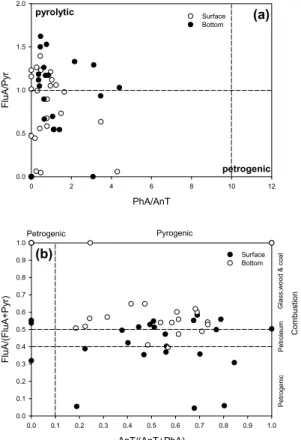
해수 내 PAHs의 조성분석을 수행한 결과, 용해도 가 높은 나프탈렌과 저분자량 PAHs가 총 PAHs의 대 부분을 차지하였다. 8월 및 11월 해수 중 PAHs의 농 도를 측정하여 Diagnostic ratio (PhA/AnT and FluA/Pyr)로 PAHs의 기원을 살펴보았다. 일반적으로 PhA/AnT이 10 이하, FluA/Pyr이 1 이상을 나타내면 연소기원이며 PhA/AnT이 10 이상, FluA/Pyr이 1 이 하를 나타낼 때 유류기원으로 분류한다(Baumard 등, 1999; Colombo 등, 1989). 이 결과에서 해수는 PhA/AnT이 모두 5 이하로 나타났고 전체 station 중 약 70%의 station에서 FluA/Pyr이 1 이상으로 조사되 었다. 따라서 해수에 포함된 PAHs는 연소기원에 가
까운 지역이 많은 것으로 나타났다(Fig. 3a). Li 등 (2006)은 AnT/(AnT+PhA)의 비율로 PAHs의 기원을 연소기원과 유류기원으로 분석하였으며 AnT/(AnT+
PhA)의 비율이 0.5 보다 작을 때 유류기원, 0.5보다 클 때 연소기원으로 분류하였다. Yunker 등(2002)은 FluA/(FluA+Pyr)의 비율로서 PAHs의 기원을 분석하 였다. FluA/(FluA+Pyr)의 비율이 0.4보다 작을 때 유 류기원으로 분류하였으며 0.4와 0.5 사이에 있을 때는 화석연료의 연소기원으로, 0.5보다 클 때는 석탄 또는 목재 등에서 기원한 것으로 분류하였다. Liu 등(2009) 은 이러한 두 가지 분류법을 종합하여 PAHs의 기원을 분석하였으며 Figure 3b는 Liu 등의 분석법을 이용하 여 PAHs의 기원을 분석한 그림이다. 이 결과에서 대
PhA/AnT
0 2 4 6 8 10 12
FluA/Pyr
0.0 0.5 1.0 1.5 2.0
Surface Bottom
petrogenic
pyrolytic (a)
AnT/(AnT+PhA)
0.0 0.1 0.2 0.3 0.4 0.5 0.6 0.7 0.8 0.9 1.0
FluA/(FluA+Pyr)
0.0 0.1 0.2 0.3 0.4 0.5 0.6 0.7 0.8 0.9 1.0
Surface Bottom
Petrogenic Pyrogenic
Glass,wood & coalPetroleumPetrogenic Combustion
(b)
Fig. 3. Analysis on origin of 16 PAHs in seawater with diagnostic ratio. (a) is relationship between phenanthrene/
anthracene and fluroranthene/pyrene, (b) is relationship between phenanthrene/(phenanthrene+anthracene) and fluroranthene/(fluroranthene+pyrene).
부분의 해수에 포함된 PAHs의 대부분이 연소기원으 로 나타났으며 연소기원 중에서도 석유계보다는 목재 나 석탄 등에서 기인한 지역이 많은 것으로 나타났다.
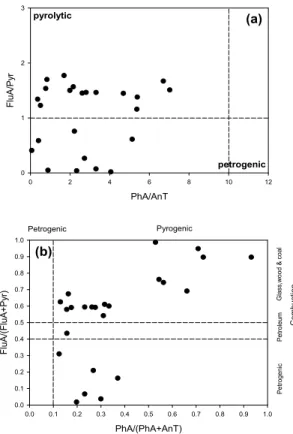
바다목장 지역은 어장이 밀집하고 공장 등의 산업시 설이 거의 없는 지역의 특성으로 판단된다. 퇴적물에 포함된 PAHs의 기원을 분석한 결과 퇴적물 PhA/AnT 이 모두 8 이하로 나타났고 약 60%의 station에서 FluA/Pyr이 1 이상으로 조사되었다 (Fig. 4a). Liu 등 의 방법을 통해 연소기원을 세분화해서 살펴본 결과 해수에 비해 퇴적물의 경우 석유계연료의 연소가 많 이 줄어든 것으로 나타났다 Fig. 4b). 이러한 결과는 석유계 연소기원의 주 물질인 선박이나 자동차연료에 서 기인한 PAHs등이 퇴적물에 잔류하기 전에 UV 또 는 해양 미생물 등에 의해서 분해됨으로서 해수에 비
PhA/AnT
0 2 4 6 8 10 12
FluA/Pyr
0 1 2 3
pyrolytic
petrogenic
(a)
PhA/(PhA+AnT)
0.0 0.1 0.2 0.3 0.4 0.5 0.6 0.7 0.8 0.9 1.0
FluA/(FluA+Pyr)
0.0 0.1 0.2 0.3 0.4 0.5 0.6 0.7 0.8 0.9 1.0
Petrogenic Pyrogenic
Glass,wood & coalPetroleumPetrogenic Combustion
(b)
Fig. 4. Analysis on origin of 16 PAHs in sediment with diagnostic ratio. (a) is relationship between phenanthrene/
anthracene and fluroranthene/pyrene, (b) is relationship between phenanthrene/(phenanthrene+anthracene) and fluroranthene/(fluroranthene+pyrene).
해 퇴적물에서 차지하는 비율이 낮은 것으로 판단된 다. 전체적으로 연소 및 유류기원을 정확히 구분하기 힘든 지역도 발견되었으며 diagnostic ratio를 나타낸 결과에서 해수와 퇴적물은 유사한 분포를 보였으나 퇴적물에 비해 해수는 pyrolytic 부분에 좀더 높은 집 적도를 보였으며 퇴적물은 연소기원과 유류기원을 판 단하기 힘든 곳이 많이 존재하여 유류기원과 연소기 원이 혼재된 형태로 판단된다. 따라서 바다목장 지역 에서는 퇴적물보다 해수에 존재하는 PAHs가 보다 연 소기원에 가까운 것으로 나타났다. 이러한 결과는 저 층 시료보다 표층시료에서 좀더 높은 PAHs의 농도를 나타낸 것이 대기에서 이동한, 즉 연소기원 PAHs가 표층 해수의 PAHs의 농도에 영향을 미친 것으로 판 단된다.
3.4. 퇴적물의 깊이에 따른 PAHs의 분포
퇴적물의 깊이에 따른 PAHs의 분포특성을 조사하 기 위하여 11월에 station 8과 10에서 직경 10 cm의 원통형 core를 이용하여 퇴적물을 채취한 후 PAHs의 농도를 조사하였다(Fig 5). Station 8과 10에서 표층은 각각 56.1 및 42.5 ng/g D.W.로 조사되었으며 저층으 로 갈수록 농도가 감소하는 경향을 보였으며 최종적 으로 station 8의 35 cm에서 21.1 ng/g D.W., station 10의 56 cm에서 24.2 ng/g D.W.로 조사되었다. Sahu
SPAH (ng/g D.W.)
0 10 20 30 40 50 60
Depth (cm)
0
10
20
30
40
50
60
S8 S10
Fig. 5. The concentration of total PAHs in St. 8 and St. 10 sediment of sublittoral zone on depth.
등(2009)이 발표한 결과에 의하면 해양에 투입된 PCBs나 PAHs등의 유기오염물을 퇴적물의 깊이에 따 라 조사하였을 때 깊이가 증가함에 따라서 농도는 감 소한다고 보고 하였다.
4. 결 론
본 연구에서는 유류오염사고 이후 안면도 지역의 해수와 퇴적물에 잔류하는 PAHs의 농도를 조사하였 다. 해수는 표층과 저층으로 나누어 분석하였는데 표 층과 저층 모두 매우 낮은 농도분포를 보였으며 해수 는 유류오염의 영향에서 회복된 것으로 판단되었다.
수온이 높은 8월이 11월 보다, 표층이 저층보다 높은 농도로 조사되었다. 퇴적물 또한 8월이 11월 보다 조 금 높게 나타났으나 그 차이는 크지 않았다. 퇴적물은 유류오염사고 이전의 농도에 비해 소량 증가한 것으 로 나타났다. 해수와 퇴적물의 PAHs의 기원을 살펴 본 결과 해수에서는 원소기원의 분포가 많았으며 일 부 퇴적물에서 원소기원과 유류기원이 혼재한 것으로 나타났다. 따라서 일부 퇴적물에서는 유류오염의 영 향이 있었으나 영향이 크지는 않은 것으로 나타났다.
퇴적물의 깊이에 따른 PAHs의 농도 분포를 살펴본 결과 깊이에 따라 농도가 감소하는 것으로 조사 되었 다. 따라서 안면도 지역은 유류사고의 영향을 직접적 으로 받은 것으로 판단되지는 않으나 어장이 밀집되 어 있는 지역인 만큼 국민 건강과 해양 자원 보호를 위해서라도 지속적으로 관찰이 필요한 것으로 사료 된다.
감사의 글
본 연구는 국립수산과학원 경상연구과제인 서해해 양환경연구(RP-2010-ME-056) 및 농특과제인 태안어 장 정밀조사 및 양식어장 복원사업의 연구비 지원에 의해 수행되었습니다.
참 고 문 헌
유영석, 조현서, 최영찬, 2007, 광양만 주변해역 표층퇴 적물에서의 다환방향족탄화수소류(PAHs)의 오염 에 관한 연구, 해양환경안전학회, 13, 9-20.
해양수산부, 2002, 씨프린스호 유류오염사고 사후관리 방안 연구, 해양수산부, 172-187.
Abrahamson, A., Brandt, I., Brunström, B., Sundt, R. C., Jørgensen, E. H., 2008, Monitoring contaminants from oil production atseaby measuring gill EROD activity in Atlantic cod (Gadus morhua), Environ.
Pollut., 153, 169-175.
Baumard, P., Budzinski, H., Garrigues, P., Dizer, H., Hansen, P., 1999, Polycyclic aromatic hydrocarbons in recent sediments and mussels (Mytilus edulis) from the Western Baltic Sea: occurrence, bioavailability and seasonal variations, Mar. Environ. Res., 47, 17-47.
Carls, M. G., Short, J. W., Payne, J., 2006, Accumulation of polycyclic aromatic hydrocarbons by Neocalanus- copepods in Port Valdez, Alaska, Mar. Pollut. Bull., 52, 1487-1489.
Colombo, J. C., Pelletier, E., Brochu, C., Khalil, M., Catoggio, J. A., 1989, Determination of hydrocarbon sources using n-alkane and polyaromatic hydrocarbon distribution indexes. Case study: Rio de la Plata Estuary, Argentina Environ. Sci. Technol., 23, 888-894.
Farrington, J. W., Goldberg, E. D., Risegrough, R. W., Martin, J. H., Bowen, V. T., 1983, US 'Mussel Watch' 1976-1978: An Overview of the Trace-metal, DDE, PCB, hydrocarbon, and artificial radionuclide data, Environ. Sci. Technol., 17, 490-496.
Ferrares, E., Andreottola, G., Oprea, I. A., 2008, Remediation of PAH-contaminated Sediments by Chemical Oxidation, J. Hazard. Materials, 152, 128-139.
Garrigues, P., Socolo, H., Marniess, M. P., 1987, Origin of polycyclic aromatic hydrocarbons in recent sediments from the continental shelf of the "Golfe de Gascogne"(Atlantic Oean) and in the Gironde estuary, J. Environ. Anal. Chem., 28, 121-131.
Henner, P., Schiavon, M., Morel, J. L., Lichtfouse, E., 1997, Polycyclic Aromatic Hydrocarbon (PAH) Occurrence and Remediation Methods, Analysis, 25, 56-59.
Hostettler, F. D., Pereira, W. E., Kvenvolden, K. A., van Green, A., Luoma, S. N., Fuller, C. C., Anima, R., 1999, A record of hydrocarbon input to San Francisco Bay as traced by biomarker profiles in
surface sediment and sediment core, Mar. Chem., 64, 115-127.
Lan, X., Wang, H., LI, R., Lin, Z., Zhang, Z., 2007, Major Elements Composition and Provenance Analysis in the Sediments of the South Yellow Sea, Ear. Sci. Front., 14, 197-203.
Law, R. J., Whinnett, J. A., 1992, Polycyclic Aromatic Hydrocarbons in mussel Tissue of Harbor Propoises (Phocoena phocona) from UK Waters, Mar. Pollut.
Bull., 24, 550-553.
Law, R. J., Kelly, C. A., Baker, K. L., Langford, K. H., Bartlett, T., 2002, Polycyclic aromatic hydrocarbons in sediments, mussels and crustacea around a former gasworks site in Shoreham-by-Sea, UK, Mar. Pollut. Bull., 44, 903-911.
Li, G., Xia, X., Yang, Z., Wang, R., Voulvoulis, N., 2006, Distribution and sources of polycyclic aromatic hydrocarbons in the middle and lower reaches of the Yellow river, China, Environ. Pollut., 144, 985-993.
Lipiatou, E., Tolosa, I., Simo, R., Bouloubassi, I., Dachs, J., Marti, S., Sicre, M.-A., Bayona, J. M., Grimalt, J. O., Saliot, A., Albaiges, J., 1997, Mass budget and dynamics of polycyclic aromatic hydrocarbons in the Mediterranean Sea, Deep-Sea Res. II, 44, 881-905.
Liu, Y., Chen, L., Huang, Q., Li W., Tang, Y., Zhao, J, 2009, Source apportionment of polycyclic aromatic hydrocarbons (PAHs) in surface sediments of the Huangpu river, Shanghai, China, Sci. Total Envion., 407, 2931-2938.
Luthy, R. G., Dzombak, D. A., Peters, C. A., Roy, S. B., Ramaswami, A., Nakles, D. V., 1994, Remediating Tar-contaminated Soils at Manufactured Gas Plant Sites, Environ. Sci. Technol., 28, 266-276.
Moon, H. B., Choi, H. G., Kim, S. S., Lee, P. Y., 2002, Accumulation and Characterization of Polycyclic Aromatic Hydrocarbons in Seafood from the Coastal Areas of Korea, J. Fish. Sci. Tech., 5, 127-135.
Moon, H,. B., Kang, S. K., Kim, H. S., Choi, M. K., 2007, Polycyclic Aromatic Hydrocarbons (PAHs) in Seawater and Marine Sediments from Mokpo Coast in Korea, J. Korea Soci. Environ. Anal., 10, 83-90.
Payne, R. J., Clayton, J. R., Kirstein, B. E., 2003,
Oil/Suspended Particulate Material Interactions and Sedimentation, Spill Sci. & Techno. Bull., 8, 201-221.
Payne, R. J., William, J., Driskell, B. J., Shor, W., Larsen, M. L., 2008, Long term monitoring for oil in the Exxon Valdez spill region, Mar. Pollut. Bull., 56, 2067-2081.
Peacock, E. E., Hampson, G. R., Nelson, R. K., Xu, L., Frysinger, G. S., Gaines, R. B., Farrington, J. W., Tripp, B. W., Reddy, C. M., 2007, The 1974 spill of the Bouchard 65 oil barge: Petroleum hydrocarbons persist in Winsor Cove salt marsh sediments, Mar.
Pollut. Bull., 54, 214-225.
Platt, H. M., Mackie, P. R., 1979, Analysis of aliphatic and aromatic hydrocarbons in Antarctic marine sediment layers, Nature, 280, 576-578.
Reddy, C. M., Quinn, J. C., 2001, The North Cape oil spill: hydrocarbons in Rhode Island coastal waters and Point Judith Pond, Mar. Environ. Res., 52.
445-461.
Sahu, S. K., Ajmal, P. Y., Pandit, G. G., Puranik, V. D., 2009, Vertical distribution of polychlorinated biphenyl congeners in sediment core from Thane Creek area of Mumbai, India, J. Hazardous Materials, 164, 1573-1579.
Taylor, L. T., Jones, D. M., 2001, Bioremediation of Coal tar PAH in Soil Using Biodiesel, Chemosphere, 44, 1131-1136.
Wild, S. R., Jones, K. C., 1995, Polynuclear Aromatic Hydrocarbons in the United Kingdom Environment:
a Preliminary Source Inventory and Budget, Environ. Pollut., 88, 91-108.
Wu, S. P., Tao, S., Xu, F. L., Dawson, R., Lan, T., Li, B.
G., Cao, J., 2005, Polycyclic aromatic hydrocarbons in dustfall in Tianjin, China, Sci. Total Environ., 345, 115-126.
Wu, Y., Zhang, J., Mi, T., Li, B., 2001, Occurrence of n-alkanes and polycyclic aromatic ydrocarbons in the core sediments of the Yellow Sea, Mar. Chem., 76, 115.
Yim, U. H., Hong, S. H., Shim, W. J., 2007, Distribution and characteristics of PAHs in sediment from the marine environment of Korea, Chemosphere, 68, 85-92.
Yunker, M. B., Macdonald, R. W., Cretney, W. J., Fowler, B. R., McLaughlin, F. A., 1993, Alkane,
terpene and polycyclic aromatic hydrocarbon geochemistry of the Mackenzie River and Mackenzie Shelf: riverine contributions to Beaufort Sea coastal sediment, Geochim. Cosmochim. Acta, 57, 3041-3061.
Yunker, M. B., Macdonald, R. W., Vingarzan, R., Mitchell, R. H., Goyette, D., Sylvestre, D., 2002, PAHs in the fraser river Basin: a critical appraisal
of PAH ratios as indicators of PAH source and composition, Org. Geochem. 33, 489-515.
Zakaria, M. P., Okuda, T., Takada, H., 2001, Polycyclic Aromatic Hydrocarbon (PAHs) and Hopanes in Stranded Tar-Ball on the Coasts Peninsular Malaysia:
Applications of Biomarkers for Identifying Sources of Oil Pollution, Mar. Poll. Bull. 42, 1357-1366.