397
Copyright © 2021 The Korean Society of Fisheries and Aquatic Science pISSN:0374-8111, eISSN:2287-8815
서 론
다환방향족탄화수소(polycyclic aromatic hydrocarbons, PAHs) 는유류유출, 자동차매연, 하수및폐수등다양한경로를통 하여연안해역에유입되어퇴적물또는수중유기체에 흡착 및축적이된다. 이러한이유로 PAHs는가공되지않은생산단 계수산물및조리된수산물에도존재할수있으며, 특히수산
물중패류는주변환경의농도보다높은농도의 PAHs를축
적하게된다(Vives et al., 2004; Oliveira Ribeiro et al., 2005;
Johnson-Restrepo et al., 2008). 패류는인간에게단백질과지 질등을공급하는주요공급원으로패류의섭취로인한 PAHs 에대한노출은흡연자와직업적으로노출된사람을제외하고
는 PAHs에인간이노출되는가장중요한경로로보고된바있
다(Guillén et al., 1997; Scherer et al., 2000; Falcó et al., 2003).
또한, 일반적인집단보다 PAHs에오염된식품을섭취한집단
에서건강에대한위해성이높았다는연구도있다(Martí-Cid
et al., 2007, 2008). 이에각국에서는식품중 PAHs에대한기 준을설정하여관리하고있으며, PAHs의성분중 benzo(a)py- rene은높은잔류성및독성이있는위해물질로국제암연구소 (IARC, 2006)에서는 group 1의인체발암물질로분류하고있 다. 특히식품중 benzo(a)pyrene의기준은우리나라에서는식 품공전에패류중의 benzo(a)pyrene이 10 µg/kg으로설정되어 있으며, EU에서는 benzo(a)pyrene이 5 µg/kg, PAHs 4종성분 (benzo(a)pyrene, benzo(a)anthracene, benzo(b)fluoranthene, chrysene)의합이 30 µg/kg으로설정되어있다. 수산물중패류 는부착성생물로이동성이거의없고서식분포가넓고긴수명 을가지므로여러오염물질의기원및실태를파악할수있는유 용한지표생물(Viarengo and Canesi, 1991)로서우리나라에서
우리나라 연안해역 생산 패류 중 다환방향족탄화수소 분석
홍도희·강은혜·윤민철·조미라·손광태·이가정*
국립수산과학원 식품위생가공과
Analysis of Polycyclic Aromatic Hydrocarbons (PAHs) in Shellfishes from Korean Coastal Area
Do Hee Hong, Eun Hye Kang, Minchul Yoon, Mi Ra Jo, Kwang Tae Son and Ka Jeong Lee*
Food Safety and Processing Research Division, National Institute of Fisheries Science, 216, Busan 46083, Korea
Polycyclic Aromatic Hydrocarbons (PAHs) were analyzed and safety evaluation was carried out in Korean coastal area. The target congeners were benzo[a]pyrene, benzo[a]anthracene, benzo[b]fluoranthene, and chrysene. The meth- od of analysis was significant. The highest PAHs 4 congener concentrations (12.2 µg/kg) was found in the mussel of Gangwon area. Comparison among the average concentration of PAHs for each congener showed that, benzo[a]
anthracene was found in mussel (0.276 µg/kg), oyster (0.463 µg/kg), ark shell clam (1.92 µg/kg), and chrysene was found in mussel (0.848 µg/kg), oyster (1.36 µg/kg), scallop (0.489 µg/kg), sea squirt (3.07 µg/kg), and ark shell clam (0.449 µg/kg). In addition, benzo[b]fluoranthene was found in mussel (0.253 µg/kg), scallop (0.244 µg/kg), and sea squirt (1.64 µg/kg). The most hazardous benzo[a]pyrene was found in mussel (0.147 µg/kg), and scallop (0.244 µg/
kg), it was not detected in the other shellfishes. However, all the PAHs levels recorded in this study did not exceed in- ternational MRLs. There was no significant difference among the PAHs concentration in shellfish based on sampling area or species. Body exposure was calculated based on PAHs concentration and intake rate. The results of this study indicated that PAHs in shellfish were within acceptable safe levels.
Keywords: Shellfishes, Bivalves, Polycyclic aromatic hydrocarbons, PAHs
*Corresponding author: Tel: +82. 51. 720. 2636 Fax: +82. 51. 720. 2619 E-mail address: [email protected]
This is an Open Access article distributed under the terms of the Creative Commons Attribution Non-Commercial Licens (http://creativecommons.org/licenses/by-nc/3.0/) which permits unrestricted non-commercial use, distribution, and reproduction in any medium, provided the original work is properly cited.
Received 28 June 2021; Revised 22 July 2021; Accepted 2 August 2021
저자 직위: 홍도희(연구원), 강은혜(연구원), 윤민철(연구사), 조미라(연구관), 손광태(연구관), 이가정(연구사)
https://doi.org/10.5657/KFAS.2021.0397
Korean J Fish Aquat Sci 54(4), 397-403, August 2021
식품으로즐겨섭취하는패류에서의 PAHs 오염농도를조사하 는것은매우의미있는것이라사료된다.
현재까지우리나라에서패류의위생관리체계는대부분수출 중심으로이루어지고있어내수공급패류에대한안전관리를 위하여수출용패류생산지정해역이외의일반해역에서생산
되는패류에대한 PAHs 잔류조사및위해도평가연구가필요
한실정이다. 따라서본연구에서는국내생산수산물중패류의 안전성확보및식품오염방지를위한기초자료를제공하여국 민보건향상에기여하고자일반해역생산패류 7종에서 PAHs 4 종을모니터링하고, 검출된 PAHs의위해평가를수행하였다.
재료 및 방법 시료 채취 및 방법
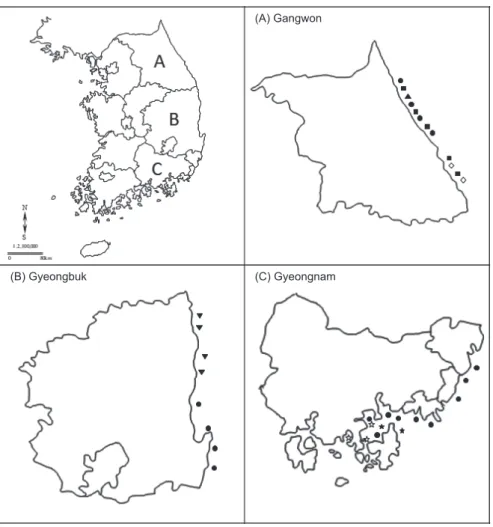
패류시료는 2018년 12월부터 2019년 1월까지매월 1회부 산, 울산, 경상남도, 경상북도, 강원도연안의총 25개소에서 채취한것을사용하였다(Fig. 1). 조사대상패류는지중해담치
(Mytilus galloprovincialis) 17개, 굴(Crassostrea gigas) 3개, 참 가리비(Patinopecten yessoensis) 5개, 떡조개(Gomphina ven- eriformis) 1개, 참전복(Nordotis discus discus) 2개, 우렁쉥이 (Halocynthia roretzi) 4개, 피조개(Scapharca broughtonii) 2개 였으며, 채취한시료는식품공전의수산물중중금속검사를위 한검체손질실무해설서(MFDS, 2014)에따라근육부또는전 체로구분해처리하고, 시험시까지 -18°C 이하에보관하였다. 시약
다환방향족탄화수소(PAHs) 표준물질 4종(benzo[a]anthra- cene, chrysene, benzo[b]fluoranthene, benzo[a]pyrene)과전 처리 시오차를보정하기 위한대체표준물질(surrogate stan- dard) chrysene-d12는 AccuStandard (New Haven, CT, USA) 에서, 전처리후의기기분석시오차를보정하기위한내부표준 물질(internal standard) 2-fluorobuphenyl은 Sigma-aldrich (St.
Louis, MO, USA)에서구입하여사용하였다. 표준물질희석, 추출, 정제용매인 n-헥산, 디클로로메탄은 GC grade (Merck,
(A) Gangwon
(B) Gyeongbuk (C) Gyeongnam
Fig. 1. Sampling stations of shellfishes from the Korean coastal area. ●, Mussel; ■, Scallop; ▲, Equilatera venus; ◇, Abalone; ▼, Sea squirt;
★, Ark shell clam; ☆, Oyster.
Darmstadt, Germany)를사용하였고, 추출액의세정을위한정 제수는 Milli-Q water purification system (Millipore, Bedford, MA, USA)에서탈이온화하여사용하였다. 또한, 정제를위한 카트리지는 Sep-Pak florisil Vac (Waters, Milford, MA, USA) 를사용하였고, 무수황산나트륨은 GR grade (Junsei, Tokyo, Japan)을사용하였다. 이외의기타시약은특급시약또는잔류 농약분석급이상을사용하였다.
다환방향족탄화수소 분석
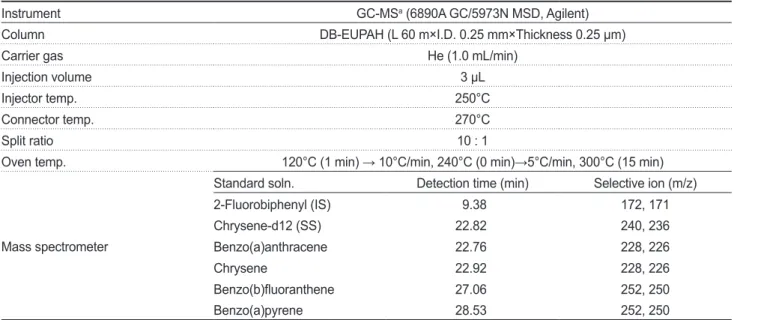
시료의전처리는식품공전(MFDS, 2019)을참고하였다. 균 질화한시료 10 g에 chrysene-d12 200 µg/kg을주입한후 1 M KOH/ethanol 100 mL를넣어 2시간동안혼합하였다. 반응시 킨혼합액은 n-헥산 100 mL를이용하여 2회추출하였다. 추출 액은정제수 100 mL로총 3회세정후무수황산나트륨을이 용하여수분을제거하고, 질소농축기(EYELA, Tokyo, Japan) 를이용하여약 2 mL로농축한다음 Sep-pak florisil Vac 카트 리지에통과시켜정제하였다. 이때카트리지는디클로로메탄 10 mL와 n-헥산 20 mL로활성화시켰으며, 이후 n-헥산 10 mL, n-헥산:디클로로메탄(3:1) 8 mL, 디클로로메탄 6 mL 순 으로유기용매를흘려용출하였다. 용출액은질소농축기로 1 mL까지농축한다음 2-fluorobiphenyl 200 µg/kg을넣어시험 용액으로하였다. GC-MS 기기분석조건은 Table 1과같다. 다 환방향족탄화수소의정량분석을위한검량선은각각의표준물 질을 n-헥산에녹여 100 µg/kg의 stock solution을조제하고동 일용매로희석하여 0.1, 0.5, 1.0, 2.5, 5.0, 10.0 µg/kg의농도로 조제한후이들표준물질을 3 µL씩기기에주입하여얻은크로 마토그램상의피크의면적을기준으로각성분별표준검량선을 작성하여다환방향족탄화수소를정량하였다.
인체노출량 산정을 통한 위해평가
위해평가는본연구에서도출된패류의 PAHs 농도와패류섭 취량으로부터인체노출량을산출하여유해물질의인체노출안 전기준설정을위한용량반응평가연구(MFDS, 2016) 및유 럽식품안전청(EFSA, 2008)의인체안전기준과비교하여수행 하였다.
만성인체노출량= ∑i=1n Ci×IRi BW Ci, 패류 i에함유된해당 PAHs의잔류량 IRi, 패류 i의섭취량
BW, 체중
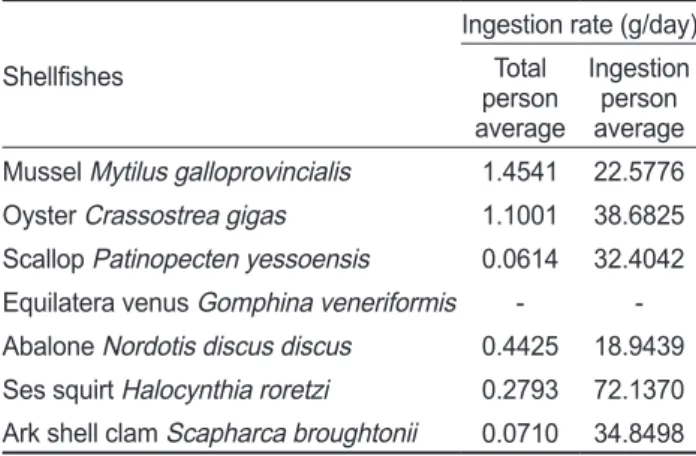
패류섭취량은국민건강영양조사(KHIDI, 2016)의원시자료 를이용하여산정하였고, 영양조사중식품섭취조사의 3차식품 코드명을기준으로각패류의개인별 24시간회상조사자료를 추출하여영양조사가중치가적용된가중평균을산출하였다 (Table 4). 또한, 인체노출량은국민건강영양조사의전체조사 자에대한가중평균과섭취자만을대상으로한가중평균두가 지경우에대해서각각산출하였다. 체중은화학물질위해성평 가의구체적방법등에관한규정(NIER, 2020) 중위해성평가 를위한인체노출계수에수록된 64.2 kg을적용하였다.
결과 및 고찰
분석방법의 유효성 검증
본연구의분석결과는해양환경공정시험법(MOF, 2020) 및 CODEX alimentarius commission (2008)의기준에따라검
Table 1. GC-MS operating conditions for the analysis of polycyclinc aromatic hydrocarbons (PAHs)
Instrument GC-MSa (6890A GC/5973N MSD, Agilent)
Column DB-EUPAH (L 60 m×I.D. 0.25 mm×Thickness 0.25 µm)
Carrier gas He (1.0 mL/min)
Injection volume 3 µL
Injector temp. 250°C
Connector temp. 270°C
Split ratio 10 : 1
Oven temp. 120°C (1 min) → 10°C/min, 240°C (0 min)→5°C/min, 300°C (15 min)
Mass spectrometer
Standard soln. Detection time (min) Selective ion (m/z)
2-Fluorobiphenyl (IS) 9.38 172, 171
Chrysene-d12 (SS) 22.82 240, 236
Benzo(a)anthracene 22.76 228, 226
Chrysene 22.92 228, 226
Benzo(b)fluoranthene 27.06 252, 250
Benzo(a)pyrene 28.53 252, 250
aGC-MS, gas chromatograph-mass spectrometer.
정곡선(직선성), 검출한계(limit of detection, LOD), 정량한계 (limit of quantitation, LOQ), 바탕시료, 첨가시료(정확도및정 밀도), 대체표준물질을이용한회수율등으로유효성을검증하 였다. 다환방향족탄화수소 4종(benzo[a]anthracene, chrysene, benzo[b]fluoranthene, benzo[a]pyrene)의표준물질을각각희 석하여만든단계별표준용액을분석하여얻은검정곡선의결정 계수(R2)는 benzo[a]anthracene은 0.9993, chrysene은 0.9996, benzo[b]fluoranthene은 0.9994, benzo[a]pyrene은 0.9996이 었다. 시험방법의유효성검증결과는 table 2에나타내었다. 식 품공전(MFDS, 2019)에규정된수산물중 benzo[a]pyrene의 정량한계인 0.9 µg/kg 부근의농도로시료에표준물질 0.1 µg/
kg을주입하여준비하고, 7회분석하여구한농도의표준편차
에 3.14를곱한값을 LOD로, 10을곱한값을 LOQ로결정하 였다. 본분석법에서 LOD는 0.222-0.283 µg/kg 범위, LOQ는
0.706-0.901 µg/kg 범위로나타났다. 또한, 이전에 PAHs에오 염되지않은것으로확인된바탕시료를준비하여시료와동일 한과정을거쳐분석하여시험과정의오염유무를파악한결과 시험에영향을미치지않는것으로나타났다. 시료에 10 µg/kg 농도의각각의표준물질을첨가한후 7회분석하여대상물질의 정확도및정밀도를산출하였다. 그결과, 정확도는 97.3-110%
범위, 정밀도는 2.97-4.00% 범위로매우유의미한결과를나타 내었다. CODEX alimentarius commission (2008)에서는첨가 한표준물질의농도가 0.1-10 µg/g 범위에서는 80-110%, 0.01 µg/g에서는 60-115%, 0.001 µg/g에서는 40-120%의정확성을 요구하고있는데, 본연구에서의정확도는 CODEX 기준을만 족하였다. 한편, 시료전처리전시료마다주입한대체표준물질 인 chrysene-d12의회수율은 61.2-108% 범위로우리나라의해 양환경공정시험법에규정된회수율 60-130%의범위를만족하
Table 2. Results of accuracy, precision, LOD, LOQ and recovery of the method Analyte Fortified Samples
(μg/kg)a Experimental Concentration±RSDb
(μg/kg) Accuracy
(%) Precision
(%) LODc
(μg/kg) LOQd
(μg/kg) Recoverye (%)
Benzo[a]anthracene 10 11.0 ± 0.327 110 2.97 0.257 0.819 -
Chrysene 10 10.2 ± 0.318 102 3.11 0.241 0.769 -
Benzo[b]fluoranthene 10 9.92 ± 0.397 99.2 4.00 0.283 0.901 -
Benzo[a]pyrene 10 9.73 ± 0.320 97.3 3.29 0.222 0.706 -
Chrysene-d12 - - - - - - 61.2-108
an=7 replicate sample. bRSD, related standard deviation. cLOD, limits of detection. dLOQ, limits of quantitation. en=34 replicate sample.
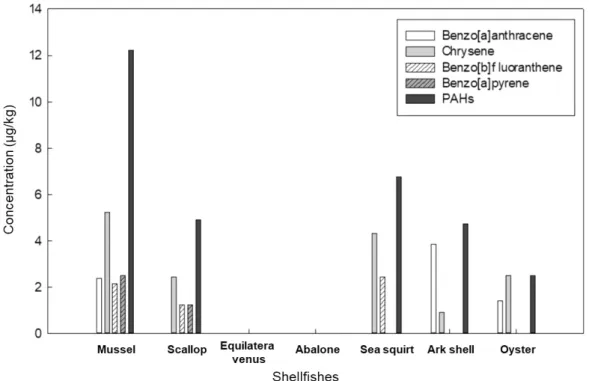
Fig. 2. Comparison of PAHs concentrations in shellfish samples from Korean coastal area. PAHs, polycyclic aromatic hydrocarbons.
여본시험방법은유효성이있는것으로확인되었다. 패류 중 다환방향족탄화수소 모니터링
본연구에서조사한패류는지중해담치 17개, 굴 3개, 참가리
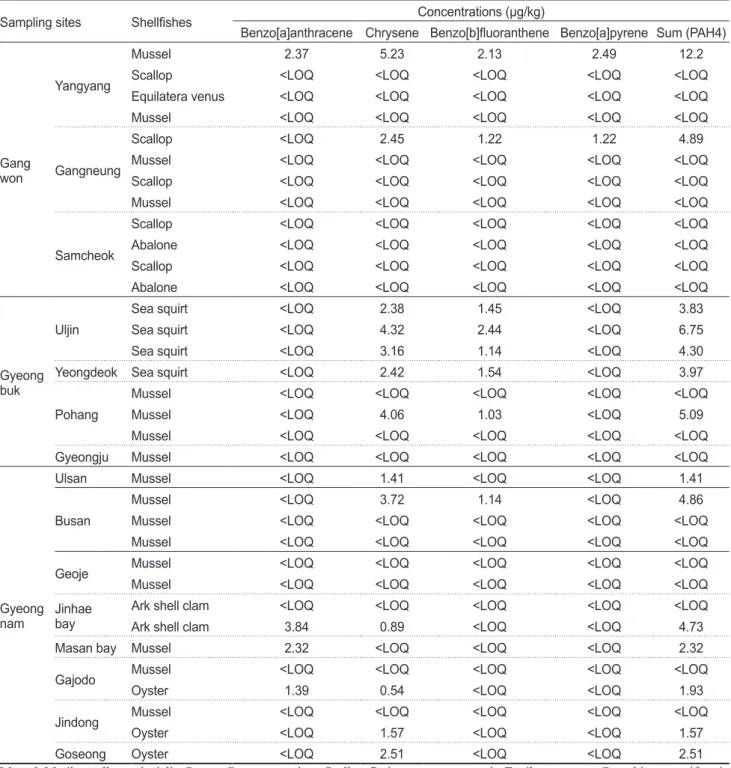
비 5개, 떡조개 1개, 참전복 2개, 우렁쉥이 4개, 피조개 2개였 으며, 총 34개의시료에대한패류별 PAHs 분석결과를 Fig. 2 에나타내었다. 모든종에서 4종 PAHs의합의평균농도를비 교하였을때우렁쉥이가 4.71 µg/kg로가장높았으며, 피조개
Table 3. Concentrations of PAHs (μg/kg) in shellfishes collected from Korean coastal areas.
Sampling sites Shellfishes Concentrations (μg/kg)
Benzo[a]anthracene Chrysene Benzo[b]fluoranthene Benzo[a]pyrene Sum (PAH4)
Gangwon
Yangyang
Mussel 2.37 5.23 2.13 2.49 12.2
Scallop <LOQ <LOQ <LOQ <LOQ <LOQ
Equilatera venus <LOQ <LOQ <LOQ <LOQ <LOQ
Mussel <LOQ <LOQ <LOQ <LOQ <LOQ
Gangneung
Scallop <LOQ 2.45 1.22 1.22 4.89
Mussel <LOQ <LOQ <LOQ <LOQ <LOQ
Scallop <LOQ <LOQ <LOQ <LOQ <LOQ
Mussel <LOQ <LOQ <LOQ <LOQ <LOQ
Samcheok
Scallop <LOQ <LOQ <LOQ <LOQ <LOQ
Abalone <LOQ <LOQ <LOQ <LOQ <LOQ
Scallop <LOQ <LOQ <LOQ <LOQ <LOQ
Abalone <LOQ <LOQ <LOQ <LOQ <LOQ
Gyeong buk
Uljin
Sea squirt <LOQ 2.38 1.45 <LOQ 3.83
Sea squirt <LOQ 4.32 2.44 <LOQ 6.75
Sea squirt <LOQ 3.16 1.14 <LOQ 4.30
Yeongdeok Sea squirt <LOQ 2.42 1.54 <LOQ 3.97
Pohang
Mussel <LOQ <LOQ <LOQ <LOQ <LOQ
Mussel <LOQ 4.06 1.03 <LOQ 5.09
Mussel <LOQ <LOQ <LOQ <LOQ <LOQ
Gyeongju Mussel <LOQ <LOQ <LOQ <LOQ <LOQ
Gyeong nam
Ulsan Mussel <LOQ 1.41 <LOQ <LOQ 1.41
Busan
Mussel <LOQ 3.72 1.14 <LOQ 4.86
Mussel <LOQ <LOQ <LOQ <LOQ <LOQ
Mussel <LOQ <LOQ <LOQ <LOQ <LOQ
Geoje Mussel <LOQ <LOQ <LOQ <LOQ <LOQ
Mussel <LOQ <LOQ <LOQ <LOQ <LOQ
Jinhae
bay Ark shell clam <LOQ <LOQ <LOQ <LOQ <LOQ
Ark shell clam 3.84 0.89 <LOQ <LOQ 4.73
Masan bay Mussel 2.32 <LOQ <LOQ <LOQ 2.32
Gajodo Mussel <LOQ <LOQ <LOQ <LOQ <LOQ
Oyster 1.39 0.54 <LOQ <LOQ 1.93
Jindong Mussel <LOQ <LOQ <LOQ <LOQ <LOQ
Oyster <LOQ 1.57 <LOQ <LOQ 1.57
Goseong Oyster <LOQ 2.51 <LOQ <LOQ 2.51
Mussel Mytilus galloprovincialis; Oyster Crassostrea gigas; Scallop Patinopecten yessoensis; Equilatera venus Gomphina veneriformis;
Abalone Nordotis discus discus; Sea squirt Halocynthia roretzi; Ark shell clam Scapharca broughtonii; PAHs, polycyclic aromatic hydro- carbons; LOQ, limit of quantitation.
(2.37 µg/kg), 굴(1.823 µg/kg), 지중해담치(1.52 µg/kg), 가리 비(0.978 µg/kg) 순으로나타났고, 떡조개와참전복에서는정 량한계이하로검출되지 않았다. 한편, PAHs 각성분별로평 균농도를비교하여보았을때, benzo[a]anthracene은지중해 담치(0.276 µg/kg), 굴(0.463 µg/kg), 피조개(1.92 µg/kg) 순으 로검출되었고, chrysene은지중해담치(0.848 µg/kg), 굴(1.36 µg/kg), 참가리비(0.489 µg/kg), 우렁쉥이(3.07 µg/kg), 피조개 (0.449 µg/kg) 순으로검출되었다. 또한, benzo[b]fluoranthene 은지중해담치(0.253 µg/kg), 참가리비(0.244 µg/kg), 우렁쉥이 (1.64 µg/kg) 순으로검출되었고, 위해성이가장높은 benzo[a]
pyrene은지중해담치(0.147 µg/kg), 참가리비(0.244 µg/kg) 순 이었으며, 다른패류에서는검출되지않았다.
본연구에서패류를채취한해역에서검출된결과를비교하여 Table 3에나타내었다. 지역별로검출된시료와검출되지않은 시료가모두발견되었고, 동일한지역에서도다양한농도로검 출되어지역별로유의한차이는없는것으로확인되었으며, 이 결과는지역별차이가아닌시료의개별차이인것으로사료된 다. 한편, 국내일반해역에서생산된패류의안전성평가를위 하여국내·외기준과본연구결과를비교하였다. 본연구의패 류에서검출된 benzo[a]pyrene의최대농도는강원도양양에 서채취한진주담치에서 2.49 µg/kg으로국내및 EU의기준보 다는낮았고, 4종 PAHs의합은최대 12.2 µg/kg으로검출되어 EU의기준인 30 µg/kg 이하의수준인것으로나타났다. 인체 노출량 산정을 통한 위해평가
인체노출량은국민건강영양조사(KHIDI, 2016)의전체조사 자에대한가중평균과섭취자만을대상으로한가중평균두가 지경우에대하여각각산출하고그결과는 Table 5에나타내었 다. 전체조사자에대한인체노출량은섭취를하지않은경우도 포함된평균값이므로실제섭취자에대한영향을알아보기위 하여본조사에서는섭취자만을대상으로한인체노출량도추 가로산출하였다. 국민건강영양조사(KHIDI, 2016)의조사자 전체에대한인체노출량은각 PAHs 물질별로합계를나타내었 으나섭취자만을대상으로한경우는모집단이서로상이하여 Table 4. Ingestion rate (g/day) of shellfishes based on national food
and nutrition statistics
Shellfishes
Ingestion rate (g/day) Total
person average
Ingestion person average Mussel Mytilus galloprovincialis 1.4541 22.5776 Oyster Crassostrea gigas 1.1001 38.6825 Scallop Patinopecten yessoensis 0.0614 32.4042 Equilatera venus Gomphina veneriformis - - Abalone Nordotis discus discus 0.4425 18.9439 Ses squirt Halocynthia roretzi 0.2793 72.1370 Ark shell clam Scapharca broughtonii 0.0710 34.8498
Table 5. Exposure assessment of PAHs in shellfishes
Shellfishes Acceptable daily intake (mg/kg body weight)
Benzo[a]anthracene Chrysene Benzo[b]fluoranthene Benzo[a]pyrene Sum (PAH4)
Total person average
Mussel 6.25×10⁻⁹ 1.92×10⁻⁸ 5.73×10⁻⁹ 3.33×10⁻⁹ 3.44×10⁻⁸
Oyster 7.93×10⁻⁹ 2.33×10⁻⁹ - - 3.12×10⁻⁸
Scallop - 4.68×10⁻⁹ 2.33×10⁻⁹ 2.33×10⁻⁹ 9.35×10⁻¹⁰
Equilatera
venus - - - - -
Abalone - - - - -
Ses squirt - 2.12×10⁻⁸ 1.13×10⁻⁸ - 3.25×10⁻⁸
Ark shell clam 2.12×10⁻⁹ 4.97×10⁻¹⁰ - - 2.62×10⁻⁹
Ingestion person average
Mussel 9.71×10⁻⁸ 2.98×10⁻⁷ 8.9×10⁻⁸ 5.17×10⁻⁸ 5.35 10-7
Oyster 2.79×10⁻⁷ 8.19×10⁻⁷ - - 1.1×10⁻⁶
Scallop - 2.47×10⁻⁷ 1.23×10⁻⁷ 1.23×10⁻⁷ 4.94×10⁻⁷
Equilatera
venus - - - - -
Abalone - - - - -
Ses squirt - 3.45×10⁻⁶ 1.84×10⁻⁶ - 5.29×10⁻⁶
Ark shell clam 1.04×10⁻⁶ 2.44×10⁻⁷ - - 1.29×10⁻⁶
Mussel Mytilus galloprovincialis; Oyster Crassostrea gigas; Scallop Patinopecten yessoensis; Equilatera venus Gomphina veneriformis;
Abalone Nordotis discus discus; Sea squirt Halocynthia roretzi; Ark shell clam Scapharca broughtonii; PAHs, polycyclic aromatic hydro- carbons.
인체노출량의합계는산출하지않았다.
PAHs의 인체안전기준은 benzo[a]pyrene이 0.07 mg/kg b.w./d (BMDL10)이고, 4종 PAHs의합은 0.34 mg/kg b.w./d (BMDL10)이다. 본연구에서의 PAHs의인체노출량은조사자 전체및섭취자대상의모든경우에서인체안전기준미만으로
패류섭취로인한 PAHs의위해도는허용가능한수준이었다.
본 연구에서의분석방법은유의성이 있어 PAHs 검출에유 효한것으로판단되었다. 또한, 국내일반해역생산패류 중의 PAHs 분석결과는국내외기준보다낮은수준이었고, 패류섭
취량및 PAHs 검출농도를이용하여산출한인체노출량역시
인체안전기준을만족하였다. 이결과는일반해역생산패류에
함유된 PAHs에대한기초자료및안전한수산물공급을위한
정책자료로활용가능할것이라사료된다. 그러나, 국내외에서 위해물질에대한관심이고조되고있고, 특히 PAHs는환경에 의한비의도적인오염을통해수산물을오염시킬가능성이있 으므로생산단계수산물에대한지속적인모니터링이필요할 것으로사료된다.
사 사
이논문은 2021년도국립수산과학원수산과학연구사업수출
패류생산해역및수산물위생조사(R2021060)의지원으로수 행된연구이며연구비지원에감사드립니다.
References
CODEX alimentarius commission. 2008. Report of the twen- ty-ninth session of the CODEX committee on methods of analysis and sampling. Geneva, Switzerland, 31-33.
EFSA (European Food Safety Authority). 2008. Polycyclic aro- matic hydrocarbons in food sicientific opinion of the panel on contaminants in the food chain. EFSA, Parma, Italy.
Falcó G, Domingo JL, Llobet JM, Teixidó A, Casas C and Mül- ler L. 2003. Polycyclic aromatic hydrocarbons in foods:
Human exposure through the diet in Catalonia, Spain. J Food Prot 66, 2325-2331. https://doi.org/10.4315/0362- 028X-66.12.2325.
Guillén MD, Sopelana DP and Partearroyo MA. 1997. Food as a source of polycyclic aromatic carcinogens. Rev Environ Health 12, 133-146. https://doi.org/10.1515/
reveh.1997.12.3.133.
IARC (International Agency for Research on Cancer). 2006.
Polynuclear aromatic compoundsPart 1: Chemical, environ- mental and experimental data. Vol. 21. IARC, Lyon, France, 211-224.
Johnson-Restrepo B, OliveropVerbel J, Lu S, Guette-Fernández J, Baldiris-Avila R, O’Byrne-Hoyos I, Aldous KM, Addink R and Kannan K. 2008. Polycyclic aromatic hydrocarbons and their hydroxylated metabolites in fish bile and sediments from coastal waters of Colombia. Environ Pollut 151, 452-
459. https://doi.org/10.1016/j.envpol.2007.04.011.
KHIDI (Korea Health Industry Development Institute). 2016.
National food and nutrition statistics I: based on 2013 Korea national health and nutrition examination survey. Retrieved from http://www. Khidi.or.kr/nutristat on Oct 10, 2019.
Martí-Cid R, Bocio A, Llobet JM and Domingo JL. 2007. Intake of chemical contaminants through fish and seafood con- sumption by children of Catalonia, Spain: health risks. Food Chem Toxicol 45, 1968-1974. https://doi.org/10.1016/j.
fct.2007.04.014.
Martí-Cid R, Llobet JM, Castell V and Domingo JL. 2008. Evo- lution of the dietary exposure to polycyclic aromatic hydro- carbons in Catalonia, Spain. Food Chem Toxicol 46, 3163- 3171. https://doi.org/10.1016/j.fct.2008.07.002.
MFDS (Ministry of Food and Drug Safety). 2019. Food code.
Chapter 8. General analytical method (Benzo[a]pyrene).
Retrieved from http://www.foodsafetykorea.go.kr/food- code/01_03.jsp?idx=12070 on Jul 19, 2021.
MFDS (Ministry of Food and Drug Safety). 2016. Study on dose response evaluation of health-based guidance values for food contaminants. MFDS, Osong, Korea, 71.
MFDS (Ministry of Food and Drug Safety). 2014. Food code.
Retrieved from http://www.foodsafetykorea.go.kr/portal/
safefoodlife/food/foodRvlv/foodRvlv.do on Sep 3, 2018.
MOF (Ministry of Oceans and Fisheries). 2020. Korean stan- dard method for marine environment, MOF notification No. 2020-143. Retrieved from http://www.mof.go.kr/ar- ticle/view.do?menuKey=888&boardKey=35&articleK ey=35375 on Sep 4, 2020.
NIER (National Institue of Environmental Research). 2020.
NIER notification No. 2020-1. http://www.nier.go.kr/NIER/
cop/bbs/selectNoLoginBoardList.do# on Jun 1, 2021.
Oliveira Ribeiro CA, Vollaire Y, Sanchez-Chardi A and Roche H.
2005. Bioaccumulation and effects of organochlorine pesti- cides, PAH and haevy metals in the eel Anguilla Anguilla at the Camargue Nature Reserve, France. Aquat Toxicol 74, 53-69. https://doi.org/10.1016/j.aquatox.2005.04.008.
Scherer G, Frank S, Riedel K, Meger-Kossien I and Renner T.
2000. Biomonitoring of exposure to polycyclic aromatic hy- drocarbons of nonoccupationally exposed persons. Cancer Epidemiol Biomark Prev 9, 373-380.
Viarengo A and Canesi L. 1991. Mussels as biological indi- cators of pollution. Aquaculture 94, 225-243. https://doi.
org/10.1016/0044-8486(91)90120-V.
Vives I, Grimalt JO, Fernández P and Rosseland B. 2004. Poly- cyclic aromatic hydrocarbons in fish from remote and high mountain lakes in Europe and Greenland. Sci Total Environ 324, 67-77. https://doi.org/10.1016/j.scitotenv.2003.10.026.