소변 중 다환방향족탄화수소 대사체의 분석법 확립 및 교차분석
박나연*·전중대*·구혜령**·김정환***·이은희****·이경무*****·문철진**·고영림*
†*을지대학교 보건환경안전학과
**녹십자의료재단 대사의학연구소
***을지대학교 식품산업외식학과
****극동대학교 보건과학대학원
*****한국방송통신대학교 환경보건학과
Method Development and Cross Validation of Analysis of Hydroxylated Polycyclic Aromatic Hydrocarbons (OH-PAHs) in Human Urine
Na-Youn Park *, Jung-Dae Jeon*, Hyeryeong Koo**, Jung Hoan Kim***, Eun-Hee Lee****, Kyungmu Lee*****, Cheoljin Mun**, and Younglim Kho*
†*Department of Health, Environment & Safety, Eulji University
**Institute of Metabolism, Green Cross Laboratories
***Food Technology & Service, Eulji University
****Graduate School of Health Science, Far-East University
*****Department of Environmental Health, Korea National Open University, Korea
ABSTRACTS
Objectives: This study was performed to evaluate the analytical method for PAH metabolites in human urine using enzyme hydrolysis and solid-phase extraction coupled with LC-(ESI)-MS/MS technique.
Methods: We employed HPLC tandem mass spectrometry techniques with appropriate pre-treatment for analysis of 16 OH-PAHs in human urine. Samples were hydrolysis by β-flucuronidase/Aryl sulfatase, and target compounds were extracted by solid-phase extraction with a strata-x cartridge. Cross-validation was performed between Eulji University and Green Cross laboratories with 200 human urine samples.
Results: The accuracies were between 90.3% and 118.8%, and precisions (relative standard deviations) were lower than 10%. The linearity obtained was satisfying for the 16 OH-PAH compounds, with a coefficient of determination (r
2) higher than 0.99. The results of cross-validation at the two organizations were compared by ICC (interclass correlation coefficient) values. The cross-validation results were excellent or good for all compounds.
Conclusion: An analytical method was validated for low nanogram levels of 16 OH-PAHs in human urine. Also, satisfying results were obtained for method validation such as accuracy, precision and ICC of cross-validation.
Keywords: Cross validation, LC-MS/MS, OH-PAHs, urine
I. 서 론
다환방향족탄화수소(PAHs, polycyclic aromatic
hydrocarbons) 란 2개 이상의 벤젠고리로 형성된 방 향족탄화수소를 말한다.
1)PAHs 는 고기를 굽거나 석 탄, 가스 등의 유기물질의 불완전연소에 의해 인위
†
Corresponding author: Department of Health, Environment and Safety, Eulji University, Seongnam, 461-713, Korea, Tel: +82-31-740-7142, Fax: +82-31-740-7327, E-mail: [email protected]
Received: 9 July 2015, Revised: 14 October 2015, Accepted: 15 October 2015
원 저 Original articles적으로 생성되거나, 산불, 화산 폭발 등 자연적인 현 상에 의해 발생하여 대기 중으로 방출된다.
2)PAHs 에 노출되면 생식, 발달, 혈액, 심장 혈관, 신 경 및 면역계통에 문제가 생길 뿐만 아니라 암이 발 생할 가능성이 있고, 또한 최근 연구에 따르면 태아 에서 높은 PAHs 수준은 태아의 불안, 우울 및 주의 력 문제와 연관 될 수 있다.
3)PAHs 의 생체 내 변화 는 cytochrome P450 효소에 의해 가수분해 반응이 복잡하고 빠르게 일어나고(Phase I), glucuronide 또 는 황산염 접합체로 변환된다(phase II).
4)이렇게 대 사된 몇몇의 PAHs 대사산물은 난분해성 탄화수소 성분으로, 암 또는 돌연변이를 유발하는 등 독성이 강한 물질로 알려져 있다. 세계보건기구(WHO, World Health Organization) 산하 국제암연구센터(IARC, International Agency for Research on Cancer) 는 벤 조피렌 (benzo[a]pyrene)을 포함하여 PAHs 15종을 Group 1( 인간 발암물질)로 지정하였다.
5)대표적인 발 암성 PAHs인 벤조피렌은 인체 내 잔류성과 독성이 강하며, 내분비계장애 추정물질인 동시에 발암가능 물질로써 거의 모든 실험동물에서 암이 유발되는 것 으로 확인되었다.
6)코울타르와 같이 PAHs 발생 작업장에서는 고농도 의 직업적인 노출이 가능하며 비직업적으로는 식이 (diet), 흡연, 대기오염 등이 PAHs의 노출원으로 알 려져 있다.
7)미국, 유럽 등 선진국에서는 매년 국민 들의 PAHs 노출 수준을 소변 중 대사체 분석으로 파악하고 있으나 우리나라에서는 특정 직업적 노출 외에 일반인들의 다양한 PAHs 노출수준은 보고된 바가 없다.
소변 중 OH-PAHs를 분석하기 위해서는 주로 HPLC/FD
8-11), LC-MS
12-18), GC/FID
19)또는 GC-MS
20)
를 이용하는데, HPLC 형광검출기를 이용하여 다 양한 PAHs 대사체를 측정하기 위해서는 분석시간이 상당히 길어질 수 있으며, GC/FID나 GC-MS를 이 용할 경우에는 휘발성 증가를 위한 유도체화 과정이 필요하다. LC-MS, LC-MS/MS를 이용한 분석법의 경우, naphthalene, phenanthrene, pyrene 등 벤젠고 리가 2~4개인 PAHs의 대사체를 측정하는데 적용되 고 있는데, 이보다 벤젠고리가 많은 발암성 PAHs 대사체를 함께 분석할 수 있도록 개발된다면 적은 양의 시료를 이용하여 PAHs에 대한 노출 수준을 신 속하고 정확하게 분석할 수 있는 좋은 방법이 될 것
이다.
소변에서 배출되는 OH-PAHs는 glucuronide나 sulfate와의 결합된 형태로 배출되는데, 이러한 결합 을 깨기 위해서 효소(glucuronidase/arlsulfatase)를 이 용한 가수분해법이 일반적으로 이용되어왔다. 가수 분해 이후에 소변시료 중의 OH-PAHs의 추출을 위 하여 메탄올이나 아세토니트릴을 혼합하여 고형물질 을 제거하는 방법과,
14)액체-액체 추출(liquid liquid extraction) 또는 고체상추출(solid phase extraction) 을 이용하는데, 액체-액체 추출은 주로 펜탄,
19)펜탄 :톨루엔(80:20) 혼합액
13)등을 사용한다. 고체상추출 법은 방해물질의 제거와 농축을 위한 전처리로써, HPLC 형광검출기 분석과는 달리 질량분석기의 검 출기에 소변과 같이 다양한 오염물질이 혼재된 시료 를 직접 주입할 수는 없기 때문에 질량분석기를 이 용할 경우에 자주 사용된다.
12,16-18)이에 본 연구는 한국인의 성인 및 어린이 4,000명 을 대상으로 소변 중 OH-PAHs 분석법 마련을 위해 고체상추출법 통해 전처리하고, LC-MS/MS를 이용 하여 OH-PAHs 16종을 동시에 분석하는 방법을 개 발하였다. 또한 새로운 분석법의 반복성, 재현성, 견 고성을 평가하기 위해 2개 기관(을지대, 녹십자의료 재단)에서 교차분석을 실시하였다.
II. 재료 및 방법 1. 분석 대상 물질
소변 중 OH-PAHs 분석에 사용된 16종의 표준물
질 중 1-Napthol (1-Na)와 2-Napthol (2-Na)은 Fluka
(Buchs, Switzerland)에서, 1-Hydroxyphenanthrene
(1-OH-Phe), 4-Hydroxyphenanthrene (4-OH-Phe),
3-Hydroxyfluorene (3-OH-Flu) 은 Cambridge Isotope
Laboratories (Andover, MA, USA) 에서 구입하였
고, 2-Hydroxyphenanthrene (2-OH-Phe), 3-Hydro-
xyphenanthrene (3-OH-Phe), 3-Hydroxyfluoranthene
(3-OH-Fluoran), 1-Hydroxypyrene (1-OHP), 6-
Hydroxychrysene (6-OH-Chr), 3-Hydroxybenzo[a]-
anthracene (3-OH-BaA), 3-Hydroxybenzo[a]pyrene
(3-OH-BaP), 3-Hydroxybenzo[j]fluoranthene (3-
OH-BjF), 3-hydroxydibenzo[a,h]anthracene (3-OH-
DBA) 은 Midwest Research Institute (Kansas City,
MO, USA), 9-Hydroxyphenanthrene (9-OH-Phe), 2-
Hydroxyfluorene (2-OH-Flu) 는 Aldrich (Milwawkee, WI, USA) 에서 각각 구입하여 사용하였다. 내부표준물 질 (IS, Internal Standard)로 사용된 6종은 1-Naphthol- 2,3,4,5,6,7,8-d
7(1-Na-d
7) 은 ISOTEC (Miamisburg, OH, USA)에서 구입하였으며, 1-Hydroxy[
13C
6]Pyrene (
13C
6-1-OHP), 1-Hydroxy[
13C
6]benzo[a]anthracene (
13C
6-1-OH-BaA), 3-Hydroxy[
13C
6]chrysene (
13C
6- 3-OH-Chr) 은 Midwest Research Institute에서, 2- Hydroxy[
13C
6]fluorene (
13C
6-2-OH-Flu), 3-Hydroxy- [
13C
6]phenanthrene (
13C
6-3-OH-Phe)은 Cambridge Isotope Laboratories 에서 각각 구입하여 사용하였다.
소변의 글루크로나이드 결합을 가수분해하기 위한 효소 β-glucoronidase/aryl sulfatase는 Sigma Aldrich (St Louis, MO, USA), 고체상 추출에서 사용되는 Starata-X 카트리지는 phenomenex (Torrance, CA, USA) 에서 구입하였다. 전처리와 HPLC 이동상에 사 용되는 메탄올과 에틸아세테이트는 JT Baker (Avantor Performance Mate- rials, Center Valley, USA), 증류 수는 Burdick & Jackson (Muskegon, MI, USA) 사 에서 구입하여 사용하였다.
2. 전처리 방법
본 연구에서 확립한 PAHs 대사체 분석법은 Onyemauwa 등
16)이 개발한 방법을 일부 변형하여 수행되었다. 분석 대상 물질을 2~4개 벤젠고리보다 큰 물질(3-OH-BjF 등)을 추가하고 전처리에 이용된 소변시료의 양도 1 ml로 축소한 후, 전처리 방법과 기기분석조건을 확립하였으며 구체적인 내용은 다음 과 같다.
우선, 소변에 포함된 OH-PAHs 대부분 Glucuronide 및 Sulfate와 결합하고 있으므로 이 결합을 끊어주 기 위하여 효소 (β-glucuronidase/Ary sulfatase)를 이 용한 가수분해반응을 진행하였다. 소변 1 ml를 1.5 ml 원심분리관에 넣고 효소 10 μl, IS 혼합용액 20 μl, 1M HCl 30 μl를 넣고 2분간 혼합한 후 14시간동안 37
oC로 맞춰진 incubator에서 반응시켰다.
효소에 의한 가수분해가 완료된 시료는 세척과 농축 을 위해 Strata-X 카트리지 (1 cc/30 mg, Phenomenex) 를 이용한 고체상추출 (solid phase extraction)을 실 시하였다. 우선 2 ml 메탄올과 2 ml 초순수로 카트 리지를 활성화하고, 2 ml 초순수와 2 ml 50% 메탄 올로 세척한 후 3 ml에틸아세테이트로 용출시켰다.
추출된 에틸아세테이트 용액은 원심농축기 (Speed- Vac) 를 이용하여 진공상태에서 40
oC 로 가열하며 완 전히 건조시키고 여기에 0.3% 암모니아 용액이 첨 가된 아세토니트릴 100 μl를 첨가하여 용매 재조정 하여 200 μl vial에 넣고 LC-MS/MS 시스템에서 정 량분석하였다.
검량선 작성을 위하여 소변을 고체상추출 카트리 지에 통과시킨 공시료 (blank urine)에 표준용액을 첨가하여 0.01, 0.05, 0.1, 0.2, 0.5, 1, 5, 10, 30 ng/
ml 농도의 검정곡선 용액을 제조하고 시료를 처리 하는 방법과 같이 전처리하여 분석하였다. 1-Na와 2-Na 의 검량선 범위는 0.01~30 ng/ml 였으며, 다른 OH-PAHs 14 종의 검량선의 범위는 0.01~10 ng/ml 로 설정하였다.
3. 기기분석
소변 중 OH-PAHs 분리는 SI-2 (Shiseido, Japan) 액체크로마토그래피 시스템과 Capcellpak C
18(2.0×150 mm, 3.0 μm, Shiseido, Japan) 컬럼을 이용 하여 수행하였다. 고체상추출로 전처리된 용액 5 μl 를 HPLC system에 주입하여 경사용매법 (gradient mode)을 이용하여 분석대상물질의 피크를 분리하였 다. 분리를 위한 이동상은 물(A)과 메탄올(B)이었으 며, 유량은 200 μl/min이었다. 이동상의 조건은 초기 에 B 60%로 시작하여 19분까지 82%로 상승시키고 24 분까지 유지시켰다. 이후 24.1분에 100%로 상승 시켜서 3분간 유지하고 다시 초기 상태로 되돌아오 도록 하였으며, 총 분석시간은 35분이었다.
OH-PAHs 정량분석은 API 4000 질량분석기 (Appliedbiosystems, USA) 를 MRM (multiple reaction mode) 방법으로 수행하였다. PAHs 대사체의 물질 별 확인은 Harvard apparatus를 이용한 최적화 (quantitative optimization) 를 실시한 후 정량분석을 위하여 확립된 조건으로 ESI(electron spray ionization) 음이온 모드에서 이루어졌으며, 확립된 질량분석 조건은 Table 1과 같다. PAHs 대사체의 경 우 전자와의 충돌에 의해 Q3 이온의 생성이 어려우 므로 일부 물질의 경우에는 Q1과 Q3를 동일하게 하 는 pseudo-MRM 방법을 이용하여 정량하였다.
질량분석기의 parameter는 분석의 감도를 최상으
로 유지하기 위하여 curtain gas 15 Mpsi, GS1 40
Mpsi, GS2 60 Mpsi, detector temperature 400 를 유
지하고, 모든 분석대상물질의 EP(entrance potential) 는 -10.0 V로 하였다. Ion source는 electrospray ionization (ESI) negative 방식을 이용하였으며 ion source energy 는 -4500 V, ion source의 충돌 에너지 (collision energy)를 표현하는 CAD(collisionally activated dissociation) 는 5 eV로 고정하였다
3. 분석법의 정확도 검증 방법
본 연구에서 확립한 소변 중 16종 OH-PAHs의 동 시 분석법의 정확도 검증을 위하여 검출한계 평가와 정확도 및 정밀도 확인을 위한 실험을 실시하였다.
이 때 사용한 시료는 소변시료를 고체상추출 카트리 지를 통과시켜 분석대상물질이 없는 상태의 공시료 에 표준물질을 첨가하여 이용하였고, 실제 소변 시 료와 같은 방법으로 전처리하여 LC-MS/MS를 통해 정량분석을 하였다.
검출한계(LOD)는 저농도 시료를 반복분석하여 계
산하는 EPA method(40 CFR Part 136. APPENDEX B, revision 1.11) 를 이용하였다. 정확도와 정밀도 확인 실험을 위해 공시료에 농도가 각각 0.05, 0.1, 0.5, 1, 5 ng/ml 인 표준물질을 첨가하여 각 농도별 로 7개의 검정시료를 소변과 같은 방법으로 전처 리하여 정량분석하였다. 정확도의 경우 회수율 (recovery) 을 이용하여 측정하였으며, 정밀도는 반 복 측정의 일정성을 확인하기 위하여 상대표준편차 (RSD)를 이용하였다.
4. 교차분석 및 검증방법
분석에 이용한 시료는 2009년 식품의약품안전평 가원 과제로 수행된 유해물질의 인체모니터링 기 반연구(과제번호: 09182유해물607)에서 2009~2010 년 동안 전국민을 대상으로 표본추출하여 수집한 성인 및 어린이 소변시료 2000건 중 각 100건씩 총 200건을 무작위로 선정하여 이용하였으며, 시 료 수집 전에 결정된 윤리위원회(IRB) 결정과는 별도로 본 분석법 개발과 시료분석을 위한 심의를 을지대 윤리위원회에서 획득 후 분석을 수행하였 으며, 소변 시료는 전처리 전까지 -80
oC 로 냉동보 관 하였다.
소변 시료 중 OH-PAHs 분석법을 검증하기 위하 여 2개 기관(을지대, 녹십자)에서 교차분석을 수행하 였다. 을지대에서 개발된 전처리 및 기기분석 방법 을 동일하게 이용하여 녹십자에서 분석한 결과와 비 교하였다.
분석법의 재현성은 두 기관 분석결과의 ICC (interclass correlation coefficient) 값을 구하여 검증 하였다. ICC는 전체 분산 중에서 그룹 내의 분산이 차지하는 비율을 의미하며, 다음의 식으로 표현된다 ( 식 1).
21)ICC 값의 경우 0.75 이상일 때 우수, 0.4~0.75 일 때 양호, 0.4 미만일 때 적합하지 않은 것으로 판정한다.
22)ICC or ρ = . (1)
여기서 Sb는 비교군 간의 변이를 나타내며, Sw는 동일군 내의 변이를 나타낸다. 시료별로 두 기관 간 분석결과를 엑셀에서 정리한 자료(wide form)를 SAS ver. 9.2 에서 로그 변환 후 icc_sas macro를 이용하 여 분석하였다.
S
b2S
b2+ S
w2( )
--- Table 1. The mass spectrometer parameter of PAHs
metabolites
compound Q1(m/z) Q3(m/z) DP CE CXP
1-Na 142.9 114.9 -55 -34 -5
2-Na 143.1 143.0 -65 -30 -11
2-OH-Flu 181.0 181.0 -75 -35 -7 3-OH-Flu 181.1 181.0 -85 -26 -9 OH-Phe(1,2,4,9) 192.8 165.1 -90 -40 -9 193.0 193.0 -110 -48 -11 3-OH-Phe 193.1 164.9 -55 -40 -11
1-OHP 216.9 189.0 -50 -44 -7
3-OH-Fluoran 217.0 217.0 -50 -30 -5 6-OH-Chr 243.0 243.0 -100 -44 -13 3-OH-BaA 243.0 214.9 -110 -44 -15 3-OH-BaP 267.0 238.9 -115 -46 -13 3-OH-BjF 267.0 267.0 -95 -50 -5 3-OH-DBA 293.0 293.0 -90 -45 -6 1-Na-d
7150.0 150.0 -65 -30 -11
13
C
6-2-OH-Flu 187.0 187.0 -80 -22 -3
13
C
6-3-OH-Phe 199.0 170.1 -80 -44 -17
13
C
6-1-OHP 223.0 194.8 -115 -48 -13
13
C
6-3-OH-Chr 249.0 249.0 -105 -46 -11
13
C
6-1-OH-BaA 249.1 221.1 -105 -44 -13 DP: declustering potential, CE: collision energy, CXP:
collision cell exit potential
III. 연구결과
1. 소변 시료 중 OH-PAHs 16종의 동시 분석법 소변 시료 중 OH-PAHs 분석을 위한 검정곡선에 서 회귀직선의 결정계수(r
2) 값은 0.9988~1.000으로 안정적인 직선성을 보여주었다. 각 분석대상 물질별 일내 및 일간 정확도는 Table 2에 제시하였으며 일
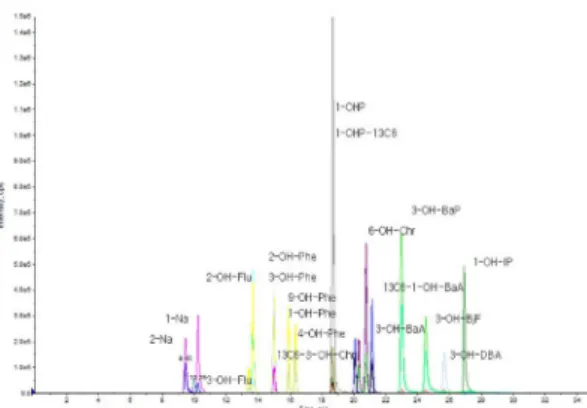
내 및 일간 정밀도와 검출한계는 Table 3에 제시하 였다. OH-PAHs 분석을 위해 표준물질을 첨가하여 분석한 LC-MS/MS 크로마토그램은 Fig. 1과 같이 나타났다.
검출한계(LOD)는 0.02 ng/ml ((2+3)-OH-Phe) ~ 0.125 ng/ml (2-Na) 의 범위로 나타났다. 16종의 OH- PAHs 의 정확도는 89.2~118.8%, 정밀도는 10%미만 Table 2. Validation results; intra-day and inter-day accuracy
compound Intra-day (n=5), ng/ml Inter-day (3days), ng/ml
0.05 0.1 0.5 1 5 0.05 0.1 0.5 1 5
1-Na 108.7 105.2 100.8 96.9 98.7 101.3
2-Na 95.1 98.0 98.0 91.3 99.2 103.1
2-OH-Flu 92.5 96.1 99.1 104.2 96.8 94.9 97.0 100.0 103.4 98.1
3-OH-Flu 104.1 105.6 102.9 118.8 107.0 103.2
(1+9)-OH-Phe 100.2 102.5 108.3 116.6 106.7 103.1 108.8 111.8 118.9 107.3 (2+3)-OH-Phe 98.0 99.4 98.8 104.4 100.5 92.9 97.5 99.2 104.3 99.5 4-OH-Phe 100.8 103.7 105.7 109.8 99.8 107.1 106.8 106.2 109.0 100.4
1-OHP 103.5 100.2 97.7 101.8 98.4 100.6 100.0 97.7 102.6 98.5
3-OH-Fluoran 99.3 99.7 89.2 95.7 90.2 100.3 100.9 92.0 96.9 90.6
6-OH-Chr 104.8 106.9 109.9 113.4 110.8 103.2 104.8 100.1 104.9 101.9
3-OH-BaA 100.8 102.3 92.2 98.1 93.1 102.1 103.6 95.5 100.8 95.7
3-OH-BaP 98.7 99.4 103.0 108.2 107.2 98.7 90.3 103.3 106.3 105.9 3-OH-BjF 98.9 104.4 102.9 109.9 102.4 98.5 106.6 102.9 110.1 101.7 3-OH-DBA 102.0 104.6 95.3 95.6 89.2 112.6 103.4 94.4 97.7 93.1 Table 3. Validation results; intra-day and inter-day precision and limit of detection
compound Intra-day (n=5), ng/ml Inter-day (3days), ng/ml LOD ng/ml
0.05 0.1 0.5 1 5 0.05 0.1 0.5 1 5
1-Na 0.5 0.9 1.6 1.7 2.0 2.2 0.051
2-Na 1.4 1.3 2.2 2.0 2.7 3.8 0.125
2-OH-Flu 0.7 1.6 2.5 2.9 2.4 1.8 1.9 2.1 2.9 3.3 0.056
3-OH-Flu 3.0 4.7 3.4 3.7 4.1 2.9 0.050
(1+9)-OH-Phe 1.9 1.3 2.7 3.2 4.2 2.4 1.7 3.0 3.8 3.8 0.050
(2+3)-OH-Phe 2.6 3.2 1.2 1.6 2.7 3.3 3.1 1.2 2.6 2.4 0.020
4-OH-Phe 5.5 2.0 2.2 2.7 2.4 4.4 2.4 2.6 3.0 2.1 0.037
1-OHP 1.9 1.4 2.1 1.6 2.0 2.8 2.4 1.8 1.7 1.6 0.037
3-OH-Fluoran 3.9 6.2 1.6 3.2 1.7 3.3 5.5 2.0 2.6 2.0 0.022
6-OH-Chr 3.1 3.3 3.8 2.3 2.7 3.5 5.6 4.3 3.7 3.9 0.066
3-OH-BaA 6.3 5.4 2.0 2.6 4.9 5.5 4.2 3.0 3.2 5.5 0.029
3-OH-BaP 2.8 4.8 2.6 5.6 5.0 2.8 4.0 3.4 5.4 5.4 0.042
3-OH-BjF 5.5 3.5 3.8 4.3 3.6 4.1 4.1 4.2 3.5 4.3 0.061
3-OH-DBA 7.3 4.6 5.4 4.1 3.9 7.7 3.0 5.9 3.5 4.4 0.081
으로 안정적인 값을 얻었다.
2. PAHs 대사체 교차분석 결과
성인 및 어린이 200명의 소변시료를 분석한 결과
검출한계 이상의 값을 나타낸 비율은 2-Na (96%), 1-Na (93%), 2-OH-Flu (84%), (2+3)-OH-Phe (84%), 1-OHP (76%), (1+9)-OH-Phe (61%), 3-OH-Flu (47%), 3-OH-Fluoran (31%), 4-OH-Phe (26%), 3-OH-BaA (3%) 순으로 검출되었으며, 나머지 물질들은 모두 검출되지 않았다. 가장 높은 농도를 보인 물질은 2- Na 이었으며, 그 다음으로 1-Na, 2-OH-Flu, (1+9)- OH-Phe 순이었다 (Table 4).
본 연구에서는 새로운 OH-PAHs의 분석법을 확립 한 후 재현성을 평가하기 위해 을지대학교와 녹십자 의료재단에서 교차분석을 수행하였다. 두 기관에서 분석에 이용한 기본적인 방법은 동일하지만 사용한 시약, 분석장비, 실험자, 분석시간 등 세부적인 조건 이 바뀐 상황에서 정확도와 정밀도가 유지되는지를 관찰하는 분석방법의 신뢰도의 일종인 견고성을 평 가한 것이다. 두 기관의 교차분석 결과를 검증하기 위하여 75% 이상 검출된 8종의 물질에 대하여 ICC 값을 구하여 비교하였다. 비교결과 4종의 물질(1-Na, Fig 1. LC-MS/MS Chromatograms of PAHs metabolites.
Table 4. Cross-Validation results between Eulji University and Green Cross Laboratory (unit: ng/ml) compound Eulji University Green Cross-labs Log transformation
N
aMean
bSD
cN Mean SD LOD N r ICC(95% CI)
1-Na 185 4.95 9.47 173 5.77 11.08 0.152 169 0.86 0.86
(0.82-0.89)
2-Na 192 5.07 7.38 197 6.21 8.95 0.125 190 0.87 0.86
(0.82-0.89)
2-OH-Flu 168 0.459 0.70 166 0.666 0.98 0.141 158 0.90 0.78
(0.71-0.83)
3-OH-Flu 94 0.152 0.43 72 0.164 0.37 0.168 74 0.83 0.49
(0.25-0.67) (1+9)-OH-Phe
d122 0.096 0.10 133 0.118 0.20 0.068 115 0.84 0.77
(0.68-0.83)
(2+3)-OH-Phe
d167 0.087 0.08 72 0.079 0.11 0.12 72 0.72 0.70
(0.56-0.80)
4-OH-Phe 51 0.029 0.03 15 0.011 0.11 0.069 14 0.75 0.65
(0.24-0.86)
1-OHP 152 0.124 0.11 172 0.209 0.19 0.053 147 0.78 0.56
(0.44-0.66)
3-OH-Fluoran 62 0.022 0.03 1 0.002 0.339 1 NC
eNC
a
N : number of detected.
b
Mean was calculated assuming that levels <LOD are equal to 1/2 LOD.
c
SD : standard deviation of detected sample concentration.
d : two OH-phenanthrenes were simultaneously eluted.
e