J. Exp. Biomed. Sci. 11 (2005) 143–152
The Relationship between Urinary 8-hydroxydeoxyguanosine and Polycyclic Aromatic Hydrocarbons Exposure in Working Environment
Jong-Seong Lee1†, Eun-A Kim1, Yong-Hag Lee1, Deog-Hwan Moon2 and Kwang-Jong Kim1
1Occupational Safety and Health Research Institute, Korea Occupational Safety and Health Agency, Daejeon 305-380, Korea.
2Institute of Industrial Medicine and Department of Occupational & Environmental Medicine, Inje University Paik Hospital, Pusan 614-735, Korea
To investigate the exposure effect of polycyclic aromatic hydrocarbons (PAHs), we analyzed the relationship between urinary 8-hydroxydeoxyguanosine (8-OHdG) concentration and PAHs exposure. The study population contained 44 workers in steel-pipe coating and paint manufacture industries. We measured airborne total PAHs as an external dose, urinary 1-hydroxypyrene (1-OHP) as an internal dose of PAHs exposure, and urinary 8-OHdG as an effective dose of oxidative DNA damage. There was significant correlation between the urinary concentration of 1-OHP and the environmental concentration of PAHs, pyrene, urinary cotinine, AST, and GGT. The mean of urinary 8-OHdG was 17.07±1.706 µg/g creatinine in workers exposed to airborne PAHs. There was significant correlation between the urinary concentration of 8-OHdG and the airborne concentration of PAHs. From the results of stepwise multiple regression analysis about 8-OHdG, significant independents was total PAHs. In this study, there were significant correlation between the urinary concentration of 8-OHdG and the airborne concentration of PAHs. The urinary 1-OHP was effective index as a biomarker of airborne PAHs in workplace. But it was influenced by non-occupational PAHs source, smoking and biomarkers of liver function test.
Key Words: Cotinine, Coal-tar, 8-hydroxydeoxyguanosine, 1-hydroxypyrene, Polycyclic aromatic hydrocarbons
서 론
다환방향족탄화수소류 (polycyclic aromatic hydrocarbons, 이하 PAHs)는 화석연료의 불완전 연소로 인해 생성되는 혼 합물질로서 피부암, 폐암, 방광암, 후두암, 신장암 그리고 유방암 등을 유발하는 발암물질로서 보고되고 있다 (Boffetta et al., 1997; Li et al., 2002). 국제 암연구소에서는 PAHs를 함 유하고 있는 콜타르, 콜타르 피치, 그을음과 같은 물질과 알 루미늄, 석탄가스 그리고 코크스를 제조하는 공정을 사람에 게 발암성이 있는 Group 1로 규정하고 있고 (IARC, 1983), 우리나라 노동부에서도 benzo(a)pyrene과 chrysene에 대하여 별도의 노출기준을 정하고 있지는 않지만 발암성 추정물질 로 지정하고 있다.
PAHs는 호흡기, 피부 그리고 경구 등 다양한 경로를 통해 체내에 흡수된다. 이와 같이 여러 경로를 통하여 체내에 흡 수되는 물질에 대한 노출평가를 위해서 체내 노출량 (inter- nal dose)과 건강영향 (health effect)을 반영하는 생물학적 모 니터링이 근래에 널리 이용되고 있다. 생물학적 노출지표로 는 pyrene의 요 중 대사산물인 1-hydroxypyrene (1-OHP)과 부가체 형태의 benzo(a)pyrene-diol-epoxide가 자주 이용되고 있다 (Jongeneelen, 1988; Jongeneelen, 1992; Hummelen et al., 1993; Ferreira et al., 1994; Buckley et al., 1995; Pastorelli et al., 1999; Kwack and Lee, 2000; Scherer et al., 2000). PAHs의 생물 학적 영향지표로서는 활성산소에 의한 DNA 산화적 손상지 표인 요 중 8-hydroxydeoxyguanosine (8-OHdG) 등에 대한 연 구가 보고되고 있다 (Toraason et al., 2001; Kim et al., 2003;
Wu et al., 2003).
활성산소는 노화, 퇴행성질환 및 암과 같은 내재적 요인과 흡연, 유해물질 및 유해광선과 같은 외부적 요인과 관련성이 있다 (Loft et al., 1992; Loft et al., 1993; Lagorio et al., 1994;
Chiou et al., 2003). PAHs 노출에 의한 활성산소의 생성 기전 은 Cu(I) 촉매된 Fenton 반응으로 생성된 수산기가 중요한
*논 문 접 수: 2005년 4월 7일 수정재접수: 2005년 5월 20일
†교신저자: 이종성, (우) 305-380 대전광역시 유성구 문지동 104-8, 한국산업안전공단 산업안전보건연구원 화학물질안전보건센터 Tel: 042-869-0346, Fax: 042-863-8361
e-mail: [email protected]
역할을 하는 것으로 알려져 있으나 (Flows et al., 1997), PAHs 노출과 요 중 8-OHdG와의 관련성이 아직 명확하게 정리되 지 못하고 있다.
본 연구는 공기 중 PAHs 노출 근로자를 대상으로 공기 중 총 PAHs 농도 및 그 혼합물의 공기 중 농도와 8-OHdG 농 도간의 상관성을 분석하여 PAHs 노출집단의 건강 유해성 평가를 파악하고자 하는 것이며 이를 위해 첫째, 공기 중 PAHs 노출 근로자에서 PAHs 노출량에 대한 생체노출지표 로서 요 중 1-OHP 농도의 유의성을 검증하고 둘째, 공기 중 PAHs 농도와 요 중 8-OHdG 농도를 비교 분석하여, PAHs 노출이 8-OHdG 농도에 영향을 미치는지를 보고자 하였다.
재료 및 방법
1. 연구 대상
연구 대상자는 페인트 제조업종 5개소와 강관 도포업종 2개소 등 7개소에서 콜타르함유 페인트 및 콜타르 에나멜을 취급한 남자 근로자 44명을 선정하였다 (Table 1). 연구 대상 자에 대하여 실 작업시간 동안 공기 중의 PAHs 농도를 측정 하였고, 작업이 종료된 후 소변과 혈액을 채취하였다. 면담 조사를 통하여 연구 대상자의 일반적 특성인 연령, 체중, 신 장, 근속년수, 흡연여부, 그리고 음주여부를 조사하였다. 연 구 대상자 중에서 작업환경측정을 거부한 6명은 측정 및 분 석에서 제외하였다.
2. 공기 중 PAHs 농도분석
공기 중 시료채취 및 분석은 Leinster and Evans (1986)과 미국 국립산업안전보건연구원 (National Institute for Occupa- tional Safety and Health, NIOSH)의 공정시험법 (Mehtod No.
5515)에 준하여 실시하였다 (NIOSH, 1995). 시료채취용 여재 는 PTFE membrane filter (2 µm, 37 mm)와 XAD-2 tube (100 mg/50 mg)를 시료채취용 펌프 (Gilian, USA)에 연결하여 2 L/min의 유속으로 작업자의 호흡영역에서 실 작업시간 동 안 측정하였다. 측정된 PTFE filter와 XAD-2 흡착관은 각각 사이클로헥산과 톨루엔 5 mL를 가한 후 30분 동안 초음파처 리를 하여 추출하였다. 각각의 추출용액은 syringe filter (0.45 µm, Millex-SR 25 mm, Millipore Co.)로 여과한 후 가스크로
마토그래프 (gas chromatograph/mass selective detector, GC/
MSD, Agilent 6890A/Agilent 5973 MSD, Agilent Co., USA)로 16 항목의 PAHs를 정량분석 하였다. PTFE filter와 XAD-2 흡착관으로부터 개별항목의 PAHs 농도와 각각을 합한 총 PAHs 농도를 8시간 시간가중평균치 (time weighted average, TWA)로 환산하여 결과를 산출하였다.
3. 요 중 대사산물 분석
요 중 1-OHP 농도는 Jongeneelen et al. (1987)과 Kim et al.
(1999)의 방법을 실험실의 조건에 맞게 일부 변형하여 사용 하였다. 원심 분리기용 2 mL 용기에 소변 600 µL를 넣고 2 N sodium acetate 완충액 (pH 5.0) 60 µL를 첨가한 후 혼합하였다.
β-glucuronidase/sulfatase (100,000 U/ml) 6 µL를 첨가하고 빛을 차단한 후 37℃에서 16시간 동안 가수분해 시켰다. 아세토니 트릴 1 mL를 첨가한 후 10초간 진탕하고 4℃에서 원심 분리 (10,000 × g, 10 min)한 후 상층 액을 분취하여 고속액체크 로마토그래프 (high performance chromatograph- fluorescence detector, HPLC, Agilent 1100, Agilent Co., USA)에 주입하여 분석하였다. 1-OHP 농도는 요 중 크레아티닌으로 보정하여 µmol/mol 크레아티닌으로 표시하였다. 요 중 8-OHdG 농도 는 Witherell et al. (1998)과 Shigeru et al. (2000)의 효소면역분 석법 (enzyme-linked immunosorbent assay kit, ELISA, Japan)을 이용하여 ELISA 분석기 (Sanofi Pasteur diagnostics사, France) 로 분석하였다. 최종농도는 요 중 크레아티닌으로 보정하여 µg/g 크레아티닌으로 표시하였다. 요 중 cotinine 농도는 No- riaki et al. (1993)의 분석방법을 준용하여 분석하였다. 요 3 mL에 5 Ν sodium hydroxide 1 mL를 넣고 혼합한 후, 디클 로로메탄 3 mL를 넣어 진탕하고 원심 분리 (3,000 rpm, 10 min)하였다. 디클로로메탄 2 mL 용액을 취하여 증발시킨 후, 탈이온수 800 µL를 넣어 녹인 후 HPLC를 이용하여 최종농 도는 요 중 크레아티닌으로 보정하여 µg/g 크레아티닌으로 표시하였다.
4. 생화학적 검사
요 중 1-OHP 농도, cotinine 농도, 8-OHdG 농도의 보정을 위한 요 중 크레아티닌 농도는 자동생화학분석기 (DADE Behring Inc, USA)로 분석하였다. 혈액 중 AST, ALT, 그리고 Table 1. Number of workers sampled for airborne PAHs in workplace, urine, and blood by the type of industries
No. of case Industry Handling material No. of plants
Airborne PAHs Urine Blood
Paints manufacture coal-tar paint 5 20 20 20
Steel-pipe coating coal-tar enamel 2 18 24 24
Total subjects 7 38 44 44
GGT의 활성도 측정은 응고촉진제가 함유된 시험관 (SST gel tube, Becton Dickinson, USA)에 약 7 mL의 혈액을 채취하여 약 1시간 실온에 방치하여 응고시킨 후, 원심 분리 (3,000 rpm, 10 min)하여 혈청을 취한 후 분석하였다.
5. 자료분석
수집된 자료는 SPSS/PC를 이용하여 분석하였다. 요 중 1-OHP 농도와 공기 중 PAHs 농도간의 관련성을 상관분석과 회귀분석을 통해 검토하였다. 요 중 8-OHdG 농도와 공기 중
PAHs 농도, 요 중 1-OHP 농도, 연령, 체질량지수 (body mass index, 이하 BMI), 근속년수, 요 중 cotinine, 음주여부 및 간 기능 검사항목의 활성도 간의 관련성은 분산분석, 상관분석 및 회귀분석을 실시하였다 (Table 2).
결 과
1. 업종별 연구 대상자의 일반적 특성 비교
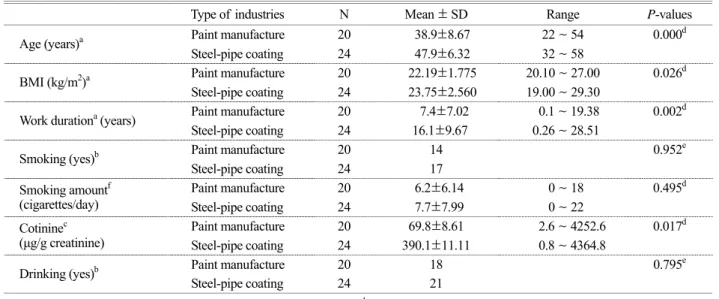
업종별 연구 대상자의 특성을 비교해 보면 강관 도포업종
Table 2. Mean value of each variables in workers exposed to PAHs
Variables N Mean ± SD Range P-valuesa
Age (years) 44 43.8† ± 8.68 22 ~ 58 0.529
BMI (kg/m2)b 44 23.04† ± 2.350 19.0 ~ 29.3 0.356 Work duration (years) 44 12.1† ± 9.54 0.1 ~ 28.5 0.351 Cotinine (µg/g creatinine)c 44 178.4¶ ± 11.35 0.8 ~ 4364.8 0.122 PAHs (µg/m3)d 38 87.7¶ ± 7.81 2.6 ~ 6311.3 0.599 1-OHP (µmol/mol creatinine)e 44 12.63¶ ± 7.759 0.24 ~ 664.95 0.379 8-OHdG (µg/g creatinine)f 44 17.70¶ ± 1.706 3.04 ~ 57.68 0.665
AST (unit/L)g 44 22.0¶ ± 1.31 12 ~ 43 0.598
ALT (unit/L)h 44 41.4¶ ± 1.30 28 ~ 86 0.230
GGT (unit/L)i 44 42.7¶ ± 1.94 12 ~ 293 0.565
† Mean: arithmetic mean, SD: arithmetic standard deviation, ¶ Mean: geometric mean, SD: geometric standard deviation
a p-values: calculated by Kolmogorov-Smirnov test, b Body mass index
c Urinary cotinine, d Total polycyclic aromatic hydrocarbons in air
e Urinary 1-hydroxypyrene, f Urinary 8-hydroxydeoxyguanosine
g Aspartate aminotransferase, h Alanine aminotranferase
i γ-glutamyl transpeptidase
Table 3. General characteristics of the study subjects by the type of industries
Type of industries N Mean ± SD Range P-values Paint manufacture 20 38.9±8.67 22 ~ 54 0.000d Age (years)a
Steel-pipe coating 24 47.9±6.32 32 ~ 58
Paint manufacture 20 22.19±1.775 20.10 ~ 27.00 0.026d BMI (kg/m2)a
Steel-pipe coating 24 23.75±2.560 19.00 ~ 29.30
Paint manufacture 20 7.4±7.02 0.1 ~ 19.38 0.002d Work durationa (years)
Steel-pipe coating 24 16.1±9.67 0.26 ~ 28.51
Paint manufacture 20 14 0.952e
Smoking (yes)b
Steel-pipe coating 24 17
Paint manufacture 20 6.2±6.14 0 ~ 18 0.495d Smoking amountf
(cigarettes/day) Steel-pipe coating 24 7.7±7.99 0 ~ 22
Paint manufacture 20 69.8±8.61 2.6 ~ 4252.6 0.017d Cotininec
(µg/g creatinine) Steel-pipe coating 24 390.1±11.11 0.8 ~ 4364.8
Paint manufacture 20 18 0.795e
Drinking (yes)b
Steel-pipe coating 24 21
a Arithmetic mean ± Arithmetic standard deviation, b Number of smokers; Number of drinkers
c Geometric mean ± Geometric standard deviation, d Calculated by t-test
e Calculated by χ2-test
f Amount of cigarette consumption until sampling time of urine for the survey day
에서 연구 대상자의 연령, BMI, 근속년수, 요 중 cotinine 농 도의 평균농도는 페인트 제조업종보다 유의하게 높았으나 (P<0.05), 흡연 및 음주여부는 두 업종간 차이가 없었다 (Ta- ble 3).
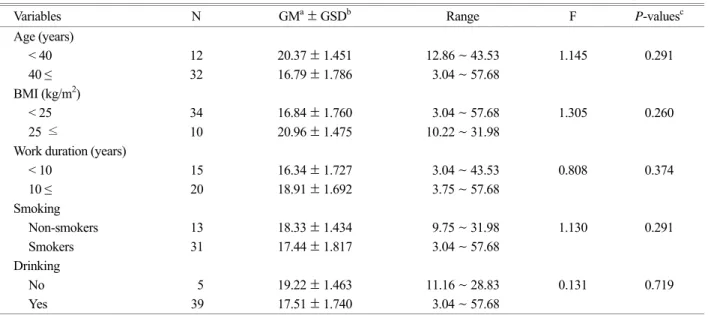
2. 일반적 특성별 요 중 8-OHdG 평균농도간의 비교 일반적 특성별 요 중 8-OHdG 평균농도간의 차이를 비교 한 결과는 Table 4와 같다. 연령별, BMI별, 근속년수별, 흡 연여부별, 그리고 음주여부별 요 중 8-OHdG 평균농도간에 는 유의한 차이가 없었다.
3. 업종별 요 중 1-OHP 및 요 중 8-OHdG 평균농도 간의 비교
업종별 공기 중 PAHs, 요 중 1-OHP 그리고 8-OHdG의 평
균농도의 차이를 비교한 결과는 Table 5와 같다. 공기 중 PAHs의 평균농도는 강관 도포업종이 526.5±2.85 µg/m3로서 페인트 제조업종의 17.5±3.36 µg/m3보다 30배 이상 높았고 (P<0.05), 요 중 1-OHP 평균농도도 강관 도포업종에서 51.63 µmol/mol 크레아티닌으로 페인트 제조업종보다 22배 이상 높았다 (P<0.05). 그러나 요 중 8-OHdG 농도는 강관 도포업 종이 20.10 µg/g 크레아티닌으로 페인트 제조업종 15.19 µg/g 크레아티닌보다 높은 경향을 보였으나 유의한 차이는 없었다.
4. 요 중 8-OHdG 농도와 관련변수간의 상관관계 요 중 8-OHdG 농도와 이에 영향을 미치는 관련변수간의 상관분석 결과는 Table 6과 같다. 요 중 8-OHdG 농도와 공 기 중 PAHs 농도 (r=0.333, P<0.05) 및 pyrene 농도 (r=0.327, P<0.05)가 통계적으로 유의한 상관성을 보였다. 그러나 연령, Table 4. Comparison with the mean concentrations on urinary 8-OHdG by age, BMI, work duration, smoking, and drinking
(unit: µg/g creatinine)
Variables N GMa ± GSDb Range F P-valuesc
Age (years)
< 40 12 20.37 ± 1.451 12.86 ~ 43.53 1.145 0.291
40 ≤ 32 16.79 ± 1.786 3.04 ~ 57.68
BMI (kg/m2)
< 25 34 16.84 ± 1.760 3.04 ~ 57.68 1.305 0.260
25 ≤ 10 20.96 ± 1.475 10.22 ~ 31.98
Work duration (years)
< 10 15 16.34 ± 1.727 3.04 ~ 43.53 0.808 0.374
10 ≤ 20 18.91 ± 1.692 3.75 ~ 57.68
Smoking
Non-smokers 13 18.33 ± 1.434 9.75 ~ 31.98 1.130 0.291
Smokers 31 17.44 ± 1.817 3.04 ~ 57.68
Drinking
No 5 19.22 ± 1.463 11.16 ~ 28.83 0.131 0.719
Yes 39 17.51 ± 1.740 3.04 ~ 57.68
a GM: geometric mean, b GSD: geometric standard error, c p-values: calculated by ANOVA test
Table 5. Comparison with the mean concentrations on airborne PAHs, urinary 1-OHP and 8-OHdG by the type of industries
N GMa ± GSDb Range t P-valuesc
PAHs (µg/m3)
Paint manufacture 20 17.5 ± 3.36 2.6 ~ 148.4 9.220 0.000 Steel-pipe coating 18 526.5 ± 2.85 112.1 ~ 6311.3
1-OHP (µmol/mol creatinine)
Paint manufacture 20 2.33 ± 4.709 0.24 ~ 53.77 7.617 0.000 Steel-pipe coating 24 51.63 ± 3.144 7.35 ~ 664.95
8-OHdG (µg/g creatinine)
Paint manufacture 20 15.19 ± 1.595 3.04 ~ 26.15 1.776 0.083 Steel-pipe coating 24 20.10 ± 1.755 3.75 ~ 57.68
a GM: geometric mean, b GSD: geometric standard deviation, c p-values: calculated by t-test
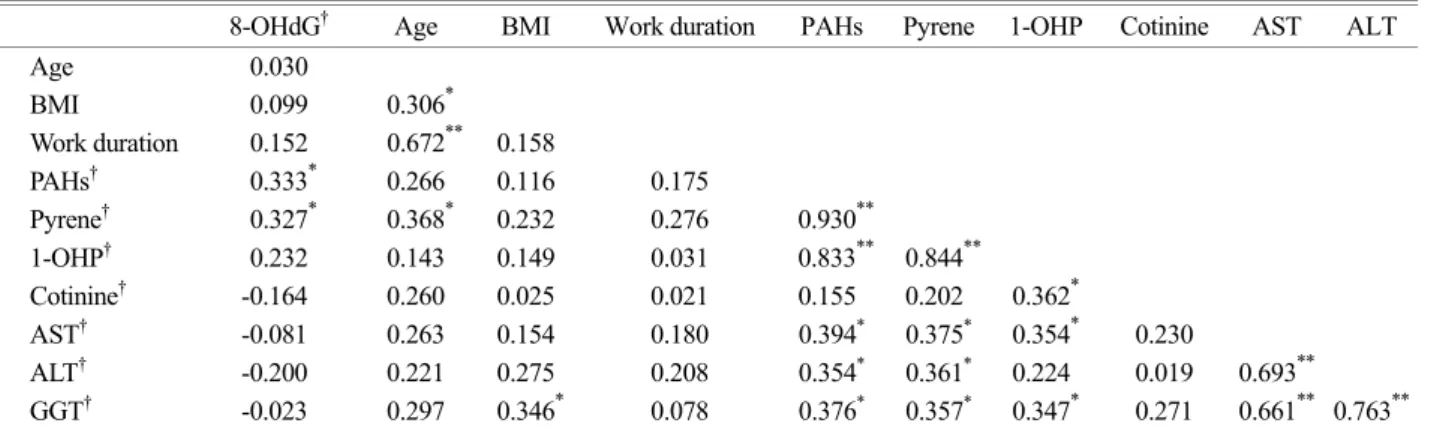
BMI, 근속년수, 요 중 1-OHP 농도, 요 중 cotinine 농도, 간 기능 손상지표 농도 등의 변수들과 요 중 8-OHdG 농도 간 에는 유의한 상관성이 없었다. 요 중 1-OHP 농도는 공기 중 PAHs (r=0.833, P<0.01)및 pyrene 농도 (r=0.844, P<0.01) 뿐 아니라 요 중 cotinine 농도 (r=0.362, P<0.05)와 혈 중 AST (r=0.354, P<0.05) 및 GGT 농도 (r=0.347, P<0.05)에 대해서 도 유의한 상관성을 보였다. 요 중 8-OHdG 농도와 이와 관 련된 변수들 간에 다단계회귀분석 (stepwise multiple regres- sion analysis) 결과, 요 중 8-OHdG에 대해 공기 중 PAHs는 유의한 영향을 미치는 변수인 것으로 나타났다 (Table 7) (Fig. 1).
고 찰
PAHs는 일반 생활환경 중의 자동차 배기가스, 난방시설, 담배 연기 그리고 콜타르 함유 의약품 등에 의해 노출될 수 있으며, 작업환경 중에는 코크스 제조공정, 흑연전극 제조공 정, 콜타르 함유물질 취급공정, 석유화학공정 등에서 PAHs 에 노출될 가능성이 높다 (Jongeneelen et al., 1990; Buchet et al., 1992; Boogard and Sittert, 1994). Ny et al. (1993)은 Sorden- berg 전극공장 근로자에 대하여 공기 중 PAHs를 농도별로
층화하여 요 중 1-OHP 농도를 조사한 결과, 공기 중 PAHs 평균농도가 25 µg/m3일 때, 주말의 요 중 1-OHP 평균농도는 2.6 µmol/mol 크레아티닌이었고 147 µg/m3에서는 31 µmol/
mol 크레아티닌이라고 하였다. 본 연구의 페인트 제조업종의 경우는 공기 중 PAHs 농도가 17.5 µg/m3이었고 요 중 1-OHP 농도는 2.33 µmol/mol 크레아티닌으로서 선행연구와 거의 일 치한 결과를 나타냈다.
Ny et al. (1993)은 발암성 PAHs가 pyrene과 같은 대사 기 전을 갖는다면 호흡기와 피부 등 모든 흡수 경로를 반영하 는 PAHs의 생체 노출지표 지표로서 요 중 1-OHP를 측정하 는 것이 공기 중 PAHs 보다 효과적이며 PAHs와 관련된 생 체의 영향과도 잘 연관된다고 제안하였다. 본 연구에서 공기 Table 6. Correlation matrix between urinary 8-OHdG concentration and each independent variables
8-OHdG† Age BMI Work duration PAHs Pyrene 1-OHP Cotinine AST ALT
Age 0.030
BMI 0.099 0.306*
Work duration 0.152 0.672** 0.158
PAHs† 0.333* 0.266 0.116 0.175
Pyrene† 0.327* 0.368* 0.232 0.276 0.930**
1-OHP† 0.232 0.143 0.149 0.031 0.833** 0.844**
Cotinine† -0.164 0.260 0.025 0.021 0.155 0.202 0.362*
AST† -0.081 0.263 0.154 0.180 0.394* 0.375* 0.354* 0.230 ALT† -0.200 0.221 0.275 0.208 0.354* 0.361* 0.224 0.019 0.693**
GGT† -0.023 0.297 0.346* 0.078 0.376* 0.357* 0.347* 0.271 0.661** 0.763**
* Pearson's product moment correlation coefficient (*P<0.05; **P<0.01), † Log transformed value
Table 7. Stepwise multiple regression analysis of log (8-OHdG) against associated variables
Variables Ba SE β P-value
Intercept 1.107 0.079 0.000 PAHsb 0.079 0.037 0.333 0.041
R2 0.111
adjusted R2 0.086
F 4.477 (p=0.041)
a B: regression coefficients, SE: standard error, β: standardized B
b Log transformed value
Fig. 1. Scatter diagram between urinary 8-OHdG concentration (µg/g creatinine) and PAHs concentration (µg/m3) in air. Urinary 8-OHdG = 1.11 + 0.08 × Log PAHs, r=0.333, (P<0.05)
중 pyrene 농도와 공기 중 총 PAHs 농도 간에 높은 상관관 계 (r=0.930)가 있었고, 요 중 1-OHP 농도는 공기 중 pyrene 농도 (r=0.844) 총 PAHs 농도 (r=0.833)에 대해 높은 상관성 을 보였다. 이러한 결과는 Buchet et al. (1992)의 요 중 1-OHP 도 pyrene 농도 (r=0.67), 공기 중 PAHs 농도 (r=0.72)에 높은 상관성을 보인 연구들과 잘 일치하였다. 따라서 pyrene은 총 PAHs와 높은 상관성을 보였고 pyrene의 대사물질인 요 중 1-OHP도 pyrene 뿐만 아니라 총 PAHs와도 비교적 높은 상 관관계가 존재하므로, 총 PAHs의 생체 노출지표로서 1-OHP 가 적절하였다.
살아있는 세포는 생화학적 작용과 외부요인에 의해 지속 적으로 활성산소가 생성되어 DNA, 단백질, 지질에 대해 산 화적 손상을 유발할 수 있다. DNA의 산화적 손상은 노화, 암 그리고 기타 퇴행성질병 등과 관련성이 있는 것으로 알 려져 있으며 (Shigeru et al., 2000), 벤젠 (Lagorio et al., 1994), PAHs (Toraason et al., 2001; Kim et al., 2003; Zhang et al., 2003), perchloroethylene (Toraason et al., 2003) 등과 같은 유해물질 에 직업적으로 노출되었을 경우에도 유의하게 증가하는 것 으로 보고되고 있다.
본 연구는 요 중 8-OHdG를 이용하여 PAHs 노출에 의한
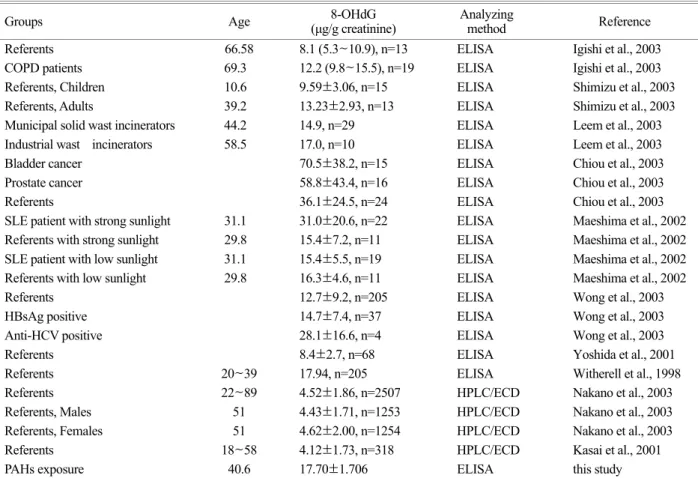
DNA 산화적 손상을 평가하고자 하였다. 요 중 8-OHdG는 비경혈적 방법이고 -20℃에서 보관할 경우 1년 이상 안정한 물질이기 때문에 DNA의 산화적 손상지표로서 많이 이용되 고 있다 (Loft et al., 1992). 본 연구의 요 중 8-OHdG 평균 농도는 17.70 µg/g 크레아티닌 이었고, 농도범위는 3.04~
57.68 µg/g 크레아티닌으로서 최대 값은 최소 값의 약 19배 이었다. 요 중 8-OHdG 배설량의 정상적인 범위로 알려져 있 는 7~10배 정도의 범위보다 넓었으나, Wong et al. (2003)의 1.4~60.1 µg/g 크레아티닌과 유사한 농도분포를 보였다. 본 연구의 8-OHdG 농도는 비노출군에 대한 연구 (Shimizu et al., 2003; Wong et al., 2003)에서의 8.10~13.23 µg/g 크레아티닌 보다는 높았으나, Chiou et al. (2003)의 방광암과 전립선암 환자에서의 58.8~70.5 µg/g 크레아티닌 보다는 낮았다. 8- OHdG 분석은 HPLC-ECD와 ELISA 방법이 많이 이용되고 있는데, HPLC-ECD법은 8-OHdG만 분리하여 분석하는데 비 해, ELISA법은 8-OHdG의 단일항체에 반응하는 8-OHdG와 비슷한 형태의 분자에 의해 증가할 수 있다. 손상된 DNA가 수복되면서 8-OHdG를 비롯한 여러 가지 형태의 물질로 만 들어져 소변으로 배출되므로 ELISA법은 HPLC법에 비해 생체내 산화적 스트레스에 대한 총량적 평가 (total assess-
Table 8. Reported values of urinary 8-OHdG concentrations in various status
Groups Age 8-OHdG
(µg/g creatinine) Analyzing
method Reference Referents 66.58 8.1 (5.3~10.9), n=13 ELISA Igishi et al., 2003 COPD patients 69.3 12.2 (9.8~15.5), n=19 ELISA Igishi et al., 2003 Referents, Children 10.6 9.59±3.06, n=15 ELISA Shimizu et al., 2003 Referents, Adults 39.2 13.23±2.93, n=13 ELISA Shimizu et al., 2003 Municipal solid wast incinerators 44.2 14.9, n=29 ELISA Leem et al., 2003 Industrial wast incinerators 58.5 17.0, n=10 ELISA Leem et al., 2003
Bladder cancer 70.5±38.2, n=15 ELISA Chiou et al., 2003
Prostate cancer 58.8±43.4, n=16 ELISA Chiou et al., 2003
Referents 36.1±24.5, n=24 ELISA Chiou et al., 2003
SLE patient with strong sunlight 31.1 31.0±20.6, n=22 ELISA Maeshima et al., 2002 Referents with strong sunlight 29.8 15.4±7.2, n=11 ELISA Maeshima et al., 2002 SLE patient with low sunlight 31.1 15.4±5.5, n=19 ELISA Maeshima et al., 2002 Referents with low sunlight 29.8 16.3±4.6, n=11 ELISA Maeshima et al., 2002
Referents 12.7±9.2, n=205 ELISA Wong et al., 2003
HBsAg positive 14.7±7.4, n=37 ELISA Wong et al., 2003
Anti-HCV positive 28.1±16.6, n=4 ELISA Wong et al., 2003
Referents 8.4±2.7, n=68 ELISA Yoshida et al., 2001
Referents 20~39 17.94, n=205 ELISA Witherell et al., 1998 Referents 22~89 4.52±1.86, n=2507 HPLC/ECD Nakano et al., 2003 Referents, Males 51 4.43±1.71, n=1253 HPLC/ECD Nakano et al., 2003 Referents, Females 51 4.62±2.00, n=1254 HPLC/ECD Nakano et al., 2003 Referents 18~58 4.12±1.73, n=318 HPLC/ECD Kasai et al., 2001
PAHs exposure 40.6 17.70±1.706 ELISA this study
ment)에 적합한 분석법이다 (Saito et al., 2000; Nakano et al., 2003). 따라서 ELISA로 분석하였을 경우 HPLC-ECD법 보 다 약간 높은 결과를 나타낸다 (Table 8).
Wu et al. (2003)은 코크스 오븐 작업자들을 대상으로 한 연 구에서 요 중 8-OHdG 농도와 공기 중 PAHs 농도 간에 유의 한 상관성이 있다고 하였는데, 본 연구에서도 요 중 8-OHdG 농도 공기 중 PAHs와 유의한 상관성 (r=0.333, P<0.05)을 나 타내었고, 비록 결정계수는 낮았지만 다중회귀분석에서 공 기 중 PAHs는 유의한 영향변수이었다. PAHs 노출 근로자에 대한 DNA 산화적 손상 연구에서 Zhang et al. (2003)은 코크 스 오븐 작업장의 근로자에서 백혈구 중의 8-OHdG은 PAHs 의 DNA 부가체와 관련성이 있었고, Toraason et al. (2001)은 콜타르피치와 아스팔트 흄 노출 근로자에서는 공기 중 PAHs 노출에 의해 DNA가 손상될 수 있다고 하였다. 그러나 본 연 구의 PAHs의 평균 노출농도 87.82 µg/m3 보다 낮은 작업조 건인 알루미늄 제련작업자에 대한 환자 대조군 연구 (Cars- tensen et al., 1999)에서 공기 중 PAHs 농도가 29.5 µg/m3 정 도의 낮은 농도에서는 요 중 8-OHdG 농도는 노출 군과 비 노출 군이 유의한 차이를 보이지 않았고, 공기 중 PAHs, 근 무기간, 요 중 1-OHP 농도, PAHs의 DNA 부가체 등 노출 지표들과 유전독성학적 지표들과 연관성을 입증할 수 없었 다고 하였다.
담배연기에는 400~500여종의 가스상 물질과 3500여종의 입자상 물질이 존재하며 이들 입자의 질량과 크기는 400~
500 mg의 0.1~1.0 µm (평균 0.25 µm) 정도이다. 특히 담배 한 개비 속의 입자상 물질 중에는 0.3~0.5 µg의 pyrene과 함 께 발암성 PAHs가 0.1~0.25 µg이 존재하는 것으로 알려져 있으며 (VanRooij et al., 1993), 또한 phenols, quinones, alde- hydes 및 ketones과 같이 활성산소를 생성하는 물질들이 함 유되어 있어 세포의 산화적 손상을 일으킬 수 있다 (Mae- shima et al., 2002). Xueliang and Joachim (1995)은 동물실험에 서 catechol estrogen과 quinone의 산화환원 대사 기전에서 DNA의 산화적 손상을 유발하고 신장암을 일으킬 수 있다고 하였고, Kasai et al. (2001)은 일반인 318명에서 요 중 8- OHdG의 배설량에 대해 흡연은 양의 상관성 (P=0.0032)을 보였으며, Loft et al. (1993)은 흡연량이 증가할수록 8-OHdG 의 배설량이 유의하게 증가한다고 하였다. 그리고 Howard et al. (1998)은 흡연지표로서 cotinine을 이용한 연구에서는 간 접흡연에 노출되었을 경우 cotinine이 증가할수록 혈액 중의 8-OHdG가 증가하는 것으로 보아 흡연이 DNA의 산화적 손 상을 일으킨다고 주장하였지만 많은 연구에서 8-OHdG와 흡 연과의 관련성을 입증하지 못하였다 (Carstensen et al., 1999;
Igishi et al., 2003; Toraason et al., 2003; Zhang et al., 2003). 본 연구에서도 흡연여부에 따른 요 중 8-OHdG 평균농도는 차 이가 없었고, 상관분석 및 회귀분석에서도 요 중 cotinine은
유의한 관련성을 확인할 수 없었다.
Fraga et al. (1990)은 랫드를 이용한 동물실험에서 연령이 증가할수록 간, 신장, 내장 등의 조직의 DNA에 변형된 염 기형태인 8-hydroxyguanosine (8-OHG)의 축적량이 증가한 반 면, 요 중 8-OHdG 배설량은 감소한다고 하였고, Hayakawa et al. (1991)은 연령이 증가할수록 산화된 8-OHdG를 환원시 키는 능력이 감소한다고 하였다. Kasai et al. (2001)은 일반인 318명을 대상으로 실시한 연구에서 연령이 요 중 8-OHdG에 대해 양의 방향으로 영향을 미친다고 하였으나, Nakano et al. (2003)은 일반인 2507명을 대상으로 조사를 하였을 때 관 련성이 없었다고 하였다. 본 연구에서는 연령을 층화하여 분 석하였을 때 요 중 8-OHdG 평균농도의 차이가 없었고 상관 분석 및 회귀분석에서도 유의한 관련성을 확인할 수 없었다.
본 연구에서 BMI와 8-OHdG 농도 간에는 관련성을 확인 하지 못하였다. Kasai et al. (2001)와 Loft et al. (1992)는 BMI 가 증가할수록 요 중 8-OHdG 농도는 감소한다고 하였는데, 이와 같이 BMI가 요 중의 8-OHdG와 음의 방향성을 보이는 것에 대해 Shah et al. (1988)의 기초대사율 결과처럼 비만한 사람이 마른 체형에 비해 대사율이 떨어진다는 것으로 설명 될 수 있다.
Yoshida et al. (2001)은 음주와 활성산소의 관련성에 대한 연구에서 전신의 산화적 스트레스의 지표로서 요 중의 bio- phyrrins와 혈청 중의 AST, ALT 및 GGT간에 유의한 양의 관련성이 존재하는 것으로 보아, 알코올은 활성산소를 생성 하여 이로 인해 간세포의 손상을 일으킬 수 있다고 하였다.
Wong et al. (2003)은 음주에 대해 용량반응관계가 성립하지는 않았으나 다중회귀분석에서 음주는 요 중 8-OHdG에 대해 영향변수이었고, B형 간염 표지항원 (HBsAg)과 C형 간염 항체 (HCV)와 양의 관련성이 있었다. 이와 같은 선행 연구 로 볼 때 요 중 8-OHdG에 대해 간 손상 지표는 영향변수로 서 취급되어야 할 것으로 보인다. 본 연구에서는 요 중 8- OHdG 농도와 AST, ALT 및 GGT 간에 관련성을 확인하지 못하였다.
본 연구의 제한점은, PAHs 흡수량에 영향을 줄 수 있는 식습관을 조사하지 못하였고, 8-OHdG의 영향변수 중의 하 나인 방사선의 피폭여부에 대한 조사가 이루어지지 못했다.
그리고 노출군 대상의 용량반응 관계 중심연구로 수행되었 기 때문에 향후 비노출 군과의 비교 연구가 필요하였다.
따라서 본 연구는 페인트 제조와 강관 도포 작업장에서 콜 타르 함유 페인트 및 콜타르 에나멜을 취급한 남성 근로자 44명을 대상으로 공기 중 PAHs에 노출된 근로자에서 요 중 8-OHdG 농도와 연령, 근속년수, 흡연, 음주 등의 일반적인 특성 및 공기 중 PAHs 농도간의 상관성을 살펴본 결과, 요 중 8-OHdG 농도는 공기 중 PAHs 농도에 영향을 받는 변수 이었으며, PAHs의 혼합물 중 일부에서도 요 중 8-OHdG와
상관성을 보이는 것으로 입증되었다. 또한 요 중 1-OHP 농 도는 공기 중 PAHs 농도와 매우 높은 상관성을 나타내는 등 체내 노출지표로서 유의하였으나, 비직업적 노출요인인 흡 연과 간 기능 손상지표들에 의해서도 영향을 받기 때문에 PAHs 노출평가에 있어 요 중 1-OHP를 적용하는데 주의가 필요하였다.
REFERENCES
Boffetta P, Jourenkova N, Custavsson P. Cancer risk from occupa- tional and environmental exposure to polycyclic aromatic hydrocarbons. Cancer Causes Control. 1997. 8: 444-472.
Boogard PJ, Sittert NJV. Exposure to polycyclic aromatic hydro- carbons in petrochemical industries by measurement of uri- nary 1-hydroxypyrene. Occup Environ Med. 1994. 51: 250 -258.
Buchet JP, Gennart JP, Mercado-Calderon F, Delavignette JP, Cupers L, Lauwerys R. Evaluation of exposure to polycyclic aromatic hydrocarbons in a coke production and a graphite electrode manufacturing plant: assessment of urinary excre- tion of 1-hydroxypyrene as a biological indicator of exposure.
Br J Ind Med. 1992. 49: 761-768.
Buckley TJ, Waldman JM, Dhara R, Greenberg A, Ouyang Z, Lioy PJ. An assessment a urinary biomarker for total human environmental exposure to benzo(a)pyrene. Int Arch Occup Environ Health. 1995. 67: 257-266.
Carstensen U, Hou SM, Alexandrie AK, Hogstedt B, Tagesson C, Warholm M, Rannug A, Lambert B, Axmon A, Hagmar L.
Influence of genetic polymorphisms of biotransformation enzymes on gene mutations, strand breaks of deoxyribonu- cleic acid, and micronuclei in mononuclear blood cells and urinary 8-hydroxydeoxyguanosine in potroom workers expo- sed to polyaromatic hydrocarbons. Scand J Work Environ Health. 1999. 25: 351-360.
Chiou CC, Chang PY, Chan EC, Wu TL, Tsao KC, Wu JT. Uri- nary 8-hydroxydeoxyguanosine and its analogs as DNA mar- ker of oxidative stress: development of an ELISA and mea- surement in both bladder and prostate cancers. Clin Chim Acta. 2003. 334: 87-94.
Ferreira JMF, Tas S, dell'Omo M, Goormans G, Buchet JP, Lau- werys R. Determinants of benzo(a)pyrenediol epoxide ad- ducts to haemoglobin in workers exposed to polycyclic aro- matic hydrocarbons. Occup Environ Med. 1994. 51: 451 -455.
Flows L, Ohnish ST, Penning TM. DNA strand scission by
polycyclic aromatic hydrocarbon o-quinone: Role of reactive oxygen species, Cu(II)/Cu(I) redox cycling, o-semiquinone anion radicals. Biochemistry. 1997. 36: 8640-8648.
Fraga CG, Shigenaga MK, Park JW, Degan P, Ames BN. Oxi- dative damage to DNA during aging: 8-hydroxy-2'-deoxygu- anosine in rat organ DNA and urine. Proc Natl Acad Sci USA. 1990. 87: 4533-4537.
Howard DJ, Ota RB, Briggs LA, Hampton M, Pritsos CA. Envi- ronmental tobacco smoke in the workplace induces oxidative stress in employees, including increased production of 8- hydroxy-2'-deoxyguanosine. Cancer Epidemiol Biomarkers Prev. 1998. 7: 141-146.
Hayakawa M, Torii K, Sugiyama M, Tanaka M, Ozawa T. Age- associated accumulation of 8-hydroxydeoxyguanosine in mitochondrial DNA of human diaphragm. Biochem Biophys Res Com. 1991. 179: 1023-1029.
Hummelen PV. Biological markers in PAH exposed workers and control. Mutat Res. 1993. 300: 231-239.
IARC. IARC monographs on the evaluation of carcinogenic risk to humans. polycyclic aromatic compounds. Part I Vol 32:
1983.
Igishi T, Hitsuda Y, Kato K, Sako T, Burioka N, Yasuda K, Sano H, Shigeoka Y, Nakanishi H, Shimizu E. Elevated urinary 8-hydroxydeoxyguanosine, a biomarker of oxidative stress, and lack of association with antioxidant vitamins in chronic obstructive pulmonary disease. Respiratory. 2003. 8: 455-460.
Jongeneelen FJ, Anzion RB, Henderson PT. Determination of hydroxylated metabolites of polycyclic aromatic hydrocar- bons in urine. J Chromatogr. 1987. 413: 227-232.
Jongeneelen FJ. Airborne concentration, skin contamination, and urinary metabolite excretion of polycyclic aromatic hydro- carbons among paving workers exposed to coal tar derived road tars. Am Ind Hyg Assoc J. 1988. 49: 600-607.
Jongeneelen FJ, van Leeuwen FE, Oosterink S, Anzion RBM, Loop FVDL, Bos RP, Veen HGV. Ambient and biological monitoring of cokeoven workers: determinants of the internal dose of polycyclic aromatic hydrocarbons. Br J Ind Med.
1990. 47: 454-461.
Jongeneelen FJ. Biological exposure limit for occupational expo- sure to coal tar pitch volatiles at cokeovens. Int Arch Occup Environ Health. 1992. 63: 511-516.
Kasai H, Iwamoto-Tanaka N, Miyamoto T, Kawanami K, Kawa- nami S, Kido R, Ikeda M. Life style and urinary 8-hydro- xydeoxyguanosine, a marker of oxidative dna damage: effects of exercise, working conditions, meat intake, body mass
index, and smoking. Jpn J Cancer Res. 2001. 92: 9-15.
Kim H, Kim YD, Lee H, Kawamoto T, Yang M, Kato T. Assay of 2-naphthol in human urine by high performance liquid chro- matography. J Chromatogr B Biomed Appl. 1999. 734: 211 -217.
Kim YD, Lee CH, Nan HM, Kang JW, Kim H. Effects of genetic polymorphisms in metabolic enzymes on the relationships between 8-hydroxydeoxyguanosine levels in human leuko- cytes and urinary 1-hydroxypyrene and 2-naphthol concen- trations. J Occup Health. 2003. 45: 160-167.
Kwack SJ, Lee BM. Correlation between DNA or protein adducts and benzo(a)pyrene diol epoxide I-triglyceride adduct de- tected in vitro and in vivo. Carcinogenesis. 2000. 21: 629 -632.
Lagorio S, Tagesson C, Forastiere F, Iavarone I, Axelson O, Carere A. Exposure to benzene and urinary concentrations of 8-hydroxydeoxyguanosine, a biological marker of oxidative damage to DNA. Occup Environ Med. 1994. 51: 739-743.
Leem JH, Hong YC, Lee KH, Kwon HJ, Chang YS, Jang JY.
Health survey on workers and residents near the municipal waste and industrial waste incinerators in Korea. Ind Health.
2003. 41: 181-188.
Leinster P, Evans MJ. Factors affecting the sampling of airborne polycyclic aromatic hydrocarbons-a review. Ann Occup Hyg.
1986. 30: 481-495.
Li D, Walcott FL, Chang P, hang W, Zhu J, Petrulis E, Singletary SE, Sahin AA, Bondy ML. Genetic and environmental deter- minants on tissue response to in vitro carcinogen exposure and risk of breast cancer. Cancer Res. 2002. 62: 4566-4570.
Loft S, Fisher-Nielsen A, Jeding IB, Virsten K, Poulsen HE.
8-hydroxydeoxyguanosine as a urinary biomarker of oxida- tive DNA damage. J Toxicol Environ Health. 1993. 40: 391 -404.
Loft S, Vistisen K, Ewertz M, Tjonneland A, Overvad K, Poulsen HE. Oxidative DNA damage estimated by 8-hydroxydeoxy- guanosine excretion in humans: influence of smoking, gender and body mass index. Carcinogenesis. 1992. 13: 2241-2247.
Maeshima E, Liang XM, Otani H, Mune M, Yukawa S. Effect of environmental changes on oxidative deoxyribonucleic acid (DNA) damage in systemic lupus erythematosus. Arch Envi- ron Health. 2002. 57: 425-428.
Nakano M, Kawanishi Y, Kamohara S, Uchida Y, Shiota M, Inatomi Y, Komori T, Miyazawa K, Gondo K, Yamasawa I.
Oxidative DNA damage (8-hydroxydeoxyguanosine) and body iron status: a study on 2507 healthy people. Free Radic
Biol Med. 2003. 35: 826-832.
NIOSH. Guidelines for Air Sampling and Analytical Method Development and Evaluation. DHHA(NIOSH) Pub. No. 95 -117. NIOSH. 1995.
Noriaki T, Fumihiko J, Fumiyuki A, Shigeru S, Yoshiki M, Ichiro F, Atsushi G. Simultaneous determination of cotinine and creatinine by high performance liquid chromatography. Jpn J Ind Health. 1993. 35: 198-199.
Ny ET, Heederik D, Kromhout H, Jongeneelen F. The relationship between polycyclic aromatic hydrocarbons in air and in urine of workers in a Soderberg potroom. Am Ind Hyg Assoc J.
1993. 54: 277-284.
Pastorelli R, Guanci M, Restano J, Berri A, Micoli G, Minoia C, Alcini D, Carrer P, Negri E, La Vecchia C, Fanelli R, Airoldi L. Seasonal effect on airborne pyrene, urinary 1-hydroxypy- rene, and benzo(a)pyrene diol epoxide-hemoglobin adducts in the general population. Cancer Epidemiol Biomarkers Prev.
1999. 8: 561-565.
Saito S, Yamauchi H, Hasui Y, Kurashige J, Ochi H, Yoshida K.
Quantitative determination of urinary 8-hydroxydeoxyguano- sine (8-OH-dg) by using ELISA. Res Commun Mol Pathol Pharmacol. 2000. 107: 39-44.
Scherer G, Frank S, Riedel K, Meger Kossien I, Renner T. Biomo- nitoring of exposure to polycyclic aromatic hydrocarbons of nonoccupationally exposed persons. Cancer Epidemiol Bio- markers Prev. 2000. 9: 373-380.
Shah M, Miller DS, Geissler CA. Lower metabolic rates of post- obese versus lean women: thermogenesis, basal metabolic rate and genetics. Eur J Clin Nutr. 1988. 42: 741-752.
Shigeru S, Hiroshi Y, Yuri H, un K, Hirotomo O, Katsumi Y.
Quantitative determination of urinary 8-hydroxydeoxyguan- osine(8-OH-dG) by using ELISA. Res Commun Mol Pathol Pharmacol. 2000. 107: 39-44.
Shimizu T, Lee T, Shoji H, Kudo T, Satoh Y, Yamashiro Y. Urinary 8-hydroxydeoxyguanosine excretion in children before and after therapy for eradication of Helicobacter pylori infection.
Acta Paediatr. 2003. 92: 1026-1028.
Toraason M, Hayden C, Marlow D, Rinehart R, Mathias P, Werren D, Olsen LD, Neumeister CE, Mathews ES, Cheever KL, Marlow KL, DeBord DG, Reid TM, Loft S, Fischer-Nielsen A, Jeding IB, Vistisen K, Poulsen HE. DNA strand breaks, oxidative damage, and 1-OH pyrene in roofers with coal-tar pitch dust and/or asphalt fume exposure. Int Arch Occup Environ Health. 2001. 74: 396-404.
Toraason M, Butler MA, Ruder A, Forrester C, Taylor L, Ashley
DL, Mathias P, Marlow KL, Cheever KL, Krieg E, Wey H.
Effect of perchloroethylene, smoking, and race on oxidative DNA damage in female dry cleaners. Mutat Res. 2003. 539:
9-18.
VanRooij JG, De Roos JH, Bodelier-Bade MM, Jongeneelen FJ.
Absorption of polycyclic aromatic hydrocarbons through human skin: differences between anatomical sites and indivi- duals. J Toxicol Environ Health. 1993. 38: 355-368.
Witherell HL, Hiatt RA, Peplogle M, Parsonnet J. Helicobacter pylroi infection and urinary excretion of 8-hydroxy-2'-deo- xyguanosine, an oxidative DNA adduct. Cancer Epidemiol.
Biomarkers Prev. 1998. 7: 91-96.
Wong RH, Yeh CY, Hsueh YM, Wang JD, Lei YC, Cheng TJ.
Association of hepatitis virus infection, alcohol consumption and plasma vitamin A levels with urinary 8-hydroxydeoxy- guanosine in chemical workers. Mutat Res. 2003. 535: 181
-186.
Wu MT, Pan CH, Huang PJ, et al. Urinary excretion 8-hydroxy- 2-deoxyguanosine in coke-oven workers. Environ Mol Muta- gen. 2003. 42: 98-105.
Xueliang H, Joachim GL. Microsome-mediated 8-hydroxylation of guanine bases of DNA by steroid estrogen: correlation of DNA damage by free radicals with metabolic activation to quinones. Carcinogenesis. 1995. 16: 2571-2574
Yoshida R, Shioji I, Kishida A, Ogawa Y. Moderate alcohol con- sumption reduces urinary 8-hydroxydeoxyguanosine by in- ducing of uric acid. Ind Health. 2001. 39: 322-329.
Zhang J, Ichiba M, Hanaoka T, Pan G, Yamano Y, Hara K, Takahashi K, Tomokuni K. Leukocyte 8-hydroxydeoxyguan- osine and aromatic DNA adduct in coke-oven workers with polycyclic aromatic hydrocarbon exposure. Int Arch Occup Environ Health. 2003. 76: 499-504.