영
영남 남지 지역 역 논 논토 토양 양에 에서 서 다 다핵 핵방 방향 향족 족탄 탄화 화수 수소 소 농 농도 도의 의 장 장기 기변 변동 동
Long-term Changes in Polycyclic Aromatic Hydrocarbon Content of Paddy Soils in Youngnam area
남재작*·홍석영·이희동1·박창영2·이상학3
Jae-Jak Nam,*Suk-Young Hong, Hee-Dong Lee1, Chang-Young Park2, and Sang-Hak Lee3
농업과학기술원 농업환경부, 1농업과학기술원 농산물안전성부, 2작물과학원 영남농업연구소, 3경북대학교 화학과
Agricultural Environment Department, NIAST, RDA, Suwon, Gyeonggi-do 441-707, Korea
1Crop Life Safety Department, NIAST, RDA, Suwon, Gyeonggi-do 441-707, Korea
2Yeongnam Agricultural Research Institute, Milyang, Gyeongsangnam-do 627-803, Korea
3Department of Chemistry, Kyungpook National University, Daegu 702-701, Korea
This study was to determine long-term changes of polycyclic aromatic hydrocarbons (PAHs) in paddy soils.
To do this, we analyzed 16 PAHs in soil samples which were stored in the archive of Yeoungnam Agricultural Research Institute, Milyang, Kyeoungnam province, Korea. The samples used in this study were collected every year from 1978 to 2001 at the plough layer (0-12cm). In average, total PAHs accumulated in paddy soil was continuously decreased since 1980 when it peaked to be 237 g kg-1. No significant changes were observed for PAHs having 5-6 phenyl rings for the past two decades, whereas PAHs with 3-4 phenyl rings were greatly decreased, reaching at about a half levels of the 1980's. It is worthy to be noted that the large reduction in PAHs with 3-4 phenyl rings has mainly been attributed to the decrease of PAHs in paddy soils for last 20 years. The major compounds accumulated were:
phenanthrene > fluoroanthene > chrysene/benzo(b)fluoroanthene. The present results suggest that the switch of main fuels used in Korea from coal to petroleum around at the end of 1970's is likely contributed to decrease in PAH accumulation in paddy soils.
Key words : PAHs, Long-term change, paddy soil
서 언
다 핵 방 향 족 탄 화 수 소 (polynuclear aromatic hydrocarbons, PAHs)는 환경 중 광범위하게 존재하는 화합물로써, 주로 화석연료 및 바이오연료(초목류 및 폐기물 등)의 불완전 연소에 의해서 생성된다 (Freeman and Cattell, 1990; Lemieux et al., 2004;
Sims and Overcash, 1983). 많은 종류의 PAHs는 변 이원성 또는 발암성 화합물로 분류되고 있고, 이로 인 해 이들 화합물은 잠재적인 환경 위해요소로 간주되 고 있다(Mumtaz et al., 1996; Shor et al., 2004). 현재 이러한 PAHs의 배출을 줄이기 위한 노력들이 진행 중에 있고(Jacob et al., 1997; Jones et al., 1992), 일부 국가에서는 대기 및 토양에서 잔류기준을 규정하고 있다(Wilson and Jones, 1993). 그러므로 다양한 발생 원으로부터 환경에 유입되어 광범위하게 환경 중으로
이동 및 잔류하는 PAHs에 관한 연구는 환경화학자들 에게 주요 관심 대상이다(Baek et al., 1991;
Cornelissen et al., 2006).
토양에서 PAHs는 주로 오염지역 주변의 대기나 다 른 지 역 으 로 부 터 장 거 리 대 기 이 동 (long-range atmospheric transport, LRAT) 과정을 거쳐서 토양에 침적(deposition) 된다(Aamot et al., 1996). 그러므로 어느 지역토양에서 장기적인 PAHs 농도변화는 과거 의 인간활동과 현재의 환경오염 방지노력들에 중요한 정보를 제공할 수 있다. 하지만 현재까지 우리나라 토 양에서 이러한 장기오염물질 변동에 관한 연구는 수 행된 바가 없어서 우리나라의 산업화에 따른 영향과 토양환경변화를 평가할 수 있는 기회가 없었다.
농경지 토양에서 장기오염변동 연구는 영국 로담스 테드연구소 장기연용 시험포장의 토양을 이용하여 랑 카스터대학교의 Jones 교수그룹에서 수행한바 있다.
1880/1890년대 이후 한 세기 동안 농경지 토양의 PAHs 함량은 지속적으로 증가해 왔는데 이는 지역 접 수 : 2007. 3. 30 수 리 : 2007. 5. 27
*연락저자 : Phone: +82312900231, E-mail: [email protected]
적인 화석연료 사용량 증가에 기인한 것이라고 제언 하고 있다(Jones et al., 1989). 사료작물을 이용한 분 석에서는 Polychlorinated Biphenyls(PCBs)와 같이 1970년대 전후로 사용이 금지된 화합물은 1965-1989 년 사이에 뚜렷하게 감소하는 추세를 보여주고 있다 (Jones et al., 1992). 이와 같이 토양 중 유기화합물 농도는 인근지역에서 오염원인 물질 발생량과 밀접한 관련이 있다. 우리나라에서는 1970년대 이후에 본격 적인 산업화가 시작되었고, 이 시기를 기점으로 화석 연료의 사용량이 급격히 증가하게 된다. 그러므로 1970년대 이후에 우리나라 토양에서 PAHs의 함량이 증가되었을 것으로 예측되지만 이에 관한 자료는 없 는 실정이다.
본 연구는 영남농업연구소에 장기 보관된 토양시료 의 분석을 통하여, 산업활동에 따른 토양환경의 장기 적인 변동이력을 추적할 목적으로 수행 하였다. 본 연 구결과는 우리나라에서 직접적인 산업 활동에 의한 오염원이 적은 지역에 위치한 농경지의 PAHs 잔류량 변화에 대한 정보를 제공할 수 있을 것으로 기대된다.
재료 및 방법
토양시료 논토양에서 PAHs의 장기변동을 조사하 기 위하여 사용한 토양시료는 영남농업연구소(경남 밀양시 소재)의 비료 및 퇴비의 장기연용 시험포장에 서 채취된 토양시료 중 일부로 장기보관용 창고에 저 장되어 있던 시료이다. 이 중 1978년부터 2001년까지 의 무처리구(control)와 퇴비처리구(compost plot)의 시료를 분석하였다. 시험은 3 반복으로 진행되었지만 보관된 시료 중 3반복 시료 모두를 구할 수 없는 시 료들도 있었으며, 일부 년도(1983, 1984, 1993 및 1994 년)의 시료는 구할 수가 없었다. 무처리구는 비료 및 퇴비의 시용이 없었던 토양이었으며, 퇴비처리구는 퇴비를 장기 연용하여 벼를 재배한 토양이다. 이 두 처리 토양의 비교를 통해 대기집적 이외의 영향에 대 한 분석을 시도하였다.
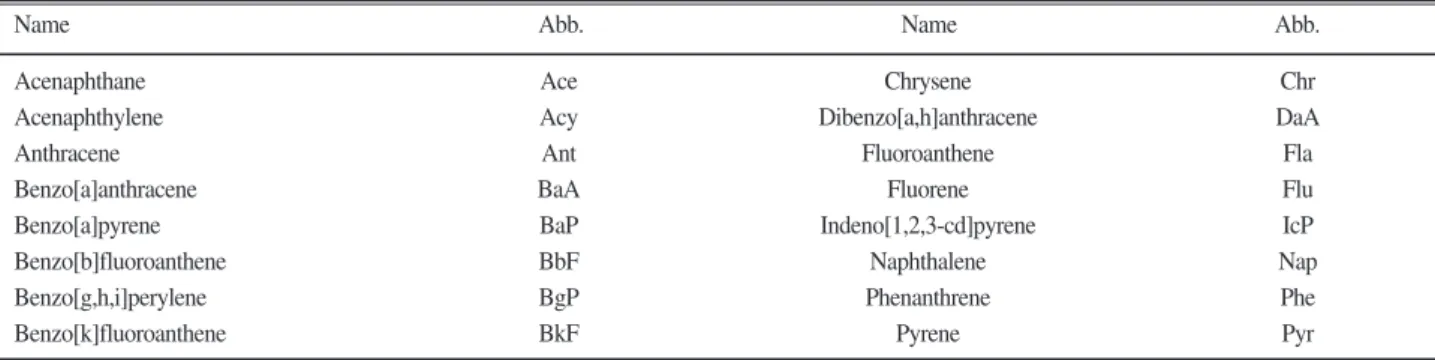
분석 US EPA의 우선감시물질 목록(priority pollutant lists)에 포함된 16종류의 PAHs에 대해 분석 하였다(Table 1). 토양시료 20 g을 16시간 동안 dichloromethane을 이용하여 Soxhlet으로 추출하였다.
내부표준물질 (Naphthalene-d8, Acenaphthene-d10, Phenanthrene-d10, Chrysene-d12, Perylene-d12)은 토양 을 추출하기 전에 첨가하였다. 추출된 시료는 EPA method 3630 실리카겔 칼럼 정제법을 이용하여 정제 하였다(U.S. EPA, 1986). 칼럼 유출액은 1 mL로 농 축 후 분석시료로 하였다. 정량분석은 GC/MS (GCQ, ThermoFinnigan, USA)를 사용하여 full scan (mass range : 100-285 m/z) mode로 분석하였다. 컬럼은 용 융 실리카 컬럼 (DB-5ms, 30 m × 0.25 mmID × 0.25 m film thickness, J&W Sci., USA)을 사용하였 으며, 헬륨을 이동상으로 40 cm sec-1 설정하였다. GC 오븐은 75℃에서 5 분간 머무른 후 150℃까지 25℃
min-1으로, 다시 265℃까지 4℃ min-1으로, 마지막으로 285℃까지 30℃ min-1으로 상승 후 10분간 유지하도록 프로그램 하였다. 시료 1 μL를 GC에 주입하였고, 질 량분석기에서 full scan으로 얻어진 데이터의 분자이 온(molecular ion)을 사용하여 내부표준물질법으로 정 량하였다.
분석정도관리 분석시료의 전반적인 회수율을 구 하기 위해 바다모래에 100 ng μL-1의 PAHs를 첨가한 후 시료분석에 사용한 방법과 같은 방법으로 분석하 였다. 16종의 PAHs에 대한 전체적인 회수율은 86∼
123%였으며, 검출한계는 2∼7 pg 이었다. 검출한계는 바탕시료 분석값에서 3배의 표준편차를 적용하여 구 하 였 다 (Knoll, 1985; Mazzera et al., 1999;
Winefordner and Long, 1983). 그리고 사용된 분석법 은 NIST SRM 1941a를 사용하여 검증하였다. 이때 분석된 SRM의 평균분석농도는 인증값(certified values)의 76-180%의 범위를 보였다.
통계분석 이 실험에 사용된 통계는 S-Plus 6(Insightful Co., USA)를 사용하여 분석하였다. 대조
Name Acenaphthane Acenaphthylene Anthracene Benzo[a]anthracene Benzo[a]pyrene Benzo[b]fluoroanthene Benzo[g,h,i]perylene Benzo[k]fluoroanthene
Ace Acy Ant BaA BaP BbF BgP BkF
Chr DaA Fla Flu IcP Nap Phe Pyr Chrysene
Dibenzo[a,h]anthracene Fluoroanthene
Fluorene Indeno[1,2,3-cd]pyrene
Naphthalene Phenanthrene
Pyrene
Abb.
Abb. Name
Table 1. The abbreviations of PAHs quantified.
구 및 퇴비구의 평균비교는 t-test를 사용하였다.
결과 및 고찰
논토양 중 PAHs 농도 토양 시료는 모두 플라스틱 병에 담아져 상온에서 보관되었다. 시료분석결과 Nap 의 농도가 상대적으로 높았는데 이는 실험실의 시료 에서도 전반적으로 나타나는 문제였다. 시료를 오랜 기간 동안 상온에서 보관하면 휘발성이 강한 나프탈 렌은 상대적으로 낮을 것으로 예상되었지만 높게 나 타났는데, 이는 보관 중 오염 때문이거나 아니면 전반 적으로 많은 양의 나프탈렌이 최근까지 일상생활에 광범위하게 사용된 영향으로 추정되었다. 다른 자료 와의 비교를 위해 평균과 범위에는 Nap 분석결과를 포함하였지만, 연도별 변화량을 보기 위한 본 연구 목 적상 Nap를 데이터 해석 및 토론에서는 제외하였다.
토양시료의 보관기간 및 온도에 따라 ∼5 페닐링 PAHs의 손실도 고려해야할 중요한 요인이지만 이 연 구에서는 이에 대한 고려는 하지 않았다 (Rost, et al., 2002).
농경지 토양에 존재하는 PAHs등 유기화합물은 대 부분 대기침적을 통해 토양에 유입된다. 대기 침적을 통해 토양에 도달한 PAHs는 토양의 유기물 및 점토 입자와의 분배를 통해 토양에 잔류하게 되는데, 이때 생물학적 및 광학적 분해와 대기 중으로 재분배되는 평형에 의해 현재의 농도가 결정된다(Gustafsson and Gschwend, 1997; Koelmans et al., 2006; Ribes et al.,
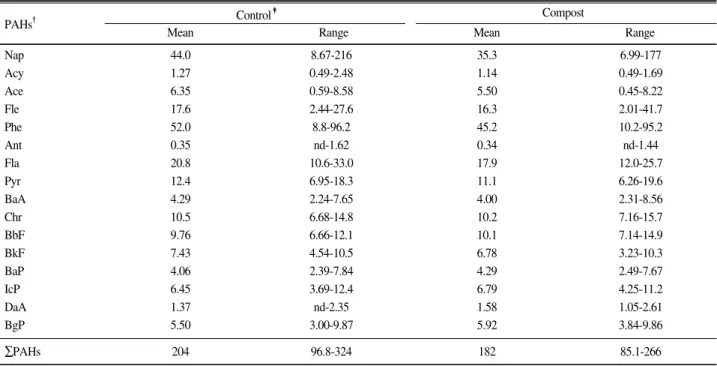
2003). 1978년부터 2001년 사이 영남농업연구소내 포 장의 논토양 중 PAHs의 평균농도는 204 ㎍ kg-1으로 (Table 2), 이는 Nam et al.(2003)이 보고한 2002년도 우리나라 농경지 토양의 평균농도 236 ㎍ kg-1(범위 85∼324 ㎍ kg-1)과 비슷한 결과이다. Nam et al.(2003)의 연구에서 대부분 농촌지역 논토양의 PAHs 농도가 200 ㎍ kg-1 이하였고, 도시인근 농경지 에서는 500 ㎍ kg-1 이상이었던 토양이 많았던 것을 고려하면, 이 지역은 특별한 대기오염원이 없는 곳에 있는 평균적인 농경지 토양으로 판단되었다. 또한, 이 값은 스위스의 토양 225 ㎍ kg-1과도 비슷한 값을 보 여주고 있지만(Bucheli et al., 2004), 오랜 산업화의 전통을 가진 영국 로담스테드 연구소의 토양 중 PAHs 농도, 1,000 ㎍ kg-1, 보다는 크게 낮았다(Jones et al., 1989). PAHs의 농도 범위는 전국 토양을 대상 으로 했을 때는 수십∼수백 배인데 비해(Nam et al., 2003), 한 지역에서 20년간의 변동을 분석한 이 연구 에서는 수배의 범위에 불과하였다. 이는 본 시험지역 과 같이 산업화에 의한 고강도의 대기오염원이 없는 지역에서는 PAHs의 장기적인 농도변동이 매우 작다 는 것을 시사한다. 개별 PAH 농도는 Phe>Fla>
Chr/BbF 순이었다. 대조구 토양과 퇴비장기 연용 토 양을 비교했을 때, 두 처리 사이에 유의한 차이는 없 었다. 하지만 평균적으로 퇴비를 처리한 구에서 약간 낮은 농도를 나타내었는데 이는 토양유기물과 미생물 의 활발한 활성으로 인한 빠른 분해에 기인한 것으로 추정할 수 있다(Katner and Mahro, 1996). 그러나 토
PAHs"
"
Refer to Table 1 for the abbreviations.
‡The soils sampled from the fields applied with no-chemical fertilizer and compost, respectively for rice growth.
Nap Acy Ace Fle Phe Ant Fla Pyr BaA Chr BbF BkF BaP IcP DaA BgP
∑PAHs
44.0 1.27 6.35 17.6 52.0 0.35 20.8 12.4 4.29 10.5 9.76 7.43 4.06 6.45 1.37 5.50 204
8.67-216 0.49-2.48 0.59-8.58 2.44-27.6 8.8-96.2
nd-1.62 10.6-33.0 6.95-18.3 2.24-7.65 6.68-14.8 6.66-12.1 4.54-10.5 2.39-7.84 3.69-12.4 nd-2.35 3.00-9.87
96.8-324
35.3 1.14 5.50 16.3 45.2 0.34 17.9 11.1 4.00 10.2 10.1 6.78 4.29 6.79 1.58 5.92 182
6.99-177 0.49-1.69 0.45-8.22 2.01-41.7 10.2-95.2 nd-1.44 12.0-25.7 6.26-19.6 2.31-8.56 7.16-15.7 7.14-14.9 3.23-10.3 2.49-7.67 4.25-11.2 1.05-2.61 3.84-9.86 85.1-266 Range Mean
Range Mean
Control‡ Compost
Table 2. Average concentrations and ranges of PAHs in paddy soils (μμg kg-1, dry weight basis, 1978~2001).
¨
양에서 우세한 PAHs 종류에 있어서는 대조구와 퇴비 구 모두 같은 경향을 보였다.
PAHs 장기변동 1978년부터 2001년 사이의 논토양 PAHs 함량변화를 보면, 1980년도에 최고 농도(237
㎍ kg-1)에 도달하였다가, 이후 지속적으로 감소하였 다(Fig. 1). 이러한 결과는 지난세기 동안 영국 토양 에서 PAHs 농도가 지속적으로 증가하였다는 Jones et al.(1989)의 연구결과와는 상반되는 것이다. 1880년 대 시작된 산업혁명 이후, 영국에서는 대량의 화석연 료가 소비됨에 따라 지난 1세기 동안 대기 중에 오염 물질이 축적되고 지속적으로 토양에 침적되었기 때문 이다. 반면, 밀양지역 토양에서의 지속적인 PAHs 감 소는 이 지역에서 배출되는 PAHs의 양이 지속적으로 감소하였기 때문으로 추정된다. 1990년대 후반에 일시 적인 증가가 있기는 하지만 전체적인 감소추세는 2000년대 초반에도 계속되었다. 이러한 감소의 가장 큰 원인은 이 지역이 PAHs를 배출하는 대규모 대기 오염원으로부터 비교적 멀리 떨어져 있고, 또한 1980 년대 이후에 연료를 점진적으로 석탄에서 석유로 전 환했기 때문으로 추정된다. 이와 같이 논토양에서의 낮은 PAH 함량에는 지속적인 경운에 의한 표토 혼 합 효과와 함께 논토양의 낮은 유기물 함량도 기여하 였을 것으로 사료된다(Sweetman et al., 2005).
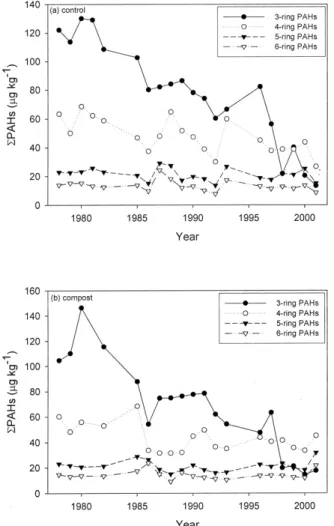
밀양지역 논토양 중에는 대부분 페닐링 3개 이하 PAHs가 차지하고 있었으며, 다음으로 4개인 PAHs, 그리고 6개의 페닐링을 가진 PAHs 농도가 가장 낮았 다(Fig. 2). 이러한 결과는 공업단지인근 농경지에서 5-6 페닐링 화합물이 다량 존재하던 것과는 차이가 있다(Nam et al., 2002). 또한 영국 로담스테드 토양 에서 BaA, BaP, IcP등 4-6개의 페닐링 PAHs의 급격 한 증가와도 분명한 차이가 있다(Jones, et al., 1989).
PAHs의 경시적인 변화양상은 퇴비구와 대조구에서 유사한 경향을 나타내었다. 가벼운 3-4개 페닐링 PAHs는 1980년대 이후 급격히 감소한 반면, 5-6개
페닐링 PAHs 들은 비교적 일정한 경향을 유지하였 다. 이로부터 이 지역 PAHs는 주로 생활에 사용하는 화석연료에 기인하는 것으로 추정되었으며, 대규모 공업지역에서 많이 발생하는 높은 분자량의 PAHs에 의한 영향은 없는 것으로 판단되었다. 즉, 밀양지역 논토양 중 PAHs의 지속적인 감소 추세는 석탄으로부 터 석유로의 사용연료 전환에 따른 가벼운 3-4 페닐 링 PAHs의 감소와 무거운 5-6 링 PAHs를 발생원이 없었기 때문으로 판단된다. 그러나 밀양지역의 논토 양에서 나타난 PAHs의 경시적 감소 추세는 직접적인 오염원이 증가한 비농업 지역에서는 다른 결과를 예 상할 수도 있으므로 이에 대한 추가적인 연구가 요구 된다.
적 요
영남농업연구소에 보관된 토양 시료의 분석결과 밀 양지역 논토양에서의 PAHs 함량 1978년 이후 지속적 으로 감소되고 있는 것으로 나타났다. 1978년에 200
Fig. 1. Long-term changes of total PAH concentration in paddy. Refer to the text for the missing samples in year.
Fig. 2. Long-term changes of PAHs with different number of phenyl rings, (a) compost, (b) control. Refer to the text for the missing samples in year.
㎍ kg-1을 넘어서 1980년에 최고농도(237 ㎍ kg-1)에 달하였으나, 이후 지속적으로 감소하여 2001년에는 100 ㎍ kg-1 수준까지 감소하였다. 이상의 결과는 PAHs의 발생원이 적은 지역의 농경지에서는 1980년 대 이후 대체적으로 PAHs의 농도가 감소하고 있고, 오염물질(PAHs)의 대기이동에 의한 토양오염의 우려 가 비교적 낮다는 것을 시사한다.
인 용 문 헌
Aamot, E., E. Steinnes, and R. Schmid. 1996. Polycyclic aromatic hydrocarbons in Norwegian forest soils:Impact of long range atmospheric transport. Environmental Pollution 92:275-280.
Baek, S.O., R.A. Field, M.E. Goldstone, P.W. Kirk, J.N. Lester, and R. Perry. 1991. A review of atmospheric polycyclic aromatic hydrocarbons: Sources, fate and behavior. Water, Air, & Soil Pollution 60:279-300.
Bucheli, T.D., F. Blum, A. Desaules, and O. Gustafsson. 2004.
Polycyclic aromatic hydrocarbons, black carbon, and molecular markers in soils of Switzerland. Chemosphere 56:1061-1076.
Cornelissen, G., G.D. Breedveld, S. Kalaitzidis, K. Christanis, A.
Kibsgaard, and A. M. P. Oen. 2006. Strong sorption of native PAHs to pyrogenic and unburned carbonaceous geosorbents in sediments. Environmental Science and Technology 40:1197-1203.
Freeman, D.J., and F.C.R. Cattell. 1990. Woodburning as a source of atmospheric polycyclic aromatic hydrocarbons. Environment Science and Technology 24:1581-1585.
Gustafsson, O. and P.M. Gschwend 1997. Soot as a strong partition medium for polycyclic aromatic hydrocarbons in aquatic systems, Molecular Markers in Environmental Geochemistry. ACS Symposium Series 671:365-381.
Jacob, J., G. Grimmer, and A. Hildebrandt. 1997. Long-term decline of atmospheric and marine pollution by polycyclic aromatic hydrocarbons (PAHS) in Germany. Chemosphere 34:2099-2108.
Jones, K.C., J.A. Stratford, K.S. Waterhouse, E.T. Furlong, W.
Giger, R.A. Hites, C. Schaffner, and A.E. Johnston. 1989.
Increases in the polynuclear aromatic hydrocarbon content of an agricultural soil over the last century. Environmental Science and Technology 23:95-101.
Jones, K.C., G. Sanders, S.R. Wild, V. Burnett, and A.E. Johnston.
1992. Evidence for a decline of PCBs and PAHs in rural vegetation and air in the United Kingdom. Nature 356:137-140.
Katner, M. and B. Mahro. 1996. Microbial degradation of polycyclic aromatic hydrocarbons in soils affected by the organic matrix of compost. Applied Microbiology and Biotechnology 44:668-675.
Knoll, J.E. 1985. Estimation of the limit of detection in chromatography. Journal of Chromatographic Science 23:422-425.
Koelmans, A.A., M.T.O. Jonker, G. Cornelissen, T.D. Bucheli, P.C.M. Van Noort, and O. Gustafasson. 2006. Black carbon: The reverse of its dark side. Chemosphere 63:365-377.
Lemieux, P.M., C.C. Lutes, and D.A. Santoianni. 2004. Emissions of organic air toxics from open burning: a comprehensive review.
Progress in Energy and Combustion Science 30:1-32.
Mazzera, D., T. Hayes, D. Lowenthal, and B. Zielinska. 1999.
Quantification of polycyclic aromatic hydrocarbons in soil at McMurdo Station, Antarctica. The Science of the Total Environment 229:65-71.
Mumtaz, M.M., J.D. George, K.W. Gold, W. Cibulas, and C.T.
DeRosa. 1996. ATSDR evaluation of health effects of chemicals.
IV. Polycyclic aromatic hydrocarbons (PAHs): understanding a complex problem. Toxicology and Industrial Health 12:742-971.
Nam, J.J., B.H. Song, K.C. Eom, S.H. Lee, and A. Smith. 2003.
Distribution of polycyclic aromatic hydrocarbons in agricultural soils in South Korea. Chemosphere 50:1281-1289.
Ribes, S., B. van Drooge, J. Dachs, O. Gustafsson, and J.O. Grimalt.
2003. Influence of Soot Carbon on the Soil-Air Partitioning of Polycyclic Aromatic Hydrocarbons. Environmental Science and Technology 37:2675-2680.
Rost, H., A.P. Loibner, M. Hasinger, R. Braun, and O.H. Szolar.
2002. Behavior of PAHs during cold storage of historically contaminated soik samples. Chemosphere 49:1239-1246
Shor, L M., D.S. Kosson, K.J. Rockne, L.Y. Young, and G.L.
Taghon. 2004. Combined effects of contaminant desorption and toxicity on risk from PAH contaminated sediments. Risk Analysis 24:1109-1120.
Sims, R.C., and M.R. Overcash. 1983. Fate of polynuclear aromatic compounds (PNAs) in soil-plant systems. Residue Review 88:1- 51.
Sweetman, A.J., M.D. Valle, K. Prevedouros, K.C. Jones. 2005. The role of soil organic carbon in the global cycling of persistent organic (POPs): interpreting and modeling field data.
Chemosphere 60:959-972.
Wilson, S.C., and K.C. Jones. 1993. Bioremediation of soil contaminated with polynuclear aromatic hydrocarbons (PAHs): A review. Environmental Pollution 81:229-249.
Winefordner, J.P., and G.L. Long. 1983. Limit of detection. A closer look at the IUPAC definition. Analytical Chemistry 55:712A- 724A.
U.S. EPA 1986. Test Methods for Evaluating Solid Waste, Physical/Chemical Methods, 3rd ed., SW-846, U.S.
Environmental Protection Agency, Washington, D.C.
¨