Korean J Environ Agric (2013) Online ISSN: 2233-4173 Vol. 32, No. 2, pp. 142-147 http://dx.doi.org/10.5338/KJEA.2013.32.2.142 Print ISSN: 1225-3537
국내 유통 과실류의 잔류농약 모니터링 및 위해성 평가
안지운,1 전영환,1 황정인,1 김정민,1 석다롱,1 이은향,1 이성은,1 정덕화,2 김장억1*
1경북대학교 응용생명과학부, 2경상대학교 응용생명과학부
Monitoring of Pesticide Residues and Risk Assessment for Fruits in Market
Ji-Woon Ahn,
1Young-Hwan Jeon,
1Jeong-In Hwang,
1Jeong-Min Kim,
1Da-Rong Seok,
1Eun-Hyang Lee,
1Seong-Eun Lee,
1Duck-Hwa Chung
2and Jang-Eok Kim
1*(
1Division of Applied Biology and Chemistry, Kyungpook National University, Daegu 702-701, Korea,
2Division of Applied Life Science, Gyeongsang National University, Jinju 660-701, Korea)
Received: 24 April 2013 / Revised: 14 June 2013 / Accepted: 23 June 2013
ⓒ 2013 The Korean Society of Environmental Agriculture
This is an Open-Access article distributed under the terms of the Creative Commons Attribution Non-Commercial License (http://creativecommons.org/licenses/by-nc/3.0) which permits unrestricted non-commercial use, distribution, and reproduction in any medium, provided the original work is properly cited.
*교신저자(Corresponding author)
Tel: +82-53-950-5720, Fax: +82-53-953-7233;
Email: [email protected]
142
Abstract
BACKGROUND: This study was conducted to monitor residual pesticides in domestic agricultural products and to assess their risk to human health.
METHODS AND RESULTS: 123 samples containing both general and environment-friendly certified agricultural products were purchased from traditional domestic markets and supermarkets in six provinces of Korea. Multiresidue analyses of one hundred twenty-two pesticides except for herbicides were performed with gas chromatography-electron capture detector, gas chromatography-nitrogen/phosphorus detector, and high-performance liquid chromatography.
Sixteen pesticides were detected in 45 agricultural product samples, which were 38 general, 6 low pesticide and 1 of GAP agricultural product samples and the detection rate was 33.6%. Pesticides detected in agricultural product samples were cypermethrin, lufenuron, fenvalerate, bifenthrin, chlorfenapyr and iprodione. Residual concentration of 18 samples were exceeded the recommended maximum residue limit set by Ministry of Food and Drug Safety and
two kinds of unregistered pesticides in korea were also detected in two samples.
CONCLUSION(S): In order to do risk assessment by agricultural products consumption, estimated daily intake of residual pesticides were determined and compared to acceptable daily intake, referring to %ADI values. The range of %ADI values was from 0.038% to 2.748%. Taken together, it demonstrates the pesticides found in agricultural products samples were below the safety margin, indicating no effect on human health.
Key Words: Pesticide residue, Monitoring, Agricultural product, ADI
서 론
과실류는 식물성 식품 중 곡류, 채소류 다음으로 우리나라 국민 일인당 일일 섭취량이 많은 식품군이다. 특히 과실류에 는 항산화성분이 풍부한 각종 phytochemicals를 다량 함유 하고 있어 항암, 항노화 식품으로서 최근 중요성이 더욱 부각 되고 있다. 과실류에는 재배기간이 대체로 길고 재배과정 중 발생하는 각종 병해충 방제와 품질향상을 위해 다양한 농약 이 살포되어지고 있다. 만약 농약을 사용하지 않을 경우 벼는 평균 30%, 채소류는 20∼70% 정도의 수확량이 감소되는 반 면, 과실류는 무농약 재배가 거의 불가능한 것이 많은 것으로
Open Access
Research Article
알려져 있다(Lee et al ., 2004; Kim et al ., 2009; Kim et al ., 2011; Do et al ., 2012).
농약은 병해충, 잡초 등의 방제에 사용되고 농산물의 품질 향상, 수확량 증대 및 노동력 절감을 위한 필수불가결한 농자 재라는 유익성을 가지는 반면 때로는 인간과 환경적인 면에 서 위해성을 가지고 있는 양면성을 가지고 있다(Lee et al. , 2009). 농약은 오남용으로 농산물에 부적절하게 사용되었을 경우 그 독성으로 인해 인체에 유해하게 작용할 수도 있다.
따라서 이러한 농약의 오남용을 방지하고 국민건강에 피해를 주지 않도록 각 농약별 사용량, 사용횟수, 수확기에 따른 살 포 횟수 및 시기 등에 관한 농약안전사용기준과 농약의 최대 잔류허용기준을 설정하여 사용방법과 사용량을 엄격히 규제 하고 있다(Nam et al ., 2006; Kim et al ., 2007).
그러나 최근 식품안전과 관련된 사건⋅사고들은 소비자들 의 식품에 대한 불안감 야기와 함께, 식품 안전에 대한 관심 증가는 물론, 이로 인한 안전 농식품의 수요도 늘었으며, 특 히, 과실류의 친환경인증농산물에 대한 관심은 더욱 커지게 되었다(Huh and Kim, 2010; Jin and Keum, 2011). 하지 만 농촌경제연구원의 보고에 따르면 친환경인증농산물의 안 전성에 대한 소비자의 신뢰도는 5점 척도를 이용한 평가에서 3.30으로 보통보다 약간 높은 수준으로 농산물에 대한 소비 자의 신뢰를 제고하기 위해서는 생산단계부터 소비자에 이르 는 모든 단계에 걸친 철저한 안전성 관리가 필수적이라 하겠 다(Lee et al ., 2012).
농산물 중 잔류농약은 세척, 가공, 조리과정 중에 제거될 수 있다. 특히 과실류의 경우 농약이 껍질에 대부분 잔류되어 있으므로 껍질제거로 평균 91%의 유기인계 농약 제거 효과가 있으며, 두꺼운 껍질을 가진 과실일수록 껍질제거만으로도 농 약 섭취량을 현저히 줄일 수 있다. 그러나 과실류에 적용되는 농약은 수십 가지이며 침투성 약제일수록 과육 중에도 잔류가 용이하고 농약에 따라 세척과 조리과정 중에도 쉽게 제거되지 않기 때문에 과실류 중 잔류농약의 안전성을 입증하기 위해서 는 식이섭취에 따른 위해 평가 자료가 충분히 제시되어야 한 다(Hwang et al ., 2011; Lee et al ., 2010; Do et al ., 2012).
따라서 본 연구에서는 시중에 유통되고 있는 친환경농산 물과 관행농산물에 대한 농약잔류실태를 파악하기 위하여 국 내 유통 농산물 중 과실류를 대상으로 잔류농약을 조사하고,
그 결과를 토대로 각 농산물에서 검출된 농약에 대한 섭취량 을 추정하여 위해성을 평가하고자 하였다.
재료 및 방법
농산물
시료는 2012년 6월부터 9월까지 전국 9개 도시(서울, 수 원, 대전, 광주, 대구, 경주, 영천, 포항, 부산)의 대형마트, 백 화점 및 재래시장에서 유통 중인 사과 60점과 복숭아 63점을 구입하였다. 재래시장에서 관행농산물을 구입하였고, 대형마 트와 백화점에서 관행농산물과 친환경 인증마크가 표시된 농 산물인 GAP농산물, 무농약농산물 및 저농약농산물을 Table 1과 같이 구입하였다. 구입한 시료는 식품공전의 표준조제법 에 따라 꼭지를 제거한 후 균질화하여 분석 전까지 -20℃ 냉 동고에 보관하면서 분석용 시료로 사용하였다.
시약
잔류농약 분석에 사용한 acetone은 Kanto Chemical Co.(Tokyo, Japan)의 잔류농약분석용을 사용하였고 acetonitrile, dichloromethane 및 n -hexane은 Burdick & Jackson Inc.(Muskegon, MI, USA)의 잔류농약분석용을 사용하였 다. 정제에 사용된 florisil cartridge(1,000 mg, 6 mL)와 NH
2cartridge(1,000 mg, 6 mL)는 Varian Inc.(Lake Forest, CA, USA)을 사용하였고, sodium chloride(순도 99.5% 이상)와 sodium sulfate anhydrous(순도 99.0% 이 상)는 Junsei Chemical Co.(Tokyo, Japan)을 사용하였다.
분석농약
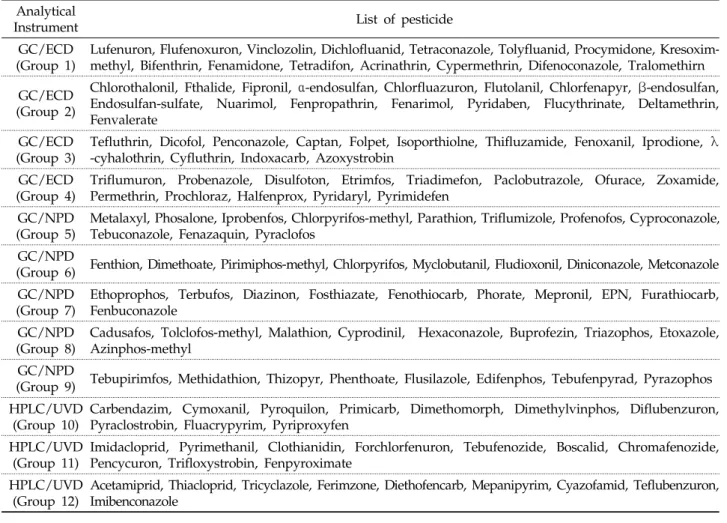
농약 122종의 표준품은 Dr. Ehrenstorfer GmbH(Augsbug, Germany) 또는 Chem Service(West Chester, PA, USA) 의 제품을 사용하였다. 표준원액은 각 성분의 용해도에 따라 acetone과 acetonitrile을 이용하여 1,000 mg/L로 조제하 였다. 각 농약의 검출능을 비교한 후 검출기 별로 분류하여 Table 2와 같이 나누어 피크의 머무름 시간(retention time) 이 겹치지 않도록 만들었다. 각 농약을 그룹별로 혼합한 후, acetone과 acetonitrile로 희석하여 10 mg/L의 혼합 표준 품 용액을 제조하였다.
Agricultural products
Non-certified agricultural
products
Certified agricultural products
Total Environment-friendly certified
agricultural products
General Pesticide-free Low pesticide GAP
No. of analysis
No. of detection
No. of analysis
No. of detection
No. of analysis
No. of detection
No. of analysis
No. of detection
No. of analysis
No. of detection
Detection rate(%)
Apple 48 18 0 0 12 4 0 0 60 22 36.6
Peach 48 20 1 0 8 2 6 1 63 23 36.5
Total 96 38 1 0 20 6 6 1 123 45 36.6
Table 1. Collected sample number and detection rate of pesticide residues monitoring in agricultural products
Analytical
Instrument List of pesticide
GC/ECD (Group 1)
Lufenuron, Flufenoxuron, Vinclozolin, Dichlofluanid, Tetraconazole, Tolyfluanid, Procymidone, Kresoxim- methyl, Bifenthrin, Fenamidone, Tetradifon, Acrinathrin, Cypermethrin, Difenoconazole, Tralomethirn GC/ECD
(Group 2)
Chlorothalonil, Fthalide, Fipronil, α-endosulfan, Chlorfluazuron, Flutolanil, Chlorfenapyr, β-endosulfan, Endosulfan-sulfate, Nuarimol, Fenpropathrin, Fenarimol, Pyridaben, Flucythrinate, Deltamethrin, Fenvalerate
GC/ECD (Group 3)
Tefluthrin, Dicofol, Penconazole, Captan, Folpet, Isoporthiolne, Thifluzamide, Fenoxanil, Iprodione, λ -cyhalothrin, Cyfluthrin, Indoxacarb, Azoxystrobin
GC/ECD (Group 4)
Triflumuron, Probenazole, Disulfoton, Etrimfos, Triadimefon, Paclobutrazole, Ofurace, Zoxamide, Permethrin, Prochloraz, Halfenprox, Pyridaryl, Pyrimidefen
GC/NPD (Group 5)
Metalaxyl, Phosalone, Iprobenfos, Chlorpyrifos-methyl, Parathion, Triflumizole, Profenofos, Cyproconazole, Tebuconazole, Fenazaquin, Pyraclofos
GC/NPD
(Group 6) Fenthion, Dimethoate, Pirimiphos-methyl, Chlorpyrifos, Myclobutanil, Fludioxonil, Diniconazole, Metconazole GC/NPD
(Group 7)
Ethoprophos, Terbufos, Diazinon, Fosthiazate, Fenothiocarb, Phorate, Mepronil, EPN, Furathiocarb, Fenbuconazole
GC/NPD (Group 8)
Cadusafos, Tolclofos-methyl, Malathion, Cyprodinil, Hexaconazole, Buprofezin, Triazophos, Etoxazole, Azinphos-methyl
GC/NPD
(Group 9) Tebupirimfos, Methidathion, Thizopyr, Phenthoate, Flusilazole, Edifenphos, Tebufenpyrad, Pyrazophos HPLC/UVD
(Group 10)
Carbendazim, Cymoxanil, Pyroquilon, Primicarb, Dimethomorph, Dimethylvinphos, Diflubenzuron, Pyraclostrobin, Fluacrypyrim, Pyriproxyfen
HPLC/UVD (Group 11)
Imidacloprid, Pyrimethanil, Clothianidin, Forchlorfenuron, Tebufenozide, Boscalid, Chromafenozide, Pencycuron, Trifloxystrobin, Fenpyroximate
HPLC/UVD (Group 12)
Acetamiprid, Thiacloprid, Tricyclazole, Ferimzone, Diethofencarb, Mepanipyrim, Cyazofamid, Teflubenzuron, Imibenconazole
Table 2. Classification of pesticide for multiresidue analyses of agricultural products
시료의 전처리
균질화된 시료 50 g에 100 mL acetonitrile을 첨가한 후 homogenizer에서 3분간 고속 마쇄, 추출하여 sodium chloride를 첨가하고 진탕시킨 후 원심분리하였다. 상징액 10 mL를 취하여 40℃의 수욕상에서 감압농축 후 acetone/
n -hexane(2/8, v/v)로 재용해하여 정제용 시료로 이용하였 다. GC 분석용 시료는 florisil cartridge에 5 mL의 n -hexane으로 흘려보낸 후 5 mL의 acetone/ n -hexane (2/8, v/v)을 순차적으로 안정화시키고 정제용 시료를 cartridge에 주입한 다음 acetone/ n -hexane(2/8, v/v)으 로 용출하여 감압농축하고, 농축 건고된 시료를 acetone에 재용해하였다. HPLC 분석용 시료에 대해서는 상징액 10 mL를 취하여 감압농축 후 methanol/methylene chloride (5/95, v/v)로 재용해하였다. NH
2cartridge에 methylene chloride 5 mL를 흘려보낸 후 정제용 시료를 cartridge에 주입한 다음 methanol/methylene chloride(5/95, v/v)로 용출하여 감압농축 한 후 acetonitrile에 재용해하였다.
기기분석 조건
GC-ECD는 Shimadzu Q2010(Shimadzu, Japan)을 사용 하였고 컬럼은 DB-5[30 m(L.) × 0.25 mm(I.D.) × 0.25
μm(film thickness)]를 사용하였다. Carrier gas는 N
2, 유속은 60 mL/min로 분석하였다. Injection volume은 1 μL, injector는 split ratio 50:1로 사용하였으며 injector 온도는 250℃, detector 온도는 320℃이었으며, oven 온도는 80℃에 서 2분 동안 유지하고 200℃ 까지 10℃/min의 속도로 승온시 킨 후 220℃까지 2℃/min의 속도로 승온시켜 4분간 유지하고 300℃까지 10℃/min의 속도로 승온시킨 후 4분간 유지하였다.
GC-NPD는 Varian CP-3800(Varian, USA)을 사용하였 다. 컬럼은 DB-5[30 m(L.) × 0.25 mm(I.D.) × 0.25 μm(film thickness)]를 사용하였고, carrier gas는 N
2, H
2및 air이고 N
2의 유속은 3 mL/min, H
2의 유속은 10 mL/min이며 air의 유속은 60 mL/min로 분석하였다.
Injection volume은 1 μL, injector는 splitless로 사용하였 으며 온도조건은 GC-ECD와 동일하였다.
HPLC-UVD는 YoungLin 930D(YoungLin, Korea)을 사용하였다. 분석용 컬럼은 C-18[250 mm(L.) × 4.6 mm(I.D.)]
을 사용하였다. 유속은 1.0 mL/min이었으며 mobile phase 는 water와 acetonitrile을 사용하였으며, gradient는 20%
acetonitrile에서 80% acetonitrile으로 40분간 농도구배 후
10분간 유지하였다. Injection volume은 20 μL, detector
wavelength는 254 nm에서 분석하였다.
부적합 농산물 판정
농산물에서 검출된 잔류농약은 식품의약품안전처에서 고 시한 농약잔류허용기준(maximum residue limit, MRL)에 따라 초과 여부를 평가하였으며, 친환경농업육성법에 따라 유 기 및 무농약농산물에서 농약이 검출될 경우 식품위생법 제7 조 제1항에 따라 농약잔류허용기준의 1/20을 초과하면 부적 합 농산물로 판정하였고 저농약농산물의 경우 농약잔류허용 기준의 1/2을 초과했을 경우 부적합 농산물로 판정하였다.
검출된 농약이 해당 농산물에 대한 잔류허용기준이 설정 되지 않은 농약이 검출되었을 경우 다음 순서로 적⋅부 판정 을 하였다. 잔류한 농약의 검출농도는 당해 농산물에 대한 Codex Alimentarius Commission(CAC) 기준을 따르고, 기준이 설정되어 있지 않다면 식품공전 별표 4 농산물의 농 약 잔류허용기준의 그 농약기준 중 당해농산물과 제 1,3,1.식 물성 원료의 분류에서 정한 동일 대분류군(단, 견과종실류, 과 실류 및 채소류에 한해서는 소분류를 우선 적용)에 속한 농산 물의 최저기준을 따른다. 대분류군에 속한 농산물의 최저기준 마저 설정되어 있지 않다면 식품공전 별표4 농산물의 농약 잔류허용기준의 그 농약기준 중 최저기준을 적용하여 부적합 농산물을 판정하게 된다.
잔류농약의 위해성 평가
검출된 농약의 위해성 평가는 Ahn 등이 보고한(Kim et al ., 2011; Ahn et al ., 2012) 국내 유통 농산물 중 과채류와 근채류의 잔류농약 모니터링 및 위해성 평가와 같은 방법으 로 실시하였다.
결과 및 고찰
분석법의 검출한계
다성분 잔류농약 분석을 위한 검출한계(limit of detection, LOD)는 기기 상에서 측정 가능한 최소검출량을 이용하여 아 래 식에 따라 산출하였다. 농약의 검출한계는 0.02 mg/kg으 로 식품의약품안전처에서 고시한 농산물 중 잔류농약 다성분 분석법의 적합성의 검출한계 0.05 mg/kg 이내로 나타나 양 호한 수준이었다.
LOD (mg/kg) = 기기상의 최소검출량 (ng) × 시료용액 (mL)
×
1주입량 (uL) 시료량 (g)
분석법의 회수율시험
회수율 시험은 시중에서 구입한 유기농산물 중 농약이 검 출되지 않은 시료를 선택하여 농약 표준품 용액을 0.2 mg/kg 및 1.0 mg/kg 수준으로 처리하여 시료 분석과 동일한 방법 으로 수행하였다. 식품의약품안전처에서 고시한 농산물 중 잔 류농약 다성분 분석법의 적합성은 회수율 70% 이상 130%
이하이고, 분석오차가 30% 이내이다. 본 연구에서 수행한 사 과, 복숭아에서 분석대상 농약의 회수율이 70∼121%로 나타 나 다성분 분석법으로 사용 가능하였고, 표준편차는 10% 미
만이었다.
잔류농약 모니터링 결과
채취한 과실류 123점을 대상으로 잔류농약을 분석한 결과 는 Table 3에 제시한 바와 같이 농약이 검출된 시료는 45점 으로 전체 분석 시료의 36.6% 검출률을 차지하였다.
과실류 중 사과는 관행농산물 18점, 저농약농산물 4점에서 농약이 검출되었고, 검출된 농약은 lufenuron, chlorothalonil, flutolanil, iprodione, bifenthrin, fenpropathrin, permethrin, cypermethrin, fenvalerate으로 9종의 농약이 검출되었다.
이 중 chlorothalonil, iprodione, fenpropathrin, cypermethrin 의 검출량은 잔류허용기준 이하로 나타나 안전한 수준이었으 나, 저농약농산물 사과에서 검출된 bifenthrin(MRL, 0.5 mg/kg)과 fenvalerate(MRL, 2.0 mg/kg)은 잔류허용기준 1/2을 초과하였으며, 관행농산물 사과에서 검출된 lufenuron (MRL, 0.3 mg/kg)과 permethrin(MRL, 0.05 mg/kg)은 사과에 설정된 잔류허용기준을 초과하여 부적합한 농산물로 나타났다. 또한 관행농산물 사과에서 검출된 flutolanil은 잔 류허용기준이 설정되어 있지 않거나 품목고시가 되어 있지 않은 농약으로 부적합한 농산물로 판단된다.
복숭아는 관행농산물 20점, GAP농산물 1점, 저농약농산 물 2점에서 lufenuron, tetraconazole, procymidone, chlorfenapyr, iprodione, bifenthrin, λ-cyhalothrin, cypermethrin, fenvalerate, difenoconazole, indoxacarb, teflubenzuron으로 총 12종의 농약이 검출되었다. 관행농산 물 복숭아 9점에서 검출된 lufenuron(MRL, 0.5 mg/kg), chlorfenapyr(MRL, 1.0 mg/kg), bifenthrin (MRL, 0.3 mg/kg), λ-cyhalothrin(MRL, 0.5 mg/kg), cypermethrin (MRL, 2.0 mg/kg)은 복숭아에 설정된 잔류허용기준을 초과하 였으며, 저농약농산물 복숭아 1점에서 검출된 difenoconazole (MRL, 0.5 mg/kg)은 잔류허용기준 1/2을 초과하여 부적합 한 농산물로 나타났다. 또한 관행농산물 복숭아 1점에서 검출 된 tetraconazole은 복숭아에 대한 잔류허용기준이 설정되어 있지 않거나 품목고시가 되어 있지 않은 농약으로 농민들에 의한 부적절한 사용으로 부적합한 농산물로 판단된다. GAP 농산물로 인증 받은 복숭아에서 검출된 fenvalerate의 검출 농도는 1.23 mg/kg으로 잔류허용기준인 5.0 mg/kg 이하 로 안전한 수준이었다.
도 등(Do et al ., 2012)이 연구한 경기도내 유통 과실류의 잔류농약 위해평가(2006∼2010)에 따르면 과실류 33품목 중 23품목(69.7%)에서 잔류농약이 검출되었고, 이 중 사과와 복 숭아에서 가장 다양한 농약이 검출되었다고 보고한 것과 같이 본 연구에서도 사과와 복숭아에서 다양한 농약이 검출되었다.
또한 사과와 복숭아에 품목이 고시되어 있지 않은 flutolanil
및 tetraconazole이 검출되었는데 이는 농민들이 농약을 선
택할 때 작물에 사용할 수 있는 농약을 골라 사용하기 보다는
병해충에 적용 가능한 농약을 우선시하기 때문이라 짐작하였
다. 따라서 올바른 농약 사용을 위해서 해당 작물에 품목 고
시된 농약을 사용 할 수 있도록 생산자들에게 주지시켜 주어
야 할 것으로 생각된다.
이 외 인증농산물에서 검출된 농약의 잔류량은 친환경 인 증 농산물에 적합한 수준이었다. 다만 친환경 인증 농산물에 서 검출된 농약이 해당 농약의 잔류허용기준을 초과하지 않 더라도 친환경 인증 농산물은 높은 가격에도 불구하고 안전 한 먹거리를 찾는 소비자에게 판매되기 때문에 친환경 인증 농산물의 생산자가 원칙과 규정을 지킬 수 있도록 영농교육 을 강화함과 함께 생산단계에서부터 엄격한 기준을 적용하고 출하 후에도 유통 친환경 인증 농산물에 대하여 지속적인 사 후관리가 필요할 것으로 판단된다.
잔류농약의 위해성평가
해당 작물에서 검출된 농약에 대한 위해성 평가를 위해 ADI 대비 식이섭취율로 산출하였다(Table 3). 검출된 농약 에 대한 위해성은 평균 잔류량으로부터 구한 일일섭취추정량 (estimated daily intake, EDI)을 일일섭취허용량(ADI)으 로 나누어 구한 %ADI 값으로 평가하였다. 평균 잔류량은 미 국 EPA의 위해성 평가방법에 따라 검출한계 이하인 시료 수
에 검출한계의 절반을 곱한 값을 시료의 평균 잔류량에 합한 후 전체 시료 수로 나누어 구하였다.
검출된 농약이 잔류하는 해당 농산물의 섭취로 인체에 유 입될 1일 추정섭취량의 %ADI를 살펴보면 사과의 경우 일일 식이섭취량은 21.1 g/day로써 검출된 농약의 %ADI 값은 lufenuron 1.096%, chlorothalonil 1.170%, flutolanil 1.133%, iprodione 0.831%, bifenthrin 2.071%, fenpropathrin 2.748%, permethrin 1.910%, cypermethrin 1.553%, fenvalerate 1.834%으로 나타나 fenpropathrin이 가장 높은
%ADI 값을 보였으나 사과를 섭취함에 따른 위해성은 낮은 것 으로 나타났다. 복숭아의 경우 검출된 농약에 대한 %ADI 값은 lufenuron 0.309%, tetraconazole 0.744%, procymidone 0.033%, chlorfenapyr 0.316%, iprodion 0.127%, bifenthrin 0.426%m cyhalothrin-λ 0.426%, cypermethrin 0.555%, fenvalerate 0.426%, difenoconazole 0.261%, indoxacarb 0.512%, teflubenzuron 1.244%로 낮은 수준을 보여 복숭아의 섭취에 의한 위해성도 낮은 것으로 나타났다.
Commodity Pesticide detected
No. of sample detected
Detection range (mg/kg)
Daily food intake(g)
Averageconc.a) (mg/kg)
MRL (mg/kg)
EDIb) ADIc)
%ADId) (mg/person/day)
Apple
Lufenuron 3 0.21∼0.55 21.09 0.400 0.3 0.00844 0.770 1.096
Chlorothalonil 2 0.34∼0.88 21.09 0.610 2.0 0.01286 1.100 1.170
Flutolanil 1 2.66 21.09 2.660 5.0e) 0.05610 4.950 1.133
Iprodione 3 0.70∼2.11 21.09 1.300 2.0 0.02742 3.300 0.831
Bifenthrin 4 0.43∼0.69 21.09 0.540 0.5 0.01139 0.550 2.071
Fenpropathrin 1 2.15 21.09 2.150 5.0 0.04534 1.650 2.748
Permethrin 3 1.90∼3.31 21.09 2.490 0.05 0.05251 2.750 1.910
Cypermethrin 7 0.21∼1.50 21.09 0.810 2.0 0.01708 1.100 1.553
Fenvalerate 3 0.40∼1.41 21.09 0.957 2.0 0.02018 1.100 1.834
Peach
Lufenuron 4 0.18∼1.24 3.78 0.629 0.5 0.00238 0.770 0.309
Tetraconazole 1 0.79 3.78 0.790 1.0f) 0.00299 0.402 0.744
Procymidone 1 0.48 3.78 0.480 10.0 0.00181 5.500 0.033
Chlorfenapyr 4 0.82∼1.99 3.78 1.196 1.0 0.00452 1.430 0.316
Iprodione 1 1.11 3.78 1.110 10.0 0.00420 3.300 0.127
Bifenthrin 1 0.62 3.78 0.620 0.3 0.00234 0.550 0.426
λ-Cyhalothrin 2 0.98∼1.49 3.78 1.239 0.5 0.00468 1.100 0.426
Cypermethrin 7 0.28∼3.13 3.78 1.614 2.0 0.00610 1.100 0.555
Fenvalerate 2 1.23∼1.25 3.78 1.240 5.0 0.00469 1.100 0.426
Difenoconazole 1 0.38 3.78 0.380 0.5 0.00144 0.550 0.261
Indoxacarb 2 0.70∼0.79 3.78 0.745 1.0 0.00282 0.550 0.512
Teflubenzuron 1 1.81 3.78 1.810 1.0 0.00684 0.550 1.244
a) {(Number of sample below LOD × 1/2 LOD) + Σ(detected concentration)}/number of total sample.
b) Average concentration(mg/kg) × daily food intake(kg/kg bw/day).
c) ADI(mg/kg bw/day) × 55 kg(average body weight of Korean adults).
d) (EDI/ADI) × 100.
e) MRL of strawberry.
f) MRL of apple.
Table 3. Risk assessment of pesticides detected from agricultural products
이와 같은 ADI와의 비교를 통한 위해도 평가는 위해물질 의 허용량 결정과 안전사용기준 설정을 위한 기본 자료로 매 우 중요하므로, 농약의 위해성평가는 향후 국가차원의 잔류농 약 모니터링 사업 및 식이섭취량을 활용한 평가로 장기간에 걸쳐 체계적으로 이루어져야 할 것으로 생각된다.
요 약
국내 유통 농산물의 잔류농약 안전성을 평가하고자 2012 년 전국 6개 도시에서 유통되고 있는 과실류인 사과와 복숭 아에 대하여 123점의 시료를 수거하여 잔류농약을 분석하였 다. 122종의 농약에 대해 GC-ECD, GC-NPD 및 HPLC- UVD을 이용한 다성분분석법으로 잔류농약을 분석하였고, 분석 결과 총 농약이 검출된 시료는 관행농산물에서 38점, 저 농약농산물에서 6점, GAP농산물에서 1점으로 시료에서 16 종의 농약이 검출되어 33.6% 검출률을 나타내었다. 농약 성 분별 검출 빈도는 cypermethrin, lufenuron, fenvalerate, bifenthrin, chlorfenapyr, iprodione 순이었다. 농약이 검 출된 시료 중 잔류허용기준을 초과하는 시료는 18점으로 14.6% 검출되었으며, 해당 작물에 대한 잔류허용기준이 설정 되어 있지 않거나 품목고시 되어있지 않은 농약은 2점의 시 료에서 2종의 농약이 검출되어 1.6% 검출률을 보였다.
본 연구에서 검출된 농약이 해당 농산물의 섭취로 인체에 유입될 잔류농약의 일일섭취허용량 대비 일일섭취추정량은 최저 0.033%에서 최고 2.748%로 농산물 섭취에 의한 위해성 은 낮은 것으로 나타났다.
Acknowledgement
This work was carried out with the support of
“Cooperative Research Program for Agriculture Science & Technology Development (Project No.
PJ007392201006)” Rural Development Administration, Republic of Korea.
References