http://dx.doi.org/10.7585/kjps.2013.17.4.271 Open Access
271
농협에서 실시한 농산물우수관리인증 농산물 대상 농약 잔류량 조사결과의 최근 4년간 현황 분석
김형국*·최동선·김성구 농협중앙회 식품안전연구원
Analysis of Recent Four Years Situation for Pesticide Residues in the GAP Certified Agricultural Products Analyzed
by National Agricultural Cooperative Federation
Hyeong-Kook Kim*, Dong-Seon Choi and Sung-Gu Kim National Agricultural Cooperative Federation Food and Research Institute,
229, Yangjae 2-dong, Seocho-gu, Seoul 137-893 Korea
(Received on September 3, 2013. Revised on September 17, 2013. Accepted on October 18, 2013)
Abstract This is the result of pesticide residue monitoring certified Good Agricultural Practice (GAP) by national agricultural cooperative federation (NACF) from 2009 to 2012. NACF evaluated simultaneously 283 pesticide multi-analysis method with GC (ECD, NPD) and HPLC. 6,590 agricultural products were analyzed in this period. As the results 1) detected 20.27% in 2009, 23.42% in 2010, 28.07% in 2011 and finally 31.75% in 2012, respectively. There was the total detected pesticide residue in the agricultural products. The violated ratio of agricultural products were 2.25% in 2009, 1.82% in 2010, 1.67% in 2011 and 3.47% in 2012, respectively. 13 pesticides went over the maximum residue limits (MRLs); carbendazim was the predominant violation. 40 pesticides; endosulfan was the predominant detected pesticide did not registered respectively crops in Korea. Most agricultural products that were under the MRLs met the safety standard, however agricultural products that contain neither registered nor set up MRL any level for example endosulfan in strawberry. Agricultural products that go over the MRLs with permitted pesticides, for example carbendazim in apple, are rejected. Because of these intricacies continual observation and evaluation will be need during GAP agricultural cultivation.
Key words GAP, pesticides, safety, GC, HPLC
서 론
농약은 농작물의 재배과정에서 잡초 및 병해충 발생을 막 기 위해 불가피하게 사용되는 화학물질로서 우리나라에서는 1988년 9월 처음 17종 농약에 대한 잔류허용기준(Maximum Residue Limits, MRLs) 이 설정 된 이래로 꾸준히 개정되면 서 2013년 8월 현재 432종의 농약성분에 대한 잔류허용기 준이 설정되어 있다. 농약잔류허용기준은 농산물(식품)에 남
아있는 농약성분을 사람이 일생 동안 매일 먹어도 인체에 아무런 영향이 없는 수준을 법으로 정한 기준량으로, 농약 의 독성, 식품별 섭취량 등 과학적인 시험결과를 토대로 식 품의약품안전처에서 설정, 고시하고 있다.
한 (2012)과 안 (2012) 등에 따르면 2011년 서울지역에서 유통된 농산물의 경우 농약 검출률 14.8%, 잔류허용기준을 초과한 부적합률 1.0%로 나머지 대부분의 농산물이 안전하 다고 사료되지만 대다수 국민들은 농약의 위험성과 농산물 의 안전성에 대한 관심이 높은 편이다. 이러한 안전농산물 공급에 대한 국내 소비자의 요구 증대와 Codex, FAO 등과 같은 국제기구에서의 움직임으로 인해 2006년 농산물품질
*Corresponding author
Tel: +82-2-570-5060, Fax: +82-2-2057-5645 E-mail: [email protected]
ORIGINAL ARTICLES / RESIDUE
관리법 제5조 내지 제7조의7에 의거해 농산물우수관리제도 (Good Agricultural Practices, GAP) 를 시행하게 되었다. 이 는 국내에서 재배되는 모든 농산물을 대상으로 하는 농산물 관리 방법 중 하나로 토양, 수질 및 농약 등을 농산물 우수 관리기준에 따라 관리하고 농산물의 수확 후에는 GAP 위생 시설에서 저장, 선별, 선과 등의 처리를 하도록 하고 있다.
GAP는 농산물의 생산에서부터 수확 후 포장 단계까지 농약, 중금속, 미생물 등의 위해 요소를 종합적으로 관리하는 유 일한 제도이며 현재 GAP 인증을 받은 단체는 전국적으로 1,974개소에 달하고, 인증기관은 2006년 3월 7일, 민간 지정 제1호 농협중앙회 식품안전연구원을 시작으로 2013년 현재 50개 기관이 있으며 수확 후 가공시설은 737개소가 운영 중 이다.
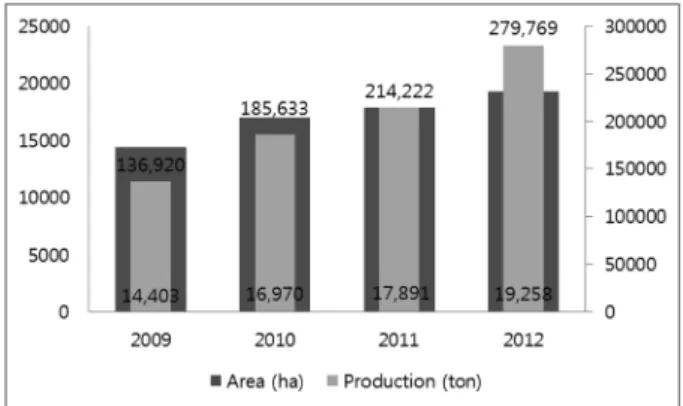
Fig. 1과 2에서 농협중앙회의 GAP 인증범위를 살펴보면 농협의GAP 인증 농가 수는 매년 꾸준히 증가하고 있으며 단체 수 역시 초기에 비해 두 배 이상 늘어났으며, 2013년 현재 인증농산물의 재배면적은 2만 ha, 인증농산물의 생산 량은 27만여톤으로 현재 GAP 제도에서 매우 큰 부분을 차 지하고 있다.
김(2011) 등에 따르면GAP 제도는 친환경농산물제도와 비교되고는 하는데 인증주체부터 품목, 인증단계 등에서 두 제도의 차이가 있다. GAP는 농산물품질관리법을 따르며 GAP 재배관리 지침이 있는 농산물(100품목)에 대하여 인증 을 받을 수 있고 생산품의 규격(특, 상, 보통)을 나누며 농약 과 비료를 사용할 수 있으나 농약의 사용은 등록사항에 따 라 권장사용량을 지키도록 규정하고 있다. 친환경농산물제 도는 친환경농업육성법을 따르며 모든 농산물에 대해 인증 이 가능하다. 친환경인증은 유기농, 무농약, 저농약(2014년 폐지예정)으로 구분되며 농약과 비료사용을 금지하거나 최 소화하여 재배하도록 하고 있다.
농약은 농약관리법에 따라 농약 제품별로 작물, 적용대상 병해충, 사용량 및 사용방법을 농촌진흥청에 등록하도록 정 하고 있다. 농약안전사용기준은 작물을 보호하기 위해 사용
한 농약이 농산물 중에 농약 잔류량이 허용기준을 초과하지 않도록 하기 위해 작물별로 농약 사용횟수와 수확 전 최종 사용시기 등을 제한하는 기준으로, ① 적용대상 작물에 한 하여 사용할 것, ② 적용대상 병해충에 한하여 사용할 것,
③ 사용시기를 지켜 사용할 것, ④ 적용대상 농작물에 대한 재배기간 중의 사용가능 횟수 내에서 사용할 것으로 규정하 고 있으며 GAP 농산물은 반드시 이 지침서에 따라 재배 관 리 되어야 한다.
GAP 인증이 친환경인증과 다른 점은 농약 잔류허용 기준 적용 시, 식품공전의 ‘농산물의 농약잔류농약허용기준’ 이 외에 대상작물에 등록되어 있는지 확인하는 단계가 있어서 일본, EU 등에서 시행되는 포지티브 리스트 제도(Positive List System, PLS)의 성격을 띄고 있다는 점이다. 임(2012) 등에 따르면 국내에서도 식품의약품안전처는 잔류농약의 효 율적인 관리를 위해 포지티브 리스트 제도의 도입을 중기과 제로 선정해 도입을 위한 준비를 진행하고 있으므로, 현 시 점에서 GAP 제도의 구조적 발전과 홍보가 요구되는 바이다.
우리나라 뿐만 아니라 미국, EU, 중국, 일본 등 여러 나라 에서도 정부 혹은 민간차원에서 GAP를 실시하고 있는데 그 중에서도 1997년 설립된 EU의 EUREP GAP (Euro- Retailer Produce Working Group GAP)는 식품안전, 추적관 리, 농가복지 및 환경 등에 관한 230종 이상의 control point 를 설정하여 종합적으로 관리하고 있다. EUREP GAP는 2001년 GAP 인증 등 관리를 위하여 Food PLUS 를 설립하 고, 2007년 명칭을 Global GAP으로 변경하여 세계화를 지 향하고 있다.
우리나라에서도 국제수준의 Global GAP에 부합하고 보 다 안전한 농산물 생산을 위해서는 국내 생산 GAP 인증농 산물의 안전성 여부와 농약잔류실태에 대한 조사가 선행되 어야 할 것이다. 따라서 본 연구는 2009년부터 2012년까지 4년간 농협중앙회에서 인증한 GAP 농산물의 농약잔류 실 태를 분석하여 향후 GAP농산물 안전성관리 기준의 설정 및 관리를 위한 기초자료로 활용하고자 수행하였다.
Fig. 1. Number of GAP farmhouse and group certified by NACF*.
* NACF : National Agricultural Cooperative Federation.
Fig. 2. NACF GAP-certified agricultural products and cultivation area of farm.
재료 및 방법
재료
실험에 사용한 시료는 우리나라 주요 과수인 사과 및 배 와 주식으로 사용되는 쌀과 대두, 다소비 채소류에 대해 중 점적으로 분석하였다. 4년간 전국 각지 GAP 농산물을 분석 하였고, 연도별로 살펴보면 2009년 1,776건, 2010년 1,592 건, 2011년 1,489건, 2012년 1,733건으로 총 6,590 건을 분 석하였다.
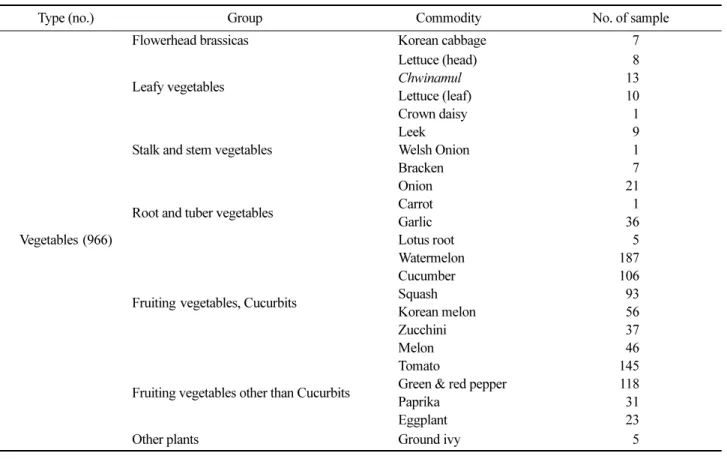
각 농산물별 분석건수를 살펴보면 Table 1과 같으며 쌀 2,022건, 사과 1,695건을 비롯하여 총 38 품목의 농산물을 분석하였다.
시약 및 기구
추출 및 정제를 위한 유기용매는 acetone, acetonitrile, methanol, methylene chloride 및 n-hexane은 Burdick and Jackson (USA) 사와 J. T. Baker (USA) 사의 제품을 사용하 였고, 가스크로마토그래피(GC) 분석을 위해 Phenomenex (USA) 사의 정제용 florisil cartridge (1 g/6 mL)를, 액체크로 마토그래피(LC) 분석을 위해 amino-propyl cartridge (1 g/
6 mL)를 사용하였다.
분석기기는 GC/ECD (Gas Chromatography/µ-Electron Capture Detector, 6890N, Agilent, USA), GC/NPD (Gas Chromatography/Nitrogen Phosphorus Detector, 6890N, Agilent, USA)와 HPLC (High Performance Liquid Chro-
matography, 1200 serises, Agilent, USA)를 사용하였으 며, 검출된 농약의 정성분석을 위하여 GC/MSD (Gas Chromatography/Mass Spectrometry Detector, 320MS, Varian, USA)와 LC/MS-QQQ (Liquid Chromatography/
Mass Spectrometry-triple quadrupole, 6410, Agilent, USA) 사용하였다.
분석성분
분석대상 농약은 Table 2와 같이 GC와 HPLC로 다성분 동시분석이 가능한 283종 농약을 대상으로 하였으며 283종 의 농약 표준품은 Chem Service (USA), Dr. Ehrenstorfer GmbH (Germany), Riedel-de Haen (Germany), Sigma- aldrich (USA), Wako (Japan) 등의 제품을 사용하였다. 각 농약 표준품 중 GC 분석 대상 성분은 acetone에, HPLC분 석 대상 성분은 acetonitrile에 각각 희석하여 표준원액(stock solution)으로 조제하였고 머무름 시간(retention time)이 겹 치지 않는 성분끼리 묶어 표준용액(working solution)을 조 제 후 실험에 사용하였다.
분석방법
식품공전 일반시험법 4. 식품 중 잔류농약 분석법 4.1.1 검체 채취 기준표에 따라 시료를 채취하고, 같은 시험법의 4.1.2.2. 잔류농약다성분동시분석법 제2법을 이용하여 전처 리를 하였다. 시료 50 g에 100 mL acetonitrile을 첨가한 뒤 homogenizer (Omni, USA)에서 3분간 고속마쇄추출하였다.
Table 1-1. List of cereals and analyzed commodities
Type (no.) Group Commodity No. of sample
Cereals (2,105)
Cereal grains (2,041) Rice 2,022
Corn 19
Potatoes (3) Potato 3
Beans (24) Beans 24
Nuts & seeds (37) Chestnut 37
Table 1-2. List of fruits and analyzed items
Type (no.) Group Commodity No. of sample
Fruits (3,519)
Pome fruits
Apple 1,695
Pear 542
Persimmon 116
Citrus fruits Citrus Fruits 29
Stone fruits
Peach 331
Plum 79
Korean Plum 11
Jujube 10
Berries and other small fruits Strawberry 381
Grape 325
Table 1-3. List of vegetables and analyzed items
Type (no.) Group Commodity No. of sample
Vegetables (966)
Flowerhead brassicas Korean cabbage 7
Leafy vegetables
Lettuce (head) 8
Chwinamul 13
Lettuce (leaf) 10
Crown daisy 1
Stalk and stem vegetables
Leek 9
Welsh Onion 1
Bracken 7
Root and tuber vegetables
Onion 21
Carrot 1
Garlic 36
Lotus root 5
Fruiting vegetables, Cucurbits
Watermelon 187
Cucumber 106
Squash 93
Korean melon 56
Zucchini 37
Melon 46
Fruiting vegetables other than Cucurbits
Tomato 145
Green & red pepper 118
Paprika 31
Eggplant 23
Other plants Ground ivy 5
Table 2. List of pesticides residue analysis
GC-ECD Group
(109)
acetochlor, acrinathrin, alachlor, aldrin, amisulbrom, anilazine, anilofos, bensulfuron-methyl, BHC (-α, -β, -γ, -δ), bifenox, bifenthrin, bromacil, bromopropylate, butachlor, captafol, captan, chinomethionat, chlomethoxyfen, chlorfenapyr, chlorflu- azuron, chlorobenzilate, chlorothalonil, cyflufenamid, cyfluthrin (include β-cyfluthrin), λ-cyhalothrin, cypermethrin (include α-cypermethrin, ζ-cypermethrin), DDT (DDD-o,p',DDD-p,p',DDE-o,p',DDE-p,p',DDT-o.p',DDT-p,p'), delta- methrin, dichlobenil, dichlofluanid, diclofop-methyl, dicloran, dicofol, dieldrin, difenoconazole, dimethenamid, dime- thipin, disulfoton, dithianon, dithiopyr, endosulfan (sum of endosulfan sulfate, α-endosulfan, β-endosulfan), endrin, ethaboxam, ethalfluralin, fenarimol, fenhexamid, fenoxanil, fenpropathrin, fenvalerate, fipronil, flonicamid, flucythrinate, flufenacet, fluopicolide, fluoroimide, fluvalinate, folpet, fthalide, halfenprox, heptachlor (include heptachlor-epoxide), imazalil, indanofan, iprodione, isoprothiolane, linuron, metam-sodium trihydrate, methoxychlor, metobromuron, meto- lachlor, metribuzin, myclobutanil, nitrapyrin, norflurazon, ofurace, oxadiazon, oxyflurofen, permethrin, phenthoate, phos- met, pretilachlor, probenazole, prochloraz, procymidone, prodiamine, profenofos, propanil, prothiofos, pyraclofos, pyrazophos, pyrazoxyfen, pyridaben, pyridalyl, pyriminobac-methyl, quintozene (include pentachloroaniline,
methylpentachlorosulfide), spiromesifen, tecnazene, tefluthrin, terrazole, tetradifon, thiazopyr, thifensulfuron-methyl, thio- cyclam, tolylfluanid, tralomethrin, triadimefon, tri-allate, trifluralin, vinclozolin, zoxamide
GC-NPD group (101)
amitraz, azinphos-methyl, benfluralin, benfuracarb, bitertanol, buprofezin, cadusafos, carbophenothion, carbosulfan, chlor- fenvinphos, chlorpyrifos, chlorpyrifos-methyl, clomazone, cyproconazloe, cyprodinil, demeton-S-methyl, diazinon, dichlorvos, diethofencarb, dimepiperate, dimethametryn, dimethoate, dimethylvinphos, diniconazole, diphenamid, diphe- nylamine, edifenphos,EPN, ethion, ethoprophos, ethoxysulfuron, ethylendbis-dithiocarbamate, etoxazole, etrimfos, fenamiphos, fenazaquin, fenbuconazole, fenclorim, fenitrothion, fenobucarb, fenothiocarb, fensulfotion, fenthion, fludiox- onil, flusilazole, formothion, fosthiazate, furathiocarb, hexaconazole, hexazinone, iprobenfos, isazofos, isofenphos, kresoxim-methyl, malathion, mecarbam, mepanipyrim, mepronil, metalaxyl, metconazole, methamidophos, methidathion (dmtp), mevinphos, napropamid, nuarimol, oxadixyl, paclobutrazole, parathion, parathion-methyl, penconazole, pen- dimethalin, phorate, phosalone, phosphamidon, piperophos, pirimicarb, pirimiphos-ethyl, pirimiphos-methyl, prometryn, propamocarb-HCL, propiconazole, pyrimidifen, quinalphos, simeconazole, simetryn, tebuconazole, tebufenpyrad, tebupir- imfos, terbufos, terbuthylazine, terbutryn, thenylchlor, thifluzamide, thiobencarb, thiometon, tolclofos-methyl, triadimenol, triazophos, trichlorfon, tricyclazole, triflumizole
HPLC group
(73)
acetamiprid, acibenzolar-S-methyl, aldicarb, azoxystrobin, bendiocarb, boscalid, butafenacil, carbaryl, carbendazim (include thiophanate-methyl, benomyl), carbofuran, carfenstrole, carfentrazone-ethyl, clethodim, clofentezine, clothiani- din, cyazofamid, cyhalofop-butyl, cymoxanil, diflubenzuron, dimethomorph, dimethyldithio-carbamates, dymron, ethiofencarb, famoxadone, fenoxaprop-ethyl, fenpyroximate, fluazifop-butyl, flucycloxuron, flufenoxuron, flumioxazine, fluquinconazole, forchlorfenuron, hexaflumuron, hexythiazox, imibenconazole, imidacloprid, inabenfide, indoxacarb, iso- procarb, isoxaben, lufenuron, methiocarb, methomyl, methoxyfenozide, metolcarb, o-phenyl phenol, oxadiagyl, oxamyl, oxaziclomefone, oxycarboxin, pencycuron, pentoxazone, phoxim, piperonylbutoxide, propaquizafop-ethyl, propoxur, pyr- aclostrobin, pyributicarb, pyriftalid, pyrimethanil, pyriproxyfen, pyroquilon, quizalofop-ethyl, sethoxydim, tebufenozide, teflubenzuron, thiacloprid, thiametoxam, thidiazuron, thiodicarb, thiram, trifloxystrobin, triflumuron
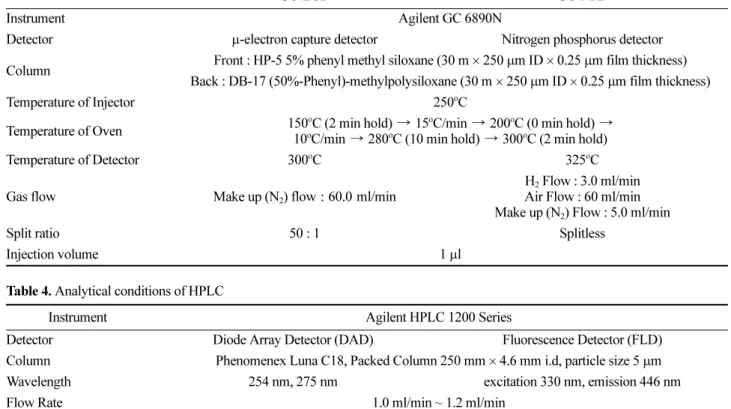
Table 3. Analytical conditions of GC-ECD and GC-NPD
GC-ECD GC-NPD
Instrument Agilent GC 6890N
Detector µ-electron capture detector Nitrogen phosphorus detector Column Front : HP-5 5% phenyl methyl siloxane (30 m× 250 µm ID × 0.25 µm film thickness)
Back : DB-17 (50%-Phenyl)-methylpolysiloxane (30 m× 250 µm ID × 0.25 µm film thickness)
Temperature of Injector 250oC
Temperature of Oven 150oC (2 min hold)→ 15oC/min→ 200oC (0 min hold)→ 10oC/min→ 280oC (10 min hold)→ 300oC (2 min hold)
Temperature of Detector 300oC 325oC
Gas flow Make up (N2) flow : 60.0 ml/min
H2 Flow : 3.0 ml/min Air Flow : 60 ml/min Make up (N2) Flow : 5.0 ml/min
Split ratio 50 : 1 Splitless
Injection volume 1µl
Table 4. Analytical conditions of HPLC
Instrument Agilent HPLC 1200 Series
Detector Diode Array Detector (DAD) Fluorescence Detector (FLD) Column Phenomenex Luna C18, Packed Column 250 mm× 4.6 mm i.d, particle size 5 µm
Wavelength 254 nm, 275 nm excitation 330 nm, emission 446 nm
Flow Rate 1.0 ml/min ~ 1.2 ml/min
Mobile Phase A : Water, B : Acetonitrile
Gradient program
Time (min) A (%) B (%) Flow (ml/min)
0 ~ 5 70 30 1.0
5 ~ 15 15 85 1.2
15 ~ 22 15 85 1.2
Table 5. Analytical conditions of GC-MS
Instrument Varian 320-MS/MS
Column VF-5MS capillary column (30 m× 0.25 mm (i.d) × 0.25 µm)
Detector MSD
Detector type / Ionization mode Electron multiplier / EI mode
Inlet temp. 250oC
Split ratio 50 : 1
Oven temp.
150oC (2 min hold)→ 15oC/min→ 200oC (0 min hold)→ 10oC/min→ 280oC (10 min hold)→ 300oC (2 min hold) Total run time : 25.33 min
Column Flow : Constant flow (He) - 1.0 ml/min Table 6. Analytical conditions of LC-MS/MS
Instrument Agilent LC-MS 6410 Series
Column Phenomenex Luna C18, Packed Column 150 mm× 4.6 mm i.d, particle size 5 µm Ionization mode Electrospray ionization (ESI, positive)
Injection volume 10µl
Mobile Phase A : 0.1% formic acid in Water, B : 0.1% formic acid in Acetonitrile
Gradient program
Time (min) A (%) B (%) Flow (ml/min)
0 ~ 5 70 30 1.0
5 ~ 15 15 85 1.2
15 ~ 22 15 85 1.2
이를 여과하여 여액에 sodium chloride 10~15 g을 넣고 왕 복진탕기에서 30초간 진탕 시킨 뒤 3,000 rpm, 5분간 원심 분리하였고 acetonitilre 층을 무수황산나트륨에 통과시켜 탈 수 한 뒤, 별도의 acetonitrile을 가하여 최종부피 100 mL가 되게 하였다. 여기서 20 mL를 각각 취하여 gas spray water
bath에서 증발건고시켰다.
GC 분석용 시료는 1 mL의 acetone:n-hexane (2 : 8, v/v) 으로 재용해하여 정제용 시료로 사용하였다. 불순물정제를 위한 florisil cartridge에 5 mL의 acetone:n-hexane (2 : 8, v/
v)을 흘려 보내 활성화시킨 뒤 재용해한 GC 분석용 시료 Table 7. The number of detected pesticides and violated commodities
Pesticide No. of detection (No. of violation)
Total Pesticide No. of detection (No. of violation) Total
2009 2010 2011 2012 2009 2010 2011 2012
Carbendazim 78 (4) 110 (7) 96 (1) 85 (2) 369(14) Prochloraz 1 3 4 4 12 Tebuconazole 22 36 45 69 (1) 172 (1) Iprobenfos - - 2 (1) 9 11 (1)
Difenoconazol 43 51 34 32 160 Tetradifon 6 4 1 - 11
Chlorpyrifos 25 25 40 48 (8) 138 (8) Captan - 2 3 5 10
Procymidone 22 (11) 35 (3) 24 39 (2) 120(16) Imidacloprid 1 (1) 1 6 (1) 1 9 (2) Chlorothalonil 25 (1) 19 35 40 119 (1) Azoxystrobin - 7 1 1(1) 9 (1)
Fenvalerate 11 7 (2) 46 (2) 48 112 (4) Acetamiprid 2 2 3 2 9
Chlorfenapyr 25 9 29 38 (3) 101 (3) Edifenphos 4 - 2 (2) 2 8 (2)
Spiromesifen 36 (2) 10 23 30 (1) 99 (3) Pyraclostrobin - 2 5 1 8
Cypermethrin 20 (1) 23 (1) 26 (2) 23 (3) 92 (7) Clothianidin - 2 2 4 8
Fenpropathrin 12 17 25 38 92 Fluopicolide - - - 6 (6) 6 (6)
Buprofezin 24 9 5 47(1) 85 (1) Diethofencarb 2 3 - 1 (1) 6 (1)
Isoprothiolane 16 14 8 46 84 Fluquinconazole - 3 (1) - 3 6 (1)
Cyhalothrin 8 (1) 6 34 (1) 19 (2) 67 (4) Flonicamid 3 1 - 2 6
Iprodione 8 4 33 (1) 11 56 (1) Fenarimol 2 - 2 1 (1) 5 (1)
Bifenthrin 17(1) 4 4 23(1) 48 (2) Cyprodinil 1 - 4 - 5
Fenitrothion 4 8 3 26 (1) 41 (1) Acrinathrin - - 1 3(1) 4 (1)
Boscalid - 12 18 7 37 Thiodicarb - 2 2 - 4
Diflubenzuron 13 8 (2) 14 1 36 (2) Methomyl - - - 3 (3) 3 (3)
Bitertanol 1 12 14 9 (1) 36 (1) Pencycuron 1 (1) 2 (2) - 3 (3)
Folpet 8 12 7 9 36 Diazinon 1 - - 2 (2) 3 (2)
Metconazole 12 7 6 10 35 Thiametoxam - 2 (1) 1 3 (1)
Methidathion 7 (3) 7 13 2 (1) 29 (4) Metalaxyl 3 - - - 3
Fludioxonil 9 10 2 8 (4) 29 (4) Triflumuron 2 1 - - 3
Fenoxanil - 25 1 - 26 Pyridaryl 1 - 1 1 3
Chlorfluazuron 5 4 16 1 26 Tolclofos-M 1 1 - 1 3
Endosulfan 11 (11) 5 (4) 4 (4) 4 (4) 24 (23) Simeconazole 1 - - 2 3
Pyrimethanil 5 2 14 (1) 2 23 (1) Tricyclazole - - 1 2 3
Fenhexamid 3 7 3 (2) 8 21 (2) Cadusafos - - - 2 (2) 2 (2)
Pyridaben 2 (1) 10 (2) 1 (1) 7 20 (4) Triflumizole - 1 (1) - 1 2 (1)
Fthalide 15 1 4 - 20 Fenazaquin - - 1 (1) - 1 (1)
Hexaconazole 2 - 18 - 20 Fosthiazate 1 (1) - - - 1 (1)
EPN 5 6 (2) 3 (1) 4 (4) 18 (7) Propiconazole 1 (1) - - - 1 (1)
Trifloxystrobin 5 2 1 10 (2) 18 (2) Chinomethionat - 1 (1) - - 1 (1)
Kresoxim-M 9 1 7 1 (1) 18 (1) Prothiofos - 1 (1) - - 1 (1)
Carbaryl 2 - 11 4 17 Famoxadon - - 1 - 1
Cyfluthrin 2 5 6 1 14 Phenthoate - 1 - - 1
Fenobucarb 2 8 (1) - 2 12 (1) Thiram - - 1 - 1
1 mL와 5 mL acetone : n-hexane (2 : 8, v/v)를 차례로 용출 시켜 수집하였다. 이를 다시 40oC의 질소미세농축기(Zymark Co., USA)에서 농축하여 농축 건고된 시료를 2 mL의 acetone 에 재용해 한 뒤 GC-ECD 및 GC-NPD를 이용하여 분석하 였다.
LC 분석용 시료는 1 mL의 methanol:methylene chloride (5 : 95, v/v)로 재용해 한 뒤, 동일용매 5 mL로 활성화한 amino-propyl cartridge (1 g/6 mL)에 주입하고 순차적으로 5 mL의 methanol : methylene chloride (5 : 95, v/v)을 주입 하여 함께 수집한다. 이를 GC 분석용 시료와 마찬가지로 질 소미세농축기에서 농축 한 뒤 농축된 시료를 2 mL의 acetonitrile에 재용해 한 뒤 membrane filter (PTFE, 0.2 um) 를 통과시켜 미세여과 하여 HPLC를 이용하여 분석한다.
정밀분석기기의 분석조건은 Table 3~6과 같다.
결과 및 고찰
검출농약의 판정기준
GAP 인증농산물에서 농약잔류량을 평가하는 이유는 작 물별로 농약의 살포횟수와 수확 전 최종 살포시기(일수)를 제한하여 안전농산물을 생산하는데 의의를 두고 있다. 이를 위해 생산자는 반드시 농약관리법상의 안전사용기준 및 취 급제한 기준을 준수하여야 하는데 생산자가 작물에 적합한 농약을 사용하였는지 아닌지를 판별하기 위해서 본 연구에 서는 한국작물보호협회에서 매년 발행하는 작물보호제(농약) 사용지침서에 해당 농약과 작물이 있는지 확인하였다. 그리 고 검출된 잔류농약은 식품의약품안전처에서 고시한 농약잔 류허용기준(MRLs)에 따라 잔류허용량을 평가하였으며 해 당 농산물에 기준이 설정되어있지 않은 경우는 Codex기준
과 잠정허용기준을 순차적으로 적용하여 판정하였다.
농약별 검출현황
본 연구에 따르면 benzimidazole계 농약인 carbendazim 이 총 369건의 최다 검출횟수를 보였고, 부적합 횟수는 endosulfan이 23회로 최다 부적합횟수를 보였다. 검출횟수 에 따른 농약성분과 부적합횟수를 Table 7에 나타내었다.
대부분의 농약이 잔류허용기준 범위 내의 검출량을 보였지 만 Table 8과 같이 '09년 8건, '10년 10건, '11년 6건, '12년 1건이 허용기준초과로 부적합을 나타내었다.
Table 9에서와 같이 해당작물에 등록되지 않은 농약 성분 이 검출되어 부적합 판정을 받은 농약성분은 endosulfan 이 23회로 제일 많았고, procymidone 16회, chlorpyrifos 8회 등, 그 외 40종의 성분들이 총 127회의 부적합 농산물로 판 정되었다.
Endosulfan은 2009년 식용작물 사용금지품목으로 설정된 후 당 년도에는 부적합율이 높았으나 그 이후에는 감소추세 를 보이고 있다. 반면 endosulfan을 대체하는 새로운 효능의 농약들이 등장하여 다양한 농약들이 검출되고 있다.
또한 chlorpyrifos, fluopicolide, fludioxonil, chlorfenapyr, methomyl, bifenthrin, diazinon, trifloxystrobin, acrinathrin, azoxystrobin, buprofezin, cadusafos, fenarimol, kresoxim- methyl, tebuconazole, diethofencarb 같은 농약은 2012년도 이전에는 부적합 이력이 없었으나 2012년 이후에는 1회 이 상의 부적합 판정을 받은 성분으로 추후 해당성분의 지속적 인 잔류현황 모니터링이 필요할 것으로 보인다.
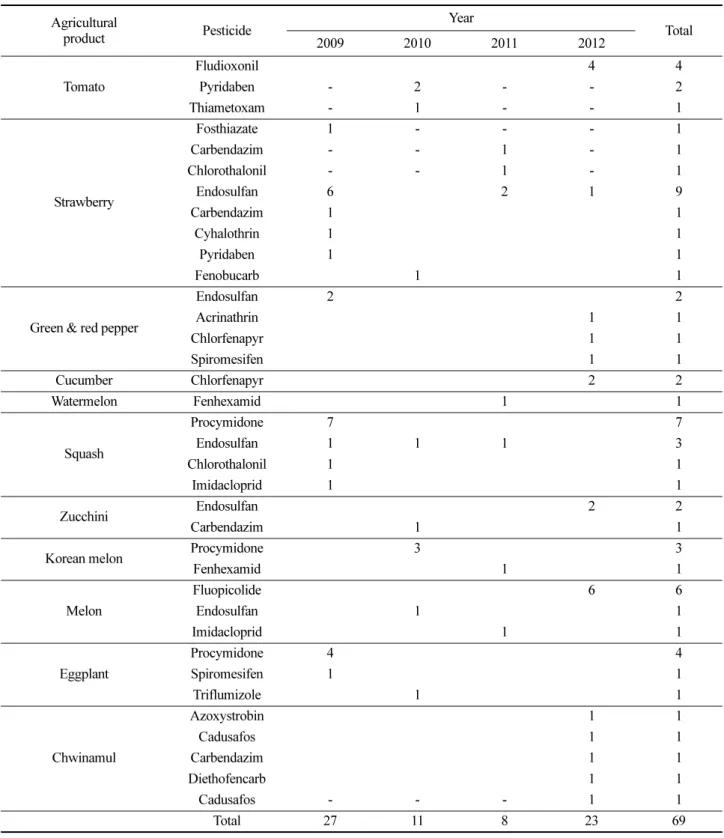
Table 8과 9의 각 연도별 부적합 횟수를 비교해보면 잔류 허용기준 초과로 인한 부적합 건수는 2010년을 기점으로 낮 아지지만 등록되지 않은 농약 사용으로 인한 부적합 건수는 Table 8. The number of violated commodities (exceeding the MRLs)
Pesticide Year
Total
2009 2010 2011 2012
Carbendazim 3 6 1 - 10
Pencycuron 1 - 2 - 3
Edifenphos - - 2 - 2
Pyridaben - 2 - - 2
Chlorothalonil - - 1 - 1
Cypermethrin 1 - - - 1
Diflubenzuron - 1 - - 1
Fosthiazate 1 - - - 1
Propiconazole 1 - - - 1
Spiromesifen 1 - - - 1
Thiametoxam - 1 - - 1
Cadusafos - - - 1 1
Total 8 10 6 1 25
2012년에 크게 증가하였다.
작물별 농약검출현황
GAP 인증 농산물의 작물별 농약 검출률은 Table 10의 1, 2 및 3에서 보는 바와 같이 과일류가 가장 높고 채소류, 곡 Table 9. The number of violated commodities (not set MRLs)
Pesticide Year
Total
2009 2010 2011 2012
Endosulfan 11 4 4 4 23
Procymidone 11 3 - 2 16
Chlorpyrifos - - - 8 8
EPN - 2 1 4 7
Fluopicolide - - - 6 6
Cypermethrin - 1 2 3 6
Methidathion 3 - 1 - 4
Fenvalerate - 2 2 - 4
Carbendazim 1 1 - 2 4
Fludioxonil - - - 4 4
Cyhalothrin 1 - 1 2 4
Chlorfenapyr - - - 3 3
Methomyl - - - 3 3
Pyridaben 1 - 1 - 2
Imidacloprid 1 - 1 - 2
Fenhexamid - - 2 - 2
Chlorothalonil 1 - - 1 2
Bifenthrin - - - 2 2
Diazinon - - - 2 2
Spiromesifen 1 - - 1 2
Trifloxystrobin - - - 2 2
Triflumizole - 1 - - 1
Pyrimethanil - - 1 - 1
Prothiofos - 1 - - 1
Iprodione - - 1 - 1
Iprobenfos - - 1 - 1
Fluquinconazole - 1 - - 1
Fenobucarb - 1 - - 1
Fenazaquin - - 1 - 1
Diflubenzuron - 1 - - 1
Chinomethionat - 1 - - 1
Bifenthrin 1 - - - 1
Acrinathrin - - - 1 1
Azoxystrobin - - - 1 1
Buprofezin - - - 1 1
Cadusafos - - - 1 1
Fenarimol - - - 1 1
Kresoxim-methyl - - - 1 1
Tebuconazole - - - 1 1
Diethofencarb - - - 1 1
Total 32 19 19 57 127
Table 10-1. Detected rate of pesticide residues in cereals from 2009 to 2012
Crop name No. of sample No. of detection Detection rate
Rice 2,022 203 10.00%
Beans 24 - -
Corn 19 - -
Potato 3 - -
Total 2,068 266,202 19.80%
Table 10-2. Detected rate of pesticide residues in fruits from 2009 to 2012
Fruit name No. of sample No. of detection Detection rate
Apple 1,695 1,443 85.10%
Pear 542 131 24.20%
Peach 331 270 81.60%
Grape 325 119 36.60%
Persimmon 116 38 32.80%
Plum 79 4 5.10%
Citrus fruits 29 23 79.30%
Chestnut 37 - -
Korean plum 11 5 45.50%
Jujube 10 2 20.00%
Total 3,175 2,6621,2 64.10%
Table 10-3. Detected rate of pesticide residues in vegetables from 2009 to 2012
Vegetable name No. of sample No. of detection Detection rate
Strawberry 335 131 39.10%
Watermelon 187 7 3.74%
Tomato 145 90 62.07%
Green & red pepper 118 59 50.00%
Cucumber 106 21 19.81%
Squash 93 17 18.28%
Korean melon 56 10 17.86%
Melon 46 9 19.57%
Zucchini 37 3 8.11%
Paprika 31 9 29.03%
Eggplant 23 25 108.70%
Garlic 36 - -
Onion 21 2 9.52%
Chwinamul 13 5 38.46%
Lettuce (leaf) 10 - -
Leek 9 - -
Lettuce (head) 8 - -
Korean cabbage 7 3 42.86%
Bracken 7 - -
Ground ivy 5 - -
Lotus root 5 - -
Carrot 1 - -
Crown daisy 1 - -
Welsh onion 1 - -
Total 1301 391 30.05%
Table 11-1. Violation number of cereals and fruits (exceeding the MRLs) Agricultural
product Pesticide Year
Total
2009 2010 2011 2012
Rice
Pencycuron 1 - 2 - 3
Propiconazole 1 - - - 1
Edifenphos - - 2 - 2
Cypermethrin 1 1 2 4
EPN 2 1 3
Endosulfan 1 1 2
Bifenthrin 1 1
Cyhalothrin 1 1
Pyrimethanil 1 1
Apple
Carbendazim 3 6 - - 9
Chinomethionat 2 2
Fluquinconazole 1 1
Iprobenfos 1 1
Carbendazim 1 1
Tebuconazole 1 1
Peach
Cypermethrin 1 - - - 1
Diflubenzuron - 1 - - 1
Spiromesifen 1 - - - 1
Fenvalerate 2 2 4
Chlorpyrifos 8 8
Methomyl 3 3
Cyhalothrin 2 2
Diazinon 2 2
Trifloxystrobin 2 2
Prothiofos 1 1
Pyridaben 1 1
Endosulfan 1 1
EPN 1 1
Fenazaquin 1 1
Buprofezin 1 1
Chlorothalonil 1 1
Procymidone 1 1
Fenitrothion 1 1
Bitertanol 1 1
Pear
Methidathion 3 1 4
Endosulfan 1 1 1 3
EPN 3 3
Grape
Diflubenzuron 1 1
Fenarimol 1 1
Kresoxim-methyl 1 1
Procymidone 1 1
Korean plum Cypermethrin 1 1 2
Plum Iprodione 1 1
Jujube Bifenthrin 1 1
Total 13 19 17 36 85
물류 순으로 나타났다. Table 10-1은 곡물류의 검출율은 쌀 에서만 10% 정도 검출되어 다른 작물에 비해 낮은 경향을 보였다. Table 10-2는 과일류의 검출율로 64% 정도로 비교 적 높은 편으로 사과, 복숭아 및 밀감이 다른 과일에 비해 상대적으로 높게 나타났다. Table 10-3은 채소류의 검사건 수 대비 잔류농약의 검출횟수를 나타낸 것으로 가지의 경우
23건의 시료 모두에서 1개 이상의 농약이 검출되어 검출률 이 100%를 상회함을 볼 수 있다. 잔류농약 검출률 상위 8개 품목이 모두 과채류로 우리 나라 주식인 쌀을 비롯한 콩, 옥 수수 등에서는 상대적으로 낮은 농약 검출률을 보였다. 그 러나 관행농산물의 잔류농약분석에서 높은 부적합률을 보이 는 양상추, 부추, 쑥갓 등 엽채류의 잔류농약 검출률이 0%
Table 11-2. Violation number of vegetables (exceeding the MRLs) Agricultural
product Pesticide Year
Total
2009 2010 2011 2012
Tomato
Fludioxonil 4 4
Pyridaben - 2 - - 2
Thiametoxam - 1 - - 1
Strawberry
Fosthiazate 1 - - - 1
Carbendazim - - 1 - 1
Chlorothalonil - - 1 - 1
Endosulfan 6 2 1 9
Carbendazim 1 1
Cyhalothrin 1 1
Pyridaben 1 1
Fenobucarb 1 1
Green & red pepper
Endosulfan 2 2
Acrinathrin 1 1
Chlorfenapyr 1 1
Spiromesifen 1 1
Cucumber Chlorfenapyr 2 2
Watermelon Fenhexamid 1 1
Squash
Procymidone 7 7
Endosulfan 1 1 1 3
Chlorothalonil 1 1
Imidacloprid 1 1
Zucchini Endosulfan 2 2
Carbendazim 1 1
Korean melon Procymidone 3 3
Fenhexamid 1 1
Melon
Fluopicolide 6 6
Endosulfan 1 1
Imidacloprid 1 1
Eggplant
Procymidone 4 4
Spiromesifen 1 1
Triflumizole 1 1
Chwinamul
Azoxystrobin 1 1
Cadusafos 1 1
Carbendazim 1 1
Diethofencarb 1 1
Cadusafos - - - 1 1
Total 27 11 8 23 69
으로 나온 데에는 본 연구에서 검시시료의 수가 10건 미만 으로 충분한 개체수가 확보되지 않았으며 조사기간 동안 병 해충의 미발생에 의한 농약을 사용할 필요가 없는 까닭으로 판단되나 이에 대한 추가적인 연구가 필요할 것으로 보인다.
감사의 글
이 논문은 농림축산식품부의 지원으로 수행된 것으로 이 에 감사의 뜻을 표합니다(과제번호 : IPET 20110710).
Literature Cited
Ahn (2012) Monitoring of Pesticide Residues and Risk Assessment for Fruit Vegetables and Root Vegetables of Environment-friendly Certified and General Agricultural Products, The Korean Society of Environmental Agriculture, 31(2):164-169.
Global G.A.P (2013) 2012 ANNUAL REPORT Available from http://www.globalgap.org
Lim (2012) Introduction of Positive List System and Safety Management of Pesticide Residue, The Korean Society of Environmental Agriculture, 2012:346-346.
Han (2012) Monitoring of pesticide residues in commercial agricultural products in the northern area of Seoul, Korea, The Korean Society of Pesticide Science, 16(2):109-120.
KFDA (2013) Korean Food Code. 4.1.2.2 multi class pesticide multiresidue methods. Korea Food and Drug Administration.
Kim (2011) Situations of GAP certified ginseng and 4P's strategies, Chungnam National University Agricultural Scientific Research, 38(2):369-381.
KFDA (2013) Pesticide Residue Database. Available from http://fse.foodnara.go.kr/residue/pesticides/pesticides_info.
jsp. Korea Food and Drug Administration.
NAQS (2010) A Survey on Pesticide Residue of Agricultural Products, National Agricultural Products Quality Manage- ment Service. Korea.
⊙ ··· ⊙
농협에서 실시한 농산물우수관리인증 농산물 대상 농약 잔류량 조사결과의 최근 4년간 현황 분석
김형국*·최동선·김성구 농협중앙회 식품안전연구원
요 약 본 연구는 2009년도부터 2012년까지 4년간 농협중앙회를 통해 농산물우수관리제도(GAP) 인증을 받은 농 산물의 농약잔류실태를 평가하기 위하여 잔류농약다성분분석법에 따라 GC(ECD, NPD)와 HPLC를 이용하여 283종 의 잔류농약을 분석하였다. 이 기간 동안 6,590점의 GAP 인증 농산물을 분석한 결과 잔류농약의 검출율은 2009년, 20.27%, 2010년, 23.42%, 2011년, 28.07% 및 2012년, 31.75%였으며, 부적합율은 2009년, 2.25%, 2010년, 1.82%
2011년, 1.67% 및 2012년, 3.47% 로 나타났다. 잔류허용기준을 초과한 농약은 carbendazim 등 12종 이었고, 미적용 농약 사용으로 인한 부적합 성분은 endosulfan을 비롯하여 40종 이었다. 대부분의 농산물에서 농약이 잔류허용기준 이내로 나타났기 때문에 안전하다고 보이지만 딸기에서 검출된 endosulfan 과 같이 해당작물에 대한 등록되지 않은 농약사용으로 인한 부적합이 127건, 사과에서 검출된 carbendazim 같이 허용기준 초과로 인한 부적합이 총 25 건이 발생하여 향후 GAP 농산물의 생산단계에서 농약사용에 대한 지속적인 관리가 필요할 것으로 사료된다.
색인어 GAP, 잔류농약, GC, HPLC
⊙ ··· ⊙